

- Industry Size (2026)
- USD 154.6 Mn
- Forecast (2036)
- USD 243.1 Mn
- CAGR (2026 to 2036)
- 4.6%
Coffee Extracts Outlook in the UK 2026 to 2036
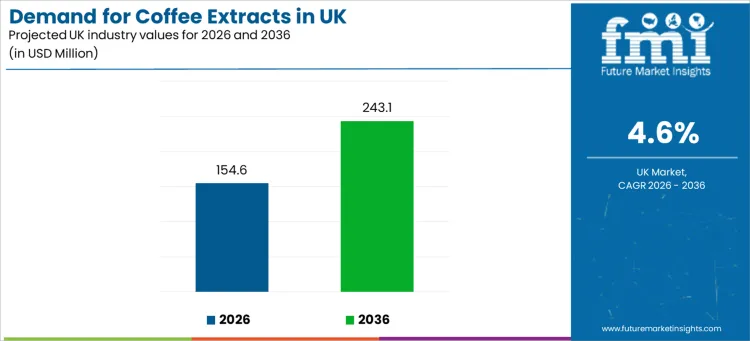
Demand for coffee extracts in the UK is projected at USD 154.6 million in 2026 and is expected to reach USD 243.1 million by 2036, expanding at a 4.6% CAGR. UK demand is shaped by how efficiently brands, beverage operators, and food manufacturers convert coffee flavour into scalable formats that deliver consistency at speed. Extract-based formats reduce prep steps, simplify dosing, and enable repeatable taste profiles across multiple channels, from beverage menus to packaged desserts and functional formats.
Coffee extracts are evaluated as performance ingredients. They are expected to deliver stable flavour concentration, predictable solubility, controlled bitterness, and consistent aroma retention. Product owners also focus on how easily the extract integrates into recipe systems without destabilising texture, sweetness perception, or shelf behaviour. This matters in cold beverages where flavour clarity can drop as temperatures change, and in baked goods where heat exposure can flatten aroma.
Operationally, extracts help teams standardise output across distributed kitchens, production lines, and retail footprints. The value is strongest when consistency protects brand identity across locations and product launches. Buyers also consider compliance and labelling rules, especially where soluble coffee composition and naming conventions apply within the UK’s regulatory framework.
Quick Stats for Coffee Extracts Demand in the UK
- Coffee Extracts Valuation in the UK (2026): USD 154.6 million
- Coffee Extracts Forecast Valuation in the UK (2036): USD 243.1 million
- Coffee Extracts Forecast CAGR 2026 to 2036: 4.6%
- Leading Regional Growth: England (5.1%)
- Leading End Use: Beverage Industry (31.6% share)
- Leading Nature: Conventional (76.5% share)
- Leading Product: Liquid Concentrate (40.6% share)
- Leading Formulation: Roasted (67.3% share)
- Key Companies Profiled: McCormick; Savory Spice; J. R. Watkins; NatureWise; Sports Research
Coffee Extracts Industry in the UK Key Takeaways
| Metric | Value |
|---|---|
| Industry Value (2026) | USD 154.6 million |
| Industry Forecast Value (2036) | USD 243.1 million |
| Forecast CAGR (2026 to 2036) | 4.6% |
Why is the UK Building Steady Demand for Coffee Extracts?
UK coffee culture supports consistent consumption volume and ongoing product innovation. The British Coffee Association highlights daily consumption levels and the scale of coffee’s economic footprint across the UK. This steady baseline strengthens demand for formats that deliver repeatable flavour, rapid preparation, and predictable taste across service environments.
Coffee extracts gain relevance when operators need speed without losing flavour control. Beverage teams use extracts to maintain consistency during peak traffic and to scale seasonal menus with limited training burden. Food manufacturers rely on extracts to deliver coffee flavour in desserts and bakery items where raw coffee addition can introduce variability, sediment risk, or flavour drift.
Regulatory clarity also matters. UK guidance on food standards highlights that soluble coffee extracts are controlled under rules such as the Coffee Extracts and Chicory Extracts (England) Regulations 2000, which define composition and labelling expectations. This gives product owners and compliance teams a predictable framework for naming, content definition, and presentation.
Formulation teams building long-term product roadmaps often align extract selection with coffee extracts positioning, while cold beverage launches and convenience-led consumption patterns are frequently benchmarked through ready-to-drink coffee. Beverage service operators that focus on speed and menu standardisation also track format choices through out-of-home coffee, especially when taste consistency is required across multiple locations.
How is Coffee Extracts Demand Segmented by End Use, Nature, Product, and Formulation?
The coffee extracts landscape segmentation in the UK reflects where coffee flavour is deployed at scale, how brands position sourcing, which product format fits operations, and how flavour profile expectations are managed.
Why does the beverage industry hold the leading end-use share for coffee extracts?
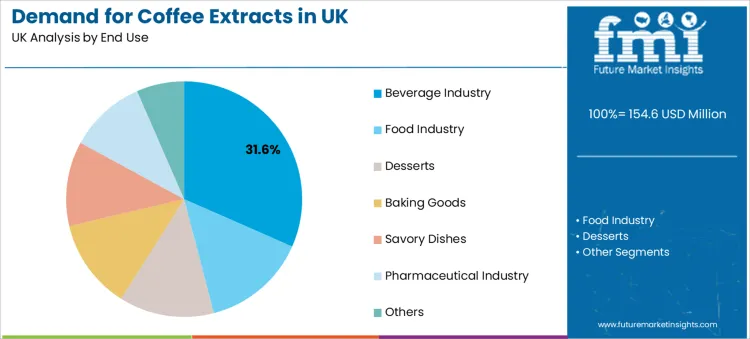
The beverage industry accounts for 31.6% share, making it the leading end use. Beverage operators prioritise speed, flavour consistency, and repeatable preparation. Extracts allow teams to control dose precision, standardise taste across sites, and reduce wastage linked to batch brewing variability. This is particularly useful for cold drinks where dilution and temperature changes can affect flavour perception.
Extract use also fits menu innovation cycles. Beverage teams can deploy coffee flavour into milk-based formats, frozen drinks, and dessert beverages without adding grind handling complexity. Operators that expand into capsule-based dispensing and single-serve consistency often align workflow decisions with coffee capsules, especially where portion control and standardised taste drive operational efficiency.
What is keeping conventional coffee extracts dominant in purchasing decisions?
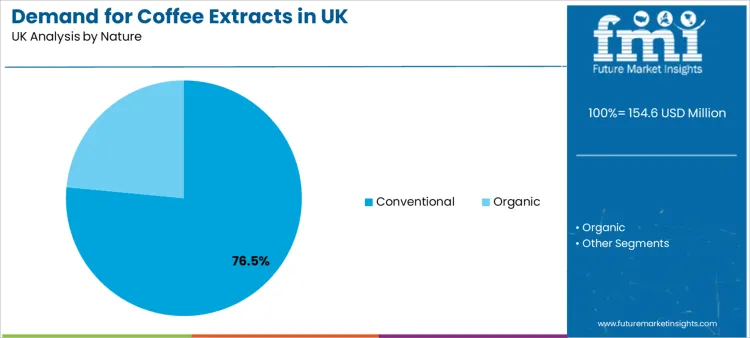
Conventional products hold a 76.5% share, placing them as the dominant nature segment. The leadership reflects scale availability, pricing structure, and broad compatibility with mainstream product development. Conventional sourcing often enables larger contracting volumes and stable supply consistency across production cycles.
For many brands, the decision comes down to operational repeatability and cost discipline. Extracts that meet standard flavour expectations and maintain stable performance under heat, mixing shear, and storage conditions remain the default choice across high-volume applications. Procurement strategies that optimise cost per serving frequently connect conventional extract choices to adjacent formats such as coffee concentrates, where dosing precision supports predictable unit economics.
Why are liquid concentrates the preferred product format for scalable applications?
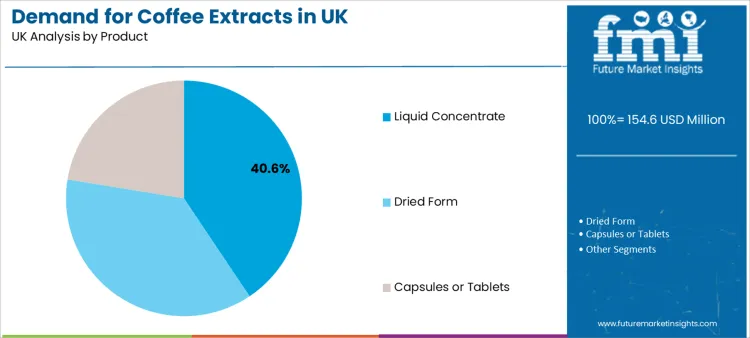
Liquid concentrate represents a 40.6% share, making it the leading product category. Liquid concentrates provide fast integration into beverage systems and rapid dispersion in food formulations. They reduce mixing steps, help operators maintain consistent flavour intensity, and allow easier metered dosing compared to some dry formats.
Liquid concentrates are also favoured when brands want smooth flavour delivery without gritty texture or sediment formation. This matters in ready-to-drink formats, dessert sauces, and baked fillings where mouthfeel stability is part of brand quality. Manufacturers scaling liquid coffee flavour across packaged formats often benchmark container and portioning strategies through single serve coffee containers, especially where packaging format affects freshness and dose control.
What explains roasted formulation holding the strongest positioning in coffee extract demand?
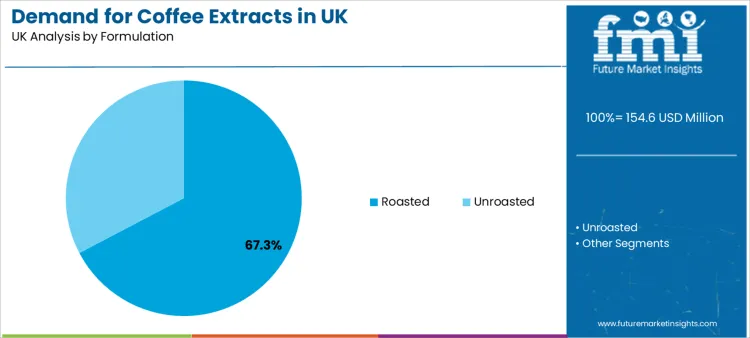
Roasted formulation holds a 67.3% share, establishing it as the leading formulation approach. Roasted flavour profiles are closely tied to consumer expectations of familiar coffee character, including depth, aroma warmth, and recognisable taste cues that translate well into beverages and desserts.
Roasted formulations also provide a stable base for flavour layering. Operators can build variations such as mocha-style drinks, dessert beverages, and coffee-flavoured bakery items without losing the core profile. Teams that prioritise roast-driven flavour performance across multiple touchpoints often align decisions with roasted coffee, especially when maintaining consistent flavour identity across retail and packaged formats matters.
What are the Dynamics, Restraints, Opportunities, and Threats Shaping this Space?
What dynamics are strengthening demand across UK food and beverage channels?
Demand is supported by high coffee consumption intensity and the operational need for consistent taste delivery. Extracts enable speed, reduce training complexity, and improve repeatability across distributed operations. The UK’s composition and labelling framework for coffee extracts supports structured product definition and compliance alignment, strengthening confidence for product owners operating at scale.
Flavour governance is another driver. Where extracts are used as flavour components, wider European flavouring rules provide recognised definitions and compliance expectations for food flavouring use. This matters for brands that manage cross-border formulation standards, even when products are distributed primarily inside the UK.
What restraints can slow adoption or limit expansion into new applications?
Flavour degradation risk is a key restraint. Aroma loss, oxidation, and taste flattening can occur if extracts are not handled under appropriate storage and packaging conditions. Dose sensitivity can also create product inconsistency if operational controls are weak. For dry formats, solubility variation and clumping risks can affect blending reliability.
Where do the most practical opportunities sit for suppliers and operators?
- Ready-to-drink expansion: Brands scaling cold coffee and convenience formats can benefit from extract formats that preserve flavour clarity, supporting initiatives aligned with ready-to-drink coffee.
- Portion-controlled beverage systems: Capsules and unit-dose formats improve consistency and reduce waste, supporting demand pathways linked to coffee capsules.
- Dessert and bakery flavour stability: Extracts can replace brewed coffee additions that introduce variability, supporting broader flavour strategy decisions tied to flavored syrups where coffee flavour is used to build menu variety.
What threats could disrupt demand expectations?
Price volatility in coffee inputs can pressure extract economics. Another threat is substitution by alternative caffeine delivery formats in supplements and functional products. Labelling expectations can also shape purchasing behaviour, especially where caffeine communication and flavouring declarations require disciplined compliance processes.
How is Coffee Extracts Demand Evolving across Key Regions in the UK?
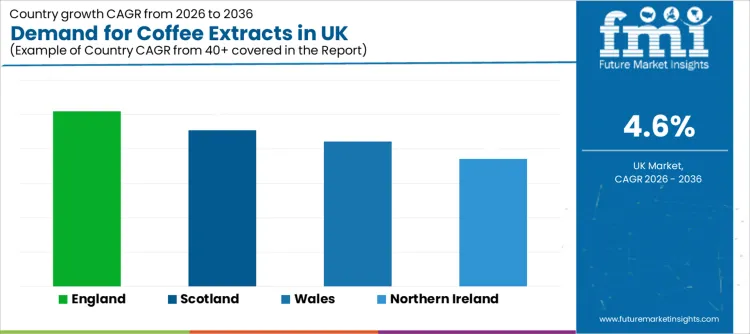
| Region | CAGR 2026 to 2036 |
|---|---|
| England | 5.1% |
| Scotland | 4.5% |
| Wales | 4.2% |
| Northern Ireland | 3.7% |
Why is England leading growth through larger-scale beverage networks and product innovation intensity?
England grows at 5.1%, supported by higher concentration of beverage chains, food manufacturing capacity, and product development activity. Demand rises where operators value fast preparation and brand consistency across multiple locations.
How is Scotland expanding through steady beverage demand and reliable packaged product pull-through?
Scotland increases at 4.5%, driven by steady consumption patterns and consistent use across beverage and food applications. Buyers tend to prioritise proven performance and supply stability.
What is shaping Wales as extract adoption grows through practical, value-led product deployment?
Wales grows at 4.2%, shaped by adoption where extracts reduce operational complexity and deliver predictable flavour results without process disruption.
Why is Northern Ireland showing measured growth tied to selective adoption and stable supplier qualification?
Northern Ireland rises at 3.7%, reflecting smaller-scale demand clusters and cautious qualification cycles. Growth strengthens once product consistency and handling reliability are proven.
What Defines the Competitive Landscape for Coffee Extracts in the UK?
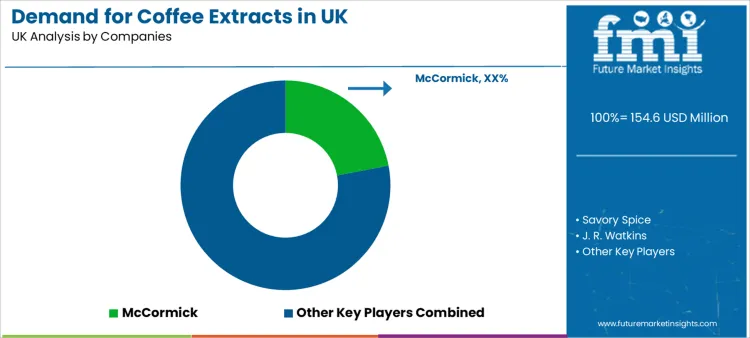
Competition is shaped by flavour quality consistency, product format flexibility, and the ability to support different application needs. Beverage operators value extracts that deliver stable coffee character under cold dilution, milk integration, and ice handling. Food manufacturers want reliable flavour intensity that holds during heat exposure and storage.
Suppliers also compete on technical support, including guidance on dosing ranges, stability management, and flavour matching for brand profiles. Product differentiation becomes stronger when suppliers offer both liquid and dried formats, can support conventional and organic positioning, and maintain consistent batch-to-batch performance.
McCormick is recognised for broad flavour and seasoning capabilities that support ingredient integration. Savory Spice and J. R. Watkins provide brand relevance through consumer-facing flavour formats. NatureWise and Sports Research reflect demand pathways tied to supplement and functional usage where coffee extract formats can support caffeine positioning and convenience.
Key Industry Participants
- McCormick
- Savory Spice
- J. R. Watkins
- NatureWise
- Sports Research
Scope of Report
| Items | Values |
|---|---|
| Quantitative Units | USD Million |
| End Use | Beverage Industry; Food Industry; Desserts; Baking Goods; Savory Dishes; Pharmaceutical Industry; Others |
| Nature | Conventional; Organic |
| Product | Liquid Concentrate; Dried Form; Capsules or Tablets |
| Formulation | Roasted; Unroasted |
| Regions Covered | England; Scotland; Wales; Northern Ireland |
| Key Companies Profiled | McCormick; Savory Spice; J. R. Watkins; NatureWise; Sports Research |
Coffee Extracts Demand in the UK by Segment
By End Use
- Beverage Industry
- Food Industry
- Desserts
- Baking Goods
- Savory Dishes
- Pharmaceutical Industry
- Others
By Nature
- Conventional
- Organic
By Product
- Liquid Concentrate
- Dried Form
- Capsules or Tablets
By Formulation
- Roasted
- Unroasted
By Region
- England
- Scotland
- Wales
- Northern Ireland
Bibliography
- European Union. (2008). Regulation (EC) No 1334/2008 on flavourings and certain food ingredients with flavouring properties for use in and on foods.
- Food Standards Agency. (2024). Guidance for food business operators on food supplements containing caffeine.
- UK Government. (2000). The Coffee Extracts and Chicory Extracts (England) Regulations 2000.
- UK Government. (2013). Food standards: labelling and composition.
- British Coffee Association. (n.d.). Coffee consumption.
Frequently Asked Questions
How big is the demand for coffee extracts in uk in 2026?
The demand for coffee extracts in uk is estimated to be valued at USD 154.6 million in 2026.
What will be the size of coffee extracts in uk in 2036?
The market size for the coffee extracts in uk is projected to reach USD 243.1 million by 2036.
How much will be the demand for coffee extracts in uk growth between 2026 and 2036?
The demand for coffee extracts in uk is expected to grow at a 4.6% CAGR between 2026 and 2036.
What are the key product types in the coffee extracts in uk?
The key product types in coffee extracts in uk are beverage industry, food industry, desserts, baking goods, savory dishes, pharmaceutical industry and others.
Which nature segment is expected to contribute significant share in the coffee extracts in uk in 2026?
In terms of nature, conventional segment is expected to command 76.5% share in the coffee extracts in uk in 2026.
Preview the report firsthand - request a free sample
Get SampleGet the brochure for pricing and purchase details.
Get PDFTable of Content
- Executive Summary
- UK Market Outlook
- Demand-side Trends
- Supply-side Trends
- Technology Roadmap Analysis
- Analysis and Recommendations
- Market Overview
- Market Coverage / Taxonomy
- Market Definition / Scope / Limitations
- Market Background
- Market Dynamics
- Drivers
- Restraints
- Opportunity
- Trends
- Scenario Forecast
- Demand in Optimistic Scenario
- Demand in Likely Scenario
- Demand in Conservative Scenario
- Opportunity Map Analysis
- Product Life Cycle Analysis
- Supply Chain Analysis
- Investment Feasibility Matrix
- Value Chain Analysis
- PESTLE and Porter’s Analysis
- Regulatory Landscape
- Regional Parent Market Outlook
- Production and Consumption Statistics
- Import and Export Statistics
- Market Dynamics
- UK Market Analysis 2021 to 2025 and Forecast, 2026 to 2036
- Historical Market Size Value (USD Million) Analysis, 2021 to 2025
- Current and Future Market Size Value (USD Million) Projections, 2026 to 2036
- Y-o-Y Growth Trend Analysis
- Absolute $ Opportunity Analysis
- UK Market Pricing Analysis 2021 to 2025 and Forecast 2026 to 2036
- UK Market Analysis 2021 to 2025 and Forecast 2026 to 2036, By End Use
- Introduction / Key Findings
- Historical Market Size Value (USD Million) Analysis By End Use , 2021 to 2025
- Current and Future Market Size Value (USD Million) Analysis and Forecast By End Use , 2026 to 2036
- Beverage Industry
- Food Industry
- Desserts
- Baking Goods
- Savory Dishes
- Pharmaceutical Industry
- Others
- Beverage Industry
- Y-o-Y Growth Trend Analysis By End Use , 2021 to 2025
- Absolute $ Opportunity Analysis By End Use , 2026 to 2036
- UK Market Analysis 2021 to 2025 and Forecast 2026 to 2036, By Nature
- Introduction / Key Findings
- Historical Market Size Value (USD Million) Analysis By Nature, 2021 to 2025
- Current and Future Market Size Value (USD Million) Analysis and Forecast By Nature, 2026 to 2036
- Conventional
- Organic
- Conventional
- Y-o-Y Growth Trend Analysis By Nature, 2021 to 2025
- Absolute $ Opportunity Analysis By Nature, 2026 to 2036
- UK Market Analysis 2021 to 2025 and Forecast 2026 to 2036, By Product
- Introduction / Key Findings
- Historical Market Size Value (USD Million) Analysis By Product, 2021 to 2025
- Current and Future Market Size Value (USD Million) Analysis and Forecast By Product, 2026 to 2036
- Liquid Concentrate
- Dried Form
- Capsules or Tablets
- Liquid Concentrate
- Y-o-Y Growth Trend Analysis By Product, 2021 to 2025
- Absolute $ Opportunity Analysis By Product, 2026 to 2036
- UK Market Analysis 2021 to 2025 and Forecast 2026 to 2036, By Formulation
- Introduction / Key Findings
- Historical Market Size Value (USD Million) Analysis By Formulation, 2021 to 2025
- Current and Future Market Size Value (USD Million) Analysis and Forecast By Formulation, 2026 to 2036
- Roasted
- Unroasted
- Roasted
- Y-o-Y Growth Trend Analysis By Formulation, 2021 to 2025
- Absolute $ Opportunity Analysis By Formulation, 2026 to 2036
- Market Structure Analysis
- Competition Dashboard
- Competition Benchmarking
- Market Share Analysis of Top Players
- By Regional
- By End Use
- By Nature
- By Product
- By Formulation
- Competition Analysis
- Competition Deep Dive
- McCormick
- Overview
- Product Portfolio
- Profitability by Market Segments (Product/Age /Sales Channel/Region)
- Sales Footprint
- Strategy Overview
- Marketing Strategy
- Product Strategy
- Channel Strategy
- Savory Spice
- J. R. Watkins
- NatureWise
- Sports Research
- McCormick
- Competition Deep Dive
- Assumptions & Acronyms Used
- Research Methodology


