

- Industry Size (2026)
- USD 1.1 Bn
- Forecast (2036)
- USD 1.8 Bn
- CAGR (2026 to 2036)
- 5.2%
EUDR Commodity Due-Diligence Software Market Size and Share Forecast Outlook 2026 to 2036
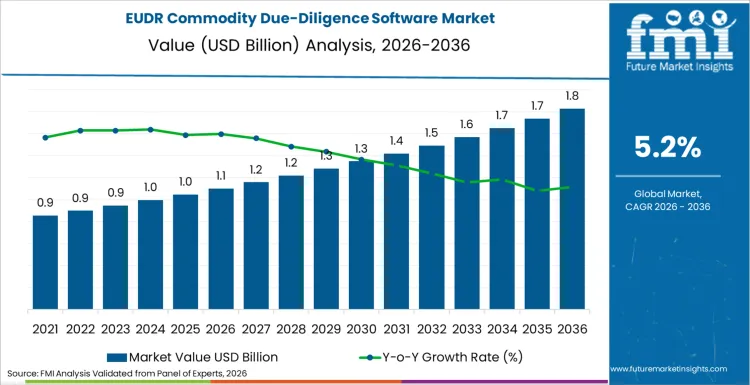
The global EUDR commodity due-diligence software market sector is on track to achieve a valuation of USD 1.8 billion by 2036, accelerating from USD 1.1 billion in 2026 at a CAGR of 5.2%. As per Future Market Insights, this expansion reflects the urgent need for automated compliance systems following the European Union Deforestation Regulation enforcement timeline.
The regulatory framework underwent significant changes in 2025 when the European Commission extended implementation deadlines due to industry readiness concerns. Originally scheduled for December 2024, large companies now must comply by December 30, 2026, while micro and small enterprises received additional time until June 30, 2027. This six-month extension provided companies breathing room to implement necessary supply chain management software solutions.
During 2026, market dynamics shifted dramatically as coffee importers began experiencing the most acute compliance pressures. Coffee supply chains, predominantly managed by smallholder farmers across multiple countries, require extensive geolocation mapping and deforestation risk assessment. Palm oil traders simultaneously accelerated software adoption, particularly those sourcing from Indonesia and Malaysia, where plantation boundaries often overlap with protected forest areas.
What Does the Summary of EUDR Commodity Due-Diligence Software Market (Cocoa/Coffee/Palm Oil) Market Reveal?
What Is Growth Outlook for EUDR Commodity Due-Diligence Software Market (Cocoa/Coffee/Palm Oil) as per Future Market Insights Projection?
The market exhibits steady growth at 5.2% CAGR, driven by mandatory compliance requirements and expanding geographical coverage. Coffee segment dominates with 35% market share, followed by palm oil and cocoa at 35% and 30% respectively. Growth acceleration is expected post-2028 as enforcement mechanisms strengthen and penalties for non-compliance increase.
FMI Research Approach: Primary research with EUDR-affected companies, regulatory body consultations, and supply chain software vendor interviews across 15 countries.
How Do FMI Analysts Perceive EUDR Commodity Due-Diligence Software Market (Cocoa/Coffee/Palm Oil) to Evolve?
FMI analysts anticipate market consolidation around comprehensive platforms offering end-to-end traceability solutions. Integration with satellite monitoring, blockchain verification, and automated risk assessment tools will become standard features. The market will shift from basic compliance tools toward predictive analytics platforms that identify deforestation risks before they occur.
FMI Research Approach: Technology trend analysis, patent filing reviews, and venture capital investment tracking in agricultural technology companies.
Which Country Holds Largest Share in Global EUDR Commodity Due-Diligence Software Market (Cocoa/Coffee/Palm Oil)?
Germany commands the largest market share within the EU region, driven by extensive coffee importing operations and stringent internal compliance standards. German companies implemented voluntary traceability systems ahead of mandatory requirements, creating demand for sophisticated software solutions. The country hosts major coffee roasters and chocolate manufacturers requiring comprehensive supply chain visibility.
FMI Research Approach: Import volume analysis, company headquarters mapping, and software licensing data from major vendors.
How Large Will EUDR Commodity Due-Diligence Software Market (Cocoa/Coffee/Palm Oil) Be by 2036?
The market will reach USD 1.8 billion by 2036, representing 65% growth from 2026 baseline. This expansion includes both direct software licensing fees and associated services such as supplier onboarding, data verification, and ongoing monitoring subscriptions.
FMI Research Approach: Bottom-up market modeling based on import volumes, software pricing benchmarks, and compliance cost analysis.
What Is Definition of EUDR Commodity Due-Diligence Software Market (Cocoa/Coffee/Palm Oil)?
EUDR commodity due-diligence software includes digital platforms enabling companies to collect, verify, and report supply chain data required under European Union Deforestation Regulation. These systems manage geolocation coordinates, deforestation risk assessments, and automated due diligence statement generation for cocoa, coffee, and palm oil imports into EU markets.
FMI Research Approach: Regulatory text analysis, software functionality categorization, and market boundary definition consultation with legal experts.
What Are Globally Unique Trends Shaping EUDR Commodity Due-Diligence Software Market (Cocoa/Coffee/Palm Oil)?
Blockchain integration for immutable audit trails, AI-powered satellite imagery analysis for deforestation detection, and mobile applications for smallholder farmer data collection represent key technological trends. Increased collaboration between certification bodies and software providers creates interoperable systems reducing duplicate data collection efforts.
FMI Research Approach: Technology patent analysis, startup funding trends, and partnership agreement monitoring across the agricultural technology sector.EUDR Commodity Due-Diligence Software Market (Cocoa/Coffee/Palm Oil) Key Takeaways / Source: Future Market Insights (FMI) analysis, based on proprietary forecasting model and primary research
EUDR Commodity Due-Diligence Software Market (Cocoa/Coffee/Palm Oil) Key Takeaways
| Metric | Details |
|---|---|
| Industry Size (2026) | USD 1.1 Billion |
| Industry Value (2036) | USD 1.8 Billion |
| CAGR (2026-2036) | 5.2% |
Source: Future Market Insights (FMI) analysis, based on proprietary forecasting model and primary research
Which Factors Drive EUDR Compliance Adoption?
The regulatory framework underwent significant changes in late 2024 when the European Commission extended implementation deadlines due to industry readiness concerns. Originally scheduled for December 2024, large and medium-sized companies now must comply by December 30, 2026, while micro and small enterprises received additional time until June 30, 2027. This 12-month extension provided companies necessary breathing room to implement supply chain management software and geolocation mapping.
Regulatory compliance represents the primary adoption driver, with penalties reaching up to 4% of annual company turnover for non-compliance.
How Is the EUDR Commodity Due-Diligence Software Market (Cocoa, Coffee, Palm Oil) Segmented?
The EUDR commodity due-diligence software market is segmented by commodity type, solution type, end user, and region to reflect the regulatory structure and operational complexity of agricultural supply chains. By commodity type, the market covers coffee, palm oil, and cocoa, each presenting distinct traceability and deforestation risk profiles, with coffee and palm oil requiring the highest level of geolocation and monitoring intensity. By solution type, platforms span supply chain mapping, geolocation tracking, deforestation risk assessment, and automated compliance documentation. By end user, adoption is led by agricultural traders, food manufacturers, and large importers, with cooperatives and certification bodies increasingly participating. FMI analysis indicates that while the regulation is commodity-specific, the market is converging toward integrated, multi-commodity platforms that provide standardized compliance depth alongside scalable digital reporting.
Why Does Coffee Hold a Dominant Share?
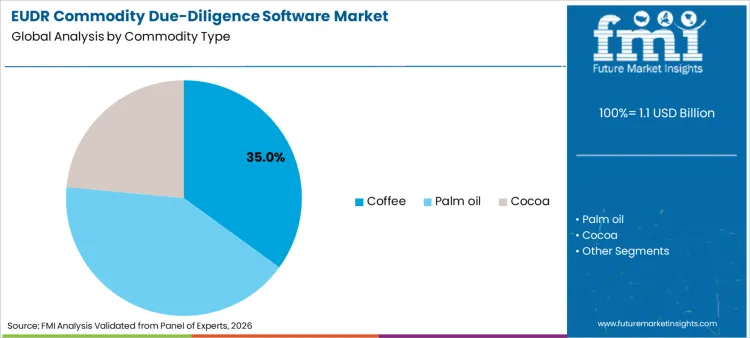
Coffee commands 35% market share due to supply chain complexity involving millions of smallholder farmers across more than 60 producing countries. International Coffee Organization data shows 25 million farming families participate in global coffee production, creating unprecedented traceability challenges for importers serving European markets. Nestle announced USD 1.2 billion investment in coffee supply chain digitization during March 2025, partnering with Satelligence to implement satellite-based monitoring across 180,000 supplier farms.
JAB Holding Company, controlling premium coffee brands including Keurig Dr Pepper and JDE Peet's, deployed Sourcemap's blockchain platform across Central American supply chains in January 2026. The system processes geolocation data from 50,000 coffee farms quarterly, generating automated risk assessments for deforestation probability scoring. Small-lot specialty coffee importers adopted BanQu's mobile data collection platform, enabling direct farmer data input through smartphone applications available in local languages.
Why Does Palm Oil Maintain a Strong Market Position?
Palm oil software demand captures 25% market share due to the high geographic concentration and deforestation risk associated with production in Malaysia and Indonesia, which together account for over 85% of global supply. Industry estimates, including data referenced by the World Wildlife Fund, indicate that oil palm cultivation spans approximately 27 million hectares globally, with plantation boundaries frequently overlapping high-conservation-value areas. This risk profile has made continuous satellite monitoring a baseline requirement for EUDR compliance. Unilever now monitors more than 20 million hectares through its internal dashboard developed with partners such as Google Cloud and Orbital Insight, verifying 95.7% of its 2024–2025 palm oil volumes as deforestation-free.
In Indonesia, Golden Agri-Resources has achieved 99% traceability to plantation using its SmartTrace blockchain platform combined with satellite alert systems to support real-time compliance reporting ahead of the December 2026 deadline. Procter & Gamble has similarly scaled always-on satellite monitoring across 18.9 million hectares of supplier landbanks, maintaining 100% RSPO physical certification by late 2025 while tracking over 4,000 mills and plantations for deforestation risk.
What Trends Are Shaping Industry Evolution?
Consumer psychology shifts toward environmental accountability drive demand for verifiable sustainability claims. European consumers increasingly scrutinize product labeling for deforestation-free certifications, creating competitive advantages for companies demonstrating transparent supply chains.
Artificial intelligence integration transforms deforestation risk assessment capabilities. Machine learning algorithms analyze satellite imagery changes over time, identifying forest loss patterns with 95% accuracy compared to manual assessment methods.
Blockchain technology adoption creates immutable audit trails supporting regulatory compliance requirements. Each supply chain transaction records permanently on distributed ledgers, preventing data manipulation and ensuring verification authenticity.
Mobile technology penetration enables direct farmer data collection, bypassing traditional intermediary systems that often lack transparency. Smartphone applications collect GPS coordinates, production volumes, and sustainability practice documentation directly from farm locations. Smallholder farmers upload real-time data, creating comprehensive databases supporting EUDR compliance requirements for downstream buyers.
Supply chain consolidation accelerates as companies seek simplified compliance management. Vertical integration reduces the number of intermediary relationships requiring individual due diligence assessments. Major commodity traders acquire upstream processing facilities, creating controlled supply chains with enhanced traceability capabilities from farm to final product delivery.
What Is EUDR Commodity Due-Diligence Software Market (Cocoa, Coffee, Palm Oil) Regional Outlook?
Regional expansion patterns reflect uneven regulatory pressure, commodity import dependence, and producer-country readiness for digital traceability. While the global market grows steadily at a 5.2% CAGR, adoption intensity varies sharply by geography. Producing countries in Asia are scaling fastest as compliance becomes a prerequisite for EU market access, with Indonesia leading at a 6.2% CAGR and Malaysia close behind at 5.8%, driven by palm oil digitization mandates. In Europe, structurally important trading hubs such as the Netherlands (5.1%) and Germany (4.8%) are focused on port-level automation and importer readiness rather than volume growth. France advances at 4.2% through integration with sustainability policy frameworks, while the United States grows at 4.5% as multinationals proactively align global sourcing systems with EUDR standards despite no direct regulatory obligation. FMI analysis indicates that future growth will be anchored in producer-side digitization and exporter compliance enablement rather than discretionary sustainability spending.
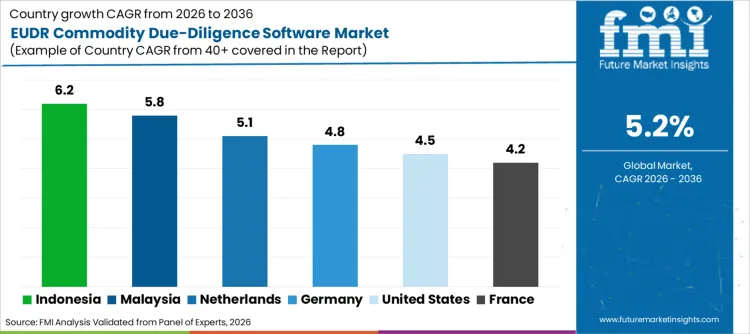
| Country | CAGR (2026 to 2036) |
|---|---|
| Indonesia | 6.2% |
| Malaysia | 5.8% |
| Netherlands | 5.1% |
| Germany | 4.8% |
| United States | 4.5% |
| France | 4.2% |
Source: FMI historical analysis and forecast data.
Why Is Germany Building Importer-Led Compliance Infrastructure?
Germany is expanding at a 4.8% CAGR, reflecting its role as Europe’s largest coffee importer and third-largest cocoa processor. Hamburg port remains the continent’s primary coffee gateway, concentrating compliance pressure among German traders. Federal support for supply chain digitization, combined with industry initiatives such as the EUDR Coffee Check backed by the German Coffee Association, has enabled standardized risk assessment data sharing and lower per-importer compliance costs. In cocoa, German manufacturer Ritter Sport reached full farm-level traceability by early 2026, mapping thousands of plots in Ghana and Nicaragua to generate automated Due Diligence Statements, reducing administrative friction and reinforcing Germany’s leadership in agricultural transparency.
How Is France Integrating EUDR With Sustainability Policy?
France grows at a 4.2% CAGR through alignment of EUDR compliance with national sustainable development priorities. Louis Dreyfus Company expanded Sourcemap deployment across African cocoa supply chains during the 2025 harvest, digitizing 15,000 farmer profiles in Ivory Coast. These private-sector initiatives extend compliance requirements upstream to processors and cooperatives, creating cascading software demand beyond direct importers. FMI analysis suggests that France’s policy-led approach will influence wider European adoption patterns, particularly in integrating smallholders into digital traceability ecosystems.
Why Is the Netherlands Acting as Europe’s Digital Gateway?
The Netherlands records 5.1% CAGR growth, driven by Rotterdam’s position as Europe’s primary cocoa and coffee entry point. Concentrated compliance pressure on Dutch logistics and trading firms has accelerated investment in digital infrastructure to process geolocation and legality data at scale. Barry Callebaut supported over 500,000 farmers through its sustainability programs by late 2025, applying European Forest Institute frameworks to verify West African supply chains. Support from the Dutch Sustainable Trade Initiative and continued AgTech financing by Rabobank ensure that digitization efforts do not exclude smallholders, reinforcing the Netherlands’ central role in global agricultural transparency.
How Is the United States Aligning Global Supply Chains With EUDR?
The United States grows at a 4.5% CAGR despite not being directly subject to EUDR, as multinational food companies standardize global traceability systems. General Mills, Kellanova, and Mondelez International have deployed unified compliance platforms across sourcing regions. Starbucks’ C.A.F.E. Practices now cover more than 400,000 farmers with plot-level monitoring aligned to the December 2026 deadline, while Mars achieved full farm-level cocoa traceability by the end of 2025 using high-resolution satellite monitoring. USAID-backed digital agriculture programs further enable smallholder participation, supporting proactive EUDR alignment by US-based multinationals.
Why Is Indonesia Leading Producer-Side Digitization?
Indonesia leads with a 6.2% CAGR as the world’s largest palm oil producer accelerates supply chain digitization to preserve EU market access. The National Traceability Dashboard launched in 2025 synchronizes geolocation and legality data across commodities. Large producers such as PT Sinar Mas Agro Resources and Technology integrate AI-enabled field tools and mobile harvesting systems, while industry advocacy for ISPO recognition aims to protect smallholders through standardized data sharing. FMI analysis highlights that Indonesia’s state-supported transparency model is critical to balancing export competitiveness with domestic sustainability goals.
How Is Malaysia Coordinating Certification and Digital Traceability?
Malaysia expands at a 5.8% CAGR through tight integration of EUDR requirements with the MSPO 2.0 standard. SD Guthrie has already assessed 600,000 hectares for deforestation risk and delivered fully compliant shipments to Europe using plot-level transparency tools. Government funding in the 2025 and 2026 budgets supports GPS mapping and smartphone onboarding for 720,000 smallholders. FMI notes that Malaysia’s coordinated approach, linking mandatory certification with state-backed digital investment, positions the country as a highly competitive and transparent palm oil supplier under EUDR.
What Strategic Moves Are Defining the Competitive Landscape?
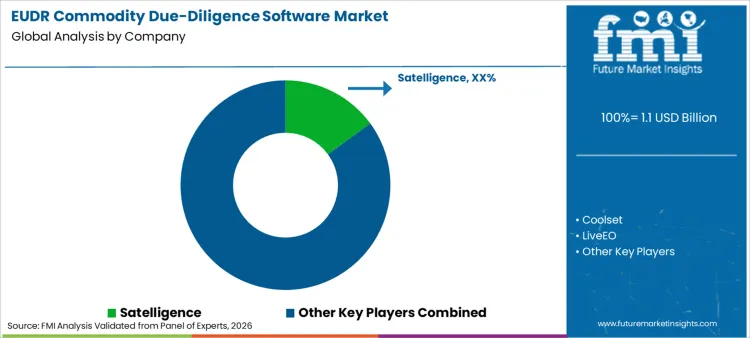
Competitive dynamics in the AgTech sector now center on platform integration rather than isolated solutions. Leading vendors such as Satelligence and IntegrityNext have expanded their offerings to include AI-powered predictive analytics, allowing companies to identify forest-loss patterns before they become compliance violations. These platforms are increasingly interoperable with global certification bodies, reducing the data-entry burden for suppliers.
Strategically, these companies emphasize cloud-native deployment, ensuring that traceability data can be accessed and verified across diverse geographical regions in real-time. This technological shift is supported by a "flight to quality" in the investment market, where venture capital is increasingly directed toward established firms with proven ROI in digital supply chains. Furthermore, tech giants are deepening their involvement; Microsoft, for instance, recently expanded its agricultural AI capabilities through a major partnership with Land O'Lakes, utilizing Azure AI Foundry to turn decades of agronomic data into actionable, mobile-friendly insights for farmers and retailers alike.
Recent Developments:
- In January 2026, Rainforest Alliance launched comprehensive certification program integration with major EUDR compliance software platforms, enabling automatic verification of sustainability credentials across coffee and cocoa supply chains.
- In November 2025, European Forest Institute released open-source methodology for legality due diligence assessment, tested across cocoa supply chains in Ivory Coast, Ghana, and Cameroon with plans for coffee and palm oil expansion.
- In September 2025, Solidaridad introduced pre-check protocol for Honduran coffee and palm oil exporters, offering comprehensive traceability verification and compliance assessment services supporting EUDR requirements.
Who Are the Key Players in EUDR Commodity Due-Diligence Software Market (Cocoa/Coffee/Palm Oil)?
- Satelligence
- Coolset
- LiveEO
- IntegrityNext
- Sourcemap
- BanQu
- Passionfruit
- osapiens
- Agriplace
- MasterSustainability.today
- Trade in Space
- Sphera
Market Definition
The EUDR Commodity Due-Diligence Software Market (Cocoa, Coffee, Palm Oil) comprises digital platforms and systems designed to enable companies to comply with the European Union Deforestation Regulation by collecting, validating, and reporting supply chain data linked to deforestation risk. These solutions support mandatory due diligence for regulated commodities by managing geolocation coordinates, plot-level mapping, legality verification, and deforestation risk assessment across multi-tier agricultural supply chains. The market measures revenues generated from software licenses, subscriptions, and bundled digital services that automate Due Diligence Statements and regulatory reporting for imports into the European Union. The market is structurally compliance-led, with demand anchored to the December 2026 enforcement deadline and expanding as enforcement mechanisms, penalties, and audit scrutiny intensify across EU member states.
Market Inclusion
The market includes cloud-based and hybrid software platforms that provide end-to-end EUDR compliance functionality for cocoa, coffee, and palm oil supply chains. Included solutions cover geolocation data collection, satellite-based deforestation monitoring, risk scoring, supplier verification, blockchain-enabled audit trails, and automated generation of Due Diligence Statements. Mobile applications used for smallholder farmer onboarding, GPS mapping, and field-level data capture are included when integrated into a broader compliance platform. Subscription fees, implementation services, system integration, ongoing technical support, and compliance monitoring services are included when delivered as part of a software-led offering. Platforms serving importers, traders, food manufacturers, cooperatives, and certification-aligned workflows fall fully within scope.
Market Exclusion
The market excludes standalone consulting services, legal advisory offerings, and certification audits that do not include proprietary software platforms. General enterprise resource planning systems, logistics software, or supply chain management tools without EUDR-specific geolocation, deforestation risk assessment, or due diligence reporting capabilities are excluded. Hardware-only components such as GPS devices, satellites, drones, or sensing equipment are not included unless bundled within an integrated software solution. Costs associated with raw satellite imagery procurement, independent third-party certification fees, and physical inspection services are excluded when sold separately. Consumer-facing sustainability labels, carbon accounting tools unrelated to deforestation compliance, and non-agricultural traceability software fall outside the defined market scope.
Scope of Report
| Items | Values |
|---|---|
| Quantitative Units | USD Billion |
| Product Type | Cloud-based platforms, Mobile applications, Blockchain integration systems, Satellite monitoring tools |
| Commodity Type | Coffee, Palm oil, Cocoa |
| Regions Covered | Europe; Asia Pacific; North America; Latin America; Middle East & Africa |
| Key Countries Covered | Germany; Netherlands; France; United States; Indonesia; Malaysia; Brazil; Côte d’Ivoire; Ghana; Colombia |
| Key Companies Profiled | Satelligence; Sourcemap; IntegrityNext; LiveEO; BanQu; Coolset; osapiens; Agriplace; Sphera; Trade in Space; Passionfruit |
| Additional Attributes | Dollar sales measured for software licenses, subscriptions, and bundled services supporting EUDR compliance, supplier onboarding, ongoing monitoring, and automated due-diligence reporting across regulated agricultural commodity supply chains |
How Is EUDR Commodity Due-Diligence Software Market (Cocoa/Coffee/Palm Oil) Categorised by Segments?
By Product Type:
- Cloud-based platforms
- Mobile applications
- Blockchain integration systems
- Satellite monitoring tools
By Commodity Type:
- Coffee (35% market share)
- Palm oil (35% market share)
- Cocoa (30% market share)
By Region:
- Europe (32% market share)
- Asia Pacific (30% market share)
- North America (19% market share)
- Latin America (12% market share)
- Rest of World (7% market share)
Bibliography
- International Coffee Organization. (2026). Coffee Market Report 2025/26. ICO Publications.
- Indonesian Ministry of Agriculture. (2025). National Palm Oil Monitoring System Implementation Plan. Government of Indonesia.
- SD Guthrie Berhad (formerly Sime Darby Plantation). (2025). Annual Integrated Report 2024: Delivering the First EUDR-Compliant Palm Oil Shipments. Corporate Sustainability Disclosures.
Frequently Asked Questions
How big is the global EUDR Commodity Due-Diligence Software market?
The global EUDR Commodity Due-Diligence Software market is valued at USD 1.1 billion in 2026 and is projected to reach USD 1.8 billion by 2036.
What is the growth outlook for the EUDR Commodity Due-Diligence Software market over the next 10 years?
The market is expected to grow at a steady 5.2% CAGR from 2026 to 2036, driven by mandatory compliance with the EU Deforestation Regulation enforcement deadlines.
Which product segments or formats drive demand in this market?
Demand is driven by cloud-based traceability platforms integrating geolocation mapping, satellite deforestation monitoring, and automated due-diligence reporting for coffee, palm oil, and cocoa.
How does consumer behavior differ by region?
Adoption is strongest in Europe due to direct regulatory exposure, while producer regions in Asia-Pacific scale rapidly to maintain EU export access and North America aligns proactively through multinational sourcing standards.
What are the main risks and constraints affecting this market?
Key constraints include high implementation costs for smallholders, data accuracy challenges across fragmented supply chains, and tight compliance timelines linked to regulatory penalties.
Preview the report firsthand - request a free sample
Get SampleGet the brochure for pricing and purchase details.
Get PDFTable of Content
- Executive Summary
- Global Market Outlook
- Demand-side Trends
- Supply-side Trends
- Technology Roadmap Analysis
- Analysis and Recommendations
- Market Overview
- Market Coverage / Taxonomy
- Market Definition / Scope / Limitations
- Market Background
- Market Dynamics
- Drivers
- Restraints
- Opportunity
- Trends
- Scenario Forecast
- Demand in Optimistic Scenario
- Demand in Likely Scenario
- Demand in Conservative Scenario
- Opportunity Map Analysis
- Product Life Cycle Analysis
- Supply Chain Analysis
- Investment Feasibility Matrix
- Value Chain Analysis
- PESTLE and Porter’s Analysis
- Regulatory Landscape
- Regional Parent Market Outlook
- Production and Consumption Statistics
- Import and Export Statistics
- Market Dynamics
- Global Market Analysis 2021 to 2025 and Forecast, 2026 to 2036
- Historical Market Size Value (USD Million) Analysis, 2021 to 2025
- Current and Future Market Size Value (USD Million) Projections, 2026 to 2036
- Y-o-Y Growth Trend Analysis
- Absolute $ Opportunity Analysis
- Global Market Pricing Analysis 2021 to 2025 and Forecast 2026 to 2036
- Global Market Analysis 2021 to 2025 and Forecast 2026 to 2036, By Product Type
- Introduction / Key Findings
- Historical Market Size Value (USD Million) Analysis By Product Type , 2021 to 2025
- Current and Future Market Size Value (USD Million) Analysis and Forecast By Product Type , 2026 to 2036
- Cloud-based platforms
- Mobile applications
- Blockchain integration systems
- Satellite monitoring tools
- Cloud-based platforms
- Y-o-Y Growth Trend Analysis By Product Type , 2021 to 2025
- Absolute $ Opportunity Analysis By Product Type , 2026 to 2036
- Global Market Analysis 2021 to 2025 and Forecast 2026 to 2036, By Commodity Type
- Introduction / Key Findings
- Historical Market Size Value (USD Million) Analysis By Commodity Type, 2021 to 2025
- Current and Future Market Size Value (USD Million) Analysis and Forecast By Commodity Type, 2026 to 2036
- Coffee
- Palm oil
- Cocoa
- Coffee
- Y-o-Y Growth Trend Analysis By Commodity Type, 2021 to 2025
- Absolute $ Opportunity Analysis By Commodity Type, 2026 to 2036
- Global Market Analysis 2021 to 2025 and Forecast 2026 to 2036, By Region
- Introduction
- Historical Market Size Value (USD Million) Analysis By Region, 2021 to 2025
- Current Market Size Value (USD Million) Analysis and Forecast By Region, 2026 to 2036
- North America
- Latin America
- Western Europe
- Eastern Europe
- East Asia
- South Asia and Pacific
- Middle East & Africa
- Market Attractiveness Analysis By Region
- North America Market Analysis 2021 to 2025 and Forecast 2026 to 2036, By Country
- Historical Market Size Value (USD Million) Trend Analysis By Market Taxonomy, 2021 to 2025
- Market Size Value (USD Million) Forecast By Market Taxonomy, 2026 to 2036
- By Country
- USA
- Canada
- Mexico
- By Product Type
- By Commodity Type
- By Country
- Market Attractiveness Analysis
- By Country
- By Product Type
- By Commodity Type
- Key Takeaways
- Latin America Market Analysis 2021 to 2025 and Forecast 2026 to 2036, By Country
- Historical Market Size Value (USD Million) Trend Analysis By Market Taxonomy, 2021 to 2025
- Market Size Value (USD Million) Forecast By Market Taxonomy, 2026 to 2036
- By Country
- Brazil
- Chile
- Rest of Latin America
- By Product Type
- By Commodity Type
- By Country
- Market Attractiveness Analysis
- By Country
- By Product Type
- By Commodity Type
- Key Takeaways
- Western Europe Market Analysis 2021 to 2025 and Forecast 2026 to 2036, By Country
- Historical Market Size Value (USD Million) Trend Analysis By Market Taxonomy, 2021 to 2025
- Market Size Value (USD Million) Forecast By Market Taxonomy, 2026 to 2036
- By Country
- Germany
- UK
- Italy
- Spain
- France
- Nordic
- BENELUX
- Rest of Western Europe
- By Product Type
- By Commodity Type
- By Country
- Market Attractiveness Analysis
- By Country
- By Product Type
- By Commodity Type
- Key Takeaways
- Eastern Europe Market Analysis 2021 to 2025 and Forecast 2026 to 2036, By Country
- Historical Market Size Value (USD Million) Trend Analysis By Market Taxonomy, 2021 to 2025
- Market Size Value (USD Million) Forecast By Market Taxonomy, 2026 to 2036
- By Country
- Russia
- Poland
- Hungary
- Balkan & Baltic
- Rest of Eastern Europe
- By Product Type
- By Commodity Type
- By Country
- Market Attractiveness Analysis
- By Country
- By Product Type
- By Commodity Type
- Key Takeaways
- East Asia Market Analysis 2021 to 2025 and Forecast 2026 to 2036, By Country
- Historical Market Size Value (USD Million) Trend Analysis By Market Taxonomy, 2021 to 2025
- Market Size Value (USD Million) Forecast By Market Taxonomy, 2026 to 2036
- By Country
- China
- Japan
- South Korea
- By Product Type
- By Commodity Type
- By Country
- Market Attractiveness Analysis
- By Country
- By Product Type
- By Commodity Type
- Key Takeaways
- South Asia and Pacific Market Analysis 2021 to 2025 and Forecast 2026 to 2036, By Country
- Historical Market Size Value (USD Million) Trend Analysis By Market Taxonomy, 2021 to 2025
- Market Size Value (USD Million) Forecast By Market Taxonomy, 2026 to 2036
- By Country
- India
- ASEAN
- Australia & New Zealand
- Rest of South Asia and Pacific
- By Product Type
- By Commodity Type
- By Country
- Market Attractiveness Analysis
- By Country
- By Product Type
- By Commodity Type
- Key Takeaways
- Middle East & Africa Market Analysis 2021 to 2025 and Forecast 2026 to 2036, By Country
- Historical Market Size Value (USD Million) Trend Analysis By Market Taxonomy, 2021 to 2025
- Market Size Value (USD Million) Forecast By Market Taxonomy, 2026 to 2036
- By Country
- Kingdom of Saudi Arabia
- Other GCC Countries
- Turkiye
- South Africa
- Other African Union
- Rest of Middle East & Africa
- By Product Type
- By Commodity Type
- By Country
- Market Attractiveness Analysis
- By Country
- By Product Type
- By Commodity Type
- Key Takeaways
- Key Countries Market Analysis
- USA
- Pricing Analysis
- Market Share Analysis, 2025
- By Product Type
- By Commodity Type
- Canada
- Pricing Analysis
- Market Share Analysis, 2025
- By Product Type
- By Commodity Type
- Mexico
- Pricing Analysis
- Market Share Analysis, 2025
- By Product Type
- By Commodity Type
- Brazil
- Pricing Analysis
- Market Share Analysis, 2025
- By Product Type
- By Commodity Type
- Chile
- Pricing Analysis
- Market Share Analysis, 2025
- By Product Type
- By Commodity Type
- Germany
- Pricing Analysis
- Market Share Analysis, 2025
- By Product Type
- By Commodity Type
- UK
- Pricing Analysis
- Market Share Analysis, 2025
- By Product Type
- By Commodity Type
- Italy
- Pricing Analysis
- Market Share Analysis, 2025
- By Product Type
- By Commodity Type
- Spain
- Pricing Analysis
- Market Share Analysis, 2025
- By Product Type
- By Commodity Type
- France
- Pricing Analysis
- Market Share Analysis, 2025
- By Product Type
- By Commodity Type
- India
- Pricing Analysis
- Market Share Analysis, 2025
- By Product Type
- By Commodity Type
- ASEAN
- Pricing Analysis
- Market Share Analysis, 2025
- By Product Type
- By Commodity Type
- Australia & New Zealand
- Pricing Analysis
- Market Share Analysis, 2025
- By Product Type
- By Commodity Type
- China
- Pricing Analysis
- Market Share Analysis, 2025
- By Product Type
- By Commodity Type
- Japan
- Pricing Analysis
- Market Share Analysis, 2025
- By Product Type
- By Commodity Type
- South Korea
- Pricing Analysis
- Market Share Analysis, 2025
- By Product Type
- By Commodity Type
- Russia
- Pricing Analysis
- Market Share Analysis, 2025
- By Product Type
- By Commodity Type
- Poland
- Pricing Analysis
- Market Share Analysis, 2025
- By Product Type
- By Commodity Type
- Hungary
- Pricing Analysis
- Market Share Analysis, 2025
- By Product Type
- By Commodity Type
- Kingdom of Saudi Arabia
- Pricing Analysis
- Market Share Analysis, 2025
- By Product Type
- By Commodity Type
- Turkiye
- Pricing Analysis
- Market Share Analysis, 2025
- By Product Type
- By Commodity Type
- South Africa
- Pricing Analysis
- Market Share Analysis, 2025
- By Product Type
- By Commodity Type
- USA
- Market Structure Analysis
- Competition Dashboard
- Competition Benchmarking
- Market Share Analysis of Top Players
- By Regional
- By Product Type
- By Commodity Type
- Competition Analysis
- Competition Deep Dive
- Satelligence
- Overview
- Product Portfolio
- Profitability by Market Segments (Product/Age /Sales Channel/Region)
- Sales Footprint
- Strategy Overview
- Marketing Strategy
- Product Strategy
- Channel Strategy
- Coolset
- LiveEO
- IntegrityNext
- Sourcemap
- BanQu
- Passionfruit
- osapiens
- Agriplace
- MasterSustainability.today
- Trade in Space
- Sphera
- Satelligence
- Competition Deep Dive
- Assumptions & Acronyms Used
- Research Methodology


