

- Industry Size (2026)
- USD 1.14 Bn
- Forecast (2036)
- USD 2.23 Bn
- CAGR (2026 to 2036)
- 7.0%
Dodecanedioic Acid Market Size, Market Forecast and Outlook
In 2025, the dodecanedioic acid market was valued at USD 1.06 billion. Based on Future Market Insights' analysis, demand is estimated to reach USD 1.14 billion in 2026 and USD 2.09 billion by 2035, before rising further to approximately USD 2.23 billion by 2036. This trajectory reflects a CAGR of 7.0% during the forecast period.
Absolute dollar growth of more than USD 1.09 billion between 2026 and 2036 signals a market expanding at an accelerated pace, underpinned by increasing demand for high-performance polymers, coatings, and resins across automotive, electrical, and industrial applications. Synthetic dodecanedioic acid accounts for 61.3% of market value, reflecting its consistent purity, high yield, and ability to meet stringent performance requirements in large-scale manufacturing.
Summary of Dodecanedioic Acid Market
- Demand Drivers in the Market
- Nylon 6,12 production for automotive fuel lines, pneumatic tubing, and cable sheathing, where DDDA's C12 chain provides low moisture absorption and dimensional stability compared to nylon 6 or 66 .
- Powder coatings consumption for automotive components, architectural finishes, and industrial equipment, where DDDA-based polyester resins offer excellent weatherability and mechanical properties.
- Adhesives and lubricants applications requiring thermal stability and chemical resistance in demanding environments.
- Key Segments Analyzed in the FMI Report
- Product Type: Synthetic dodecanedioic acid, which accounts for 61.3% of market value in 2026 due to consistent purity, high yield, and cost-effectiveness in large-scale manufacturing.
- Application: Resins, capturing 27.9% of market value as the leading application, driven by demand for high-performance coatings, adhesives, and specialty polymers.
- End-use Industry: Automotive, holding 31.2% of market value as the largest end-use sector, driven by requirements for lightweight, high-strength materials in vehicle manufacturing.
- Analyst Opinion at FMI
- Nikhil Kaitwade, principal consultant for Chemicals & Materials at Future Market Insights observes: "Dodecanedioic acid's market trajectory reflects the broader shift toward engineered performance in polymer applications. Synthetic routes currently dominate due to scale and consistency, but bio-based production is gaining traction as sustainability criteria enter procurement decisions."
- Strategic Implications/Executive Takeaways
- Prioritize synthetic DDDA production for automotive and industrial applications where consistency and scale are paramount, while monitoring bio-based technology developments for future differentiation.
- Align product portfolios with powder coatings growth by developing DDDA grades optimized for polyester resin formulations with enhanced weatherability and mechanical properties.
- Build technical service capabilities that help customers optimize DDDA incorporation into polyamide and polyester polymerization processes, reducing development cycles and improving end-product performance.
- Methodology
- The market view is grounded in primary input from polyamide manufacturers, coatings formulators, and chemical producers, and in technical and policy sources focused on polymer chemistry and advanced materials, avoiding reliance on secondary market research reports from competing providers.
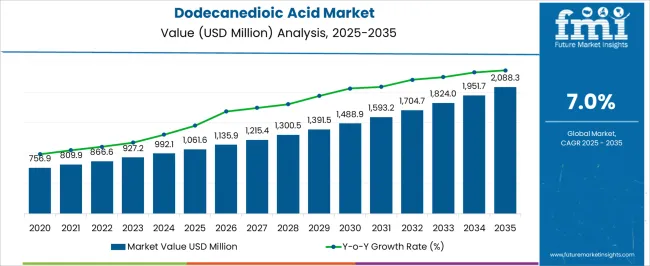
North America, Europe, and Asia-Pacific account for the bulk of incremental revenues through 2036, with distinct demand drivers in each region. In Asia-Pacific, rapid industrialization and expanding automotive production drive consumption for nylon 6,12 and engineering plastics, with China and India as primary growth centers. In Europe, established automotive, adhesives, and plasticizers markets, particularly in Germany, the UK, and Italy, support demand. North America's market growth is driven by textile and industrial applications, with the USA and Canada as major consumers.
Dodecanedioic Acid Market Definition
Dodecanedioic acid (DDDA) is a dicarboxylic acid with the chemical formula C12H22O4, appearing as a white solid with slight odor. It is manufactured primarily from butadiene through chemical synthesis, though bio-based production routes are emerging. DDDA is used extensively in the production of polyamides, notably nylon 6,12, polyester coatings, adhesives, lubricants, corrosion inhibitors, pharmaceuticals, and surfactants. Its long carbon chain imparts flexibility, thermal stability, and chemical resistance to downstream products.
Dodecanedioic Acid Market Inclusions
The report provides a comprehensive analysis of the dodecanedioic acid market, covering global and regional market sizes in value terms and a 10-year forecast from 2026 to 2036. It includes segmental breakdowns by product type, application, and end-use industry, across core regions including North America, Latin America, Western Europe, Eastern Europe, East Asia, South Asia & Pacific, and the Middle East & Africa.
Dodecanedioic Acid Market Exclusions
The scope excludes other dicarboxylic acids such as adipic acid, sebacic acid, and azelaic acid unless they are part of a product family marketed primarily as dodecanedioic acid. It also omits finished products where DDDA is converted into polymers or other derivatives. Very low-volume, specialty grades for niche research applications that do not contribute meaningfully to global revenue pools are likewise outside the quantified scope.
Dodecanedioic Acid Market Research Methodology
- Primary research: Structured interviews were conducted with procurement managers in polyamide manufacturing, coatings formulators, and specialty chemical distributors, alongside producers of dodecanedioic acid on production capacity, technology trends, pricing dynamics, and regional supply-demand balances.
- Desk research: Technical documentation and application guides from major DDDA manufacturers, together with industry publications on polymer chemistry and end-use sector reports from government agencies and industry associations, were assessed to benchmark performance and to align market modeling with the latest data on automotive production and coatings consumption.
- Market-sizing and forecasting: A hybrid top-down and bottom-up modeling framework was applied, reconstructing DDDA demand from nylon production volumes, powder coatings output, and automotive component manufacturing activity, then validating outputs against publicly available data from government statistical agencies and industry associations.
- Data validation and update cycle: Model outputs undergo consistency checks across regions, product types, and applications, with iterative calibration using new capacity announcements, technology developments, and emerging bio-based production data.
Segmental Anlaysis
Dodecanedioic Acid Market Analysis by Product Type
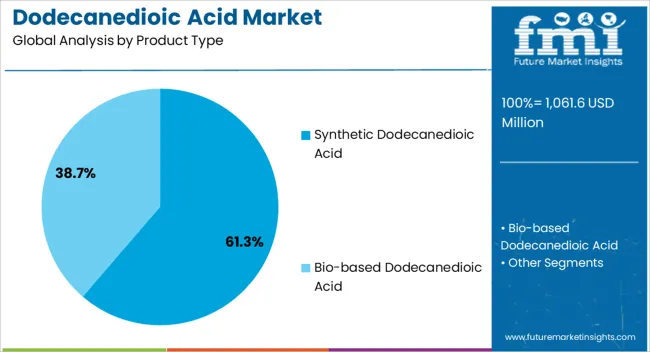
Based on FMI's dodecanedioic acid market assessment, Synthetic dodecanedioic acid constitutes 61.3% of global market value in 2026, establishing its position as the leading product type. Its dominance is attributed to consistent purity, high yield, and ability to meet stringent performance requirements in industrial applications.
The synthetic variant allows better control over chemical properties, enhancing its suitability for producing high-performance resins, polyamides, and engineering plastics. It is preferred in large-scale manufacturing due to process efficiency and cost-effectiveness, particularly where material consistency and reliability are critical.
Bio-based dodecanedioic acid, produced from renewable feedstocks such as lauric acid, represents a smaller but growing segment driven by sustainability initiatives and regulatory pressure for renewable content. Companies including Verdezyne have pursued bio-based routes, though production economics and scale remain challenging relative to synthetic processes.
Dodecanedioic Acid Market Analysis by Application
Resins represent the largest application segment for dodecanedioic acid, capturing 27.9% of market value in 2026. Resins derived from DDDA provide enhanced flexibility, durability, and processability, making them critical for applications in automotive, industrial machinery, and electronics. The segment's expansion is supported by rising need for lightweight, high-strength, and environmentally compliant materials.
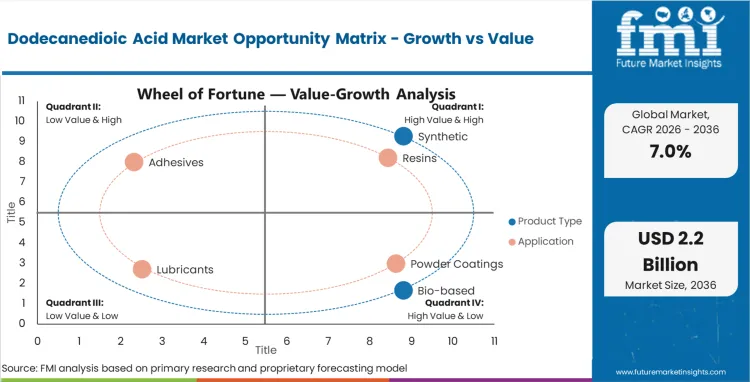
Powder Coatings follow as a significant application, with DDDA-based polyester resins offering excellent weatherability, mechanical properties, and environmental compliance compared to liquid coatings. Adhesives consume DDDA for high-performance formulations requiring thermal stability and chemical resistance. Lubricants applications include synthetic esters where DDDA imparts desirable viscosity and oxidation stability. Pharmaceuticals utilize DDDA in controlled-release formulations and as an intermediate.
Dodecanedioic Acid Market Analysis by End-use Industry
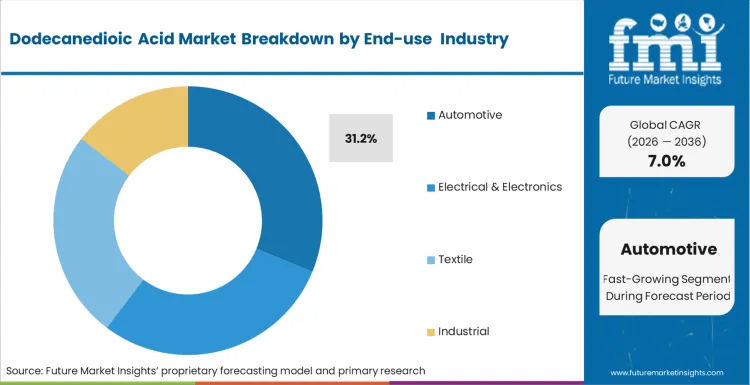
Automotive represents the largest end-use industry for dodecanedioic acid, holding 31.2% of market value in 2026. DDDA is used extensively to improve durability, thermal stability, and corrosion resistance in automotive polymers, contributing to fuel efficiency and vehicle longevity.
The segment benefits from increasing production of electric and hybrid vehicles, which rely heavily on advanced polymers for battery enclosures, wiring insulation, and lightweight structural components.
Electrical & electronics applications include components requiring high-temperature resistance and dimensional stability. Textile applications consume DDDA in specialty fibers with enhanced properties. Industrial applications span machinery components, corrosion inhibitors, and high-performance coatings.
Dodecanedioic Acid Market Drivers, Restraints, Opportunities and Trends
Drivers
Nylon 6,12 Demand Growth
Nylon 6,12, produced from dodecanedioic acid and hexamethylenediamine, offers lower moisture absorption and better dimensional stability than nylon 6 or 66, making it preferred for automotive fuel lines, pneumatic tubing, and precision components. Global automotive production and the trend toward under-hood components with higher temperature requirements drive demand .
Powder Coatings Expansion
Environmental regulations restricting VOC emissions favor powder coatings over liquid alternatives, with DDDA-based polyester resins providing excellent weatherability and mechanical properties. Architectural, automotive, and industrial applications increasingly specify powder coatings, driving DDDA consumption .
Engineering Plastics Substitution
Engineers increasingly specify high-performance polymers where metals or standard plastics prove inadequate. DDDA-based materials offer property combinations—chemical resistance, thermal stability, mechanical strength that enable substitution in demanding applications across automotive, electronics, and industrial sectors .
Restraints
Raw Material Price Volatility
Synthetic DDDA production depends on butadiene, a petrochemical derivative subject to price fluctuations driven by crude oil markets and cracker operating rates. Price volatility challenges manufacturer margin management and long-term supply agreements, particularly for fixed-price contracts .
Bio-based Production Economics
While bio-based DDDA offers sustainability benefits, production costs remain higher than synthetic routes, limiting market penetration. Scale-up challenges and feedstock availability constrain bio-based capacity expansion, preventing significant share gain without policy support or breakthrough cost reductions .
Opportunities
Electric Vehicle Component Requirements
Electric vehicle proliferation creates new applications for DDDA-based polymers in battery enclosures requiring thermal management and electrical insulation, high-voltage cabling needing flame retardance, and lightweight structural components where metal substitution reduces weight and extends range .
Bio-based Technology Advancement
Continued R&D in bio-based DDDA production, including fermentation routes from renewable feedstocks, offers potential for cost reduction and scale-up. Success in achieving cost parity with synthetic routes would enable penetration of sustainability-focused applications and markets with renewable content requirements .
Regional Analysis
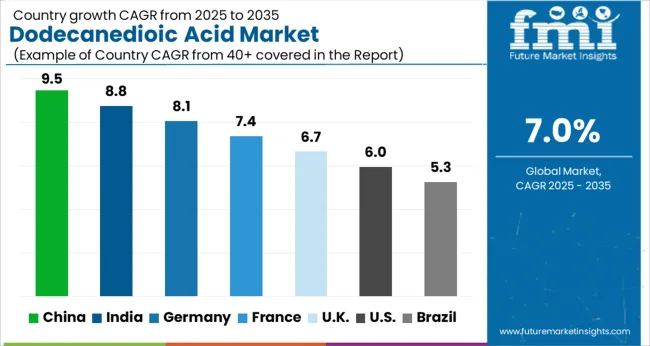
.webp "Top Country Growth Comparison Dodecanedioic Acid Market Cagr (2026 2036)")
| Countries | Value CAGR (2026 to 2036) |
|---|---|
| United States | 6.5% |
| Germany | 6.8% |
| China | 7.8% |
| India | 8.2% |
| Japan | 6.2% |
Source: Future Market Insights analysis, supported by proprietary forecasting model and primary research
United States
The United States dodecanedioic acid market is projected to grow at a 6.5% CAGR from 2026 to 2036, driven by demand from textile and industrial applications. The USA and Canada are major consumers in North America, with polyamide consumption for automotive components and industrial applications driving demand.
Powder coatings adoption for architectural and industrial finishes contributes to DDDA consumption. Bio-based DDDA development activities, including Verdezyne's initiatives, position the region for sustainable production advances.
Germany
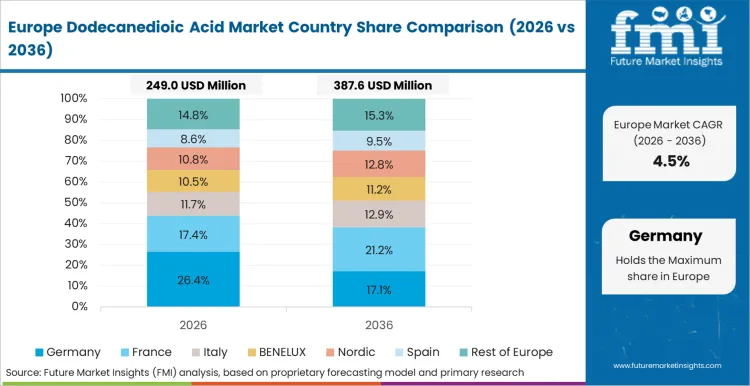
Germany's dodecanedioic acid market is forecast to grow at a 6.8% CAGR from 2026 to 2036, reflecting the country's strong automotive industry and chemical sector. German automotive manufacturers consume DDDA-based polymers for fuel lines, tubing, and under-hood components requiring thermal and chemical resistance.
Powder coatings demand for industrial and architectural applications supports consumption. The country's leadership in specialty chemicals and polymer research drives innovation in DDDA applications.
China
China's dodecanedioic acid market is expected to grow at a 7.8% CAGR from 2026 to 2036, driven by rapid industrialization and expanding automotive production. China is a major consumer of DDDA for nylon 6,12 production, serving domestic automotive and industrial markets.
Powder coatings consumption for architectural finishes and industrial equipment adds demand. Domestic production capacity expansion, including Sinopec's facilities, supports supply for growing consumption .
India
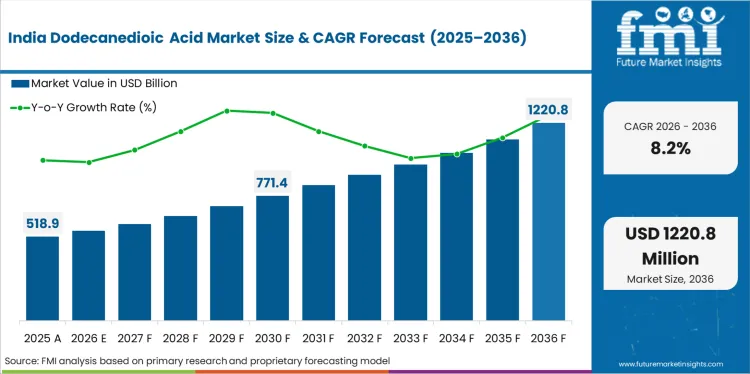
India's dodecanedioic acid market is projected to expand at an 8.2% CAGR from 2026 to 2036, the highest among key countries. Growing automotive production and industrial manufacturing drive demand for DDDA-based polymers and coatings.
Infrastructure development and construction activity increase powder coatings consumption. Expanding textile industry creates demand for specialty fibers. Domestic consumption growth outpaces production, creating import requirements for refined DDDA .
Japan
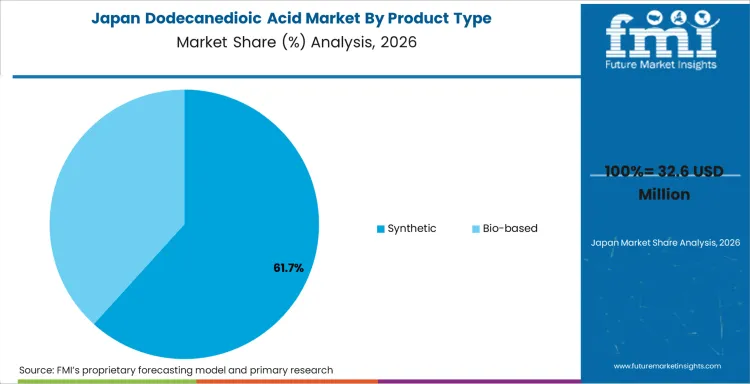
Japan's dodecanedioic acid market is forecast to grow at a 6.2% CAGR from 2026 to 2036. Advanced automotive manufacturing and electronics production generate demand for high-performance polymers. Japanese chemical companies including UBE Industries are significant DDDA producers, serving domestic and export markets.
Precision components requiring dimensional stability and chemical resistance drive DDDA consumption. Electronics applications for components with high-temperature performance contribute to demand.
Competitive Aligners for Market Players
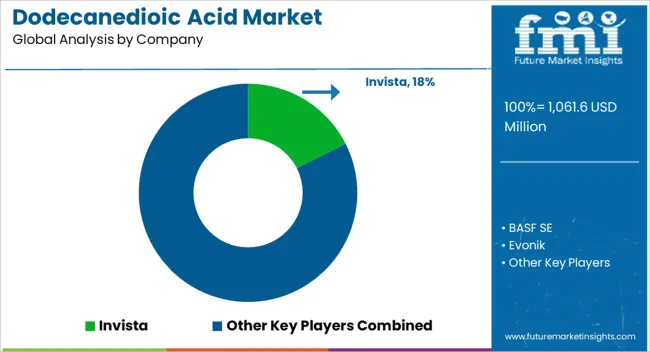
The dodecanedioic acid market features a mix of global chemical manufacturers with integrated production capabilities and specialized players focusing on bio-based routes. Competitive positioning hinges on production technology, scale, raw material access, and relationships with downstream polymer and coating manufacturers.
Leading players such as Invista, BASF, and Evonik leverage their global manufacturing footprints, integrated supply chains, and extensive customer relationships in polyamide and polymer markets. Their synthetic DDDA production benefits from scale economies and process optimization. UBE Industries maintains strong position in Asian markets with integrated production serving automotive and electronics customers. Cathay Industrial Biotech represents the bio-based segment, developing fermentation-based production routes from renewable feedstocks.
From a strategic perspective, differentiation is moving beyond commodity chemical production toward demonstrable capability in three areas. These include application-specific grade development for polyamide, coating, and lubricant formulations; supply chain reliability ensuring consistent quality and availability; and sustainability positioning through bio-based production or reduced environmental footprint.
Key Developments
- Invista continues to operate as a leading integrated producer of nylon intermediates including dodecanedioic acid, serving global polyamide markets with consistent quality and supply reliability. The company's position in the nylon value chain provides downstream integration advantages.
- BASF offers dodecanedioic acid as part of its specialty chemicals portfolio, serving customers in automotive, coatings, and industrial applications. The company's global technical service network supports customer formulation development and application optimization.
- Cathay Industrial Biotech has developed bio-based dodecanedioic acid production using fermentation technology, positioning to serve customers with sustainability requirements. The company's focus on renewable chemistry addresses growing demand for bio-based intermediates.
Key Players Profiled
- Invista
- BASF SE
- Evonik Industries AG
- UBE Industries, Ltd.
- Verdezyne, Inc.
- Cathay Industrial Biotech Ltd.
- Cathay Industrial Biotech
- Santa Cruz Biotechnology, Inc.
- Ube Corporation
Scope of the Report
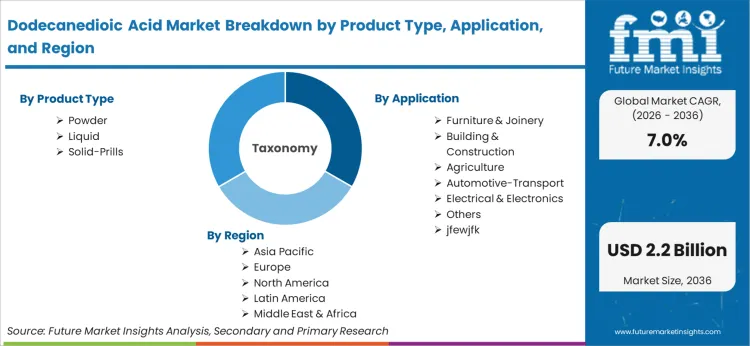
| Metric | Value |
|---|---|
| Quantitative Units | USD 1.14 billion (2026) to approximately USD 2.23 billion (2036), at a CAGR of 7.0%, with 2025 historic value of USD 1.06 billion |
| Market Definition | Dodecanedioic acid (DDDA) is a C12 dicarboxylic acid used primarily in production of polyamides (nylon 6,12), polyester coatings, adhesives, lubricants, corrosion inhibitors, pharmaceuticals, and surfactants, offering enhanced flexibility, thermal stability, and chemical resistance to downstream products. |
| Product Type Segmentation | Synthetic Dodecanedioic Acid (61.3% in 2025); Bio-based Dodecanedioic Acid |
| Application Coverage | Resins (27.9% in 2025); Powder Coatings; Adhesives; Lubricants; Pharmaceuticals; Others |
| End-use Industry Coverage | Automotive (31.2% in 2025); Electrical & Electronics; Textile; Industrial; Others |
| Regions Covered | North America, Latin America, Western Europe, Eastern Europe, East Asia, South Asia & Pacific, Middle East & Africa |
| Countries Covered | United States, Germany, China, India, Japan |
| Key Companies Profiled | Invista; BASF SE; Evonik Industries AG; UBE Industries, Ltd.; Verdezyne, Inc.; Cathay Industrial Biotech Ltd.; Cathay Industrial Biotech; Santa Cruz Biotechnology, Inc.; Ube Corporation |
| Forecast Period | 2026 to 2036 |
| Approach | Hybrid top-down and bottom-up market modeling validated through primary interviews with polyamide manufacturers, coatings formulators, and chemical producers, supported by benchmarking against automotive production statistics, coatings consumption data, and polymer industry reports. |
Dodecanedioic Acid Market Analysis by Segments
Product Type:
- Synthetic Dodecanedioic Acid
- Bio-based Dodecanedioic Acid
Application:
- Resins
- Powder Coatings
- Adhesives
- Lubricants
- Pharmaceuticals
- Others
End-use Industry:
- Automotive
- Electrical & Electronics
- Textile
- Industrial
- Others
Region:
- North America
- Latin America
- Western Europe
- Eastern Europe
- East Asia
- South Asia & Pacific
- Middle East & Africa
Bibliography
- USA Geological Survey. (2025). Mineral commodity summaries: Butadiene and petrochemical feedstocks. USGS.
- International Council of Chemical Associations. (2024). Dicarboxylic acids in polymer applications. ICCA Technical Brief.
- European Chemical Industry Council. (2025). Specialty chemicals market analysis. Cefic.
- American Chemistry Council. (2025). Plastics and polymer additives market data. ACC.
- China National Chemical Information Center. (2025). Petrochemical intermediates production statistics. CN-CIC.
- Government of India, Ministry of Chemicals and Fertilizers. (2025). Annual report on chemical and petrochemical industry. Department of Chemicals and Petrochemicals.
- Japan Chemical Industry Association. (2025). Chemical industry statistics. JCIA.
- Verband der Chemischen Industrie. (2025). German chemical industry data. VCI.
- International Organization of Motor Vehicle Manufacturers. (2025). World motor vehicle production statistics. OICA.
- European Powder Coating Association. (2025). Powder coatings market statistics. EPCA.
This bibliography is provided for reader reference and is not exhaustive. The full report contains the complete reference list and detailed citations.
This Report Addresses
- Market intelligence to enable structured strategic decision-making across dodecanedioic acid manufacturers, polymer producers, and industry investors.
- Market size estimation and 10-year revenue forecasts from 2026 to 2036, including validated CAGR and absolute dollar opportunity sizing.
- Growth opportunity mapping across Product Type, Application, End-use Industry, and regional demand pockets, with emphasis on synthetic production and automotive-driven consumption patterns.
- Segment and regional forecasting covering synthetic DDDA and resin applications, alongside end-use-specific demand trajectories across automotive and industrial sectors.
- Competition strategy assessment, including production technology, raw material access, and buyer leverage dynamics shaping sourcing decisions.
- Product and technology tracking focused on synthetic process optimization, bio-based route development, and application-specific grade formulation.
- Regional automotive production analysis and industrial activity trends influencing dodecanedioic acid procurement.
- Report delivery in PDF, Excel, and presentation-ready formats to support executive planning, capacity investment decisions, and competitive benchmarking.
Frequently Asked Questions
What is the size of the global dodecanedioic acid market in 2025 and how fast is it expected to grow through 2036?
The global dodecanedioic acid market is valued at USD 1.06 billion in 2025 and is projected to grow at a 7.0% CAGR, reaching about USD 1.14 billion in 2026 and approximately USD 2.23 billion by 2036.
Why does Synthetic dodecanedioic acid hold 61.3% of the market in 2025?
Synthetic DDDA dominates due to consistent purity, high yield, and cost-effectiveness in large-scale manufacturing, enabling it to meet stringent performance requirements for polyamides, resins, and engineering plastics.
What drives Resins as the largest application segment at 27.9%?
Resins lead because DDDA-based formulations provide enhanced flexibility, durability, and processability critical for high-performance coatings, adhesives, and specialty polymers used in automotive, industrial machinery, and electronics.
Why is Automotive the leading end-use industry at 31.2%?
Automotive leads due to demand for lightweight, high-strength materials in vehicle manufacturing. DDDA improves durability, thermal stability, and corrosion resistance in automotive polymers, with electric vehicle production creating new applications in battery enclosures and lightweight components.
How does nylon 6,12 demand affect the DDDA market?
Nylon 6,12, produced from DDDA and hexamethylenediamine, offers lower moisture absorption and better dimensional stability than other nylons, making it preferred for automotive fuel lines, pneumatic tubing, and precision components .
What role do powder coatings play in DDDA consumption?
Environmental regulations favoring low-VOC powder coatings drive demand for DDDA-based polyester resins offering excellent weatherability and mechanical properties for architectural, automotive, and industrial applications.
Why is India's dodecanedioic acid market projected to grow at an 8.2% CAGR?
India's 8.2% CAGR reflects growing automotive production, industrial manufacturing, infrastructure development increasing powder coatings consumption, and expanding textile industry creating demand for specialty fibers.
What drives China's 7.8% growth forecast?
China's 7.8% CAGR is driven by rapid industrialization, expanding automotive production consuming DDDA-based polymers, powder coatings demand for architectural finishes, and domestic production capacity expansion.
How does Germany achieve 6.8% growth?
Germany's 6.8% CAGR reflects strong automotive industry consuming DDDA-based polymers for fuel lines and under-hood components, powder coatings demand, and leadership in specialty chemicals driving application innovation.
What factors contribute to the United States' 6.5% growth?
The United States' 6.5% CAGR reflects demand from textile and industrial applications, powder coatings adoption for architectural finishes, and bio-based DDDA development activities positioning for sustainable production.
Why does Japan's market grow at a 6.2% CAGR?
Japan's 6.2% CAGR reflects advanced automotive manufacturing, electronics production requiring high-performance polymers, and domestic producers including UBE Industries serving precision component applications .
How are leading manufacturers like Invista positioning in the market?
Invista operates as an integrated producer of nylon intermediates including DDDA, serving global polyamide markets with consistent quality and supply reliability through downstream integration advantages.
What is BASF's strategic approach?
BASF offers DDDA as part of its specialty chemicals portfolio, serving automotive, coatings, and industrial customers with global technical service supporting formulation development and application optimization.
How does Cathay Industrial Biotech differentiate its offering?
Cathay develops bio-based DDDA using fermentation technology, positioning to serve customers with sustainability requirements and addressing growing demand for renewable chemical intermediates.
What are the main technical advantages of DDDA-based polymers?
DDDA's C12 carbon chain imparts enhanced flexibility, lower water absorption, and improved chemical resistance compared to shorter-chain diacids, enabling performance in demanding automotive, industrial, and electronic applications.
How do raw material price fluctuations affect the market?
Synthetic DDDA depends on butadiene, a petrochemical derivative subject to price volatility from crude oil markets. This challenges manufacturer margin management and long-term supply agreements.
What opportunities exist in electric vehicle applications?
EV proliferation creates new applications for DDDA-based polymers in battery enclosures requiring thermal management, high-voltage cabling needing flame retardance, and lightweight structural components for weight reduction .
How does bio-based DDDA development create market differentiation?
Bio-based production from renewable feedstocks offers sustainability benefits, though current cost premiums limit penetration. Success in achieving cost parity would enable access to sustainability-focused applications and markets with renewable content requirements .
Preview the report firsthand - request a free sample
Get SampleGet the brochure for pricing and purchase details.
Get PDFTable of Content
- Executive Summary
- Global Market Outlook
- Demand-side Trends
- Supply-side Trends
- Technology Roadmap Analysis
- Analysis and Recommendations
- Market Overview
- Market Coverage / Taxonomy
- Market Definition / Scope / Limitations
- Research Methodology
- Chapter Orientation
- Analytical Lens and Working Hypotheses
- Market Structure, Signals, and Trend Drivers
- Benchmarking and Cross-market Comparability
- Market Sizing, Forecasting, and Opportunity Mapping
- Research Design and Evidence Framework
- Desk Research Programme (Secondary Evidence)
- Company Annual and Sustainability Reports
- Peer-reviewed Journals and Academic Literature
- Corporate Websites, Product Literature, and Technical Notes
- Earnings Decks and Investor Briefings
- Statutory Filings and Regulatory Disclosures
- Technical White Papers and Standards Notes
- Trade Journals, Industry Magazines, and Analyst Briefs
- Conference Proceedings, Webinars, and Seminar Materials
- Government Statistics Portals and Public Data Releases
- Press Releases and Reputable Media Coverage
- Specialist Newsletters and Curated Briefings
- Sector Databases and Reference Repositories
- FMI Internal Proprietary Databases and Historical Market Datasets
- Subscription Datasets and Paid Sources
- Social Channels, Communities, and Digital Listening Inputs
- Additional Desk Sources
- Expert Input and Fieldwork (Primary Evidence)
- Primary Modes
- Qualitative Interviews and Expert Elicitation
- Quantitative Surveys and Structured Data Capture
- Blended Approach
- Why Primary Evidence is Used
- Field Techniques
- Interviews
- Surveys
- Focus Groups
- Observational and In-context Research
- Social and Community Interactions
- Stakeholder Universe Engaged
- C-suite Leaders
- Board Members
- Presidents and Vice Presidents
- R&D and Innovation Heads
- Technical Specialists
- Domain Subject-matter Experts
- Scientists
- Physicians and Other Healthcare Professionals
- Governance, Ethics, and Data Stewardship
- Research Ethics
- Data Integrity and Handling
- Primary Modes
- Tooling, Models, and Reference Databases
- Desk Research Programme (Secondary Evidence)
- Data Engineering and Model Build
- Data Acquisition and Ingestion
- Cleaning, Normalisation, and Verification
- Synthesis, Triangulation, and Analysis
- Quality Assurance and Audit Trail
- Market Background
- Market Dynamics
- Drivers
- Restraints
- Opportunity
- Trends
- Scenario Forecast
- Demand in Optimistic Scenario
- Demand in Likely Scenario
- Demand in Conservative Scenario
- Opportunity Map Analysis
- Product Life Cycle Analysis
- Supply Chain Analysis
- Investment Feasibility Matrix
- Value Chain Analysis
- PESTLE and Porter’s Analysis
- Regulatory Landscape
- Regional Parent Market Outlook
- Production and Consumption Statistics
- Import and Export Statistics
- Market Dynamics
- Global Market Analysis 2021 to 2025 and Forecast, 2026 to 2036
- Historical Market Size Value (USD Million) Analysis, 2021 to 2025
- Current and Future Market Size Value (USD Million) Projections, 2026 to 2036
- Y-o-Y Growth Trend Analysis
- Absolute $ Opportunity Analysis
- Global Market Pricing Analysis 2021 to 2025 and Forecast 2026 to 2036
- Global Market Analysis 2021 to 2025 and Forecast 2026 to 2036, By Product Type
- Introduction / Key Findings
- Historical Market Size Value (USD Million) Analysis By Product Type , 2021 to 2025
- Current and Future Market Size Value (USD Million) Analysis and Forecast By Product Type , 2026 to 2036
- Synthetic
- Bio-based
- Synthetic
- Y-o-Y Growth Trend Analysis By Product Type , 2021 to 2025
- Absolute $ Opportunity Analysis By Product Type , 2026 to 2036
- Global Market Analysis 2021 to 2025 and Forecast 2026 to 2036, By Application
- Introduction / Key Findings
- Historical Market Size Value (USD Million) Analysis By Application, 2021 to 2025
- Current and Future Market Size Value (USD Million) Analysis and Forecast By Application, 2026 to 2036
- Resins
- Powder Coatings
- Adhesives
- Lubricants
- Resins
- Y-o-Y Growth Trend Analysis By Application, 2021 to 2025
- Absolute $ Opportunity Analysis By Application, 2026 to 2036
- Global Market Analysis 2021 to 2025 and Forecast 2026 to 2036, By End-use
- Introduction / Key Findings
- Historical Market Size Value (USD Million) Analysis By End-use, 2021 to 2025
- Current and Future Market Size Value (USD Million) Analysis and Forecast By End-use, 2026 to 2036
- Automotive
- Electrical & Electronics
- Textile
- Industrial
- Automotive
- Y-o-Y Growth Trend Analysis By End-use, 2021 to 2025
- Absolute $ Opportunity Analysis By End-use, 2026 to 2036
- Global Market Analysis 2021 to 2025 and Forecast 2026 to 2036, By Region
- Introduction
- Historical Market Size Value (USD Million) Analysis By Region, 2021 to 2025
- Current Market Size Value (USD Million) Analysis and Forecast By Region, 2026 to 2036
- North America
- Latin America
- Western Europe
- Eastern Europe
- East Asia
- South Asia and Pacific
- Middle East & Africa
- Market Attractiveness Analysis By Region
- North America Market Analysis 2021 to 2025 and Forecast 2026 to 2036, By Country
- Historical Market Size Value (USD Million) Trend Analysis By Market Taxonomy, 2021 to 2025
- Market Size Value (USD Million) Forecast By Market Taxonomy, 2026 to 2036
- By Country
- USA
- Canada
- Mexico
- By Product Type
- By Application
- By End-use
- By Country
- Market Attractiveness Analysis
- By Country
- By Product Type
- By Application
- By End-use
- Key Takeaways
- Latin America Market Analysis 2021 to 2025 and Forecast 2026 to 2036, By Country
- Historical Market Size Value (USD Million) Trend Analysis By Market Taxonomy, 2021 to 2025
- Market Size Value (USD Million) Forecast By Market Taxonomy, 2026 to 2036
- By Country
- Brazil
- Chile
- Rest of Latin America
- By Product Type
- By Application
- By End-use
- By Country
- Market Attractiveness Analysis
- By Country
- By Product Type
- By Application
- By End-use
- Key Takeaways
- Western Europe Market Analysis 2021 to 2025 and Forecast 2026 to 2036, By Country
- Historical Market Size Value (USD Million) Trend Analysis By Market Taxonomy, 2021 to 2025
- Market Size Value (USD Million) Forecast By Market Taxonomy, 2026 to 2036
- By Country
- Germany
- UK
- Italy
- Spain
- France
- Nordic
- BENELUX
- Rest of Western Europe
- By Product Type
- By Application
- By End-use
- By Country
- Market Attractiveness Analysis
- By Country
- By Product Type
- By Application
- By End-use
- Key Takeaways
- Eastern Europe Market Analysis 2021 to 2025 and Forecast 2026 to 2036, By Country
- Historical Market Size Value (USD Million) Trend Analysis By Market Taxonomy, 2021 to 2025
- Market Size Value (USD Million) Forecast By Market Taxonomy, 2026 to 2036
- By Country
- Russia
- Poland
- Hungary
- Balkan & Baltic
- Rest of Eastern Europe
- By Product Type
- By Application
- By End-use
- By Country
- Market Attractiveness Analysis
- By Country
- By Product Type
- By Application
- By End-use
- Key Takeaways
- East Asia Market Analysis 2021 to 2025 and Forecast 2026 to 2036, By Country
- Historical Market Size Value (USD Million) Trend Analysis By Market Taxonomy, 2021 to 2025
- Market Size Value (USD Million) Forecast By Market Taxonomy, 2026 to 2036
- By Country
- China
- Japan
- South Korea
- By Product Type
- By Application
- By End-use
- By Country
- Market Attractiveness Analysis
- By Country
- By Product Type
- By Application
- By End-use
- Key Takeaways
- South Asia and Pacific Market Analysis 2021 to 2025 and Forecast 2026 to 2036, By Country
- Historical Market Size Value (USD Million) Trend Analysis By Market Taxonomy, 2021 to 2025
- Market Size Value (USD Million) Forecast By Market Taxonomy, 2026 to 2036
- By Country
- India
- ASEAN
- Australia & New Zealand
- Rest of South Asia and Pacific
- By Product Type
- By Application
- By End-use
- By Country
- Market Attractiveness Analysis
- By Country
- By Product Type
- By Application
- By End-use
- Key Takeaways
- Middle East & Africa Market Analysis 2021 to 2025 and Forecast 2026 to 2036, By Country
- Historical Market Size Value (USD Million) Trend Analysis By Market Taxonomy, 2021 to 2025
- Market Size Value (USD Million) Forecast By Market Taxonomy, 2026 to 2036
- By Country
- Kingdom of Saudi Arabia
- Other GCC Countries
- Turkiye
- South Africa
- Other African Union
- Rest of Middle East & Africa
- By Product Type
- By Application
- By End-use
- By Country
- Market Attractiveness Analysis
- By Country
- By Product Type
- By Application
- By End-use
- Key Takeaways
- Key Countries Market Analysis
- USA
- Pricing Analysis
- Market Share Analysis, 2025
- By Product Type
- By Application
- By End-use
- Canada
- Pricing Analysis
- Market Share Analysis, 2025
- By Product Type
- By Application
- By End-use
- Mexico
- Pricing Analysis
- Market Share Analysis, 2025
- By Product Type
- By Application
- By End-use
- Brazil
- Pricing Analysis
- Market Share Analysis, 2025
- By Product Type
- By Application
- By End-use
- Chile
- Pricing Analysis
- Market Share Analysis, 2025
- By Product Type
- By Application
- By End-use
- Germany
- Pricing Analysis
- Market Share Analysis, 2025
- By Product Type
- By Application
- By End-use
- UK
- Pricing Analysis
- Market Share Analysis, 2025
- By Product Type
- By Application
- By End-use
- Italy
- Pricing Analysis
- Market Share Analysis, 2025
- By Product Type
- By Application
- By End-use
- Spain
- Pricing Analysis
- Market Share Analysis, 2025
- By Product Type
- By Application
- By End-use
- France
- Pricing Analysis
- Market Share Analysis, 2025
- By Product Type
- By Application
- By End-use
- India
- Pricing Analysis
- Market Share Analysis, 2025
- By Product Type
- By Application
- By End-use
- ASEAN
- Pricing Analysis
- Market Share Analysis, 2025
- By Product Type
- By Application
- By End-use
- Australia & New Zealand
- Pricing Analysis
- Market Share Analysis, 2025
- By Product Type
- By Application
- By End-use
- China
- Pricing Analysis
- Market Share Analysis, 2025
- By Product Type
- By Application
- By End-use
- Japan
- Pricing Analysis
- Market Share Analysis, 2025
- By Product Type
- By Application
- By End-use
- South Korea
- Pricing Analysis
- Market Share Analysis, 2025
- By Product Type
- By Application
- By End-use
- Russia
- Pricing Analysis
- Market Share Analysis, 2025
- By Product Type
- By Application
- By End-use
- Poland
- Pricing Analysis
- Market Share Analysis, 2025
- By Product Type
- By Application
- By End-use
- Hungary
- Pricing Analysis
- Market Share Analysis, 2025
- By Product Type
- By Application
- By End-use
- Kingdom of Saudi Arabia
- Pricing Analysis
- Market Share Analysis, 2025
- By Product Type
- By Application
- By End-use
- Turkiye
- Pricing Analysis
- Market Share Analysis, 2025
- By Product Type
- By Application
- By End-use
- South Africa
- Pricing Analysis
- Market Share Analysis, 2025
- By Product Type
- By Application
- By End-use
- USA
- Market Structure Analysis
- Competition Dashboard
- Competition Benchmarking
- Market Share Analysis of Top Players
- By Regional
- By Product Type
- By Application
- By End-use
- Competition Analysis
- Competition Deep Dive
- Invista
- Overview
- Product Portfolio
- Profitability by Market Segments (Product/Age /Sales Channel/Region)
- Sales Footprint
- Strategy Overview
- Marketing Strategy
- Product Strategy
- Channel Strategy
- BASF SE
- Evonik Industries AG
- UBE Industries, Ltd.
- Verdezyne, Inc.
- Cathay Industrial Biotech Ltd.
- Cathay Industrial Biotech
- Invista
- Competition Deep Dive
- Assumptions & Acronyms Used


