

- Industry Size (2026)
- USD 17.37 Mn
- Forecast (2036)
- USD 24.27 Mn
- CAGR (2026 to 2036)
- 3.4%
Demand for Vegan Tuna in Japan Market Size, Market Forecast and Outlook By FMI
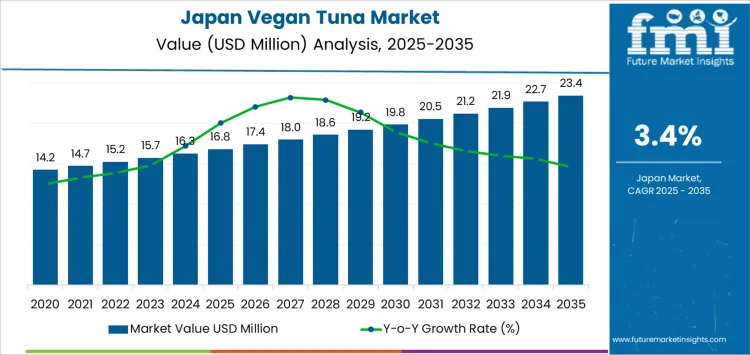
The demand for vegan tuna in Japan market was valued at USD 16.80 million in 2025, projected to reach USD 17.37 million in 2026, and is forecast to expand to USD 24.27 million by 2036 at a 3.4% CAGR. Growing awareness of marine ecosystem depletion and a steady shift toward plant-based protein consumption in Japan are accelerating vegan tuna adoption across retail and food service channels. Japanese consumers, particularly in the 25-to-45 age demographic, are integrating plant-based seafood alternatives into regular meal preparation routines, moving vegan tuna from a niche health food into a functional protein category. Procurement managers at major convenience store chains are evaluating plant-based tuna for integration into onigiri and bento product lines, categories that represent some of the highest-volume prepared food segments in Japanese retail.
Summary of Demand for Vegan Tuna in Japan Market
- Market Overview
- The market is valued at USD 16.80 million in 2025 and is projected to reach USD 24.27 million by 2036.
- The industry is expected to grow at a 3.4% CAGR from 2026 to 2036, creating an incremental opportunity of USD 6.90 million.
- The market is a texture-technology and ingredient-innovation category where consumer acceptance depends on replicating conventional seafood experience across retail and food service channels in Japan.
- Demand and Growth Drivers
- Japanese consumers are reducing conventional tuna consumption in response to published fisheries data showing declining bluefin tuna stocks, creating substitution demand that directly benefits plant-based alternatives with credible sustainability credentials.
- Advancements in protein extrusion and fiber alignment technologies are closing the sensory gap between plant-based and conventional tuna, enabling product acceptance in texture-critical applications such as onigiri filling, sashimi-style preparations, and sushi roll ingredients.
- Convenience store chains and prepared food operators in Japan are evaluating vegan tuna for integration into high-volume product lines such as bento boxes and onigiri, providing manufacturers with bulk demand anchors that justify production capacity investments and dedicated packaging line configurations.
- Among key regions, Kyushu & Okinawa at 4.2%, Kanto at 3.9%, Kinki at 3.4%, Chubu at 3.0%, Tohoku at 2.6%, Rest of Japan at 2.5%.
- Product and Segment View
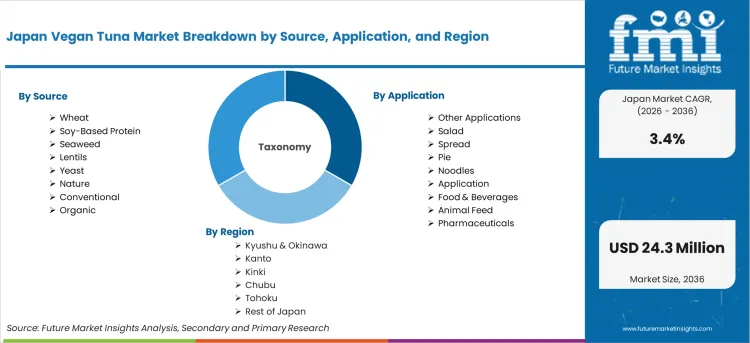
- The market includes products segmented by Source, Application, Distribution Channel, covering Wheat, Soy-Based Protein, Seaweed, Lentils, Yeast under Source and Other Applications, Salad, Spread, Pie, Noodles under Application.
- Wheat leads Source segmentation with 24.0% share in 2026.
- Other Applications leads Application segmentation with 39.0% share in 2026.
- Geography and Competitive Outlook
- Kyushu & Okinawa is the fastest-growing area at 4.2% CAGR, while Rest of Japan registers steady but lower expansion.
- Competition is shaped by product diversification, distribution reach, and pricing discipline, with key players including Good Catch Plant-Based Tuna, Sophies Kitchen Plant-Based Toona, Loma Linda TUNO, Vegan ZeaStar Tuna, Worthington Meatless Tuna.
- Analyst Opinion at FMI
- Nandini Roy Choudhury, Principal Consultant at FMI, opines: 'In my analysis, I have observed that the principal barrier to mainstream adoption of vegan tuna in Japan is not consumer willingness but texture fidelity under thermal processing conditions. Manufacturers who solve the flake structure degradation problem during heating will unlock the onigiri and bento preparation channels.'
- Strategic Implications / Executive Takeaways
- Manufacturers must prioritize texture replication R&D that preserves flake structure under thermal processing to access bento and onigiri preparation channels.
- Supply chain managers should diversify seaweed and soy protein sourcing to mitigate competition from cosmetic and supplement sector procurement.
- Brand strategists must position vegan tuna as a mainstream protein option rather than a niche health product to capture volume in conventional supermarket channels.
Demand for Vegan Tuna in Japan Market Key Takeaways
| Metric | Details |
|---|---|
| Industry Size (2026) | USD 17.37 Million |
| Industry Value (2036) | USD 24.27 Million |
| CAGR (2026-2036) | 3.4% |
Source: Future Market Insights, 2026
FMI is of the opinion that the vegan tuna category in Japan is transitioning from a niche health food to a functional protein source integrated into mainstream meal preparation. Manufacturers are investing in texture replication technologies that closely mimic the flake structure of conventional tuna, which is critical for consumer acceptance in a market where seafood texture expectations are exceptionally high. Domestic food service operators are testing plant-based tuna in onigiri, sushi, and bento applications. Raw material sourcing from wheat gluten, soy isolate, and seaweed extract supply chains in Japan remains stable, though competition for food-grade seaweed inputs is intensifying as cosmetic and supplement sectors increase procurement volumes. The Consumer Affairs Agency labeling framework for plant-based products is evolving, with clearer categorization standards expected to reduce consumer confusion and accelerate trial purchase rates.
Regional demand trajectories reflect distinct structural conditions within Japan. Kyushu & Okinawa leads with a 4.2% CAGR, followed by Kanto at 3.9%, Kinki at 3.4%, Chubu at 3.0%, Tohoku at 2.6%, Rest of Japan at 2.5%. As per FMI, these regional variations are tied to local dietary culture openness to plant-based alternatives, retail distribution density, and the pace at which food service operators integrate vegan tuna into prepared meal offerings. Kyushu and Okinawa lead adoption rates partly because of the younger consumer demographic and the island region's established tradition of seafood innovation and culinary experimentation. Kanto generates the largest absolute demand volume, anchored by Tokyo's dense retail network and early-adopter consumer base. Tohoku and Rest of Japan regions register lower growth rates as traditional seafood consumption patterns remain more deeply entrenched.
Demand for Vegan Tuna in Japan Market Definition
Vegan tuna refers to plant-based protein products formulated to replicate the taste, texture, and nutritional profile of conventional canned or pouched tuna. Manufacturing processes utilize wheat gluten, soy protein isolate, seaweed extract, lentil protein, and yeast-derived ingredients combined through extrusion, shredding, and flavor infusion techniques. These products serve as direct substitutes in salad preparation, sandwich fillings, sushi rolls, onigiri, and other traditional tuna consumption applications across retail and food service channels in Japan.
Demand for Vegan Tuna in Japan Market Inclusions
Market scope includes plant-based tuna analogues derived from wheat, soy-based protein, seaweed, lentils, and yeast sources. Distribution channel coverage spans convenience stores, supermarkets, specialty food stores, and online retail. Application categories include salad, spread, pie, noodles, and other preparation formats. Regional coverage spans all major prefectural regions within Japan with forecast projections from 2026 to 2036.
Demand for Vegan Tuna in Japan Market Exclusions
Conventional canned and pouched tuna products are excluded. Cell-cultured or lab-grown tuna, generic plant-based protein supplements not formulated as tuna alternatives, and fresh seafood products are outside the scope. General purpose soy or wheat protein products that are not specifically marketed as tuna substitutes are excluded from the valuation.
Demand for Vegan Tuna in Japan Market Research Methodology
- Primary Research: Analysts conducted structured interviews with supply chain managers, product procurement leads, and distribution network operators to map decision triggers that shape purchasing volumes and vendor selection criteria.
- Desk Research: Data collection phases aggregated regulatory filings, trade body publications, national consumption surveys, and public procurement records from government statistical agencies.
- Market-Sizing and Forecasting: Baseline values derive from a bottom-up aggregation of category-level consumption volumes, applying region-specific penetration curves and pricing benchmarks to project future demand trajectories.
- Data Validation and Update Cycle: Projections are cross-checked against publicly reported trade statistics, manufacturer shipment disclosures, and import-export databases maintained by customs authorities.
Demand for Vegan Tuna in Japan Market Drivers, Restraints, and Opportunities
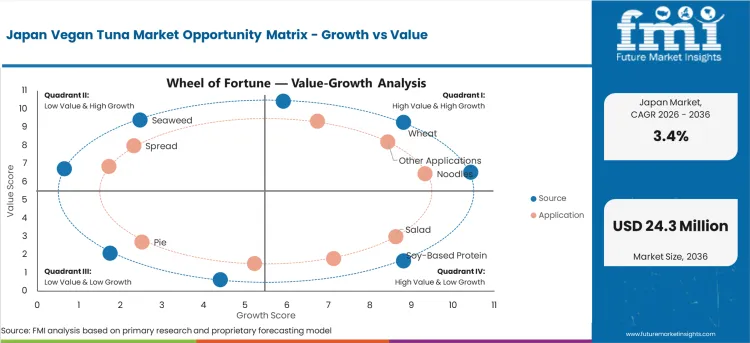
Future Market Insights analysis indicates the vegan tuna market in Japan has crossed from an early-adopter phase into an early mainstream phase, with retail distribution expanding beyond specialty health food stores into convenience store and supermarket channels. The structural drivers are twofold: sustainability-motivated consumers reducing conventional seafood consumption, and food manufacturers seeking shelf-stable protein ingredients that avoid the supply chain volatility associated with wild-catch tuna procurement. Japan's tuna consumption per capita remains among the highest globally, providing a large addressable market for plant-based substitution even at low penetration rates. The Ministry of Agriculture, Forestry and Fisheries has signaled support for domestic plant-based food production as part of broader food security diversification objectives.
The pricing dynamics of vegan tuna in Japan are stabilizing as production volumes increase and ingredient sourcing efficiencies improve. Per-unit retail pricing for plant-based tuna currently exceeds conventional canned tuna by 30% to 50%, but the gap is narrowing as manufacturers achieve economies of scale in extrusion processing and flavor formulation. FMI analysts observe that Japanese consumers demonstrate higher price tolerance for plant-based products when taste and texture expectations are met, creating a viable premium positioning strategy for brands that invest in sensory quality. The food service channel represents the largest near-term volume opportunity, as restaurant and prepared food operators can absorb ingredient cost premiums through menu pricing strategies that retail-only brands cannot replicate.
- Marine Sustainability Awareness: Japanese consumers are reducing conventional tuna consumption in response to published fisheries data showing declining bluefin tuna stocks, creating substitution demand that directly benefits plant-based alternatives with credible sustainability credentials.
- Texture Technology Maturation: Advancements in protein extrusion and fiber alignment technologies are closing the sensory gap between plant-based and conventional tuna, enabling product acceptance in texture-critical applications such as onigiri filling, sashimi-style preparations, and sushi roll ingredients.
- Food Service Channel Expansion: Convenience store chains and prepared food operators in Japan are evaluating vegan tuna for integration into high-volume product lines such as bento boxes and onigiri, providing manufacturers with bulk demand anchors that justify production capacity investments and dedicated packaging line configurations.
What Is Driving the Demand for Vegan Tuna in Japan?
The demand for vegan tuna in Japan has emerged from shifts in dietary ethics, seafood supply pressure, and changing consumer definitions of protein quality. Traditionally, tuna holds cultural and culinary importance through sushi, rice bowls, and convenience foods. Over time, overfishing concerns, seafood price instability, and food security debates created space for alternative seafood concepts.
Early demand for vegan tuna developed through specialty restaurants, plant based grocery sections, and health focused retailers in urban centers. Younger consumers and flexitarian households began to view plant based tuna not as a full replacement for seafood tradition but as a parallel option aligned with environmental and wellness priorities. Food service operators also adopted it as a way to diversify menus without supply risk tied to seasonal catch variation.
Future demand for vegan tuna in Japan will be shaped by expansion of plant based ready meals, corporate sustainability policies in food service, and export oriented development of Japanese style alternative seafood products. Convenience stores and meal kit providers will play a role in normalizing consumption beyond niche audiences. Growth will also be supported by tourist facing food outlets that seek inclusive menu formats for international dietary preferences.
Barriers include skepticism around taste authenticity, texture replication limits, and ingredient processing complexity. Supply chain scaling for plant based seafood analogs also remains capital intensive. Long term demand will depend on improvements in flavor engineering, cost parity with conventional tuna products, and broader acceptance of plant based seafood as a mainstream protein option within everyday Japanese eating habits.
What Is the Structural Breakdown of the Demand for Vegan Tuna in Japan by Source and Application?
The demand for vegan tuna in Japan is segmented by source and application. By source, usage includes wheat, soy based protein, seaweed, lentils, and yeast. By application, demand is distributed across other applications, salads, spreads, pies, and noodles. These segment divisions reflect how product texture, flavor carry, and protein yield influence formulation decisions across Japanese food manufacturing. Application demand is shaped by convenience food growth, foodservice volume stability, and retail readiness for plant based seafood analogs. Centralized procurement systems, strict allergen disclosure requirements, and consistent cold chain logistics define how source selection and application targeting are executed across Japan.
Why Does Wheat Dominate the Demand for Vegan Tuna in Japan by Source?
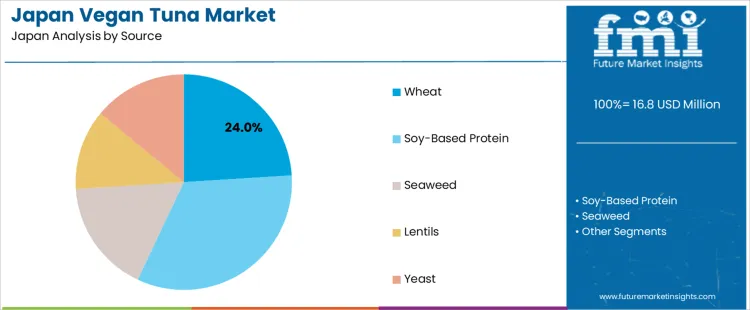
Wheat accounts for 24% of the demand for vegan tuna in Japan by source, reflecting strong alignment with domestic processed food infrastructure. Consumption intensity is driven by wheat gluten availability, neutral flavor carries, and cost stability across large scale protein texturization lines. Usage remains steady because wheat based analogs integrate easily into existing noodle, deli, and ready meal manufacturing. Procurement is contract driven through domestic milling and ingredient distributors. Price sensitivity remains moderate since texture yield and hydration performance outweigh raw input cost. Specification control centers on protein strength, allergen labeling, and moisture retention. Import dependence is limited, stability nationwide.
Wheat sourced vegan tuna contributes consistently to incremental demand in Japan due to predictable agricultural inputs and efficient domestic protein processing capacity. Repeat production runs remain high because wheat formulations perform reliably across extrusion, steaming, and retort cooking cycles. Buyers favor long term sourcing to stabilize batch hydration behavior and finished texture uniformity. Margin structure remains narrow under private label pricing discipline within convenience retail channels. Certification exposure is focused on allergen management, traceability, and food safety audits. Inventory risk remains low due to short ingredient lead times. Substitution pressure from soy and pea proteins persists, though wheat retains preference.
What Is Driving Other Applications to Lead the Demand for Vegan Tuna in Japan by Application?
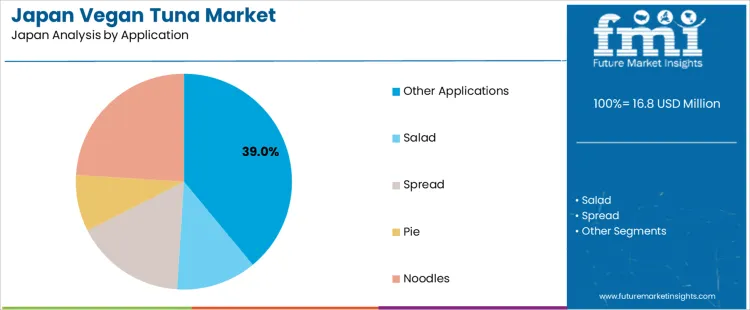
Other applications account for 39.0% of the demand for vegan tuna in Japan by application, covering ready meals, rice toppings, fillings, and institutional catering formats. Consumption intensity is driven by high volume bento production, convenience stores, airline catering, and corporate foodservice kitchens. Usage remains stable because these channels operate daily standardized menus with tight cost control. Procurement is centralized through foodservice distributors managing frozen and chilled inventory. Price sensitivity remains moderate as protein Analogs are balanced against portion cost targets. Specification control centers on flake size, water binding, and seasoning absorption. Import dependence varies by formulation but remains contracted programs.
Other applications drive recurring volume through menu rotation, seasonal promotions, and private label prepared food expansion across Japanese retailers. Repeat purchase frequency remains high because institutional customers require continuous replenishment on weekly delivery cycles. Buyers favor standardized ingredient specifications to reduce prep variability and staff training burdens. Margin structure remains tight due to competitive bidding between frozen food manufacturers. Certification exposure is shaped by school lunch standards, nursing care hygiene rules, and airline catering audits. Inventory risk is minimized through frozen logistics. Substitution pressure from plant based chicken and surimi style analogs persists, though tuna style formats retain demand nationwide.
What Is Shaping the Demand for Vegan Tuna in Japan Foodservice and Retail Protein Alternatives?
Demand for vegan tuna in Japan is shaped by seafood supply volatility, sustainability pressure, and changing urban consumption habits rather than by ideology alone. Tuna plays a central role in sushi, onigiri, and convenience meals, making its price and availability highly sensitive. Alternative products that replicate flake texture and umami profile are being tested by sushi chains, convenience stores, and prepared meal brands. Younger consumers in Tokyo, Osaka, and Yokohama show higher trial rates, driven by environmental awareness and health positioning. Demand is therefore developing as a functional seafood substitute within familiar formats.
How Is Seafood Supply Risk Influencing Acceptance of Tuna Alternatives?
Japan reliance on imported tuna and exposure to global fishing quotas, fuel costs, and geopolitical shipping risk are encouraging processors to evaluate alternative protein formats. Declining wild catch volumes and rising auction prices place pressure on mass sushi and ready-meal pricing. Vegan tuna offers cost stability and year-round supply independence when used in lower-priced menu items and private-label meals. It is being positioned as a buffering ingredient to protect margin rather than as a full seafood replacement. This supply-risk logic is a key structural driver of demand.
Why Are Convenience Stores and Foodservice Pilots Creating Early Commercial Traction?
Japan convenience store chains and quick-service restaurants play a central role in testing vegan tuna acceptance. Limited-time bento meals, rice balls, and salad toppings using tuna-style alternatives allow rapid consumer feedback without full menu conversion. Foodservice operators value the ease of cold storage, standardized portioning, and contamination control versus raw seafood. Urban office lunch demand supports these pilot volumes. This channel-led experimentation is creating real demand signals without requiring broad household adoption at an early stage.
How Do Cultural Food Expectations, Pricing, and Texture Limits Restrain Growth?
Demand for vegan tuna in Japan is restrained by deep cultural expectations around freshness, mouthfeel, and marine flavor authenticity. Many consumers judge tuna primarily on texture fiber and natural fat release, which plant-based versions still struggle to replicate fully. Pricing remains higher than entry-grade real tuna used in mass retail. In addition, ingredient labeling scrutiny and allergen management complicate foodservice rollout. These factors slow mainstream conversion and confine near-term demand to experimental menu formats and selected retail categories.
What is the Demand for Vegan Tuna in Japan by Region?
.webp "Top Country Growth Comparison Japan Vegan Tuna Market Cagr (2026 2036)")
| Region | CAGR (%) |
|---|---|
| Kyushu & Okinawa | 4.2% |
| Kanto | 3.9% |
| Kinki | 3.4% |
| Chubu | 3.0% |
| Tohoku | 2.6% |
| Rest of Japan | 2.5% |
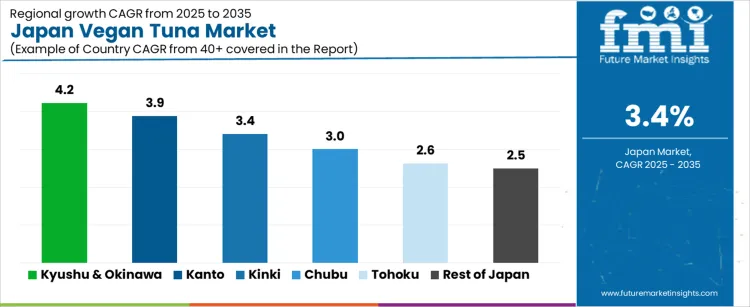
The demand for vegan tuna in Japan is rising steadily across regions, with Kyushu and Okinawa leading at a 4.2% CAGR. Growth in this region is supported by strong tourism driven foodservice demand, adoption by hotel and restaurant operators, and rising interest in plant based seafood alternatives. Kanto follows at 3.9%, driven by dense urban retail networks, rapid product innovation in convenience foods, and higher exposure to global food trends.
Kinki records 3.4% growth, reflecting stable demand from ready meal producers and specialty food retailers. Chubu at 3.0% shows moderate uptake linked to regional food manufacturing and private label expansion. Tohoku and the Rest of Japan, at 2.6% and 2.5%, reflect slower growth shaped by traditional seafood consumption preferences, lower penetration of alternative proteins, and limited shelf space allocation in local retail formats.
How Is Coastal Food Innovation in Kyushu and Okinawa Shaping Vegan Tuna Demand?
Demand for vegan tuna in Kyushu and Okinawa is advancing at a CAGR of 4.2% through 2036, supported by strong tourism activity, rising flexitarian diets, and seafood alternative adoption across resort foodservice and urban retail. Fukuoka and Okinawa restaurant clusters are expanding plant based menu options targeting international visitors and younger consumers. Unlike Tohoku, growth here is shaped by hospitality driven food experimentation rather than household retail alone. Vegan tuna is gaining placement in sushi alternatives, salad toppings, and ready meals supplied through hotels and specialty dining brands.
- Tourism driven foodservice anchors primary demand
- Sushi alternatives support menu level adoption
- Urban health retail strengthens packaged product sales
- Resort supply chains influence procurement volumes
What Is Driving Vegan Tuna Consumption Across Retail and Convenience Channels in Kanto?
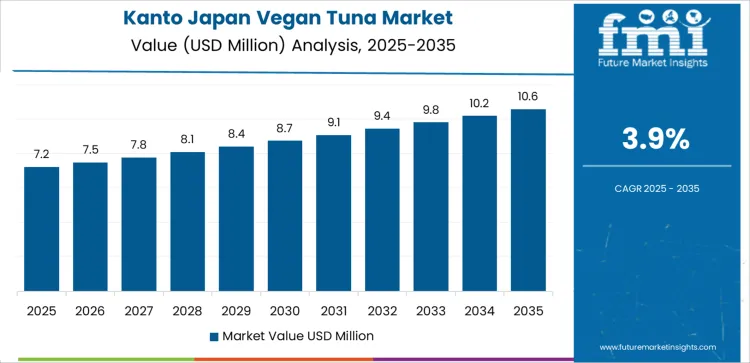
Demand for vegan tuna in Kanto is expanding at a CAGR of 3.9% through 2036, led by dense supermarket networks, convenience food expansion, and rising plant based ready meal penetration across Tokyo and surrounding prefectures. This region differs from Kyushu and Okinawa through stronger influence of mass retail rather than hospitality led consumption. Vegan tuna is increasingly used in onigiri fillings, sandwich spreads, sushi trays, and chilled deli items positioned for office workers. Large food processors and private label brands dominate packaging and distribution across metro retail corridors.
- Supermarket private labels drive recurring product turnover
- Convenience meals support high frequency consumption
- Office lunch formats expand daily demand exposure
- National processors control bulk production volumes
Why Is Regional Manufacturing Supporting Moderate Vegan Tuna Growth in Kinki?
Vegan tuna demand in Kinki is advancing at a CAGR of 3.4% through 2036, supported by regional food brands, soy processing facilities, and plant based seafood innovation in Osaka and Kyoto. Kinki contrasts with Kanto through greater reliance on local brand portfolios rather than national retail consolidation. Vegan tuna is used in bento meals, frozen entrees, pasta sauces, and mixed protein Alternatives supplied to school catering and workplace cafeterias. Growth remains tied to steady institutional food demand rather than rapid consumer driven trial cycles.
- Regional brands sustain steady product demand
- Bento and cafeteria meals support institutional uptake
- Frozen food formats stabilize volume movement
- Local soy processors shape supply availability
How Is Manufacturing and Retail Balance Influencing Vegan Tuna Adoption in Chubu?
Demand for vegan tuna in Chubu is progressing at a CAGR of 3.0% through 2036, supported by balanced growth in food processing, automotive workforce catering, and suburban retail penetration around Nagoya. Unlike Kinki, this region shows stronger ties between industrial employment centers and plant based food demand. Vegan tuna is increasingly supplied into factory canteens, frozen meal kits, supermarket deli counters, and protein blended products for health oriented consumers. Procurement remains volume driven with emphasis on cost control and portion standardization.
- Factory catering drives recurring meal inclusion
- Frozen meal kits support controlled portion demand
- Suburban retail supports gradual household adoption
- Cost focused sourcing guides supplier selection
What Is Sustaining Gradual Vegan Tuna Uptake in Tohoku Household Food Markets?
Vegan tuna demand in Tohoku is increasing at a CAGR of 2.6% through 2036, supported by gradual shift toward plant based diets, public health food programs, and limited foodservice experimentation. This region differs from Kanto and Kyushu and Okinawa through lower restaurant density and slower premium food adoption. Vegan tuna is mainly used in home cooking kits, shelf stable canned alternatives, school lunch supplements, and community meal services. Budget sensitivity and limited product diversity continue to restrain faster consumption expansion.
- Household cooking drives primary product usage
- School meal programs support basic demand base
- Shelf stable formats suit rural distribution needs
- Budget sensitivity limits rapid premium product uptake
How Do Low Density Foodservice Networks Shape Vegan Tuna Demand in the Rest of Japan?
Demand for vegan tuna in the Rest of Japan is advancing at a CAGR of 2.5% through 2036, shaped by small town foodservice operators, institutional catering, and limited specialty retail. This region contrasts with Kanto and Chubu through slower product rotation and minimal exposure to trend led food innovation. Vegan tuna is primarily used in hospital meals, corporate lunches, community cafeterias, and value ready meal packs. Procurement patterns remain conservative and closely linked to distributor led menu standardization and annual supply contracts.
- Institutional catering anchors baseline demand
- Hospital and corporate meals support steady usage
- Limited specialty retail restricts trial driven growth
- Distributor contracts determine product availability
Competitive Aligners for Market Players
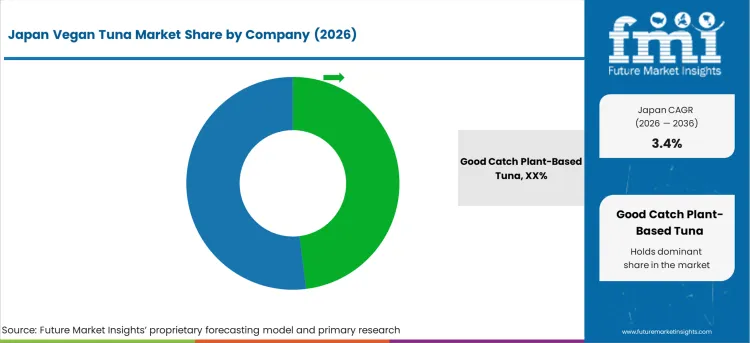
The competitive structure of the vegan tuna market in Japan remains fragmented, with no single player holding more than 15% of organized retail value. Good Catch Plant-Based Tuna, Sophies Kitchen Plant-Based Toona, Loma Linda TUNO, Vegan ZeaStar Tuna, and Worthington Meatless Tuna compete for shelf space through differentiated ingredient platforms and texture positioning strategies. Competitive differentiation centers on taste fidelity, texture under thermal processing, ingredient transparency, and the ability to secure placement in convenience store prepared food supply chains.
First-mover advantage in securing food service contracts provides a structural competitive moat for brands that can demonstrate consistent supply volumes and acceptable thermal processing performance. Companies with in-house extrusion and flavor development capabilities achieve faster product iteration cycles compared to brands relying on contract manufacturing. Buyer leverage is distributed between major convenience store procurement groups, supermarket category managers, and food service distributors who collectively gate access to the highest-traffic consumption channels.
Entry barriers include the technical complexity of achieving acceptable texture fidelity, the capital investment required for dedicated extrusion and flavoring production lines, and the regulatory compliance costs associated with novel food ingredient registration in Japan. Domestic Japanese startups are entering the category with locally sourced ingredient platforms that leverage proximity to seaweed and soy supply chains.
Key Players in Demand for Vegan Tuna in Japan Market
- Good Catch Plant-Based Tuna
- Sophies Kitchen Plant-Based Toona
- Loma Linda TUNO
- Vegan ZeaStar Tuna
- Worthington Meatless Tuna
Scope of the Report
| Metric | Value |
|---|---|
| Quantitative Units | USD 17.37 Million to USD 24.27 Million, at a CAGR of 3.4% |
| Market Definition | Vegan tuna refers to plant-based protein products formulated to replicate the taste, texture, and nutritional profile of conventional canned or pouched tuna. Manufacturing processes utilize wheat gluten, soy protein isolate, seaweed extract, lentil protein, and yeast-derived ingredients combined through extrusion, shredding, and flavor infusion techniques. |
| Source Segmentation | Wheat, Soy-Based Protein, Seaweed, Lentils, Yeast |
| Application Segmentation | Other Applications, Salad, Spread, Pie, Noodles |
| Distribution Channel Segmentation | Convenience Stores, Supermarkets, Specialty Food Stores, Online Retail |
| Regions Covered | Kyushu & Okinawa, Kanto, Kansai/Kinki, Chubu, Tohoku, and Rest of Japan |
| Key Companies Profiled | Good Catch Plant-Based Tuna, Sophies Kitchen Plant-Based Toona, Loma Linda TUNO, Vegan ZeaStar Tuna, Worthington Meatless Tuna |
| Forecast Period | 2026 to 2036 |
| Approach | Bottom-up methodology starting with category-level consumption data and applying regional penetration assumptions. |
Demand for Vegan Tuna in Japan Market Analysis by Segments
By Source:
Wheat, Soy-Based Protein, Seaweed, Lentils, Yeast
By Application:
Other Applications, Salad, Spread, Pie, Noodles
By Distribution Channel:
Convenience Stores, Supermarkets, Specialty Food Stores, Online Retail
By Region:
Kyushu & Okinawa, Kanto, Kansai/Kinki, Chubu, Tohoku, and Rest of Japan
Bibliography
- 1. Ministry of Agriculture, Forestry and Fisheries Japan. (2024). Plant-Based Food Market Survey and Consumption Statistics. MAFF.
- 2. Food and Agriculture Organization of the United Nations. (2024). The State of World Fisheries and Aquaculture. FAO.
- 3. Consumer Affairs Agency Japan. (2024). Food Labeling Standards for Plant-Based Products. CAA.
- 4. Good Food Institute. (2024). Plant-Based Seafood Market Intelligence Report. GFI.
- 5. Japan Plant-Based Foods Association. (2024). Industry Survey on Plant-Based Product Distribution. JPBFA.
This bibliography is provided for reader reference. The full Future Market Insights report contains the complete reference list with primary research documentation.
Frequently Asked Questions
How large is the Demand for Vegan Tuna in Japan Market in 2026?
The Demand for Vegan Tuna in Japan market is estimated to be valued at USD 17.37 million in 2026.
What will be the market size of Demand for Vegan Tuna in Japan by 2036?
The Demand for Vegan Tuna in Japan market is projected to reach USD 24.27 million by 2036.
What is the expected CAGR for Demand for Vegan Tuna in Japan between 2026 and 2036?
The Demand for Vegan Tuna in Japan market is expected to grow at a CAGR of 3.4% between 2026 and 2036.
Which Source is poised to lead in 2026?
Wheat accounts for 24.0% share in 2026, maintaining its position as the leading source segment.
Which region is projected to grow the fastest?
Kyushu & Okinawa is projected to grow at a CAGR of 4.2% during 2026 to 2036, the fastest among all covered regions.
What does Demand for Vegan Tuna in Japan mean in this report?
Vegan tuna refers to plant-based protein products formulated to replicate the taste, texture, and nutritional profile of conventional canned or pouched tuna. Manufacturing processes utilize wheat gluten, soy protein isolate, seaweed extract, lentil protein, and yeast-derived ingredients combined through extrusion, shredding, and flavor infusion techniques.
What is included in the scope of this report?
Market scope includes plant-based tuna analogues derived from wheat, soy-based protein, seaweed, lentils, and yeast sources. Distribution channel coverage spans convenience stores, supermarkets, specialty food stores, and online retail.
How does FMI build and validate the Demand for Vegan Tuna in Japan forecast?
Forecasting models apply a bottom-up methodology starting with category-level consumption data and cross-validate projections against trade statistics, manufacturer shipment disclosures, and regulatory filings.
Preview the report firsthand - request a free sample
Get SampleGet the brochure for pricing and purchase details.
Get PDFTable of Content
- Executive Summary
- Japan Market Outlook
- Demand-side Trends
- Supply-side Trends
- Technology Roadmap Analysis
- Analysis and Recommendations
- Market Overview
- Market Coverage / Taxonomy
- Market Definition / Scope / Limitations
- Research Methodology
- Chapter Orientation
- Analytical Lens and Working Hypotheses
- Market Structure, Signals, and Trend Drivers
- Benchmarking and Cross-market Comparability
- Market Sizing, Forecasting, and Opportunity Mapping
- Research Design and Evidence Framework
- Desk Research Programme (Secondary Evidence)
- Company Annual and Sustainability Reports
- Peer-reviewed Journals and Academic Literature
- Corporate Websites, Product Literature, and Technical Notes
- Earnings Decks and Investor Briefings
- Statutory Filings and Regulatory Disclosures
- Technical White Papers and Standards Notes
- Trade Journals, Industry Magazines, and Analyst Briefs
- Conference Proceedings, Webinars, and Seminar Materials
- Government Statistics Portals and Public Data Releases
- Press Releases and Reputable Media Coverage
- Specialist Newsletters and Curated Briefings
- Sector Databases and Reference Repositories
- FMI Internal Proprietary Databases and Historical Market Datasets
- Subscription Datasets and Paid Sources
- Social Channels, Communities, and Digital Listening Inputs
- Additional Desk Sources
- Expert Input and Fieldwork (Primary Evidence)
- Primary Modes
- Qualitative Interviews and Expert Elicitation
- Quantitative Surveys and Structured Data Capture
- Blended Approach
- Why Primary Evidence is Used
- Field Techniques
- Interviews
- Surveys
- Focus Groups
- Observational and In-context Research
- Social and Community Interactions
- Stakeholder Universe Engaged
- C-suite Leaders
- Board Members
- Presidents and Vice Presidents
- R&D and Innovation Heads
- Technical Specialists
- Domain Subject-matter Experts
- Scientists
- Physicians and Other Healthcare Professionals
- Governance, Ethics, and Data Stewardship
- Research Ethics
- Data Integrity and Handling
- Primary Modes
- Tooling, Models, and Reference Databases
- Desk Research Programme (Secondary Evidence)
- Data Engineering and Model Build
- Data Acquisition and Ingestion
- Cleaning, Normalisation, and Verification
- Synthesis, Triangulation, and Analysis
- Quality Assurance and Audit Trail
- Market Background
- Market Dynamics
- Drivers
- Restraints
- Opportunity
- Trends
- Scenario Forecast
- Demand in Optimistic Scenario
- Demand in Likely Scenario
- Demand in Conservative Scenario
- Opportunity Map Analysis
- Product Life Cycle Analysis
- Supply Chain Analysis
- Investment Feasibility Matrix
- Value Chain Analysis
- PESTLE and Porter’s Analysis
- Regulatory Landscape
- Regional Parent Market Outlook
- Production and Consumption Statistics
- Import and Export Statistics
- Market Dynamics
- Japan Market Analysis 2021 to 2025 and Forecast, 2026 to 2036
- Historical Market Size Value (USD Million) Analysis, 2021 to 2025
- Current and Future Market Size Value (USD Million) Projections, 2026 to 2036
- Y-o-Y Growth Trend Analysis
- Absolute $ Opportunity Analysis
- Japan Market Pricing Analysis 2021 to 2025 and Forecast 2026 to 2036
- Japan Market Analysis 2021 to 2025 and Forecast 2026 to 2036, By Source
- Introduction / Key Findings
- Historical Market Size Value (USD Million) Analysis By Source , 2021 to 2025
- Current and Future Market Size Value (USD Million) Analysis and Forecast By Source , 2026 to 2036
- Wheat
- Soy-Based Protein
- Seaweed
- Lentils
- Yeast
- Wheat
- Y-o-Y Growth Trend Analysis By Source , 2021 to 2025
- Absolute $ Opportunity Analysis By Source , 2026 to 2036
- Japan Market Analysis 2021 to 2025 and Forecast 2026 to 2036, By Application
- Introduction / Key Findings
- Historical Market Size Value (USD Million) Analysis By Application, 2021 to 2025
- Current and Future Market Size Value (USD Million) Analysis and Forecast By Application, 2026 to 2036
- Other Applications
- Salad
- Spread
- Pie
- Noodles
- Other Applications
- Y-o-Y Growth Trend Analysis By Application, 2021 to 2025
- Absolute $ Opportunity Analysis By Application, 2026 to 2036
- Japan Market Analysis 2021 to 2025 and Forecast 2026 to 2036, By Distribution Channel
- Introduction / Key Findings
- Historical Market Size Value (USD Million) Analysis By Distribution Channel, 2021 to 2025
- Current and Future Market Size Value (USD Million) Analysis and Forecast By Distribution Channel, 2026 to 2036
- Convenience Stores
- Supermarkets
- Specialty Food Stores
- Online Retail
- Convenience Stores
- Y-o-Y Growth Trend Analysis By Distribution Channel, 2021 to 2025
- Absolute $ Opportunity Analysis By Distribution Channel, 2026 to 2036
- Japan Market Analysis 2021 to 2025 and Forecast 2026 to 2036, By Region
- Introduction
- Historical Market Size Value (USD Million) Analysis By Region, 2021 to 2025
- Current Market Size Value (USD Million) Analysis and Forecast By Region, 2026 to 2036
- Kyushu & Okinawa
- Kanto
- Kinki
- Chubu
- Tohoku
- Rest of Japan
- Market Attractiveness Analysis By Region
- Kyushu & Okinawa Market Analysis 2021 to 2025 and Forecast 2026 to 2036, By Country
- Historical Market Size Value (USD Million) Trend Analysis By Market Taxonomy, 2021 to 2025
- Market Size Value (USD Million) Forecast By Market Taxonomy, 2026 to 2036
- By Country
- By Source
- By Application
- By Distribution Channel
- By Country
- Market Attractiveness Analysis
- By Country
- By Source
- By Application
- By Distribution Channel
- Key Takeaways
- Kanto Market Analysis 2021 to 2025 and Forecast 2026 to 2036, By Country
- Historical Market Size Value (USD Million) Trend Analysis By Market Taxonomy, 2021 to 2025
- Market Size Value (USD Million) Forecast By Market Taxonomy, 2026 to 2036
- By Country
- By Source
- By Application
- By Distribution Channel
- By Country
- Market Attractiveness Analysis
- By Country
- By Source
- By Application
- By Distribution Channel
- Key Takeaways
- Kinki Market Analysis 2021 to 2025 and Forecast 2026 to 2036, By Country
- Historical Market Size Value (USD Million) Trend Analysis By Market Taxonomy, 2021 to 2025
- Market Size Value (USD Million) Forecast By Market Taxonomy, 2026 to 2036
- By Country
- By Source
- By Application
- By Distribution Channel
- By Country
- Market Attractiveness Analysis
- By Country
- By Source
- By Application
- By Distribution Channel
- Key Takeaways
- Chubu Market Analysis 2021 to 2025 and Forecast 2026 to 2036, By Country
- Historical Market Size Value (USD Million) Trend Analysis By Market Taxonomy, 2021 to 2025
- Market Size Value (USD Million) Forecast By Market Taxonomy, 2026 to 2036
- By Country
- By Source
- By Application
- By Distribution Channel
- By Country
- Market Attractiveness Analysis
- By Country
- By Source
- By Application
- By Distribution Channel
- Key Takeaways
- Tohoku Market Analysis 2021 to 2025 and Forecast 2026 to 2036, By Country
- Historical Market Size Value (USD Million) Trend Analysis By Market Taxonomy, 2021 to 2025
- Market Size Value (USD Million) Forecast By Market Taxonomy, 2026 to 2036
- By Country
- By Source
- By Application
- By Distribution Channel
- By Country
- Market Attractiveness Analysis
- By Country
- By Source
- By Application
- By Distribution Channel
- Key Takeaways
- Rest of Japan Market Analysis 2021 to 2025 and Forecast 2026 to 2036, By Country
- Historical Market Size Value (USD Million) Trend Analysis By Market Taxonomy, 2021 to 2025
- Market Size Value (USD Million) Forecast By Market Taxonomy, 2026 to 2036
- By Country
- By Source
- By Application
- By Distribution Channel
- By Country
- Market Attractiveness Analysis
- By Country
- By Source
- By Application
- By Distribution Channel
- Key Takeaways
- Key Countries Market Analysis
- Kyushu & Okinawa
- Pricing Analysis
- Market Share Analysis, 2025
- By Source
- By Application
- By Distribution Channel
- Kanto
- Pricing Analysis
- Market Share Analysis, 2025
- By Source
- By Application
- By Distribution Channel
- Kinki
- Pricing Analysis
- Market Share Analysis, 2025
- By Source
- By Application
- By Distribution Channel
- Chubu
- Pricing Analysis
- Market Share Analysis, 2025
- By Source
- By Application
- By Distribution Channel
- Tohoku
- Pricing Analysis
- Market Share Analysis, 2025
- By Source
- By Application
- By Distribution Channel
- Rest of Japan
- Pricing Analysis
- Market Share Analysis, 2025
- By Source
- By Application
- By Distribution Channel
- Kyushu & Okinawa
- Market Structure Analysis
- Competition Dashboard
- Competition Benchmarking
- Market Share Analysis of Top Players
- By Regional
- By Source
- By Application
- By Distribution Channel
- Competition Analysis
- Competition Deep Dive
- Good Catch Plant-Based Tuna
- Overview
- Product Portfolio
- Profitability by Market Segments (Product/Age /Sales Channel/Region)
- Sales Footprint
- Strategy Overview
- Marketing Strategy
- Product Strategy
- Channel Strategy
- Sophies Kitchen Plant-Based Toona
- Loma Linda TUNO
- Vegan ZeaStar Tuna
- Worthington Meatless Tuna
- Good Catch Plant-Based Tuna
- Competition Deep Dive
- Assumptions & Acronyms Used


