

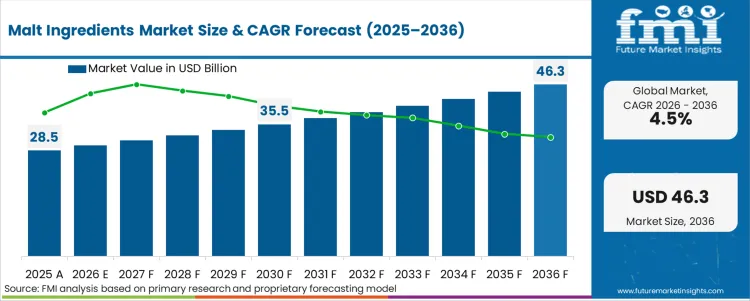
In 2025, the malt ingredients market crossed a valuation of USD 28.5 billion. Based on Future Market Insights’ analysis, demand for malt ingredients is estimated to grow to USD 29.8 billion in 2026 and USD 52.5 billion by 2036. FMI projects a CAGR of 4.5% during the forecast period.
Processing facilities face rising energy costs during kilning and germination phases. Upgrading legacy maltings equipment requires substantial capital expenditure. Buyers prioritize suppliers offering verified carbon reductions to meet downstream corporate emission targets. FMI analysts opine that integrating low-carbon agricultural practices directly offsets baseline energy premiums, transforming sustainability from a compliance burden into a competitive pricing mechanism.
United Malt Managing Director and CEO, Mark Palmquist, said: “The strategic rationale for establishing United Malt as a stand-alone malt company included enabling the company to pursue a separate growth agenda and potentially participate in industry consolidation opportunities.” [10] Such operational pressures and strategic shifts highlight how market participants are recalibrating both infrastructure and growth agendas to remain competitive in an increasingly sustainability‑driven malt ecosystem.
Growth tracks varied paths across primary consumption hubs. Expansion in USA reaches 5.7% CAGR, alongside India advancing at 5.3% CAGR and China posting 4.1% CAGR. Germany registers 3.0% CAGR, Japan follows with 2.6% CAGR, and UK marks 2.3% CAGR. Rapid urbanization in emerging economies fuels industrial brewing capacity investments, pulling forward demand for standardized malt extract.
Ingredients derived from controlled germination and kilning of cereal grains represent foundational inputs for diverse processing industries. Production involves steeping raw grains to activate natural enzymes before halting growth through thermal treatment. Final profiles vary based on heating intensity and duration. End-users deploy these components primarily for starch conversion, flavor enhancement, and color modification in food systems.
Analysis captures commercial sales of processed grain derivatives across all standardized formats. Liquid extracts and dry powders fall within scope alongside raw malts. Valuation models track consumption by commercial breweries, distilleries, bakeries, and packaged food manufacturers. Primary focus rests on industrial-scale procurement contracts rather than retail-level distribution channels.
Raw unprocessed cereal grains traded purely as agricultural commodities remain outside valuation models. Post-production consumer goods containing malted components fall beyond scope. Spent grains sold into animal feed markets do not contribute to primary revenue calculations. Laboratory-scale experimental batches lack sufficient commercial volume for inclusion.
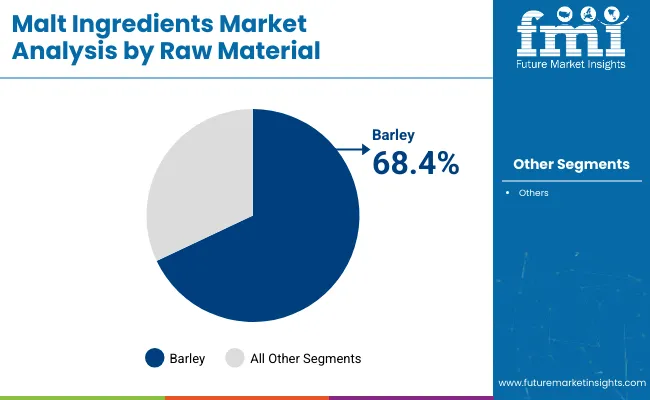
Barley secures a dominant 68.4% share among raw inputs owing to optimal enzymatic properties required for starch conversion. Processing facilities favor cultivated varieties bred explicitly for germination efficiency and high extract yields. As per FMI's projection, procurement strategies increasingly prioritize direct-to-farm contracting models to guarantee consistent quality parameters amid changing climate conditions. Reliance on dedicated supply networks shields processors from extreme commodity market fluctuations.
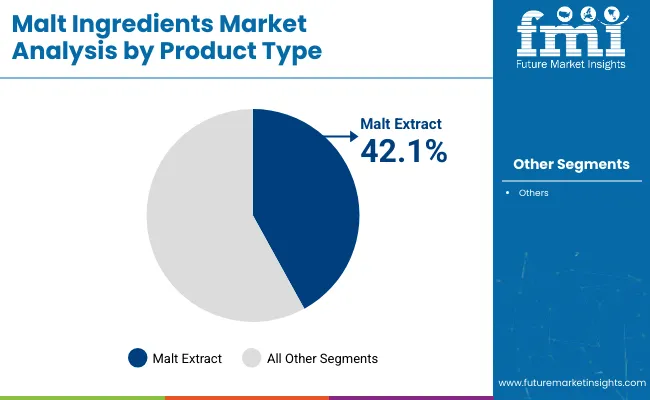
Malt extract accounts for 42.1% of segment valuation due to broad applicability across non-alcoholic beverage and food manufacturing. Concentrated formats offer extended shelf life and simplified storage compared to bulk grains. According to FMI's estimates, industrial bakeries rapidly adopt liquid variants to enhance dough fermentation consistency without altering dry ingredient ratios. Formulation flexibility positions concentrated derivatives as high-growth targets within diverse culinary applications.
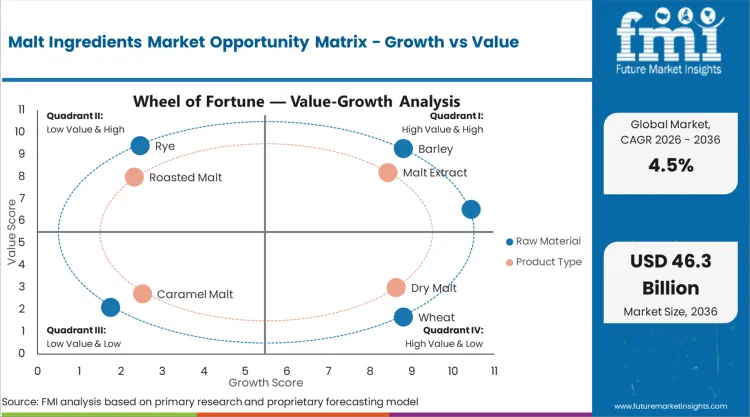
Clean-label consumer preferences compel manufacturers to replace synthetic colorants and artificial sweeteners with natural grain derivatives. Formulators increasingly utilize specialty malt extracts to achieve complex flavor profiles and maintain simplified ingredient declarations. Transitioning away from high-fructose syrups expands addressable applications across baked goods and healthy snacks. As per FMI's projection, corporate commitments to ingredient transparency propel continuous volume expansion across premium food categories. Demand for authentic sensory experiences directly translates into higher inclusion rates per formulation.
Weather-induced agricultural volatility constrains margin predictability for processors reliant on specific grain qualities. Drought conditions frequently diminish kernel plumpness, directly reducing final extract yields per metric ton processed. Buyers face sudden pricing surges when regional harvests fail to meet minimum malting specifications. According to FMI's estimates, mitigating supply risks requires maintaining costly geographic redundancy across multiple grain-producing continents.
Based on the regional analysis, the Malt Ingredients market is segmented into North America, Latin America, Europe, East Asia, South Asia, Oceania and Middle East & Africa across 40+ countries. The full report also offers market attractiveness analysis based on regional trends.
.webp "Top Country Growth Comparison Malt Ingredients Market Cagr (2026 2036)")
| Country | CAGR (2026 to 2036) |
|---|---|
| USA | 5.7% |
| India | 5.3% |
| China | 4.1% |
| Germany | 3.0% |
| Japan | 2.6% |
| UK | 2.3% |
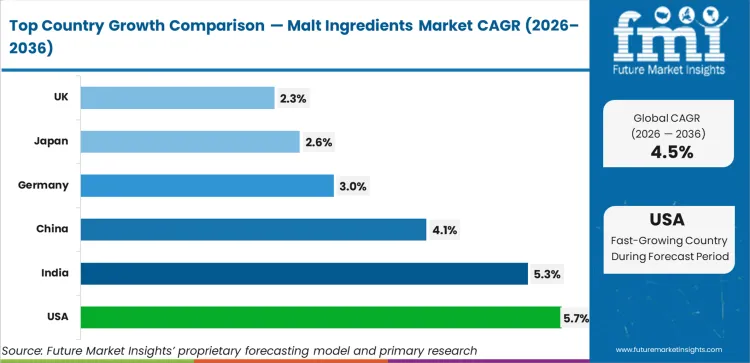
Source: Future Market Insights (FMI) analysis, based on proprietary forecasting model and primary research
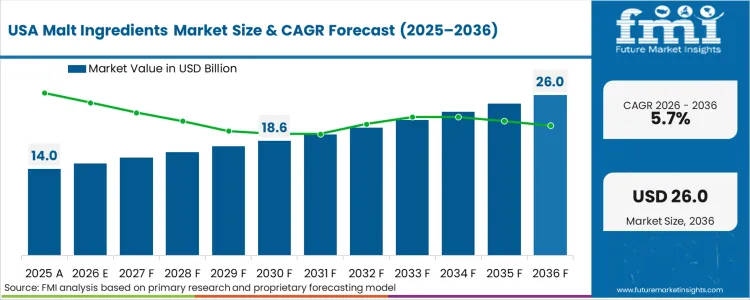
North American consumption reflects strong demand for diverse beverage applications and premium malted milk formulations. Industrial bakeries scale operations, requiring consistent liquid extracts to maintain production efficiency. FMI analysts opine that integrated processing facilities dominate regional supply, leaning on advanced logistics networks to distribute finished products efficiently. Corporate consolidation enhances vendor ability to service multinational accounts through unified procurement interfaces.
FMI's report includes extensive details on North American performance. Canada and Mexico represent logical expansion targets for vendors seeking cross-border integration. Cross-border trade in wheat malt supports regional brewing diversity.
South Asia emerges as a high-velocity growth center propelled by urbanization and rising disposable incomes. Expanding organized retail networks push adoption of packaged convenience foods requiring stable enzymatic inputs. Domestic agricultural output struggles to meet specific quality parameters, forcing reliance on global trade networks to satisfy industrial demand. FMI analysts opine that establishing localized processing capacity presents distinct first-mover advantages for multinational suppliers willing to navigate regional logistics.
FMI's report includes deep analysis of South Asian dynamics. Bangladesh and Sri Lanka offer emerging opportunities for entry-level malt extract products. Suppliers targeting these nations must prioritize moisture-resistant packaging to withstand humid supply chains.
East Asian markets balance industrial processing volumes with shifting consumer preferences toward premium categories. Domestic brewing giants require immense quantities of standardized inputs to sustain global export operations. High agricultural dependency forces regional buyers to secure long-term international supply agreements to guarantee factory uptime. As per FMI's projection, import regulations heavily influence trade flows, creating advantages for suppliers maintaining impeccable traceability documentation.
FMI's report includes thorough evaluation of East Asian commercial landscapes. South Korea and Taiwan present lucrative targets for specialized roasted malt profiles. Advanced logistics infrastructure in these nations allows rapid integration of delicate high-value imports.
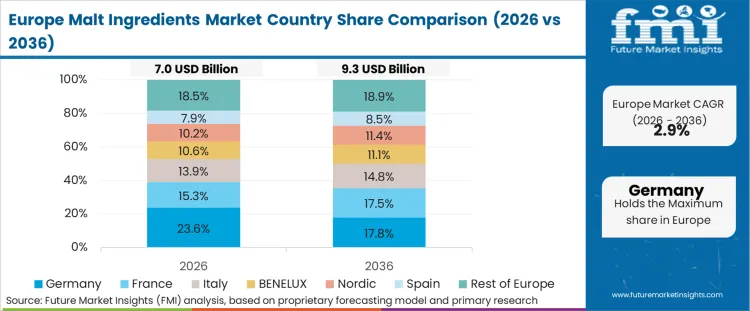
European facilities operate within strict regulatory frameworks prioritizing agricultural sustainability and reduced carbon footprints. Legacy brewing traditions dictate rigid quality specifications, limiting adoption of cheaper alternative grains. Processors invest heavily in energy-efficient kilning technologies to offset rising regional utility costs and comply with environmental mandates. According to FMI's estimates, premiumization remains the primary value driver as volume expansion stagnates across mature consumer demographics.
FMI's report includes detailed European market metrics. France and Belgium remain critical production hubs for specialized caramel malt varieties. Regional suppliers focus on farm-level carbon verification to satisfy strict EU corporate reporting requirements.
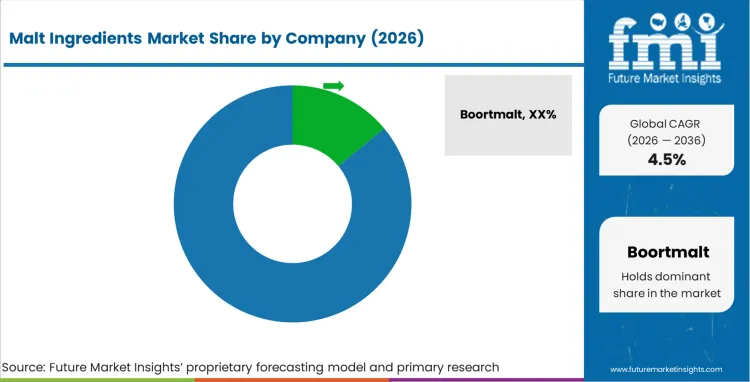
Corporate restructuring dramatically alters competitive dynamics across major supply networks. Merging distinct operational units allows singular entities to control broader spectrums of product delivery, from raw grain sourcing to specialized ingredient distribution. Rahr Corporation CEO Willie Rahr noted, 'Our newly combined business unit, RahrBSG, presents us with an excellent opportunity to recognize operational synergies.' [1] Such consolidation pressures independent operators lacking equivalent geographic reach.
Processors actively deploy proprietary innovations to capture market share among environmentally conscious buyers. Launching ingredients with verified carbon reductions allows suppliers to command premium price points and aid downstream partners in hitting sustainability metrics. First-mover advantage in verified sustainable inputs establishes high barriers to entry for slower competitors.
Capital investments in capacity expansion remain vital for servicing expanding regional hubs. Expanding production footprints near agricultural zones minimizes transport-related emissions and lowers raw material logistics costs. Localized processing hubs provide a distinct agility advantage over competitors relying on long-distance import models.
Recent Developments:
The report includes full coverage of key trends from competitive benchmarking. Some of the recent developments covered in the reports:
| Metric | Value |
|---|---|
| Quantitative Units | USD 29.8 billion (2026) to USD 52.5 billion (2036), at a CAGR of 4.5% |
| Market Definition | Market comprises global production and commercial trade of germinated grain derivatives used primarily for enzymatic conversion and flavor enhancement in industrial food and beverage applications. |
| Raw Material Segmentation | Barley, Wheat, Rye, Oats, Specialty Grains |
| Product Type Segmentation | Malt Extract, Dry Malt, Roasted Malt, Caramel Malt |
| Application Coverage | Brewing, Distilling, Food and Beverages, Pharmaceuticals |
| Regions Covered | North America, Latin America, Europe, East Asia, South Asia, Oceania, Middle East & Africa |
| Countries Covered | USA, India, China, Germany, Japan, UK and 40+ countries |
| Key Companies Profiled | Boortmalt, Rahr Corporation, Muntons plc, Simpsons Malt, Viking Malt |
| Forecast Period | 2026 to 2036 |
| Approach | Hybrid top-down and bottom-up market modeling validated through primary interviews and agricultural data benchmarking. |
This bibliography is provided for reader reference and is not exhaustive. The full report contains the complete reference list and detailed citations.
How large is the demand for Malt Ingredients in the global market in 2026?
Demand for Malt Ingredients in the global market is estimated to be valued at USD 29.8 billion in 2026.
What will be the market size of Malt Ingredients in the global market by 2036?
Market size for Malt Ingredients is projected to reach USD 52.5 billion by 2036.
What is the expected demand growth for Malt Ingredients in the global market between 2026 and 2036?
Demand for Malt Ingredients in the global market is expected to grow at a CAGR of 4.5% between 2026 and 2036.
Which Raw Material is poised to lead global sales by 2026?
Barley is expected to be the dominant raw material, capturing approximately 68.4% of global market share in 2026 due to optimal enzymatic conversion properties.
How significant is the role of Malt Extract in driving Malt Ingredients adoption in 2026?
Malt Extract represents a critical segment, projected to hold a substantial 42.1% share of total volume in 2026 as formulators prioritize versatile liquid concentrates.
What is driving demand in USA?
Expansion of premium nutritional beverages and fortified baked goods is pushing higher volumes.
What compliance standards or regulations are referenced for USA?
Corporate carbon emission targets and clean-label agricultural traceability mandates serve as primary compliance benchmarks.
What is the USA growth outlook in this report?
USA is projected to grow at a CAGR of 5.7% during 2026 to 2036.
Why is South Asia described as a priority region in this report?
Growth accelerates through rapid urbanization and surging consumption of packaged convenience foods requiring stable enzymatic inputs.
What type of demand dominates in South Asia?
Adoption of standardized malt extracts for nutritional supplements and industrial bakery applications dominates regional consumption.
What is India growth outlook in this report?
India is projected to expand at a CAGR of 5.3% during 2026 to 2036.
Does the report cover China in its regional analysis?
China is included within East Asia under the regional scope of analysis.
What are the sources referred to for analyzing China?
Official customs import statistics tracking massive inbound barley shipments are cited as primary reference sources.
What is the main demand theme linked to China in its region coverage?
High reliance on bulk external sourcing to sustain immense domestic industrial processing capacities.
Does the report cover Germany in its regional analysis?
Germany is included within Europe under the regional coverage framework.
What is the main Germany related demand theme in its region coverage?
Strict adherence to traditional brewing standards requiring premium domestic agricultural inputs.
Which product formats or configurations are strategically important for North America supply chains?
Concentrated liquid extracts are prioritized due to seamless integration into automated food processing lines.
What is Malt Ingredients and what is it mainly used for?
Germinated grain derivatives utilized primarily for starch conversion, natural sweetening, and flavor enhancement in commercial brewing and baking.
What does Malt Ingredients mean in this report?
Commercial production and industrial trade of processed grain extracts, powders, and roasted whole malts.
What is included in the scope of this Malt Ingredients report?
Scope covers grain varieties, extract formats, and industrial applications spanning brewing, distilling, and food formulation.
What is excluded from the scope of this report?
Raw unprocessed commodities, post-production retail consumer goods, and animal feed byproducts are excluded.
What does market forecast mean on this page?
Market forecast represents a model-based projection built on verified corporate capacities and agricultural yield assumptions.
How does FMI build and validate the Malt Ingredients forecast?
Forecast is developed using hybrid modeling validated through global agricultural yield data, customs logs, and primary industry review.
What does zero reliance on speculative third party market research mean here?
Primary interviews and verifiable public datasets are used instead of unverified syndicated market estimates.
Full Research Suite comprises of:

Market outlook & trends analysis
Interviews & case studies
Strategic recommendations
Vendor profiles & capabilities analysis
5-year forecasts
8 regions and 60+ country-level data splits
Market segment data splits
12 months of continuous data updates
DELIVERED AS:
PDF EXCEL ONLINE

Malt Ingredients Market

Thank you!
You will receive an email from our Business Development Manager. Please be sure to check your SPAM/JUNK folder too.

