

- Industry Size (2026)
- USD 1.6 Bn
- Forecast (2036)
- USD 5.1 Bn
- CAGR (2026 to 2036)
- 12.1%
TSA-Compliant Travel Packaging Market Size, Market Forecast and Outlook By FMI
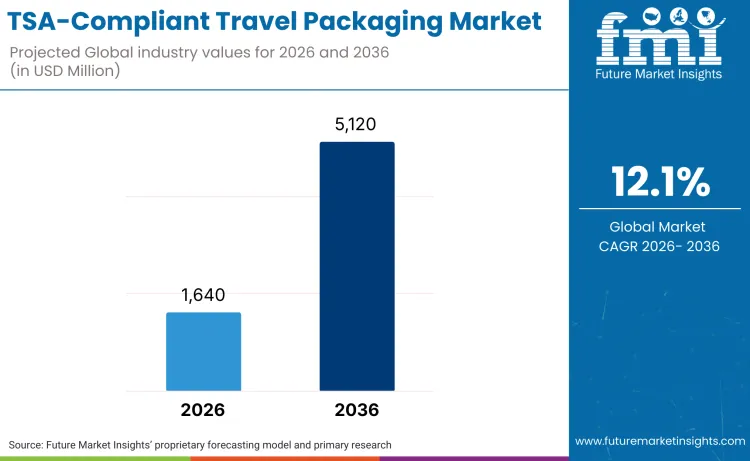
The global TSA-compliant travel packaging market is set to exceed a valuation of USD 1.6 billion in 2026, advancing toward USD 5.1 billion by 2036, representing a robust 12.1% CAGR. This growth trajectory is underpinned by surging passenger volumes; the Transportation Security Administration (TSA) reported screening 904 million passengers in 2024, a 5% increase from the previous year. Justin Erbacci, Director General of ACI World, validated this momentum, stating: "Air travel is on track to reach 9.8 billion passengers in 2025, underscoring aviation's role as a driver of global mobility and economic growth." Such high-volume traffic directly correlates to sustained demand for disposable and reusable travel pouches as passengers navigate security checkpoints globally.
Quick Stats for TSA-Compliant Travel Packaging Market
- Market Snapshot
- The TSA-compliant travel packaging market is valued at USD 1.6 billion in 2026.
- The TSA-compliant travel packaging market is projected to reach USD 5.1 billion by 2036.
- The market is expected to expand at a CAGR of 12.1% between 2026 and 2036.
- Demand and Growth Drivers
- Global passenger traffic reached 904 million screenings in 2024, increasing demand for compliant packaging.
- Air travel is expected to reach 9.8 billion passengers in 2025, supporting higher consumption of travel-sized containers.
- EU regulations aim to reduce waste by 15% per person by 2040, accelerating adoption of refillable packaging.
- Product and Segment View
- Bottles and vials account for 40% of total market share as the primary compliant format.
- Airline and airport retail contributes 46% of total end-use demand.
- Packaging formats are restricted to 100 ml or below under aviation liquid regulations.
- Geography and Competitive Outlook
- India holds a 15.4% market share, driven by aviation infrastructure expansion.
- China accounts for 14.2% share, supported by rising middle-class air travel.
- The market is consolidated with key players including Amcor, Sealed Air, TOPPAN Holdings, and Berry Global.
TOPPAN Holdings acquired Sonoco's TFP business in December 2024 for USD 1.8 billion to secure dominance in the Americas. Companies that can integrate high-barrier sustainability into travel formats will dominate the post-recovery landscape, as confirmed when Hideharu Maro, CEO of TOPPAN, noted: "This is an essential milestone in the TOPPAN Group's global strategy to scale the sustainable packaging business." This strategic consolidation allows major players to standardize compliant packaging solutions across multiple jurisdictions, effectively meeting the complex needs of international travelers.
Summary of TSA‑Compliant Travel Packaging Market
What Is Growth Outlook for TSA‑Compliant Travel Packaging Market as per Future Market Insights Projection?
Future Market Insights projects the TSA‑compliant travel packaging industry to expand at a CAGR of 12.1% from 2026 to 2036, increasing from USD 1.6 billion in 2026 to USD 5.1 billion by 2036.
FMI Research Approach: Based on proprietary bottom‑up forecasting, correlating packaging format revenue with global passenger throughput trends, supported by TSA, IATA, and ACI World traffic data, and validated through primary interviews with packaging converters and airline amenity kit manufacturers.
How Do FMI Analysts Perceive TSA‑Compliant Travel Packaging Market to Evolve?
FMI analysts perceive the market evolving from generic travel containers toward certified, high‑barrier, reusable systems engineered for repeat compliance across global airport security frameworks.
FMI Research Approach: Evidence includes rising regulatory volatility across the US, EU, and Asia‑Pacific, clear shifts from disposable miniatures to durable refillable formats, investment momentum in high‑clarity PET and silicone systems, and consolidation among suppliers to standardize compliant designs.
Which Country Groups Are Driving TSA‑Compliant Travel Packaging Market Expansion?
India and China are the fastest‑growing markets, while the United States and Western Europe continue to shape replacement‑driven demand.
FMI Research Approach: Based on regional share modeling highlighting India at 15.4% and China at 14.2%, analysis of expanding aviation infrastructure and rising middle‑class air travel in Asia‑Pacific, strong outbound travel volumes in the US, and Europe’s regulatory push for refillable formats.
How Large Will TSA‑Compliant Travel Packaging Market Be by 2036?
The global TSA‑compliant travel packaging market is projected to reach USD 5.1 billion by 2036.
FMI Research Approach: Long‑term forecasts based on material mix, packaging format segmentation, expected adoption of reusable kits, scaling in airline and airport retail channels, and cross‑validation with historical aviation recovery cycles.
What Is Definition of TSA‑Compliant Travel Packaging Market?
The market comprises packaging solutions engineered to meet international aviation security regulations for liquids, aerosols, and gels carried in cabin baggage, typically 100 ml or below.
FMI Research Approach: Defined through FMI’s taxonomy covering compliant bottles, vials, tubes, sachets, sprayers, and clear security bags, and including PET, silicone, glass, metal, and bioplastic formats; excludes bulk and non‑compliant cosmetic packaging.
What Are Globally Unique Trends Shaping TSA‑Compliant Travel Packaging Market?
Key global trends include regulatory whiplash in liquid screening rules, hospitality‑driven adoption of refillable systems, and material innovation focused on high clarity and recyclability.
FMI Research Approach: Supported by evidence of temporary reversion to 100 ml limits at EU airports despite scanner upgrades, EU bans on single‑use hotel cosmetics accelerating dispenser adoption, and R\&D investment in paper‑based and recycled barrier materials alongside strategic acquisitions to secure compliance‑grade materials expertise.
TSA-Compliant Travel Packaging Market Key Takeaways
| Metric | Details |
|---|---|
| Industry Size (2026) | USD 1.6 billion |
| Industry Value (2036) | USD 5.1 billion |
| CAGR (2026-2036) | 12.1% |
Source: Future Market Insights (FMI) analysis, based on proprietary forecasting model and primary research
What Drives Travel Packaging Adoption?
Technological advancements in security screening are fundamentally reshaping the regulatory landscape for mini packaging. Heathrow Airport announced in January 2026 the scrapping of the 100ml liquid limit for departing passengers, a move that Thomas Woldbye, CEO of Heathrow Airport, noted means "Every Heathrow passenger can now leave their liquids and laptops in their bags at security as we become the largest airport in the world to roll out the latest security scanning technology. That means less time preparing for security and more time enjoying their journey." While this suggests a long-term shift, immediate regulatory volatility ensures continued reliance on standard-sized containers for global compatibility.
Environmental policy is forcing a format shift; the European Commission enforced a ban on single-use mini hotel cosmetics in April 2024 to reduce waste by 15% per person by 2040. This dual pressure drives the market toward larger, refillable, and sustainable container solutions. Manufacturers like Amcor are responding with initiatives like the "Lift-Off Winter 2025/26 Challenge" to develop paper-based barriers that comply with these evolving standards. This innovation is crucial for replacing traditional stick packaging formats that are difficult to recycle.
How is the TSA-Compliant Travel Packaging market segmented?
The TSA-compliant travel packaging market is segmented by packaging format, material type, and end-use application. By format, the industry includes bottles, vials, pouches, and tubes designed to meet specific volume restrictions. By material, production utilizes plastics (PET, PP, PE), glass, and metal, with a growing shift toward sustainable bioplastics. By end-use, consumption is driven by airline & airport retail, personal care companies, and hospitality providers, reflecting the diverse channels through which travel toiletry products reach the consumer. The segmentation outlook reveals a distinct pivot toward materials that offer both transparency for security screening and durability for repeated travel use.
Why do Bottles & Vials hold a dominant share?
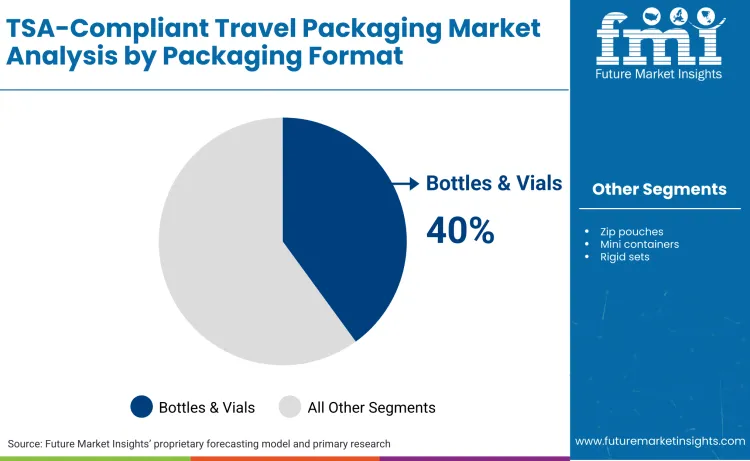
Bottles and vials command a 40% share, serving as the primary format for compliance despite regulatory volatility. The European Commission announced that effective September 1, 2024, the maximum allowed size for liquid containers would revert to 100ml at airports with EDSCB equipment due to a technical issue. This ensures continued demand for 100ml-compliant cosmetic vials despite long-term scanner upgrades. A Commission Spokesperson stated: "This precautionary measure is not in response to any new threat but addresses a temporary technical issue, undertaken in alignment with the EU's international partners." This statement reinforces the necessity for manufacturers to maintain production of standard 100ml units rather than prematurely shifting to larger formats.
Why does Airline & Airport Retail lead in consumption?
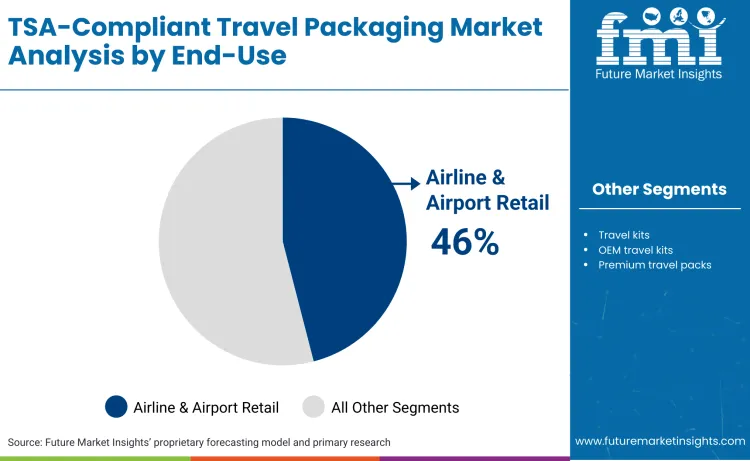
Airline and airport retail holds a leading 46% share, fueled by the resurgence of global passenger traffic. IATA reported in April 2025 that industry-wide Revenue Passenger Kilometers (RPK) increased by 8.0% year-on-year, directly increasing the addressable market for onboard amenities and duty-free plastic tube packaging. UN Tourism estimated 2024 international tourism receipts at USD 1.6 trillion, a 3% increase over 2023, validating that travelers are spending more on premium travel-sized goods. This spending surge supports the expansion of premium retail channels that require specialized, high-clarity packaging solutions.
Why Is the
Regulatory bans on single-use miniatures are pushing hotels to bulk dispensers and refillable systems. ADA Cosmetics reported that its SmartCare dispenser system enables a 75% plastic saving compared to small portions, positioning it as a key solution for compliance. Gerd von Podewils, CMO of ADA Cosmetics, stated: "This proposed EU-wide law is another crucial step forward in the journey towards an environmentally conscious travel industry. It will allow both travellers and hotel owners to make sustainable choices that help reduce plastic waste and protect our planet for future generations." This trend is accelerating the adoption of solid travel size skincare kits that eliminate liquid packaging entirely, reducing the compliance burden for travelers.
How Is Outbound Travel Influencing Compliance Kit Demand?
A significant travel trade deficit in the US is driving demand for pre-packed compliance kits. The US Travel Association reported in April 2025 that the US is running a USD 50 billion travel trade deficit, indicating high outbound travel volumes. As Americans travel abroad to regions with varying security protocols, the purchase rate for standardized travel accessories and clear pouches increases. The TSA facilitated this by expanding mobile driver's licenses to 15 states in January 2025, streamlining the experience for these frequent international flyers who prioritize efficiency.
Why Is Sustainability Driving Material Innovation?
The industry is pivoting from virgin plastics to paper-based and recycled barriers. Amcor launched the "Amcor Lift-Off Winter 2025/26 Challenge" in November 2025 to find home-compostable adhesive partners. Frank Lehmann, VP at Amcor, noted: "The Lift-Off initiative has delivered outstanding results, and we are eager to carry this success forward. With the launch of our new initiative, we reaffirm Amcor's dedication to advancing circularity and environmental responsibility through collaboration with the brightest minds in the start-up ecosystem." This innovation is critical for replacing cosmetic jars made from non-recyclable polymers, ensuring that travel convenience does not come at an environmental cost.
What is Regional Growth Outlook for TSA-Compliant Travel Packaging Market?
Emerging aviation hubs, particularly across Asia‑Pacific, are accelerating the demand for TSA‑compliant travel packaging as their passenger volumes grow significantly faster than those of mature Western markets. Asia‑Pacific alone is expected to handle 3.6 billion passengers in 2025, marking a 5.6% year‑on‑year rise that outpaces the growth trajectory of North America and Europe. This surge directly boosts consumption of compliant bottles, vials, pouches, and amenity-kit formats as more travelers pass through security checkpoints requiring standardized packaging. The expansion is also supported by infrastructure investments, the rapid rise of middle‑class travelers, and aggressive aviation capacity building in countries like India and China. As these markets continue scaling up, packaging manufacturers are aligning production strategies, focusing on high‑clarity PET formats, durable reusable kits, and region‑specific compliance designs, to meet the increased throughput and evolving security protocols that define global passenger mobility.
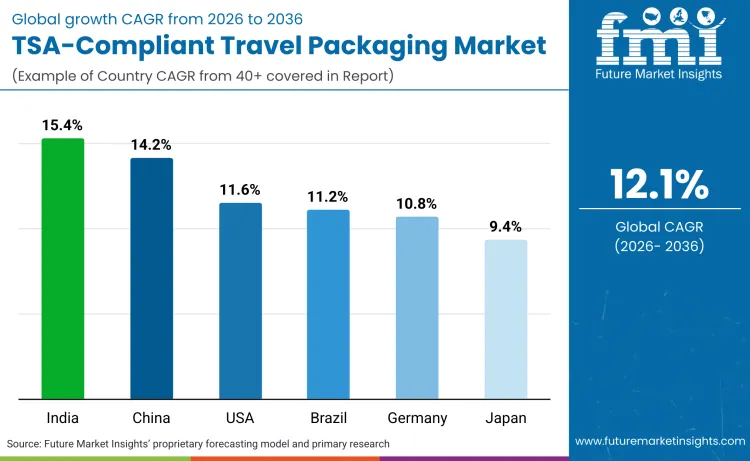
| Country | Market Share |
|---|---|
| India | 15.40% |
| China | 14.20% |
| USA | 11.60% |
| Brazil | 11.20% |
| Germany | 10.80% |
| Japan | 9.40% |
Source: FMI historical analysis and forecast data.
Why is India expanding aviation infrastructure?
The TSA-compliant packaging market in India is projected to leverage a 15.40% regional share. The Ministry of Civil Aviation stated: "Driven by groundbreaking legislative reforms, extensive infrastructure expansion, and an unwavering commitment to connectivity, safety, and sustainability, the Ministry has achieved landmark milestones, positioning India among the world's leading aviation markets." This infrastructure boom requires a parallel increase in travel bags and amenity kit logistics to serve the growing middle-class traveler base.
What drives the high outbound volume in the USA?
The USA holds an 11.60% share, driven primarily by outbound travel volume and strict security enforcement. TSA PreCheck enrollment reached a milestone of over 20 million members in January 2025, creating a consistent user base for premium utility cases. The TSA Administrator noted in the Year in Review: "TSA set an agency record on the Sunday after Thanksgiving, the agency's busiest holiday travel period on record, screening 3.1 million people." High passenger throughput ensures steady replacement cycles for compliant packaging, particularly for durable goods that frequent flyers prefer over disposables.
How is Germany adapting to circular economy rules?
Germany accounts for a 10.80% share, heavily influenced by EU sustainability directives banning single-use hotel plastics. An EU Commission Spokesperson commented on related liquid restrictions: "This precautionary measure is not in response to any new threat but addresses a temporary technical issue, undertaken in alignment with the EU's international partners." Such regulatory environment favors reusable silicone bottles over disposable mini spray bottles, pushing local innovation toward durable, high-value travel sets.
Why is Japan seeing a surge in packaging demand?
Japan captures a 9.40% share, buoyed by an inbound tourism boom due to currency depreciation. UN Tourism highlighted in January 2025 that Japan saw a 16% increase in international arrivals in 2024 compared to 2019. Toppan Holdings is leveraging this by acquiring US assets to expand its global footprint. Hideharu Maro, CEO of TOPPAN, explained the move: "We are extremely pleased to have the opportunity to bring Sonoco's TFP business to the TOPPAN Group. In order to accelerate our strategy to become a global leader in sustainable packaging solutions, we will employ the complementary strengths of both parties to drive growth, solve customers' needs and create significant value for our shareholders." This validates the strategy of using regional acquisitions to secure advanced pocket containers technologies.
How is the Competition in the TSA-Compliant Travel Packaging Market?
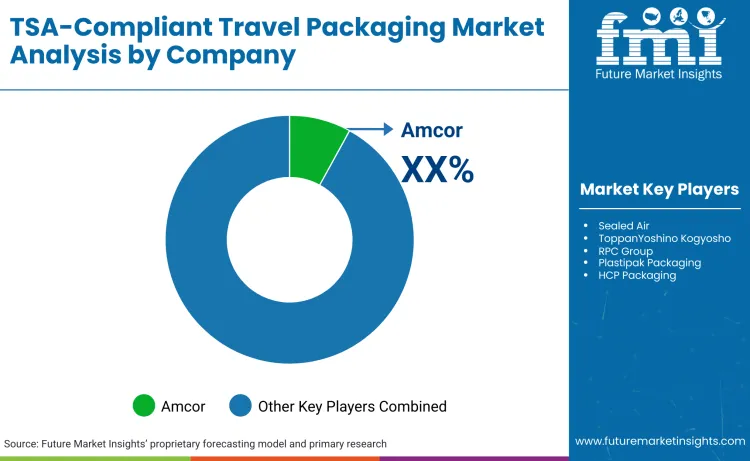
The market is characterized by high consolidation, exemplified by Toppan's acquisition of Sonoco's TFP business in December 2024. FMI analysis indicates that leaders are shifting from passive compliance to active sustainability, utilizing sachet packaging technologies that reduce material usage. Competitors are aggressively investing in R&D to create proprietary barrier films that meet both aviation security standards and environmental recycling goals.
Strategic moves are increasingly technical; Shiseido and Yoshino Kogyosho won the WorldStar Award 2024 for "SHISEIDO EUDERMINE Activating Essence" packaging, which utilizes LiquiForm technology. A Shiseido Press Release stated: "By reusing the main container, it is possible to reduce the amount of plastic discarded after use by 92%. Across the entire supply chain, this product achieves approximately a 70% reduction in CO2 emissions compared to our standard conventional refillable containers of the same volume." This innovation sets a new benchmark for premium cosmetic packaging, forcing other players to accelerate their own sustainable designs.
Amcor continues to lead in material innovation, launching its "Lift-Off" challenge in November 2025 to crowdsource sustainable solutions. Howard Coker, CEO of Sonoco, commented on their divestiture strategy: "The decision to sell our TFP business accelerates our portfolio simplification strategy, streamlines our organizational structure, and enables more focused capital investments in our remaining industrial paper and consumer packaging businesses." This clearly delineates the market into specialized technical packagers versus general industrial suppliers.
Recent Development:
- In April 2025, Amcor completed its all-stock combination with Berry Global, creating a larger global leader better positioned to innovate and scale TSA-compliant travel packaging solutions across liquids and personal care.
- In March 2025, The Amcor-Berry combination strengthens development of compact, compliant bottles and pouches for travel liquids, supporting 3.4 oz limits and leak-proof designs widely used in TSA-regulated travel packaging.
- In September 2025, Amcor expanded its Exclusive Stick and Refill range with three new travel-friendly sizes (15 ml, 20 ml, and 25 ml), designed to meet growing demand for TSA-compliant, refillable, on-the-go packaging in beauty and hygiene categories.
Key Players in TSA-Compliant Travel Packaging Market
- Amcor
- Sealed Air
- TOPPAN Holdings
- Yoshino Kogyosho
- Berry Global
- Alpla
- AptarGroup
- Silgan Holdings
Market Definition
The TSA-compliant travel packaging market represents revenue generated from packaging solutions specifically engineered to meet international aviation security regulations regarding the carriage of liquids, aerosols, and gels (LAGs) in carry-on luggage. As operationally defined in the article, the market measures the sales of containers (bottles, vials, tubes) typically 100ml (3.4 oz) or less, as well as the clear, resealable quart-sized bags required for screening. Market sizing reflects the value of these packaging formats sold through retail channels and B2B supply to airlines, hotels, and travel amenity kit manufacturers, expressed in USD billion.
The market includes bottles, vials, jars, tubes, and sprayers made from PET, HDPE, silicone, aluminum, or glass that adhere to the "3-1-1" rule or similar international standards. It covers both single-use sachets and reusable, refillable travel kits. Revenue generated from "smart" packaging with integrated tracking or digital labeling for travel compliance is also included. The scope counts consumption by individual travelers, hospitality chains providing toiletries, and airlines provisioning amenity kits.
Excluded from this market are standard-sized cosmetic or toiletry packaging that does not meet carry-on restrictions (over 100ml). Industrial bulk packaging for cargo transport is not counted. General luggage sales are excluded unless specifically referring to the 3-1-1 compliant clear toiletry bag segment. Non-packaging travel accessories such as neck pillows or adapters are outside the scope.
Scope of Report
| Items | Values |
|---|---|
| Quantitative Units (2026) | USD 1.6 billion |
| Packaging Format | Bottles & Vials, Pouches, Tubes, Sachets, Sprayers |
| Material Type | PET, PP, PE, Glass, Metal, Bioplastics |
| End Use | Airline & Airport Retail, Personal Care Companies, Hospitality, Individual Consumers |
| Regions Covered | North America, Europe, Asia Pacific, Latin America, Middle East & Africa |
| Countries Covered | United States, Germany, United Kingdom, India, China, Japan, Brazil, and 40+ countries |
| Key Companies Profiled | Amcor, Sealed Air, Toppan, Yoshino Kogyosho, Berry Global, Alpla, AptarGroup, Silgan Holdings |
| Additional Attributes | Revenue analysis by format and material, impact of security regulations (TSA 3-1-1, EU liquid bans), sustainability trends (refillable vs. single-use), passenger volume correlation, and competitive consolidation analysis |
Source: FMI historical analysis and forecast data.
TSA-Compliant Travel Packaging Market by Segments
By Packaging Format:
- Bottles & Vials
- Pouches
- Tubes
- Sachets
- Sprayers
By Material:
- PET
- PP
- PE
- Glass
- Metal
- Bioplastics
By End Use:
- Airline & Airport Retail
- Personal Care Companies
- Hospitality
- Individual Consumers
By Region:
- North America
- Europe
- Asia Pacific
- Latin America
- Middle East & Africa
Bibliography
- Transportation Security Administration. (2025, January). 2024 year in review: Record passenger volumes. TSA.
- Airports Council International World. (2025, September). Global air travel forecast to reach 9.8 billion passengers. ACI World.
- International Air Transport Association. (2025, April). Air passenger market analysis. IATA.
- European Commission. (2024, July). Temporary restrictions on liquid screening at certain EU airports. EC Transport.
- UK Department for Transport. (2025). Changes to airport security rules on liquids in cabin baggage. DfT.
- Press Information Bureau, Government of India. (2025, January). Domestic air passenger traffic statistics 2024. PIB.
- UN Tourism (UNWTO). (2025, January). International tourism reaches pre-pandemic levels in 2024. UNWTO.
- International Civil Aviation Organization. (2024). Security control of liquids, aerosols and gels (LAGs) in cabin baggage. ICAO.
- USA Food and Drug Administration. (2024). Import Alert 62-08: Medical and hygiene product packaging compliance. FDA.
- TOPPAN Holdings Inc. (2024, December). Acquisition of Sonoco Thermoformed & Flexible Packaging business. TOPPAN News.
- Sonoco Products Company. (2024, December). Strategic review and divestiture of TFP business. Sonoco Investor Relations.
- Organisation for Economic Co-operation and Development. (2024). Global plastics outlook and packaging waste trends. OECD.
Frequently Asked Questions
What is the current global market size for TSA-Compliant Travel Packaging?
The global market is valued at USD 1.6 billion in 2026, driven by record passenger volumes and stricter enforcement of security regulations.
What is the projected CAGR for the TSA-Compliant Travel Packaging market?
Revenue is projected to expand at a 12.1% CAGR from 2026 to 2036, significantly outpacing general packaging growth due to the travel recovery.
Which segment currently dominates the industry?
Airline & Airport Retail holds the dominant share at 46%, serving as the primary distribution channel for amenity kits and duty-free goods.
What are the primary market drivers?
Growth is driven by rising international tourism, the "refill revolution" in hospitality due to plastic bans, and the expansion of aviation infrastructure in emerging markets like India.
Who are the leading players in the TSA-Compliant Travel Packaging space?
Amcor, Sealed Air, and TOPPAN Holdings lead the market, with Toppan recently securing a major position in the Americas through its acquisition of Sonoco's flexible packaging business.
Preview the report firsthand - request a free sample
Get SampleGet the brochure for pricing and purchase details.
Get PDFTable of Content
- Executive Summary
- TSA-Compliant Travel Packaging Market Introduction
- Market Definition
- Market Scope
- Market Taxonomy
- Research Methodology
- Study Framework
- Assumptions and Limitations
- Data Sources
- Market Estimation and Forecasting Approach
- TSA-Compliant Travel Packaging Market Dynamics
- Drivers
- Restraints
- Opportunities
- Trends
- Global TSA-Compliant Travel Packaging Market Analysis 2021 to 2025 and Forecast 2026 to 2036
- Global TSA-Compliant Travel Packaging Market Analysis by Packaging Format
- Global TSA-Compliant Travel Packaging Market Analysis by Material Type
- Global TSA-Compliant Travel Packaging Market Analysis by End Use
- Global TSA-Compliant Travel Packaging Market Analysis by Region
- North America TSA-Compliant Travel Packaging Market Analysis
- United States
- Canada
- Mexico
- Latin America TSA-Compliant Travel Packaging Market Analysis
- Brazil
- Chile
- Rest of Latin America
- Europe TSA-Compliant Travel Packaging Market Analysis
- Germany
- United Kingdom
- France
- Italy
- Spain
- Rest of Europe
- Asia Pacific TSA-Compliant Travel Packaging Market Analysis
- China
- India
- Japan
- ASEAN
- Australia & New Zealand
- Rest of Asia Pacific
- Middle East & Africa TSA-Compliant Travel Packaging Market Analysis
- GCC
- South Africa
- Rest of Middle East & Africa
- Competitive Landscape Analysis
- Key Players Profiled
- Market Definition
- Market Segmentation
- Bibliography
- Frequently Asked Questions


