

- Industry Size (2026)
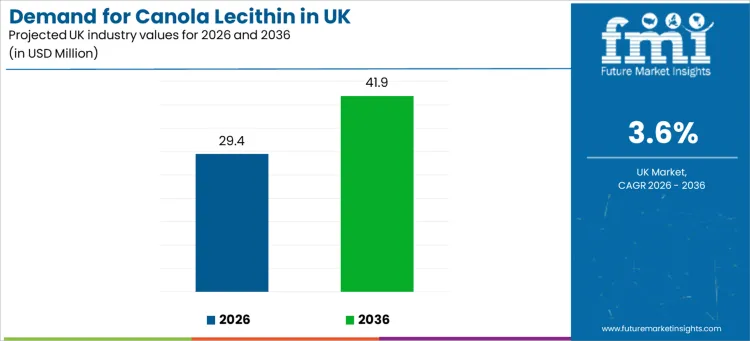
- USD 29.4 Mn
- Forecast (2036)
- USD 41.9 Mn
- CAGR (2026 to 2036)
- 3.6%
Canola Lecithin Outlook in the UK 2026 to 2036
Demand for canola lecithin in the UK is projected at USD 29.4 million in 2026 and is expected to reach USD 41.9 million by 2036, expanding at a 3.6% CAGR. Demand is shaped by formulation needs in packaged foods, bakery production lines, confectionery processing, convenience meal manufacturing, and dairy applications where ingredient behaviour influences texture consistency, processing yield, and finished-product stability.
Canola-derived lecithin is increasingly evaluated as a plant-origin emulsifying aid that supports clean ingredient positioning while delivering functional performance in fat-water systems. For procurement leaders, the decision is rarely only about ingredient substitution. It is about whether the emulsifier can protect batch-to-batch repeatability, maintain throughput efficiency, and lower defects such as fat bloom, separation, inconsistent aeration, or uneven mouthfeel.
Ingredient owners also examine how the ingredient behaves under heat exposure, storage stress, shear intensity during mixing, and compatibility with other functional inputs. Across high-volume food categories, canola lecithin demand is supported by outcomes such as reliable dispersion, improved wetting, stable emulsification, and fewer stoppages tied to ingredient handling.
Quick Stats for Canola Lecithin Demand in the UK
- Canola Lecithin Valuation in the UK (2026): USD 29.4 million
- Canola Lecithin Forecast Valuation in the UK (2036): USD 41.9 million
- Canola Lecithin Forecast CAGR 2026 to 2036: 3.6%
- Leading Regional Growth: England (3.94%)
- Leading Form: Powder (75.0% share)
- Leading Available Grade: Standard (40.0% share)
- Leading End Use: Food and Beverages (41.1% share)
- Leading Functionality: Wetting (38.4% share)
- Key Companies Profiled: Cargill; Ciranda; Austrade Inc.; Lecico; American Chemie
Canola Lecithin Industry in the UK Key Takeaways
| Metric | Value |
|---|---|
| Industry Value (2026) | USD 29.4 million |
| Industry Forecast Value (2036) | USD 41.9 million |
| Forecast CAGR (2026 to 2036) | 3.6% |
Why is the UK Building Steady Demand for Canola Lecithin?
UK demand is building as food brands and manufacturers balance functional performance with ingredient transparency expectations. Emulsifiers remain essential across many formulations because they help stabilise mixtures, protect texture uniformity, improve processing consistency, and reduce separation risks in storage.
Regulatory familiarity supports continued usage. The Food Standards Agency’s approved additives list includes E322 (Lecithins), reinforcing its established position within approved additive frameworks. This clarity supports procurement confidence for manufacturers that need stable compliance alignment for ingredient declarations and consistent formulation governance.
Sourcing preferences also shape buying decisions. Canola-derived variants provide an option for product developers that want a plant-origin emulsifier route while maintaining practical outcomes in bakery, confectionery, and prepared foods. Many ingredient teams calibrate selection against broader performance expectations linked to lecithin-based formulation strategies, particularly where portfolio owners want a consistent emulsification tool across multiple product lines.
Safety confidence adds further support. EFSA’s scientific opinion on lecithins (E322) covers its re-evaluation when used as a food additive, strengthening technical confidence for stakeholders operating within EU-aligned quality practices.
How is Canola Lecithin Demand Segmented by Form, Available Grades, End Use, and Functionality?
The UK’s canola lecithin landscape reflects how production teams prioritise dosing control, handling efficiency, functional delivery, and repeatable performance under real plant constraints.
Why does powder form remain the most selected option for dosing stability and storage discipline?
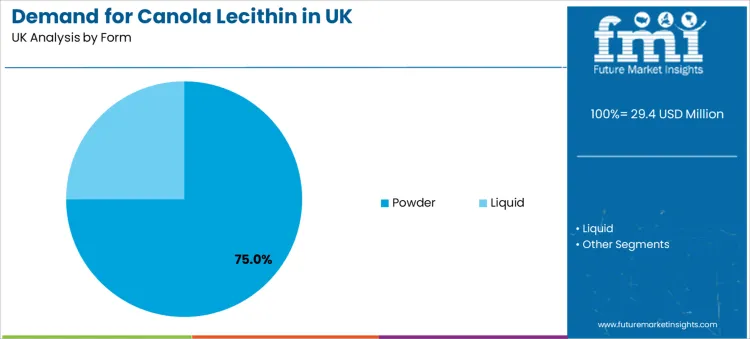
Powdered canola lecithin holds a 75.0% share, making it the dominant form. Manufacturers value predictable dosing, smooth integration into dry blending systems, and storage convenience in many ingredient handling environments. Powder formats align well with automated feeders and controlled dry-mix operations where batch accuracy must be repeatable.
Powder also supports process consistency across multiple sites. For multi-plant operators, standardising a powder input reduces the likelihood of operator-dependent variability and makes troubleshooting more straightforward when texture issues appear. These decisions often sit beside broader ingredient standardisation moves linked to canola-derived functional ingredient planning where scalability and handling discipline influence adoption.
What keeps standard grade in the lead for mainstream formulation requirements?
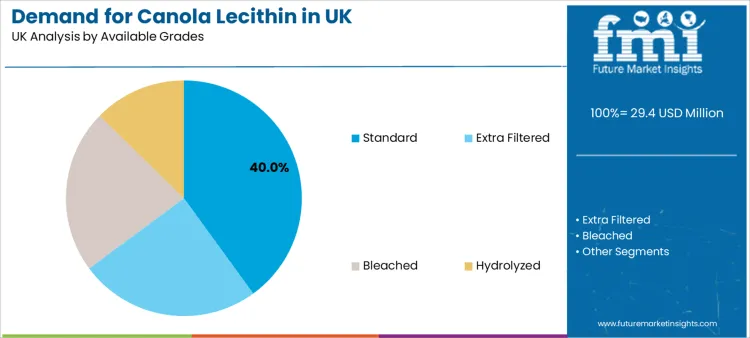
Standard grade accounts for a 40.0% share, showing that demand remains anchored in high-volume formulations where cost control and performance reliability matter most. Standard grades suit established recipes where specification ranges are already built into quality systems and where switching costs can be high.
For procurement leaders, standard grade sourcing simplifies qualification and vendor consolidation. It reduces the need for multiple grade approvals, shortens formulation validation cycles, and supports volume contracting. Grade discussions also tend to run alongside comparisons with other sourcing routes such as soy-derived lecithin options when manufacturers manage supply diversity and performance expectations across categories.
Why does food and beverages remain the largest end-use demand centre?
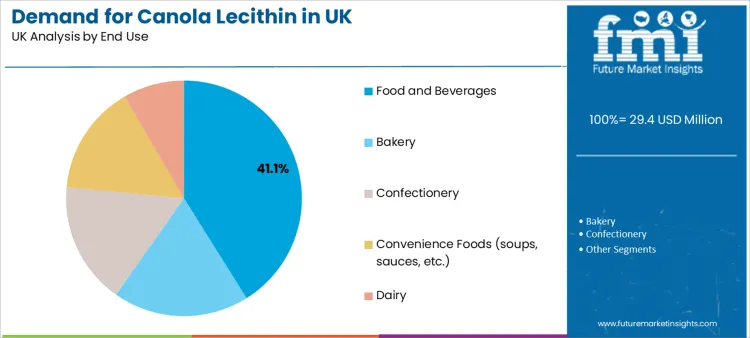
Food and beverages hold a 41.1% share, making it the leading end-use segment. This reflects the scale of emulsifier needs across everyday product categories where consistency defines brand trust. Manufacturers rely on lecithin to manage fat phase behaviour, reduce mixing friction, support uniform dispersion, and maintain stable mouthfeel.
This segment benefits from application flexibility, spanning coatings, fillings, soups, sauces, ready meals, and dairy systems where ingredient interactions can destabilise texture if emulsification is weak. Portfolio-level decisions in this category are often aligned with performance expectations concerning food emulsifier selection patterns where functionality and label positioning are assessed together.
What makes wetting functionality a priority for throughput-focused processing lines?
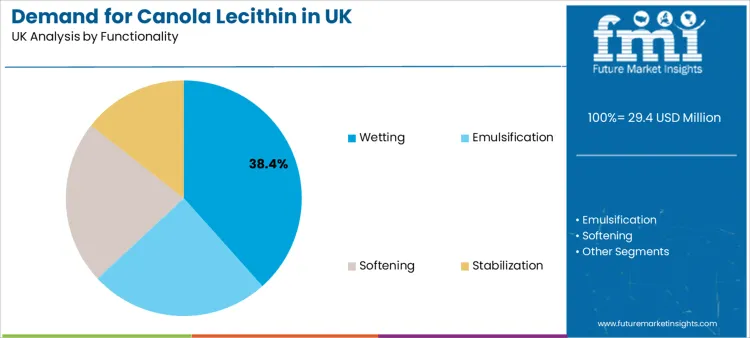
Wetting represents a 38.4% share, making it the leading functionality. The requirement is practical: powders need to hydrate and disperse efficiently without clumping, floating, or forming mixing dead zones that slow production. Strong wetting improves blend uniformity and supports stable viscosity control, especially in sauces, soups, and convenience foods where dispersion quality is visible in the final product.
Many teams tune wetting and emulsification behaviour while coordinating broader ingredient transparency targets linked to clean-label emulsifier positioning, particularly where brands want simple ingredient language without compromising texture.
What are the Dynamics, Restraints, Opportunities, and Threats Shaping this Space?
What dynamics are strengthening demand across formulation and processing environments?
Ongoing reformulation activity sustains demand, especially where manufacturers need emulsification support without sacrificing processing speed or texture quality. Lecithin’s recognised status under E-number frameworks supports stable adoption, with E322 listed in the Food Standards Agency’s approved additives guidance.
Product complexity also keeps emulsifier requirements active. Higher protein systems, plant-forward formats, and texture-sensitive convenience products need better dispersion control and stable fat-water behaviour under heating and storage.
What restraints limit faster adoption or create qualification friction?
Formulation risk remains a key restraint. Small shifts in emulsifier behaviour can change texture, mouthfeel, aeration, and shelf stability. Manufacturers often run controlled validation cycles before switching suppliers or grades. Supply reliability matters as well. If vendors cannot maintain consistent specs and availability, buyers may delay transitions.
Where do the strongest opportunities sit for ingredient suppliers and brand owners?
- Performance-led sourcing diversification: Manufacturers can balance canola-derived emulsifiers alongside broader phospholipid strategies tied to lecithin and phospholipids portfolios when stabilising multi-category formulations.
- Targeted processing upgrades for bakery and confectionery: Suppliers that help reduce fat bloom risk, improve softness, and strengthen texture consistency can expand adoption. In several plants, this is assessed alongside specialty routes such as fractionated lecithin applications where tailored performance is required.
- Powder-led operational standardisation: Facilities that optimise dry ingredient handling often broaden powder emulsifier usage with approaches aligned to de-oiled lecithin positioning where dosing and dispersion stability are central.
What threats could disrupt demand expectations?
Technical substitution remains a risk when alternative emulsifiers or hydrocolloid systems deliver lower cost or better stability in specific recipes. Another threat comes from inconsistent consumer messaging around emulsifiers, where misunderstandings can affect brand positioning. Regulatory updates also matter if labelling expectations change or if specification controls tighten in sensitive categories.
How is Canola Lecithin Demand Evolving across Key Regions in the UK?
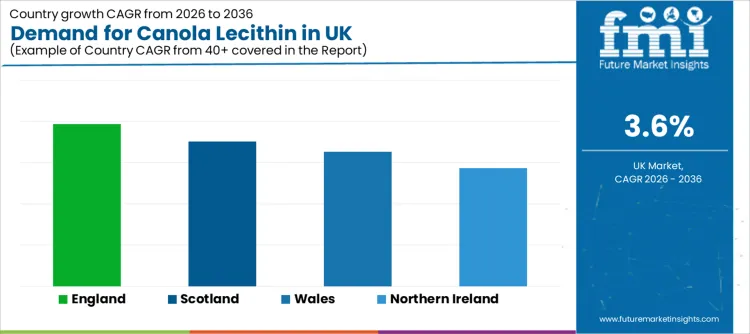
| Region | CAGR 2026 to 2036 |
|---|---|
| England | 3.9% |
| Scotland | 3.5% |
| Wales | 3.3% |
| Northern Ireland | 2.9% |
Why is England leading expansion through higher food processing scale and procurement standardisation?
England grows at 3.9%, supported by higher concentration of food processing sites and stronger procurement standardisation across multi-facility operators. Demand rises where manufacturers run high-throughput production and prioritise ingredients that protect consistency and reduce rework.
How is Scotland progressing through steady adoption in bakery and processed food formats?
Scotland expands at 3.5%, shaped by stable demand from bakery and processed food production where emulsifier functionality supports texture outcomes and production reliability. Buyers typically prioritise supplier dependability and predictable functional delivery.
What is shaping Wales as manufacturers balance performance needs with value discipline?
Wales grows at 3.3%, driven by practical adoption where cost control and production stability guide purchasing. Demand strengthens when canola lecithin improves mixing behaviour and reduces texture variation without requiring large process changes.
Why is Northern Ireland showing measured progress tied to selective qualification and stable sourcing?
Northern Ireland rises at 2.9%, reflecting careful sourcing decisions and selective qualification cycles. Adoption expands when the ingredient delivers clear performance value in targeted product formats and when supply consistency remains reliable.
What Defines the Competitive Landscape for Canola Lecithin in the UK?
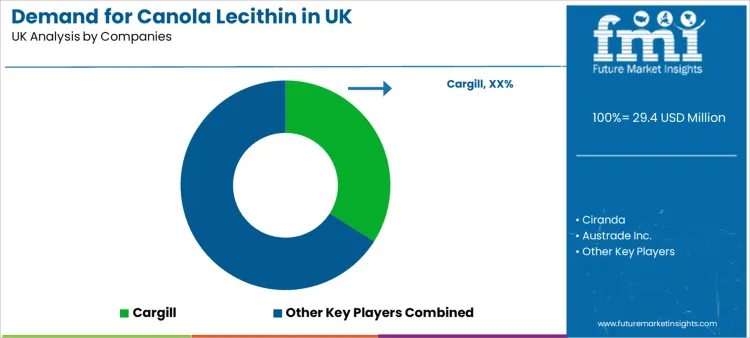
Competition is shaped by supply reliability, specification consistency, and technical support that helps manufacturers maintain stable product quality. Buyers assess vendors on documentation readiness, batch uniformity, and the ability to support qualification in bakery, confectionery, prepared foods, and dairy systems.
Cargill competes through broad ingredient capabilities and supply infrastructure. Ciranda is positioned through plant-based ingredient offerings aligned with natural sourcing expectations. Austrade Inc., Lecico, and American Chemie contribute through supply availability and application fit across selected use cases. Manufacturers value partners that provide formulation troubleshooting support, mixing guidance, and fast response when texture or dispersion issues emerge during rollout.
Key Industry Participants
- Cargill
- Ciranda
- Austrade Inc.
- Lecico
- American Chemie
Scope of Report
| Items | Values |
|---|---|
| Quantitative Units | USD Million |
| Form | Powder; Liquid |
| Available Grades | Standard; Extra Filtered; Bleached; Hydrolyzed |
| End Use | Food and Beverages; Bakery; Confectionery; Convenience Foods (soups, sauces, etc.); Dairy |
| Functionality | Wetting; Emulsification; Softening; Stabilization |
| Regions Covered | England; Scotland; Wales; Northern Ireland |
| Key Companies Profiled | Cargill; Ciranda; Austrade Inc.; Lecico; American Chemie |
Canola Lecithin Demand in the UK by Segments
By Form:
- Powder
- Liquid
By Available Grades:
- Standard
- Extra Filtered
- Bleached
- Hydrolyzed
By End Use:
- Food and Beverages
- Bakery
- Confectionery
- Convenience Foods (soups, sauces, etc.)
- Dairy
By Functionality:
- Wetting
- Emulsification
- Softening
- Stabilization
By Region:
- England
- Scotland
- Wales
- Northern Ireland
Bibliography
- European Commission. (2008). Regulation (EC) No 1333/2008 on food additives (Union list and authorisations).
- European Food Safety Authority. (2017). Re-evaluation of lecithins (E 322) as a food additive. EFSA Journal.
- Food Standards Agency. (2025). Approved additives and E numbers.
Frequently Asked Questions
How big is the demand for canola lecithin in uk in 2026?
The demand for canola lecithin in uk is estimated to be valued at USD 29.4 million in 2026.
What will be the size of canola lecithin in uk in 2036?
The market size for the canola lecithin in uk is projected to reach USD 41.9 million by 2036.
How much will be the demand for canola lecithin in uk growth between 2026 and 2036?
The demand for canola lecithin in uk is expected to grow at a 3.6% CAGR between 2026 and 2036.
What are the key product types in the canola lecithin in uk?
The key product types in canola lecithin in uk are powder and liquid.
Which available grades segment is expected to contribute significant share in the canola lecithin in uk in 2026?
In terms of available grades, standard segment is expected to command 40.0% share in the canola lecithin in uk in 2026.
Preview the report firsthand - request a free sample
Get SampleGet the brochure for pricing and purchase details.
Get PDFTable of Content
- Executive Summary
- UK Market Outlook
- Demand-side Trends
- Supply-side Trends
- Technology Roadmap Analysis
- Analysis and Recommendations
- Market Overview
- Market Coverage / Taxonomy
- Market Definition / Scope / Limitations
- Market Background
- Market Dynamics
- Drivers
- Restraints
- Opportunity
- Trends
- Scenario Forecast
- Demand in Optimistic Scenario
- Demand in Likely Scenario
- Demand in Conservative Scenario
- Opportunity Map Analysis
- Product Life Cycle Analysis
- Supply Chain Analysis
- Investment Feasibility Matrix
- Value Chain Analysis
- PESTLE and Porter’s Analysis
- Regulatory Landscape
- Regional Parent Market Outlook
- Production and Consumption Statistics
- Import and Export Statistics
- Market Dynamics
- UK Market Analysis 2021 to 2025 and Forecast, 2026 to 2036
- Historical Market Size Value (USD Million) Analysis, 2021 to 2025
- Current and Future Market Size Value (USD Million) Projections, 2026 to 2036
- Y-o-Y Growth Trend Analysis
- Absolute $ Opportunity Analysis
- UK Market Pricing Analysis 2021 to 2025 and Forecast 2026 to 2036
- UK Market Analysis 2021 to 2025 and Forecast 2026 to 2036, By Form
- Introduction / Key Findings
- Historical Market Size Value (USD Million) Analysis By Form , 2021 to 2025
- Current and Future Market Size Value (USD Million) Analysis and Forecast By Form , 2026 to 2036
- Powder
- Liquid
- Powder
- Y-o-Y Growth Trend Analysis By Form , 2021 to 2025
- Absolute $ Opportunity Analysis By Form , 2026 to 2036
- UK Market Analysis 2021 to 2025 and Forecast 2026 to 2036, By Available Grades
- Introduction / Key Findings
- Historical Market Size Value (USD Million) Analysis By Available Grades, 2021 to 2025
- Current and Future Market Size Value (USD Million) Analysis and Forecast By Available Grades, 2026 to 2036
- Standard
- Extra Filtered
- Bleached
- Hydrolyzed
- Standard
- Y-o-Y Growth Trend Analysis By Available Grades, 2021 to 2025
- Absolute $ Opportunity Analysis By Available Grades, 2026 to 2036
- UK Market Analysis 2021 to 2025 and Forecast 2026 to 2036, By End Use
- Introduction / Key Findings
- Historical Market Size Value (USD Million) Analysis By End Use, 2021 to 2025
- Current and Future Market Size Value (USD Million) Analysis and Forecast By End Use, 2026 to 2036
- Food and Beverages
- Bakery
- Confectionery
- Convenience Foods (soups, sauces, etc.)
- Dairy
- Food and Beverages
- Y-o-Y Growth Trend Analysis By End Use, 2021 to 2025
- Absolute $ Opportunity Analysis By End Use, 2026 to 2036
- UK Market Analysis 2021 to 2025 and Forecast 2026 to 2036, By Functionality
- Introduction / Key Findings
- Historical Market Size Value (USD Million) Analysis By Functionality, 2021 to 2025
- Current and Future Market Size Value (USD Million) Analysis and Forecast By Functionality, 2026 to 2036
- Wetting
- Emulsification
- Softening
- Stabilization
- Wetting
- Y-o-Y Growth Trend Analysis By Functionality, 2021 to 2025
- Absolute $ Opportunity Analysis By Functionality, 2026 to 2036
- Market Structure Analysis
- Competition Dashboard
- Competition Benchmarking
- Market Share Analysis of Top Players
- By Regional
- By Form
- By Available Grades
- By End Use
- By Functionality
- Competition Analysis
- Competition Deep Dive
- Cargill
- Overview
- Product Portfolio
- Profitability by Market Segments (Product/Age /Sales Channel/Region)
- Sales Footprint
- Strategy Overview
- Marketing Strategy
- Product Strategy
- Channel Strategy
- Ciranda
- Austrade Inc.
- Lecico
- American Chemie
- Cargill
- Competition Deep Dive
- Assumptions & Acronyms Used
- Research Methodology


