

- Industry Size (2026)
- USD 14.73 Bn
- Forecast (2036)
- USD 96.64 Bn
- CAGR (2026 to 2036)
- 20.70%
Bare Metal Cloud Market Size, Market Forecast and Outlook By FMI
The bare metal cloud market was valued at USD 12.20 billion in 2025, projected to reach USD 14.73 billion in 2026, and is forecast to expand to USD 96.64 billion by 2036 at a 20.70% CAGR. Enterprise demand for dedicated single-tenant cloud infrastructure that delivers hypervisor-free performance for latency-sensitive workloads, AI model training, and high-frequency trading applications is driving rapid adoption of bare metal cloud services. Organizations migrating from on-premise data centres seek bare metal cloud configurations that replicate physical server performance characteristics within cloud consumption models, eliminating the virtualization overhead that degrades workload performance in shared-tenant environments.
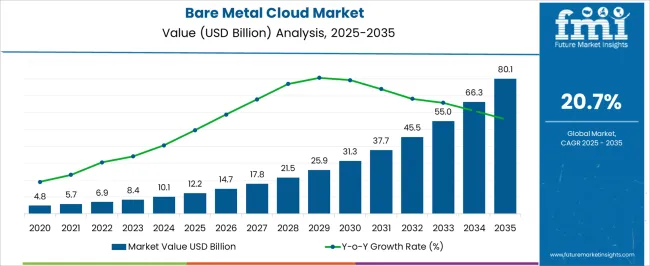
The absolute dollar opportunity of approximately USD 81.91 billion over the forecast period reflects one of the fastest-growing segments within cloud infrastructure services. AI training workload proliferation requiring GPU-accelerated bare metal instances is generating the highest per-hour instance pricing and the strongest demand growth trajectory within the bare metal service portfolio. Data sovereignty regulations requiring workloads to run on dedicated physical infrastructure within specific geographic jurisdictions are creating compliance-driven bare metal demand that cannot be served by multi-tenant virtualized cloud services. Edge computing deployment models requiring bare metal cloud instances at network edge locations are expanding the addressable market beyond centralized data centre deployments.
Summary of Bare Metal Cloud Market
- Bare Metal Cloud Market Definition
- Bare metal cloud delivers dedicated, single-tenant physical servers through cloud consumption models without virtualization, providing direct hardware access for AI training, HPC, trading, and data sovereignty workloads with cloud provisioning flexibility.
- Demand Drivers in the Market
- AI model training workload proliferation requiring GPU-accelerated bare metal instances is generating the highest per-hour pricing and the strongest demand growth trajectory within cloud infrastructure, as virtualization overhead is incompatible with training performance requirements.
- Data sovereignty regulations mandating workloads on dedicated physical infrastructure within specific jurisdictions create compliance-driven bare metal demand that multi-tenant virtualized cloud cannot serve.
- Enterprise data centre migration programmes seek bare metal cloud configurations that replicate on-premise physical server performance within cloud consumption billing models, eliminating capital equipment procurement cycles.
- Key Segments Analyzed in the FMI Report
- Hardware by Component Type: 41.2% share in 2026, reflecting the capital-intensive server procurement investment required to build bare metal cloud capacity, particularly GPU-accelerated server clusters for AI training workloads.
- China: 27.9% compound growth driven by AI training infrastructure buildout, data sovereignty compliance, and enterprise cloud migration acceleration under national digital economy programmes.
- Analyst Opinion at FMI
- Sudip Saha, Principal Consultant for Technology, opines, The bare metal cloud market is experiencing exponential demand acceleration driven by AI training compute requirements that cannot tolerate virtualization overhead, creating a structural preference for dedicated physical server access within cloud consumption models. Providers who cannot offer GPU-accelerated bare metal instances with sub-minute provisioning face exclusion from AI training procurement as data science teams require rapid cluster scaling during model development cycles. The critical capacity risk centers on GPU server supply chain constraints, as bare metal cloud providers compete with hyperscale cloud companies and enterprise direct purchasers for limited GPU server allocation from a concentrated manufacturing base.
- Strategic Implications / Executive Takeaways
- Bare metal cloud providers must secure long-term GPU server supply agreements with hardware manufacturers to guarantee capacity availability during the current AI training demand surge and prevent customer churn to better-provisioned competitors.
- Enterprise cloud architects must evaluate bare metal cloud for AI training, HPC, and regulatory compliance workloads where virtualization overhead creates measurable performance degradation or data sovereignty non-compliance risk.
- Data sovereignty programme managers must specify bare metal cloud deployment models for regulated workloads requiring demonstrable single-tenant physical infrastructure isolation within compliant geographic jurisdictions.
Bare Metal Cloud Market Key Takeaways
| Metric | Details |
|---|---|
| Industry Size (2026) | USD 14.73 Billion |
| Industry Value (2036) | USD 96.64 Billion |
| CAGR (2026-2036) | 20.70% |
Source: Future Market Insights, 2026
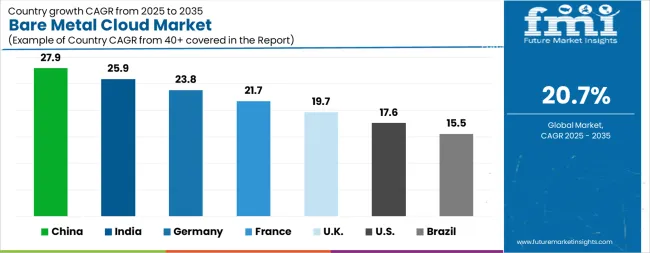
China sets the pace at a 27.9% CAGR, driven by AI training infrastructure buildout, data sovereignty regulation compliance, and enterprise cloud migration acceleration under digital economy development programmes. India follows at 25.9% as Digital India infrastructure investment, AI startup ecosystem growth, and data localization mandates generate bare metal cloud procurement. Germany registers 23.8% growth under GDPR data processing sovereignty requirements and AI industry infrastructure investment. France maintains 21.7% supported by sovereign cloud programme mandates and AI national strategy infrastructure allocations. UK expands at 19.7% anchored by financial services low-latency trading infrastructure and AI research computing demand. USA tracks at 17.6% driven by AI model training GPU cluster demand, financial services dedicated infrastructure, and government FedRAMP compliant bare metal requirements. Brazil registers 15.5% with LGPD data sovereignty compliance and enterprise cloud migration.
Bare Metal Cloud Market Definition
Bare metal cloud encompasses cloud infrastructure services delivering dedicated, single-tenant physical servers provisioned on demand through cloud consumption models without hypervisor virtualization layers. These services provide enterprises with direct hardware access for performance-sensitive workloads including AI model training, high-performance computing, real-time analytics, high-frequency trading, and data sovereignty-compliant processing, combining the performance characteristics of dedicated physical infrastructure with the operational flexibility of cloud provisioning and billing models.
Bare Metal Cloud Market Inclusions
Market scope includes bare metal server hardware deployed for cloud service delivery, bare metal cloud management software platforms, bare metal provisioning and orchestration services, GPU-accelerated bare metal instances, and managed bare metal cloud services. Coverage spans public cloud provider bare metal offerings, dedicated hosting provider bare metal services, and enterprise private cloud bare metal deployments.
Bare Metal Cloud Market Exclusions
Shared multi-tenant virtualized cloud instances, traditional colocation services without cloud provisioning capabilities, and conventional dedicated server hosting without on-demand provisioning are excluded. Hyperconverged infrastructure software without bare metal deployment models falls outside analytical parameters.
Bare Metal Cloud Market Research Methodology
- Primary Research: Analysts engaged with enterprise cloud architecture directors, bare metal cloud service provider product managers, and AI infrastructure procurement leads to map the workload and compliance triggers for bare metal cloud adoption.
- Desk Research: Data collection phases aggregated cloud infrastructure spending forecasts, AI training compute procurement budgets, data sovereignty regulation compliance timelines, and bare metal cloud provider capacity expansion announcements.
- Market-Sizing and Forecasting: Baseline values derive from a bottom-up aggregation of bare metal cloud instance-hour consumption multiplied by average per-hour pricing across CPU and GPU instance categories, applying workload-specific growth curves for AI, HPC, and financial services segments.
- Data Validation and Update Cycle: Projections are tested against publicly reported infrastructure-as-a-service revenue guidance from leading cloud providers and bare metal service specialists.
Why is the Bare Metal Cloud Market Growing?
The Bare Metal Cloud market is experiencing strong growth, driven by increasing demand for high-performance, dedicated cloud infrastructure that offers superior control, security, and customization. Enterprises are seeking solutions that provide direct access to physical servers without the overhead of virtualization, enabling enhanced performance for compute-intensive workloads such as big data analytics, AI, and high-frequency trading. Adoption is being accelerated by growing digital transformation initiatives and the need for scalable, flexible, and cost-efficient cloud services.
Security and compliance requirements across industries are further supporting the market, as bare metal infrastructure allows organizations to maintain isolated environments while meeting regulatory standards. Advanced server provisioning, automated orchestration, and remote management capabilities are improving operational efficiency and reducing deployment time.
The growing emphasis on hybrid and multi-cloud strategies is also driving demand, as enterprises increasingly integrate bare metal clouds with public and private cloud environments As organizations continue to prioritize performance, data security, and flexibility, the bare metal cloud market is poised for sustained expansion globally.
Segmental Analysis
The bare metal cloud market is segmented by component type, and geographic regions. By component type, bare metal cloud market is divided into Hardware, Software, and Services. Regionally, the bare metal cloud industry is classified into North America, Latin America, Western Europe, Eastern Europe, Balkan & Baltic Countries, Russia & Belarus, Central Asia, East Asia, South Asia & Pacific, and the Middle East & Africa.
Insights into the Hardware Component Type Segment
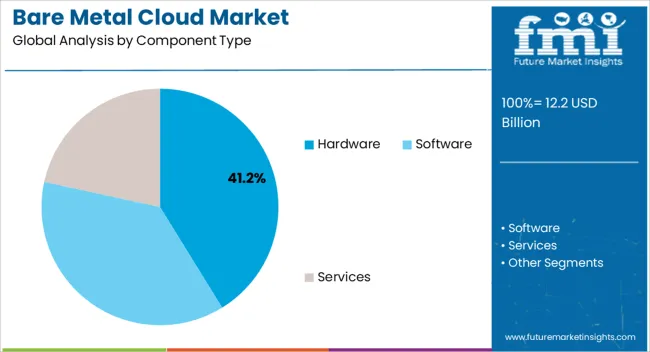
The hardware component type segment is projected to hold 41.2% of the Bare Metal Cloud market revenue in 2026, making it the leading component. Its dominance is being driven by the increasing demand for high-performance physical servers that provide dedicated resources without the limitations of shared virtual environments. Organizations are leveraging hardware-based solutions to achieve predictable performance, lower latency, and improved reliability for critical workloads such as enterprise applications, database management, and high-performance computing.
The ability to customize server configurations, including CPU, memory, storage, and networking capabilities, allows businesses to optimize resources for specific applications. Security and compliance benefits are further supporting adoption, as physical isolation reduces risks associated with multi-tenant environments.
The scalability, high availability, and enhanced operational control offered by hardware-based bare metal solutions are strengthening market leadership As enterprises continue to pursue hybrid cloud strategies and seek infrastructure that supports compute-intensive workloads while maintaining governance standards, the hardware component segment is expected to maintain its dominant position and drive overall market growth.
Market Overview
Bare Metal Cloud Market Overview
Growing demand for high performance and flexible cloud services drives the growth of global bare metal cloud market. Bare metal cloud is a single tenant server with a non-virtualized cloud infrastructure.
The bare metal cloud environment allows an organization to rent dedicated servers and hardware resources from a remote cloud service provider. Bare metal cloud configuration delivers high performance cost effective solutions for organizations, by replacing the virtualization of cloud with a single dedicated tenant server.
The bare metal cloud service is ideal for companies under strict regulatory requirements and in need to perform short-term, data-intensive functions, without any overhead delays. Bare metal cloud services are available with hourly and monthly pricing model, with various on-demand storage and processing capacity.
Analysis of Bare Metal Cloud Market By Key Countries
.webp "Top Country Growth Comparison Bare Metal Cloud Market Cagr (2026 2036)")
| Country | CAGR |
|---|---|
| China | 27.9% |
| India | 25.9% |
| Germany | 23.8% |
| France | 21.7% |
| UK | 19.7% |
| USA | 17.6% |
| Brazil | 15.5% |
Source: FMI analysis based on primary research and proprietary forecasting model
Country-wise Analysis
The Bare Metal Cloud Market is expected to register a CAGR of 20.7% during the forecast period, exhibiting varied country level momentum. China leads with the highest CAGR of 27.9%, followed by India at 25.9%. Developed markets such as Germany, France, and the UK continue to expand steadily, while the USA is likely to grow at consistent rates. Brazil posts the lowest CAGR at 15.5%, yet still underscores a broadly positive trajectory for the global Bare Metal Cloud Market. In 2024, Germany held a dominant revenue in the Western Europe market and is expected to grow with a CAGR of 23.8%. The USA Bare Metal Cloud Market is estimated to be valued at USD 4.3 billion in 2026 and is anticipated to reach a valuation of USD 21.8 billion by 2036. Sales are projected to rise at a CAGR of 17.6% over the forecast period between 2026 and 2036. While Japan and South Korea markets are estimated to be valued at USD 626.0 million and USD 324.6 million respectively in 2026.
Key Players in the Bare Metal Cloud Market
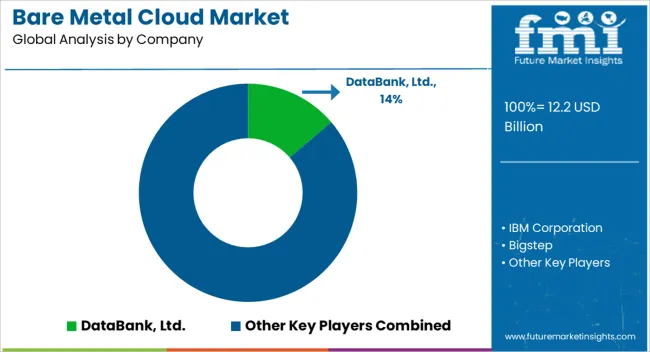
- DataBank, Ltd.
- IBM Corporation
- Bigstep
- Equiix Metal
- Hivelocity, Inc
- Hetzner Online GmbH
- HorizonlQ
- Linode, LLC
- Lumen Technologies
- OVH SAS
- Oracle Corporation
- phoenixNAP
- Scaleway SAS
- Vapor IO
- Zenlayer
Scope of the Report
| Metric | Value |
|---|---|
| Quantitative Units | USD 14.73 Billion to USD 96.64 Billion, at a CAGR of 20.70% |
| Market Definition | Bare metal cloud delivers dedicated, single-tenant physical servers through cloud consumption models without virtualization, providing direct hardware access for AI training, HPC, trading, and data sovereignty workloads with cloud provisioning flexibility. |
| Segmentation | Component Type: Hardware, Software, and Services |
| Regions Covered | North America, Latin America, Europe, East Asia, South Asia, Oceania, Middle East & Africa |
| Countries Covered | China, India, Germany, France, UK, USA, Brazil, and 40 plus countries |
| Key Companies Profiled | DataBank, Ltd., IBM Corporation, Equinix Metal, Hivelocity, Inc, Hetzner Online GmbH, Linode, LLC, Lumen Technologies, OVH SAS, Oracle Corporation, phoenixNAP, Scaleway SAS, Vapor IO, Zenlayer |
| Forecast Period | 2026 to 2036 |
| Approach | Forecasting models apply a bottom-up methodology starting with installed base metrics and projecting conversion rates to technology adoption. |
Bare Metal Cloud Market by Segments
Component Type:
- Hardware
- Software
- Services
Region:
- North America
- USA
- Canada
- Mexico
- Latin America
- Brazil
- Chile
- Rest of Latin America
- Western Europe
- Germany
- UK
- Italy
- Spain
- France
- Nordic
- BENELUX
- Rest of Western Europe
- Eastern Europe
- Russia
- Poland
- Hungary
- Balkan & Baltic
- Rest of Eastern Europe
- East Asia
- China
- Japan
- South Korea
- South Asia and Pacific
- India
- ASEAN
- Australia & New Zealand
- Rest of South Asia and Pacific
- Middle East & Africa
- Kingdom of Saudi Arabia
- Other GCC Countries
- Turkiye
- South Africa
- Other African Union
- Rest of Middle East & Africa
Bibliography
- 1. European Commission. (2024). GDPR Implementation: Data Processing Infrastructure Sovereignty Requirements. European Commission.
- 2. Ministry of Electronics and Information Technology, India. (2024). Digital India Programme: Cloud Infrastructure Investment and Data Localization Framework. MeitY.
- 3. Cyberspace Administration of China. (2024). Data Security Law Implementation: Cloud Infrastructure Compliance Requirements. CAC.
- 4. USA General Services Administration. (2024). FedRAMP Authorization: Bare Metal Cloud Service Assessment Framework. GSA.
- 5. Organisation for Economic Co-operation and Development. (2024). AI Compute Infrastructure: Investment Trends and Policy Implications. OECD.
- 6. Autorite Nationale en matiere de Securite des Systemes d Information. (2024). SecNumCloud Qualification: Sovereign Cloud Infrastructure Requirements. ANSSI.
This bibliography is provided for reader reference. The full FMI report contains the complete reference list with primary research documentation.
Frequently Asked Questions
How large is the demand for Bare Metal Cloud in the global market in 2026?
Demand for bare metal cloud in the global market is estimated to be valued at USD 14.73 billion in 2026.
What will be the market size by 2036?
Market size for bare metal cloud is projected to reach USD 96.64 billion by 2036.
What is the expected CAGR between 2026 and 2036?
Demand is expected to grow at a CAGR of 20.70% between 2026 and 2036.
Which Component Type is poised to lead global sales by 2026?
Hardware accounts for 41.2% share in 2026 reflecting the capital-intensive GPU server procurement required for AI training bare metal capacity.
What is driving demand in China?
AI training infrastructure buildout, data sovereignty compliance, and enterprise cloud migration under digital economy programmes fuel the fastest growth at 27.9% CAGR through 2036.
What is included in the scope of this report?
The market covers bare metal server hardware, management software, provisioning services, GPU-accelerated instances, and managed bare metal services across public, dedicated, and private cloud deployments.
What is excluded from the scope of this report?
Multi-tenant virtualized cloud, traditional colocation, conventional dedicated hosting without on-demand provisioning, and HCI software without bare metal deployment are excluded.
What are the key data sovereignty drivers?
GDPR, LGPD, Chinese Data Security Law, and FedRAMP requirements mandate single-tenant physical infrastructure isolation that only bare metal cloud can provide.
Preview the report firsthand - request a free sample
Get SampleGet the brochure for pricing and purchase details.
Get PDFTable of Content
- Executive Summary
- Global Market Outlook
- Demand-side Trends
- Supply-side Trends
- Technology Roadmap Analysis
- Analysis and Recommendations
- Market Overview
- Market Coverage / Taxonomy
- Market Definition / Scope / Limitations
- Research Methodology
- Chapter Orientation
- Analytical Lens and Working Hypotheses
- Market Structure, Signals, and Trend Drivers
- Benchmarking and Cross-market Comparability
- Market Sizing, Forecasting, and Opportunity Mapping
- Research Design and Evidence Framework
- Desk Research Programme (Secondary Evidence)
- Company Annual and Sustainability Reports
- Peer-reviewed Journals and Academic Literature
- Corporate Websites, Product Literature, and Technical Notes
- Earnings Decks and Investor Briefings
- Statutory Filings and Regulatory Disclosures
- Technical White Papers and Standards Notes
- Trade Journals, Industry Magazines, and Analyst Briefs
- Conference Proceedings, Webinars, and Seminar Materials
- Government Statistics Portals and Public Data Releases
- Press Releases and Reputable Media Coverage
- Specialist Newsletters and Curated Briefings
- Domain Subject-matter Experts
- Scientists
- Physicians and Other Healthcare Professionals
- Governance, Ethics, and Data Stewardship
- Research Ethics
- Data Integrity and Handling
- Desk Research Programme (Secondary Evidence)
- Tooling, Models, and Reference Databases
- Data Engineering and Model Build
- Data Acquisition and Ingestion
- Cleaning, Normalisation, and Verification
- Synthesis, Triangulation, and Analysis
- Quality Assurance and Audit Trail
- Market Background
- Market Dynamics
- Drivers
- Restraints
- Opportunity
- Trends
- Scenario Forecast
- Demand in Optimistic Scenario
- Demand in Likely Scenario
- Demand in Conservative Scenario
- Opportunity Map Analysis
- Product Life Cycle Analysis
- Supply Chain Analysis
- Investment Feasibility Matrix
- Value Chain Analysis
- PESTLE and Porter’s Analysis
- Regulatory Landscape
- Regional Parent Market Outlook
- Production and Consumption Statistics
- Import and Export Statistics
- Market Dynamics
- Global Market Analysis 2021 to 2025 and Forecast, 2026 to 2036
- Historical Market Size Value (USD Million) Analysis, 2021 to 2025
- Current and Future Market Size Value (USD Million) Projections, 2026 to 2036
- Y-o-Y Growth Trend Analysis
- Absolute $ Opportunity Analysis
- Global Market Pricing Analysis 2021 to 2025 and Forecast 2026 to 2036
- Global Market Analysis 2021 to 2025 and Forecast 2026 to 2036, By Component Type
- Introduction / Key Findings
- Historical Market Size Value (USD Million) Analysis By Component Type , 2021 to 2025
- Current and Future Market Size Value (USD Million) Analysis and Forecast By Component Type , 2026 to 2036
- Hardware
- Software
- Services
- Hardware
- Y-o-Y Growth Trend Analysis By Component Type , 2021 to 2025
- Absolute $ Opportunity Analysis By Component Type , 2026 to 2036
- Global Market Analysis 2021 to 2025 and Forecast 2026 to 2036, By Region
- Introduction
- Historical Market Size Value (USD Million) Analysis By Region, 2021 to 2025
- Current Market Size Value (USD Million) Analysis and Forecast By Region, 2026 to 2036
- North America
- Latin America
- Western Europe
- Eastern Europe
- East Asia
- South Asia and Pacific
- Middle East & Africa
- Market Attractiveness Analysis By Region
- North America Market Analysis 2021 to 2025 and Forecast 2026 to 2036, By Country
- Historical Market Size Value (USD Million) Trend Analysis By Market Taxonomy, 2021 to 2025
- Market Size Value (USD Million) Forecast By Market Taxonomy, 2026 to 2036
- By Country
- USA
- Canada
- Mexico
- By Component Type
- By Country
- Market Attractiveness Analysis
- By Country
- By Component Type
- Key Takeaways
- Latin America Market Analysis 2021 to 2025 and Forecast 2026 to 2036, By Country
- Historical Market Size Value (USD Million) Trend Analysis By Market Taxonomy, 2021 to 2025
- Market Size Value (USD Million) Forecast By Market Taxonomy, 2026 to 2036
- By Country
- Brazil
- Chile
- Rest of Latin America
- By Component Type
- By Country
- Market Attractiveness Analysis
- By Country
- By Component Type
- Key Takeaways
- Western Europe Market Analysis 2021 to 2025 and Forecast 2026 to 2036, By Country
- Historical Market Size Value (USD Million) Trend Analysis By Market Taxonomy, 2021 to 2025
- Market Size Value (USD Million) Forecast By Market Taxonomy, 2026 to 2036
- By Country
- Germany
- UK
- Italy
- Spain
- France
- Nordic
- BENELUX
- Rest of Western Europe
- By Component Type
- By Country
- Market Attractiveness Analysis
- By Country
- By Component Type
- Key Takeaways
- Eastern Europe Market Analysis 2021 to 2025 and Forecast 2026 to 2036, By Country
- Historical Market Size Value (USD Million) Trend Analysis By Market Taxonomy, 2021 to 2025
- Market Size Value (USD Million) Forecast By Market Taxonomy, 2026 to 2036
- By Country
- Russia
- Poland
- Hungary
- Balkan & Baltic
- Rest of Eastern Europe
- By Component Type
- By Country
- Market Attractiveness Analysis
- By Country
- By Component Type
- Key Takeaways
- East Asia Market Analysis 2021 to 2025 and Forecast 2026 to 2036, By Country
- Historical Market Size Value (USD Million) Trend Analysis By Market Taxonomy, 2021 to 2025
- Market Size Value (USD Million) Forecast By Market Taxonomy, 2026 to 2036
- By Country
- China
- Japan
- South Korea
- By Component Type
- By Country
- Market Attractiveness Analysis
- By Country
- By Component Type
- Key Takeaways
- South Asia and Pacific Market Analysis 2021 to 2025 and Forecast 2026 to 2036, By Country
- Historical Market Size Value (USD Million) Trend Analysis By Market Taxonomy, 2021 to 2025
- Market Size Value (USD Million) Forecast By Market Taxonomy, 2026 to 2036
- By Country
- India
- ASEAN
- Australia & New Zealand
- Rest of South Asia and Pacific
- By Component Type
- By Country
- Market Attractiveness Analysis
- By Country
- By Component Type
- Key Takeaways
- Middle East & Africa Market Analysis 2021 to 2025 and Forecast 2026 to 2036, By Country
- Historical Market Size Value (USD Million) Trend Analysis By Market Taxonomy, 2021 to 2025
- Market Size Value (USD Million) Forecast By Market Taxonomy, 2026 to 2036
- By Country
- Kingdom of Saudi Arabia
- Other GCC Countries
- Turkiye
- South Africa
- Other African Union
- Rest of Middle East & Africa
- By Component Type
- By Country
- Market Attractiveness Analysis
- By Country
- By Component Type
- Key Takeaways
- Key Countries Market Analysis
- USA
- Pricing Analysis
- Market Share Analysis, 2025
- By Component Type
- Canada
- Pricing Analysis
- Market Share Analysis, 2025
- By Component Type
- Mexico
- Pricing Analysis
- Market Share Analysis, 2025
- By Component Type
- Brazil
- Pricing Analysis
- Market Share Analysis, 2025
- By Component Type
- Chile
- Pricing Analysis
- Market Share Analysis, 2025
- By Component Type
- Germany
- Pricing Analysis
- Market Share Analysis, 2025
- By Component Type
- UK
- Pricing Analysis
- Market Share Analysis, 2025
- By Component Type
- Italy
- Pricing Analysis
- Market Share Analysis, 2025
- By Component Type
- Spain
- Pricing Analysis
- Market Share Analysis, 2025
- By Component Type
- France
- Pricing Analysis
- Market Share Analysis, 2025
- By Component Type
- India
- Pricing Analysis
- Market Share Analysis, 2025
- By Component Type
- ASEAN
- Pricing Analysis
- Market Share Analysis, 2025
- By Component Type
- Australia & New Zealand
- Pricing Analysis
- Market Share Analysis, 2025
- By Component Type
- China
- Pricing Analysis
- Market Share Analysis, 2025
- By Component Type
- Japan
- Pricing Analysis
- Market Share Analysis, 2025
- By Component Type
- South Korea
- Pricing Analysis
- Market Share Analysis, 2025
- By Component Type
- Russia
- Pricing Analysis
- Market Share Analysis, 2025
- By Component Type
- Poland
- Pricing Analysis
- Market Share Analysis, 2025
- By Component Type
- Hungary
- Pricing Analysis
- Market Share Analysis, 2025
- By Component Type
- Kingdom of Saudi Arabia
- Pricing Analysis
- Market Share Analysis, 2025
- By Component Type
- Turkiye
- Pricing Analysis
- Market Share Analysis, 2025
- By Component Type
- South Africa
- Pricing Analysis
- Market Share Analysis, 2025
- By Component Type
- USA
- Market Structure Analysis
- Competition Dashboard
- Competition Benchmarking
- Market Share Analysis of Top Players
- By Regional
- By Component Type
- Competition Analysis
- Competition Deep Dive
- DataBank, Ltd.
- Overview
- Product Portfolio
- Profitability by Market Segments (Product/Age /Sales Channel/Region)
- Sales Footprint
- Strategy Overview
- Marketing Strategy
- Product Strategy
- Channel Strategy
- IBM Corporation
- Bigstep
- Equiix Metal
- Hivelocity, Inc
- Hetzner Online GmbH
- HorizonlQ
- Linode, LLC
- Lumen Technologies
- OVH SAS
- Oracle Corporation
- phoenixNAP
- Scaleway SAS
- Vapor IO
- Zenlayer
- DataBank, Ltd.
- Competition Deep Dive
- Assumptions & Acronyms Used


