

- Industry Size (2026)
- USD 0.77 Mn
- Forecast (2036)
- USD 2.00 Mn
- CAGR (2026 to 2036)
- 10%
Demand for Bubble Tea in EU Size, Market Forecast and Outlook By FMI
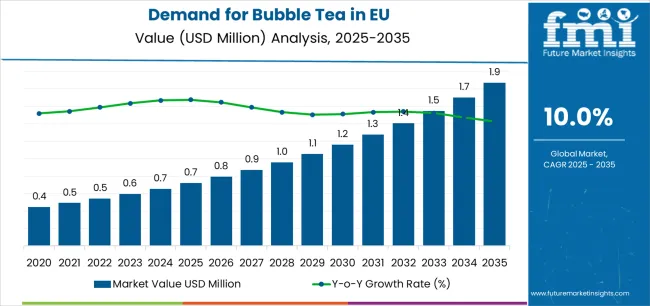
The Demand for Bubble Tea in EU was valued at USD 0.70 million in 2025, projected to reach USD 0.77 million in 2026, and is forecast to expand to USD 2.00 million by 2036 at a 10% CAGR. Rapid expansion of bubble tea retail chains and growing consumer adoption of Asian-origin beverage formats across EU urban markets are accelerating demand for ready-to-drink and made-to-order bubble tea products. The category is transitioning from a niche specialty beverage into a mainstream food service offering, with franchise operations scaling across major European metropolitan areas.
Summary of Demand for Bubble Tea in EU
- Market Snapshot
- The market is valued at USD 0.70 million in 2025 and is projected to reach USD 2.00 million by 2036.
- The industry is expected to grow at a 10% CAGR from 2026 to 2036, creating an incremental opportunity of USD 1.2 million.
- The market is a consumer-trend-driven, franchise-scaled beverage category where brand recognition, retail location density, and social media engagement define competitive positioning.
- Demand and Growth Drivers
- Youth demographic adoption (16 to 35 age group) driven by social media exposure and cultural mainstreaming of Asian beverage formats is the primary demand driver.
- Franchise-based retail network expansion across EU metropolitan areas is scaling distribution reach and brand visibility.
- Ready-to-drink product availability in convenience stores and online channels is extending consumption occasions beyond food service locations.
- Among key countries, Rest of Europe is at 10.8% CAGR, Netherlands is at 10.5% CAGR, Spain is at 10.2% CAGR, Italy is at 9.8% CAGR, France is at 9.4% CAGR, Germany is at 9.2% CAGR.
- Product and Segment View
- The market covers bubble tea products in ready-to-drink and made-to-order formats, incorporating tapioca pearls, popping boba, jelly, and other toppings across flavored and unflavored base beverages.
- Distribution spans food service (franchise stores, cafes), indirect retail, and online channels.
- Ready-to-Drink leads the Nature segment with 87.6% share in 2026.
- Tapioca Pearls leads the Product Type segment with 40% share in 2026.
- Geography and Competitive Outlook
- Rest of Europe leads growth at 10.8% CAGR, while Germany tracks at 9.2% reflecting a more mature demand base.
- Rest of Europe and the Netherlands lead growth rates as franchise expansion reaches newer urban markets, while Germany and France anchor established demand.
- Competition is shaped by Gong Cha, CoCo Fresh Tea & Juice, Tiger Sugar, Sharetea, Chatime, The Alley, Yi Fang Taiwan Fruit Tea.
Demand for Bubble Tea in EU Key Takeaways
| Metric | Details |
|---|---|
| Industry Size (2026) | USD 0.77 million |
| Industry Value (2036) | USD 2.00 million |
| CAGR (2026 to 2036) | 10% |
Source: Future Market Insights, 2026
The EU Demand for Bubble Tea in EU operates under food safety and labelling requirements established by Regulation (EU) No 1169/2011, with specific attention to allergen disclosure for tapioca-based and dairy-containing formulations. Novel Food regulation under Regulation (EU) 2015/2283 governs the authorization status of certain functional additions such as popping boba and specialty toppings. FMI analysts note that the structural growth driver for this market is the cultural mainstreaming of bubble tea consumption among EU consumers aged 16 to 35, supported by social media-driven brand awareness and the rapid scaling of franchise-based retail networks across Germany, France, the Netherlands, and Southern European markets.
All major markets reflect differentiated growth trajectories through 2036. Rest of Europe is projected at a 10.8% CAGR, Netherlands is projected at a 10.5% CAGR, Spain is projected at a 10.2% CAGR, Italy is projected at a 9.8% CAGR, France is projected at a 9.4% CAGR, Germany is projected at a 9.2% CAGR. Rest of Europe leads at 10.8% CAGR, reflecting emerging adoption in Central and Eastern European urban markets. Germany tracks at 9.2%, supported by its large youth demographic and established Asian food service infrastructure in major cities.
Demand for Bubble Tea in EU Definition
The Demand for Bubble Tea in EU encompasses tea-based beverages combined with chewy tapioca pearls, popping boba, fruit jellies, or other textured toppings, served in ready-to-drink or made-to-order formats. The EU market is supplied through franchise-operated retail stores, independent food service outlets, and packaged ready-to-drink products distributed through convenience stores and online channels.
Demand for Bubble Tea in EU Inclusions
Market scope includes ready-to-drink and made-to-order bubble tea products across tapioca pearl, popping boba, and jelly topping variants. Coverage extends across food service, indirect retail, and online distribution channels with EU-level and country-level sizing for 2026 to 2036.
Demand for Bubble Tea in EU Exclusions
The scope excludes standard iced tea and flavored tea products without boba or textured toppings. Raw tapioca starch sold as a bulk commodity and tea leaves sold for home brewing are outside the analytical boundary.
Demand for Bubble Tea in EU Research Methodology
- Primary Research: Analysts engaged with procurement directors, production managers, and supply chain leads across relevant manufacturing and distribution companies to map purchasing specifications and volume trends.
- Desk Research: Data collection aggregated regulatory filings, trade association publications, statistical agency databases, and company annual reports to establish baseline market parameters.
- Market-Sizing and Forecasting: Baseline values derive from a bottom-up aggregation of production volumes and trade flow data, applying country-specific consumption curves to project adoption velocity through 2036.
- Data Validation and Update Cycle: Projections are tested against publicly reported industry data and verified through cross-referencing with official statistical databases. Models are updated on a quarterly cycle.
Why is the Demand for Bubble Tea in EU Growing?
Industry expansion is being supported by the rising influence of Asian culture among European consumers and the demand for customizable, Instagram-worthy beverages that deliver both sensory and social experiences. Bubble tea enables convenient incorporation of diverse flavors, textures, and visual elements into personalized drinks without the limitations of traditional beverages. The category benefits from dual drivers: necessity-driven adoption by food service operators seeking differentiated offerings to attract younger customers, and choice-driven consumer demand for novel experiences like popping boba and cheese foam toppings. This convergence of customization, visual appeal, and experiential value is creating sustained opportunities across food service, retail, and online channels.
The growing body of social media content linking bubble tea with lifestyle, fashion, and cultural trends is driving uptake across multiple demographic segments. European millennials and Generation Z consumers view bubble tea as more than a beverage—it represents cultural sophistication, global awareness, and social currency. The ritualistic aspects of ordering, customizing, and consuming bubble tea create memorable experiences that traditional beverages cannot replicate. Producers with established brand recognition and authentic Taiwanese or Asian heritage gain competitive advantages by offering credibility and quality assurance. At the same time, local adaptations incorporating European flavors and preferences provide differentiation while maintaining the core bubble tea experience.
Expanding distribution channels and consumption occasions further elevate the role of bubble tea in EU industry. The beverage's versatility allows positioning as an afternoon refreshment, a dessert replacement, or a social drink, creating multiple daily consumption opportunities. Regulatory trends favoring natural ingredients over artificial additives support bubble tea's use of real fruit, natural sweeteners, and authentic tea bases. Beyond core food service applications, bubble tea is increasingly seen as a customizable platform for innovation, enabling operators to introduce seasonal offerings, limited editions, and collaborative flavors.
Segmental Analysis
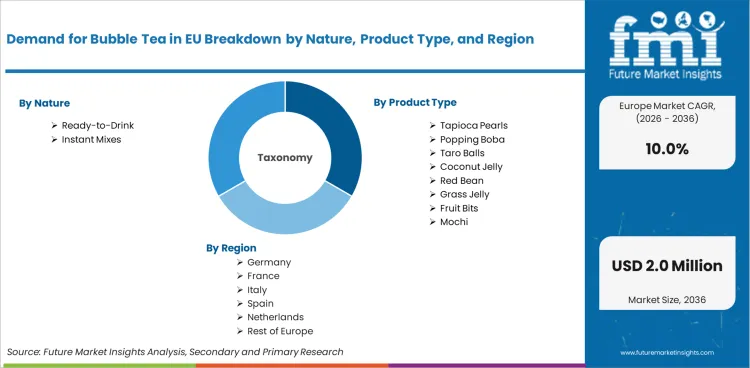
Sales of bubble tea are segmented by product type (toppings), nature (format), application (flavor), distribution channel, and region. By product type, demand spans tapioca pearls, popping boba, taro balls, coconut jelly, red bean, grass jelly, fruit bits, and mochi, with tapioca pearls leading but gradually losing share to innovative alternatives. By nature, the industry is split between ready-to-drink and instant mixes, with ready-to-drink dominant but instant mixes gaining traction. Application segmentation includes flavored, unflavored, and residential categories; flavored variants lead and continue expanding. By distribution channel, products are sold through food service, indirect retail, and online retail; food service leads but online shows fastest growth. Regionally, sales cover Germany, France, Italy, Spain, Netherlands, and Rest of Europe, with Rest of Europe demonstrating the highest growth rates.
By Product Type, Tapioca Pearls Account for 40% Share by 2036
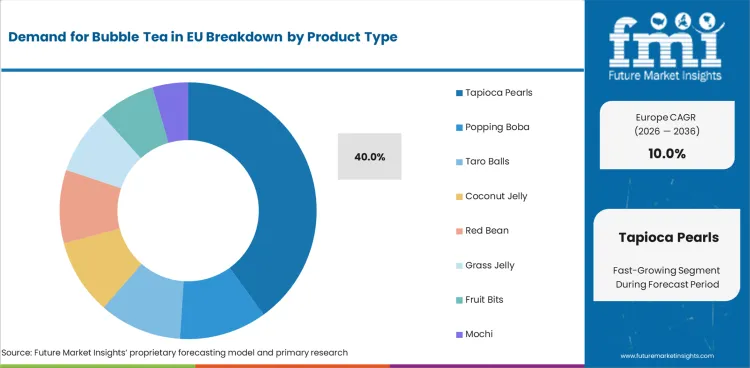
The tapioca pearls segment is projected to account for 42.6% of EU bubble tea sales in 2026, declining to 40% by 2036, while maintaining its position as the largest topping category despite gradual industry share erosion to innovative alternatives. This dominant position reflects tapioca pearls' iconic status as the original and most recognizable bubble tea component, with their distinctive chewy texture and subtle sweetness providing the authentic bubble tea experience that consumers expect. The slight share decline indicates industry maturation and diversification as consumers explore novel toppings while still maintaining strong loyalty to traditional offerings.
Popping boba emerges as a key growth driver, expanding from 13.0% share in 2026 to 14.0% by 2036, capitalizing on its Instagram-worthy appeal and explosive flavor delivery. These juice-filled spheres provide dramatic burst-in-mouth sensations that enhance the multisensory experience and create shareable social media moments. Fruit bits demonstrate similar expansion from 11.0% to 12.0% share, benefiting from health-conscious consumers seeking real fruit ingredients with natural sweetness and nutritional benefits.
Traditional Asian toppings maintain stable niche positions, with grass jelly holding 7.0% share, coconut jelly growing from 8.0% to 8.5%, and taro balls expanding from 7.0% to 7.5%, while red bean declines from 6.0% to 5.5% and mochi maintains 5.4-5.5% share throughout the forecast period.
Key advantages:
- Tapioca pearls provide authentic experience driving core demand
- Innovative toppings enable menu differentiation and premium pricing
- Diverse options cater to varying taste preferences and dietary requirements
By Nature, Ready-to-Drink Segment Accounts for 87.6% Share by 2036
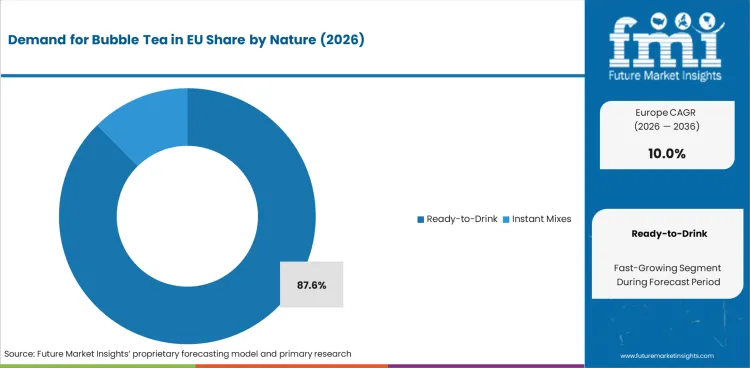
Ready-to-drink bubble tea is positioned to represent 87.6% of total EU industry demand in 2026, declining slightly to 85.0% by 2036, reflecting sustained consumer preference for professionally prepared beverages despite growing instant mix alternatives. This leading share demonstrates the importance of authentic preparation, optimal texture achievement, and immediate consumption convenience in driving bubble tea adoption across European industrys.
The RTD segment benefits from the expertise required for proper pearl cooking, tea brewing, and flavor balancing that ensures consistent quality difficult to replicate at home. Food service outlets provide the social environment, customization options, and experiential elements that transform bubble tea from mere beverage to lifestyle experience. Bottled and canned RTD options in retail channels offer grab-and-go convenience while maintaining quality standards through specialized packaging and preservation techniques.
The instant mix segment's growth from 12.4% share in 2026 to 15.0% by 2036 reflects evolving consumer capabilities and industry education, with improved product quality, detailed preparation instructions, and readily available ingredients enabling satisfactory home preparation experiences.
Key drivers:
- Professional preparation ensuring quality and consistency
- Social and experiential aspects of bubble tea shop visits
- Convenience of ready-to-consume options in retail channels
What are the Drivers, Restraints, and Key Trends?
EU bubble tea sales are advancing rapidly due to increasing influence of Asian popular culture, rising demand for customizable and Instagram-worthy beverages, and the shift toward experiential consumption that prioritizes novelty and personalization over traditional beverage attributes. However, the industry faces challenges, including high sugar content concerns driving regulatory scrutiny, premium pricing that can limit mass industry adoption, and supply chain complexities tied to specialized ingredients and equipment. Continued innovation in health-conscious formulations and sustainable packaging remains central to addressing consumer concerns while unlocking new industry segments across demographics and consumption occasions.
Cultural Globalization and Social Media Influence
The rapid proliferation of Asian popular culture across Europe is fundamentally transforming beverage preferences and consumption patterns among younger demographics. K-pop, anime, and Asian drama consumption creates cultural affinity that extends to food and beverage choices, with bubble tea serving as accessible entry point to Asian lifestyle trends. Social media platforms, particularly TikTok and Instagram, amplify bubble tea's visual appeal through viral challenges, aesthetic presentations, and influencer endorsements that drive awareness and trial among trend-conscious consumers.
Major European cities witness bubble tea shops becoming social hubs comparable to traditional cafes but with distinct cultural positioning appealing to digitally native generations. The photogenic nature of colorful drinks with distinctive toppings creates user-generated content that provides organic industrying reach exceeding traditional advertising effectiveness. Customization options enabling personalized creations further enhance social sharing potential while building emotional connections with brands.
Health Consciousness and Product Reformulation
Modern bubble tea producers systematically address health concerns through reformulation strategies, offering reduced sugar options, natural sweeteners, and functional ingredients that align with wellness trends. The ability to customize sweetness levels empowers consumers to balance taste preferences with health goals, while expanding non-dairy alternatives caters to lactose intolerant and vegan segments. Integration of superfoods, probiotics, and adaptogens positions bubble tea within the broader functional beverage category rather than purely indulgent treat.
Leading operators implement transparency initiatives, providing detailed nutritional information and ingredient sourcing details that build trust with health-conscious consumers. Partnerships with fitness influencers and wellness brands help reposition bubble tea from guilty pleasure to acceptable treat within balanced lifestyles. Development of low-calorie toppings and sugar-free options expands addressable industry while maintaining taste and texture expectations.
Sustainability and Environmental Responsibility
European consumers increasingly prioritize environmental considerations in purchase decisions, pushing bubble tea operators toward sustainable practices throughout value chains. The transition from plastic to biodegradable straws and cups addresses immediate environmental concerns while demonstrating brand responsibility. Implementation of reusable cup programs with incentive structures builds customer loyalty while reducing single-use packaging waste.
Supply chain sustainability extends to ingredient sourcing, with organic tea bases, fair trade practices, and local fruit suppliers where feasible reducing environmental footprints while supporting premium positioning. Energy-efficient store designs, waste reduction programs, and carbon offset initiatives align with European sustainability values. These environmental commitments transition from differentiators to table stakes as consumers expect responsible practices from food service operators.
Demand Analysis by Key Countries
.webp "Top Country Growth Comparison Demand For Bubble Tea In Eu Cagr (2026 2036)")
| Country | CAGR % (2026-2036) |
|---|---|
| Rest of Europe | 10.8% |
| Netherlands | 10.5% |
| Spain | 10.2% |
| Italy | 9.8% |
| France | 9.4% |
| Germany | 9.2% |

Germany Maintains Leadership with Industry Scale
Germany is projected to remain the largest EU bubble tea industry, expanding from USD 173.0 million in 2026 to USD 417.1 million by 2036, at a 9.2% CAGR. Growth is anchored by Germany's large population, urban concentration, and established Asian communities that provide both supply and demand foundations. Major cities like Berlin, Munich, and Hamburg demonstrate high bubble tea shop density, with Berlin emerging as the European bubble tea capital featuring diverse offerings from premium chains to innovative independents.
German industry development benefits from systematic expansion strategies, with chains leveraging franchise models for rapid scaling while maintaining quality standards. Local adaptation includes reduced sweetness levels aligning with German preferences and seasonal flavors incorporating local fruits. Strong delivery infrastructure and digital adoption enable omnichannel strategies reaching consumers across multiple touchpoints.
Growth drivers:
- Large addressable industry with high urbanization
- Established Asian communities providing authenticity
- Systematic franchise expansion ensuring quality scaling
France Benefits from Premium Positioning and Café Culture
France is forecast to grow from USD 129.7 million in 2026 to USD 318.6 million in 2036, recording a 9.4% CAGR. Growth is supported by French consumers' appreciation for quality beverages, willingness to pay premiums for authentic preparation, and integration of bubble tea into established café culture. Parisian adoption leads national trends, with specialized shops in trendy arrondissements setting standards for presentation and quality that influence broader industry development.
French operators emphasize artisanal preparation methods, premium ingredients, and sophisticated flavor profiles that resonate with discerning consumers. Integration of French culinary elements, such as lavender, violet, and local fruit varieties, creates unique positioning while maintaining bubble tea authenticity. The industry benefits from strong tourist flows seeking Instagram-worthy experiences and authentic Asian beverages.
Success factors:
- Premium positioning aligning with quality expectations
- Integration with established café culture
- Tourist demand supplementing local consumption
Italy Demonstrates Accelerating Adoption Despite Cultural Barriers
Italy's bubble tea sales are projected to expand from USD 100.9 million in 2026 to USD 257.0 million in 2036, reflecting a 9.8% CAGR that exceeds larger industrys despite initial resistance from strong coffee culture. Growth is shaped by younger Italian consumers' increasing openness to international beverages and desire for novel experiences that differentiate from traditional options. Milan leads adoption as a fashion and business hub with international exposure, while Rome, Turin, and Naples show expanding presence.
Italian industry development requires careful positioning that respects coffee culture while offering distinct value propositions. Smaller serving sizes, afternoon consumption positioning, and integration with aperitivo culture enable bubble tea to complement rather than compete with established beverages. Quality emphasis on tea selection and preparation methods appeals to Italian appreciation for craftsmanship and authenticity.
Development factors:
- Youth demographic driving cultural change
- Positioning as complementary to coffee culture
- Quality focus resonating with Italian values
Spain Shows Robust Expansion with Social Culture Alignment
Spain's bubble tea demand is set to grow from USD 79.3 million in 2026 to USD 209.4 million by 2036, at a 10.2% CAGR, the highest among major established industrys. Expansion is supported by Spanish social culture emphasizing group gatherings, extended leisure time, and openness to international trends. Madrid and Barcelona lead with vibrant scenes in university districts and shopping areas, while coastal cities benefit from tourist demand.
Spanish consumption patterns favor larger sharing sizes, group orders, and extended consumption occasions that increase average transaction values. Late-night culture creates additional dayparts beyond traditional beverage timings. Price sensitivity drives value positioning and promotional strategies that build trial and repeat purchase behavior among student and young professional segments.
Growth enablers:
- Social culture aligning with bubble tea consumption
- Extended operating hours matching lifestyle patterns
- Tourist demand supplementing local growth
Netherlands Leads in Innovation and Early Adoption
The Netherlands is forecast to expand from USD 43.2 million in 2026 to USD 117.4 million by 2036, advancing at a 10.5% CAGR, reflecting the industry's innovation orientation and early adopter characteristics. Growth is driven by Dutch consumers' international outlook, experimental nature, and appreciation for novel experiences that differentiate from traditional offerings. Amsterdam's multicultural environment supports diverse bubble tea concepts from authentic Taiwanese to fusion innovations.
Dutch industry development benefits from high population density, cycling infrastructure enabling easy access, and digital payment adoption facilitating transactions. Innovation extends to sustainable packaging, plant-based alternatives, and technology integration that positions the Netherlands as a testing ground for concepts potentially scalable across Europe. Strong English proficiency enables international brands to enter easily while local operators expand internationally.
Innovation drivers:
- Early adopter consumers embracing novelty
- Sustainability focus driving packaging innovation
- Technology adoption enabling operational efficiency
Rest of Europe Shows Highest Growth Potential
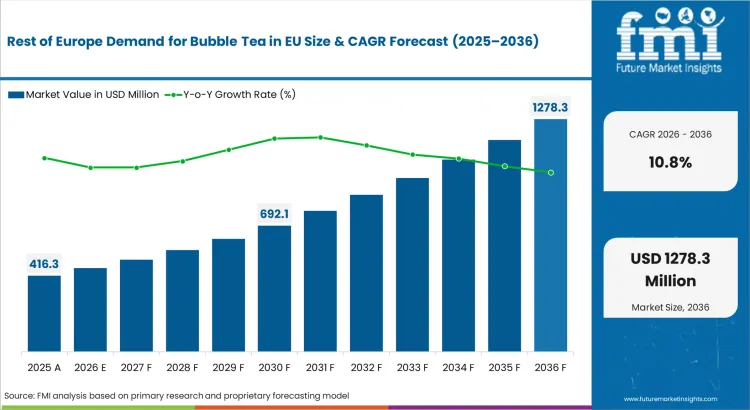
The Rest of Europe segment, including Belgium, Austria, Poland, Scandinavia, and Eastern Europe, is projected to grow from USD 194.6 million in 2026 to USD 544.6 million by 2036, at the fastest 10.8% CAGR. Growth reflects diverse industry dynamics: Nordic countries demonstrate premium positioning with high willingness to pay, Eastern European industrys offer volume opportunities with expanding middle classes, and smaller Western European industrys benefit from spillover effects from neighboring countries.
Poland emerges as a significant growth driver with young demographics, rising disposable incomes, and increasing Western influence. Scandinavian industrys command premium pricing through quality positioning and sustainability emphasis. Belgium benefits from EU institution presence and international population. Austria leverages proximity to Germany for supply chain efficiencies. Collectively, these industrys provide portfolio diversification and growth acceleration opportunities.
Potential drivers:
- Lower saturation enabling rapid expansion
- Diverse industry characteristics providing portfolio balance
- Emerging middle class in Eastern Europe driving volume
Europe Industry Split by Countr
EU bubble tea sales are projected to grow from USD 720.7 million in 2026 to USD 1,864.0 million by 2036, registering a strong CAGR of 10.0% over the forecast period. The Rest of Europe region is expected to demonstrate the fastest growth trajectory with a 10.8% CAGR, supported by emerging industry dynamics, lower saturation levels, and rapid adoption among youth populations. The Netherlands follows with a 10.5% CAGR, attributed to its innovation ecosystem, early adopter consumers, and strategic position as a testing ground for new concepts.
Spain records a 10.2% CAGR, supported by youth enthusiasm, tourism influences, and late-night consumption culture. Italy shows 9.8% CAGR, reflecting accelerating adoption despite initial coffee culture resistance. France contributes a 9.4% CAGR, underpinned by premiumization trends and sophisticated flavor preferences. Germany, while the largest individual industry, grows at 9.2% CAGR, reflecting industry maturity balanced with continued expansion opportunities.
Competitive Landscape
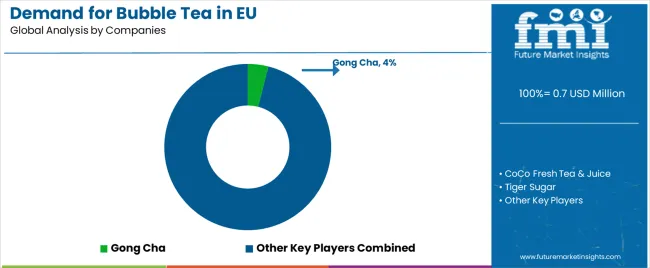
The EU bubble tea industry is characterized by fragmentation with specialized chains, regional operators, and independent shops collectively shaping competitive dynamics. Industry leadership remains distributed, with the top four chains collectively holding only 10.9% industry share, while independent operators and local chains account for 89.1%. This fragmentation reflects low entry barriers, diverse consumer preferences, and the importance of local industry knowledge in successful operations.
Gong Cha leads the industry with an estimated 4% share, leveraging its Taiwanese heritage, global brand recognition, and systematic expansion through franchising. The company's extensive menu, consistent quality standards, and established supply chains provide competitive advantages in scaling across diverse European industrys while maintaining authenticity.
CoCo Fresh Tea & Juice follows with 3.5% share, positioned as a premium chain emphasizing fresh ingredients and extensive customization options. Its strong presence in major European capitals and focus on product innovation through seasonal offerings and limited editions maintains consumer interest and supports premium pricing.
Tiger Sugar holds 1.8% share through distinctive positioning around its signature brown sugar pearl milk creation that achieved viral social media status. The brand's limited availability and queue culture create exclusivity perceptions that support premium pricing despite smaller store networks.
Sharetea maintains 1.6% share by balancing authenticity with local adaptation, offering extensive customization options at competitive prices that appeal to price-conscious students and young professionals.
The fragmented nature of the remaining 89.1% industry share creates both opportunities and challenges. Independent operators provide innovation, local adaptation, and competitive pricing that prevents consolidation while ensuring diverse consumer options. However, fragmentation also limits economies of scale, industrying efficiency, and negotiating power with suppliers. Consolidation trends are expected to accelerate as the industry matures, with successful regional chains potentially emerging as acquisition targets for international players seeking European industry entry or expansion.
Key Players
- Gong Cha
- CoCo Fresh Tea & Juice
- Tiger Sugar
- Sharetea
- Chatime
- The Alley
- Yi Fang Taiwan Fruit Tea
- Xing Fu Tang
- T4
- Happy Lemon
Scope of the Report
| Metric | Value |
|---|---|
| Quantitative Units | USD 0.77 million to USD 2.00 million, at a CAGR of 10% |
| Market Definition | The Demand for Bubble Tea in EU encompasses tea-based beverages combined with chewy tapioca pearls, popping boba, fruit jellies, or other textured toppings, served in ready-to-drink or made-to-order formats. Th... |
| Segmentation | Nature: Ready-to-Drink, Instant Mixes; Product Type: Tapioca Pearls, Popping Boba, Taro Balls, Coconut Jelly, Red Bean, Grass Jelly, Fruit Bits, Mochi; Application: Flavored, Unflavored, Residential; Distribution Channel: Food Service, Indirect, Online Retail |
| Regions Covered | EU (Western Europe, Southern Europe, Central Europe) |
| Countries Covered | Rest of Europe, Netherlands, Spain, Italy, France, Germany |
| Key Companies Profiled | Gong Cha, CoCo Fresh Tea & Juice, Tiger Sugar, Sharetea, Chatime, The Alley, Yi Fang Taiwan Fruit Tea, Xing Fu Tang |
| Forecast Period | 2026 to 2036 |
| Approach | Hybrid bottom-up modeling using production volume data, trade flow analysis, and primary research validation |
Key Segments
Nature (Format):
- Ready-to-Drink
- Instant Mixes
Product Type (Toppings):
- Tapioca Pearls
- Popping Boba
- Taro Balls
- Coconut Jelly
- Red Bean
- Grass Jelly
- Fruit Bits
- Mochi
Application (Flavor):
- Flavored
- Unflavored
- Residential
Distribution Channel:
- Food Service
- Indirect (Retail)
- Online Retail
Countries:
- Germany
- France
- Italy
- Spain
- Netherlands
- Rest of Europe
Bibliography
- 1. European Commission. (2024). Regulation (EU) No 1169/2011 on food information to consumers, consolidated text. EUR-Lex.
- 2. European Commission. (2024). Regulation (EU) 2015/2283 on Novel Foods, consolidated implementation guidance. EUR-Lex.
- 3. Eurostat. (2025). Non-alcoholic beverage retail and food service statistics, EU-27. European Commission Statistical Office.
- 4. European Food Safety Authority. (2024). Assessment of novel food ingredients in specialty beverages. EFSA Journal.
- 5. Food and Agriculture Organization of the United Nations. (2024). FAOSTAT: Cassava and tapioca production data. FAO.
This bibliography is provided for reader reference. The full Future Market Insights report contains the complete reference list with primary research documentation.
Frequently Asked Questions
How large is the demand for Bubble Tea in the market in 2026?
Demand for bubble tea is estimated to be valued at USD 0.77 million in 2026.
What will be the market size of Bubble Tea by 2036?
Market size for bubble tea is projected to reach USD 2.00 million by 2036.
What is the expected demand growth for Bubble Tea between 2026 and 2036?
Demand for bubble tea is expected to grow at a CAGR of 10% between 2026 and 2036.
Which Nature is poised to lead sales by 2026?
Ready-to-Drink accounts for 87.6% share in 2026, making it the leading sub-segment within the Nature category.
How is the role of Tapioca Pearls in driving bubble tea adoption in 2026?
Tapioca Pearls holds 40% of the Product Type segment share in 2026.
Which country is the fastest-growing market for bubble tea?
Rest of Europe is projected to grow at a CAGR of 10.8% during 2026 to 2036, the fastest rate among markets covered.
What is Bubble Tea and what is it mainly used for?
The Demand for Bubble Tea in EU encompasses tea-based beverages combined with chewy tapioca pearls, popping boba, fruit jellies, or other textured toppings, served in ready-to-drink or made-to-order formats. The EU market is supplied through franchise-operated retail stores, independent food service outlets, and packaged ready-to-drink products distributed through convenience stores and online channels.
How does FMI build and validate the bubble tea forecast?
Forecasting models apply a bottom-up methodology starting with production volume data and cross-validate projections against publicly reported industry statistics and primary research inputs.
Preview the report firsthand - request a free sample
Get SampleGet the brochure for pricing and purchase details.
Get PDFTable of Content
- Executive Summary
- Global Market Outlook
- Demand-side Trends
- Supply-side Trends
- Technology Roadmap Analysis
- Analysis and Recommendations
- Market Overview
- Market Coverage / Taxonomy
- Market Definition / Scope / Limitations
- Research Methodology
- Chapter Orientation
- Analytical Lens and Working Hypotheses
- Market Structure, Signals, and Trend Drivers
- Benchmarking and Cross-market Comparability
- Market Sizing, Forecasting, and Opportunity Mapping
- Research Design and Evidence Framework
- Desk Research Programme (Secondary Evidence)
- Company Annual and Sustainability Reports
- Peer-reviewed Journals and Academic Literature
- Corporate Websites, Product Literature, and Technical Notes
- Earnings Decks and Investor Briefings
- Statutory Filings and Regulatory Disclosures
- Technical White Papers and Standards Notes
- Trade Journals, Industry Magazines, and Analyst Briefs
- Conference Proceedings, Webinars, and Seminar Materials
- Government Statistics Portals and Public Data Releases
- Press Releases and Reputable Media Coverage
- Specialist Newsletters and Curated Briefings
- Sector Databases and Reference Repositories
- FMI Internal Proprietary Databases and Historical Market Datasets
- Subscription Datasets and Paid Sources
- Social Channels, Communities, and Digital Listening Inputs
- Additional Desk Sources
- Expert Input and Fieldwork (Primary Evidence)
- Primary Modes
- Qualitative Interviews and Expert Elicitation
- Quantitative Surveys and Structured Data Capture
- Blended Approach
- Why Primary Evidence is Used
- Field Techniques
- Interviews
- Surveys
- Focus Groups
- Observational and In-context Research
- Social and Community Interactions
- Stakeholder Universe Engaged
- C-suite Leaders
- Board Members
- Presidents and Vice Presidents
- R&D and Innovation Heads
- Technical Specialists
- Domain Subject-matter Experts
- Scientists
- Physicians and Other Healthcare Professionals
- Governance, Ethics, and Data Stewardship
- Research Ethics
- Data Integrity and Handling
- Primary Modes
- Tooling, Models, and Reference Databases
- Desk Research Programme (Secondary Evidence)
- Data Engineering and Model Build
- Data Acquisition and Ingestion
- Cleaning, Normalisation, and Verification
- Synthesis, Triangulation, and Analysis
- Quality Assurance and Audit Trail
- Market Background
- Market Dynamics
- Drivers
- Restraints
- Opportunity
- Trends
- Scenario Forecast
- Demand in Optimistic Scenario
- Demand in Likely Scenario
- Demand in Conservative Scenario
- Opportunity Map Analysis
- Product Life Cycle Analysis
- Supply Chain Analysis
- Investment Feasibility Matrix
- Value Chain Analysis
- PESTLE and Porter’s Analysis
- Regulatory Landscape
- Regional Parent Market Outlook
- Production and Consumption Statistics
- Import and Export Statistics
- Market Dynamics
- Global Market Analysis 2021 to 2025 and Forecast, 2026 to 2036
- Historical Market Size Value (USD Million) Analysis, 2021 to 2025
- Current and Future Market Size Value (USD Million) Projections, 2026 to 2036
- Y-o-Y Growth Trend Analysis
- Absolute $ Opportunity Analysis
- Global Market Pricing Analysis 2021 to 2025 and Forecast 2026 to 2036
- Global Market Analysis 2021 to 2025 and Forecast 2026 to 2036, By Nature
- Introduction / Key Findings
- Historical Market Size Value (USD Million) Analysis By Nature , 2021 to 2025
- Current and Future Market Size Value (USD Million) Analysis and Forecast By Nature , 2026 to 2036
- Ready-to-Drink
- Instant Mixes
- Ready-to-Drink
- Y-o-Y Growth Trend Analysis By Nature , 2021 to 2025
- Absolute $ Opportunity Analysis By Nature , 2026 to 2036
- Global Market Analysis 2021 to 2025 and Forecast 2026 to 2036, By Product Type
- Introduction / Key Findings
- Historical Market Size Value (USD Million) Analysis By Product Type, 2021 to 2025
- Current and Future Market Size Value (USD Million) Analysis and Forecast By Product Type, 2026 to 2036
- Tapioca Pearls
- Popping Boba
- Taro Balls
- Coconut Jelly
- Red Bean
- Grass Jelly
- Fruit Bits
- Mochi
- Tapioca Pearls
- Y-o-Y Growth Trend Analysis By Product Type, 2021 to 2025
- Absolute $ Opportunity Analysis By Product Type, 2026 to 2036
- Global Market Analysis 2021 to 2025 and Forecast 2026 to 2036, By Application
- Introduction / Key Findings
- Historical Market Size Value (USD Million) Analysis By Application, 2021 to 2025
- Current and Future Market Size Value (USD Million) Analysis and Forecast By Application, 2026 to 2036
- Flavored
- Unflavored
- Residential
- Flavored
- Y-o-Y Growth Trend Analysis By Application, 2021 to 2025
- Absolute $ Opportunity Analysis By Application, 2026 to 2036
- Global Market Analysis 2021 to 2025 and Forecast 2026 to 2036, By Distribution Channel
- Introduction / Key Findings
- Historical Market Size Value (USD Million) Analysis By Distribution Channel, 2021 to 2025
- Current and Future Market Size Value (USD Million) Analysis and Forecast By Distribution Channel, 2026 to 2036
- Food Service
- Indirect
- Online Retail
- Food Service
- Y-o-Y Growth Trend Analysis By Distribution Channel, 2021 to 2025
- Absolute $ Opportunity Analysis By Distribution Channel, 2026 to 2036
- Global Market Analysis 2021 to 2025 and Forecast 2026 to 2036, By Region
- Introduction
- Historical Market Size Value (USD Million) Analysis By Region, 2021 to 2025
- Current Market Size Value (USD Million) Analysis and Forecast By Region, 2026 to 2036
- North America
- Latin America
- Western Europe
- Eastern Europe
- East Asia
- South Asia and Pacific
- Middle East & Africa
- Market Attractiveness Analysis By Region
- North America Market Analysis 2021 to 2025 and Forecast 2026 to 2036, By Country
- Historical Market Size Value (USD Million) Trend Analysis By Market Taxonomy, 2021 to 2025
- Market Size Value (USD Million) Forecast By Market Taxonomy, 2026 to 2036
- By Country
- USA
- Canada
- Mexico
- By Nature
- By Product Type
- By Application
- By Distribution Channel
- By Country
- Market Attractiveness Analysis
- By Country
- By Nature
- By Product Type
- By Application
- By Distribution Channel
- Key Takeaways
- Latin America Market Analysis 2021 to 2025 and Forecast 2026 to 2036, By Country
- Historical Market Size Value (USD Million) Trend Analysis By Market Taxonomy, 2021 to 2025
- Market Size Value (USD Million) Forecast By Market Taxonomy, 2026 to 2036
- By Country
- Brazil
- Chile
- Rest of Latin America
- By Nature
- By Product Type
- By Application
- By Distribution Channel
- By Country
- Market Attractiveness Analysis
- By Country
- By Nature
- By Product Type
- By Application
- By Distribution Channel
- Key Takeaways
- Western Europe Market Analysis 2021 to 2025 and Forecast 2026 to 2036, By Country
- Historical Market Size Value (USD Million) Trend Analysis By Market Taxonomy, 2021 to 2025
- Market Size Value (USD Million) Forecast By Market Taxonomy, 2026 to 2036
- By Country
- Germany
- UK
- Italy
- Spain
- France
- Nordic
- BENELUX
- Rest of Western Europe
- By Nature
- By Product Type
- By Application
- By Distribution Channel
- By Country
- Market Attractiveness Analysis
- By Country
- By Nature
- By Product Type
- By Application
- By Distribution Channel
- Key Takeaways
- Eastern Europe Market Analysis 2021 to 2025 and Forecast 2026 to 2036, By Country
- Historical Market Size Value (USD Million) Trend Analysis By Market Taxonomy, 2021 to 2025
- Market Size Value (USD Million) Forecast By Market Taxonomy, 2026 to 2036
- By Country
- Russia
- Poland
- Hungary
- Balkan & Baltic
- Rest of Eastern Europe
- By Nature
- By Product Type
- By Application
- By Distribution Channel
- By Country
- Market Attractiveness Analysis
- By Country
- By Nature
- By Product Type
- By Application
- By Distribution Channel
- Key Takeaways
- East Asia Market Analysis 2021 to 2025 and Forecast 2026 to 2036, By Country
- Historical Market Size Value (USD Million) Trend Analysis By Market Taxonomy, 2021 to 2025
- Market Size Value (USD Million) Forecast By Market Taxonomy, 2026 to 2036
- By Country
- China
- Japan
- South Korea
- By Nature
- By Product Type
- By Application
- By Distribution Channel
- By Country
- Market Attractiveness Analysis
- By Country
- By Nature
- By Product Type
- By Application
- By Distribution Channel
- Key Takeaways
- South Asia and Pacific Market Analysis 2021 to 2025 and Forecast 2026 to 2036, By Country
- Historical Market Size Value (USD Million) Trend Analysis By Market Taxonomy, 2021 to 2025
- Market Size Value (USD Million) Forecast By Market Taxonomy, 2026 to 2036
- By Country
- India
- ASEAN
- Australia & New Zealand
- Rest of South Asia and Pacific
- By Nature
- By Product Type
- By Application
- By Distribution Channel
- By Country
- Market Attractiveness Analysis
- By Country
- By Nature
- By Product Type
- By Application
- By Distribution Channel
- Key Takeaways
- Middle East & Africa Market Analysis 2021 to 2025 and Forecast 2026 to 2036, By Country
- Historical Market Size Value (USD Million) Trend Analysis By Market Taxonomy, 2021 to 2025
- Market Size Value (USD Million) Forecast By Market Taxonomy, 2026 to 2036
- By Country
- Kingdom of Saudi Arabia
- Other GCC Countries
- Turkiye
- South Africa
- Other African Union
- Rest of Middle East & Africa
- By Nature
- By Product Type
- By Application
- By Distribution Channel
- By Country
- Market Attractiveness Analysis
- By Country
- By Nature
- By Product Type
- By Application
- By Distribution Channel
- Key Takeaways
- Key Countries Market Analysis
- USA
- Pricing Analysis
- Market Share Analysis, 2025
- By Nature
- By Product Type
- By Application
- By Distribution Channel
- Canada
- Pricing Analysis
- Market Share Analysis, 2025
- By Nature
- By Product Type
- By Application
- By Distribution Channel
- Mexico
- Pricing Analysis
- Market Share Analysis, 2025
- By Nature
- By Product Type
- By Application
- By Distribution Channel
- Brazil
- Pricing Analysis
- Market Share Analysis, 2025
- By Nature
- By Product Type
- By Application
- By Distribution Channel
- Chile
- Pricing Analysis
- Market Share Analysis, 2025
- By Nature
- By Product Type
- By Application
- By Distribution Channel
- Germany
- Pricing Analysis
- Market Share Analysis, 2025
- By Nature
- By Product Type
- By Application
- By Distribution Channel
- UK
- Pricing Analysis
- Market Share Analysis, 2025
- By Nature
- By Product Type
- By Application
- By Distribution Channel
- Italy
- Pricing Analysis
- Market Share Analysis, 2025
- By Nature
- By Product Type
- By Application
- By Distribution Channel
- Spain
- Pricing Analysis
- Market Share Analysis, 2025
- By Nature
- By Product Type
- By Application
- By Distribution Channel
- France
- Pricing Analysis
- Market Share Analysis, 2025
- By Nature
- By Product Type
- By Application
- By Distribution Channel
- India
- Pricing Analysis
- Market Share Analysis, 2025
- By Nature
- By Product Type
- By Application
- By Distribution Channel
- ASEAN
- Pricing Analysis
- Market Share Analysis, 2025
- By Nature
- By Product Type
- By Application
- By Distribution Channel
- Australia & New Zealand
- Pricing Analysis
- Market Share Analysis, 2025
- By Nature
- By Product Type
- By Application
- By Distribution Channel
- China
- Pricing Analysis
- Market Share Analysis, 2025
- By Nature
- By Product Type
- By Application
- By Distribution Channel
- Japan
- Pricing Analysis
- Market Share Analysis, 2025
- By Nature
- By Product Type
- By Application
- By Distribution Channel
- South Korea
- Pricing Analysis
- Market Share Analysis, 2025
- By Nature
- By Product Type
- By Application
- By Distribution Channel
- Russia
- Pricing Analysis
- Market Share Analysis, 2025
- By Nature
- By Product Type
- By Application
- By Distribution Channel
- Poland
- Pricing Analysis
- Market Share Analysis, 2025
- By Nature
- By Product Type
- By Application
- By Distribution Channel
- Hungary
- Pricing Analysis
- Market Share Analysis, 2025
- By Nature
- By Product Type
- By Application
- By Distribution Channel
- Kingdom of Saudi Arabia
- Pricing Analysis
- Market Share Analysis, 2025
- By Nature
- By Product Type
- By Application
- By Distribution Channel
- Turkiye
- Pricing Analysis
- Market Share Analysis, 2025
- By Nature
- By Product Type
- By Application
- By Distribution Channel
- South Africa
- Pricing Analysis
- Market Share Analysis, 2025
- By Nature
- By Product Type
- By Application
- By Distribution Channel
- USA
- Market Structure Analysis
- Competition Dashboard
- Competition Benchmarking
- Market Share Analysis of Top Players
- By Regional
- By Nature
- By Product Type
- By Application
- By Distribution Channel
- Competition Analysis
- Competition Deep Dive
- Gong Cha
- Overview
- Product Portfolio
- Profitability by Market Segments (Product/Age /Sales Channel/Region)
- Sales Footprint
- Strategy Overview
- Marketing Strategy
- Product Strategy
- Channel Strategy
- CoCo Fresh Tea & Juice
- Tiger Sugar
- Sharetea
- Chatime
- The Alley
- Yi Fang Taiwan Fruit Tea
- Xing Fu Tang
- T4
- Happy Lemon
- Gong Cha
- Competition Deep Dive
- Assumptions & Acronyms Used


