


Smart Mining Market
Smart Mining Market Outlook 2026 to 2036
Historical Data Covered: 2016 to 2024 | Base Year: 2025 | Estimated Year: 2026 | Forecast Period: 2027 to 2036
Smart Mining Market Forecast and Outlook 2026 to 2036
The global smart mining sector is on track to achieve a valuation of USD 57.7 billion by 2036, accelerating from USD 20.5 billion in 2026 at a CAGR of 10.9%. As per Future Market Insights, expansion is structurally underpinned by the global surge in demand for critical minerals including copper, lithium, and rare earths required for EV batteries and energy transition infrastructure. The International Council on Mining and Metals (ICMM) reported in its 2024 Safety and Innovation Review that autonomous haulage systems had been deployed across 40+ mine sites globally, validating the commercial maturity of autonomous fleet technology.
This critical minerals demand compels mining companies to invest in AI-powered operational intelligence, autonomous equipment, and digital twin platforms that maximise ore recovery from existing assets. Simultaneously the workforce landscape is shifting as labour shortages in remote mining regions force operators to adopt remote-controlled and autonomous systems which makes digital transformation a prerequisite for maintaining production volumes.
In January 2026, Caterpillar introduced the Cat AI Assistant, a conversational AI solution for heavy equipment that unifies operational data into real-time jobsite decisions, alongside an expanded collaboration with NVIDIA to integrate on-board AI features and AI agents into its industrial product lines. FMI opines that conversational AI interfaces for mining equipment will achieve 30 to 40% adoption among Tier-1 mining operators by 2029, as natural language querying of operational data eliminates the need for specialised data science teams at remote mine sites.
The competitive landscape in 2025 and 2026 is defined by AI platform launches and autonomous fleet expansion. Komatsu formed a multi-year strategic partnership with Applied Intuition in September 2025 to co-develop a unified software-defined vehicle and autonomy platform for mining. Sandvik finalised an updated group structure in January 2026 to prioritise its Intelligent Manufacturing and Digital Mining Technologies divisions, following double-digit growth and major 2026 orders for battery-electric vehicles in Canada and Australia.
Innomotics (Siemens) deployed digital mining solutions at Anglo American's Quellaveco copper mine in Peru in April 2024 for Design-to-Production monitoring. ABB and Caterpillar launched AI-powered predictive maintenance systems for deep pit and underground mining in February 2025, integrating with private 5G connectivity now deployed in approximately 38% of large surface mines. Komatsu reported that autonomous fleet expansions increased by 34% by mid-2025 with real-time monitoring and digital twin capabilities improving ore recovery rates by up to 14%. As per FMI, this convergence of conversational AI, autonomous fleet scaling, and digital twin deployment confirms that smart mining is transitioning from a technology pilot category into the operational standard for Tier-1 mining companies.
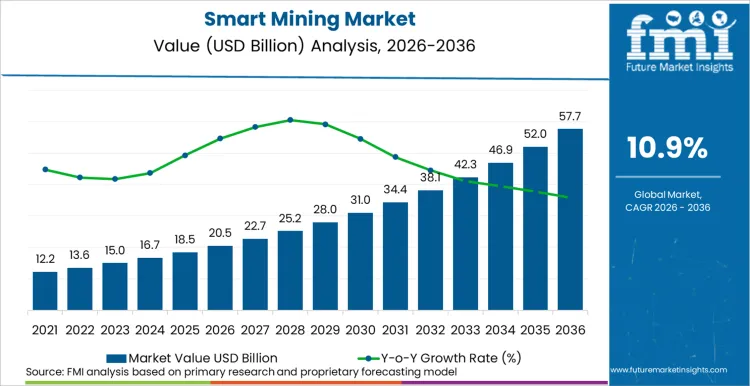
Summary of Smart Mining Market
What Is Growth Outlook for Smart Mining Market as per Future Market Insights Projection?
Future Market Insights projects the smart mining industry to expand at a CAGR of 10.9% from 2026 to 2036, increasing from USD 20.5 Billion in 2026 to USD 57.7 Billion by 2036.
FMI Research Approach: FMI proprietary forecasting model based on ICMM autonomous haulage deployment data, mining CAPEX budgets, and critical minerals production volume projections.
How Do FMI Analysts Perceive Smart Mining Market to Evolve?
FMI analysts perceive the market evolving toward software-defined mining operations where conversational AI, autonomous haulage, and digital twins are integrated into unified platforms that enable real-time production optimisation and predictive maintenance across entire mine sites.
FMI Research Approach: Caterpillar-NVIDIA AI collaboration analysis and Komatsu-Applied Intuition partnership tracking.
Which Country Holds Largest Share in Global Smart Mining Market?
The United States holds a significant share of the global smart mining market by value which is supported by the headquarters of Caterpillar and the concentration of mining technology providers, combined with growing critical minerals extraction investment.
FMI Research Approach: FMI country-level revenue modeling by mining technology CAPEX and autonomous equipment deployment counts.
How Large Will Smart Mining Market Be by 2036?
The global smart mining market is projected to reach USD 57.7 Billion by 2036.
FMI Research Approach: FMI long-term revenue forecast derived from critical minerals demand projections and mining automation adoption S-curves.
What Is Definition of Smart Mining Market?
The smart mining market includes autonomous haulage and drilling systems, AI-powered predictive maintenance platforms, digital twin solutions, mine planning software, IoT sensor networks, private 5G/LTE connectivity for mines, and conversational AI interfaces used to optimise mining operations.
FMI Research Approach: FMI market taxonomy aligned with ICMM innovation classification and mining equipment OEM product categories.
What Are Globally Unique Trends Shaping Smart Mining Market?
Globally unique trends include conversational AI for mining equipment (Caterpillar Cat AI Assistant with NVIDIA), software-defined autonomous vehicle platforms (Komatsu-Applied Intuition), and battery-electric underground fleet orders driving zero-emission autonomous operations (Sandvik).
FMI Research Approach: Caterpillar CES 2026 product announcements and Sandvik 2026 group restructuring analysis.
Smart Mining Market Key Takeaways
| Metric | Details |
|---|---|
| Industry Size (2026) | USD 20.5 Billion |
| Industry Value (2036) | USD 57.7 Billion |
| CAGR (2026 to 2036) | 10.9% |
Source: Future Market Insights (FMI) analysis, based on proprietary forecasting model and primary research
Segment-wise Analysis
By Automated Equipment
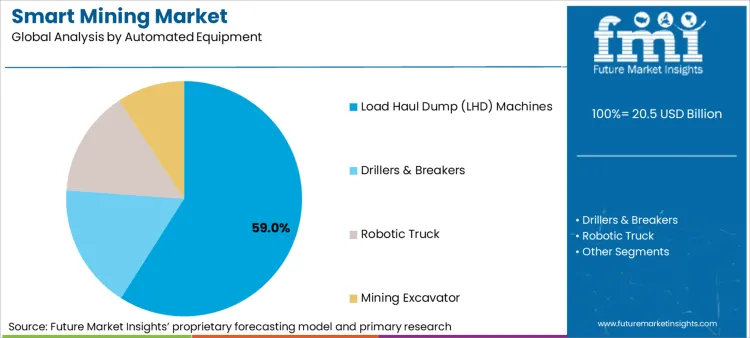
Drillers & Breakers, and Load Haul Dump (LHD) Machines are part of the Automated Equipment segment of the industry, which is expected to grow at a healthy compound annual growth rate (CAGR) from 2018 to 2026. 41% of the industry share will be covered by Drillers & Breakers, while the remaining 59% will be covered by Load Haul Dump (LHD) Machines.
Drillers & Breakers are a key part to modernizing mining operations, improving accuracy and reducing human labor on site. Mineral exploration companies, such as Rio Tinto, have led the way in implementing autonomous blast hole drill rigs to advance productivity and worker safety. Drilling automation has lowered operational costs and reduced human exposure to hazardous environments.
Machine Loading Haul Dump (LHD) underground mining It has all but doubled productivity and improved safety. It is now in one prominent system, the DISPATCH Underground from Modular Mining Systems, the original utility of which was laid at least as far back as 1991 in a diamond mine in South Africa. The system displayed real-time equipment location and engaged automated fleet management, which resulted in improved coordination and less downtime.
Driving the movement toward Automation is the demand for efficiency, worker and environmental safety. Fortescue Metals Group Policy is at the forefront of this transition with a USD 2.8 billion partnership with Liebherr to convert two-thirds of its mining fleet to zero-emission battery technology. This consists of 360 electric trucks, 55 excavators, and 60 dozers, coming into service in 2026, but all of them will be autonomous, too. As the industry approaches sustainability, the Automation of mining will proceed to change global operations.
By Component
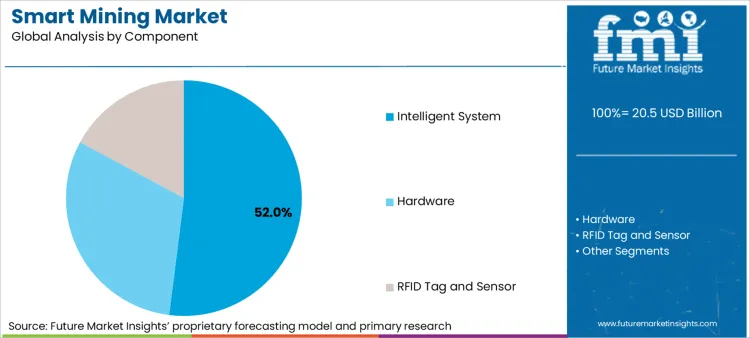
By component, hardware is expected to account for 48% of the industry share in 2026, and the smart systems segment accounts for 52%.
Hardware is the backbone of the industry, from autonomous drilling equipment and haul trucks to monitoring sensors. The adoption of IoT-based sensors from organizations such as Caterpillar and Sandvik has captured real-time data to optimize equipment performance while reducing unplanned downtime. Autonomous haul trucks are in heavy demand, with industry share dominated by Komatsu and Liebherr, which manufacture autonomous mining machinery that boosts efficiency and safety.
Smart systems are leading the digital transformation of the mining industry, harnessing the power of AI, machine learning, and cloud-based analytics for predictive maintenance, fleet management, and operational optimization. For example, Rio Tinto’s Mine of the Future program is using AI-powered predictive analytics to improve productivity and reduce costs. On a macro level, Anglo American’s FutureSmart Mining™ initiative makes data-driven decision-making integral to its approach to advancing resource usage and sustainable practices.
Investment is being driven by the increasing demand for Automation, energy efficiency, and safety standards, in addition to the need for smart systems. The move towards AI-based platforms, as well as the adoption of digital and autonomous mining solutions, is likely to accelerate the digitization and decarbonization of operations, as big mining companies are looking to shift to digital at scale. It is leading the way to the future of mining by providing greater operational efficiency, lower costs, and less environmental impact.
Trend Analysis and Purchasing Criteria Across Different End-Use Segments
The industry is at the forefront of the transformations chromatic through the automation, IoT, AI-driven analytics, and environmentally sustainable mining practices. Surface and underground mining companies are acquiring autonomous drilling rigs, real-time monitoring systems, AI predictive maintenance for safety and productive efficiency improvements.
The mineral processing industry is preoccupied with the automation of production lines that costs less, consumes less energy, and is more efficient in processing the materials to improve the quality of the final product. Exploration and drilling businesses utilize AI geospatial analysis, and drone imaging to cut costs and exploration time.
Equipment companies are working on the traditional model of interoperability and connection by introducing smart, connected machinery that consists of real-time diagnostics and remote operation functionalities. Furthermore, cybersecurity measures are now taking the front seat mainly because of the exploding use of IoT-powered devices and cloud-based data security management.
The need for sustainable mining is thus also pushing the demand for green solutions, emission cuts, and water-efficient technologies for processing.
Contract & Deals Analysis - Smart Mining Market
| Company | Contract Value (USD Million) |
|---|---|
| Hexagon AB | Approximately USD 70 - USD 80 |
| Komatsu Ltd. | Approximately USD 90 - USD 100 |
| Sandvik AB | Approximately USD 60 - USD 70 |
| Caterpillar Inc. | Approximately USD 80 - USD 90 |
Shifts in the Market from 2021 to 2026 and Future Trends 2026 to 2036
2021 to 2026, the industry for smart mining saw a meteoric rise with demand for operational efficiency, safe working conditions, and environmental responsibility in mines growing higher by the day. Autonomous drilling, autonomous haulage systems, and real-time data analytics were the solutions embraced by mining industries to increase levels of productivity and lower operational expenses. IoT sensors, predictive maintenance based on artificial intelligence, and machine learning-based algorithms allowed equipment performance and geological conditions to monitor in real-time.
Governments and regulatory authorities instituted more stringent environmental regulations, propelling the use of electric and hybrid mining vehicles for curbing emissions and optimizing fuel efficiency. Remote-controlled mining equipment, AI-driven geological modeling, and automated ventilation systems enhanced the safety of workers and minimized the exposure of people to dangerous environments.
Despite advancement, the industry was challenged by high initial capital expenditure, security threats from cyber-attacks, and technology uptake in conventional mining operations. But rising investments in digital transformation and adoption of cloud-based mining solutions enhanced scalability and technology convergence across the sector.
2026 to 2036, the industry will experience revolutionary transformation through AI, automation, and green mining.
Artificial intelligence-enabled autonomous drill and haul systems will characterize big-mining operations with less human contact and higher efficiency. Artificial intelligence-driven geological modeling and quantum computing will accelerate the identification of ore bodies and maximize mineral returns. Supply chain management using blockchain technology will enhance material traceability and transparency of materials mined to enhance compliance with ethical sourcing provisions. Solar-powered mining camps and hydrogen fueled heavy equipment will minimize the green footprint of mines.
Environmental monitoring systems based on artificial intelligence will enable real-time tracking of air quality, water usage, and soil health to aid sustainable mining practices. Drone and robotics technologies will be used in deep-sea mining and hostile environment exploration. Enhanced cybersecurity via AI-driven threat detection and quantum encryption will protect mining facilities against cyberattacks. The implementation of circular mining practices like metal recycling and waste reduction will align the industry with global sustainability targets.
Comparative Market Shift Analysis 2021 to 2026 vs. 2026 to 2036
| 2021 to 2026 | 2026 to 2036 |
|---|---|
| Governments enacted stricter environmental and safety regulations, which forced mining companies to adopt automation and real-time monitoring technologies. | Stricter global sustainability regulations require carbon-free mining operations. Governments mandate AI-based compliance monitoring and emissions cuts. |
| Firms utilized autonomous haul trucks, drilling rigs, and predictive maintenance with AI to optimize efficiency and minimize downtime. | Autonomous mines are the norm, utilizing AI-powered robots, real-time decision-support systems, and digital twin technology to optimize mining operations. |
| IoT sensors have been adopted by mining operators for tracking equipment condition, reducing fuel usage, and optimizing employee safety. | Highly sophisticated sensor packages and artificial intelligence-driven predictive analytics drive autonomous mines to respond to changing real-time operating and environmental conditions. |
| Companies started replacing diesel-powered mine vehicles with electric vehicles in order to cut down on emissions and fuel costs. | Hydrogen fuel cell-based mining fleets and all-electric underground mining are the standard, solar and wind providing power to the energy for mining activities. |
| COVID-19 accelerated the use of remote-operated mining systems, requiring fewer on-site employees. | AI-based remote command centers control a number of mines from centralized locations through high-speed 6G networks for seamless operation. |
| Top mining firms tested digital twins to replicate mining operations and maximize the extraction of resources. | Digital twins become critical to mine planning, sustainability tracking, and real-time adjustments in operations, minimizing waste and maximizing efficiency. |
| Mining companies incorporated AI-powered supply chain analytics to manage raw material deficiencies and maximize logistics. | AI-driven smart contracts and blockchain enable efficient, effective, and ethical supply chain management for minerals and rare earth. |
| Higher digitization of mining processes generated higher issues with cyber security threats, encouraging firms to integrate robust security technologies. | Artificial intelligence-based cybersecurity systems and quantum encryption safeguard linked mining systems from changing cyber risks, making operations integrity intact. |
| Firms invested in minimizing tailings waste and installing water recycling systems to meet environmental standards. | Artificial intelligence-based waste separation and circular mining practices optimize resource recovery, significantly minimizing environmental footprint and maximizing sustainable mining operations. |
Risk Assessment of the Smart Mining Market
The industry is growing due to the operating efficiencies and safety improvements as a result of automation, IoT, and AI technologies. Nonetheless, the initial cost incurred is very high, and the difficulty involved in the integration of new technologies remains a barrier to financial growth. However, companies must employ Agile technologies, ensure financial flexibility through the right strategic partnerships, and utilize affordable implementation means to entirely exploit the available returns and sustain their competitiveness in the industry.
Production and mining operations are heavily affected by supply chain interruptions like chip shortages and dependence on special purpose tools. Also, due to geopolitical tensions, trade embargoes, and raw material price fluctuation, the market is instability is further compounded. The situation can be rectified by the diversification of the supplier base, investments in local industries, and contingencies for various risks.
Companies should focus on digital upscaling, especially on security systems, and regular software upgrades to avoid the aforementioned attacks and other damage to systems. Moreover, companies need to consider the impact of AI environmental protection on the industry.
The ethical framework is harder to follow as strict safety, environmental, and data protection rules and regulations make the industry challenging. Companies need to deal with the changes in the law, get the necessary accreditations, and adopt sustainable mining methods to avoid any legal penalties or operational disruptions. The success of the industry in the long run will depend on creativity, resilience in cyberspace, and a solid supply chain policy.
Country wise Analysis
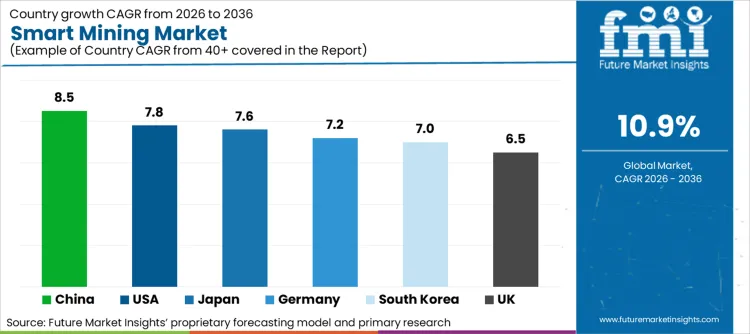
| Country | CAGR (2026 to 2036) |
|---|---|
| USA | 7.8% |
| UK | 6.5% |
| France | 6.8% |
| Germany | 7.2% |
| Italy | 6.3% |
| South Korea | 7.0% |
| Japan | 7.6% |
| China | 8.5% |
| Australia | 7.4% |
| New Zealand | 6.1% |
USA
The USA industry is expanding with the use of autonomous haulage systems, real-time monitoring solutions, and AI-based predictive maintenance. Green mining operations and stringent policy regulations necessitate the digitalization of mines by investing in them. Industry behemoths like Caterpillar and Komatsu are leading the way with best-of-breed autonomous mining solutions. This boom for electric vehicles also propels the demand for lithium and other primary minerals, spurring investment in automation and AI.
Big mining players, such as Newmont Corporation and Freeport-McMoRan, are using IoT technology for increased efficiency and safer operations. The industry is getting significant venture capital investments, driving technological advances in remote monitoring and digital twins. Carbon footprint minimization has also led to increased use of electrified haul trucks and AI-driven efficiency solutions.
UK
The UK industry is transforming with the adoption of digital twins, AI-based exploration, and green mining technologies. Efficiency in mining is prioritized in the nation with the application of automation and analytics to ensure maximum extraction of resources. Rio Tinto, an entity with a presence in the UK, invests in premium mining solutions, driving the industry growth.
The UK government's pledge to net zero has encouraged investment in green mining technology. Mining companies are utilizing blockchain technology for improved supply chain traceability, and AI-based predictive maintenance is used to reduce downtime. Better battery technology and demand for critical minerals such as cobalt and lithium add a further drive for the industry operations.
France
The mining industry in France is changing, with an overwhelming focus on sustainability and automation. With increased demand for rare earth minerals, the mining industry is implementing AI-based geospatial analytics and drone reconnaissance. Advanced predictive mining simulation software by French technology companies such as Dassault Systèmes allows overall productivity to be improved.
Government initiatives supporting digitalization and greenery spur the adoption of electric mining machines and remote equipment. Eramet, a leader in French mining, is leading carbon reduction through electrification and AI-based mining operations. The adoption of battery-grade nickel and lithium also spurs industry demand.
Germany
Smart mining in Germany thrives thanks to strict rules on sustainability and adopting Industry 4.0 technology. Industry giants Siemens and Bosch are at the forefront of developing AI-enabled mining automation technology that fuels operation efficiency and safety. Digital twins and predictive analysis are used in Germany's mining sector to provide better-informed decisions.
Germany's efforts to reduce its carbon footprint have led the way in the use of electrified heavy mining equipment and hydrogen fuel cell-battery mining trucks. Innovation is also being driven by the focus on recycling necessary minerals and environmentally friendly mining. The demand for rare earth metals used to manufacture electric cars further rooted the industry.
Italy
Italy's industry is emerging due to increased automation and digitalization of mineral mining. EU sustainability targets through adopting energy-efficient mining strengthen the country. AI-driven exploration and real-time monitoring provide opportunities for investment. Companies like Prysmian Group provide infrastructure services for digitizing mining.
Italy's mining industry, though small in size relative to others, also has the benefit of high-technology robotics and sensor-based exploration technology. The push towards sustainable mining operations has opened up industry opportunities for employing AI-facilitated risk analysis tools and electric mine vehicles. Expansion in the application of battery components offers impetus to the application of the industry machines.
South Korea
South Korea's technological expertise in AI, IoT, and high-end automation makes it possible for the country's industry. Hyundai and Samsung Heavy Industries are just a few of the big industrial giants that make autonomous vehicle innovation in mining possible. Demand for rare earth elements and battery materials drives the investment in the industry technology.
Government support for digitalization has led to the development of AI-based exploration techniques and blockchain traceability of supply chains. The mining industry is relying more and more on 5G connectivity to provide real-time data and enhance efficiency and safety measures.
Japan
The 7.6% CAGR growth for the 2026 to 2036 period is projected. Robotics, artificial intelligence-based automated processes, and deep sea mining make Japan's high-tech mining flourish. Hitachi and Komatsu lead the way in constructing autonomous systems by automating drill and haulage operations independently to provide maximum efficiency and safety. The industry growth is driven by demand for the application of rare earth metals in electronics and EVs.
Japan emphasizes digitalization, such as AI-based predictive maintenance and IoT-based monitoring systems. Green mining is encouraged through government subsidies to invest in electric mining gear and energy-saving mining. Digital twins also increase productivity
China
China leads the sector with massive investment in AI, automation, and digitalization. The government actively supports smart mining infrastructure, and industry leaders like Huawei and Baidu are developing AI-driven mining solutions. The country's vast mining industry heavily invests in automated drilling and autonomous haulage systems.
China's push for local self-reliance in strategic minerals has encouraged the application of blockchain-based traceability systems. The combination of digital twins and real-time monitoring enhances productivity and security. Increasing demand for lithium and rare earth metals also encourages the application of the industry.
Australia
Australia's huge mining sector embraced automation and AI-driven efficiency solutions. Companies like BHP and Rio Tinto are spearheading investment in autonomous trucks, AI-driven predictive maintenance, and electric mining. The country's effort to lower emissions coincides with the application of renewable energy in mining.
Australia's remote mining operations are facilitated through IoT-based tracking and machine learning to enhance decision-making. Operational efficiency is brought by bringing AI and digital twins together. This strategic mineral demand expands driven by EV production worldwide and supports the vibrancy of the industry growth opportunity.
New Zealand
New Zealand's smart mining industry is in an early stage with increased investment in automated and eco-friendly green mining technology. The government supports green mining and the use of AI monitoring-based and electric-powered machinery.
New Zealand companies are emphasizing mineral exploration using AI-driven geospatial analytics and remote sensing technology. Predictive analytics and digital twins improve efficiency, while blockchain-based traceability enhances supply chain transparency. New Zealand's mining industry is increasingly using autonomous operations to mine the maximum resources.
Competition Outlook
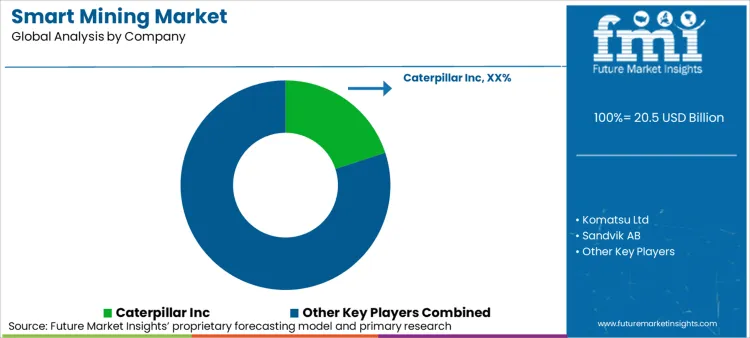
The demand for smart mining organic practices has opened the growth of the industry. Several steps are being taken to optimize mining operations, from employing automated systems for hauling materials to real-time monitoring of data and predictive maintenance solutions to enhance safety and operational efficiency.
Industry leaders like Caterpillar Inc., Komatsu Ltd., and Sandvik AB are capitalizing on advanced digital technologies and AI-driven solutions. Hitachi Construction Machinery, ABB Ltd., etc which offer smart mining software, conversion to electric fleets, and asset optimization are also among keeping gaps filled in smart technologies for the industry.
Fleet automation, sustainability mining solutions, and increased funding in AI-powered digital and automated transformation processes are key factors shaping the competition. Organizations offer evolving technologies like process optimization, industrial automation cybersecurity, and AI-enabled predictive maintenance to maintain a competitive advantage. With global demand for effective and eco-friendly mining solutions on the rise, the industry will be led by businesses investing in smart technologies and automation in the future.
Market Share Analysis by Company
| Company Name | Estimated Market Share (%) |
|---|---|
| Caterpillar Inc. | 20-25% |
| Komatsu Ltd. | 15-20% |
| Sandvik AB | 10-15% |
| Hexagon AB | 8-12% |
| Hitachi Construction Machinery | 5-10% |
| ABB Ltd. | 4-8% |
| Other Companies (combined) | 30-38% |
Recent Developments:
- In January 2026, Caterpillar introduced the Cat AI Assistant and expanded its NVIDIA collaboration to integrate on-board AI features and AI agents into its industrial equipment for real-time jobsite decision support.
- In September 2026, Komatsu formed a multi-year strategic partnership with Applied Intuition to co-develop a unified software-defined vehicle and autonomy platform for mining operations.
- In January 2026, Sandvik finalised its updated group structure to prioritise Digital Mining Technologies, following double-digit growth and major battery-electric vehicle orders in Canada and Australia.
Key Company Offerings and Activities
| Company Name | Key Offerings/Activities |
|---|---|
| Caterpillar Inc. | Autonomous haulage systems, real-time fleet management, AI-powered predictive analytics. |
| Komatsu Ltd. | Autonomous vehicles, smart mining solutions, remote monitoring, and optimization of operations. |
| Sandvik AB | Advanced drilling automation, digital mine solutions, and connected equipment for safety enhancement. |
| Hexagon AB | The integrated mining software, IoT-enabled monitoring solutions, and AI-driven asset tracking. |
| Hitachi Construction Machinery | Smart mining devices, cloud computing analytics, and self-ruling armada control frameworks. |
| ABB Ltd.AI- | AI-driven mine automation, electrification solutions, and digital twin technology for process optimization. |
Strategic Outlook
Caterpillar Inc. (20-25%)
Caterpillar's future smart mining solutions feature industry-first autonomous haulage systems powered by artificial intelligence-enabled predictive maintenance. By integrating IoT and machine learning into equipment, the company is committed to enhancing the efficiency and safety of mining operations. Executive summary Digital twin: Overview and recent developments
Komatsu Ltd. (15-20%)
Komatsu is a smart mining powerhouse leaning on autonomous vehicle and remote operation tech. The company offers real-time monitoring and analytics solutions that provide operational visibility and allow for better control of cost factors. These innovations trend in the same direction as the recently established AI-powered fleet management platforms, which put Komatsu on the map as a leading constructor in the sector.
Sandvik AB (10-15%)
Sandvik is a leader in mining automation and digital transformation, with connected solutions that improve drilling, loading, and hauling operations. With its AI-driven predictive maintenance and IoT-enabled equipment monitoring, it provides mining sites around the world with maximum production efficiency and minimum downtime.
Hexagon AB (8-12%)
Hexagon provides integrated software and real-time data analytics solutions across several industries, including mining. The AI-powered mine safety solutions and Internet of Things (IoT)-connected monitoring devices they provide help the mining operators become more efficient while minimizing their impact on the environment. It goes on to establish itself more through acquisitions and tech advancements.
Hitachi Construction Machinery (5-10%)
Hitachi where uses smart mining equipment and cloud-based data analytics to optimize mining operations. Its fleet control systems are fully autonomous, and its teams lead digital transformation initiatives that focus on enhanced efficiency and risk mitigation. Hitachi is bolstering its smart mining portfolio with a growing focus on AI and robotics.
ABB Ltd. (4-8%)
ABB focuses on electrification and automation solutions designed for the mining industry. Its AI-powered process optimization and digital twin technologies support mining companies in converting to more sustainable and efficient operations. ABB provides power management solutions that help mine efficiently by using energy in a smart way.
Other Key Players (30-38% Combined)
- Rio Tinto
- Siemens AG
- Schneider Electric
- Trimble Inc.
- Epiroc AB
Key Market Players
- Caterpillar Inc.
- Komatsu Ltd.
- Sandvik AB
- Hexagon AB
- Hitachi Construction Machinary
- ABB Ltd.
- Rio Tinto
- Siemens AG
- Schneider Electric
- Trimble Inc.
- Epiroc AB
Market Definition
The smart mining market represents revenue generated from the provision of digital technology solutions, autonomous systems, and AI-powered platforms that optimise mining operations. The market measures the value of autonomous haulage systems, AI predictive maintenance, digital twins, mine planning software, IoT sensor networks, private connectivity infrastructure, and conversational AI sold to mining operators.
Inclusions cover autonomous haul trucks and drills, AI-powered predictive maintenance platforms, digital twin and simulation software, mine planning and scheduling systems, IoT sensor arrays for environmental and equipment monitoring, private 5G/LTE mine connectivity, fleet management systems, and conversational AI interfaces for operational data querying.
Exclusions include conventional mining equipment without digital connectivity or autonomy capability, geological survey and exploration services without digital analytics, commodity trading platforms, and general-purpose enterprise IT infrastructure not deployed specifically for mining operations.
Scope of Report
| Items | Values |
|---|---|
| Quantitative Units (2026) | USD 20.5 Billion |
| Product Type | Autonomous Haulage, AI Predictive Maintenance, Digital Twins, Mine Planning Software, IoT Sensors, Private 5G/LTE, Conversational AI |
| Mining Type | Surface Mining, Underground Mining, Open Pit, Deep Shaft |
| End User | Mining Operators (Tier-1, Tier-2), Mining Equipment OEMs, Mining Technology Providers |
| Regions Covered | North America, Europe, Asia Pacific, Latin America, Middle East and Africa |
| Countries Covered | USA, Australia, Canada, Chile, Peru, South Africa, China, and 30+ countries |
| Key Companies Profiled | Caterpillar, Komatsu, Sandvik, ABB, Siemens (Innomotics), Hexagon, NVIDIA |
Key Segmentation
By Automated Equipment:
By automated equipment, the industry includes driller & breaker, load haul dump, mining excavator, robotic truck, and other automated equipment, with robotic trucks leading due to their efficiency in reducing operational costs and improving safety in mining operations.
By Component:
By component, the industry is segmented into hardware, intelligent systems, RFID tags and sensors, and other hardware, with intelligent systems holding the largest share due to their role in optimizing automation and data-driven decision-making.
By Solution:
By solution, the industry includes data & operation management software, analytics solutions, and connectivity platforms, with analytics solutions gaining traction due to their ability to enhance predictive maintenance and operational efficiency.
By Services:
By services, the industry covers engineering & maintenance services, consulting services, product training services, and implementation & integration services, with implementation & integration services leading due to the increasing adoption of automation technologies in mining operations.
By Region:
By region, the industry spans North America, Latin America, Europe, East Asia, South Asia & Pacific, and the Middle East & Africa (MEA), with North America leading due to heavy investments in mining automation and smart technology adoption.
Bibliography
- International Council on Mining and Metals. (2024). ICMM Safety and Innovation Review: Autonomous Haulage Deployment Data. ICMM.
- Caterpillar Inc. (2026, January). Caterpillar introduces Cat AI Assistant and expands NVIDIA collaboration. Caterpillar Newsroom.
- Komatsu Ltd. (2025, September). Komatsu and Applied Intuition announce mining innovation partnership. Komatsu Newsroom.
- Sandvik AB. (2026, January). Sandvik updated group structure: Digital Mining Technologies prioritisation. Sandvik Investor Relations.
Frequently Asked Questions
What is the current global market size for Smart Mining?
The global market is valued at USD 20.5 Billion in 2026, driven by critical minerals demand, autonomous haulage deployment, and AI-powered operational intelligence adoption.
What is the projected Compound Annual Growth Rate (CAGR) for the market over the next 10 years?
The market is projected to grow at a CAGR of 10.9% from 2026 to 2036.
Which regions are experiencing the fastest expansion?
Latin America and Asia Pacific are the fastest-growing regions driven by copper and lithium extraction investment, while North America and Australia lead by technology adoption maturity.
What are the primary market drivers?
Critical minerals demand for EV batteries, labour shortages at remote sites, conversational AI and autonomous fleet technology maturation, and private 5G mine connectivity are the primary growth catalysts.
Who are the leading suppliers in the industry?
Caterpillar, Komatsu, Sandvik, and ABB are key players, differentiating through conversational AI platforms, software-defined autonomy, and digital twin deployment at scale.
Table of Content
- Executive Summary
- Global Market Outlook
- Demand to side Trends
- Supply to side Trends
- Technology Roadmap Analysis
- Analysis and Recommendations
- Market Overview
- Market Coverage / Taxonomy
- Market Definition / Scope / Limitations
- Research Methodology
- Chapter Orientation
- Analytical Lens and Working Hypotheses
- Market Structure, Signals, and Trend Drivers
- Benchmarking and Cross-market Comparability
- Market Sizing, Forecasting, and Opportunity Mapping
- Research Design and Evidence Framework
- Desk Research Programme (Secondary Evidence)
- Company Annual and Sustainability Reports
- Peer-reviewed Journals and Academic Literature
- Corporate Websites, Product Literature, and Technical Notes
- Earnings Decks and Investor Briefings
- Statutory Filings and Regulatory Disclosures
- Technical White Papers and Standards Notes
- Trade Journals, Industry Magazines, and Analyst Briefs
- Conference Proceedings, Webinars, and Seminar Materials
- Government Statistics Portals and Public Data Releases
- Press Releases and Reputable Media Coverage
- Specialist Newsletters and Curated Briefings
- Sector Databases and Reference Repositories
- FMI Internal Proprietary Databases and Historical Market Datasets
- Subscription Datasets and Paid Sources
- Social Channels, Communities, and Digital Listening Inputs
- Additional Desk Sources
- Expert Input and Fieldwork (Primary Evidence)
- Primary Modes
- Qualitative Interviews and Expert Elicitation
- Quantitative Surveys and Structured Data Capture
- Blended Approach
- Why Primary Evidence is Used
- Field Techniques
- Interviews
- Surveys
- Focus Groups
- Observational and In-context Research
- Social and Community Interactions
- Stakeholder Universe Engaged
- C-suite Leaders
- Board Members
- Presidents and Vice Presidents
- R&D and Innovation Heads
- Technical Specialists
- Domain Subject-matter Experts
- Scientists
- Physicians and Other Healthcare Professionals
- Governance, Ethics, and Data Stewardship
- Research Ethics
- Data Integrity and Handling
- Primary Modes
- Tooling, Models, and Reference Databases
- Desk Research Programme (Secondary Evidence)
- Data Engineering and Model Build
- Data Acquisition and Ingestion
- Cleaning, Normalisation, and Verification
- Synthesis, Triangulation, and Analysis
- Quality Assurance and Audit Trail
- Market Background
- Market Dynamics
- Drivers
- Restraints
- Opportunity
- Trends
- Scenario Forecast
- Demand in Optimistic Scenario
- Demand in Likely Scenario
- Demand in Conservative Scenario
- Opportunity Map Analysis
- Product Life Cycle Analysis
- Supply Chain Analysis
- Investment Feasibility Matrix
- Value Chain Analysis
- PESTLE and Porter’s Analysis
- Regulatory Landscape
- Regional Parent Market Outlook
- Production and Consumption Statistics
- Import and Export Statistics
- Market Dynamics
- Global Market Analysis 2021 to 2025 and Forecast, 2026 to 2036
- Historical Market Size Value (USD Million) Analysis, 2021 to 2025
- Current and Future Market Size Value (USD Million) Projections, 2026 to 2036
- Y to o to Y Growth Trend Analysis
- Absolute $ Opportunity Analysis
- Global Market Pricing Analysis 2021 to 2025 and Forecast 2026 to 2036
- Global Market Analysis 2021 to 2025 and Forecast 2026 to 2036, By Automated Equipment
- Introduction / Key Findings
- Historical Market Size Value (USD Million) Analysis By Automated Equipment , 2021 to 2025
- Current and Future Market Size Value (USD Million) Analysis and Forecast By Automated Equipment , 2026 to 2036
- Load Haul Dump (LHD) Machines
- Drillers & Breakers
- Robotic Truck
- Mining Excavator
- Load Haul Dump (LHD) Machines
- Y to o to Y Growth Trend Analysis By Automated Equipment , 2021 to 2025
- Absolute $ Opportunity Analysis By Automated Equipment , 2026 to 2036
- Global Market Analysis 2021 to 2025 and Forecast 2026 to 2036, By Component
- Introduction / Key Findings
- Historical Market Size Value (USD Million) Analysis By Component, 2021 to 2025
- Current and Future Market Size Value (USD Million) Analysis and Forecast By Component, 2026 to 2036
- Intelligent System
- Hardware
- RFID Tag and Sensor
- Intelligent System
- Y to o to Y Growth Trend Analysis By Component, 2021 to 2025
- Absolute $ Opportunity Analysis By Component, 2026 to 2036
- Global Market Analysis 2021 to 2025 and Forecast 2026 to 2036, By Region
- Introduction
- Historical Market Size Value (USD Million) Analysis By Region, 2021 to 2025
- Current Market Size Value (USD Million) Analysis and Forecast By Region, 2026 to 2036
- North America
- Latin America
- Western Europe
- Eastern Europe
- East Asia
- South Asia and Pacific
- Middle East & Africa
- Market Attractiveness Analysis By Region
- North America Market Analysis 2021 to 2025 and Forecast 2026 to 2036, By Country
- Historical Market Size Value (USD Million) Trend Analysis By Market Taxonomy, 2021 to 2025
- Market Size Value (USD Million) Forecast By Market Taxonomy, 2026 to 2036
- By Country
- USA
- Canada
- Mexico
- By Automated Equipment
- By Component
- By Country
- Market Attractiveness Analysis
- By Country
- By Automated Equipment
- By Component
- Key Takeaways
- Latin America Market Analysis 2021 to 2025 and Forecast 2026 to 2036, By Country
- Historical Market Size Value (USD Million) Trend Analysis By Market Taxonomy, 2021 to 2025
- Market Size Value (USD Million) Forecast By Market Taxonomy, 2026 to 2036
- By Country
- Brazil
- Chile
- Rest of Latin America
- By Automated Equipment
- By Component
- By Country
- Market Attractiveness Analysis
- By Country
- By Automated Equipment
- By Component
- Key Takeaways
- Western Europe Market Analysis 2021 to 2025 and Forecast 2026 to 2036, By Country
- Historical Market Size Value (USD Million) Trend Analysis By Market Taxonomy, 2021 to 2025
- Market Size Value (USD Million) Forecast By Market Taxonomy, 2026 to 2036
- By Country
- Germany
- UK
- Italy
- Spain
- France
- Nordic
- BENELUX
- Rest of Western Europe
- By Automated Equipment
- By Component
- By Country
- Market Attractiveness Analysis
- By Country
- By Automated Equipment
- By Component
- Key Takeaways
- Eastern Europe Market Analysis 2021 to 2025 and Forecast 2026 to 2036, By Country
- Historical Market Size Value (USD Million) Trend Analysis By Market Taxonomy, 2021 to 2025
- Market Size Value (USD Million) Forecast By Market Taxonomy, 2026 to 2036
- By Country
- Russia
- Poland
- Hungary
- Balkan & Baltic
- Rest of Eastern Europe
- By Automated Equipment
- By Component
- By Country
- Market Attractiveness Analysis
- By Country
- By Automated Equipment
- By Component
- Key Takeaways
- East Asia Market Analysis 2021 to 2025 and Forecast 2026 to 2036, By Country
- Historical Market Size Value (USD Million) Trend Analysis By Market Taxonomy, 2021 to 2025
- Market Size Value (USD Million) Forecast By Market Taxonomy, 2026 to 2036
- By Country
- China
- Japan
- South Korea
- By Automated Equipment
- By Component
- By Country
- Market Attractiveness Analysis
- By Country
- By Automated Equipment
- By Component
- Key Takeaways
- South Asia and Pacific Market Analysis 2021 to 2025 and Forecast 2026 to 2036, By Country
- Historical Market Size Value (USD Million) Trend Analysis By Market Taxonomy, 2021 to 2025
- Market Size Value (USD Million) Forecast By Market Taxonomy, 2026 to 2036
- By Country
- India
- ASEAN
- Australia & New Zealand
- Rest of South Asia and Pacific
- By Automated Equipment
- By Component
- By Country
- Market Attractiveness Analysis
- By Country
- By Automated Equipment
- By Component
- Key Takeaways
- Middle East & Africa Market Analysis 2021 to 2025 and Forecast 2026 to 2036, By Country
- Historical Market Size Value (USD Million) Trend Analysis By Market Taxonomy, 2021 to 2025
- Market Size Value (USD Million) Forecast By Market Taxonomy, 2026 to 2036
- By Country
- Kingdom of Saudi Arabia
- Other GCC Countries
- Turkiye
- South Africa
- Other African Union
- Rest of Middle East & Africa
- By Automated Equipment
- By Component
- By Country
- Market Attractiveness Analysis
- By Country
- By Automated Equipment
- By Component
- Key Takeaways
- Key Countries Market Analysis
- USA
- Pricing Analysis
- Market Share Analysis, 2025
- By Automated Equipment
- By Component
- Canada
- Pricing Analysis
- Market Share Analysis, 2025
- By Automated Equipment
- By Component
- Mexico
- Pricing Analysis
- Market Share Analysis, 2025
- By Automated Equipment
- By Component
- Brazil
- Pricing Analysis
- Market Share Analysis, 2025
- By Automated Equipment
- By Component
- Chile
- Pricing Analysis
- Market Share Analysis, 2025
- By Automated Equipment
- By Component
- Germany
- Pricing Analysis
- Market Share Analysis, 2025
- By Automated Equipment
- By Component
- UK
- Pricing Analysis
- Market Share Analysis, 2025
- By Automated Equipment
- By Component
- Italy
- Pricing Analysis
- Market Share Analysis, 2025
- By Automated Equipment
- By Component
- Spain
- Pricing Analysis
- Market Share Analysis, 2025
- By Automated Equipment
- By Component
- France
- Pricing Analysis
- Market Share Analysis, 2025
- By Automated Equipment
- By Component
- India
- Pricing Analysis
- Market Share Analysis, 2025
- By Automated Equipment
- By Component
- ASEAN
- Pricing Analysis
- Market Share Analysis, 2025
- By Automated Equipment
- By Component
- Australia & New Zealand
- Pricing Analysis
- Market Share Analysis, 2025
- By Automated Equipment
- By Component
- China
- Pricing Analysis
- Market Share Analysis, 2025
- By Automated Equipment
- By Component
- Japan
- Pricing Analysis
- Market Share Analysis, 2025
- By Automated Equipment
- By Component
- South Korea
- Pricing Analysis
- Market Share Analysis, 2025
- By Automated Equipment
- By Component
- Russia
- Pricing Analysis
- Market Share Analysis, 2025
- By Automated Equipment
- By Component
- Poland
- Pricing Analysis
- Market Share Analysis, 2025
- By Automated Equipment
- By Component
- Hungary
- Pricing Analysis
- Market Share Analysis, 2025
- By Automated Equipment
- By Component
- Kingdom of Saudi Arabia
- Pricing Analysis
- Market Share Analysis, 2025
- By Automated Equipment
- By Component
- Turkiye
- Pricing Analysis
- Market Share Analysis, 2025
- By Automated Equipment
- By Component
- South Africa
- Pricing Analysis
- Market Share Analysis, 2025
- By Automated Equipment
- By Component
- USA
- Market Structure Analysis
- Competition Dashboard
- Competition Benchmarking
- Market Share Analysis of Top Players
- By Regional
- By Automated Equipment
- By Component
- Competition Analysis
- Competition Deep Dive
- Caterpillar Inc
- Overview
- Product Portfolio
- Profitability by Market Segments (Product/Age /Sales Channel/Region)
- Sales Footprint
- Strategy Overview
- Marketing Strategy
- Product Strategy
- Channel Strategy
- Komatsu Ltd
- Sandvik AB
- Hexagon AB
- Hitachi Construction Machinery
- ABB Ltd
- Caterpillar Inc
- Competition Deep Dive
- Assumptions & Acronyms Used
List of Tables
- Table 1: Global Market Value (USD Million) Forecast by Region, 2021 to 2036
- Table 2: Global Market Value (USD Million) Forecast by Automated Equipment , 2021 to 2036
- Table 3: Global Market Value (USD Million) Forecast by Component, 2021 to 2036
- Table 4: North America Market Value (USD Million) Forecast by Country, 2021 to 2036
- Table 5: North America Market Value (USD Million) Forecast by Automated Equipment , 2021 to 2036
- Table 6: North America Market Value (USD Million) Forecast by Component, 2021 to 2036
- Table 7: Latin America Market Value (USD Million) Forecast by Country, 2021 to 2036
- Table 8: Latin America Market Value (USD Million) Forecast by Automated Equipment , 2021 to 2036
- Table 9: Latin America Market Value (USD Million) Forecast by Component, 2021 to 2036
- Table 10: Western Europe Market Value (USD Million) Forecast by Country, 2021 to 2036
- Table 11: Western Europe Market Value (USD Million) Forecast by Automated Equipment , 2021 to 2036
- Table 12: Western Europe Market Value (USD Million) Forecast by Component, 2021 to 2036
- Table 13: Eastern Europe Market Value (USD Million) Forecast by Country, 2021 to 2036
- Table 14: Eastern Europe Market Value (USD Million) Forecast by Automated Equipment , 2021 to 2036
- Table 15: Eastern Europe Market Value (USD Million) Forecast by Component, 2021 to 2036
- Table 16: East Asia Market Value (USD Million) Forecast by Country, 2021 to 2036
- Table 17: East Asia Market Value (USD Million) Forecast by Automated Equipment , 2021 to 2036
- Table 18: East Asia Market Value (USD Million) Forecast by Component, 2021 to 2036
- Table 19: South Asia and Pacific Market Value (USD Million) Forecast by Country, 2021 to 2036
- Table 20: South Asia and Pacific Market Value (USD Million) Forecast by Automated Equipment , 2021 to 2036
- Table 21: South Asia and Pacific Market Value (USD Million) Forecast by Component, 2021 to 2036
- Table 22: Middle East & Africa Market Value (USD Million) Forecast by Country, 2021 to 2036
- Table 23: Middle East & Africa Market Value (USD Million) Forecast by Automated Equipment , 2021 to 2036
- Table 24: Middle East & Africa Market Value (USD Million) Forecast by Component, 2021 to 2036
List of Figures
- Figure 1: Global Market Pricing Analysis
- Figure 2: Global Market Value (USD Million) Forecast 2021-2036
- Figure 3: Global Market Value Share and BPS Analysis by Automated Equipment , 2026 and 2036
- Figure 4: Global Market Y-o-Y Growth Comparison by Automated Equipment , 2026-2036
- Figure 5: Global Market Attractiveness Analysis by Automated Equipment
- Figure 6: Global Market Value Share and BPS Analysis by Component, 2026 and 2036
- Figure 7: Global Market Y-o-Y Growth Comparison by Component, 2026-2036
- Figure 8: Global Market Attractiveness Analysis by Component
- Figure 9: Global Market Value (USD Million) Share and BPS Analysis by Region, 2026 and 2036
- Figure 10: Global Market Y-o-Y Growth Comparison by Region, 2026-2036
- Figure 11: Global Market Attractiveness Analysis by Region
- Figure 12: North America Market Incremental Dollar Opportunity, 2026-2036
- Figure 13: Latin America Market Incremental Dollar Opportunity, 2026-2036
- Figure 14: Western Europe Market Incremental Dollar Opportunity, 2026-2036
- Figure 15: Eastern Europe Market Incremental Dollar Opportunity, 2026-2036
- Figure 16: East Asia Market Incremental Dollar Opportunity, 2026-2036
- Figure 17: South Asia and Pacific Market Incremental Dollar Opportunity, 2026-2036
- Figure 18: Middle East & Africa Market Incremental Dollar Opportunity, 2026-2036
- Figure 19: North America Market Value Share and BPS Analysis by Country, 2026 and 2036
- Figure 20: North America Market Value Share and BPS Analysis by Automated Equipment , 2026 and 2036
- Figure 21: North America Market Y-o-Y Growth Comparison by Automated Equipment , 2026-2036
- Figure 22: North America Market Attractiveness Analysis by Automated Equipment
- Figure 23: North America Market Value Share and BPS Analysis by Component, 2026 and 2036
- Figure 24: North America Market Y-o-Y Growth Comparison by Component, 2026-2036
- Figure 25: North America Market Attractiveness Analysis by Component
- Figure 26: Latin America Market Value Share and BPS Analysis by Country, 2026 and 2036
- Figure 27: Latin America Market Value Share and BPS Analysis by Automated Equipment , 2026 and 2036
- Figure 28: Latin America Market Y-o-Y Growth Comparison by Automated Equipment , 2026-2036
- Figure 29: Latin America Market Attractiveness Analysis by Automated Equipment
- Figure 30: Latin America Market Value Share and BPS Analysis by Component, 2026 and 2036
- Figure 31: Latin America Market Y-o-Y Growth Comparison by Component, 2026-2036
- Figure 32: Latin America Market Attractiveness Analysis by Component
- Figure 33: Western Europe Market Value Share and BPS Analysis by Country, 2026 and 2036
- Figure 34: Western Europe Market Value Share and BPS Analysis by Automated Equipment , 2026 and 2036
- Figure 35: Western Europe Market Y-o-Y Growth Comparison by Automated Equipment , 2026-2036
- Figure 36: Western Europe Market Attractiveness Analysis by Automated Equipment
- Figure 37: Western Europe Market Value Share and BPS Analysis by Component, 2026 and 2036
- Figure 38: Western Europe Market Y-o-Y Growth Comparison by Component, 2026-2036
- Figure 39: Western Europe Market Attractiveness Analysis by Component
- Figure 40: Eastern Europe Market Value Share and BPS Analysis by Country, 2026 and 2036
- Figure 41: Eastern Europe Market Value Share and BPS Analysis by Automated Equipment , 2026 and 2036
- Figure 42: Eastern Europe Market Y-o-Y Growth Comparison by Automated Equipment , 2026-2036
- Figure 43: Eastern Europe Market Attractiveness Analysis by Automated Equipment
- Figure 44: Eastern Europe Market Value Share and BPS Analysis by Component, 2026 and 2036
- Figure 45: Eastern Europe Market Y-o-Y Growth Comparison by Component, 2026-2036
- Figure 46: Eastern Europe Market Attractiveness Analysis by Component
- Figure 47: East Asia Market Value Share and BPS Analysis by Country, 2026 and 2036
- Figure 48: East Asia Market Value Share and BPS Analysis by Automated Equipment , 2026 and 2036
- Figure 49: East Asia Market Y-o-Y Growth Comparison by Automated Equipment , 2026-2036
- Figure 50: East Asia Market Attractiveness Analysis by Automated Equipment
- Figure 51: East Asia Market Value Share and BPS Analysis by Component, 2026 and 2036
- Figure 52: East Asia Market Y-o-Y Growth Comparison by Component, 2026-2036
- Figure 53: East Asia Market Attractiveness Analysis by Component
- Figure 54: South Asia and Pacific Market Value Share and BPS Analysis by Country, 2026 and 2036
- Figure 55: South Asia and Pacific Market Value Share and BPS Analysis by Automated Equipment , 2026 and 2036
- Figure 56: South Asia and Pacific Market Y-o-Y Growth Comparison by Automated Equipment , 2026-2036
- Figure 57: South Asia and Pacific Market Attractiveness Analysis by Automated Equipment
- Figure 58: South Asia and Pacific Market Value Share and BPS Analysis by Component, 2026 and 2036
- Figure 59: South Asia and Pacific Market Y-o-Y Growth Comparison by Component, 2026-2036
- Figure 60: South Asia and Pacific Market Attractiveness Analysis by Component
- Figure 61: Middle East & Africa Market Value Share and BPS Analysis by Country, 2026 and 2036
- Figure 62: Middle East & Africa Market Value Share and BPS Analysis by Automated Equipment , 2026 and 2036
- Figure 63: Middle East & Africa Market Y-o-Y Growth Comparison by Automated Equipment , 2026-2036
- Figure 64: Middle East & Africa Market Attractiveness Analysis by Automated Equipment
- Figure 65: Middle East & Africa Market Value Share and BPS Analysis by Component, 2026 and 2036
- Figure 66: Middle East & Africa Market Y-o-Y Growth Comparison by Component, 2026-2036
- Figure 67: Middle East & Africa Market Attractiveness Analysis by Component
- Figure 68: Global Market - Tier Structure Analysis
- Figure 69: Global Market - Company Share Analysis


