

- Industry Size (2026)
- USD 276.0 Mn
- Forecast (2036)
- USD 825.0 Mn
- CAGR (2026 to 2036)
- 11.2%
Hemp Fiber Market Size, Market Forecast and Outlook By FMI
In 2025, the hemp fiber market surpassed a value of USD 248.0 million, is projected at USD 276.0 million in 2026 and USD 825.0 million by 2036, implying an 11.2% CAGR, with momentum tied to bio-based construction material adoption. As per FMI's projection, procurement teams increasingly favor vegetal natural fiber to offset high carbon footprints associated with synthetic polymers. Integrating renewable bast components allows industrial buyers to secure stable, high-volume composite streams while meeting stringent environmental targets.
Emerging localized supply ecosystems present significant untapped potential for industrial offtakers. Commercial operations began at Panda Hemp Gin in April 2024, enabling industrial hemp decortication for textile-grade fiber and hurd mixes [1]. Scaling rural infrastructure transforms raw agricultural biomass into verifiable industrial-grade feedstock, removing historical supply bottlenecks for high-volume composite buyers.
Summary of Hemp Fiber
- Hemp Fiber Market Definition
- Hemp bast fiber and hurd (woody core) derived from industrial hemp stalk decortication are utilized for biocomposites, nonwovens, and insulation feedstocks.
- Demand Drivers in the Market
- Stringent automotive lightweighting targets.
- Subsidized bio-based construction material adoption.
- Processing infrastructure expansion near cultivation zones.
- Key Segments Analyzed in the FMI Report
- Application: Industrial textiles & composites (34% of total volume) versus other industrial uses.
- End-Use Industry: Automotive & transportation (31%) versus construction and other sectors.
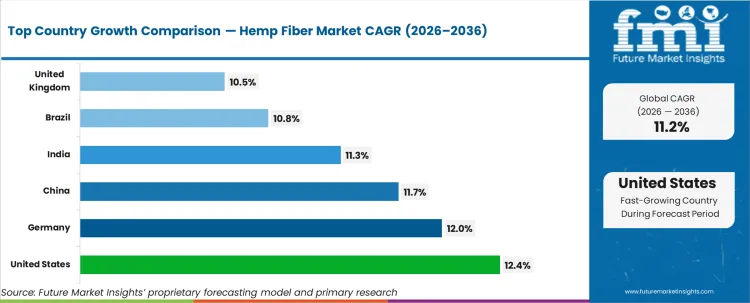
- Geography: High-growth North America and Europe (United States 12.4%, Germany 12.0%) versus emerging Asia-Pacific (China 11.7%, India 11.3%).
- Analyst Opinion at FMI
- Ismail Sutaria, Principal Consultant for Packaging at Future Market Insights, opines, “In our updated Hemp Fiber Market analysis, my team and I have identified molded fiber packaging as the most immediate commercialization pathway. Brands replacing EPS and thermoformed plastics are exploring hemp-based pulp for its strength-to-weight ratio and compostability credentials. However, fiber refinement, water absorption control, and surface smoothness remain engineering priorities. Converters that optimize blending with recycled paper streams will accelerate scalable adoption.”
- Anchor supply chains near high-capacity decortication hubs.
- Standardize grading protocols to match automotive composite specifications.
- Secure long-term off-take agreements to justify processing capital expenditure.
- Methodology
- Validated through first-hand corporate production and capacity data.
- Zero reliance on speculative third-party market research reports.
- Based on verifiable industrial benchmarks and verified sources.
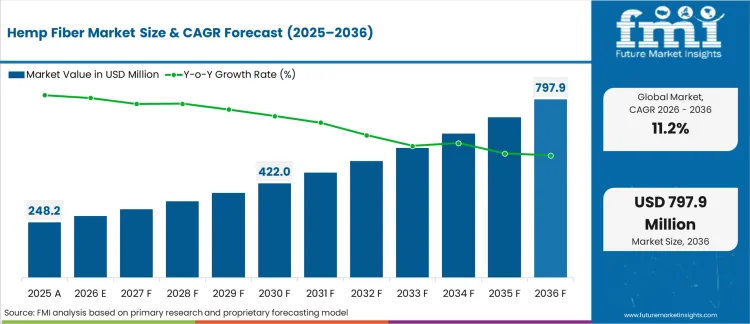
Hemp Fiber Market Key Takeaways
| Metric | Details |
|---|---|
| Industry Size (2026) | USD 276.0 million |
| Industry Value (2036) | USD 825.0 million |
| CAGR (2026-2036) | 11.2% |
"Panda Biotech's state-of-the-art industrial hemp processing facility is a monumental achievement and a game-changer for both agriculture and industry,” said Dixie Carter, president of Panda Biotech. “As research and development in this area continue to advance, industrial hemp fiber and cellulose will help transform numerous industries with sustainable goals and challenges. Panda’s industrial hemp will play a pivotal role in satisfying significant global market demand for renewable processes and products.” [2]
Across North America and Europe, growth concentrates where processing capacity aligns with green building standards and automotive supply clusters. According to FMI's estimates, direct capital injection into decortication infrastructure drives higher conversion rates across global manufacturing hubs. Procurement clusters around framework agreements, favoring incumbents with high-throughput processing capabilities.
Hemp Fiber Market Definition
The Hemp Fiber market refers to the commercial trade of mechanically extracted bast fibers and inner hurd fractions obtained from industrial hemp stalk processing. It captures revenues associated with primary processed fiber inputs used as industrial raw materials in composite plastics, nonwoven textiles, insulation systems, and sustainable construction applications. Market valuation focuses on bulk material supply rather than finished end-use products.
Hemp Fiber Market Inclusions
The scope includes textile-grade long fibers, short technical fibers, and processed hurd particles actively supplied to manufacturing industries. Revenue assessment covers primary processed outputs sold to automotive composite formulators, insulation board producers, bioplastic compounders, and other industrial material integrators purchasing hemp-derived fiber as a functional input.
Hemp Fiber Market Exclusions
The scope excludes hemp seeds, seed oils, cannabinoid extracts, and unprocessed or unharvested stalks. Sales of finished consumer goods such as ready-to-wear garments, furniture, or completed residential structures are not included, as valuation remains limited to primary material-level transactions.
Hemp Fiber Market Research Methodology
- Primary Research: Direct interviews with decortication facility operators, composite engineers, and agricultural cooperative directors.
- Desk Research: Analysis of official crop acreage reports, regional bio-economy funding allocations, and corporate plant commissioning disclosures.
- Market-Sizing and Forecasting: Bottom-up volume modelling from planted acreage yields validated against declared regional processing capacities.
- Data Validation and Update Cycle: Quarterly cross-referencing of import trade codes and announced facility off-take agreements.
Segmental Analysis
Hemp Fiber Market Analysis by Application
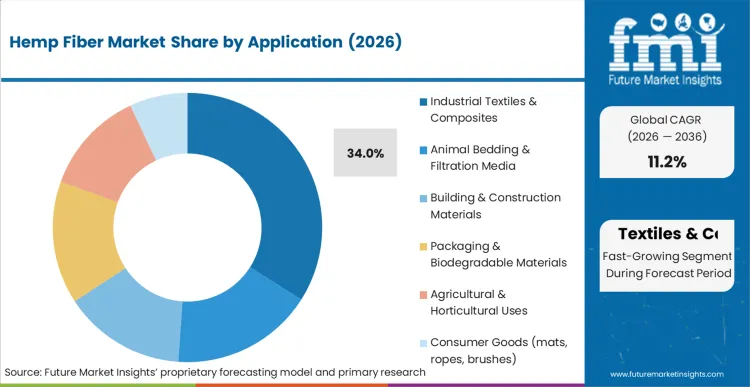
Industrial Textiles & Composites command 34% of overall volume in 2026. FMI analysts opine that transitioning from experimental plastics requires uniform tensile strength and moisture resistance, making biocomposites highly attractive for structural components. Automotive manufacturers mandate strict consistency, pushing raw material suppliers to refine mechanical separation methods. High-volume buyers secure capacity through multi-year agreements, shielding operations from spot market shortages. Expansion of specialized processing lines directly increases spec-grade technical fiber availability.
- Procurement trigger: Demand is reinforced by automotive targets, compelling buyers to substitute synthetic plastics with bio components, opening immediate tender opportunities for verified producers.
- Supply-side move: Processing expansion occurs where capital meets feedstock, scaling technical outputs to match industrial order volumes without straining domestic agriculture networks.
- Technology shift: Adoption accelerates where advanced lines standardize fiber length, reducing defect rates for nonwoven felt producers aiming for structural grade consistency.
Hemp Fiber Market Analysis by End-Use Industry
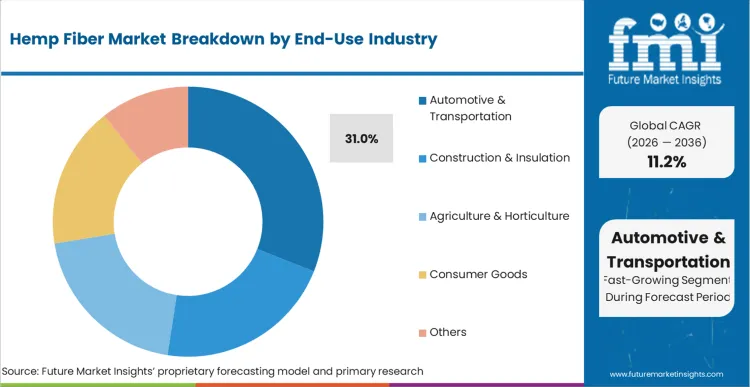
Automotive & Transportation captures 31% of total sector valuation in 2026. As per FMI's projection, lightweighting imperatives force original equipment manufacturers to evaluate natural fiber composites for interior door panels and dashboard substrates. Material substitution reduces overall vehicle weight, directly improving fuel efficiency metrics and battery range parameters. Suppliers integrating vertically with farm cooperatives guarantee volume stability, mitigating seasonal harvest fluctuations. Guaranteed feedstock flow allows composite moulders to optimize resin binding formulations for bast inputs.
- Regulatory signal: Procurement shifts because emission penalties punish heavy vehicle builds, forcing engineers to specify lighter components to maintain compliance margins.
- Capital deployment: Growth is anchored in funding rounds targeting industrial applications, equipping startups to integrate local fibers directly into regional plastics compounding ecosystems.
- Buyer priority: Sourcing concentrates around proven processing capability, ensuring large-batch consistency without tooling modifications, yielding higher margin retention for tier-one suppliers.
Hemp Fiber Market Drivers, Restraints, and Opportunities
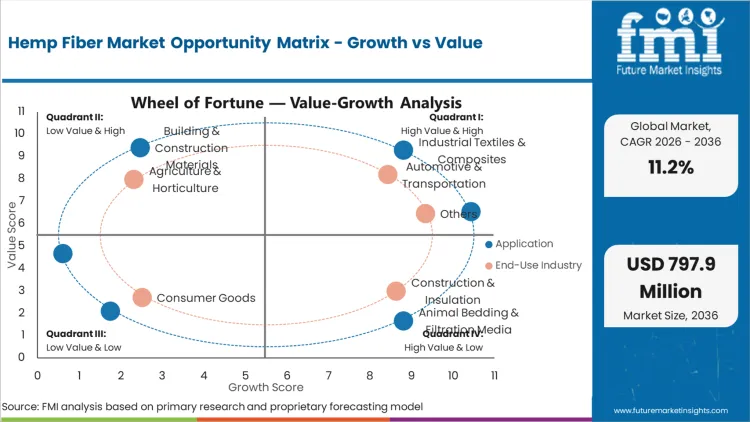
Regulatory mandates targeting embodied carbon serve as primary growth catalysts across industrial landscapes. According to FMI's estimates, governments increasingly attach financial incentives to bio-based building materials, altering cost calculus for developers evaluating insulation options. Subsidized adoption pulls demand through supply chains, requiring massive scaling of primary extraction infrastructure. Established construction firms absorb smaller bio-material specialists to rapidly acquire certified product lines and technical expertise.
Inconsistent feedstock grading acts as severe implementation friction for high-speed manufacturing lines. Industrial composite production relies on uniform lengths and moisture levels; deviations cause line jamming and structural defects in finished moulded parts. Buyers mitigate risk by imposing rigorous inbound material testing and penalizing suppliers for batch variability. Standardization requires significant capital investment in advanced decorticator machine infrastructure, creating high barriers to entry for undercapitalized agricultural processors.
- Policy Integration: Government funding accelerates infrastructure deployment for processors, directly subsidizing capital required to build out rural industrial facilities.
- Material Substitution: Traditional conglomerates pivot toward bio-based binders, securing captive demand for raw stalk components and validating commercial viability of natural additives.
- Agricultural Expansion: State-backed cultivation scaling secures necessary volumes for newly commissioned plants, eliminating upstream feedstock bottlenecks that historically constrained material adoption.
Regional Analysis
Based on the regional analysis, the Hemp Fiber market is segmented into North America, Latin America, Europe, East Asia, South Asia, Oceania and Middle East & Africa across 40+ countries. The full report also offers market attractiveness analysis based on regional trends.
.webp "Top Country Growth Comparison Hemp Fiber Market Cagr (2026 2036)")
| Country | CAGR (2026 to 2036) |
|---|---|
| United States | 12.4% |
| Germany | 12.0% |
| China | 11.7% |
| India | 11.3% |
| Brazil | 10.8% |
| United Kingdom | 10.5% |
Source: Future Market Insights (FMI) analysis, based on proprietary forecasting model and primary research
North America Hemp Fiber Market Analysis
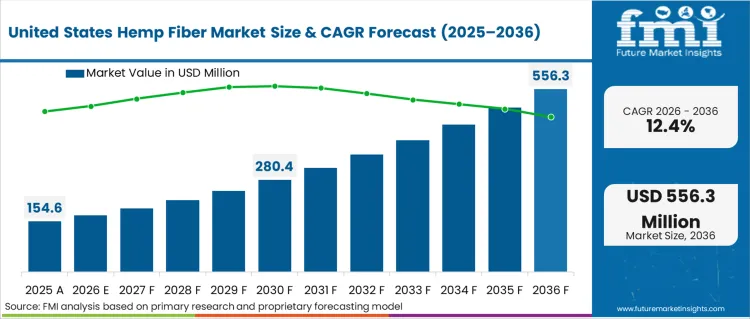
North America commands attention through rapid commercialization of large-scale decortication hubs. Private capital flows into Texas and Midwest corridors, aiming to link vast agricultural acreage directly with automotive off-takers. Robust processing throughput fundamentally alters pricing leverage, shifting market power from niche importers to domestic industrial suppliers. Rising crop allocations reinforce raw material baselines necessary for sustained industrial textile production.
- United States: Demand for Hemp Fiber in the United States is projected to expand at a 12.4% CAGR through 2036, as processing capacity ramps up ahead of procurement cycles that are expected to drive higher deployment volumes. In 2024, harvested open-field acreage reached 32,694 acres, strengthening the domestic biomass base and ensuring a more reliable supply foundation for downstream automotive and packaging applications [3].
FMI’s report includes a comprehensive assessment of North American landscape dynamics. Canada and Mexico present strong opportunistic expansion paths driven by agricultural policy alignment. Buyers should monitor harmonization of oem insulation standards across North American natural fiber supply chains, which dictates procurement velocity.
Europe Hemp Fiber Market Analysis
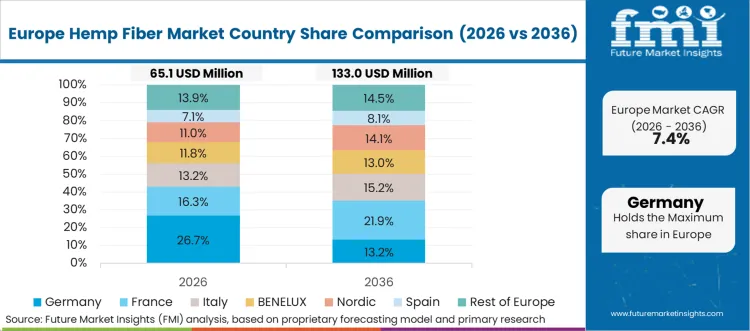
Europe drives consumption through aggressive green building mandates and stringent emission reduction targets for vehicle fleets. Established automotive brands actively qualify bast inputs for interior components, creating reliable demand pull for regional processors. Extraction technology providers expand local installations to match incoming waves of textile and nonwoven felt requirements. Mainstream construction suppliers embed bio-based alternatives into standard catalogues, signaling widespread sector maturity.
- Germany: In Germany, expanding OEM sustainability roadmaps are accelerating the adoption of hemp-based materials across construction and insulation applications. As environmental targets increasingly convert into structured procurement commitments, suppliers are seeing stronger integration into mainstream building specifications. The launch of dedicated hemp-based insulation products such as HemKor in November 2023 highlights how these materials are becoming embedded within standard construction catalogues [4]. Supported by this structural shift toward low-carbon inputs, Hemp Fiber sales in Germany are projected to grow at a 12.0% CAGR from 2026 to 2036.
- United Kingdom: The United Kingdom Hemp Fiber sector is poised to expand at 10.5% CAGR during 2026 to 2036 because green building retrofits accelerate, which lifts utilization rates and justifies technology refresh decisions. Strategic pre-seed funding of USD 1.3 million raised in October 2024 widens industrial access and highlights crucial localized processing investments [5].
FMI’s report includes volume tracking and competitive positioning across European territories. France, Italy, and Sweden display robust momentum based on mature textile processing clusters. Sourcing teams must track capacity additions in building thermal insulation hubs, as localized supply dictates cost competitiveness against synthetic foams.
East Asia Hemp Fiber Market Analysis
East Asia dominates technical textile conversion and high-volume composite manufacturing. Deeply entrenched processing ecosystems absorb raw bast inputs, upgrading material into consistent, spec-grade forms for global export markets. Modernization of legacy decortication lines improves yield quality, directly addressing strict defect tolerances demanded by international automotive brands. Reliable agricultural outputs ensure stable pricing, allowing regional compounders to aggressively target synthetic polymer replacement.
- China: In China, expanding export-oriented fiber conversion capacity is strengthening demand for Hemp Fiber as manufacturers align operations with global sustainability and trade requirements. Growing industrial integration is tightening the link between production scale and procurement commitments. As export competitiveness and industrial scaling advance in parallel, Hemp Fiber demand in China is projected to grow at an 11.7% CAGR from 2026 to 2036.
FMI’s report includes deep dive insights into procurement shifts across major manufacturing economies. Japan and South Korea offer secondary growth channels tied to advanced bio-plastics research and specialized automotive part molding. Operations leaders need to evaluate organic certification frameworks within asia pacific bio composites nodes to maintain compliance with Western buyer mandates.
South Asia Hemp Fiber Market Analysis
South Asia emerges as a textile-led growth corridor, leveraging historical spinning and weaving expertise to absorb alternative natural materials. Agronomic initiatives focus on aggregating smallholder harvests into viable commercial batches for centralized processing. Regional brands blend bast inputs with traditional cotton, creating sustainable yarn portfolios aimed at eco-conscious apparel and industrial applications. Successful capacity building attracts foreign direct investment, transferring advanced extraction technology into local industrial parks.
- India: In India, the Hemp Fiber market is forecast to advance at 11.3% CAGR through 2036, with growth anchored in industrial textile blending that converts into measurable budget allocation. Multiple hemp-compatible binders introduced as dedicated bio-based construction lines validate structural scaling parallel to textile advancements [6].
FMI’s report includes granular data on fiber blending ratios and capacity utilization across subcontinent regions. Bangladesh and Sri Lanka remain relevant adjacent markets, heavily influenced by global textile sourcing dynamics. Investors should closely assess decorticator deployment rates, as mechanical refinement quality directly controls export viability.
Latin America Hemp Fiber Market Analysis
Latin America builds foundational processing capabilities, transitioning from raw agricultural output to primary industrial extraction. Regional cooperatives partner with technology vendors to establish baseline decortication sites, targeting domestic construction and nonwoven material demand. Bio-based building initiatives slowly replace traditional cement-heavy practices, driving localized hurd and fiber supply needs. Joint ventures secure capital expenditure, ensuring processing sites operate near high-yield cultivation areas to minimize raw material logistics costs.
- Brazil: In Brazil, broader adoption of bio-based construction materials is creating new opportunities for Hemp Fiber suppliers to align with evolving sustainability preferences. Growing commercial benchmarks, such as the United States reporting USD 416.665 million in utilized production value in 2024 [7], provide a reference point for scaling operations in emerging agricultural economies. As local construction ecosystems increasingly integrate renewable materials, Hemp Fiber uptake in Brazil is projected to expand at a 10.8% CAGR over the forecast period.
FMI’s report includes an assessment of agrarian policy impacts on material availability. Argentina and Colombia represent emerging frontiers where legislative updates enable broader industrial cultivation. Procurement strategies must focus on securing zero emission building insulations directly from newly commissioned decortication centers to avoid import tariffs.
Competitive Aligners for Market Players
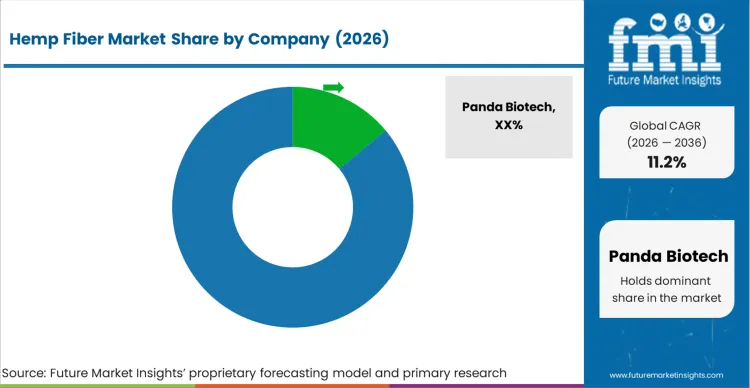
Raw material consistency dictates competitive survival within industrial composite sectors. Processors deploying advanced decortication lines capture high-margin automotive contracts by guaranteeing uniform fiber lengths and exact moisture parameters. Substandard producers face severe margin compression, relegated to supplying low-value bulk applications where technical specifications remain loose.
Vertical integration shields manufacturers from structural agricultural volatility. Companies acquiring downstream building material brands lock in captive demand for processed fiber and hurd outputs. As per FMI's projection, guaranteed internal consumption justifies initial capital expenditure on large-scale refining infrastructure, preventing idle plant capacity during slow procurement seasons.
Regulatory certifications establish hard barriers against unverified market entrants. Automotive and construction buyers mandate strict adherence to carbon footprint and structural performance standards before authorizing vendor onboarding. Suppliers holding certified life cycle assessments win multi-year tenders, while non-compliant operators struggle to access premium industrial channels.
Recent Developments
The report includes full coverage of key trends from competitive benchmarking. Some of the recent developments covered in the reports:
- In April 2024, STRABAG announced the acquisition of Naporo Klima Dämmstoff GmbH, adding Naporo’s insulation materials offering (including hemp-based insulation solutions) and expanding STRABAG’s sustainable building materials portfolio. [8]
Key Players in Hemp Fiber
- Panda Biotech
- STRABAG SE
- Heartland
- Rare Earth Global
- Hempitecture
- Ekolution
- Ma'Rijany Hemp Company
- Kingspan
- Heidelberg Materials
Scope of the Report
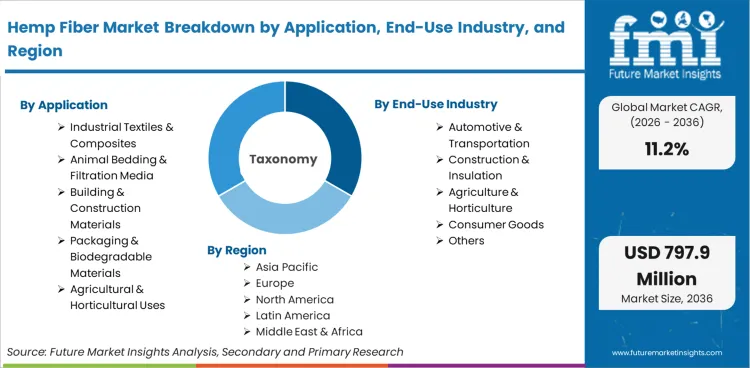
| Metric | Value |
|---|---|
| Quantitative Units | USD 276.0 million (2026) to USD 825.0 million (2036), at a CAGR of 11.2% |
| Market Definition | Hemp fiber encompasses extracted bast fibers and inner woody core fractions derived from industrial hemp stalks, utilized primarily for composite plastics, nonwoven textiles, and bio-based construction materials. |
| Application Segmentation | Industrial Textiles & Composites, Animal Bedding & Filtration Media, Building & Construction Materials, Packaging & Biodegradable Materials, Agricultural & Horticultural Uses, and Consumer Goods (mats, ropes, brushes) |
| End-Use Industry Segmentation | Automotive & Transportation, Construction & Insulation, Agriculture & Horticulture, Consumer Goods, and Others |
| Form Segmentation | Loose Fiber / Bale, Pelletized / Processed Fiber, Functional Blends (hemp fiber + additives) |
| Distribution Channel | Industrial Materials Suppliers, Direct B2B Contracts, Online / Specialty Natural Fiber Markets, and Retail Consumer Distribution |
| Regions Covered | North America, Latin America, Europe, East Asia, South Asia, Oceania, Middle East and Africa |
| Countries Covered | United States, Germany, China, India, Brazil, United Kingdom and 40 plus countries |
| Key Companies Profiled | Panda Biotech, STRABAG SE, Heartland, Rare Earth Global, Hempitecture |
| Forecast Period | 2026 to 2036 |
| Approach | Bottom-up volume modelling from planted acreage yields validated against declared regional processing capacities. |
Hemp Fiber Market Analysis by Segments
Application
- Industrial Textiles & Composites
- Animal Bedding & Filtration Media
- Building & Construction Materials
- Packaging & Biodegradable Materials
- Agricultural & Horticultural Uses
- Consumer Goods (mats, ropes, brushes)
End-Use Industry
- Automotive & Transportation
- Construction & Insulation
- Agriculture & Horticulture
- Consumer Goods
- Others
Form
- Loose Fiber / Bale
- Pelletized / Processed Fiber
- Functional Blends (hemp fiber + additives)
Distribution Channel
- Industrial Materials Suppliers
- Direct B2B Contracts
- Online / Specialty Natural Fiber Markets
- Retail Consumer Distribution
Region
- Asia Pacific
- India
- China
- Japan
- South Korea
- Indonesia
- Australia & New Zealand
- ASEAN
- Rest of Asia Pacific
- Europe
- Germany
- Italy
- France
- United Kingdom
- Spain
- Benelux
- Nordics
- Central & Eastern Europe
- Rest of Europe
- North America
- United States
- Canada
- Mexico
- Latin America
- Brazil
- Argentina
- Chile
- Rest of Latin America
- Middle East & Africa
- Kingdom of Saudi Arabia
- United Arab Emirates
- South Africa
- Turkey
- Rest of Middle East & Africa
Bibliography
- [1] Via TT. (2024). Panda Biotech commenced commercial operations at Panda Hemp Gin.
- [2] TT News Agency. (2024). Panda Biotech announces commercial operations have begun at its flagship Panda Hemp Gin.
- [3] United States Department of Agriculture. (2025). USA industrial hemp in the open-area harvested, 2024.
- [4] Powder Bulk Solids. (2023). Kingspan launched HemKor hemp-based insulation products.
- [5] BeBeez. (2024). Rare Earth Global raised USD 1.3 million pre-seed.
- [6] HempBuild Magazine. (2025). Socli introduced multiple bio-based construction lines.
- [7] United States Department of Agriculture. (2025). USA value of utilized production in the open, 2024.
- [8] STRABAG SE. (2024, April). STRABAG drives forward potential of sustainable building materials with acquisition of Naporo Klima Dämmstoff GmbH.
This bibliography is provided for reader reference and is not exhaustive. The full report contains the complete reference list and detailed citations.
This Report Addresses
- Market intelligence to enable structured strategic decision making across mature and emerging bio-composite economies
- Market size estimation and 10-year revenue forecasts from 2026 to 2036, supported by validated decortication capacity and agricultural yield benchmarks
- Growth opportunity mapping across loose fiber, bales, and hurd formats with emphasis on textile-grade processing transitions
- Segment and regional revenue forecasts covering industrial textiles, building materials, automotive components, and composite applications
- Competition strategy assessment including vertical integration models, supply chain localization, and technical grading capability benchmarking
- Material substitution tracking including natural fiber composites replacing synthetic polymers in OEM manufacturing
- Regulatory impact analysis covering green building material subsidies, embodied carbon mandates, and export-driven automotive lightweighting specifications
- Market report delivery in PDF, Excel, PPT, and interactive dashboard formats for executive and operational use
Frequently Asked Questions
How large is the demand for Hemp Fiber in the global market in 2026?
Demand for Hemp Fiber in the global market is estimated to be valued at USD 276.0 million in 2026.
What will be the market size of Hemp Fiber in the global market by 2036?
Market size for Hemp Fiber is projected to reach USD 825.0 million by 2036.
What is the expected demand growth for Hemp Fiber in the global market between 2026 and 2036?
Demand for Hemp Fiber in the global market is expected to grow at a CAGR of 11.2% between 2026 and 2036.
Which Application is poised to lead global sales by 2026?
Industrial Textiles & Composites is expected to be the dominant segment, capturing approximately 34% of global market share in 2026 due to automotive lightweighting requirements.
How significant is the role of Automotive & Transportation in driving Hemp Fiber adoption in 2026?
Automotive & Transportation represents a critical segment, projected to hold a substantial 31% share of the total market in 2026 as manufacturers seek bio-based synthetic replacements.
What is driving demand in the United States?
Demand is scaling through expanded decortication facility investments and localized supply chains feeding automotive and packaging sectors.
What compliance standards or regulations are referenced for the United States?
United States Department of Agriculture crop acreage and yield metrics serve as primary tracking benchmarks.
What is the United States growth outlook in this report?
The United States is projected to grow at a CAGR of 12.4% during 2026 to 2036.
Why is Europe described as a priority region in this report?
Growth is propelled by aggressive building retrofit targets and well-established automotive sustainability roadmaps.
What type of demand dominates in Europe?
Compliance-driven demand for certified bio-composites and thermal insulation systems dominates regional consumption.
What is Germany growth outlook in this report?
Germany is projected to expand at a CAGR of 12.0% during 2026 to 2036.
Does the report cover China in its regional analysis?
Yes, China is included within East Asia under the regional scope of analysis.
What are the sources referred to for analyzing China?
Corporate disclosures from multinational automotive brands regarding natural fiber composite integration serve as primary evidence anchors.
What is the main demand theme linked to China in its region coverage?
Export-oriented technical fiber conversion scaling drives regional operational adoption.
Does the report cover India in its regional analysis?
Yes, India is included within South Asia under the regional coverage framework.
What is the main India related demand theme in its region coverage?
Industrial textile blending and bio-plastics integration underpin local processing modernization.
Which product formats or configurations are strategically important for North America supply chains?
Baled configurations are prioritized due to bulk logistics efficiency across long-distance transit routes.
What is Hemp Fiber and what is it mainly used for?
Hemp hull fiber consists of decorticated bast fibers and inner hurd cores, primarily used in structural automotive composites and building insulation.
What does Hemp Fiber mean in this report?
Hemp hull fiber market refers to the global production, trade, and industrial processing of decorticated stalk outputs.
What is included in the scope of this Hemp Fiber report?
Scope covers textile-grade long fibers, short technical fibers, and hurd particles actively traded for industrial manufacturing.
What is excluded from the scope of this report?
Hemp seeds, cannabinoid extracts, and finished consumer apparel goods are excluded from tracking.
What does market forecast mean on this page?
Market forecast represents a model-based projection built on defined agricultural capacity and industrial off-take assumptions.
How does FMI build and validate the Hemp Fiber forecast?
Forecast is developed using bottom-up volume modelling validated against declared regional processing capabilities and crop yields.
What does zero reliance on speculative third party market research mean here?
Primary interviews and verifiable public capacity disclosures are utilized instead of unverified syndicated estimates.
Preview the report firsthand - request a free sample
Get SampleGet the brochure for pricing and purchase details.
Get PDFTable of Content
- Executive Summary
- Global Market Outlook
- Demand-side Trends
- Supply-side Trends
- Technology Roadmap Analysis
- Analysis and Recommendations
- Market Overview
- Market Coverage / Taxonomy
- Market Definition / Scope / Limitations
- Research Methodology
- Chapter Orientation
- Analytical Lens and Working Hypotheses
- Market Structure, Signals, and Trend Drivers
- Benchmarking and Cross-market Comparability
- Market Sizing, Forecasting, and Opportunity Mapping
- Research Design and Evidence Framework
- Desk Research Programme (Secondary Evidence)
- Company Annual and Sustainability Reports
- Peer-reviewed Journals and Academic Literature
- Corporate Websites, Product Literature, and Technical Notes
- Earnings Decks and Investor Briefings
- Statutory Filings and Regulatory Disclosures
- Technical White Papers and Standards Notes
- Trade Journals, Industry Magazines, and Analyst Briefs
- Conference Proceedings, Webinars, and Seminar Materials
- Government Statistics Portals and Public Data Releases
- Press Releases and Reputable Media Coverage
- Specialist Newsletters and Curated Briefings
- Sector Databases and Reference Repositories
- FMI Internal Proprietary Databases and Historical Market Datasets
- Subscription Datasets and Paid Sources
- Social Channels, Communities, and Digital Listening Inputs
- Additional Desk Sources
- Expert Input and Fieldwork (Primary Evidence)
- Primary Modes
- Qualitative Interviews and Expert Elicitation
- Quantitative Surveys and Structured Data Capture
- Blended Approach
- Why Primary Evidence is Used
- Field Techniques
- Interviews
- Surveys
- Focus Groups
- Observational and In-context Research
- Social and Community Interactions
- Stakeholder Universe Engaged
- C-suite Leaders
- Board Members
- Presidents and Vice Presidents
- R&D and Innovation Heads
- Technical Specialists
- Domain Subject-matter Experts
- Scientists
- Physicians and Other Healthcare Professionals
- Governance, Ethics, and Data Stewardship
- Research Ethics
- Data Integrity and Handling
- Primary Modes
- Tooling, Models, and Reference Databases
- Desk Research Programme (Secondary Evidence)
- Data Engineering and Model Build
- Data Acquisition and Ingestion
- Cleaning, Normalisation, and Verification
- Synthesis, Triangulation, and Analysis
- Quality Assurance and Audit Trail
- Market Background
- Market Dynamics
- Drivers
- Restraints
- Opportunity
- Trends
- Scenario Forecast
- Demand in Optimistic Scenario
- Demand in Likely Scenario
- Demand in Conservative Scenario
- Opportunity Map Analysis
- Product Life Cycle Analysis
- Supply Chain Analysis
- Investment Feasibility Matrix
- Value Chain Analysis
- PESTLE and Porter’s Analysis
- Regulatory Landscape
- Regional Parent Market Outlook
- Production and Consumption Statistics
- Import and Export Statistics
- Market Dynamics
- Global Market Analysis 2021 to 2025 and Forecast, 2026 to 2036
- Historical Market Size Value (USD Million) Analysis, 2021 to 2025
- Current and Future Market Size Value (USD Million) Projections, 2026 to 2036
- Y-o-Y Growth Trend Analysis
- Absolute $ Opportunity Analysis
- Global Market Pricing Analysis 2021 to 2025 and Forecast 2026 to 2036
- Global Market Analysis 2021 to 2025 and Forecast 2026 to 2036, By Application
- Introduction / Key Findings
- Historical Market Size Value (USD Million) Analysis By Application , 2021 to 2025
- Current and Future Market Size Value (USD Million) Analysis and Forecast By Application , 2026 to 2036
- Industrial Textiles & Composites
- Animal Bedding & Filtration Media
- Building & Construction Materials
- Packaging & Biodegradable Materials
- Agricultural & Horticultural Uses
- Consumer Goods (mats, ropes, brushes)
- Industrial Textiles & Composites
- Y-o-Y Growth Trend Analysis By Application , 2021 to 2025
- Absolute $ Opportunity Analysis By Application , 2026 to 2036
- Global Market Analysis 2021 to 2025 and Forecast 2026 to 2036, By End-Use Industry
- Introduction / Key Findings
- Historical Market Size Value (USD Million) Analysis By End-Use Industry, 2021 to 2025
- Current and Future Market Size Value (USD Million) Analysis and Forecast By End-Use Industry, 2026 to 2036
- Automotive & Transportation
- Construction & Insulation
- Agriculture & Horticulture
- Consumer Goods
- Others
- Automotive & Transportation
- Y-o-Y Growth Trend Analysis By End-Use Industry, 2021 to 2025
- Absolute $ Opportunity Analysis By End-Use Industry, 2026 to 2036
- Global Market Analysis 2021 to 2025 and Forecast 2026 to 2036, By Region
- Introduction
- Historical Market Size Value (USD Million) Analysis By Region, 2021 to 2025
- Current Market Size Value (USD Million) Analysis and Forecast By Region, 2026 to 2036
- North America
- Latin America
- Western Europe
- Eastern Europe
- East Asia
- South Asia and Pacific
- Middle East & Africa
- Market Attractiveness Analysis By Region
- North America Market Analysis 2021 to 2025 and Forecast 2026 to 2036, By Country
- Historical Market Size Value (USD Million) Trend Analysis By Market Taxonomy, 2021 to 2025
- Market Size Value (USD Million) Forecast By Market Taxonomy, 2026 to 2036
- By Country
- USA
- Canada
- Mexico
- By Application
- By End-Use Industry
- By Country
- Market Attractiveness Analysis
- By Country
- By Application
- By End-Use Industry
- Key Takeaways
- Latin America Market Analysis 2021 to 2025 and Forecast 2026 to 2036, By Country
- Historical Market Size Value (USD Million) Trend Analysis By Market Taxonomy, 2021 to 2025
- Market Size Value (USD Million) Forecast By Market Taxonomy, 2026 to 2036
- By Country
- Brazil
- Chile
- Rest of Latin America
- By Application
- By End-Use Industry
- By Country
- Market Attractiveness Analysis
- By Country
- By Application
- By End-Use Industry
- Key Takeaways
- Western Europe Market Analysis 2021 to 2025 and Forecast 2026 to 2036, By Country
- Historical Market Size Value (USD Million) Trend Analysis By Market Taxonomy, 2021 to 2025
- Market Size Value (USD Million) Forecast By Market Taxonomy, 2026 to 2036
- By Country
- Germany
- UK
- Italy
- Spain
- France
- Nordic
- BENELUX
- Rest of Western Europe
- By Application
- By End-Use Industry
- By Country
- Market Attractiveness Analysis
- By Country
- By Application
- By End-Use Industry
- Key Takeaways
- Eastern Europe Market Analysis 2021 to 2025 and Forecast 2026 to 2036, By Country
- Historical Market Size Value (USD Million) Trend Analysis By Market Taxonomy, 2021 to 2025
- Market Size Value (USD Million) Forecast By Market Taxonomy, 2026 to 2036
- By Country
- Russia
- Poland
- Hungary
- Balkan & Baltic
- Rest of Eastern Europe
- By Application
- By End-Use Industry
- By Country
- Market Attractiveness Analysis
- By Country
- By Application
- By End-Use Industry
- Key Takeaways
- East Asia Market Analysis 2021 to 2025 and Forecast 2026 to 2036, By Country
- Historical Market Size Value (USD Million) Trend Analysis By Market Taxonomy, 2021 to 2025
- Market Size Value (USD Million) Forecast By Market Taxonomy, 2026 to 2036
- By Country
- China
- Japan
- South Korea
- By Application
- By End-Use Industry
- By Country
- Market Attractiveness Analysis
- By Country
- By Application
- By End-Use Industry
- Key Takeaways
- South Asia and Pacific Market Analysis 2021 to 2025 and Forecast 2026 to 2036, By Country
- Historical Market Size Value (USD Million) Trend Analysis By Market Taxonomy, 2021 to 2025
- Market Size Value (USD Million) Forecast By Market Taxonomy, 2026 to 2036
- By Country
- India
- ASEAN
- Australia & New Zealand
- Rest of South Asia and Pacific
- By Application
- By End-Use Industry
- By Country
- Market Attractiveness Analysis
- By Country
- By Application
- By End-Use Industry
- Key Takeaways
- Middle East & Africa Market Analysis 2021 to 2025 and Forecast 2026 to 2036, By Country
- Historical Market Size Value (USD Million) Trend Analysis By Market Taxonomy, 2021 to 2025
- Market Size Value (USD Million) Forecast By Market Taxonomy, 2026 to 2036
- By Country
- Kingdom of Saudi Arabia
- Other GCC Countries
- Turkiye
- South Africa
- Other African Union
- Rest of Middle East & Africa
- By Application
- By End-Use Industry
- By Country
- Market Attractiveness Analysis
- By Country
- By Application
- By End-Use Industry
- Key Takeaways
- Key Countries Market Analysis
- USA
- Pricing Analysis
- Market Share Analysis, 2025
- By Application
- By End-Use Industry
- Canada
- Pricing Analysis
- Market Share Analysis, 2025
- By Application
- By End-Use Industry
- Mexico
- Pricing Analysis
- Market Share Analysis, 2025
- By Application
- By End-Use Industry
- Brazil
- Pricing Analysis
- Market Share Analysis, 2025
- By Application
- By End-Use Industry
- Chile
- Pricing Analysis
- Market Share Analysis, 2025
- By Application
- By End-Use Industry
- Germany
- Pricing Analysis
- Market Share Analysis, 2025
- By Application
- By End-Use Industry
- UK
- Pricing Analysis
- Market Share Analysis, 2025
- By Application
- By End-Use Industry
- Italy
- Pricing Analysis
- Market Share Analysis, 2025
- By Application
- By End-Use Industry
- Spain
- Pricing Analysis
- Market Share Analysis, 2025
- By Application
- By End-Use Industry
- France
- Pricing Analysis
- Market Share Analysis, 2025
- By Application
- By End-Use Industry
- India
- Pricing Analysis
- Market Share Analysis, 2025
- By Application
- By End-Use Industry
- ASEAN
- Pricing Analysis
- Market Share Analysis, 2025
- By Application
- By End-Use Industry
- Australia & New Zealand
- Pricing Analysis
- Market Share Analysis, 2025
- By Application
- By End-Use Industry
- China
- Pricing Analysis
- Market Share Analysis, 2025
- By Application
- By End-Use Industry
- Japan
- Pricing Analysis
- Market Share Analysis, 2025
- By Application
- By End-Use Industry
- South Korea
- Pricing Analysis
- Market Share Analysis, 2025
- By Application
- By End-Use Industry
- Russia
- Pricing Analysis
- Market Share Analysis, 2025
- By Application
- By End-Use Industry
- Poland
- Pricing Analysis
- Market Share Analysis, 2025
- By Application
- By End-Use Industry
- Hungary
- Pricing Analysis
- Market Share Analysis, 2025
- By Application
- By End-Use Industry
- Kingdom of Saudi Arabia
- Pricing Analysis
- Market Share Analysis, 2025
- By Application
- By End-Use Industry
- Turkiye
- Pricing Analysis
- Market Share Analysis, 2025
- By Application
- By End-Use Industry
- South Africa
- Pricing Analysis
- Market Share Analysis, 2025
- By Application
- By End-Use Industry
- USA
- Market Structure Analysis
- Competition Dashboard
- Competition Benchmarking
- Market Share Analysis of Top Players
- By Regional
- By Application
- By End-Use Industry
- Competition Analysis
- Competition Deep Dive
- STRABAG SE
- Overview
- Product Portfolio
- Profitability by Market Segments (Product/Age /Sales Channel/Region)
- Sales Footprint
- Strategy Overview
- Marketing Strategy
- Product Strategy
- Channel Strategy
- Heartland
- Rare Earth Global
- Hempitecture
- Ekolution
- Ma'Rijany Hemp Company
- Kingspan
- Heidelberg Materials
- STRABAG SE
- Competition Deep Dive
- Assumptions & Acronyms Used


