

- Industry Size (2026)
- USD 0.7 Bn
- Forecast (2036)
- USD 1.8 Bn
- CAGR (2026 to 2036)
- 9.9%
SiC Sintering Aids Market Forecast and Outlook 2026 to 2036
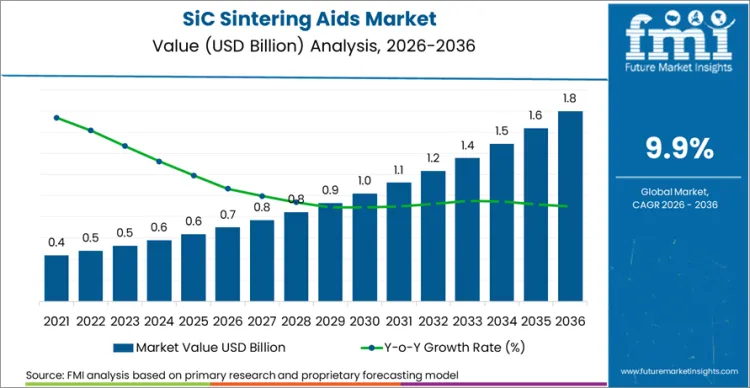
The SiC sintering aids market is projected to total USD 0.7 billion in 2026, expected to rise to USD 1.8 billion by 2036, following a CAGR of 9.9%, as per FMI’s study. The SiC sintering aids market is currently undergoing a structural transformation characterized by vertical integration and a shift toward sustainable, high-purity material cycles. A pivotal move in 2025 was the Schunk Group’s full acquisition of ESK-SIC, a leading raw material manufacturer.
This strategic integration secures a stable supply of high-quality SiC powder for Schunk’s 3D-printing and technical ceramics divisions. Central to this acquisition is the industrial scaling of RECOSiC technology, a recycling process that produces SiC powders with an 80% reduction in CO2 emissions, addressing the growing demand for green semiconductor materials.
Major semiconductor players are expanding their internal manufacturing ecosystems to support next-generation platforms. Kyocera Corporation recently completed significant facility expansions at its Kagoshima Sendai and Shiga Higashiomi plants, involving a combined investment exceeding 40 billion yen to meet the surging demand for SiC-based components in ADAS and 5G infrastructure. These capacity increases are mirrored by technological leaps, such as Wolfspeed’s 2025 launch of its Gen 4 SiC platform, which utilizes advanced MOSFET architectures to reduce power losses by up to 80% compared to traditional silicon.
“The AI revolution is fundamentally reshaping data center requirements and accelerating the shift from general-purpose facilities to purpose-built AI infrastructure that demands unprecedented power density and efficiency, playing directly into Wolfspeed's strength. Our devices are already embedded in critical AI data center power systems, and we have doubled our data center revenue in the last three quarters." -Robert Feurle, CEO, Wolfspeed. Source: Wolfspeed Q2 FY2026 Earnings Call (February 4, 2026)
Consolidation in the power electronics segment further underscores the market's evolution. onsemi’s USD 115 million acquisition of Qorvo’s SiC JFET business, including United Silicon Carbide, enables the company to integrate ultra-low on-resistance JFET technology into its EliteSiC portfolio. This shift is primarily aimed at high-growth sectors like AI data centers and EV battery disconnect units, where sintering quality and material purity are critical for thermal management. Collectively, these actions indicate a market moving away from commodity supply toward integrated, performance-driven value chains.
Summary of SiC Sintering Aids Market
What is Growth Outlook for SiC Sintering Aids Market as per Future Market Insights Projection?
Future Market Insights projects the SiC sintering aids market to expand at a CAGR of 9.9% from 2026 to 2036, increasing from USD 0.7 billion in 2026 to USD 1.8 billion by 2036.
FMI Research Approach: FMI proprietary forecasting model integrating semiconductor capacity expansion, electrification of automotive and energy infrastructure, and rising demand for high-purity, pressureless sintering solutions in advanced ceramics.
How do FMI Analysts Perceive SiC Sintering Aids Market to Evolve?
FMI analysts perceive the market evolving from fragmented additive supply toward vertically integrated, performance-driven material ecosystems. Sintering aids are increasingly treated as critical enablers of yield, density, and thermal stability rather than interchangeable inputs. Tighter contamination thresholds, sustainability requirements, and the transition to large-diameter SiC wafers are shaping growth across power electronics and semiconductor manufacturing.
FMI Research Approach: Assessment of semiconductor roadmap requirements, ceramic densification benchmarks, and integration of recycled and low-carbon SiC material cycles.
Which Country Holds Largest Share in Global SiC Sintering Aids Market?
China holds the largest share of the global SiC sintering aids market, supported by state-backed semiconductor localization programs, rapid scale-up of SiC wafer and power module manufacturing, and integration of sintering material supply within domestic fabrication clusters.
FMI Research Approach: Country-level modeling based on SiC fabrication capacity, power electronics output, and alignment with national semiconductor self-sufficiency initiatives.
How Large will the SiC Sintering Aids Market Be by 2036?
The global SiC sintering aids market is projected to reach USD 1.8 billion by 2036.
FMI Research Approach: Long-term revenue forecasting derived from growth in SiC-based power devices, adoption of 800V EV architectures, and expansion of high-temperature ceramic applications in industrial and energy systems.
What is the Definition of SiC Sintering Aids Market?
The SiC sintering aids market comprises chemical additives such as boron-based compounds, oxides, and rare-earth materials used to promote densification, grain boundary control, and mechanical integrity during the sintering of silicon carbide ceramics for semiconductor, automotive, and industrial applications.
FMI Research Approach: FMI market taxonomy and inclusion–exclusion framework covering aid types, purity grades, and end-use ceramic components requiring high thermal and structural performance.
What are some Globally Unique Trends Shaping SiC Sintering Aids Market?
Globally unique trends include the shift toward ultra-high-purity and recycled sintering aids, growing adoption of pressureless sintering for large-format components, rising material integration within semiconductor value chains, and increasing treatment of sintering aids as strategic inputs under supply-chain localization policies.
FMI Research Approach: Synthesis of semiconductor policy developments, ceramic processing innovation, and sustainability-driven material optimization across major producing regions.
SiC Sintering Aids Market Key Takeaways
| Metrics | Values |
|---|---|
| Expected Value (2026E) | USD 0.7 billion |
| Projected Value (2036F) | USD 1.8 billion |
| CAGR (2026–2036) | 9.9% |
Source: Future Market Insights-analysis driven by proprietary forecasting models and primary research
Why is the SiC Sintering Aids Market Growing?
The global expansion of the SiC sintering aids market is driven by the cross-industry transition toward high-voltage architectures and the scaling of advanced semiconductor manufacturing. As of 2026, the market is benefiting from a massive influx of capital directed at domestic supply chain security and the electrification of industrial infrastructure.
A primary catalyst is the surge in global semiconductor fabrication capacity. In 2025, capital expenditures in the semiconductor sector reached approximately $185 billion, representing a 7% increase in manufacturing capacity. This build-out is particularly concentrated in the Asia-Pacific region, where countries like India have approved massive joint ventures, such as the HCL and Foxconn partnership, to establish domestic semiconductor units. These facilities require high-performance ceramic components for wafer processing equipment, where sintered SiC-facilitated by advanced aids is preferred for its stability in high-temperature, corrosive environments.
The transition of the automotive sector toward 800-volt vehicle platforms has moved SiC from a niche material to a standard requirement for efficiency. By late 2025, the automotive segment generated approximately 61% of the silicon carbide power semiconductor market revenue. This demand is further amplified by the rapid build-out of ultra-fast charging infrastructure; global networks are currently scaling toward 350 kW+ dispensers, which rely on sintered power modules to manage extreme thermal loads.
Geopolitical shifts have also accelerated market growth through onshoring initiatives. Programs such as the U.S. CHIPS Act and the EU’s IPCEI on Microelectronics have incentivized the establishment of vertically integrated supply chains. For example, in June 2025, Singapore launched a new 200-mm SiC wafer production line, while the UK-based Clas-SiC secured a £12 million investment from Archean Chemical Industries to pioneer next-generation material technology. These investments ensure a consistent demand for high-purity sintering aids as manufacturers move from laboratory-scale demonstrations to full-scale industrial output.
How is SiC Sintering Aids Market Segmented?
How is the Shift to High-Purity Sintering Enhancing Boron-Based Adoption?
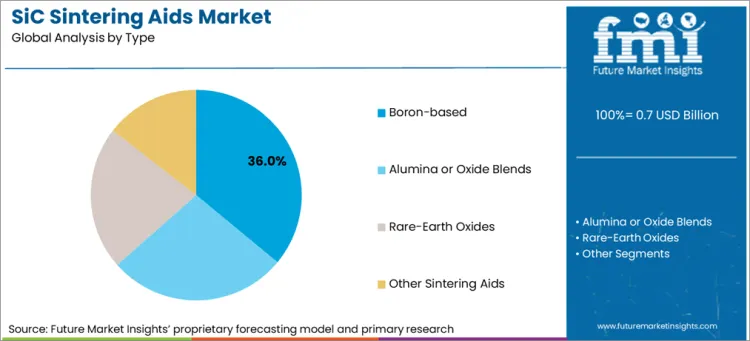
Boron-based aids represent 36% of the sintering aids market, a share sustained by their critical role in pressureless sintering for high-density industrial ceramics. Market developments in 2025 and 2026 show a significant transition from standard grades to ultra-high-purity formulations to support the expanding semiconductor "fab" ecosystem. For example, Nippon Carbide Industries expanded its portfolio in late 2025 to include specialized boron-carbide materials specifically for wear-resistant semiconductor coatings.
The Semicon India Programme, which approved Rs. 1.6 Lakh Crore in investments as of February 2026, has catalyzed demand for these aids within new domestic SiC fabrication units, such as the Tata Electronics and PSMC partnership in Gujarat. This segment's growth is further reinforced by the aerospace sector, where 3D-printed reaction-bonded structures are being deployed to reduce fracturing in high-velocity ballistic applications.
Why are Power Modules Driving the Demand for Integrated Sintering Solutions?
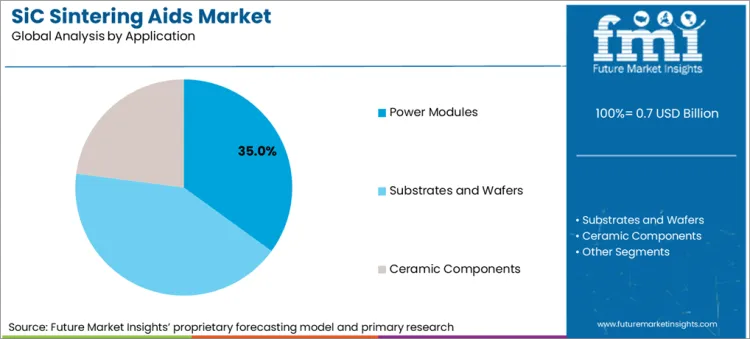
The power modules application segment accounts for 35% of the market, driven by the rapid industrialization of 800-volt EV platforms and AI data center infrastructure. In 2026, this segment is characterized by a vertical integration trend, where semiconductor firms are internalizing material processing to secure supply.
A concrete example is onsemi’s 2025 expansion of its EliteSiC production, which integrates advanced sintering profiles to support high-power density inverters. Similarly, the global transition to 200-mm (8-inch) SiC wafers, led by high-volume production at Wolfspeed’s Mohawk Valley fab, has necessitated more robust power module packaging capable of withstanding junction temperatures up to 175oC. This shift ensures that sintering aids are not treated as commodities but as essential performance enablers for energy-efficient mobility and 5G telecommunications infrastructure, which saw a 25% year-over-year increase in global EV sales through 2025.
What Drivers, Restraints, Opportunities, and Trends Prevail in the SiC Sintering Aids Market?
The primary momentum originates from a global shift toward 800V electric vehicle architectures and utility-scale renewable energy. As of February 2026, the transition from 150-mm to 200-mm (8-inch) SiC wafers, led by high-volume output at facilities like the Wolfspeed Mohawk Valley fab, has nearly doubled chip output per substrate. This industrial scale-up necessitates advanced sintering aids to ensure structural integrity across larger surface areas, driving a projected market CAGR of over 10% through 2031.
Expansion is tempered by the escalating costs of environmental and regulatory compliance. In 2026, PMN fees for new chemical substances have escalated to USD 37,000, while risk assessment fees for specialized sintering chemicals can reach USD 4.2 million per substance. These high entry barriers disproportionately affect SMEs, concentrating market power among Tier-1 manufacturers who can absorb these compliance premiums.
A significant white-space opportunity has emerged in AI data center infrastructure. Modern AI compute clusters target 25-40% reductions in cooling costs by utilizing SiC-based power supplies that operate at higher temperatures. This trend creates a direct pipeline for specialized sintering aids that enable pressureless sintering, allowing for the creation of complex, thermally efficient ceramic heat sinks that traditional silicon-based systems cannot support.
An immediate threat is the disruption of the global supply chain due to reciprocal trade tariffs. In 2025, trade tensions led to a 0.4% reduction in projected growth as sintering-grade materials from the EU and Japan became more expensive for U.S. and Chinese buyers. Furthermore, U.S. anti-dumping levies on specific raw SiC imports are forcing suppliers to reorganize pricing models and seek domestic, often higher-cost, material alternatives.
Analysis of SiC Sintering Aids Market by Key Countries
| Country | CAGR (2026-2036) |
|---|---|
| China | 11.9% |
| USA | 11.4% |
| UK | 10.4% |
| Japan | 9.2% |
Source: FMI’s proprietary forecasting model and primary research
How is State-Backed Capital Driving China’s Capacity-First Strategy?
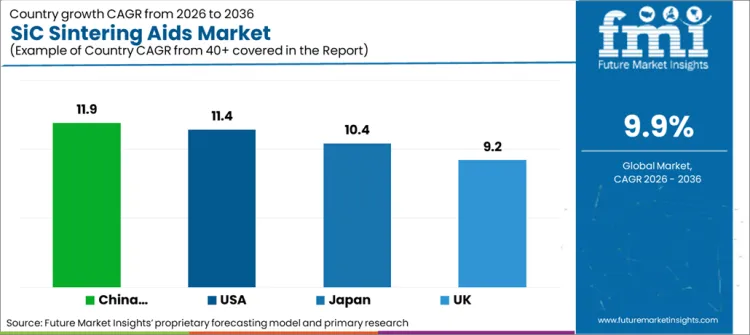
China is projected to lead global growth with a CAGR of 11.9% from 2026 to 2036. This expansion is anchored in the 15th Five-Year Plan (2026–2030), which prioritizes the "localization of core materials" to achieve semiconductor self-sufficiency. In early 2026, the China Integrated Circuit Industry Investment Fund (Big Fund III) accelerated capital injections into domestic SiC boule growth and epitaxy equipment manufacturers.
A significant milestone occurred in late 2025 when the YOFC-backed SiC facility in Wuhan achieved a 97% yield rate for its first 360,000-wafer batch, significantly reducing reliance on imported materials. As domestic NEV (New Energy Vehicle) manufacturers transition to locally produced chips, the demand for high-performance sintering aids has surged to support the aggressive scaling of 150-mm and 200-mm fabrication lines across the Yangtze River Delta cluster.
Will the Northeast Corridor Expansion Secure the USA’s Market Share?
The USA market is forecast to expand at a CAGR of 11.4%, bolstered by aggressive federal incentives under the CHIPS and Science Act. In January 2026, the Department of Commerce issued new letters of intent for vertically integrated "mine-to-magnet" and "powder-to-chip" projects, including a $277 million allocation to USA Rare Earth. Strategic growth is exemplified by Wolfspeed’s continued expansion of its Mohawk Valley fab, which is now recognized as the world’s largest 200-mm SiC facility.
This domestic manufacturing push is reinforced by the January 2026 Proclamation on Adjusting Imports of Semiconductors, which introduced a 25% tariff on specific high-tech chips to incentivize domestic sourcing. These policies have forced a realignment of the sintering aid supply chain, favoring US-based chemical providers that can provide "Made in America" certifications for defense and critical energy infrastructure.
How is the South Wales Cluster Positioned for the UK’s High-Growth Segments?
The UK maintains a steady CAGR of 10.4%, primarily driven by its dominance in the compound semiconductor R&D space. In November 2025, the UK Government announced £10 million in direct support for the South Wales semiconductor cluster (CSconnected) to enhance manufacturing along the M4 corridor. This investment coincides with the operational launch of two AI Growth Zones in 2026, which target the integration of SiC-based power electronics in aerospace and renewable energy.
Companies like Oxford Instruments have capitalized on this by opening new facilities in Bristol to house compound semiconductor systems. The UK’s growth strategy remains focused on high-value niche applications, such as the development of deep-learning optimized hardware, which requires specialized sintering processes to manage extreme thermal densities.
Why is Japan Revitalizing its Industrial Deep-Base for SiC Leadership?
Japan is expected to grow at a CAGR of 9.2%, leveraging its existing leadership in precision chemicals and material science. The Ministry of Economy, Trade and Industry (METI) approved a massive ¥1 trillion plan in early 2026, with ¥630 billion allocated for fiscal 2026 to support the mass production of next-generation chips. A key development is the expansion of JASM, a joint venture between TSMC, Sony, and Toyota, which is scaling production in Kumamoto.
Japanese chemical firms are adopting local production for local consumption models; for example, Asahi Yukizai is on track to triple its semiconductor-related material capacity by 2027. This resurgence is fueled by the automotive industry’s shift toward SiC inverters to extend EV range, a move supported by Japan's deep base of equipment suppliers like Tokyo Electron.
What is the Competition Outlook for SiC Sintering Aids?
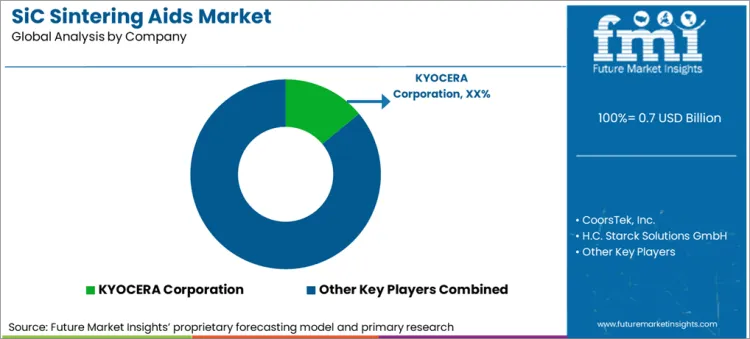
The competitive landscape of the SiC sintering aids and ceramics market is characterized by a vertical integration arms race, where leading firms are shifting from being material suppliers to becoming end-to-end solutions providers. This intensity is driven by the semiconductor industry’s transition to 2nm nodes and beyond, requiring materials with near-theoretical density and zero contamination.
In December 2025, Fujimi Incorporated announced a record-high investment phase, including the construction of a new specialized manufacturing plant to capture the surging demand for advanced CMP slurries used in 2nm device fabrication. Simultaneously, CoorsTek, Inc. has solidified its dominance in high-reliability segments, reportedly holding a 65% market share in the revenue of hot-pressed sintered SiC ceramics as of early 2026, a position maintained through proprietary uniaxial pressing technologies for defense and aerospace armor.
Strategic pivots into the renewable energy and circular economy sectors further intensify competition. In January 2026, Treibacher Industrie AG marked the completion of its €120 million recycling plant (RC2), a move that integrates spent catalyst recycling into its advanced ceramic supply chain to bolster resource security within Europe. This follows
Kyocera Corporation's September 2025 entry into a joint development agreement with Kyoto Fusioneering to co-create SiC composite materials specifically for next-generation fusion energy plants. These developments indicate that the top-tier players are no longer competing solely on powder purity, but on their ability to embed their materials into the foundational infrastructure of the 2030 energy transition.
Key Players Profiled
- KYOCERA Corporation
- CoorsTek, Inc.
- H.C. Starck Solutions GmbH
- Compagnie de Saint-Gobain (Saint-Gobain Ceramics business)
- Fiven ASA
- Fujimi Incorporated
- Treibacher Industrie AG
- Ferro Corporation
- Henze BNP AG
- Washington Mills LLC
Market Definition
The SiC sintering aids market comprises specialty chemical additives used to promote densification, grain boundary control, and mechanical integrity during the sintering of silicon carbide ceramics. These materials are critical to enabling pressureless and low-pressure sintering of SiC at industrial scale, ensuring high thermal conductivity, electrical stability, and structural reliability in advanced ceramic components. The market is closely tied to the expansion of power electronics, semiconductor manufacturing, and high-temperature structural applications where sintered SiC is a foundational material.
The report includes boron-based sintering aids, alumina and oxide blends, rare-earth oxides, and other specialty additives used in the production of SiC power modules, substrates and wafers, and advanced ceramic components. It covers sintering aids supplied for applications across electric vehicle power electronics, AI data center infrastructure, renewable energy systems, semiconductor fabrication equipment, aerospace, and defense. Commercially scaled, high-purity materials integrated into vertically coordinated ceramic and semiconductor value chains are fully within scope.
The scope excludes silicon carbide powders sold without sintering additives, finished SiC components and devices, and downstream semiconductor packaging or module assembly. It also excludes laboratory-scale sintering chemistries, experimental additives not qualified for industrial use, raw material mining, and recycling processes not directly linked to the formulation and sale of sintering aid materials. Non-SiC ceramic systems and additive manufacturing binders outside sintering-aid functionality fall outside the defined market boundary.
Scope of Report
| Items | Values |
|---|---|
| Quantitative Units | USD 0.7 billion |
| Aid Type | Boron-based, Alumina or Oxide Blends, Rare-Earth Oxides, Other Sintering Aids |
| Application | Power Modules, Substrates and Wafers, Ceramic Components |
| Regions Covered | North America, Western Europe, Eastern Europe, East Asia, South Asia & Pacific, Latin America, Middle East & Africa |
| Countries Covered | China, USA, UK, Japan and 40+ countries |
| Key Companies | KYOCERA Corporation, CoorsTek, Inc., H.C. Starck Solutions GmbH, Compagnie de Saint-Gobain (Saint-Gobain Ceramics business), Fiven ASA, Fujimi Incorporated, Treibacher Industrie AG, Ferro Corporation, Henze BNP AG, Washington Mills LLC |
SiC Sintering Aids Market Key Segments
Aid Type
- Boron-based
- Alumina or Oxide Blends
- Rare-Earth Oxides
- Other Sintering Aids
Application
- Power Modules
- Substrates and Wafers
- Ceramic Components
Region
- North America
- Western Europe
- Eastern Europe
- East Asia
- South Asia & Pacific
- Latin America
- Middle East & Africa
Bibliography
- German, R. M. (2024). Sintering theory and practice (2nd ed.). Wiley-VCH.
- Guo, J., Wang, H., Zhang, X., & Zhou, Y. (2025). Pressureless sintering of silicon carbide ceramics using boron-based additives: Densification mechanisms and property optimization. Journal of the European Ceramic Society, 45(3), 1121–1134.
- Richerson, D. W., & Lee, W. E. (2023). Modern ceramic engineering: Properties, processing, and use in design (4th ed.). CRC Press.
- Hirano, T., Ueno, K., & Yamamoto, S. (2024). High-purity sintering aids for advanced SiC ceramics in power electronics applications. Ceramics International, 50(6), 8921–8932.
- Zhang, L., Kimoto, T., & Cooper, J. A. (2024). Materials and processing challenges for large-diameter silicon carbide wafers. Materials Science in Semiconductor Processing, 172, 108124.
- Chen, Z., Li, Y., & Sun, J. (2025). Rare-earth oxide sintering aids for high-density SiC ceramics used in power module substrates. Journal of the American Ceramic Society, 108(9), 4217–4230.
Frequently Asked Questions
How large is the SiC sintering aids market from a materials perspective?
The SiC sintering aids market is valued at around USD 0.7 billion in 2026, reflecting its growing importance as a performance-critical input for advanced ceramic and semiconductor-grade silicon carbide components.
What role do sintering aids play in silicon carbide materials?
Sintering aids enable densification of SiC at lower temperatures by promoting grain boundary diffusion, improving mechanical strength, thermal conductivity, and reliability in high-temperature and high-voltage applications.
Which types of sintering aids dominate current material usage?
Boron-based sintering aids dominate due to their effectiveness in pressureless sintering, followed by alumina and rare-earth oxide systems used to achieve ultra-high density and purity in semiconductor and power electronics applications.
Why are high-purity sintering aids increasingly specified by end users?
High-purity formulations are required to minimize electrical defects, contamination, and yield loss in large-diameter SiC wafers and power modules, especially as the industry transitions to 200-mm substrates and higher operating voltages.
What factors constrain faster scale-up of SiC sintering aid materials?
Key constraints include high qualification costs, stringent regulatory and environmental compliance requirements, capital intensity of purification processes, and the need for tight integration with downstream ceramic and semiconductor manufacturing lines.
Preview the report firsthand - request a free sample
Get SampleGet the brochure for pricing and purchase details.
Get PDFTable of Content
- Executive Summary
- Global Market Outlook
- Demand-side Trends
- Supply-side Trends
- Technology Roadmap Analysis
- Analysis and Recommendations
- Market Overview
- Market Coverage / Taxonomy
- Market Definition / Scope / Limitations
- Research Methodology
- Chapter Orientation
- Analytical Lens and Working Hypotheses
- Market Structure, Signals, and Trend Drivers
- Desk Research Programme (Secondary Evidence)
- Company Annual and Sustainability Reports
- Peer-reviewed Journals and Academic Literature
- Corporate Websites, Product Literature, and Technical Notes
- Earnings Decks and Investor Briefings
- Statutory Filings and Regulatory Disclosures
- Technical White Papers and Standards Notes
- Trade Journals, Industry Magazines, and Analyst Briefs
- Conference Proceedings, Webinars, and Seminar Materials
- Government Statistics Portals and Public Data Releases
- Press Releases and Reputable Media Coverage
- Specialist Newsletters and Curated Briefings
- Sector Databases and Reference Repositories
- FMI Internal Proprietary Databases and Historical Market Datasets
- Subscription Datasets and Paid Sources
- Social Channels, Communities, and Digital Listening Inputs
- Additional Desk Sources
- Expert Input and Fieldwork (Primary Evidence)
- Primary Modes
- Qualitative Interviews and Expert Elicitation
- Quantitative Surveys and Structured Data Capture
- Blended Approach
- Why Primary Evidence is Used
- Field Techniques
- Interviews
- Surveys
- Focus Groups
- Observational and In-context Research
- Social and Community Interactions
- Stakeholder Universe Engaged
- C-suite Leaders
- Board Members
- Presidents and Vice Presidents
- R&D and Innovation Heads
- Technical Specialists
- Domain Subject-matter Experts
- Scientists
- Physicians and Other Healthcare Professionals
- Governance, Ethics, and Data Stewardship
- Research Ethics
- Data Integrity and Handling
- Primary Modes
- Tooling, Models, and Reference Databases
- Data Engineering and Model Build
- Data Acquisition and Ingestion
- Cleaning, Normalisation, and Verification
- Synthesis, Triangulation, and Analysis
- Quality Assurance and Audit Trail
- Market Background
- Market Dynamics
- Drivers
- Restraints
- Opportunity
- Trends
- Scenario Forecast
- Demand in Optimistic Scenario
- Demand in Likely Scenario
- Demand in Conservative Scenario
- Opportunity Map Analysis
- Product Life Cycle Analysis
- Supply Chain Analysis
- Investment Feasibility Matrix
- Value Chain Analysis
- PESTLE and Porter’s Analysis
- Regulatory Landscape
- Regional Parent Market Outlook
- Production and Consumption Statistics
- Import and Export Statistics
- Market Dynamics
- Global Market Analysis 2021 to 2025 and Forecast, 2026 to 2036
- Historical Market Size Value (USD Million) Analysis, 2021 to 2025
- Current and Future Market Size Value (USD Million) Projections, 2026 to 2036
- Y-o-Y Growth Trend Analysis
- Absolute $ Opportunity Analysis
- Global Market Pricing Analysis 2021 to 2025 and Forecast 2026 to 2036
- Global Market Analysis 2021 to 2025 and Forecast 2026 to 2036, By Type
- Introduction / Key Findings
- Historical Market Size Value (USD Million) Analysis By Type , 2021 to 2025
- Current and Future Market Size Value (USD Million) Analysis and Forecast By Type , 2026 to 2036
- Boron-based
- Alumina or Oxide Blends
- Rare-Earth Oxides
- Other Sintering Aids
- Boron-based
- Y-o-Y Growth Trend Analysis By Type , 2021 to 2025
- Absolute $ Opportunity Analysis By Type , 2026 to 2036
- Global Market Analysis 2021 to 2025 and Forecast 2026 to 2036, By Application
- Introduction / Key Findings
- Historical Market Size Value (USD Million) Analysis By Application, 2021 to 2025
- Current and Future Market Size Value (USD Million) Analysis and Forecast By Application, 2026 to 2036
- Power Modules
- Substrates and Wafers
- Ceramic Components
- Power Modules
- Y-o-Y Growth Trend Analysis By Application, 2021 to 2025
- Absolute $ Opportunity Analysis By Application, 2026 to 2036
- Global Market Analysis 2021 to 2025 and Forecast 2026 to 2036, By Region
- Introduction
- Historical Market Size Value (USD Million) Analysis By Region, 2021 to 2025
- Current Market Size Value (USD Million) Analysis and Forecast By Region, 2026 to 2036
- North America
- Latin America
- Western Europe
- Eastern Europe
- East Asia
- South Asia and Pacific
- Middle East & Africa
- Market Attractiveness Analysis By Region
- North America Market Analysis 2021 to 2025 and Forecast 2026 to 2036, By Country
- Historical Market Size Value (USD Million) Trend Analysis By Market Taxonomy, 2021 to 2025
- Market Size Value (USD Million) Forecast By Market Taxonomy, 2026 to 2036
- By Country
- USA
- Canada
- Mexico
- By Type
- By Application
- By Country
- Market Attractiveness Analysis
- By Country
- By Type
- By Application
- Key Takeaways
- Latin America Market Analysis 2021 to 2025 and Forecast 2026 to 2036, By Country
- Historical Market Size Value (USD Million) Trend Analysis By Market Taxonomy, 2021 to 2025
- Market Size Value (USD Million) Forecast By Market Taxonomy, 2026 to 2036
- By Country
- Brazil
- Chile
- Rest of Latin America
- By Type
- By Application
- By Country
- Market Attractiveness Analysis
- By Country
- By Type
- By Application
- Key Takeaways
- Western Europe Market Analysis 2021 to 2025 and Forecast 2026 to 2036, By Country
- Historical Market Size Value (USD Million) Trend Analysis By Market Taxonomy, 2021 to 2025
- Market Size Value (USD Million) Forecast By Market Taxonomy, 2026 to 2036
- By Country
- Germany
- UK
- Italy
- Spain
- France
- Nordic
- BENELUX
- Rest of Western Europe
- By Type
- By Application
- By Country
- Market Attractiveness Analysis
- By Country
- By Type
- By Application
- Key Takeaways
- Eastern Europe Market Analysis 2021 to 2025 and Forecast 2026 to 2036, By Country
- Historical Market Size Value (USD Million) Trend Analysis By Market Taxonomy, 2021 to 2025
- Market Size Value (USD Million) Forecast By Market Taxonomy, 2026 to 2036
- By Country
- Russia
- Poland
- Hungary
- Balkan & Baltic
- Rest of Eastern Europe
- By Type
- By Application
- By Country
- Market Attractiveness Analysis
- By Country
- By Type
- By Application
- Key Takeaways
- East Asia Market Analysis 2021 to 2025 and Forecast 2026 to 2036, By Country
- Historical Market Size Value (USD Million) Trend Analysis By Market Taxonomy, 2021 to 2025
- Market Size Value (USD Million) Forecast By Market Taxonomy, 2026 to 2036
- By Country
- China
- Japan
- South Korea
- By Type
- By Application
- By Country
- Market Attractiveness Analysis
- By Country
- By Type
- By Application
- Key Takeaways
- South Asia and Pacific Market Analysis 2021 to 2025 and Forecast 2026 to 2036, By Country
- Historical Market Size Value (USD Million) Trend Analysis By Market Taxonomy, 2021 to 2025
- Market Size Value (USD Million) Forecast By Market Taxonomy, 2026 to 2036
- By Country
- India
- ASEAN
- Australia & New Zealand
- Rest of South Asia and Pacific
- By Type
- By Application
- By Country
- Market Attractiveness Analysis
- By Country
- By Type
- By Application
- Key Takeaways
- Middle East & Africa Market Analysis 2021 to 2025 and Forecast 2026 to 2036, By Country
- Historical Market Size Value (USD Million) Trend Analysis By Market Taxonomy, 2021 to 2025
- Market Size Value (USD Million) Forecast By Market Taxonomy, 2026 to 2036
- By Country
- Kingdom of Saudi Arabia
- Other GCC Countries
- Turkiye
- South Africa
- Other African Union
- Rest of Middle East & Africa
- By Type
- By Application
- By Country
- Market Attractiveness Analysis
- By Country
- By Type
- By Application
- Key Takeaways
- Key Countries Market Analysis
- USA
- Pricing Analysis
- Market Share Analysis, 2025
- By Type
- By Application
- Canada
- Pricing Analysis
- Market Share Analysis, 2025
- By Type
- By Application
- Mexico
- Pricing Analysis
- Market Share Analysis, 2025
- By Type
- By Application
- Brazil
- Pricing Analysis
- Market Share Analysis, 2025
- By Type
- By Application
- Chile
- Pricing Analysis
- Market Share Analysis, 2025
- By Type
- By Application
- Germany
- Pricing Analysis
- Market Share Analysis, 2025
- By Type
- By Application
- UK
- Pricing Analysis
- Market Share Analysis, 2025
- By Type
- By Application
- Italy
- Pricing Analysis
- Market Share Analysis, 2025
- By Type
- By Application
- Spain
- Pricing Analysis
- Market Share Analysis, 2025
- By Type
- By Application
- France
- Pricing Analysis
- Market Share Analysis, 2025
- By Type
- By Application
- India
- Pricing Analysis
- Market Share Analysis, 2025
- By Type
- By Application
- ASEAN
- Pricing Analysis
- Market Share Analysis, 2025
- By Type
- By Application
- Australia & New Zealand
- Pricing Analysis
- Market Share Analysis, 2025
- By Type
- By Application
- China
- Pricing Analysis
- Market Share Analysis, 2025
- By Type
- By Application
- Japan
- Pricing Analysis
- Market Share Analysis, 2025
- By Type
- By Application
- South Korea
- Pricing Analysis
- Market Share Analysis, 2025
- By Type
- By Application
- Russia
- Pricing Analysis
- Market Share Analysis, 2025
- By Type
- By Application
- Poland
- Pricing Analysis
- Market Share Analysis, 2025
- By Type
- By Application
- Hungary
- Pricing Analysis
- Market Share Analysis, 2025
- By Type
- By Application
- Kingdom of Saudi Arabia
- Pricing Analysis
- Market Share Analysis, 2025
- By Type
- By Application
- Turkiye
- Pricing Analysis
- Market Share Analysis, 2025
- By Type
- By Application
- South Africa
- Pricing Analysis
- Market Share Analysis, 2025
- By Type
- By Application
- USA
- Market Structure Analysis
- Competition Dashboard
- Competition Benchmarking
- Market Share Analysis of Top Players
- By Regional
- By Type
- By Application
- Competition Analysis
- Competition Deep Dive
- KYOCERA Corporation
- Overview
- Product Portfolio
- Profitability by Market Segments (Product/Age /Sales Channel/Region)
- Sales Footprint
- Strategy Overview
- Marketing Strategy
- Product Strategy
- Channel Strategy
- CoorsTek, Inc.
- H.C. Starck Solutions GmbH
- Compagnie de Saint-Gobain
- Fiven ASA
- Fujimi Incorporated
- Treibacher Industrie AG
- Ferro Corporation
- Henze BNP AG
- Washington Mills LLC
- KYOCERA Corporation
- Competition Deep Dive
- Assumptions & Acronyms Used


