


Food Coating Ingredients Market
The food coating ingredients market is segmented by Product Type (Batters, Breadings, Flours, Starches, Hydrocolloids, Sugar & Syrups, Cocoa & Chocolates, Fats & Oils, Spices & Seasonings), Form (Dry Ingredients, Liquid Ingredients), Application (Bakery Products, Confectionery Products, Fried Foods, Meat & Seafood, Dairy Products), and Region. Forecast for 2026 to 2036.
Food Coating Ingredients Market Size, Market Forecast and Outlook By FMI
In 2025, the food coating ingredients market was valued at USD 5.5 billion. It is expected to reach USD 5.9 billion in 2026 and USD 11.3 billion by 2036, implying a CAGR of 6.7%. Absolute dollar growth of USD 5.4 billion over the decade signals a robust expansion driven by the industrialization of traditional artisanal processes in bakery and fried food production.
Procurement teams are shifting specifications from "least-cost commodity" to "performance-guaranteed systems," driven by the need to reduce waste and ensure consistency in automated lines. This "procurement specification shift" means that ingredients are now evaluated on their ability to withstand freeze-thaw cycles and high-speed mechanical handling without dusting or cracking. Consequently, suppliers are reformulating batters and coatings to offer precise viscosity control and adhesion properties that justify a premium over basic flours and starches.
As Jessie Xue, VP & Managing Director at Cargill Food North Asia, noted regarding the strategic importance of regional capacity, "China is an important market for Cargill. The expansion of our Beijing plant represents not just an increase in capacity, but another milestone" [11]. This highlights the industry trend of localizing production to align ingredient availability with the rapid speed-to-market required by global foodservice chains.
Summary of Food Coating Ingredients Market
- Food Coating Ingredients Market Definition
- The industry covers functional edible layers used to modify the surface properties of food for sensory and preservation goals.
- Demand Drivers in the Market
- Expansion of foodservice and delivery channels requires robust coatings that retain texture during transport.
- Premiumization in bakery drives demand for high-quality glazes and toppings.
- Clean-label trends push for recognizable ingredients in batter and breading systems.
- Key Segments Analyzed in the FMI Report
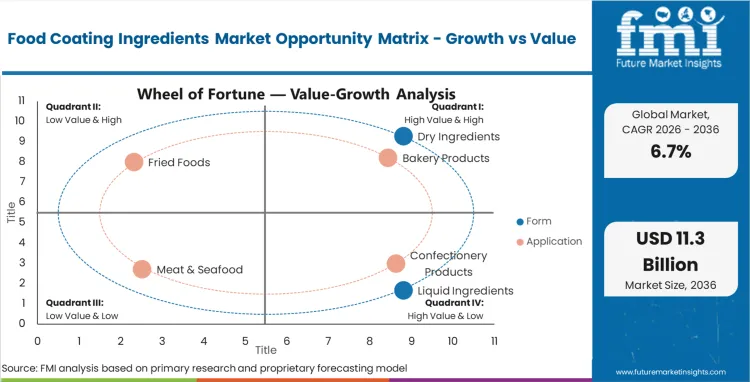
- Form: Dry Ingredients dominate with 64% share due to shelf stability and ease of shipping.
- Application: Bakery Products account for 40.2% of value, driven by demand for artisanal finishes.
- Geography: UK and India show highest growth potential amidst global expansion.
- Analyst Opinion at FMI
- Nandini Roy Choudhury, Principal Consultant for Food & Beverage, opines, "In the updated version of the Food Coating Ingredients Market Report for 2026 to 2036, CXOs will find insights into how M&A activity, such as the Tate & Lyle and CP Kelco combination, is consolidating specialty portfolios. Besides this, my findings point at a surge in enzyme-based solutions that offer functional benefits without adding 'chemical' sounding names to labels."
- Strategic Implications/Executive Takeaways
- Invest in regional blending facilities to reduce lead times for custom seasoning and coating mixes.
- Develop "fry-free" coating systems to align with health-conscious consumer trends.
- Secure long-term supply contracts for specialty starches to mitigate crop volatility risks.
- Methodology
- Validated through first-hand corporate production and capacity data.
- Zero reliance on speculative third-party market research reports.
- Based on verifiable industrial benchmarks and verified sources.
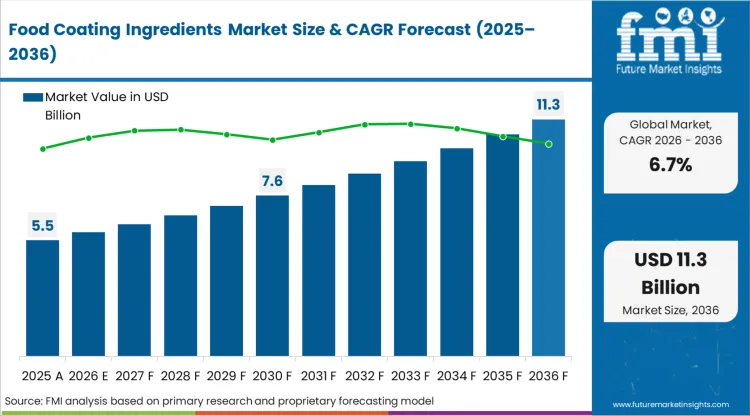
Growth is geographically dispersed, with the UK leading at 7.3% CAGR due to a sophisticated prepared foods sector, followed closely by India at 6.5% CAGR as organized processing scales up. Germany (6.4% CAGR) and the United States (6.1% CAGR) remain volume anchors driven by bakery and foodservice demand, while Brazil (5.9% CAGR) and China (5.7% CAGR) focus on leveraging domestic grain outputs for cost-competitive coating bases.
Food Coating Ingredients Market Definition
The food coating ingredients market comprises the global trade and industrial consumption of edible substances applied to the surface of food products to enhance texture, flavor, and appearance. These ingredients include dry systems like bread crumbs, predusts, and seasoning blends, as well as wet systems like batters, glazes, and compound chocolates. Their primary function ranges from providing a crispy barrier in fried foods to sealing in moisture and adding visual appeal in confectionery and bakery items.
Food Coating Ingredients Market Inclusions
The report covers a wide array of ingredients such as wheat and corn flours, modified starches, hydrocolloids, fats, and sugars specifically formulated for coating applications. It includes enrobing agents for confectionery, adhesion batters for meat and poultry, and dusting agents for bakery products. The scope extends to functional systems that incorporate enzymes or antimicrobial agents to extend shelf life or reduce oil absorption during frying.
Food Coating Ingredients Market Exclusions
The analysis excludes non-edible packaging films and casings that are removed before consumption, unless they are edible and integral to the product. Simple, standalone commodities like bulk sugar or flour sold for general household baking are omitted, focusing strictly on industrial ingredient grades. Machinery and equipment used for the application of coatings, such as enrobers or batter applicators, are also outside the scope of this market sizing.
Food Coating Ingredients Market Research Methodology
- Primary Research: Interviews were conducted with R&D heads at major ingredient firms, procurement managers in the bakery and frozen food sectors, and technical sales directors.
- Desk Research: Production data from FAO cereal balance sheets, national manufacturing statistics (ONS, USDA), and corporate annual reports supported volume benchmarking.
- Market-Sizing and Forecasting: A hybrid top-down and bottom-up model was developed, reconstructing demand from end-product volumes (frozen snacks, bakery throughput) and validating against ingredient plant capacities.
- Data Validation and Update Cycle: Outputs undergo anomaly screening, variance checks against global grain trade datasets, and structured peer review prior to release.
Segmental Analysis
Food Coating Ingredients Market Analysis by Form
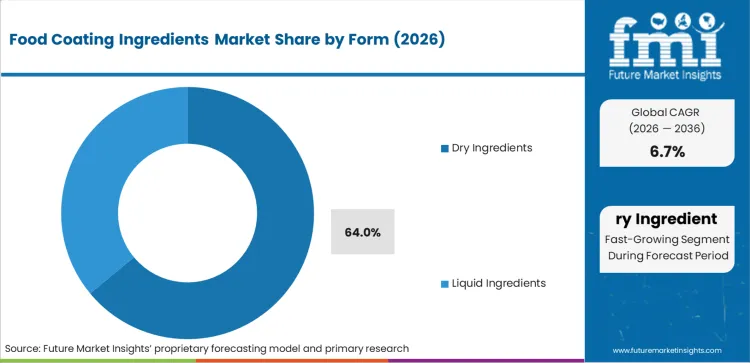
Dry Ingredients are projected to capture 64% of the global market share in 2026, serving as the logistical backbone of the industry. This segment's dominance is underpinned by the superior shelf stability and lower transport costs of dry blends compared to liquid formats, which is critical for global supply chains. FMI analysts opine that the shift toward pre-mixed dry systems allows manufacturers to simplify inventory management and ensure consistent application across different production sites.
- Logistics efficiency: Demand is reinforced by the high availability of core inputs like flour, where U.S. total flour production reached 425 million cwt in 2024, ensuring a steady stream of dry base materials for coating formulations [5].
- Production reliability: Procurement shifts because dry pre-mixes reduce the risk of microbial spoilage inherent in liquid systems, a crucial factor given the 136 food safety alerts issued in the UK in 2023/24, many of which related to ingredient contamination [3].
- Manufacturing scale: Adoption accelerates where large-scale processing hubs require massive volumes of standardized inputs, supported by India's food processing sector creating ₹2.24 lakh crore in value, necessitating robust dry ingredient supply chains [4].
Food Coating Ingredients Market Analysis by Application
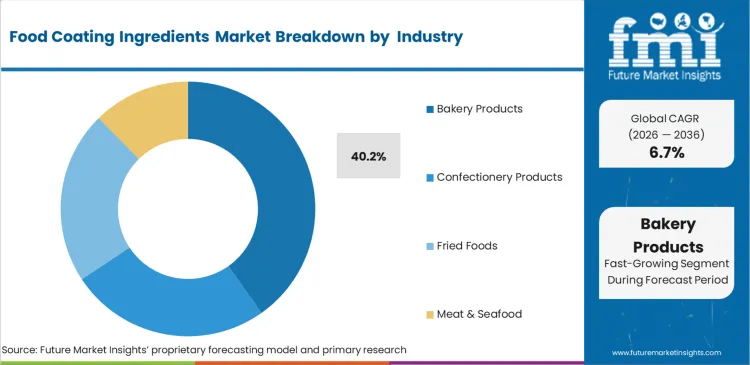
Bakery Products are expected to hold 40.2% of the total market value in 2026, driven by the visual and textural differentiation that coatings provide in a crowded retail landscape. Within this category, glazes, icings, and dusting flours are essential for extending shelf life and enhancing the "fresh-baked" appeal of industrial products. Growth is further catalyzed by the premiumization of sweet baked goods, where complex compound chocolate coatings and inclusions justify higher price points.
- Premiumization trigger: Demand tracks the high value of manufacturing outputs, as seen in the UK where food products accounted for 21% of total manufacturing sales (£452.2bn) in 2024, signaling a strong market for value-added bakery ingredients [2].
- Clean-label shift: Manufacturers are replacing synthetic emulsifiers with functional native starches to meet consumer preferences, evidenced by Ingredion's launch of NOVATION® Indulge 2940, designed to provide gelling and mouthfeel in clean-label applications [13].
- Freshness focus: Innovation in enzymatic solutions helps bakeries manage staling and texture, with IFF's launch of POWERFRESH® ACE 2000 addressing the specific fresh-keeping needs of the U.S. bakery market [15].
Food Coating Ingredients Market Drivers, Restraints, and Opportunities
The primary driver propelling the market is the booming foodservice sector, which relies heavily on coated and fried foods for their ease of preparation and consumer popularity. With food-away-from-home capturing a 58.9% share of total U.S. food expenditure in 2024 [8], the demand for batter and breading systems that maintain crispness under heat lamps and during delivery is at an all-time high. This structural shift forces ingredient suppliers to develop robust coating technologies that prevent sogginess and oil absorption, directly supporting the sales of modified starches and hydrocolloids.
However, the market faces a significant restraint in the form of raw material price volatility and supply chain security. The dependence on global commodity crops like wheat and corn means that weather events and geopolitical tensions directly impact input costs. For instance, while global cereal production is forecast at 3,023 million tonnes for 2025 [1], the tight balance with utilization levels creates pricing pressure. Manufacturers in price-sensitive markets like Germany, where the HICP Food index reached 151.8 in late 2025 [9], struggle to pass these costs onto consumers, squeezing margins and potentially limiting the adoption of premium coating ingredients.
- Enzymatic Texturization: Suppliers can leverage enzyme technologies to create novel textures and reduce reliance on traditional gums. This opportunity is highlighted by IFF's launch of TEXSTAR™, an enzymatic solution designed to transform texture in fermented products, with potential crossovers into coating systems [14].
- Local Sourcing Hubs: The industry can tap into growing processing markets by establishing local production to reduce import reliance. Cargill's inauguration of a corn milling plant in India exemplifies this strategy, creating a domestic source for starches and sweeteners used in coatings [12].
- Specialty Blends: Mergers and acquisitions open pathways for comprehensive solution selling, as seen in the Tate & Lyle and CP Kelco combination, which creates a powerhouse for specialty food and beverage solutions including texturants and fibers [10].
Regional Analysis
Based on the regional analysis, the Food Coating Ingredients market is segmented into North America, Latin America, Europe, East Asia, South Asia, Oceania and Middle East & Africa across 40+ countries. The full report also offers market attractiveness analysis based on regional trends.
.webp "Top Country Growth Comparison Food Coating Ingredients Market Cagr (2026 2036)")
| Country | CAGR (2026 to 2036) |
|---|---|
| UK | 7.3% |
| India | 6.5% |
| Germany | 6.4% |
| United States | 6.1% |
| Brazil | 5.9% |
| China | 5.7% |
Source: Future Market Insights (FMI) analysis, based on proprietary forecasting model and primary research
Europe Food Coating Ingredients Market Analysis
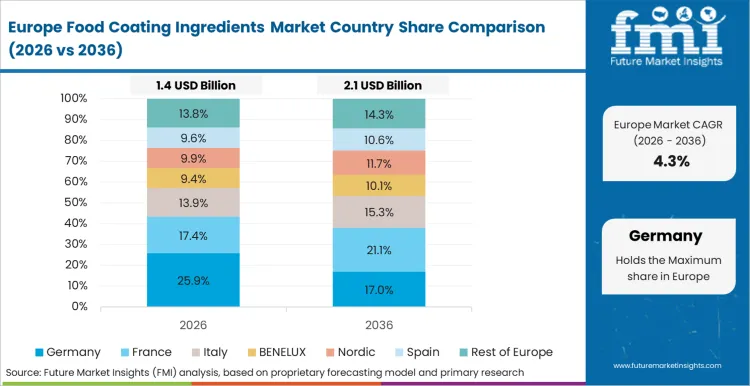
Europe represents a high-value market driven by strict quality standards and a sophisticated manufacturing base that demands advanced functionality. The region is characterized by a strong focus on clean-label and allergen-free coatings, pushing suppliers to innovate beyond standard wheat-based systems. FMI analysts opine that regulatory pressures regarding food safety and traceability are reshaping procurement, favoring suppliers with robust compliance frameworks.
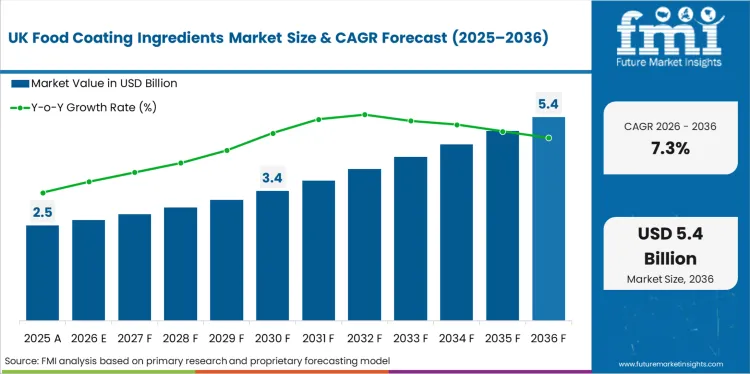
- UK: Demand for food coating ingredients in the UK is set to grow at 7.3% CAGR through 2036, supported by a massive manufacturing base with £452.2 billion in sales before procurement cycles translate into higher deployment volumes. This trajectory is supported by the intense focus on supply chain integrity, evidenced by the 136 food safety alerts in 2023/24 which drives demand for verified, safe ingredient systems [3].
- Germany: The outlook for food coating ingredients in Germany indicates a 6.4% CAGR from 2026 to 2036 as price pressure drives a search for efficiency, strengthening demand from both public programmes and private operators. This expansion is tied to the need for cost-effective reformulation amidst high food inflation, with the HICP Food index serving as a key indicator of the pricing environment manufacturers must navigate [9].
FMI’s report includes a detailed analysis of the growth in the European region, along with a country-wise assessment that includes the UK and Germany. The study also identifies France, Italy, and Spain as key opportunistic markets where artisanal bakery traditions are increasingly being industrialised, creating demand for food and beverage chemicals like glazes and preservatives. Buyers in these markets should watch for the rising popularity of "hybrid" bakery products that combine varied textures and coatings.
Asia Pacific Food Coating Ingredients Market Analysis
Asia Pacific serves as the volume growth engine, fueled by rapid urbanization and the expansion of the processed food sector. The region is seeing a shift from wet, homemade coatings to standardized industrial dry blends as Western-style fast food and convenient frozen snacks gain popularity. FMI analysts opine that the localization of ingredient production is a critical trend, reducing costs and improving supply chain resilience.
- India: In India, the food coating ingredients market is forecast to advance at 6.5% CAGR through 2036, with growth anchored in a ₹2.24 lakh crore food processing sector that converts into measurable budget allocation. This demand shift is reflected in the strategic investment by Cargill to establish local corn milling capacity, directly supporting the domestic supply of coating bases [12].
- China: China is expected to see food coating ingredients adoption rise at 5.7% CAGR from 2026 to 2036 as grain security and capacity expansion increase demand for compliant, scalable vendor offerings. This expansion is underpinned by a massive grain production base of 706.5 million tons, providing a secure feedstock for starch and flour-based coatings [6].
FMI’s report includes a detailed breakdown of the Asia Pacific market, highlighting India and China. Japan, South Korea, and Indonesia are also key markets to watch, particularly for tempura and specialized seafood coatings. Suppliers should monitor the growing export capabilities of these nations, as verified by Cargill's $240m investment in India, which underscores the region's rising status as a global processing hub [16].
North America Food Coating Ingredients Market Analysis
North America remains a mature but highly innovative market, dominated by the foodservice channel and a demand for convenient, heat-and-eat solutions. The region is a leader in adopting novel texturizers and clean-label coating systems. Growth is fueled by the continuous need to improve the "hold time" of fried foods in delivery and takeout scenarios.
- United States: The United States is likely to see food coating ingredients revenues increase at 6.1% CAGR during 2026 to 2036, given the 58.9% share of food-away-from-home spending and the resulting push for capacity and workflow upgrades. This growth is further catalyzed by the ample supply of functional flours, with 425 million cwt of flour production in 2024 supporting the bakery and batter industries [5].
FMI’s report includes a comprehensive evaluation of the North American landscape, covering the United States. Canada and Mexico represent additional growth avenues, particularly in the frozen appetizer and savory snack segments. Buyers should watch for innovations in compound chocolate coatings for nutritional bars, which are gaining traction as a healthy snacking option.
Latin America Food Coating Ingredients Market Analysis
Latin America is a key supplier of agricultural raw materials and a growing consumer of processed foods. The region's market is influenced by the strong agribusiness sector, particularly in grains and oils, which stabilizes input costs for local manufacturers. Growth is driven by the expansion of the meat and poultry processing industries, which are major users of batter and breading systems.
- Brazil: Brazil is projected to post 5.9% CAGR for food coating ingredients between 2026 and 2036 as robust grain production estimates of 353.4 million tonnes improve the conversion rate from pilots to enterprise rollouts. This steady supply of raw materials supports the cost-competitiveness of Brazilian food processors in both domestic and export markets [7].
FMI’s report includes an in-depth analysis of Latin America, with a focus on Brazil. Argentina and Chile are identified as emerging markets where the demand for value-added processed foods is rising. Manufacturers in these regions are increasingly exploring food coating ingredients to differentiate their products in competitive retail environments.
Competitive Aligners for Market Players
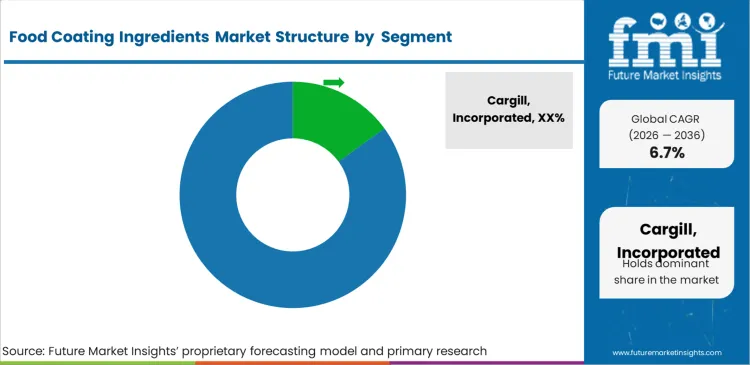
The competitive landscape is defined by consolidation and the pursuit of "total solution" capabilities. Major players are moving beyond simple ingredient supply to offer integrated systems that combine texture, flavor, and stability. This is evident in high-profile mergers like Tate & Lyle's acquisition of CP Kelco, which combines sweetening, texturizing, and fortification portfolios to serve diverse client needs [10].
Innovation is increasingly focused on technical problem-solving for specific applications. Companies are launching targeted solutions such as IFF's enzymatic texturizers and Ingredion's clean-label starches to address precise manufacturing challenges like clean-label gelling or texture retention [13]. These specialized launches allow suppliers to command higher margins and build deeper technical partnerships with food manufacturers.
Capacity expansion remains a key strategy for tapping into high-growth emerging markets. Global leaders are investing in local production facilities to bypass trade barriers and reduce logistics costs. Cargill's multiple investments in Asia, including the Beijing plant expansion and the new Indian corn mill, demonstrate a commitment to being physically present in the regions driving future volume growth [11].
Recent Developments
The report includes full coverage of key trends from competitive benchmarking. Some of the recent developments covered in the reports:
- In November 2024, Tate & Lyle completed the combination with CP Kelco to create a leading global speciality food and beverage solutions business.[10]
- In January 2026, Cargill broke ground to expand its Beijing plant, adding new lines for flavored frozen coatings to meet local demand.[11]
Key Players in Food Coating Ingredients Market
- Cargill, Incorporated
- Kerry Group plc
- Tate & Lyle PLC
- Ingredion Incorporated
- International Flavors & Fragrances Inc. (IFF)
- Archer Daniels Midland Company (ADM)
- Associated British Foods plc
- Newly Weds Foods
- Solina Group
- Dohler Group
Scope of the Report
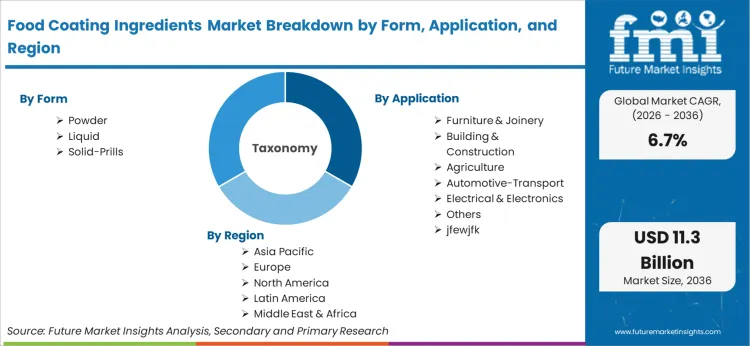
| Metric | Value |
|---|---|
| Quantitative Units | USD 5.9 billion (2026) to USD 11.3 billion (2036), at a CAGR of 6.7% |
| Market Definition | The food coating ingredients market comprises edible substances applied to food surfaces to enhance texture, flavor, and appearance, including batters, breadings, and glazes. |
| Form Segmentation | Dry Ingredients, Liquid Ingredients |
| Product Type Segmentation | Batters, Breadings, Flours, Starches, Hydrocolloids, Sugar & Syrups, Cocoa & Chocolates, Fats & Oils, Spices & Seasonings |
| Application Segmentation | Bakery Products, Confectionery Products, Fried Foods, Meat & Seafood, Dairy Products |
| Application Coverage | Glazes, Enrobing, Breading, Dusting, Batter Application |
| Regions Covered | North America, Latin America, Europe, East Asia, South Asia, Oceania, Middle East and Africa |
| Countries Covered | United States, Canada, Mexico, Brazil, Argentina, Germany, France, United Kingdom, Italy, Spain, China, India, Japan, South Korea, Indonesia, Australia and 40 plus countries |
| Key Companies Profiled | Cargill, Kerry, Tate & Lyle, Ingredion, IFF, ADM, Associated British Foods, Newly Weds Foods, Solina, Dohler |
| Forecast Period | 2026 to 2036 |
| Approach | Hybrid top down and bottom up market modeling validated through primary interviews with resin producers and panel manufacturers, supported by trade data benchmarking and plant level capacity verification |
Food Coating Ingredients Market Analysis by Segments
Form
- Dry Ingredients
- Liquid Ingredients
Product Type
- Batters
- Breadings
- Flours
- Starches
- Hydrocolloids
- Sugar & Syrups
- Cocoa & Chocolates
- Fats & Oils
- Spices & Seasonings
Application
- Bakery Products
- Confectionery Products
- Fried Foods
- Meat & Seafood
- Dairy Products
Region
- Asia Pacific
- India
- China
- Japan
- South Korea
- Indonesia
- Australia & New Zealand
- ASEAN
- Rest of Asia Pacific
- Europe
- Germany
- Italy
- France
- United Kingdom
- Spain
- Benelux
- Nordics
- Central & Eastern Europe
- Rest of Europe
- North America
- United States
- Canada
- Mexico
- Latin America
- Brazil
- Argentina
- Chile
- Rest of Latin America
- Middle East & Africa
- Kingdom of Saudi Arabia
- United Arab Emirates
- South Africa
- Turkey
- Rest of Middle East & Africa
Bibliography
- [1] FAO. (2025). World Food Situation: Cereal Supply and Demand Brief. FAO.
- [2] ONS. (2024). UK manufacturers' sales by product: 2024 results. Office for National Statistics.
- [3] FSA. (2024). Food Alerts Annual Report 2023 to 2024. Food Standards Agency.
- [4] MOFPI. (2025). Annual Report 2024-25: Food Processing Sector Performance. Ministry of Food Processing Industries, India.
- [5] USDA NASS. (2025). Flour Milling Products: 2024 Summary. USDA.
- [6] NBS China. (2024). Total Grain Production 2024. National Bureau of Statistics of China.
- [7] Conab. (2026). Grain Production Estimate 2025/26. Ministry of Agriculture, Livestock and Supply, Brazil.
- [8] USDA ERS. (2025). Food Expenditure Series: Food-Away-From-Home Share 2024. USDA ERS.
- [9] FRED. (2026). Harmonized Index of Consumer Prices: Food for Germany. Federal Reserve Bank of St. Louis.
- [10] Tate & Lyle. (2024). Completion of combination with CP Kelco. Tate & Lyle News.
- [11] Cargill. (2026). Cargill invests to expand Beijing plant. Cargill News.
- [12] Cargill. (2025). Cargill inaugurates India corn milling plant. Cargill India.
- [13] Ingredion. (2024). Ingredion launches NOVATION® Indulge 2940. Ingredion News.
- [14] IFF. (2024). IFF launches TEXSTAR™ enzymatic texturizing solution. IFF News.
- [15] IFF. (2025). IFF launches POWERFRESH® ACE 2000. IFF News.
- [16] Miller Magazine. (2025). Cargill to invest $240m in India. Miller Magazine.
This Report Addresses
- Market intelligence to enable structured strategic decision making across mature and emerging ingredient economies.
- Market size estimation and 10 year revenue forecasts from 2026 to 2036, supported by validated capacity and trade benchmarks.
- Growth opportunity mapping across dry and liquid forms with emphasis on functional benefits.
- Segment and regional revenue forecasts covering bakery, confectionery, and savory applications.
- Competition strategy assessment including integration models, source superiority positioning, and sustainability capability benchmarking.
- Product reformulation and regulatory compliance tracking including clean-label and allergen-free aligned grades.
- Regulatory impact analysis covering food safety mandates, health claim requirements, and export driven specification upgrades.
- Market report delivery in PDF, Excel, PPT, and interactive dashboard formats for executive and operational use.
Frequently Asked Questions
How large is the demand for Food Coating Ingredients in the global market in 2026?
Demand for Food Coating Ingredients in the global market is estimated to be valued at USD 5.9 billion in 2026.
What will be the market size of Food Coating Ingredients in the global market by 2036?
Market size for Food Coating Ingredients is projected to reach USD 11.3 billion by 2036.
What is the expected demand growth for Food Coating Ingredients in the global market between 2026 and 2036?
Demand for Food Coating Ingredients in the global market is expected to grow at a CAGR of 6.7% between 2026 and 2036.
Which Form is poised to lead global sales by 2026?
Dry Ingredients are expected to be the dominant form, capturing approximately 64% of global market share in 2026 due to logistical efficiency and shelf stability.
How significant is the role of Bakery Products in driving Food Coating Ingredients adoption in 2026?
Bakery Products represent a critical segment, projected to hold a substantial 40.2% share of the total market in 2026 as demand for premium finishes rises.
What is Driving Food Coating Ingredients Demand in the UK?
Demand in the UK is driven by a sophisticated manufacturing base and strict food safety standards requiring robust, traceable ingredient systems.
What compliance standards are referenced for the United States?
Food safety regulations and clean-label trends regarding additive use are referenced as key compliance benchmarks.
What is the United States Growth Outlook in this Report?
The United States is projected to grow at a CAGR of 6.1% during 2026 to 2036.
Why is Europe described as an Important Regulation Hub in this Report?
Europe is a hub for food safety and clean-label standards, driving demand for compliant and traceable coating ingredients.
What Type of Demand Dominates in Europe?
Demand is dominated by high-quality, functional ingredients for premium bakery and savory applications.
What is Germany Growth Outlook in this Report?
Germany is projected to expand at a CAGR of 6.4% during 2026 to 2036.
Does the Report Cover India in its Regional Analysis?
Yes, India is included within South Asia under the regional scope of analysis.
What are the Sources referred to for analyzing the Market in India?
Production data from the Ministry of Food Processing Industries and corporate investment announcements are used.
What is the Main Demand Theme Linked to India in Asia Coverage?
India's demand is linked to the scaling of organized food processing and the need for standardized industrial ingredients.
Does the Report Cover China in its Regional Analysis?
Yes, China is included within East Asia under the regional coverage framework.
What is the Main China Related Demand Theme in Asia Coverage?
China's demand is driven by grain security and the expansion of domestic processing capacity to reduce import reliance.
Which Product Formats are Strategically Important for Asia Pacific Supply Chains?
Dry ingredient blends are prioritized due to their stability and ease of transport across the region's diverse markets.
What is Food Coating Ingredients and What is It Mainly Used For?
Food coating ingredients are edible substances applied to food surfaces to improve texture, flavor, and appearance in bakery, fried, and confectionery products.
What does Food Coating Ingredients Market Mean in this Report?
The market refers to the global trade and industrial consumption of functional ingredients used to coat food products.
What is Included in the Scope of this Food Coating Ingredients Market Report?
Scope covers batters, breadings, glazes, flours, and starches used in industrial food processing.
What is Excluded from the Scope of this Report?
Non-edible packaging, household consumer flour sales, and coating application machinery are excluded.
What does Market Forecast Mean on this Page?
Market forecast represents a model-based projection built on defined assumptions for strategic planning purposes.
How does FMI Build and Validate the Food Coating Ingredients Market Forecast?
Forecast is developed using hybrid top-down and bottom-up modeling validated through trade data and capacity checks.
What does Zero Reliance on Speculative Third Party Market Research Mean Here?
Primary interviews and verifiable public datasets are used instead of unverified syndicated market estimates.
Table of Content
- Executive Summary
- Global Market Outlook
- Demand to side Trends
- Supply to side Trends
- Technology Roadmap Analysis
- Analysis and Recommendations
- Market Overview
- Market Coverage / Taxonomy
- Market Definition / Scope / Limitations
- Research Methodology
- Chapter Orientation
- Analytical Lens and Working Hypotheses
- Market Structure, Signals, and Trend Drivers
- Benchmarking and Cross-market Comparability
- Market Sizing, Forecasting, and Opportunity Mapping
- Research Design and Evidence Framework
- Desk Research Programme (Secondary Evidence)
- Company Annual and Sustainability Reports
- Peer-reviewed Journals and Academic Literature
- Corporate Websites, Product Literature, and Technical Notes
- Earnings Decks and Investor Briefings
- Statutory Filings and Regulatory Disclosures
- Technical White Papers and Standards Notes
- Trade Journals, Industry Magazines, and Analyst Briefs
- Conference Proceedings, Webinars, and Seminar Materials
- Government Statistics Portals and Public Data Releases
- Press Releases and Reputable Media Coverage
- Specialist Newsletters and Curated Briefings
- Sector Databases and Reference Repositories
- FMI Internal Proprietary Databases and Historical Market Datasets
- Subscription Datasets and Paid Sources
- Social Channels, Communities, and Digital Listening Inputs
- Additional Desk Sources
- Expert Input and Fieldwork (Primary Evidence)
- Primary Modes
- Qualitative Interviews and Expert Elicitation
- Quantitative Surveys and Structured Data Capture
- Blended Approach
- Why Primary Evidence is Used
- Field Techniques
- Interviews
- Surveys
- Focus Groups
- Observational and In-context Research
- Social and Community Interactions
- Stakeholder Universe Engaged
- C-suite Leaders
- Board Members
- Presidents and Vice Presidents
- R&D and Innovation Heads
- Technical Specialists
- Domain Subject-matter Experts
- Scientists
- Physicians and Other Healthcare Professionals
- Governance, Ethics, and Data Stewardship
- Research Ethics
- Data Integrity and Handling
- Primary Modes
- Tooling, Models, and Reference Databases
- Desk Research Programme (Secondary Evidence)
- Data Engineering and Model Build
- Data Acquisition and Ingestion
- Cleaning, Normalisation, and Verification
- Synthesis, Triangulation, and Analysis
- Quality Assurance and Audit Trail
- Market Background
- Market Dynamics
- Drivers
- Restraints
- Opportunity
- Trends
- Scenario Forecast
- Demand in Optimistic Scenario
- Demand in Likely Scenario
- Demand in Conservative Scenario
- Opportunity Map Analysis
- Product Life Cycle Analysis
- Supply Chain Analysis
- Investment Feasibility Matrix
- Value Chain Analysis
- PESTLE and Porter’s Analysis
- Regulatory Landscape
- Regional Parent Market Outlook
- Production and Consumption Statistics
- Import and Export Statistics
- Market Dynamics
- Global Market Analysis 2021 to 2025 and Forecast, 2026 to 2036
- Historical Market Size Value (USD Million) Analysis, 2021 to 2025
- Current and Future Market Size Value (USD Million) Projections, 2026 to 2036
- Y to o to Y Growth Trend Analysis
- Absolute $ Opportunity Analysis
- Global Market Pricing Analysis 2021 to 2025 and Forecast 2026 to 2036
- Global Market Analysis 2021 to 2025 and Forecast 2026 to 2036, By Form
- Introduction / Key Findings
- Historical Market Size Value (USD Million) Analysis By Form , 2021 to 2025
- Current and Future Market Size Value (USD Million) Analysis and Forecast By Form , 2026 to 2036
- Dry Ingredients
- Liquid Ingredients
- Dry Ingredients
- Y to o to Y Growth Trend Analysis By Form , 2021 to 2025
- Absolute $ Opportunity Analysis By Form , 2026 to 2036
- Global Market Analysis 2021 to 2025 and Forecast 2026 to 2036, By Application
- Introduction / Key Findings
- Historical Market Size Value (USD Million) Analysis By Application, 2021 to 2025
- Current and Future Market Size Value (USD Million) Analysis and Forecast By Application, 2026 to 2036
- Bakery Products
- Confectionery Products
- Fried Foods
- Meat & Seafood
- Bakery Products
- Y to o to Y Growth Trend Analysis By Application, 2021 to 2025
- Absolute $ Opportunity Analysis By Application, 2026 to 2036
- Global Market Analysis 2021 to 2025 and Forecast 2026 to 2036, By Region
- Introduction
- Historical Market Size Value (USD Million) Analysis By Region, 2021 to 2025
- Current Market Size Value (USD Million) Analysis and Forecast By Region, 2026 to 2036
- North America
- Latin America
- Western Europe
- Eastern Europe
- East Asia
- South Asia and Pacific
- Middle East & Africa
- Market Attractiveness Analysis By Region
- North America Market Analysis 2021 to 2025 and Forecast 2026 to 2036, By Country
- Historical Market Size Value (USD Million) Trend Analysis By Market Taxonomy, 2021 to 2025
- Market Size Value (USD Million) Forecast By Market Taxonomy, 2026 to 2036
- By Country
- USA
- Canada
- Mexico
- By Form
- By Application
- By Country
- Market Attractiveness Analysis
- By Country
- By Form
- By Application
- Key Takeaways
- Latin America Market Analysis 2021 to 2025 and Forecast 2026 to 2036, By Country
- Historical Market Size Value (USD Million) Trend Analysis By Market Taxonomy, 2021 to 2025
- Market Size Value (USD Million) Forecast By Market Taxonomy, 2026 to 2036
- By Country
- Brazil
- Chile
- Rest of Latin America
- By Form
- By Application
- By Country
- Market Attractiveness Analysis
- By Country
- By Form
- By Application
- Key Takeaways
- Western Europe Market Analysis 2021 to 2025 and Forecast 2026 to 2036, By Country
- Historical Market Size Value (USD Million) Trend Analysis By Market Taxonomy, 2021 to 2025
- Market Size Value (USD Million) Forecast By Market Taxonomy, 2026 to 2036
- By Country
- Germany
- UK
- Italy
- Spain
- France
- Nordic
- BENELUX
- Rest of Western Europe
- By Form
- By Application
- By Country
- Market Attractiveness Analysis
- By Country
- By Form
- By Application
- Key Takeaways
- Eastern Europe Market Analysis 2021 to 2025 and Forecast 2026 to 2036, By Country
- Historical Market Size Value (USD Million) Trend Analysis By Market Taxonomy, 2021 to 2025
- Market Size Value (USD Million) Forecast By Market Taxonomy, 2026 to 2036
- By Country
- Russia
- Poland
- Hungary
- Balkan & Baltic
- Rest of Eastern Europe
- By Form
- By Application
- By Country
- Market Attractiveness Analysis
- By Country
- By Form
- By Application
- Key Takeaways
- East Asia Market Analysis 2021 to 2025 and Forecast 2026 to 2036, By Country
- Historical Market Size Value (USD Million) Trend Analysis By Market Taxonomy, 2021 to 2025
- Market Size Value (USD Million) Forecast By Market Taxonomy, 2026 to 2036
- By Country
- China
- Japan
- South Korea
- By Form
- By Application
- By Country
- Market Attractiveness Analysis
- By Country
- By Form
- By Application
- Key Takeaways
- South Asia and Pacific Market Analysis 2021 to 2025 and Forecast 2026 to 2036, By Country
- Historical Market Size Value (USD Million) Trend Analysis By Market Taxonomy, 2021 to 2025
- Market Size Value (USD Million) Forecast By Market Taxonomy, 2026 to 2036
- By Country
- India
- ASEAN
- Australia & New Zealand
- Rest of South Asia and Pacific
- By Form
- By Application
- By Country
- Market Attractiveness Analysis
- By Country
- By Form
- By Application
- Key Takeaways
- Middle East & Africa Market Analysis 2021 to 2025 and Forecast 2026 to 2036, By Country
- Historical Market Size Value (USD Million) Trend Analysis By Market Taxonomy, 2021 to 2025
- Market Size Value (USD Million) Forecast By Market Taxonomy, 2026 to 2036
- By Country
- Kingdom of Saudi Arabia
- Other GCC Countries
- Turkiye
- South Africa
- Other African Union
- Rest of Middle East & Africa
- By Form
- By Application
- By Country
- Market Attractiveness Analysis
- By Country
- By Form
- By Application
- Key Takeaways
- Key Countries Market Analysis
- USA
- Pricing Analysis
- Market Share Analysis, 2025
- By Form
- By Application
- Canada
- Pricing Analysis
- Market Share Analysis, 2025
- By Form
- By Application
- Mexico
- Pricing Analysis
- Market Share Analysis, 2025
- By Form
- By Application
- Brazil
- Pricing Analysis
- Market Share Analysis, 2025
- By Form
- By Application
- Chile
- Pricing Analysis
- Market Share Analysis, 2025
- By Form
- By Application
- Germany
- Pricing Analysis
- Market Share Analysis, 2025
- By Form
- By Application
- UK
- Pricing Analysis
- Market Share Analysis, 2025
- By Form
- By Application
- Italy
- Pricing Analysis
- Market Share Analysis, 2025
- By Form
- By Application
- Spain
- Pricing Analysis
- Market Share Analysis, 2025
- By Form
- By Application
- France
- Pricing Analysis
- Market Share Analysis, 2025
- By Form
- By Application
- India
- Pricing Analysis
- Market Share Analysis, 2025
- By Form
- By Application
- ASEAN
- Pricing Analysis
- Market Share Analysis, 2025
- By Form
- By Application
- Australia & New Zealand
- Pricing Analysis
- Market Share Analysis, 2025
- By Form
- By Application
- China
- Pricing Analysis
- Market Share Analysis, 2025
- By Form
- By Application
- Japan
- Pricing Analysis
- Market Share Analysis, 2025
- By Form
- By Application
- South Korea
- Pricing Analysis
- Market Share Analysis, 2025
- By Form
- By Application
- Russia
- Pricing Analysis
- Market Share Analysis, 2025
- By Form
- By Application
- Poland
- Pricing Analysis
- Market Share Analysis, 2025
- By Form
- By Application
- Hungary
- Pricing Analysis
- Market Share Analysis, 2025
- By Form
- By Application
- Kingdom of Saudi Arabia
- Pricing Analysis
- Market Share Analysis, 2025
- By Form
- By Application
- Turkiye
- Pricing Analysis
- Market Share Analysis, 2025
- By Form
- By Application
- South Africa
- Pricing Analysis
- Market Share Analysis, 2025
- By Form
- By Application
- USA
- Market Structure Analysis
- Competition Dashboard
- Competition Benchmarking
- Market Share Analysis of Top Players
- By Regional
- By Form
- By Application
- Competition Analysis
- Competition Deep Dive
- Cargill, Incorporated
- Overview
- Product Portfolio
- Profitability by Market Segments (Product/Age /Sales Channel/Region)
- Sales Footprint
- Strategy Overview
- Marketing Strategy
- Product Strategy
- Channel Strategy
- Kerry Group plc
- Tate & Lyle PLC
- Ingredion Incorporated
- International Flavors & Fragrances Inc. (IFF)
- Archer Daniels Midland Company (ADM)
- Associated British Foods plc
- Cargill, Incorporated
- Competition Deep Dive
- Assumptions & Acronyms Used
List of Tables
- Table 1: Global Market Value (USD Million) Forecast by Region, 2021 to 2036
- Table 2: Global Market Value (USD Million) Forecast by Form , 2021 to 2036
- Table 3: Global Market Value (USD Million) Forecast by Application, 2021 to 2036
- Table 4: North America Market Value (USD Million) Forecast by Country, 2021 to 2036
- Table 5: North America Market Value (USD Million) Forecast by Form , 2021 to 2036
- Table 6: North America Market Value (USD Million) Forecast by Application, 2021 to 2036
- Table 7: Latin America Market Value (USD Million) Forecast by Country, 2021 to 2036
- Table 8: Latin America Market Value (USD Million) Forecast by Form , 2021 to 2036
- Table 9: Latin America Market Value (USD Million) Forecast by Application, 2021 to 2036
- Table 10: Western Europe Market Value (USD Million) Forecast by Country, 2021 to 2036
- Table 11: Western Europe Market Value (USD Million) Forecast by Form , 2021 to 2036
- Table 12: Western Europe Market Value (USD Million) Forecast by Application, 2021 to 2036
- Table 13: Eastern Europe Market Value (USD Million) Forecast by Country, 2021 to 2036
- Table 14: Eastern Europe Market Value (USD Million) Forecast by Form , 2021 to 2036
- Table 15: Eastern Europe Market Value (USD Million) Forecast by Application, 2021 to 2036
- Table 16: East Asia Market Value (USD Million) Forecast by Country, 2021 to 2036
- Table 17: East Asia Market Value (USD Million) Forecast by Form , 2021 to 2036
- Table 18: East Asia Market Value (USD Million) Forecast by Application, 2021 to 2036
- Table 19: South Asia and Pacific Market Value (USD Million) Forecast by Country, 2021 to 2036
- Table 20: South Asia and Pacific Market Value (USD Million) Forecast by Form , 2021 to 2036
- Table 21: South Asia and Pacific Market Value (USD Million) Forecast by Application, 2021 to 2036
- Table 22: Middle East & Africa Market Value (USD Million) Forecast by Country, 2021 to 2036
- Table 23: Middle East & Africa Market Value (USD Million) Forecast by Form , 2021 to 2036
- Table 24: Middle East & Africa Market Value (USD Million) Forecast by Application, 2021 to 2036
List of Figures
- Figure 1: Global Market Pricing Analysis
- Figure 2: Global Market Value (USD Million) Forecast 2021-2036
- Figure 3: Global Market Value Share and BPS Analysis by Form , 2026 and 2036
- Figure 4: Global Market Y-o-Y Growth Comparison by Form , 2026-2036
- Figure 5: Global Market Attractiveness Analysis by Form
- Figure 6: Global Market Value Share and BPS Analysis by Application, 2026 and 2036
- Figure 7: Global Market Y-o-Y Growth Comparison by Application, 2026-2036
- Figure 8: Global Market Attractiveness Analysis by Application
- Figure 9: Global Market Value (USD Million) Share and BPS Analysis by Region, 2026 and 2036
- Figure 10: Global Market Y-o-Y Growth Comparison by Region, 2026-2036
- Figure 11: Global Market Attractiveness Analysis by Region
- Figure 12: North America Market Incremental Dollar Opportunity, 2026-2036
- Figure 13: Latin America Market Incremental Dollar Opportunity, 2026-2036
- Figure 14: Western Europe Market Incremental Dollar Opportunity, 2026-2036
- Figure 15: Eastern Europe Market Incremental Dollar Opportunity, 2026-2036
- Figure 16: East Asia Market Incremental Dollar Opportunity, 2026-2036
- Figure 17: South Asia and Pacific Market Incremental Dollar Opportunity, 2026-2036
- Figure 18: Middle East & Africa Market Incremental Dollar Opportunity, 2026-2036
- Figure 19: North America Market Value Share and BPS Analysis by Country, 2026 and 2036
- Figure 20: North America Market Value Share and BPS Analysis by Form , 2026 and 2036
- Figure 21: North America Market Y-o-Y Growth Comparison by Form , 2026-2036
- Figure 22: North America Market Attractiveness Analysis by Form
- Figure 23: North America Market Value Share and BPS Analysis by Application, 2026 and 2036
- Figure 24: North America Market Y-o-Y Growth Comparison by Application, 2026-2036
- Figure 25: North America Market Attractiveness Analysis by Application
- Figure 26: Latin America Market Value Share and BPS Analysis by Country, 2026 and 2036
- Figure 27: Latin America Market Value Share and BPS Analysis by Form , 2026 and 2036
- Figure 28: Latin America Market Y-o-Y Growth Comparison by Form , 2026-2036
- Figure 29: Latin America Market Attractiveness Analysis by Form
- Figure 30: Latin America Market Value Share and BPS Analysis by Application, 2026 and 2036
- Figure 31: Latin America Market Y-o-Y Growth Comparison by Application, 2026-2036
- Figure 32: Latin America Market Attractiveness Analysis by Application
- Figure 33: Western Europe Market Value Share and BPS Analysis by Country, 2026 and 2036
- Figure 34: Western Europe Market Value Share and BPS Analysis by Form , 2026 and 2036
- Figure 35: Western Europe Market Y-o-Y Growth Comparison by Form , 2026-2036
- Figure 36: Western Europe Market Attractiveness Analysis by Form
- Figure 37: Western Europe Market Value Share and BPS Analysis by Application, 2026 and 2036
- Figure 38: Western Europe Market Y-o-Y Growth Comparison by Application, 2026-2036
- Figure 39: Western Europe Market Attractiveness Analysis by Application
- Figure 40: Eastern Europe Market Value Share and BPS Analysis by Country, 2026 and 2036
- Figure 41: Eastern Europe Market Value Share and BPS Analysis by Form , 2026 and 2036
- Figure 42: Eastern Europe Market Y-o-Y Growth Comparison by Form , 2026-2036
- Figure 43: Eastern Europe Market Attractiveness Analysis by Form
- Figure 44: Eastern Europe Market Value Share and BPS Analysis by Application, 2026 and 2036
- Figure 45: Eastern Europe Market Y-o-Y Growth Comparison by Application, 2026-2036
- Figure 46: Eastern Europe Market Attractiveness Analysis by Application
- Figure 47: East Asia Market Value Share and BPS Analysis by Country, 2026 and 2036
- Figure 48: East Asia Market Value Share and BPS Analysis by Form , 2026 and 2036
- Figure 49: East Asia Market Y-o-Y Growth Comparison by Form , 2026-2036
- Figure 50: East Asia Market Attractiveness Analysis by Form
- Figure 51: East Asia Market Value Share and BPS Analysis by Application, 2026 and 2036
- Figure 52: East Asia Market Y-o-Y Growth Comparison by Application, 2026-2036
- Figure 53: East Asia Market Attractiveness Analysis by Application
- Figure 54: South Asia and Pacific Market Value Share and BPS Analysis by Country, 2026 and 2036
- Figure 55: South Asia and Pacific Market Value Share and BPS Analysis by Form , 2026 and 2036
- Figure 56: South Asia and Pacific Market Y-o-Y Growth Comparison by Form , 2026-2036
- Figure 57: South Asia and Pacific Market Attractiveness Analysis by Form
- Figure 58: South Asia and Pacific Market Value Share and BPS Analysis by Application, 2026 and 2036
- Figure 59: South Asia and Pacific Market Y-o-Y Growth Comparison by Application, 2026-2036
- Figure 60: South Asia and Pacific Market Attractiveness Analysis by Application
- Figure 61: Middle East & Africa Market Value Share and BPS Analysis by Country, 2026 and 2036
- Figure 62: Middle East & Africa Market Value Share and BPS Analysis by Form , 2026 and 2036
- Figure 63: Middle East & Africa Market Y-o-Y Growth Comparison by Form , 2026-2036
- Figure 64: Middle East & Africa Market Attractiveness Analysis by Form
- Figure 65: Middle East & Africa Market Value Share and BPS Analysis by Application, 2026 and 2036
- Figure 66: Middle East & Africa Market Y-o-Y Growth Comparison by Application, 2026-2036
- Figure 67: Middle East & Africa Market Attractiveness Analysis by Application
- Figure 68: Global Market - Tier Structure Analysis
- Figure 69: Global Market - Company Share Analysis
Full Research Suite comprises of:

Market outlook & trends analysis
Interviews & case studies
Strategic recommendations
Vendor profiles & capabilities analysis
5-year forecasts
8 regions and 60+ country-level data splits
Market segment data splits
12 months of continuous data updates
DELIVERED AS:
PDF EXCEL ONLINE


