


India Alcohol Market
Analysis and Growth Projections for India’s Alcohol Industry Business
India Alcohol Market Forecast and Outlook 2026 to 2036
The India alcohol market is on track to achieve a valuation of USD 312.4 Billion by 2036, accelerating from USD 208.3 Billion in 2026 at a steady CAGR of 4.1%. As per Future Market Insights, expansion is structurally underpinned by a domestic premiumization wave where consumers are migrating from economy and regular segments toward single malts, craft gins, and heritage-branded spirits. The Confederation of Indian Industry (CII) noted in its 2024 annual review that India's spirits consumption grew at nearly twice the rate of volume growth, confirming a clear value-over-volume shift across the sector. This transition compels distillers to invest in maturation infrastructure, premium packaging, and controlled distribution networks that protect brand positioning. Simultaneously the regulatory landscape is shifting from state-level excise fragmentation to early signs of policy harmonization under GST discussions, which forces manufacturers to recalibrate pricing architectures and interstate logistics.
Jean Touboul, CEO of Pernod Ricard India, stated: 'Our vision is to shape a sustainable future, where India emerges as a hub for premium malt spirits crafted with global precision and local passion.' This statement accompanied Pernod Ricard India's ground-breaking ceremony in October 2024 for Asia's largest malt distillery and maturation facility in Nagpur, a commitment that validates India as a manufacturing origin for world-class spirits rather than merely an import destination. FMI is of the opinion that such capital allocation from global majors will accelerate the formalization of India's malt supply chain and raise the quality floor for the entire domestic industry.
The operational reality for Indian distillers is defined by the need to balance premiumization ambitions with a regulatory environment that varies across 28 states. Radico Khaitan has responded to this by building a diversified premium portfolio, launching 'Rampur 1943 Virasat' Single Malt in November 2025 and introducing 'TRIKAL' Indian Single Malt in May 2025, both targeting the super-premium price tier. Allied Blenders and Distillers Limited raised approximately USD 180 million through its IPO in June 2024, directing proceeds toward capacity expansion and brand building in premium categories. As per FMI, the startup ecosystem is adding competitive pressure from below: brands like The Teller (India's first rum-based coffee cane liqueur, crafted in Goa), Nisaki (India's first colour-changing gin by Project Peacock), and Davana Vermouth are expanding the category architecture beyond traditional whisky and rum, creating new consumption occasions. United Breweries reinforced premiumization in its beer portfolio by launching Kingfisher Smooth Strong in Rajasthan in July 2024, a move that confirms the value migration is not limited to spirits alone.
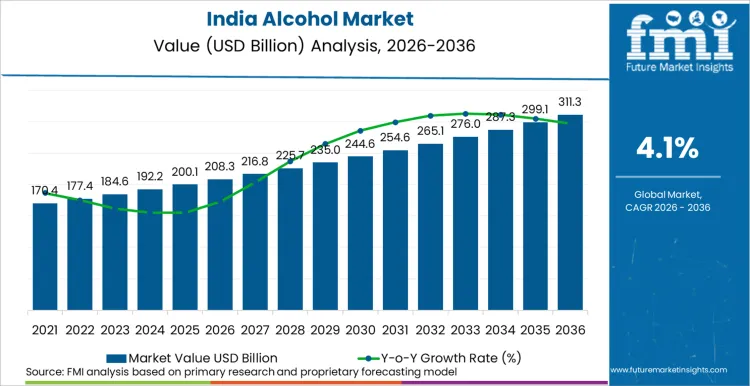
Summary of India Alcohol Market
What Is Growth Outlook for India Alcohol Market as per Future Market Insights Projection?
Future Market Insights projects the India alcohol market to expand at a CAGR of 4.1% from 2026 to 2036, increasing from USD 208.3 Billion in 2026 to USD 312.4 Billion by 2036.
FMI Research Approach: FMI proprietary forecasting model based on excise revenue filings, state-level consumption data, and premiumization index correlation.
How Do FMI Analysts Perceive India Alcohol Market to Evolve?
FMI analysts perceive the market evolving toward a bifurcated structure where volume remains anchored in economy IMFL and country liquor while value growth is concentrated in single malts, craft spirits, and premium beer segments that command three to five times higher realization per case.
FMI Research Approach: Price-tier migration analysis using excise category data across top 10 consuming states.
Which Segment Holds Largest Share in the India Alcohol Market?
Indian Made Foreign Liquor (IMFL) spirits hold a significant share of the India alcohol market by value, supported by an expanding base of legal drinking-age consumers and rising per-capita income in urban and semi-urban centres.
FMI Research Approach: FMI segment-level revenue modelling using excise duty collections and company annual report disclosures.
How Large Will India Alcohol Market Be by 2036?
The India alcohol market is projected to reach USD 312.4 Billion by 2036.
FMI Research Approach: FMI long-term revenue forecast derived from demographic consumption curves, urbanization rate projections by NITI Aayog, and state excise revenue growth trends.
What Is Definition of India Alcohol Market?
The India alcohol market includes revenue generated from the production, distribution, and retail sale of spirits (IMFL and country liquor), beer, and wine within India. The market measures the value of whisky, rum, vodka, gin, brandy, single malts, craft spirits, beer, and wine sold through on-trade and off-trade channels.
FMI Research Approach: FMI market taxonomy and inclusion-exclusion framework aligned with excise classification standards.
What Are Globally Unique Trends Shaping India Alcohol Market?
Globally unique trends include the rapid rise of Indian single malts competing at international awards, the emergence of craft distilleries in Goa and Karnataka, and the entry of venture capital and IPO funding into a sector historically dominated by family-owned conglomerates.
FMI Research Approach: Competitive landscape mapping using company filings, DPIIT FDI data, and international spirits competition results.
India Alcohol Market Key Takeaways
| Metric | Details |
|---|---|
| Industry Size (2026) | USD 208.3 Billion |
| Industry Value (2036) | USD 312.4 Billion |
| CAGR (2026 to 2036) | 4.1% |
Source: Future Market Insights (FMI) analysis, based on proprietary forecasting model and primary research
Category-wise Insights
Beer Dominates India’s Alcohol Industry Market
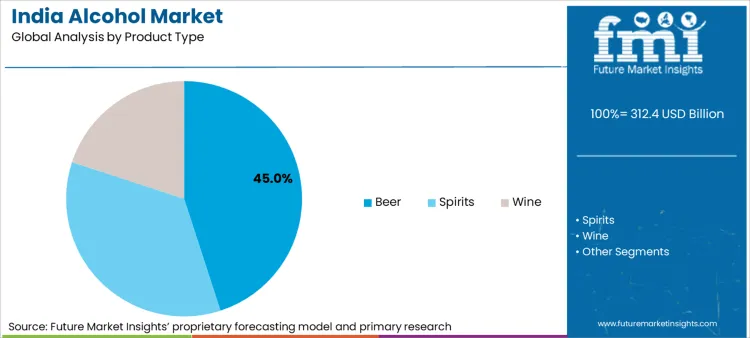
| Segment | Value Share (2026) |
|---|---|
| Beer (Product Type) | 45% |
More people particularly in urban areas are willing to pay more for premium spirits than other beverages as the nation’s disposable incomes continue to rise. Due to regional availability issues and cultural preferences wine and beer are still considered niche products in India when compared to spirits. just now.
Retail Rules the India Alcohol Market
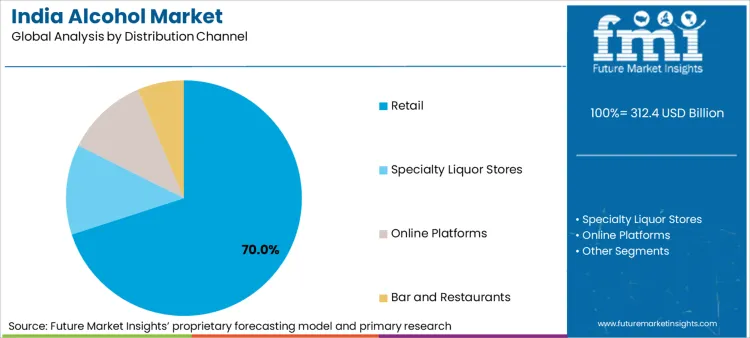
| Segment | Value Share (2026) |
|---|---|
| Retail (Distribution Channel) | 70% |
Due to the expansion of modern retail supermarkets and hypermarkets dominate the Indian alcohol market in terms of distribution channels. 70% of the market in 2026 will be used for landscape. Beyond conventional liquor consumers today are looking for a variety of shopping experiences. stores attracting customers to air-conditioned hypermarkets that carry every product category in one location.
Supermarkets are in charge. first-rate shelf space to display alcohol and have knowledgeable employees to help with selections. thorough niche and category management. Locally specific assortments encourage impulsive buying.
Key Industry Highlights
Increase in Income is Driving the Market Growth
Alcohol sales in India are expected to soar in the upcoming years. First Indias middle class is becoming more affluent. Furthermore, people will purchase more alcohol as their wealth increases. People decide to try new alcoholic beverages as their disposable income rises. The second significant reason for Indias expanding alcohol market is the countrys citizens preference for a more affluent lifestyle.
As India becomes more urbanized its citizens choose to adopt a more cosmopolitan outlook and start drinking alcohol. Additionally, as more Indians move into cities the market is probably going to continue expanding. The rising disposable income of the middle class shifting lifestyles and growing urbanization are all expected to contribute to the steady growth of the Indian alcohol market in the years to come. In general, the market is expanding due to the rising demand for high-end global alcohol brands.
Demand for International Brands is Driving the Market Growth
The increasing demand for high-end global brands is another factor propelling the expansion of the Indian alcohol market. Indian consumers are more inclined to try out different kinds of alcohol and are also more willing to pay more for premium alcohol.
This is particularly true for younger consumers who are more susceptible to trend influence. Premium and foreign brands of alcohol are becoming increasingly popular among the wealthy population in India according to the alcohol market industry. The demand for these brands is being driven by rising disposable income and increased trend exposure.
2021 to 2025 Global India Alcohol Sales Analysis Compared to Demand Forecasts for 2026 to 2036
During the period 2021-2025, the sales grew at a CAGR of 6.8%, and it is predicted to continue to grow at a CAGR of 7.2% during the forecast period of 2026 to 2036.
Growth in the alcohol sector is anticipated to be driven by rising disposable income and shifting consumer preferences toward upscale and upscale drinking experiences. India’s alcoholic beverage sales are expected to increase through 2036 due to the rising demand for flavored and premium vodka as well as the country’s growing cocktail culture and urbanization.
The increasing trend of premiumization is expected to give brands the chance to reach wealthy consumer groups and satisfy their changing preferences. The Indian liquor industry is being shaped by a number of important trends including craft spirits artisanal cocktails and experiential drinking establishments. These trends reflect a shift in drinking culture toward sophistication and individuality.
Market Concentration
Tier 1 companies comprises industry leaders acquiring a 60% share in the global business market. These leaders are distinguished by their extensive product portfolio and high production capacity. These industry leaders stand out due to their broad geographic reach, in-depth knowledge of manufacturing and reconditioning across various formats and strong customer base. They offer a variety of services and manufacturing with the newest technology while adhering to legal requirements for the best quality.
Tier 2 companies comprises of mid-size players having a presence in some regions and highly influencing the local commerce and has a market share of 30%. These are distinguished by their robust global presence and solid business acumen. These industry participants may not have cutting-edge technology or a broad global reach but they do have good technology and guarantee regulatory compliance.
Tier 3 companies comprises mostly of small-scale businesses serving niche economies and serving at the local presence having a market share of 10%. Due to their notable focus on meeting local needs these businesses are categorized as belonging to the tier 3 share segment, they are minor players with a constrained geographic scope. As an unorganized ecosystem Tier 3 in this context refers to a sector that in contrast to its organized competitors, lacks extensive structure and formalization.
State wise Insights
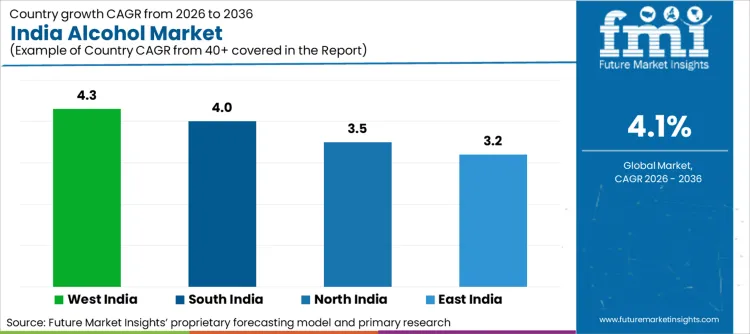
The following table shows the forecasted growth rates of the significant three geographies revenues. Maharashtra and Goa come under the exhibit of high consumption through 2036.
Maharashtra Dominates the India’s Alcohol Industry Market
Known for its energetic cities like Pune and Mumbai Maharashtra holds a sizable portion of Indias alcohol market. The state has a culture of heavy alcohol use which is fueled by a large number of alcohol enthusiasts and quickly growing urban areas.
A wide range of alcoholic products are available in its booming industry which is backed by a strong network of distilleries breweries and liquor manufacturing facilities. Maharashtra successfully meets the various needs of alcohol consumers with its well-established network of bars restaurants liquor stores and hospitality facilities. This strengthens its standing as a major force in the Indian alcoholic beverage sector.
Goa Contributes to the India’s Alcohol Industry Market Growth
Due to its popularity as a travel destination with a thriving nightlife and lax alcohol laws Goas alcohol industry is expected to grow at a strong compound annual growth rate (CAGR). Goas beaches and lively atmosphere attract a large number of domestic and foreign tourists which fuels the demand for alcoholic beverages and supports the industry’s steady expansion. Reduced taxes and longer drinking hours are just two examples of Goas liberal alcohol policies that foster the sale and consumption of alcohol and support the growth of the sector.
The availability of a variety of bars clubs and beach shacks with a large assortment of alcoholic drinks enhances the allure and draws both residents and visitors. Residents can now spend more on leisure activities such as high-end and imported alcoholic and non alcoholic beverages thanks to their growing disposable income.
Competition Outlook
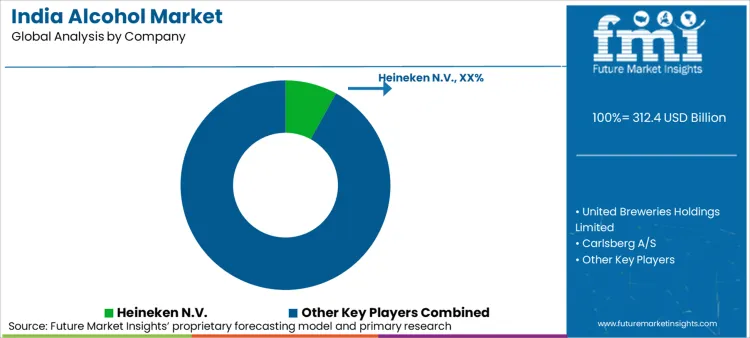
The alcohol industry in India is marked by fierce competition and dynamic forces that are influenced by a number of variables such as consumer preferences industry dynamics and regulatory frameworks. Being one of the world’s biggest producers of alcoholic beverages India draws both domestic and foreign companies fighting for market share in a number of categories such as wine beer and spirits.
In order to obtain a competitive edge major player in India’s alcohol industry use tactics like product innovation pricing strategies distribution network expansion acquisitions mergers and marketing campaigns. The industry has a wide range of offerings and a sizable consumer base. For companies looking to succeed in India’s vibrant alcohol industry it is essential to comprehend the subtleties of this competitive landscape.
Recent Developments
- In October 2024, Pernod Ricard India conducted the 'Bhoomi Pujan' for its landmark project to establish Asia's largest malt distillery and maturation facility in Nagpur, Maharashtra. This project follows a Memorandum of Understanding (MoU) signed in February 2024 with the Government of Maharashtra, involving a projected investment of up to INR 1,785 crore over 10 years.
- In December 2025, Pernod Ricard India officially launched 'Seagram's Xclamat!on,' a unified premium brand portfolio spanning five spirit categories: whisky, vodka, gin, rum, and brandy. The range is part of an innovation-led strategy to capture the 'premium admix' segment, which is expected to outpace general industry growth in the coming decade.
- In November 2025, Radico Khaitan Limited introduced the 'Rampur 1943, Virasat Single Malt' to celebrate its heritage. Earlier in the same month, the company also launched the '1965, Spirit Of Victory Espresso Coffee Rum,' specifically targeting the growing interest in coffee-infused spirits among younger premium consumers in markets like Uttar Pradesh, Haryana, and Jharkhand.
- In November 2025, Radico Khaitan reported robust financial results for Q2 FY26, highlighting a 24% value growth in its 'Prestige & Above' category. This segment now accounts for a significant portion of the company's total IMFL volume, reflecting a successful long-term shift toward premiumization and higher-margin luxury offerings.
Leading Manufacturers
- Heineken N.V.
- United Breweries Holdings Limited
- Carlsberg A/S
- Devans Modern Breweries Ltd.
- Carlsberg India Pvt. Ltd.
- Diageo PLC
- Anheuser-Busch InBev.
- Crown India Alcohols India Limited
- B9 Beverages Pvt. Ltd.
- Radico Khaitan Ltd.
- Dogfish Head Craft Brewery, Inc.
- Beijing Enterprises Holdings Limited
- Sierra Nevada Brewing Co.
- Squatters Pubs and Craft India Alcohols
- The Boston India Alcohol Company, Inc.
Market Definition
The India alcohol market represents revenue generated from the production, distribution, and retail sale of spirits (IMFL, country liquor), beer, and wine within India. The market measures the value of whisky, rum, vodka, gin, brandy, single malts, craft spirits, beer, and wine sold through on-trade (bars, restaurants, hotels) and off-trade (retail shops, e-commerce where permitted) channels.
Inclusions cover Indian Made Foreign Liquor (IMFL), country liquor, beer (domestic and imported), wine, and craft spirits produced or sold within India. It includes revenue from premium and super-premium segments, duty-paid retail, and on-premise consumption. Startup and craft distillery revenue is also included.
Exclusions include illicit and unregulated alcohol production, industrial alcohol and denatured spirits not intended for human consumption, and export revenue from Indian-produced spirits sold in international markets. Packaging materials and standalone distribution logistics services are outside the scope.
Key Segments
By Product Type:
By product type, methods industry has been categorized into Beer, Spirits and Wine
By Distribution Channel:
By distribution channel, industry has been categorized into Retail, Specialty Liquor Stores, Online Platforms and Bar and Restaurants
By Region:
Industry analysis has been carried out in zones like North India, South India, East India and West India
Bibliography
- Confederation of Indian Industry. (2024). Annual review of Indian industry: alcoholic beverages sector outlook. CII.
- Ministry of Commerce and Industry, Government of India. (2024, March). Department for Promotion of Industry and Internal Trade: FDI statistics for food processing and beverages. DPIIT.
- NITI Aayog, Government of India. (2024). India urbanization projections and consumer demand outlook. NITI Aayog.
- Pernod Ricard India. (2024, October). Pernod Ricard India advances landmark investment: Bhoomi Pujan ceremony for Asia's largest malt distillery. Pernod Ricard Media.
- Radico Khaitan. (2025, November). Radico Khaitan launches Rampur 1943 Virasat Single Malt. Radico Khaitan Investor Relations.
- Allied Blenders and Distillers Limited. (2024, June). Allied Blenders and Distillers IPO prospectus. SEBI filings.
- United Breweries Limited. (2024, July). Investor presentation Q1 FY2025. United Breweries Investor Relations.
Frequently Asked Questions
What is the current market size for the India Alcohol Market?
The market is valued at USD 208.3 Billion in 2026, driven by a domestic premiumization wave where consumers are migrating from economy segments toward single malts, craft spirits, and heritage-branded portfolios.
What is the projected Compound Annual Growth Rate (CAGR) for the market over the next 10 years?
The market is projected to grow at a CAGR of 4.1% from 2026 to 2036.
What is the primary growth driver for the market?
The migration from economy IMFL toward super-premium spirits, Indian single malts, and craft categories is the primary value driver, supported by rising disposable incomes and urbanization.
Which companies are leading the premiumization wave?
Pernod Ricard India, Radico Khaitan, Allied Blenders and Distillers, and United Breweries are key players, differentiating through premium portfolio expansion and manufacturing investment.
How is the startup ecosystem affecting the market?
Craft startups such as The Teller, Nisaki Gin, and Davana Vermouth are expanding category architecture beyond traditional whisky and rum, creating new consumption occasions in the premium tier.
Table of Content
- Executive Summary
- Global Market Outlook
- Demand to side Trends
- Supply to side Trends
- Technology Roadmap Analysis
- Analysis and Recommendations
- Market Overview
- Market Coverage / Taxonomy
- Market Definition / Scope / Limitations
- Research Methodology
- Chapter Orientation
- Analytical Lens and Working Hypotheses
- Market Structure, Signals, and Trend Drivers
- Benchmarking and Cross-market Comparability
- Market Sizing, Forecasting, and Opportunity Mapping
- Research Design and Evidence Framework
- Desk Research Programme (Secondary Evidence)
- Company Annual and Sustainability Reports
- Peer-reviewed Journals and Academic Literature
- Corporate Websites, Product Literature, and Technical Notes
- Earnings Decks and Investor Briefings
- Statutory Filings and Regulatory Disclosures
- Technical White Papers and Standards Notes
- Trade Journals, Industry Magazines, and Analyst Briefs
- Conference Proceedings, Webinars, and Seminar Materials
- Government Statistics Portals and Public Data Releases
- Press Releases and Reputable Media Coverage
- Specialist Newsletters and Curated Briefings
- Sector Databases and Reference Repositories
- FMI Internal Proprietary Databases and Historical Market Datasets
- Subscription Datasets and Paid Sources
- Social Channels, Communities, and Digital Listening Inputs
- Additional Desk Sources
- Expert Input and Fieldwork (Primary Evidence)
- Primary Modes
- Qualitative Interviews and Expert Elicitation
- Quantitative Surveys and Structured Data Capture
- Blended Approach
- Why Primary Evidence is Used
- Field Techniques
- Interviews
- Surveys
- Focus Groups
- Observational and In-context Research
- Social and Community Interactions
- Stakeholder Universe Engaged
- C-suite Leaders
- Board Members
- Presidents and Vice Presidents
- R&D and Innovation Heads
- Technical Specialists
- Domain Subject-matter Experts
- Scientists
- Physicians and Other Healthcare Professionals
- Governance, Ethics, and Data Stewardship
- Research Ethics
- Data Integrity and Handling
- Primary Modes
- Tooling, Models, and Reference Databases
- Desk Research Programme (Secondary Evidence)
- Data Engineering and Model Build
- Data Acquisition and Ingestion
- Cleaning, Normalisation, and Verification
- Synthesis, Triangulation, and Analysis
- Quality Assurance and Audit Trail
- Market Background
- Market Dynamics
- Drivers
- Restraints
- Opportunity
- Trends
- Scenario Forecast
- Demand in Optimistic Scenario
- Demand in Likely Scenario
- Demand in Conservative Scenario
- Opportunity Map Analysis
- Product Life Cycle Analysis
- Supply Chain Analysis
- Investment Feasibility Matrix
- Value Chain Analysis
- PESTLE and Porter’s Analysis
- Regulatory Landscape
- Regional Parent Market Outlook
- Production and Consumption Statistics
- Import and Export Statistics
- Market Dynamics
- Global Market Analysis 2021 to 2025 and Forecast, 2026 to 2036
- Historical Market Size Value (USD Million) Analysis, 2021 to 2025
- Current and Future Market Size Value (USD Million) Projections, 2026 to 2036
- Y to o to Y Growth Trend Analysis
- Absolute $ Opportunity Analysis
- Global Market Pricing Analysis 2021 to 2025 and Forecast 2026 to 2036
- Global Market Analysis 2021 to 2025 and Forecast 2026 to 2036, By Product Type
- Introduction / Key Findings
- Historical Market Size Value (USD Million) Analysis By Product Type , 2021 to 2025
- Current and Future Market Size Value (USD Million) Analysis and Forecast By Product Type , 2026 to 2036
- Beer
- Spirits
- Wine
- Beer
- Y to o to Y Growth Trend Analysis By Product Type , 2021 to 2025
- Absolute $ Opportunity Analysis By Product Type , 2026 to 2036
- Global Market Analysis 2021 to 2025 and Forecast 2026 to 2036, By Distribution Channel
- Introduction / Key Findings
- Historical Market Size Value (USD Million) Analysis By Distribution Channel, 2021 to 2025
- Current and Future Market Size Value (USD Million) Analysis and Forecast By Distribution Channel, 2026 to 2036
- Retail
- Specialty Liquor Stores
- Online Platforms
- Bar and Restaurants
- Retail
- Y to o to Y Growth Trend Analysis By Distribution Channel, 2021 to 2025
- Absolute $ Opportunity Analysis By Distribution Channel, 2026 to 2036
- Global Market Analysis 2021 to 2025 and Forecast 2026 to 2036, By Region
- Introduction
- Historical Market Size Value (USD Million) Analysis By Region, 2021 to 2025
- Current Market Size Value (USD Million) Analysis and Forecast By Region, 2026 to 2036
- North America
- Latin America
- Western Europe
- Eastern Europe
- East Asia
- South Asia and Pacific
- Middle East & Africa
- Market Attractiveness Analysis By Region
- North America Market Analysis 2021 to 2025 and Forecast 2026 to 2036, By Country
- Historical Market Size Value (USD Million) Trend Analysis By Market Taxonomy, 2021 to 2025
- Market Size Value (USD Million) Forecast By Market Taxonomy, 2026 to 2036
- By Country
- USA
- Canada
- Mexico
- By Product Type
- By Distribution Channel
- By Country
- Market Attractiveness Analysis
- By Country
- By Product Type
- By Distribution Channel
- Key Takeaways
- Latin America Market Analysis 2021 to 2025 and Forecast 2026 to 2036, By Country
- Historical Market Size Value (USD Million) Trend Analysis By Market Taxonomy, 2021 to 2025
- Market Size Value (USD Million) Forecast By Market Taxonomy, 2026 to 2036
- By Country
- Brazil
- Chile
- Rest of Latin America
- By Product Type
- By Distribution Channel
- By Country
- Market Attractiveness Analysis
- By Country
- By Product Type
- By Distribution Channel
- Key Takeaways
- Western Europe Market Analysis 2021 to 2025 and Forecast 2026 to 2036, By Country
- Historical Market Size Value (USD Million) Trend Analysis By Market Taxonomy, 2021 to 2025
- Market Size Value (USD Million) Forecast By Market Taxonomy, 2026 to 2036
- By Country
- Germany
- UK
- Italy
- Spain
- France
- Nordic
- BENELUX
- Rest of Western Europe
- By Product Type
- By Distribution Channel
- By Country
- Market Attractiveness Analysis
- By Country
- By Product Type
- By Distribution Channel
- Key Takeaways
- Eastern Europe Market Analysis 2021 to 2025 and Forecast 2026 to 2036, By Country
- Historical Market Size Value (USD Million) Trend Analysis By Market Taxonomy, 2021 to 2025
- Market Size Value (USD Million) Forecast By Market Taxonomy, 2026 to 2036
- By Country
- Russia
- Poland
- Hungary
- Balkan & Baltic
- Rest of Eastern Europe
- By Product Type
- By Distribution Channel
- By Country
- Market Attractiveness Analysis
- By Country
- By Product Type
- By Distribution Channel
- Key Takeaways
- East Asia Market Analysis 2021 to 2025 and Forecast 2026 to 2036, By Country
- Historical Market Size Value (USD Million) Trend Analysis By Market Taxonomy, 2021 to 2025
- Market Size Value (USD Million) Forecast By Market Taxonomy, 2026 to 2036
- By Country
- China
- Japan
- South Korea
- By Product Type
- By Distribution Channel
- By Country
- Market Attractiveness Analysis
- By Country
- By Product Type
- By Distribution Channel
- Key Takeaways
- South Asia and Pacific Market Analysis 2021 to 2025 and Forecast 2026 to 2036, By Country
- Historical Market Size Value (USD Million) Trend Analysis By Market Taxonomy, 2021 to 2025
- Market Size Value (USD Million) Forecast By Market Taxonomy, 2026 to 2036
- By Country
- India
- ASEAN
- Australia & New Zealand
- Rest of South Asia and Pacific
- By Product Type
- By Distribution Channel
- By Country
- Market Attractiveness Analysis
- By Country
- By Product Type
- By Distribution Channel
- Key Takeaways
- Middle East & Africa Market Analysis 2021 to 2025 and Forecast 2026 to 2036, By Country
- Historical Market Size Value (USD Million) Trend Analysis By Market Taxonomy, 2021 to 2025
- Market Size Value (USD Million) Forecast By Market Taxonomy, 2026 to 2036
- By Country
- Kingdom of Saudi Arabia
- Other GCC Countries
- Turkiye
- South Africa
- Other African Union
- Rest of Middle East & Africa
- By Product Type
- By Distribution Channel
- By Country
- Market Attractiveness Analysis
- By Country
- By Product Type
- By Distribution Channel
- Key Takeaways
- Key Countries Market Analysis
- USA
- Pricing Analysis
- Market Share Analysis, 2025
- By Product Type
- By Distribution Channel
- Canada
- Pricing Analysis
- Market Share Analysis, 2025
- By Product Type
- By Distribution Channel
- Mexico
- Pricing Analysis
- Market Share Analysis, 2025
- By Product Type
- By Distribution Channel
- Brazil
- Pricing Analysis
- Market Share Analysis, 2025
- By Product Type
- By Distribution Channel
- Chile
- Pricing Analysis
- Market Share Analysis, 2025
- By Product Type
- By Distribution Channel
- Germany
- Pricing Analysis
- Market Share Analysis, 2025
- By Product Type
- By Distribution Channel
- UK
- Pricing Analysis
- Market Share Analysis, 2025
- By Product Type
- By Distribution Channel
- Italy
- Pricing Analysis
- Market Share Analysis, 2025
- By Product Type
- By Distribution Channel
- Spain
- Pricing Analysis
- Market Share Analysis, 2025
- By Product Type
- By Distribution Channel
- France
- Pricing Analysis
- Market Share Analysis, 2025
- By Product Type
- By Distribution Channel
- India
- Pricing Analysis
- Market Share Analysis, 2025
- By Product Type
- By Distribution Channel
- ASEAN
- Pricing Analysis
- Market Share Analysis, 2025
- By Product Type
- By Distribution Channel
- Australia & New Zealand
- Pricing Analysis
- Market Share Analysis, 2025
- By Product Type
- By Distribution Channel
- China
- Pricing Analysis
- Market Share Analysis, 2025
- By Product Type
- By Distribution Channel
- Japan
- Pricing Analysis
- Market Share Analysis, 2025
- By Product Type
- By Distribution Channel
- South Korea
- Pricing Analysis
- Market Share Analysis, 2025
- By Product Type
- By Distribution Channel
- Russia
- Pricing Analysis
- Market Share Analysis, 2025
- By Product Type
- By Distribution Channel
- Poland
- Pricing Analysis
- Market Share Analysis, 2025
- By Product Type
- By Distribution Channel
- Hungary
- Pricing Analysis
- Market Share Analysis, 2025
- By Product Type
- By Distribution Channel
- Kingdom of Saudi Arabia
- Pricing Analysis
- Market Share Analysis, 2025
- By Product Type
- By Distribution Channel
- Turkiye
- Pricing Analysis
- Market Share Analysis, 2025
- By Product Type
- By Distribution Channel
- South Africa
- Pricing Analysis
- Market Share Analysis, 2025
- By Product Type
- By Distribution Channel
- USA
- Market Structure Analysis
- Competition Dashboard
- Competition Benchmarking
- Market Share Analysis of Top Players
- By Regional
- By Product Type
- By Distribution Channel
- Competition Analysis
- Competition Deep Dive
- Heineken N.V.
- Overview
- Product Portfolio
- Profitability by Market Segments (Product/Age /Sales Channel/Region)
- Sales Footprint
- Strategy Overview
- Marketing Strategy
- Product Strategy
- Channel Strategy
- Value (USD Million)ed Breweries Holdings Limited
- Carlsberg A/S
- Devans Modern Breweries Ltd.
- Carlsberg India Pvt. Ltd.
- Diageo PLC
- Anheuser-Busch InBev.
- Crown India Alcohols India Limited
- B9 Beverages Pvt. Ltd.
- Radico Khaitan Ltd.
- Dogfish Head Craft Brewery, Inc.
- Beijing Enterprises Holdings Limited
- Sierra Nevada Brewing Co.
- Squatters Pubs and Craft India Alcohols
- The Boston India Alcohol Company, Inc.
- Heineken N.V.
- Competition Deep Dive
- Assumptions & Acronyms Used
List of Tables
- Table 1: Global Market Value (USD Million) Forecast by Region, 2021 to 2036
- Table 2: Global Market Value (USD Million) Forecast by Product Type , 2021 to 2036
- Table 3: Global Market Value (USD Million) Forecast by Distribution Channel, 2021 to 2036
- Table 4: North America Market Value (USD Million) Forecast by Country, 2021 to 2036
- Table 5: North America Market Value (USD Million) Forecast by Product Type , 2021 to 2036
- Table 6: North America Market Value (USD Million) Forecast by Distribution Channel, 2021 to 2036
- Table 7: Latin America Market Value (USD Million) Forecast by Country, 2021 to 2036
- Table 8: Latin America Market Value (USD Million) Forecast by Product Type , 2021 to 2036
- Table 9: Latin America Market Value (USD Million) Forecast by Distribution Channel, 2021 to 2036
- Table 10: Western Europe Market Value (USD Million) Forecast by Country, 2021 to 2036
- Table 11: Western Europe Market Value (USD Million) Forecast by Product Type , 2021 to 2036
- Table 12: Western Europe Market Value (USD Million) Forecast by Distribution Channel, 2021 to 2036
- Table 13: Eastern Europe Market Value (USD Million) Forecast by Country, 2021 to 2036
- Table 14: Eastern Europe Market Value (USD Million) Forecast by Product Type , 2021 to 2036
- Table 15: Eastern Europe Market Value (USD Million) Forecast by Distribution Channel, 2021 to 2036
- Table 16: East Asia Market Value (USD Million) Forecast by Country, 2021 to 2036
- Table 17: East Asia Market Value (USD Million) Forecast by Product Type , 2021 to 2036
- Table 18: East Asia Market Value (USD Million) Forecast by Distribution Channel, 2021 to 2036
- Table 19: South Asia and Pacific Market Value (USD Million) Forecast by Country, 2021 to 2036
- Table 20: South Asia and Pacific Market Value (USD Million) Forecast by Product Type , 2021 to 2036
- Table 21: South Asia and Pacific Market Value (USD Million) Forecast by Distribution Channel, 2021 to 2036
- Table 22: Middle East & Africa Market Value (USD Million) Forecast by Country, 2021 to 2036
- Table 23: Middle East & Africa Market Value (USD Million) Forecast by Product Type , 2021 to 2036
- Table 24: Middle East & Africa Market Value (USD Million) Forecast by Distribution Channel, 2021 to 2036
List of Figures
- Figure 1: Global Market Pricing Analysis
- Figure 2: Global Market Value (USD Million) Forecast 2021-2036
- Figure 3: Global Market Value Share and BPS Analysis by Product Type , 2026 and 2036
- Figure 4: Global Market Y-o-Y Growth Comparison by Product Type , 2026-2036
- Figure 5: Global Market Attractiveness Analysis by Product Type
- Figure 6: Global Market Value Share and BPS Analysis by Distribution Channel, 2026 and 2036
- Figure 7: Global Market Y-o-Y Growth Comparison by Distribution Channel, 2026-2036
- Figure 8: Global Market Attractiveness Analysis by Distribution Channel
- Figure 9: Global Market Value (USD Million) Share and BPS Analysis by Region, 2026 and 2036
- Figure 10: Global Market Y-o-Y Growth Comparison by Region, 2026-2036
- Figure 11: Global Market Attractiveness Analysis by Region
- Figure 12: North America Market Incremental Dollar Opportunity, 2026-2036
- Figure 13: Latin America Market Incremental Dollar Opportunity, 2026-2036
- Figure 14: Western Europe Market Incremental Dollar Opportunity, 2026-2036
- Figure 15: Eastern Europe Market Incremental Dollar Opportunity, 2026-2036
- Figure 16: East Asia Market Incremental Dollar Opportunity, 2026-2036
- Figure 17: South Asia and Pacific Market Incremental Dollar Opportunity, 2026-2036
- Figure 18: Middle East & Africa Market Incremental Dollar Opportunity, 2026-2036
- Figure 19: North America Market Value Share and BPS Analysis by Country, 2026 and 2036
- Figure 20: North America Market Value Share and BPS Analysis by Product Type , 2026 and 2036
- Figure 21: North America Market Y-o-Y Growth Comparison by Product Type , 2026-2036
- Figure 22: North America Market Attractiveness Analysis by Product Type
- Figure 23: North America Market Value Share and BPS Analysis by Distribution Channel, 2026 and 2036
- Figure 24: North America Market Y-o-Y Growth Comparison by Distribution Channel, 2026-2036
- Figure 25: North America Market Attractiveness Analysis by Distribution Channel
- Figure 26: Latin America Market Value Share and BPS Analysis by Country, 2026 and 2036
- Figure 27: Latin America Market Value Share and BPS Analysis by Product Type , 2026 and 2036
- Figure 28: Latin America Market Y-o-Y Growth Comparison by Product Type , 2026-2036
- Figure 29: Latin America Market Attractiveness Analysis by Product Type
- Figure 30: Latin America Market Value Share and BPS Analysis by Distribution Channel, 2026 and 2036
- Figure 31: Latin America Market Y-o-Y Growth Comparison by Distribution Channel, 2026-2036
- Figure 32: Latin America Market Attractiveness Analysis by Distribution Channel
- Figure 33: Western Europe Market Value Share and BPS Analysis by Country, 2026 and 2036
- Figure 34: Western Europe Market Value Share and BPS Analysis by Product Type , 2026 and 2036
- Figure 35: Western Europe Market Y-o-Y Growth Comparison by Product Type , 2026-2036
- Figure 36: Western Europe Market Attractiveness Analysis by Product Type
- Figure 37: Western Europe Market Value Share and BPS Analysis by Distribution Channel, 2026 and 2036
- Figure 38: Western Europe Market Y-o-Y Growth Comparison by Distribution Channel, 2026-2036
- Figure 39: Western Europe Market Attractiveness Analysis by Distribution Channel
- Figure 40: Eastern Europe Market Value Share and BPS Analysis by Country, 2026 and 2036
- Figure 41: Eastern Europe Market Value Share and BPS Analysis by Product Type , 2026 and 2036
- Figure 42: Eastern Europe Market Y-o-Y Growth Comparison by Product Type , 2026-2036
- Figure 43: Eastern Europe Market Attractiveness Analysis by Product Type
- Figure 44: Eastern Europe Market Value Share and BPS Analysis by Distribution Channel, 2026 and 2036
- Figure 45: Eastern Europe Market Y-o-Y Growth Comparison by Distribution Channel, 2026-2036
- Figure 46: Eastern Europe Market Attractiveness Analysis by Distribution Channel
- Figure 47: East Asia Market Value Share and BPS Analysis by Country, 2026 and 2036
- Figure 48: East Asia Market Value Share and BPS Analysis by Product Type , 2026 and 2036
- Figure 49: East Asia Market Y-o-Y Growth Comparison by Product Type , 2026-2036
- Figure 50: East Asia Market Attractiveness Analysis by Product Type
- Figure 51: East Asia Market Value Share and BPS Analysis by Distribution Channel, 2026 and 2036
- Figure 52: East Asia Market Y-o-Y Growth Comparison by Distribution Channel, 2026-2036
- Figure 53: East Asia Market Attractiveness Analysis by Distribution Channel
- Figure 54: South Asia and Pacific Market Value Share and BPS Analysis by Country, 2026 and 2036
- Figure 55: South Asia and Pacific Market Value Share and BPS Analysis by Product Type , 2026 and 2036
- Figure 56: South Asia and Pacific Market Y-o-Y Growth Comparison by Product Type , 2026-2036
- Figure 57: South Asia and Pacific Market Attractiveness Analysis by Product Type
- Figure 58: South Asia and Pacific Market Value Share and BPS Analysis by Distribution Channel, 2026 and 2036
- Figure 59: South Asia and Pacific Market Y-o-Y Growth Comparison by Distribution Channel, 2026-2036
- Figure 60: South Asia and Pacific Market Attractiveness Analysis by Distribution Channel
- Figure 61: Middle East & Africa Market Value Share and BPS Analysis by Country, 2026 and 2036
- Figure 62: Middle East & Africa Market Value Share and BPS Analysis by Product Type , 2026 and 2036
- Figure 63: Middle East & Africa Market Y-o-Y Growth Comparison by Product Type , 2026-2036
- Figure 64: Middle East & Africa Market Attractiveness Analysis by Product Type
- Figure 65: Middle East & Africa Market Value Share and BPS Analysis by Distribution Channel, 2026 and 2036
- Figure 66: Middle East & Africa Market Y-o-Y Growth Comparison by Distribution Channel, 2026-2036
- Figure 67: Middle East & Africa Market Attractiveness Analysis by Distribution Channel
- Figure 68: Global Market - Tier Structure Analysis
- Figure 69: Global Market - Company Share Analysis
Full Research Suite comprises of:

Market outlook & trends analysis
Interviews & case studies
Strategic recommendations
Vendor profiles & capabilities analysis
5-year forecasts
8 regions and 60+ country-level data splits
Market segment data splits
12 months of continuous data updates
DELIVERED AS:
PDF EXCEL ONLINE


