

- Industry Size (2026)
- USD 1.5 Bn
- Forecast (2036)
- USD 4.7 Bn
- CAGR (2026 to 2036)
- 12.14%
Algorithmic Clinical Audit Trail Market Size, Market Forecast and Outlook By FMI
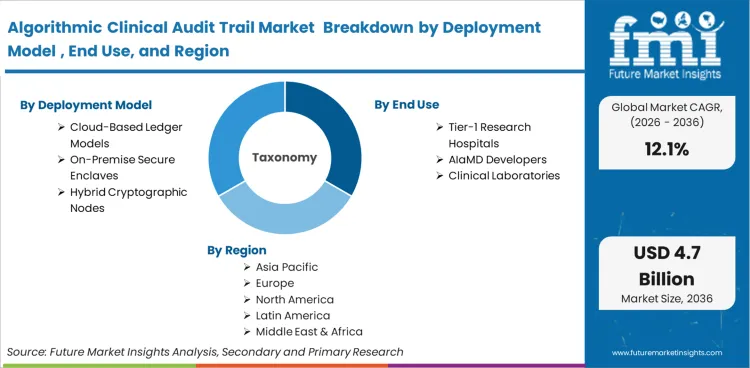
The algorithmic clinical audit trail market was valued at USD 1.2 billion in 2025. The sector is set to reach USD 1.5 billion in 2026 at a CAGR of 12.14% during the forecast period. Sustained investment propels the valuation to USD 4.7 billion through 2036 as regulatory mandates for immutable provenance in Software as a Medical Device compel clinical risk managers to replace centralized logs with cryptographic ledgers.
The shift toward autonomous clinical decision support immediately exposes Chief Medical Information Officers (CMIOs) at research hospitals to unprecedented liability gaps. Traditional IT logging architectures fail to capture the probabilistic inference paths of continuous-learning algorithms, leaving institutions unable to defend against algorithmic malpractice claims under the Bolam principle. CMIOs who delay the implementation of cryptographic provenance tools risk losing regulatory clearance for their in-house healthcare artificial intelligence systems. Outsiders often assume these audit mechanisms are merely post-incident investigation tools, but practitioners know they are the critical enabling technology that allows legal model retraining without triggering full FDA 510(k) resubmissions.
Summary of Algorithmic Clinical Audit Trail Market
- Algorithmic Clinical Audit Trail Market Definition
- The market comprises specialized software and middleware that securely log, encrypt, and preserve the computational inference paths of medical artificial intelligence. It establishes immutable accountability and regulatory compliance for algorithmic clinical decisions.
- Demand Drivers in the Market
- FDA 21 CFR Part 11 and Good Machine Learning Practice mandates force AI-as-a-Medical-Device developers to embed verifiable provenance into their diagnostic software.
- The rapid emergence of algorithmic malpractice liability compels clinical risk management directors to adopt tamper-evident ledgers to protect institutions during adverse clinical events.
- Predetermined Change Control Plan requirements drive Chief Medical Information Officers to implement dynamic logging that justifies ongoing model retraining without full regulatory resubmission.
- Key Segments Analyzed in the FMI Report
- Cloud-Based Ledger Models: 62.4% share in 2026, driven by distributed hospital networks requiring frictionless, decentralized consensus mechanisms for multi-site AI deployments.
- Tier-1 Research Hospitals: 45.8% share in 2026, necessitated by their position as early adopters of autonomous diagnostic tools carrying extreme legal exposure.
- Cryptographic Logging Software: 54.2% share in 2026, dominating as the foundational software required to lock model weights and inference variables securely.
- Medical Imaging AI Oversight: 38.6% share in 2026, propelled by the massive volume of automated radiological scanning tools requiring continuous bias monitoring.
- United States: 14.2% compound growth, accelerated by the FDA's proactive enforcement of transparent lifecycle management for software as a medical device.
- Analyst Opinion at FMI
- Sabyasachi Ghosh, Principal Analyst, opines, "The true bottleneck is not the generation of the algorithmic audit trail, but the semantic interpretation of the logs during a regulatory inspection. AIaMD developers who fail to embed clinical context into their cryptographic logs will face severe compliance penalties when liability shifts from human clinicians to autonomous systems."
- Strategic Implications / Executive Takeaways
- Chief Medical Information Officers must transition legacy access logs to immutable inference ledgers to maintain 510(k) clearance before the 2028 liability shift.
- AI-as-a-Medical-Device developers should embed modular audit APIs directly into their core algorithms to secure rapid procurement approvals from hospital legal departments.
- Clinical risk management directors must establish continuous algorithmic surveillance frameworks or face uninsurable malpractice exposure from non-human autonomous care errors.
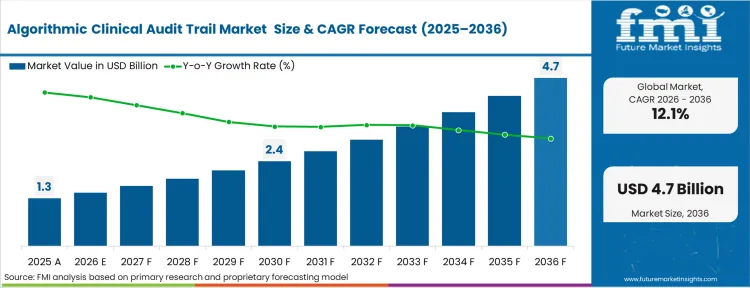
Algorithmic Clinical Audit Trail Market Key Takeaways
| Metric | Details |
|---|---|
| Industry Size (2026) | USD 1.5 billion |
| Industry Value (2036) | USD 4.7 billion |
| CAGR (2026-2036) | 12.14% |
Source: FMI analysis based on primary research and proprietary forecasting model
Healthcare systems must transition their enterprise liability policies to explicitly cover algorithmic malpractice before widespread continuous-learning adoption can accelerate safely. Hospital legal departments must finalise shared accountability contracts delineating vendor versus provider liability by 2028. Once this liability framework is codified, algorithmic deployment will shift from experimental sandboxes to acute care mainframes.
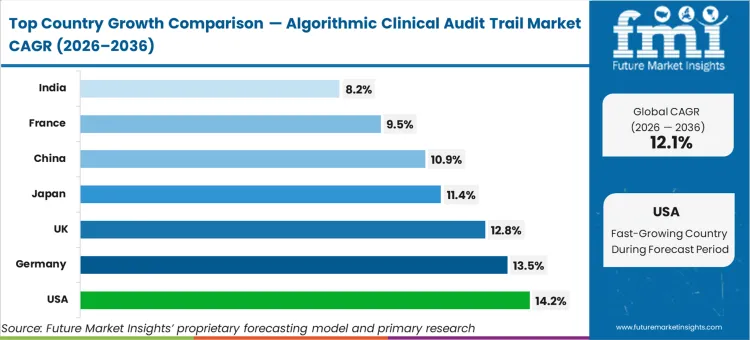
The United States advances at 14.2% compound annual growth, driven by aggressive FDA Predetermined Change Control Plan frameworks. Germany records 13.5% as strict DiGA Fast-track evaluations mandate transparent algorithmic behaviour. The United Kingdom tracks 12.8% due to localised MHRA guidelines on Good Machine Learning Practice. Japan reaches 11.4%, while China posts 10.9% through National Medical Products Administration directives. France grows at 9.5%, and India follows at 8.2%. The structural spread across these geographies stems directly from the varying maturity of localized software-as-a-medical-device regulations rather than generalized healthcare spending differences.
Algorithmic Clinical Audit Trail Market Definition
The algorithmic clinical audit trail market encompasses software and middleware that record, encrypt, and store the inference pathways of artificial intelligence applications used in healthcare. These systems provide immutable cryptographic provenance for probabilistic clinical recommendations, bridging the gap between algorithmic outputs and regulatory compliance. The market explicitly addresses the need to map model versions, training datasets, and inference logic into auditable, human-readable ledger entries.
Algorithmic Clinical Audit Trail Market Inclusions
Inclusions cover blockchain-based inference ledgers, Predetermined Change Control Plan (PCCP) automation software, semantic disambiguation mapping tools for Retrieval-Augmented Generation (RAG) models, and API middleware that links autonomous decision algorithms to the broader digital health ecosystem. Software tools designed to conduct exploratory error analysis, subgroup testing, and adversarial testing against deployed medical algorithms are fully integrated into this scope.
Algorithmic Clinical Audit Trail Market Exclusions
The market excludes general-purpose IT system access logs, standard electronic health record (EHR) patient history logs, and basic network cybersecurity monitoring tools. These legacy systems track human access and data movement rather than capturing the internal mathematical weighting, dataset provenance, and probabilistic inference steps generated autonomously by machine learning models during clinical diagnostic workflows.
Algorithmic Clinical Audit Trail Market Research Methodology
- Primary Research: FMI analysts engaged with Chief Medical Information Officers, AIaMD regulatory compliance directors, and clinical risk managers managing continuous learning deployments.
- Desk Research: The study aggregated FDA Software as a Medical Device (SaMD) directives, MHRA Good Machine Learning Practice frameworks, and 21 CFR Part 11 electronic records mandates.
- Market-Sizing and Forecasting: The baseline derives from the volume of active FDA 510(k) AI/ML medical device clearances multiplied by the average enterprise licensing cost of required cryptographic logging middleware.
- Data Validation and Update Cycle: Projections were cross-validated using software procurement expenditure reports from tier-1 research hospitals and compliance vendor revenue disclosures.
Segmental Analysis
Algorithmic Clinical Audit Trail Market Analysis by Deployment Model
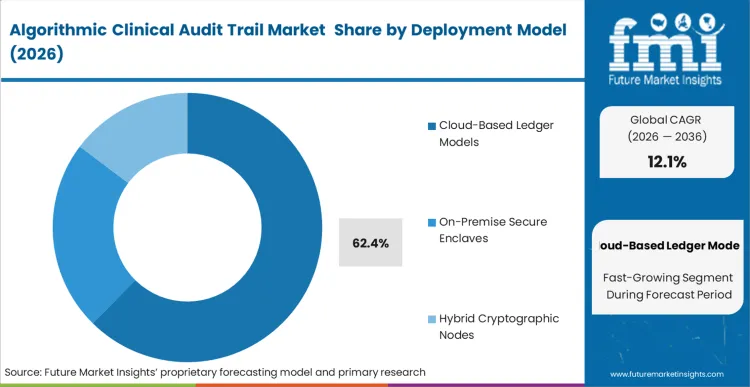
Centralized relational databases are actively failing to meet the strict immutability standards required for continuous-learning algorithms, forcing the displacement of legacy IT systems by decentralized ledgers. Cloud-Based Ledger Models command a 62.4% share in 2026 because their decentralized architecture prevents any single hospital node from altering a historical algorithmic decision.
FMI analysts suggest that this structure provides the exact mathematical certainty demanded by FDA investigators during adverse event reviews. Chief Information Officers operating multi-site acute care networks specify these cloud-ledgers to seamlessly synchronize vast quantities of inference data across their healthcare compliance software frameworks. Hospital legal departments that defer this upgrade risk having their entire evidentiary defense dismissed during algorithmic malpractice litigation due to theoretically manipulable logs.
- Immutable timestamping: Cryptographic hashes lock the exact millisecond an AI model generates a recommendation. Clinical risk managers utilizing this feature eliminate evidentiary disputes regarding when a diagnostic suggestion was presented to the attending physician.
- Node synchronization: Distributed network architectures instantly mirror audit logs across multiple remote servers. IT directors leveraging this redundancy guarantee data survival even if local hospital servers suffer catastrophic ransomware encryption.
- Permissioned accessibility: Role-based smart contracts restrict log visibility exclusively to authorized auditors. Privacy officers implementing these barriers ensure HIPAA compliance while fulfilling regulatory demands for algorithmic transparency.
Algorithmic Clinical Audit Trail Market Analysis by End User
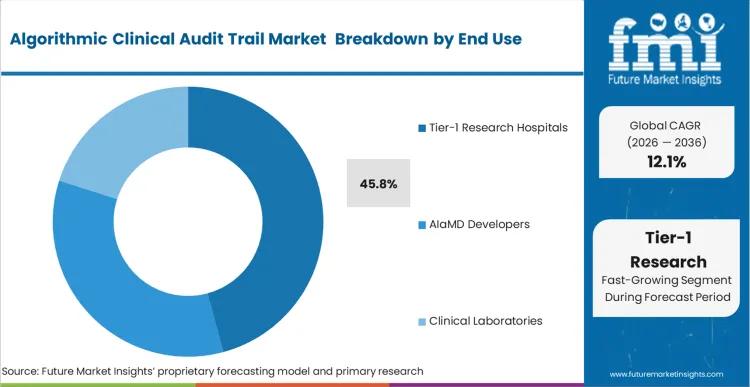
The concentration of Tier-1 Research Hospitals, holding a 45.8% share in 2026, is fused directly to their status as primary incubators for unproven, internally developed diagnostic algorithms. These institutions bear the brunt of early-adopter legal liability, forcing them to over-index on stringent provenance software compared to regional clinics.
Based on FMI's assessment, the sheer volume of experimental machine learning models running in these environments necessitates automated tracking to manage the Predetermined Change Control Plans. Chief Medical Information Officers within these academic hubs deploy massive medical image analysis overlays that update continuously based on new local data. Hospitals that fail to implement corresponding audit systems face immediate suspension of their clinical trial capabilities by federal oversight boards.
- Liability isolation: Dedicated tracking of internally built models separates hospital liability from third-party vendor errors. Hospital general counsel relying on this separation avoid paying settlements for software flaws engineered outside their walls.
- Trial documentation: Granular logging of inference changes fulfills the strict documentation requirements for investigational device exemptions. Principal investigators utilizing these logs maintain uninterrupted funding from federal health grants.
- Retraining validation: Middleware records exactly which patient data cohorts were fed into the model during periodic updates. Data scientists extracting these records successfully defend the statistical validity of their algorithms during regulatory audits.
Algorithmic Clinical Audit Trail Market Analysis by Component
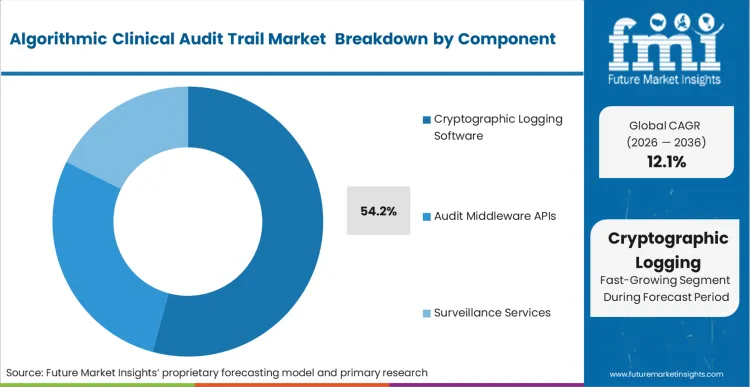
The strict compliance threshold of 21 CFR Part 11 dictates that the underlying architecture of any electronic record must be inherently secure and computer-generated without human intervention. This absolute requirement funnels buyers toward Cryptographic Logging Software, driving its 54.2% dominance in 2026.
According to FMI's estimates, this software layer is the non-negotiable prerequisite before any higher-level surveillance analytics can be deployed effectively. AIaMD developers embed these core clinical decision support logging tools directly into their product architectures to ensure out-of-the-box compliance. Developers who ignore this foundational layer find their products completely embargoed by enterprise hospital procurement committees.
- Hash generation: Automated algorithms create unique cryptographic signatures for every discrete clinical recommendation. Software engineers deploying these tools mathematically prove that the recorded inference path has never been altered post-generation.
- Semantic mapping: Advanced software modules translate complex neural network weights into human-readable clinical logic. Regulatory compliance officers reviewing these outputs instantly understand why an AI system recommended a specific fluid protocol.
- Version anchoring: The software permanently links a specific AI decision to the exact iteration of the model that produced it. Machine learning operations teams analyzing these anchors rapidly diagnose which specific software patch introduced a clinical error.
Algorithmic Clinical Audit Trail Market Analysis by Application

The operational gap in managing millions of automated radiological scans requires a specialized tracking layer to catch silent model drift. Medical Imaging AI Oversight specifically exists to solve this scale problem, leading the Application dimension with a 38.6% share in 2026.
As per FMI's projection, algorithms evaluating X-rays and MRIs are highly susceptible to spurious correlates, such as learning the type of scanning machine rather than the pathology. Radiology department heads specify this oversight application to continuously monitor healthcare cybersecurity systems and imaging models for diagnostic degradation. Departments operating without continuous imaging oversight inevitably experience clustered misdiagnoses, resulting in massive malpractice exposure once the silent drift is finally discovered.
- Pixel-level tracking: Specialized middleware records exactly which zones of an MRI influenced the algorithm's final diagnostic score. Radiologists consulting these logs quickly verify whether the AI focused on the actual tumor or a meaningless artifact.
- Drift detection: Statistical surveillance routines continuously compare current AI accuracy rates against original FDA clearance benchmarks. Quality assurance directors relying on these alerts preemptively pull degrading algorithms offline before patient harm occurs.
- Adversarial stress-testing: Automated modules inject synthetic noise into medical images to evaluate algorithmic robustness. Validation engineers running these protocols ensure the diagnostic software remains reliable despite varying hospital equipment quality.
Algorithmic Clinical Audit Trail Market Drivers, Restraints, and Opportunities
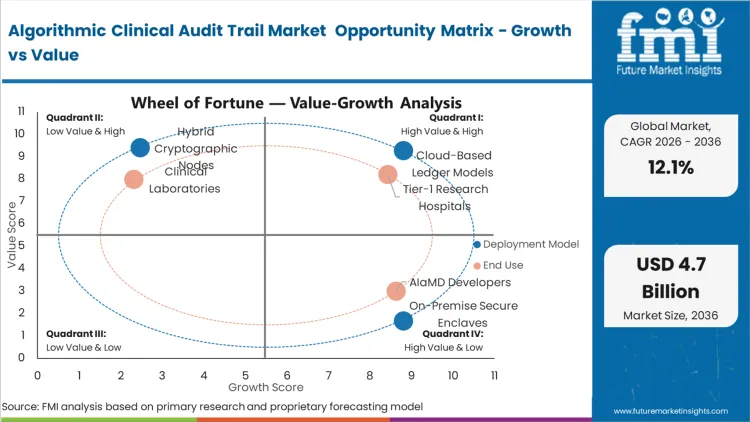
The US FDA's Good Machine Learning Practice (GMLP) principles and subsequent Predetermined Change Control Plan frameworks force AI-as-a-Medical-Device developers to integrate verifiable provenance layers. This regulatory pressure explicitly targets Chief Medical Information Officers, mandating that any continuous-learning algorithm deployed in acute care must document its evolving inference logic comprehensively. Hospitals are rapidly procuring cryptographic audit software to bridge the gap between static regulatory approval and dynamic software behaviour. Institutions that fail to implement these verifiable ledgers risk invalidating their 510(k) clearances, effectively shutting down their advanced autonomous care units.
Significant operational friction arises from the computational latency introduced by complex cryptographic logging. Generating an immutable, blockchain-anchored record for every split-second inference inside a high-frequency intensive care monitoring system can drastically slow down critical bedside alerts. While lightweight localized hashing presents an emerging workaround, it frequently lacks the cross-organizational traceability demanded by federal regulators.
Opportunities in the Algorithmic Clinical Audit Trail Market
- Semantic Disambiguation Integration: Natural language processing engines allow system architects to map raw neural network outputs directly into standardized medical ontologies like SNOMED-CT. Middleware vendors embedding this translation capability capture premium contracts by making raw audit logs instantly readable for clinical risk managers.
- Retrieval-Augmented Generation (RAG) Provenance: Advanced citation tracking protocols enable developers to trace exactly which medical journal or guideline an LLM pulled from during a diagnostic query. Electronic health records providers implementing RAG provenance secure exclusive integrations with tier-1 research hospitals demanding evidence-based accountability.
- Automated Malpractice Defense Dashboards: Specialized software interfaces aggregate cryptographic audit data specifically formatted for legal evidentiary standards. Liability insurance underwriters licensing these dashboards aggressively lower premiums for hospital networks that can mathematically prove their AI systems performed within expected parameters.
Regional Analysis
Based on the regional analysis, the Algorithmic Clinical Audit Trail market is segmented into North America, Europe, East Asia, and Asia Pacific across 40 plus countries.
.webp "Top Country Growth Comparison Algorithmic Clinical Audit Trail Market Cagr (2026 2036)")
| Country | CAGR (2026 to 2036) |
|---|---|
| United States | 14.2% |
| Germany | 13.5% |
| United Kingdom | 12.8% |
| Japan | 11.4% |
| China | 10.9% |
| France | 9.5% |
| India | 8.2% |
Source: FMI analysis based on primary research and proprietary forecasting model
North America Algorithmic Clinical Audit Trail Market Analysis
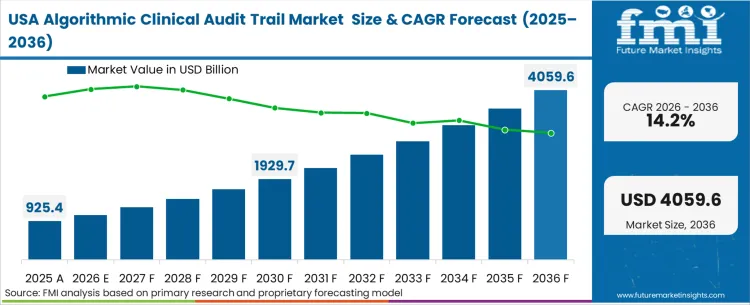
The aggressive rollout of FDA Predetermined Change Control Plans (PCCPs) under the Software as a Medical Device framework forces a highly specific compliance burden on North American institutions. This policy-led environment dictates that algorithms capable of continuous learning cannot be deployed legally without a dynamic, unalterable ledger tracking every post-market modification. In FMI's view, this regulatory environment makes North America the primary testing ground for advanced cryptographic logging architectures. Vendors are leveraging cloud computing platforms to aggregate these vast inference logs securely across disparate state health networks.
- United States: The US government push for Predetermined Change Control Plans compels AIaMD developers to integrate audit APIs directly into their core codebases. This regulatory forcing mechanism guarantees continuous market expansion because static approvals are no longer viable for modern medical software. Extensive engagement with the Digital Health Center of Excellence confirms this permanent shift in federal oversight. The market is advancing at 14.2% compound between 2026 and 2036. Chief Medical Information Officers who fail to adopt these transparent lifecycle management tools forfeit their ability to deploy cutting-edge continuous-learning diagnostics.
FMI's report includes comprehensive evaluation of Canada and Mexico. The rapid harmonization of Health Canada's medical device directives with FDA standards creates a unified regulatory bloc requiring identical software provenance tools.
Europe Algorithmic Clinical Audit Trail Market Analysis
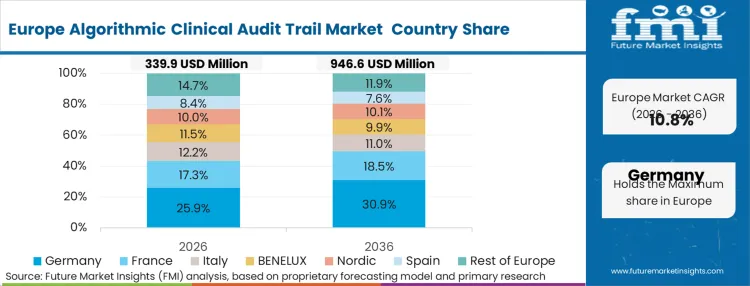
Strict infrastructure constraints surrounding the General Data Protection Regulation (GDPR) and the impending EU AI Act dictate how European hospitals handle algorithmic transparency. This unique regulatory interplay requires audit trails to simultaneously provide complete algorithmic explainability to regulators while fiercely protecting patient data from unauthorized exposure. According to FMI's estimates, European deployments rely heavily on localized secure enclaves rather than broad cloud networks.
- Germany: Sustaining a 13.5% CAGR to 2036, the German sector expands rapidly. Germany's DiGA fast-track approval process for digital health applications requires rigorous evidence of continuous algorithmic stability. This national procurement standard drives software engineers to build deeply embedded cryptographic ledgers to secure federal reimbursement eligibility. Accelerating deployments within the telematics infrastructure network highlight this systemic integration. AI vendors who cannot provide transparent, GDPR-compliant inference logs lose access to the lucrative statutory health insurance market entirely.
- United Kingdom: The MHRA in the United Kingdom enforces strict Good Machine Learning Practice (GMLP) guidelines that emphasize algorithmic transparency and accountability. This specific policy forces clinical risk directors to transition away from manual IT logging toward automated, immutable provenance records. Expanding at 12.8% between 2026 and 2036, the British market is highly specialised. System integrators failing to align with these GMLP principles face immediate disqualification from the NHS AI in Health and Care Award procurement pipelines.
- France: The stringent certification requirements imposed by the French digital health agency (ANS) mandate absolute traceability for all clinical decision support interventions. This infrastructure condition forces tier-1 hospital administrators to invest heavily in specialized audit middleware. Tracking 9.5% annual growth to 2036, the French landscape is robust. Procurement specification leads ignoring these traceability mandates suffer severe funding penalties under the Ségur du Numérique en Santé program.
FMI's report includes detailed analysis of Italy, Spain, and the Nordics. The emergence of unified European Health Data Space policies accelerates the adoption of cross-border cryptographic logging standards.
Asia Pacific Algorithmic Clinical Audit Trail Market Analysis
Specific margin pressures and the urgent need to scale healthcare delivery across massive populations dominate the Asian dynamic. This economics-led environment pushes hospitals to adopt autonomous AI diagnostics to offset severe specialist shortages, which in turn dramatically escalates their institutional malpractice exposure. Based on FMI's assessment, Asian healthcare networks prioritize lightweight, high-speed audit middleware that will not disrupt the rapid patient throughput required in hyper-dense urban medical centers.
- Japan: Japan's rapidly aging population forces hyper-efficient clinical workflows, pushing massive reliance on autonomous diagnostic systems. This demographic extreme requires hospital legal departments to implement automated malpractice defense dashboards to manage the unprecedented volume of machine-led care. Projected at 11.4% compound growth over the forecast period, Japan's adoption is swift. Facility owners delaying this oversight integration risk catastrophic legal exposure when inevitable probabilistic diagnostic errors occur at scale.
- China: Anchored to a 10.9% annual expansion through the decade, the Chinese ecosystem is strictly monitored. China's National Medical Products Administration (NMPA) requires exhaustive lifecycle management documentation for any domestically deployed AI-based medical device. This rigid regulatory gate forces domestic AIaMD developers to embed deep surveillance services into their algorithms. Technology vendors attempting to bypass these lifecycle documentation rules find their products permanently blocked from major provincial hospital networks.
- India: The rapid expansion of private tertiary care networks in India necessitates standardized oversight to maintain quality control across hundreds of distributed clinics. This fragmented infrastructure requires network operators to utilize decentralized blockchain-based ledgers to ensure uniform clinical compliance. The sector is advancing at an 8.2% compound annual rate through 2036. Capital project directors who neglect this centralized oversight architecture encounter massive brand damage and severe clinical inconsistencies across their decentralized hospital branches.
FMI's report includes coverage of South Korea and Australia. Strong investments by state health ministries in these nations underscore a rapid pivot toward standardized algorithmic accountability frameworks.
Competitive Aligners for Market Players
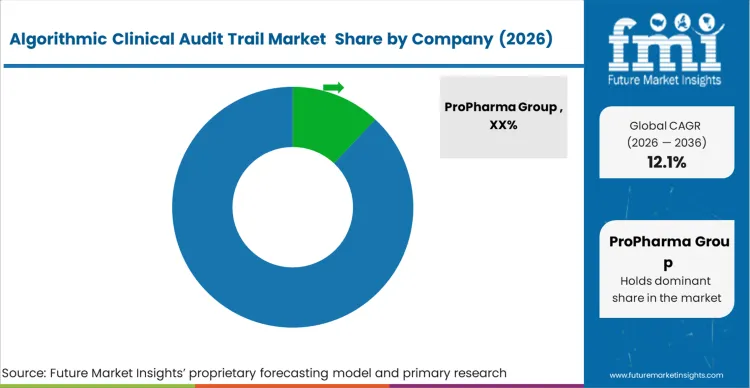
The algorithmic clinical audit trail market is moderately consolidated, dominated by major health IT incumbents and specialized regulatory software developers. This structure exists because navigating the complex intersection of FDA SaMD regulations, 21 CFR Part 11 compliance, and advanced cryptography requires massive upfront capital and specialized legal expertise. Companies like Merative and Microsoft Corporation leverage their existing hospital enterprise footholds to bundle audit capabilities into broader IT contracts. Buyers primarily distinguish qualified vendors based on their software's latency impact, specifically, the ability to generate an immutable cryptographic hash for a clinical decision without adding measurable delay to acute care diagnostic workflows.
Leading entities such as ProPharma Group and H2O.ai maintain distinct structural advantages through their deep integration with Good Machine Learning Practice frameworks and established regulatory consultancy practices. These companies possess proprietary semantic mapping algorithms that translate complex neural network weights into human-readable clinical logic instantly. A challenger entering this space must specifically build native Retrieval-Augmented Generation (RAG) provenance tracking to compete, proving exactly which medical journal an LLM utilized to generate a recommendation. By embedding ai in medical imaging overlays with these specific semantic translators, challengers can bypass established legacy IT vendors entirely.
To prevent vendor lock-in, large tier-1 research hospitals are increasingly mandating open-standard audit architectures. Buyers explicitly want their algorithmic ledgers physically and contractually separated from the vendors providing the actual AI diagnostic models to ensure unbiased performance reporting. This structural tension limits the pricing power of major AI vendors attempting to sell closed-loop, proprietary logging tools. The competitive trajectory to 2036 points toward slight fragmentation as specialized, third-party "black box" audit firms emerge to act as independent algorithmic arbitrators between healthcare providers and AI developers.
Key Players in Algorithmic Clinical Audit Trail Market
- ProPharma Group
- Merative
- Microsoft Corporation
- Oracle Cerner
- Epic Systems Corporation
- H2O.ai
- Arthur AI
- Enlitic Inc.
Scope of the Report
| Metric | Value |
|---|---|
| Quantitative Units | USD 1.5 billion to USD 4.7 billion, at a CAGR of 12.14% |
| Market Definition | Specialized software and middleware that securely record, encrypt, and store the inference pathways of medical artificial intelligence. It ensures immutable regulatory compliance and algorithmic accountability. |
| Deployment Model Segmentation | Cloud-Based Ledger Models, On-Premise Secure Enclaves, Hybrid Cryptographic Nodes |
| End User Segmentation | Tier-1 Research Hospitals, AIaMD Developers, Clinical Laboratories |
| Component Segmentation | Cryptographic Logging Software, Audit Middleware APIs, Surveillance Services |
| Application Segmentation | Medical Imaging AI Oversight, Predictive Analytics Tracking, Genomics Decision Support |
| Regions Covered | North America, Europe, East Asia, Asia Pacific |
| Countries Covered | United States, Germany, United Kingdom, Japan, China, France, India, and 40 plus countries |
| Key Companies Profiled | ProPharma Group, Merative, Microsoft Corporation, Oracle Cerner, Epic Systems Corporation, H2O.ai, Arthur AI, Enlitic Inc. |
| Forecast Period | 2026 to 2036 |
| Approach | FMI engaged Chief Medical Information Officers and regulatory compliance directors. The baseline was constructed from FDA 510(k) AI/ML medical device clearances and validated against enterprise software procurement expenditures. |
Source: Future Market Insights (FMI) analysis, based on proprietary forecasting model and primary research
Algorithmic Clinical Audit Trail Market Analysis by Segments
Deployment Model:
- Cloud-Based Ledger Models
- On-Premise Secure Enclaves
- Hybrid Cryptographic Nodes
End User:
- Tier-1 Research Hospitals
- AIaMD Developers
- Clinical Laboratories
Component:
- Cryptographic Logging Software
- Audit Middleware APIs
- Surveillance Services
Application:
- Medical Imaging AI Oversight
- Predictive Analytics Tracking
- Genomics Decision Support
Region:
- North America
- United States
- Europe
- Germany
- United Kingdom
- France
- East Asia
- Japan
- China
- Asia Pacific
- India
Bibliography
- USA Food and Drug Administration. (2025, August 18). Marketing submission recommendations for a predetermined change control plan for artificial intelligence-enabled device software functions.
- Assistant Secretary for Technology Policy/Office of the National Coordinator for Health Information Technology. (2024, January 9). Health data, technology, and interoperability: Certification program updates, algorithm transparency, and information sharing. Federal Register.
- Medicines and Healthcare products Regulatory Agency. (2024, June 13). Transparency for machine learning-enabled medical devices: Guiding principles. GOV.UK.
- Health Canada. (2024, July 29). Transparency for machine learning-enabled medical devices: Guiding principles. Government of Canada.
- National Institute of Standards and Technology. (2024, July). Artificial intelligence risk management framework: Generative artificial intelligence profile (NIST AI 600-1). USA Department of Commerce.
- European Parliament & Council of the European Union. (2024, June 13). Regulation (EU) 2024/1689 of the European Parliament and of the Council laying down harmonised rules on artificial intelligence and amending certain Union legislative acts (Artificial Intelligence Act). EUR-Lex.
- Collins, G. S., Moons, K. G. M., Dhiman, P., Riley, R. D., Beam, A. L., Van Calster, B., Ghassemi, M., Liu, X., Reitsma, J. B., van Smeden, M., Boulesteix, A.-L., Camaradou, J. C., Celi, L. A., Denaxas, S., Denniston, A. K., Glocker, B., Golub, R. M., Harvey, H., Heinze, G., ... Logullo, P. (2024). TRIPOD+AI statement: Updated guidance for reporting clinical prediction models that use regression or machine learning methods. BMJ, 385, e078378.
- Feng, J., Xia, F., Singh, K., & Pirracchio, R. (2025, January 23). Not all clinical AI monitoring systems are created equal: Review and recommendations. NEJM AI, 2(2).
- Kalokyri, V., Tachos, N. S., Kalantzopoulos, C. N., Sfakianakis, S., Kondylakis, H., Zaridis, D. I., Colantonio, S., Regge, D., Papanikolaou, N., Marias, K., Fotiadis, D. I., & Tsiknakis, M. (2025). AI model passport: Data and system traceability framework for transparent AI in health. Computational and Structural Biotechnology Journal, 28, 386-404.
- Mahajan, A., & Powell, D. (2025, January 15). Improving authenticity and provenance in digital biomarkers: The case for digital watermarking. npj Digital Medicine, 8, Article 31.
This bibliography is provided for reader reference. The full FMI report contains the complete reference list with primary source documentation.
Frequently Asked Questions
How large is the Algorithmic Clinical Audit Trail Market in 2026?
The industry is expected to cross USD 1.5 billion in 2026, driven directly by the aggressive rollout of FDA Predetermined Change Control Plan frameworks.
What will it be valued at by 2036?
Sustained investment propels the total valuation to USD 4.7 billion through 2036 as algorithmic malpractice liability forces a structural shift away from manual IT logging.
What CAGR is projected?
The sector advances at a 12.14% CAGR, anchored solidly by mandatory continuous monitoring requirements under international Software as a Medical Device (SaMD) directive.
Which Deployment Model segment leads?
Cloud-Based Ledger Models lead with a 62.4% share in 2026, due to their decentralized architecture which prevents any single node from altering historical algorithmic inference records.
Which End User segment leads?
Tier-1 Research Hospitals dictate this dimension, functioning as the primary incubators for high-risk autonomous diagnostic algorithms demanding extreme legal protection.
Which Component segment leads?
Cryptographic Logging Software holds dominance, forming the non-negotiable compliance foundation required under 21 CFR Part 11 before any higher-level surveillance can be implemented.
What drives rapid growth?
FDA mandates and Good Machine Learning Practice principles force AI developers to embed verifiable, immutable provenance into their software to maintain regulatory clearance.
What is the primary restraint?
Severe operational friction arises from the computational latency introduced by cryptographic logging, which can slow down high-frequency intensive care monitoring alerts.
Which country grows fastest?
The United States advances at 14.2% compound annual growth, driven by aggressive federal enforcement of transparent lifecycle management for software as a medical device.
How do 21 CFR Part 11 mandates affect adoption?
These mandates require that audit trails for electronic records be strictly computer-generated and unalterable, completely invalidating manual centralized legacy logs.
Why are cryptographic ledgers replacing legacy IT logs?
Blockchain-enabled ledgers lock AI decision provenance definitively, eliminating evidentiary disputes regarding probabilistic inference paths during medical malpractice litigation.
How do major vendors compete in this space?
Firms compete primarily on latency and semantic disambiguation mapping, ensuring complex algorithms are logged in milliseconds while remaining readable to compliance officers.
What is the role of Semantic Disambiguation?
It translates raw neural network outputs and mathematical weights into standardized medical ontologies like SNOMED-CT, making algorithmic logic instantly comprehensible.
How does the Bolam principle apply here?
The traditional Bolam principle protects human clinicians but struggles to accommodate non-human agency, forcing hospitals to acquire detailed audit logs to defend autonomous systems.
What constitutes Algorithmic Malpractice?
It is a novel liability concept where probabilistic outputs from AI systems cause or contribute directly to clinical errors, requiring specialized software to detect and document.
What are Predetermined Change Control Plans (PCCPs)?
PCCPs are FDA frameworks that allow AI models to learn and update continuously post-market, provided they possess a rigorous, automated audit trail justifying the changes.
Why do AIaMD Developers purchase audit middleware?
They embed these API modules directly into their core codebase to guarantee out-of-the-box compliance and secure rapid procurement from strict hospital legal departments.
How does Germany’s DiGA process impact adoption?
The DiGA fast-track evaluation mandates transparent algorithmic behavior, forcing digital health engineers to build deeply embedded cryptographic ledgers to qualify for reimbursement.
What role does Retrieval-Augmented Generation (RAG) provenance play?
It enables developers to track exactly which medical journal or consensus guideline a Large Language Model utilized to generate a specific clinical recommendation.
Why do hospitals want independent "black box" logging?
Institutions want their audit layers contractually separated from the AI vendors to prevent the manipulation of performance data and ensure completely unbiased quality reporting.
How does the NHS approach this technology?
The UK's MHRA enforces strict Good Machine Learning Practice rules, effectively barring system integrators from NHS procurement pipelines if they lack robust provenance logging.
What is the primary risk of Medical Imaging AI?
Radiological algorithms are highly susceptible to silent model drift and learning spurious correlates, requiring pixel-level continuous tracking to prevent clustered misdiagnoses.
Preview the report firsthand - request a free sample
Get SampleGet the brochure for pricing and purchase details.
Get PDFTable of Content
- Executive Summary
- Global Market Outlook
- Demand-side Trends
- Supply-side Trends
- Technology Roadmap Analysis
- Analysis and Recommendations
- Market Overview
- Market Coverage / Taxonomy
- Market Definition / Scope / Limitations
- Research Methodology
- Chapter Orientation
- Analytical Lens and Working Hypotheses
- Market Structure, Signals, and Trend Drivers
- Benchmarking and Cross-market Comparability
- Market Sizing, Forecasting, and Opportunity Mapping
- Research Design and Evidence Framework
- Desk Research Programme (Secondary Evidence)
- Company Annual and Sustainability Reports
- Peer-reviewed Journals and Academic Literature
- Corporate Websites, Product Literature, and Technical Notes
- Earnings Decks and Investor Briefings
- Statutory Filings and Regulatory Disclosures
- Technical White Papers and Standards Notes
- Trade Journals, Industry Magazines, and Analyst Briefs
- Conference Proceedings, Webinars, and Seminar Materials
- Government Statistics Portals and Public Data Releases
- Press Releases and Reputable Media Coverage
- Specialist Newsletters and Curated Briefings
- Sector Databases and Reference Repositories
- FMI Internal Proprietary Databases and Historical Market Datasets
- Subscription Datasets and Paid Sources
- Social Channels, Communities, and Digital Listening Inputs
- Additional Desk Sources
- Expert Input and Fieldwork (Primary Evidence)
- Primary Modes
- Qualitative Interviews and Expert Elicitation
- Quantitative Surveys and Structured Data Capture
- Blended Approach
- Why Primary Evidence is Used
- Field Techniques
- Interviews
- Surveys
- Focus Groups
- Observational and In-context Research
- Social and Community Interactions
- Stakeholder Universe Engaged
- C-suite Leaders
- Board Members
- Presidents and Vice Presidents
- R&D and Innovation Heads
- Technical Specialists
- Domain Subject-matter Experts
- Scientists
- Physicians and Other Healthcare Professionals
- Governance, Ethics, and Data Stewardship
- Research Ethics
- Data Integrity and Handling
- Primary Modes
- Tooling, Models, and Reference Databases
- Desk Research Programme (Secondary Evidence)
- Data Engineering and Model Build
- Data Acquisition and Ingestion
- Cleaning, Normalisation, and Verification
- Synthesis, Triangulation, and Analysis
- Quality Assurance and Audit Trail
- Market Background
- Market Dynamics
- Drivers
- Restraints
- Opportunity
- Trends
- Scenario Forecast
- Demand in Optimistic Scenario
- Demand in Likely Scenario
- Demand in Conservative Scenario
- Opportunity Map Analysis
- Product Life Cycle Analysis
- Supply Chain Analysis
- Investment Feasibility Matrix
- Value Chain Analysis
- PESTLE and Porter’s Analysis
- Regulatory Landscape
- Regional Parent Market Outlook
- Production and Consumption Statistics
- Import and Export Statistics
- Market Dynamics
- Global Market Analysis 2021 to 2025 and Forecast, 2026 to 2036
- Historical Market Size Value (USD Million) Analysis, 2021 to 2025
- Current and Future Market Size Value (USD Million) Projections, 2026 to 2036
- Y-o-Y Growth Trend Analysis
- Absolute $ Opportunity Analysis
- Global Market Pricing Analysis 2021 to 2025 and Forecast 2026 to 2036
- Global Market Analysis 2021 to 2025 and Forecast 2026 to 2036, By Deployment Model
- Introduction / Key Findings
- Historical Market Size Value (USD Million) Analysis By Deployment Model , 2021 to 2025
- Current and Future Market Size Value (USD Million) Analysis and Forecast By Deployment Model , 2026 to 2036
- Cloud-Based Ledger Models
- On-Premise Secure Enclaves
- Hybrid Cryptographic Nodes
- Cloud-Based Ledger Models
- Y-o-Y Growth Trend Analysis By Deployment Model , 2021 to 2025
- Absolute $ Opportunity Analysis By Deployment Model , 2026 to 2036
- Global Market Analysis 2021 to 2025 and Forecast 2026 to 2036, By End Use
- Introduction / Key Findings
- Historical Market Size Value (USD Million) Analysis By End Use, 2021 to 2025
- Current and Future Market Size Value (USD Million) Analysis and Forecast By End Use, 2026 to 2036
- Tier-1 Research Hospitals
- AIaMD Developers
- Clinical Laboratories
- Tier-1 Research Hospitals
- Y-o-Y Growth Trend Analysis By End Use, 2021 to 2025
- Absolute $ Opportunity Analysis By End Use, 2026 to 2036
- Global Market Analysis 2021 to 2025 and Forecast 2026 to 2036, By Component
- Introduction / Key Findings
- Historical Market Size Value (USD Million) Analysis By Component, 2021 to 2025
- Current and Future Market Size Value (USD Million) Analysis and Forecast By Component, 2026 to 2036
- Cryptographic Logging Software
- Audit Middleware APIs
- Surveillance Services
- Cryptographic Logging Software
- Y-o-Y Growth Trend Analysis By Component, 2021 to 2025
- Absolute $ Opportunity Analysis By Component, 2026 to 2036
- Global Market Analysis 2021 to 2025 and Forecast 2026 to 2036, By Application
- Introduction / Key Findings
- Historical Market Size Value (USD Million) Analysis By Application, 2021 to 2025
- Current and Future Market Size Value (USD Million) Analysis and Forecast By Application, 2026 to 2036
- Medical Imaging AI Oversight
- Predictive Analytics Tracking
- Genomics Decision Support
- Medical Imaging AI Oversight
- Y-o-Y Growth Trend Analysis By Application, 2021 to 2025
- Absolute $ Opportunity Analysis By Application, 2026 to 2036
- Global Market Analysis 2021 to 2025 and Forecast 2026 to 2036, By Region
- Introduction
- Historical Market Size Value (USD Million) Analysis By Region, 2021 to 2025
- Current Market Size Value (USD Million) Analysis and Forecast By Region, 2026 to 2036
- North America
- Latin America
- Western Europe
- Eastern Europe
- East Asia
- South Asia and Pacific
- Middle East & Africa
- Market Attractiveness Analysis By Region
- North America Market Analysis 2021 to 2025 and Forecast 2026 to 2036, By Country
- Historical Market Size Value (USD Million) Trend Analysis By Market Taxonomy, 2021 to 2025
- Market Size Value (USD Million) Forecast By Market Taxonomy, 2026 to 2036
- By Country
- USA
- Canada
- Mexico
- By Deployment Model
- By End Use
- By Component
- By Application
- By Country
- Market Attractiveness Analysis
- By Country
- By Deployment Model
- By End Use
- By Component
- By Application
- Key Takeaways
- Latin America Market Analysis 2021 to 2025 and Forecast 2026 to 2036, By Country
- Historical Market Size Value (USD Million) Trend Analysis By Market Taxonomy, 2021 to 2025
- Market Size Value (USD Million) Forecast By Market Taxonomy, 2026 to 2036
- By Country
- Brazil
- Chile
- Rest of Latin America
- By Deployment Model
- By End Use
- By Component
- By Application
- By Country
- Market Attractiveness Analysis
- By Country
- By Deployment Model
- By End Use
- By Component
- By Application
- Key Takeaways
- Western Europe Market Analysis 2021 to 2025 and Forecast 2026 to 2036, By Country
- Historical Market Size Value (USD Million) Trend Analysis By Market Taxonomy, 2021 to 2025
- Market Size Value (USD Million) Forecast By Market Taxonomy, 2026 to 2036
- By Country
- Germany
- UK
- Italy
- Spain
- France
- Nordic
- BENELUX
- Rest of Western Europe
- By Deployment Model
- By End Use
- By Component
- By Application
- By Country
- Market Attractiveness Analysis
- By Country
- By Deployment Model
- By End Use
- By Component
- By Application
- Key Takeaways
- Eastern Europe Market Analysis 2021 to 2025 and Forecast 2026 to 2036, By Country
- Historical Market Size Value (USD Million) Trend Analysis By Market Taxonomy, 2021 to 2025
- Market Size Value (USD Million) Forecast By Market Taxonomy, 2026 to 2036
- By Country
- Russia
- Poland
- Hungary
- Balkan & Baltic
- Rest of Eastern Europe
- By Deployment Model
- By End Use
- By Component
- By Application
- By Country
- Market Attractiveness Analysis
- By Country
- By Deployment Model
- By End Use
- By Component
- By Application
- Key Takeaways
- East Asia Market Analysis 2021 to 2025 and Forecast 2026 to 2036, By Country
- Historical Market Size Value (USD Million) Trend Analysis By Market Taxonomy, 2021 to 2025
- Market Size Value (USD Million) Forecast By Market Taxonomy, 2026 to 2036
- By Country
- China
- Japan
- South Korea
- By Deployment Model
- By End Use
- By Component
- By Application
- By Country
- Market Attractiveness Analysis
- By Country
- By Deployment Model
- By End Use
- By Component
- By Application
- Key Takeaways
- South Asia and Pacific Market Analysis 2021 to 2025 and Forecast 2026 to 2036, By Country
- Historical Market Size Value (USD Million) Trend Analysis By Market Taxonomy, 2021 to 2025
- Market Size Value (USD Million) Forecast By Market Taxonomy, 2026 to 2036
- By Country
- India
- ASEAN
- Australia & New Zealand
- Rest of South Asia and Pacific
- By Deployment Model
- By End Use
- By Component
- By Application
- By Country
- Market Attractiveness Analysis
- By Country
- By Deployment Model
- By End Use
- By Component
- By Application
- Key Takeaways
- Middle East & Africa Market Analysis 2021 to 2025 and Forecast 2026 to 2036, By Country
- Historical Market Size Value (USD Million) Trend Analysis By Market Taxonomy, 2021 to 2025
- Market Size Value (USD Million) Forecast By Market Taxonomy, 2026 to 2036
- By Country
- Kingdom of Saudi Arabia
- Other GCC Countries
- Turkiye
- South Africa
- Other African Union
- Rest of Middle East & Africa
- By Deployment Model
- By End Use
- By Component
- By Application
- By Country
- Market Attractiveness Analysis
- By Country
- By Deployment Model
- By End Use
- By Component
- By Application
- Key Takeaways
- Key Countries Market Analysis
- USA
- Pricing Analysis
- Market Share Analysis, 2025
- By Deployment Model
- By End Use
- By Component
- By Application
- Canada
- Pricing Analysis
- Market Share Analysis, 2025
- By Deployment Model
- By End Use
- By Component
- By Application
- Mexico
- Pricing Analysis
- Market Share Analysis, 2025
- By Deployment Model
- By End Use
- By Component
- By Application
- Brazil
- Pricing Analysis
- Market Share Analysis, 2025
- By Deployment Model
- By End Use
- By Component
- By Application
- Chile
- Pricing Analysis
- Market Share Analysis, 2025
- By Deployment Model
- By End Use
- By Component
- By Application
- Germany
- Pricing Analysis
- Market Share Analysis, 2025
- By Deployment Model
- By End Use
- By Component
- By Application
- UK
- Pricing Analysis
- Market Share Analysis, 2025
- By Deployment Model
- By End Use
- By Component
- By Application
- Italy
- Pricing Analysis
- Market Share Analysis, 2025
- By Deployment Model
- By End Use
- By Component
- By Application
- Spain
- Pricing Analysis
- Market Share Analysis, 2025
- By Deployment Model
- By End Use
- By Component
- By Application
- France
- Pricing Analysis
- Market Share Analysis, 2025
- By Deployment Model
- By End Use
- By Component
- By Application
- India
- Pricing Analysis
- Market Share Analysis, 2025
- By Deployment Model
- By End Use
- By Component
- By Application
- ASEAN
- Pricing Analysis
- Market Share Analysis, 2025
- By Deployment Model
- By End Use
- By Component
- By Application
- Australia & New Zealand
- Pricing Analysis
- Market Share Analysis, 2025
- By Deployment Model
- By End Use
- By Component
- By Application
- China
- Pricing Analysis
- Market Share Analysis, 2025
- By Deployment Model
- By End Use
- By Component
- By Application
- Japan
- Pricing Analysis
- Market Share Analysis, 2025
- By Deployment Model
- By End Use
- By Component
- By Application
- South Korea
- Pricing Analysis
- Market Share Analysis, 2025
- By Deployment Model
- By End Use
- By Component
- By Application
- Russia
- Pricing Analysis
- Market Share Analysis, 2025
- By Deployment Model
- By End Use
- By Component
- By Application
- Poland
- Pricing Analysis
- Market Share Analysis, 2025
- By Deployment Model
- By End Use
- By Component
- By Application
- Hungary
- Pricing Analysis
- Market Share Analysis, 2025
- By Deployment Model
- By End Use
- By Component
- By Application
- Kingdom of Saudi Arabia
- Pricing Analysis
- Market Share Analysis, 2025
- By Deployment Model
- By End Use
- By Component
- By Application
- Turkiye
- Pricing Analysis
- Market Share Analysis, 2025
- By Deployment Model
- By End Use
- By Component
- By Application
- South Africa
- Pricing Analysis
- Market Share Analysis, 2025
- By Deployment Model
- By End Use
- By Component
- By Application
- USA
- Market Structure Analysis
- Competition Dashboard
- Competition Benchmarking
- Market Share Analysis of Top Players
- By Regional
- By Deployment Model
- By End Use
- By Component
- By Application
- Competition Analysis
- Competition Deep Dive
- ProPharma Group
- Overview
- Product Portfolio
- Profitability by Market Segments (Product/Age /Sales Channel/Region)
- Sales Footprint
- Strategy Overview
- Marketing Strategy
- Product Strategy
- Channel Strategy
- Merative
- Microsoft Corporation
- Oracle Cerner
- Epic Systems Corporation
- H2O.ai
- Arthur AI
- Enlitic Inc.
- ProPharma Group
- Competition Deep Dive
- Assumptions & Acronyms Used


