

- Industry Size (2026)
- USD 4.6 Bn
- Forecast (2036)
- USD 10.3 Bn
- CAGR (2026 to 2036)
- 8.4%
Checkout Friction Reduction Technologies Market Size, Market Forecast And Outlook By FMI
The checkout friction reduction technologies market was valued at USD 4.2 billion in 2025. Evaluating the checkout friction reduction technologies market size for 2026, revenue is poised to reach USD 4.6 billion. Industry’s expansion at a CAGR of 8.4% during the forecast period establishes the checkout friction reduction technologies market forecast for 2036 at USD 10.3 billion. Sustained investment carries this valuation forward as retailers upgrade physical lanes and digital gateways simultaneously, accelerating overall checkout optimization.
Retail store operations are currently grappling with severe labor shortages, necessitating the immediate and urgent redesign of frontline payment flows. During peak shopping hours, retailers suffer the loss of millions of dollars annually due to customers abandoning long queues, making legacy lane configurations financially unsustainable for modern commerce. Any delay in implementing seamless scan-and-go architectures directly transfers revenue to competitors who are already running optimized, frictionless operations. A thorough exploration of the self checkout system environment clearly demonstrates that frictionless retail solutions are now the key determinants of store profitability, moving beyond their former role as mere convenience features.
Summary of Checkout Friction Reduction Technologies Market
- Market Snapshot:
- The market value is projected to grow from USD 4.2 billion in 2025 to USD 10.3 billion by 2036.
- The market is expected to have a Compound Annual Growth Rate (CAGR) of 8.4% between 2026 and 2036.
- This growth represents an incremental market opportunity of USD 5.7 billion.
- The estimated market value for 2026 is USD 4.6 billion.
- The analysis focuses specifically on checkout optimization, not the entire retail automation landscape.
- Key technology aims include speeding up payments and decreasing abandoned queues.
- The technology also aims to simplify accepting payments.
- A further goal is to integrate checkout with loyalty programs, fraud detection, and order management systems.
- Demand and Growth Drivers:
- Consumer demand is increasing due to the ongoing shift towards remote and digital payment methods, as indicated by the Federal Reserve's report of higher overall payment counts, with the majority of growth coming from remote payments.
- Retailers are prioritizing checkout modernization because payment efficiency now has a direct impact on customer abandonment, conversion rates, and labor efficiency across both physical and online stores.
- Cashless checkout remains the dominant payment structure, with an estimated 62.0% market share, as cards, digital wallets, and app-linked credentials eliminate the friction of manual tender processes at the register and during the shopping experience.
- Self-checkout kiosks are the leading checkout mode, holding an estimated 34.0% share, largely because they are already standard in the operating models of major supermarkets, pharmacies, and convenience stores.
- Among key countries, India is projected to have the highest Compound Annual Growth Rate (CAGR) at 10.1%, followed by China (9.7%), the United States (8.9%), the United Kingdom (8.4%), Germany (8.1%), South Korea (7.8%), and Japan (7.6%).
- Growth is being slowed down by costs associated with loss prevention (shrink-control), the need for robust fraud detection systems, and the requirement to integrate the checkout layer with existing Point of Sale (POS), inventory, loyalty, and payment gateway systems.
- Product and Segment View:
- The market encompasses hardware, software, and services for checkout, aiming to minimize payment issues across in-store, app, and web transactions.
- Hardware holds the largest component share, estimated at 31.0%, as physical equipment like kiosks, scanners, terminals, and vision counters are the main points for completing transactions.
- Self-checkout kiosks are the leading checkout mode, with an estimated 34.0% share, because retailers currently prefer familiar shopper behavior and fixed-lane capacity over fully autonomous systems.
- Cashless payments dominate the payment type segment, holding an estimated 62.0% share, due to the speed and omnichannel compatibility of card, wallet, and tokenized credentials.
- Supermarkets represent the largest end-use segment, with an estimated 29.0% share, because high basket size, dense queues, and labor costs make checkout improvement highly profitable in food retail.
- Cloud deployment leads the segment with an estimated 57.0% share, driven by retailers' need for centralized management of updates, analytics, fraud rules, and payment routing across many stores and digital channels.
- The scope includes technologies such as self-checkout, scan-and-go, AI checkout, one-click checkout, payment orchestration, and related service layers.
- Excluded from the scope are general retail ERP systems, warehouse automation, basic e-commerce storefront software, and in-store analytics not specifically focused on reducing checkout friction.
- Geography and Competitive Outlook:
- India and China are the fastest-growing demand centers in this model, while the United States remains the most stable high-value deployment base for enterprise checkout modernization.
- Competition is shaped by platform integration, vision-enabled checkout, cashless acceptance, kiosk ergonomics, fraud-control software, and merchant deployment scale.
- NCR Voyix, Diebold Nixdorf, Toshiba Global Commerce Solutions, Fujitsu, Verifone, Zebra Technologies, and Mashgin are among the key active participants serving this market structure.
- The market is moderately fragmented, with NCR Voyix holding a leading share, while other players does not controls the broader friction-reduction stack across hardware, software, and payment layers.
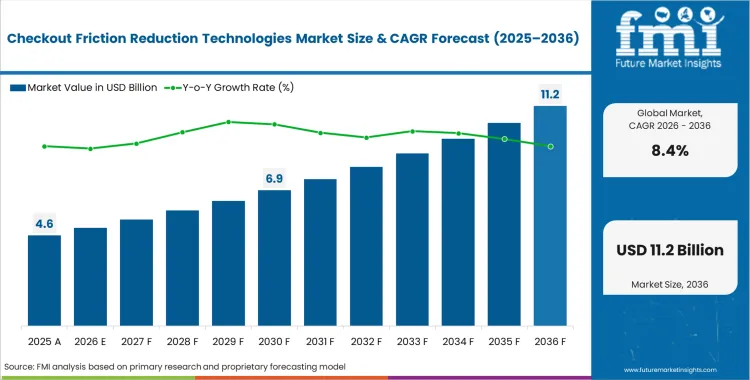
| Metric | Details |
|---|---|
| Industry Size (2026) | USD 4.6 Billion |
| Industry Value (2036) | USD 10.3 Billion |
| CAGR (2026-2036) | 8.4% |
Source: Future Market Insights (FMI) analysis, based on proprietary forecasting model and primary research
The complete elimination of manual scanning, particularly for customers with small baskets, initiates an irreversible acceleration in transaction throughput. This transformative shift is executed by sophisticated algorithms that visually identify items using advanced camera arrays, completely bypassing the need for traditional barcode reading. Furthermore, intelligent backend orchestration tools process these transactions instantly, thereby removing visible bottlenecks entirely and significantly expanding the broader retail automation footprint across the entire store environment.
Digital payment expansion is seeing robust growth across key geographies, with varying drivers shaping each market. India leads geographic expansion at a 10.1% CAGR, driven by mobile-led commerce behavior bypassing legacy card infrastructure. China follows at a 9.7% CAGR, backed by deeply integrated digital wallet ecosystems enforcing uniform payment standards. The United States expansion tracks at an 8.9% CAGR, propelled by enterprise supermarkets deploying advanced United States self checkout terminals to counter rising wages. The United Kingdom advances at an 8.4% CAGR, supported by open banking adoption. Germany scales at an 8.1% CAGR, fueled by localized orchestration needs. South Korea shows a 7.8% CAGR, relying on biometric compliance, and Japan expands at a 7.6% CAGR, supported by hybrid omnichannel synchronization.
Segmental Analysis
Checkout Friction Reduction Technologies Market Analysis by Component
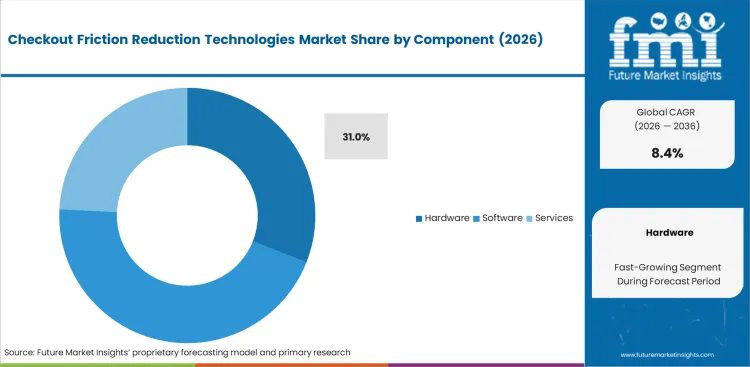
Hardware, rather than just software, determines the success of transactions through physical control points. The hardware segment holds a 31.0% market share, driven by store integration managers prioritizing robust terminals in busy lanes to reduce reliance on manual cashier assistance. Implementation teams are bringing handheld point of sale methods into retail spaces, simplifying complex scanning tasks with easy-to-use touchscreens. Advanced vision scales allow for effortless identification of fresh produce without requiring manual code input. What is often overlooked is the strategic reality: hardware components are quietly establishing independent loss-prevention networks, potentially challenging the traditional dominance of security cameras. Retail operations directors who postpone upgrading terminals will immediately see reduced throughput compared to optimized competitors, thereby boosting market projections for retail checkout automation.
- Hardware Efficiency: Store integration managers prioritize robust terminals in busy lanes to reduce reliance on manual cashier assistance, ensuring physical control points do not become throughput bottlenecks.
- Tactile Reliability: Implementation teams are bringing handheld point of sale methods into retail spaces, simplifying complex scanning tasks with easy-to-use touchscreens that reduce user error during peak hours.
- Vision Integration: Advanced vision scales allow for effortless identification of fresh produce without requiring manual code input, a critical step in removing the final barriers to full self-service adoption.
Checkout Friction Reduction Technologies Market Analysis by Checkout Mode
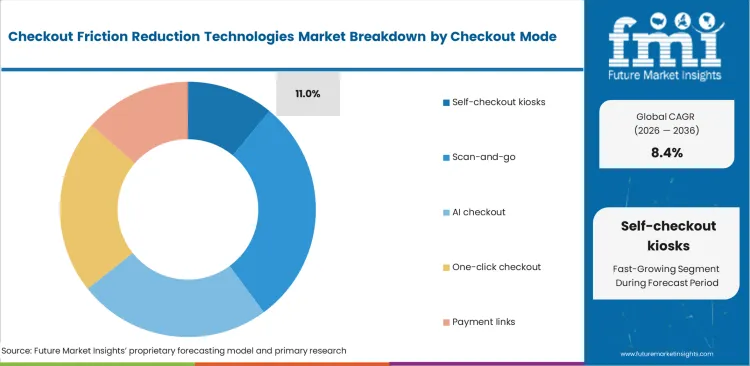
The speed of adopting new retail technology is driven more by consumer familiarity than by pure technological innovation. When comparing self-checkout, scan-and-go, and AI-powered checkout systems, the established physical kiosk continues to show the least initial difficulty, especially for older shoppers. FMI notes that modern intelligent touch screen cash register units can instantly accommodate changes in payment methods and shifts in regional preferences for cash. Their modular design allows them to handle significant surges in customer traffic during evening rush hours without requiring an increase in store floor space. While many assume kiosks are merely sophisticated cash registers, industry experts see them as an essential tool for managing the escalating cost of minimum wages. The self-checkout kiosks segment currently accounts for a 34.0% market share, fueled by store operations managers who prioritize dependable transaction completion without needing extensive shopper retraining, which substantially improves throughput during busy periods.
- Familiarity Anchor: The established physical kiosk continues to show the least initial difficulty for older shoppers, allowing retail operations to transition demographics without alienating core revenue streams.
- Peak Load Management: Modern intelligent touch screen cash register units instantly accommodate changes in payment methods, handling significant surges in customer traffic during evening rush hours without increasing the physical footprint.
- Labor Arbitrage: While many assume kiosks are merely sophisticated cash registers, industry experts see them as an essential tool for managing the escalating cost of minimum wages through automated volume handling.
Checkout Friction Reduction Technologies Market Analysis by Payment Type
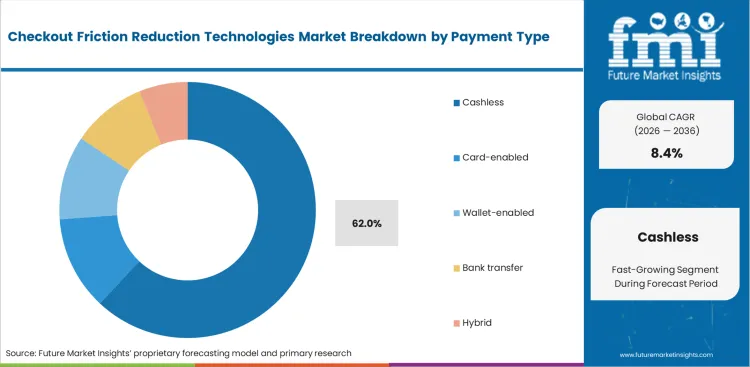
Frictionless tender acceptance necessitates enterprise-grade orchestration frameworks. To ensure seamless tender acceptance, businesses require robust, enterprise-level orchestration frameworks. Cashless transactions account for a 62.0% market share, largely driven by payment operations directors who manage numerous global digital wallet partnerships concurrently. Their goal is to dynamically reduce interchange fees. According to FMI's estimates, these organizations utilize advanced online payment gateway routers for continuous routing optimization. Employing multi-acquirer setups prevents complete system failure if a single processor goes down. Beneath the surface metrics, a key reality is hidden: cashless checkout systems function as autonomous loyalty switches. They leverage embedded payment authentication to negotiate greater access to customer data.
- Orchestration Logic: Payment operations directors manage numerous global digital wallet partnerships concurrently to dynamically reduce interchange fees while maintaining a consistent front-end experience.
- System Resiliency: Employing multi-acquirer setups prevents complete system failure if a single processor goes down, a structural necessity for high-volume retailers where downtime equals immediate loss.
- Loyalty Integration: Cashless checkout systems function as autonomous loyalty switches, leveraging embedded payment authentication to negotiate greater access to customer data than traditional cash transactions allow.
Checkout Friction Reduction Technologies Market Analysis by End Use
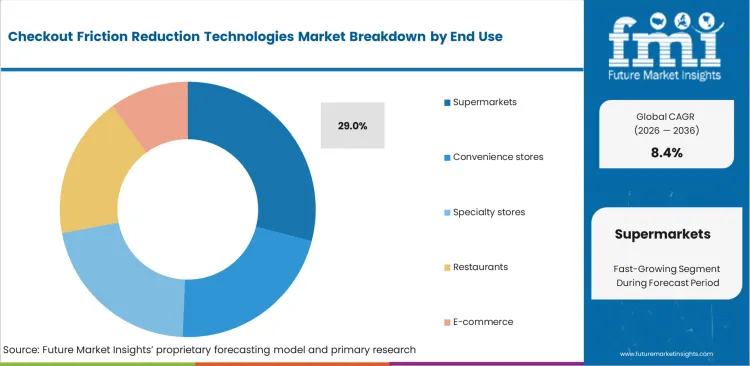
High-frequency grocery models demand absolute minimal scanning friction. For high-frequency grocery purchases, minimizing scanning friction is paramount. Supermarket checkout automation necessitates separating loyalty identification from the payment authorization process. Continuous interface rendering helps prevent form fatigue on customer-facing displays. Supermarkets segment hold a 29.0% market share, driving conversion rate optimization teams to remove all non-essential screen prompts to maximize checkout lane throughput. Counterintuitively, standard design logic is reversed: making a kiosk appear overly complicated with too many promotional banners actually lowers completion rates. Growth teams using outdated, multi-step flows observe valuable store traffic disappear at the final bagging stage, amplifying the demand for trustworthy retail automation vendor collaborations.
- Model Optimization: Supermarket checkout automation necessitates separating loyalty identification from the payment authorization process to ensure the highest possible lane throughput in high-frequency environments.
- Interface Clarity: Continuous interface rendering helps prevent form fatigue on customer-facing displays, as conversion rate optimization teams remove all non-essential screen prompts to maximize speed.
- Throughput Protection: Growth teams using outdated, multi-step flows observe valuable store traffic disappear at the final bagging stage, reinforcing the need for streamlined, single-touch interfaces.
Checkout Friction Reduction Technologies Market Analysis by Deployment
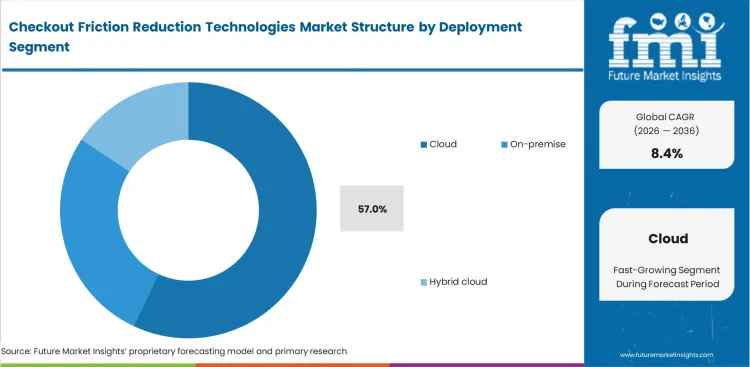
Centralized management demands minimal friction from local servers. When comparing cloud checkout software with on-premise setups, modular e commerce system architectures consistently enable specialized microservices to replace outdated, monolithic back-office platforms. Achieving real-time pricing parity and synchronizing digital catalogs is essential for attracting buyers who shop across multiple channels. The cloud technology segment holds a 57.0% market share, primarily fueled by leaders in digital products who seek minute margin gains across extensive store networks by using instant, centralized software updates. Traditional reporting overlooks a key factor: major retailers leverage the speed of the cloud as a protective barrier against local grocery rivals. Brands that neglect remote deployment essentially help fund their competitors' IT maintenance expenses due to their own lost efficiency.
- Architecture Agility: Modular e-commerce system architectures enable specialized microservices to replace outdated, monolithic back-office platforms, allowing for faster updates to pricing and inventory.
- Channel Parity: Achieving real-time pricing parity and synchronizing digital catalogs is essential for attracting buyers who shop across multiple channels and expect identical friction levels online and offline.
- Competitive Barricade: Major retailers leverage the speed of the cloud as a protective barrier against local grocery rivals, as brands that neglect remote deployment fund their own inefficiency.
Checkout Friction Reduction Technologies Market Drivers, Restraints, And Opportunities
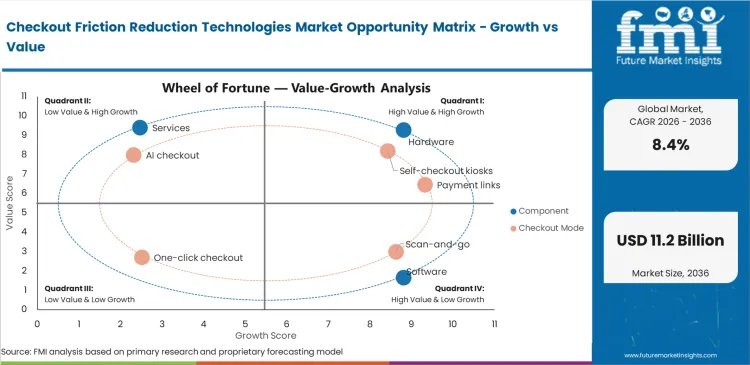
Microscopic drops in conversion rates destroy millions in enterprise retail revenue. Even minimal reductions in conversion rates can result in the loss of millions in revenue for large-scale retail businesses. A deep analysis of the factors driving the adoption of frictionless checkout technology clearly indicates intense market pressure. Retailers must urgently match the seamless, one-click speed offered by dominant mobile platforms, which necessitates immediate and costly infrastructure overhauls. A failure to execute this crucial architectural shift now actively diminishes the return on prior capital expenditures, as frustrated shoppers increasingly abandon complicated, multi-step payment terminals in favor of faster options.
Out-of-date integrations with legacy acquiring banks place severe limitations on a retailer's ability to implement dynamic payment routing capabilities. Enterprise architects face significant technical challenges in attempting to decouple deeply embedded, single-processor codebases without creating a high risk of catastrophic system downtime. While modern payment processing solutions provide highly desirable API-driven flexibility, the process of removing fully functional but outdated legacy gateways demands extensive, cross-departmental coordination. This requirement for synchronized effort often paralyzes the tight IT schedules of mid-market companies, causing significant delays in modernization efforts and prolonging the use of inefficient systems that harm the customer experience. The move towards a unified commerce platform is a critical, but often slow, process.
Opportunities in the Checkout Friction Reduction Technologies Market
- Biometric delegation protocols: Device-level authentication APIs allow merchants to bypass PIN verification steps. Mobile product managers capture higher completion rates through native face-recognition triggers enabled by ecommerce checkout optimization technology.
- Network tokenization routing: Direct card network integrations update expired credentials automatically. Billing operations directors eliminate involuntary churn across subscription portfolios.
- Behavioral biometric modeling: Passive contactless payment telemetry analyzes purchasing cadence to verify returning shoppers invisibly. Fraud directors approve higher transaction volumes without triggering visible security challenges, necessitating advanced checkout fraud detection software capabilities.
REGIONAL ANALYSIS
Based on regional analysis, the checkout friction reduction technologies market is segmented into North America, Europe, Asia Pacific, Latin America, and Middle East & Africa across multiple countries.
.webp "Top Country Growth Comparison Checkout Friction Reduction Technologies Market Cagr (2026 2036)")
| Country | CAGR (2026 to 2036) |
|---|---|
| India | 10.1% |
| China | 9.7% |
| United States | 8.9% |
| United Kingdom | 8.4% |
| Germany | 8.1% |
| South Korea | 7.8% |
| Japan | 7.6% |
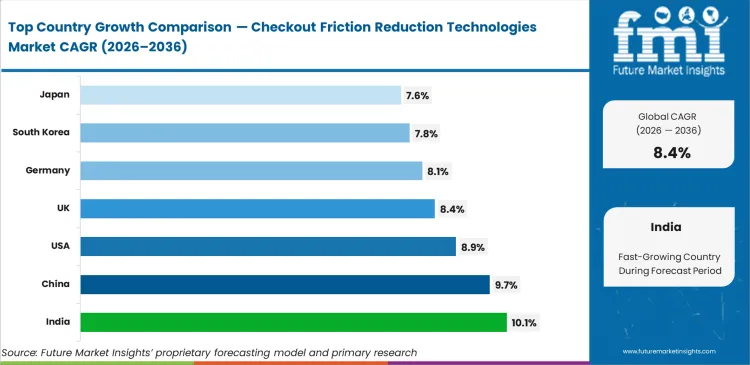
Source: Future Market Insights (FMI) analysis, based on proprietary forecasting model and primary research
North America Checkout Friction Reduction Technologies Market Analysis
Retailers are intensely focused on optimizing self-service checkouts to counteract rising labor costs and prevent theft. Flawless self-service authorization is critical, with regional retail leads continually testing computer vision to prevent shrinkage during unassisted scanning. Despite the high demand for modern solutions, FMI analysts point out that heavy reliance on older terminal infrastructure necessitates complex software overlays to preserve previous hardware investments.
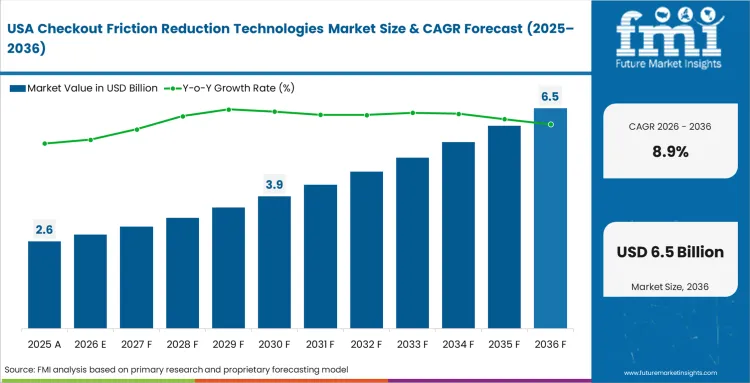
- United States: Rising minimum wages are driving the accelerated adoption of intelligent kiosk orchestration and smart point-of-sale systems. Store control systems now mandate dynamic scanning algorithms to automatically route transactions through the lowest-cost hardware available across the enterprise. The market for checkout friction reduction is growing at a robust 8.9% CAGR as enterprise retailers transition from rigid, monolithic cash registers to agile computer-vision microservices. A high priority is placed on robust anti-fraud mechanisms for high-volume transactions, with advanced telemetry models instantly identifying suspicious behavior to combat organized retail crime and protect crucial retail margins effectively.
- Canada: Cross-border commerce complexities require Canadian merchants to implement multi-currency pricing and sophisticated dynamic fraud decisioning engines to approve payments securely. Operations managers are implementing localized payment methods efficiently to minimize international cart abandonment rates and enhance the overall customer experience. Advanced biometric verification frameworks support fluid guest flows at the checkout, resulting in higher conversion rates across physical and digital channels. Merchants are integrating sophisticated AI to process hybrid transactions flawlessly and are focusing on seamlessly connecting physical retail queues with integrated digital wallet capabilities for a unified checkout experience.
Europe Checkout Friction Reduction Technologies Market Analysis
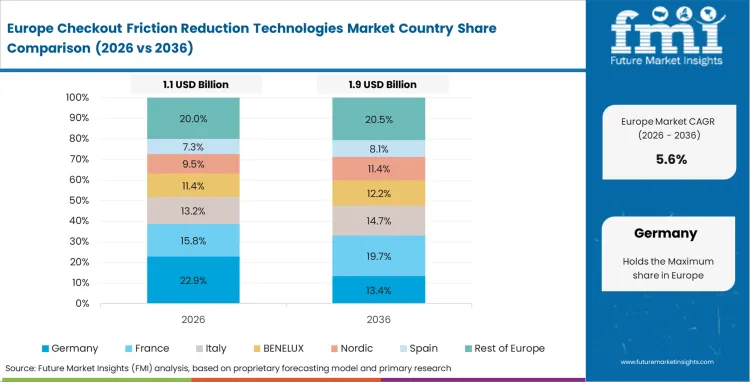
Strong Customer Authentication (SCA) mandates under the revised Payment Services Directive (PSD2) have significantly disrupted the expectation for fast digital checkouts across Europe borders. To legally circumvent strict security hurdles, Europe platform architects now implement sophisticated exemption routing engines. According to FMI's projections, integrating live commerce capabilities requires specialized, dynamic risk assessment to maintain quick purchasing speeds while adhering to stringent regulatory oversight.
- Germany: The high degree of fragmentation in local preferred payment options necessitates comprehensive payment orchestration for retail platforms. Integration managers must support standard global wallets in addition to specific regional bank-transfer protocols. Driven by strict consumer data privacy laws that demand secure yet highly localized transaction routing, the market for checkout friction reduction technologies in Germany is expanding at an 8.1% CAGR. Strict compliance rules compel local businesses to adopt decentralized tokenization vaults. Engineers heavily modify open-source security modules to meet these intense regional mandates.
- United Kingdom: The market in the United Kingdom is growing at an 8.4% CAGR, supported by open banking infrastructure that facilitates direct account-to-account transfers. Specifically, grocers are concentrating on automated loss prevention analytics to tackle increasing inventory shrinkage. The maturity of retail penetration compels merchants to compete fiercely over minimal improvements in queue optimization, accelerating the uptake of invisible weight-scale assessment tools. Store directors are implementing advanced self-checkout systems in UK protocols to ensure a smooth experience for hurried commuter traffic.
Asia Pacific Checkout Friction Reduction Technologies Market Analysis
The dominance of the mobile wallet ecosystem compels merchants to completely abandon traditional card-centric physical transaction processes. Regional operations directors are now prioritizing integrations via QR codes and deep-link APIs over conventional terminal connections. FMI believes this infrashift bypasses old routing limitations, enabling immediate settlement systems. Platform architects are specifically designing for mobile-first user experiences that eliminate the need for manual card insertion.
- China: Super-app environments set the standards for checkout architecture across all merchant categories, requiring seamless synchronization with the dominant social commerce platforms. Enterprise architects must adhere to the native platform authentication protocols instead of developing independent risk engines. The market for checkout friction reduction technologies in China is expanding at a 9.7% Compound Annual Growth Rate (CAGR), supported by universally mandated facial recognition networks. Digital wallet providers effectively maintain a monopoly on the final transaction click. Retailers are entirely dependent on these external biometric databases for verifying customer identity.
- Japan: The persistent consumer preference for cash necessitates unique synchronization of omnichannel checkout processes. Operations directors are deploying hybrid tokenization that links physical loyalty programs to smart touch screen scale fast-checkout profiles. The Japanese market for checkout friction reduction technologies is growing at a 7.6% CAGR, creating specific opportunities for integrating alternative retail technologies. Older demographic segments require simplified, highly visual interfaces to interact with self-service hardware. Robotic assistance layers are sometimes used to supplement these physical kiosk interactions.
- South Korea: The market for checkout friction reduction technology in South Korea exhibits a 7.8% CAGR, indicating sophisticated regulatory compliance achieved through the deployment of behavioral telemetry. Stringent domestic authentication mandates advanced background tokenization to maintain transaction speed. Compliance teams employ invisible device fingerprinting to meet banking regulations without interrupting consumer processes. High-speed internet penetration enables real-time cloud-based processing for all physical purchases.
- India: The Unified Payment Interface (UPI) system mandates that physical retailers integrate direct bank-to-bank transfers via scannable QR codes. Product managers focusing on payments prioritize application-intent journeys to bypass manual verification steps. India's market for checkout friction reduction technologies is expanding at a 10.1% CAGR, reflecting a significant shift away from cash within organized retail. Financial inclusion programs are driving extensive digital adoption in rural areas, which requires slim checkout applications that operate effectively on limited bandwidth.
Competitive Aligners For Market Players
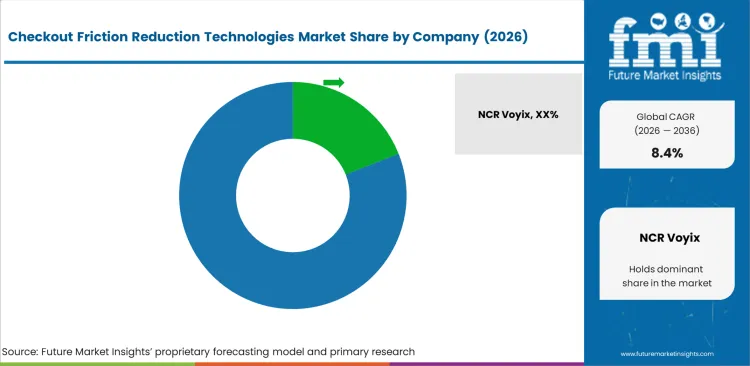
Competitive viability is determined by network effects, not just isolated processing capabilities. When identifying the market leaders in technologies that reduce checkout friction, it's necessary to look beyond hardware specifications. NCR Voyix and Diebold Nixdorf handle massive transaction volumes by offering unified hardware architectures that mask the underlying complexity of fragmented global banking systems. Enterprise integration managers choose leading checkout friction reduction technology vendors based on the reliability of their components and the availability of pre-built POS connector libraries. Platforms that demonstrate the highest uptime during peak promotional periods secure profitable enterprise contracts.
While traditional acquirers benefit from established banking relationships, they struggle to match the deployment speed of modern fintechs. Challengers develop specialized mini pos terminals integration tools, positioning themselves as flexible providers of frictionless checkout software. Agile orchestration vendors enable merchants to connect multiple acquirers to a single frontend interface, neutralizing the main competitive advantage of legacy incumbents.
Large enterprise merchants actively avoid vendor lock-in by creating their own internal payment switches. Operations directors dynamically route transaction volume across various processors, compelling vendors to constantly compete on authorization rates and pricing. Dedicated AI checkout system vendors integrate independently of the physical terminal providers. This infrastructure setup ensures merchants can maintain portable risk models regardless of their backend settlement partners. Additionally, support often comes from specialized checkout authentication solution providers.
Key Players In Checkout Friction Reduction Technologies Market
- NCR Voyix
- Diebold Nixdorf
- Toshiba Global Commerce Solutions
- Fujitsu
- Verifone
- Zebra Technologies
- Mashgin
Scope Of The Report
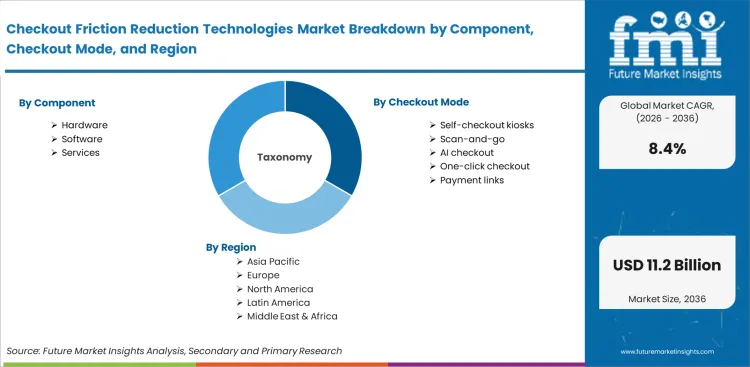
| Metric | Value |
|---|---|
| Quantitative Units | USD 4.6 Billion to USD 10.3 Billion, at a CAGR of 8.4% |
| Market Definition | Checkout friction reduction technologies encompasses hardware and software layers designed to eliminate manual scanning, optimize payment routing, and accelerate transaction completion. |
| Segmentation | By Component, By Checkout Mode, By Payment Type, By End Use, By Deployment, By Region |
| Regions Covered | North America, Europe, Asia Pacific, Latin America, Middle East & Africa |
| Countries Covered | United States, Canada, Germany, United Kingdom, France, Italy, Spain, China, Japan, South Korea, Taiwan, Singapore, India, Brazil, Mexico, Argentina, GCC Countries, South Africa, Israel, Rest of Middle East & Africa |
| Key Companies Profiled | NCR Voyix, Diebold Nixdorf, Toshiba Global Commerce Solutions, Fujitsu, Verifone, Zebra Technologies, Mashgin |
| Forecast Period | 2026 to 2036 |
| Approach | Global digital transaction volume processed through optimized orchestration layers against legacy gateway baselines. |
Source: Future Market Insights (FMI) analysis, based on proprietary forecasting model and primary research
Checkout Friction Reduction Technologies Market Analysis By Segments
Component:
- Hardware
- Software
- Services
Checkout Mode:
- Self-checkout kiosks
- Scan-and-go
- AI checkout
- One-click checkout
- Payment links
Payment Type:
- Cashless
- Card-enabled
- Wallet-enabled
- Bank transfer
- Hybrid
End Use:
- Supermarkets
- Convenience stores
- Specialty stores
- Restaurants
- E-commerce
Deployment:
- Cloud
- On-premise
- Hybrid cloud
Region:
- North America
- United States
- Canada
- Europe
- Germany
- United Kingdom
- France
- Italy
- Spain
- Asia Pacific
- China
- Japan
- South Korea
- Taiwan
- Singapore
- India
- Latin America
- Brazil
- Mexico
- Argentina
- Middle East & Africa
- GCC Countries
- South Africa
- Israel
- Rest of Middle East & Africa
Bibliography
- Board of Governors of the Federal Reserve System. (2026). Federal Reserve Payments Study (FRPS).
- Federal Reserve Financial Services. (2025). 2025 findings from the Diary of Consumer Payment Choice.
- European Central Bank. (2025). Study on the payment attitudes of consumers in the euro area (SPACE 2024).
- European Commission. (2026). Payment Services Directive (PSD2): Implementing and delegated acts.
- Open Banking Limited. (2025, May 7). Impact Report 2025.
This bibliography is provided for reader reference. The full FMI report contains the complete reference list with primary source documentation.
This Report Addresses
- Accelerated checkout configuration impacts on cart abandonment metrics.
- Enterprise merchants managing multi-acquirer orchestration logic.
- SaaS infrastructure handling continuous protocol compliance updates.
- Checkout modes decoupling barcode validation from payment authorization.
- India bypassing card rails via mobile wallet ecosystems seamlessly.
- Network tokenization routing generating seamless recurring billing.
- NCR Voyix and Diebold Nixdorf executing unified terminal architectures globally.
Frequently Asked Questions
What is checkout friction reduction technology?
It encompasses hardware and software layers designed to eliminate manual scanning, optimize payment routing, and accelerate transaction completion across physical stores and digital commerce platforms.
How big is the checkout friction reduction technologies market?
The sector was valued at USD 4.2 billion in 2025. Revenue is poised to reach USD 4.6 billion in 2026 and expand to USD 10.3 billion by 2036, compounding at an 8.4% growth rate.
What drives demand for frictionless checkout technology?
Rising store labor costs require operations managers to adopt automated self-service lanes. Simultaneously, high queue abandonment rates compel enterprise commerce directors to implement single-click tokenized workflows to preserve revenue.
How do operators evaluate self-checkout vs cashierless checkout?
Self-checkout systems require shoppers to manually scan items at a fixed terminal. Cashierless checkout utilizes ceiling cameras and shelf sensors to identify items automatically, allowing buyers to walk out without stopping at a designated lane.
Why does cloud architecture dominate deployment?
Continuous protocol updates dictate platform viability. Engineering heads cannot afford manual compliance patches when regional authentication mandates change abruptly.
Which countries are growing fastest in checkout friction reduction technologies?
India leads global growth at a 10.1% CAGR, followed closely by China at 9.7% and the United States at 8.9%, reflecting diverse strategies between mobile-first payment integration and physical terminal modernization.
How do enterprise merchants handle acquiring fees?
Sophisticated payment switches route volume dynamically. Financial controllers direct specific transactions toward whichever global acquirer offers optimal interchange rates.
What creates cart abandonment spikes?
Visible security challenges during mobile browsing kill conversion instantly. Shoppers refuse complex multi-step verification inputs on small touchscreens.
Why does India lead regional growth rates?
Unified digital payment rails bypass traditional card structures. Mobile product managers integrate direct bank app-intent flows seamlessly.
How does network tokenization increase revenue?
Expired credentials update automatically in background sequences. Subscription retention managers prevent involuntary churn without contacting customers directly.
Who are the leading companies in checkout friction reduction technologies?
Key hardware and software participants shaping the sector include NCR Voyix, Diebold Nixdorf, Toshiba Global Commerce Solutions, Fujitsu, Verifone, Zebra Technologies, and Mashgin.
Why keep fraud decisioning independent?
Portable risk models prevent total vendor lock-in. Fraud strategy directors maintain continuous scoring logic even if operations teams switch backend settlement processors.
How do biometric APIs change authentication?
Native device capabilities replace clumsy SMS text verification. Compliance officers satisfy banking mandates without forcing users to open separate messaging applications.
What stops mid-market operators from orchestrating payments?
Complex engineering resources block immediate adoption. IT schedules prioritize core product features over ripping out functional but inefficient legacy gateway modules.
How do digital wallets affect merchant integration?
They shift tokenization responsibility onto consumer devices. Platform architects must support multiple wallet standards without cluttering primary checkout interfaces.
Why is cross-border authorization difficult?
Different regional banks interpret risk signals unevenly. Payment operations managers need dynamic fallback routing when strict international gateways decline valid purchases.
What role does behavioral telemetry play?
Invisible keystroke and navigation tracking replaces manual passwords. Risk algorithms approve returning buyers silently, generating maximum velocity checkout experiences.
How do compliance rules impact conversion?
Strict mandates force manual verification steps unless specific exemptions apply. Integration teams must configure smart routing to claim exemptions legally.
Why focus on guest checkout speed?
Forcing account creation destroys initial acquisition metrics. Growth marketers rely on fast guest flows to monetize expensive social media advertising traffic.
How do modular architectures help?
Microservices isolate payment logic from core catalog functions. Engineering leads deploy specialized checkout updates without risking sitewide downtime.
What creates false positive fraud declines?
Static rule sets misinterpret legitimate high-velocity purchasing. Analytics teams must tune thresholds continuously during promotional events to prevent blocking real buyers.
Why do legacy gateways fail modern demands?
Monolithic codebases resist rapid protocol updates. Digital product leads face months of delays when requesting new alternative payment method integrations.
How does checkout speed affect marketplaces?
It functions as a critical defensive moat against competitors. Third-party sellers migrate toward platforms demonstrating highest final-step conversion efficiency.
What makes authentication optimization difficult?
Balancing regulatory demands against consumer impatience requires precise technical execution. Platform architects continually adjust invisible telemetry weightings.
Preview the report firsthand - request a free sample
Get SampleGet the brochure for pricing and purchase details.
Get PDFTable of Content
- Executive Summary
- Global Market Outlook
- Demand-side Trends
- Supply-side Trends
- Technology Roadmap Analysis
- Analysis and Recommendations
- Market Overview
- Market Coverage / Taxonomy
- Market Definition / Scope / Limitations
- Research Methodology
- Chapter Orientation
- Analytical Lens and Working Hypotheses
- Market Structure, Signals, and Trend Drivers
- Benchmarking and Cross-market Comparability
- Market Sizing, Forecasting, and Opportunity Mapping
- Research Design and Evidence Framework
- Desk Research Programme (Secondary Evidence)
- Company Annual and Sustainability Reports
- Peer-reviewed Journals and Academic Literature
- Corporate Websites, Product Literature, and Technical Notes
- Earnings Decks and Investor Briefings
- Statutory Filings and Regulatory Disclosures
- Technical White Papers and Standards Notes
- Trade Journals, Industry Magazines, and Analyst Briefs
- Conference Proceedings, Webinars, and Seminar Materials
- Government Statistics Portals and Public Data Releases
- Press Releases and Reputable Media Coverage
- Specialist Newsletters and Curated Briefings
- Sector Databases and Reference Repositories
- FMI Internal Proprietary Databases and Historical Market Datasets
- Subscription Datasets and Paid Sources
- Social Channels, Communities, and Digital Listening Inputs
- Additional Desk Sources
- Expert Input and Fieldwork (Primary Evidence)
- Primary Modes
- Qualitative Interviews and Expert Elicitation
- Quantitative Surveys and Structured Data Capture
- Blended Approach
- Why Primary Evidence is Used
- Field Techniques
- Interviews
- Surveys
- Focus Groups
- Observational and In-context Research
- Social and Community Interactions
- Stakeholder Universe Engaged
- C-suite Leaders
- Board Members
- Presidents and Vice Presidents
- R&D and Innovation Heads
- Technical Specialists
- Domain Subject-matter Experts
- Scientists
- Physicians and Other Healthcare Professionals
- Governance, Ethics, and Data Stewardship
- Research Ethics
- Data Integrity and Handling
- Primary Modes
- Tooling, Models, and Reference Databases
- Desk Research Programme (Secondary Evidence)
- Data Engineering and Model Build
- Data Acquisition and Ingestion
- Cleaning, Normalisation, and Verification
- Synthesis, Triangulation, and Analysis
- Quality Assurance and Audit Trail
- Market Background
- Market Dynamics
- Drivers
- Restraints
- Opportunity
- Trends
- Scenario Forecast
- Demand in Optimistic Scenario
- Demand in Likely Scenario
- Demand in Conservative Scenario
- Opportunity Map Analysis
- Product Life Cycle Analysis
- Supply Chain Analysis
- Investment Feasibility Matrix
- Value Chain Analysis
- PESTLE and Porter’s Analysis
- Regulatory Landscape
- Regional Parent Market Outlook
- Production and Consumption Statistics
- Import and Export Statistics
- Market Dynamics
- Global Market Analysis 2021 to 2025 and Forecast, 2026 to 2036
- Historical Market Size Value (USD Million) Analysis, 2021 to 2025
- Current and Future Market Size Value (USD Million) Projections, 2026 to 2036
- Y-o-Y Growth Trend Analysis
- Absolute $ Opportunity Analysis
- Global Market Pricing Analysis 2021 to 2025 and Forecast 2026 to 2036
- Global Market Analysis 2021 to 2025 and Forecast 2026 to 2036, By Component
- Introduction / Key Findings
- Historical Market Size Value (USD Million) Analysis By Component , 2021 to 2025
- Current and Future Market Size Value (USD Million) Analysis and Forecast By Component , 2026 to 2036
- Hardware
- Software
- Services
- Hardware
- Y-o-Y Growth Trend Analysis By Component , 2021 to 2025
- Absolute $ Opportunity Analysis By Component , 2026 to 2036
- Global Market Analysis 2021 to 2025 and Forecast 2026 to 2036, By Checkout Mode
- Introduction / Key Findings
- Historical Market Size Value (USD Million) Analysis By Checkout Mode, 2021 to 2025
- Current and Future Market Size Value (USD Million) Analysis and Forecast By Checkout Mode, 2026 to 2036
- Self-checkout kiosks
- Scan-and-go
- AI checkout
- One-click checkout
- Payment links
- Self-checkout kiosks
- Y-o-Y Growth Trend Analysis By Checkout Mode, 2021 to 2025
- Absolute $ Opportunity Analysis By Checkout Mode, 2026 to 2036
- Global Market Analysis 2021 to 2025 and Forecast 2026 to 2036, By Payment Type
- Introduction / Key Findings
- Historical Market Size Value (USD Million) Analysis By Payment Type, 2021 to 2025
- Current and Future Market Size Value (USD Million) Analysis and Forecast By Payment Type, 2026 to 2036
- Cashless
- Card-enabled
- Wallet-enabled
- Bank transfer
- Hybrid
- Cashless
- Y-o-Y Growth Trend Analysis By Payment Type, 2021 to 2025
- Absolute $ Opportunity Analysis By Payment Type, 2026 to 2036
- Global Market Analysis 2021 to 2025 and Forecast 2026 to 2036, By End Use
- Introduction / Key Findings
- Historical Market Size Value (USD Million) Analysis By End Use, 2021 to 2025
- Current and Future Market Size Value (USD Million) Analysis and Forecast By End Use, 2026 to 2036
- Supermarkets
- Convenience stores
- Specialty stores
- Restaurants
- E-commerce
- Supermarkets
- Y-o-Y Growth Trend Analysis By End Use, 2021 to 2025
- Absolute $ Opportunity Analysis By End Use, 2026 to 2036
- Global Market Analysis 2021 to 2025 and Forecast 2026 to 2036, By Deployment
- Introduction / Key Findings
- Historical Market Size Value (USD Million) Analysis By Deployment, 2021 to 2025
- Current and Future Market Size Value (USD Million) Analysis and Forecast By Deployment, 2026 to 2036
- Cloud
- On-premise
- Hybrid cloud
- Cloud
- Y-o-Y Growth Trend Analysis By Deployment, 2021 to 2025
- Absolute $ Opportunity Analysis By Deployment, 2026 to 2036
- Global Market Analysis 2021 to 2025 and Forecast 2026 to 2036, By Region
- Introduction
- Historical Market Size Value (USD Million) Analysis By Region, 2021 to 2025
- Current Market Size Value (USD Million) Analysis and Forecast By Region, 2026 to 2036
- North America
- Latin America
- Western Europe
- Eastern Europe
- East Asia
- South Asia and Pacific
- Middle East & Africa
- Market Attractiveness Analysis By Region
- North America Market Analysis 2021 to 2025 and Forecast 2026 to 2036, By Country
- Historical Market Size Value (USD Million) Trend Analysis By Market Taxonomy, 2021 to 2025
- Market Size Value (USD Million) Forecast By Market Taxonomy, 2026 to 2036
- By Country
- USA
- Canada
- Mexico
- By Component
- By Checkout Mode
- By Payment Type
- By End Use
- By Deployment
- By Country
- Market Attractiveness Analysis
- By Country
- By Component
- By Checkout Mode
- By Payment Type
- By End Use
- By Deployment
- Key Takeaways
- Latin America Market Analysis 2021 to 2025 and Forecast 2026 to 2036, By Country
- Historical Market Size Value (USD Million) Trend Analysis By Market Taxonomy, 2021 to 2025
- Market Size Value (USD Million) Forecast By Market Taxonomy, 2026 to 2036
- By Country
- Brazil
- Chile
- Rest of Latin America
- By Component
- By Checkout Mode
- By Payment Type
- By End Use
- By Deployment
- By Country
- Market Attractiveness Analysis
- By Country
- By Component
- By Checkout Mode
- By Payment Type
- By End Use
- By Deployment
- Key Takeaways
- Western Europe Market Analysis 2021 to 2025 and Forecast 2026 to 2036, By Country
- Historical Market Size Value (USD Million) Trend Analysis By Market Taxonomy, 2021 to 2025
- Market Size Value (USD Million) Forecast By Market Taxonomy, 2026 to 2036
- By Country
- Germany
- UK
- Italy
- Spain
- France
- Nordic
- BENELUX
- Rest of Western Europe
- By Component
- By Checkout Mode
- By Payment Type
- By End Use
- By Deployment
- By Country
- Market Attractiveness Analysis
- By Country
- By Component
- By Checkout Mode
- By Payment Type
- By End Use
- By Deployment
- Key Takeaways
- Eastern Europe Market Analysis 2021 to 2025 and Forecast 2026 to 2036, By Country
- Historical Market Size Value (USD Million) Trend Analysis By Market Taxonomy, 2021 to 2025
- Market Size Value (USD Million) Forecast By Market Taxonomy, 2026 to 2036
- By Country
- Russia
- Poland
- Hungary
- Balkan & Baltic
- Rest of Eastern Europe
- By Component
- By Checkout Mode
- By Payment Type
- By End Use
- By Deployment
- By Country
- Market Attractiveness Analysis
- By Country
- By Component
- By Checkout Mode
- By Payment Type
- By End Use
- By Deployment
- Key Takeaways
- East Asia Market Analysis 2021 to 2025 and Forecast 2026 to 2036, By Country
- Historical Market Size Value (USD Million) Trend Analysis By Market Taxonomy, 2021 to 2025
- Market Size Value (USD Million) Forecast By Market Taxonomy, 2026 to 2036
- By Country
- China
- Japan
- South Korea
- By Component
- By Checkout Mode
- By Payment Type
- By End Use
- By Deployment
- By Country
- Market Attractiveness Analysis
- By Country
- By Component
- By Checkout Mode
- By Payment Type
- By End Use
- By Deployment
- Key Takeaways
- South Asia and Pacific Market Analysis 2021 to 2025 and Forecast 2026 to 2036, By Country
- Historical Market Size Value (USD Million) Trend Analysis By Market Taxonomy, 2021 to 2025
- Market Size Value (USD Million) Forecast By Market Taxonomy, 2026 to 2036
- By Country
- India
- ASEAN
- Australia & New Zealand
- Rest of South Asia and Pacific
- By Component
- By Checkout Mode
- By Payment Type
- By End Use
- By Deployment
- By Country
- Market Attractiveness Analysis
- By Country
- By Component
- By Checkout Mode
- By Payment Type
- By End Use
- By Deployment
- Key Takeaways
- Middle East & Africa Market Analysis 2021 to 2025 and Forecast 2026 to 2036, By Country
- Historical Market Size Value (USD Million) Trend Analysis By Market Taxonomy, 2021 to 2025
- Market Size Value (USD Million) Forecast By Market Taxonomy, 2026 to 2036
- By Country
- Kingdom of Saudi Arabia
- Other GCC Countries
- Turkiye
- South Africa
- Other African Union
- Rest of Middle East & Africa
- By Component
- By Checkout Mode
- By Payment Type
- By End Use
- By Deployment
- By Country
- Market Attractiveness Analysis
- By Country
- By Component
- By Checkout Mode
- By Payment Type
- By End Use
- By Deployment
- Key Takeaways
- Key Countries Market Analysis
- USA
- Pricing Analysis
- Market Share Analysis, 2025
- By Component
- By Checkout Mode
- By Payment Type
- By End Use
- By Deployment
- Canada
- Pricing Analysis
- Market Share Analysis, 2025
- By Component
- By Checkout Mode
- By Payment Type
- By End Use
- By Deployment
- Mexico
- Pricing Analysis
- Market Share Analysis, 2025
- By Component
- By Checkout Mode
- By Payment Type
- By End Use
- By Deployment
- Brazil
- Pricing Analysis
- Market Share Analysis, 2025
- By Component
- By Checkout Mode
- By Payment Type
- By End Use
- By Deployment
- Chile
- Pricing Analysis
- Market Share Analysis, 2025
- By Component
- By Checkout Mode
- By Payment Type
- By End Use
- By Deployment
- Germany
- Pricing Analysis
- Market Share Analysis, 2025
- By Component
- By Checkout Mode
- By Payment Type
- By End Use
- By Deployment
- UK
- Pricing Analysis
- Market Share Analysis, 2025
- By Component
- By Checkout Mode
- By Payment Type
- By End Use
- By Deployment
- Italy
- Pricing Analysis
- Market Share Analysis, 2025
- By Component
- By Checkout Mode
- By Payment Type
- By End Use
- By Deployment
- Spain
- Pricing Analysis
- Market Share Analysis, 2025
- By Component
- By Checkout Mode
- By Payment Type
- By End Use
- By Deployment
- France
- Pricing Analysis
- Market Share Analysis, 2025
- By Component
- By Checkout Mode
- By Payment Type
- By End Use
- By Deployment
- India
- Pricing Analysis
- Market Share Analysis, 2025
- By Component
- By Checkout Mode
- By Payment Type
- By End Use
- By Deployment
- ASEAN
- Pricing Analysis
- Market Share Analysis, 2025
- By Component
- By Checkout Mode
- By Payment Type
- By End Use
- By Deployment
- Australia & New Zealand
- Pricing Analysis
- Market Share Analysis, 2025
- By Component
- By Checkout Mode
- By Payment Type
- By End Use
- By Deployment
- China
- Pricing Analysis
- Market Share Analysis, 2025
- By Component
- By Checkout Mode
- By Payment Type
- By End Use
- By Deployment
- Japan
- Pricing Analysis
- Market Share Analysis, 2025
- By Component
- By Checkout Mode
- By Payment Type
- By End Use
- By Deployment
- South Korea
- Pricing Analysis
- Market Share Analysis, 2025
- By Component
- By Checkout Mode
- By Payment Type
- By End Use
- By Deployment
- Russia
- Pricing Analysis
- Market Share Analysis, 2025
- By Component
- By Checkout Mode
- By Payment Type
- By End Use
- By Deployment
- Poland
- Pricing Analysis
- Market Share Analysis, 2025
- By Component
- By Checkout Mode
- By Payment Type
- By End Use
- By Deployment
- Hungary
- Pricing Analysis
- Market Share Analysis, 2025
- By Component
- By Checkout Mode
- By Payment Type
- By End Use
- By Deployment
- Kingdom of Saudi Arabia
- Pricing Analysis
- Market Share Analysis, 2025
- By Component
- By Checkout Mode
- By Payment Type
- By End Use
- By Deployment
- Turkiye
- Pricing Analysis
- Market Share Analysis, 2025
- By Component
- By Checkout Mode
- By Payment Type
- By End Use
- By Deployment
- South Africa
- Pricing Analysis
- Market Share Analysis, 2025
- By Component
- By Checkout Mode
- By Payment Type
- By End Use
- By Deployment
- USA
- Market Structure Analysis
- Competition Dashboard
- Competition Benchmarking
- Market Share Analysis of Top Players
- By Regional
- By Component
- By Checkout Mode
- By Payment Type
- By End Use
- By Deployment
- Competition Analysis
- Competition Deep Dive
- NCR Voyix
- Overview
- Product Portfolio
- Profitability by Market Segments (Product/Age /Sales Channel/Region)
- Sales Footprint
- Strategy Overview
- Marketing Strategy
- Product Strategy
- Channel Strategy
- Diebold Nixdorf
- Toshiba Global Commerce Solutions
- Fujitsu
- Verifone
- Zebra Technologies
- Mashgin
- NCR Voyix
- Competition Deep Dive
- Assumptions & Acronyms Used


