

- Industry Size (2026)
- USD 1.4 Bn
- Forecast (2036)
- USD 4.8 Bn
- CAGR (2026 to 2036)
- 13.1%
Faucet and Tapware Packaging Market Forecast and Outlook 2026 to 2036
The global faucet and tapware packaging sector is poised to record a valuation of USD 1.4 billion in 2026, advancing toward USD 4.8 billion by 2036, representing a robust 13.1% CAGR. Demand is reshaped by a "material substitution" dynamic, where the industry's reliance on petrochemical foams is being dismantled in favor of fiber-based alternatives. Major European and American fixture brands are enforcing strict vendor compliance mandates, effectively forcing their entire supply chains to adopt protective packaging solutions that are curbside recyclable. Industry is witnessing a significant injection of capital into fiber molding infrastructure, ensuring that capacity keeps pace with the mass exodus from plastic.
The operational impact of sustainability drive is already visible and is reshaping corporate strategies across the board. Thomas Fuhr, Leader Fittings at LIXIL International, stated in December 2020 and reaffirmed in 2024: "We have a responsibility toward future generations and, therefore, also toward the environment. That is exactly why we want to continuously introduce new ideas in the area of sustainability, which will make responsible use of resources possible." Major OEMs are aggressively removing single-use plastics ahead of 2030 targets.
Hansgrohe has committed to 100% plastic-free packaging for new products by the end of 2025, while LIXIL’s "Less Plastics Initiative" has already eliminated over 23.5 million plastic items. This forces packaging converters to invest heavily in fiber capacity. A critical gap exists in protecting heavy, scratch-sensitive chrome fixtures without the abrasion risks of traditional rough pulp. Innovation is surging, for instance, Stora Enso’s 2025 pilot of "Papira" wood foam with Novapor for bathroom mirrors demonstrates the viability of cellulose foams that mimic the cushioning of PE foam but are fully recyclable in paper streams.
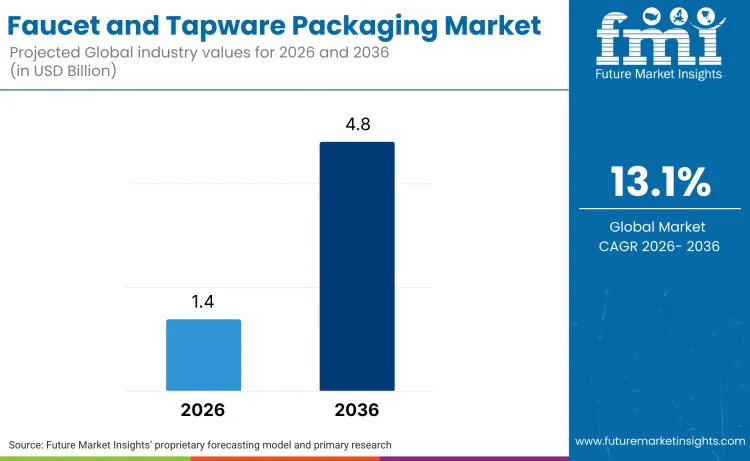
Summary of Faucet and Tapware Packaging Market
What Is the Growth Outlook for the Faucet and Tapware Packaging Market as per Future Market Insights Projection?
Future Market Insights projects the global faucet and tapware packaging market to grow from USD 1.4 billion in 2026 to USD 4.8 billion by 2036, representing a 13.1% CAGR over the forecast period.
FMI Research Approach: Based on FMI’s proprietary global modeling framework incorporating OEM plastic reduction targets (Hansgrohe, LIXIL), regulatory impact assessments (EU PPWR), and raw material price volatility assessments across the molded pulp and corrugated supply chains.
How Do FMI Analysts Perceive the Faucet and Tapware Packaging Market to Evolve?
FMI analysts perceive the market transitioning away from expanded polystyrene (EPS) and polybags toward high-precision molded fiber cradles and scratch-resistant bio-foams.
FMI Research Approach: Developed using analysis of corporate ESG roadmaps, venture capital flows into material science startups (Renw, Woola), and patent filings related to fiber molding technologies.
Which Country Holds the Largest Share in the Global Faucet and Tapware Packaging Market?
China holds a dominant value share, supported by its status as the global manufacturing hub for plumbing fixtures and a projected 13.6% CAGR, driven by the need to meet Western export compliance standards.
FMI Research Approach: Built using country-level export data for sanitary ware, analysis of domestic packaging manufacturing capacity, and mapping of supply chain shifts regarding sustainable packaging materials.
How Large Will the Faucet and Tapware Packaging Market Be by 2036?
The global faucet and tapware packaging market is expected to reach USD 4.8 billion by 2036, with the Molded Fiber segment currently commanding a 44% share.
FMI Research Approach: Long-term forecasts rely on construction industry trends, disposable income projections for home renovation, and the scaling of advanced manufacturing technologies like wet-pressing pulp.
What Is the Definition of the Faucet and Tapware Packaging Market?
The faucet and tapware packaging market encompasses revenue generated from the manufacturing and sale of primary and secondary packaging materials designed to protect, display, and transport plumbing fixtures. This includes molded pulp inserts, corrugated boxes, bio-foam cushioning, and protective wraps used for faucets, showerheads, and valves.
FMI Research Approach: Definition structured using FMI’s segmentation taxonomy covering fixture classes, protection systems, and material compositions. It explicitly includes revenue from material sales while excluding general logistics packaging not specific to the fixture industry.
What Are Globally Unique Trends Shaping the Faucet and Tapware Packaging Market?
Globally, the sector is shaped by the "Premium Pulp" trend, where luxury brands require dust-free, smooth-finish fiber packaging, and the emergence of "Grown Materials" like mycelium and hemp as plastic alternatives.
FMI Research Approach: Insights derived from global innovation scans (Stora Enso, Mushroom Packaging), tracking of sustainable luxury trends, and competitive analysis of emerging deep-tech material companies.
Faucet and Tapware Packaging Market Key Takeaways
| Metric | Details |
|---|---|
| Industry Size (2026) | USD 1.4 billion |
| Industry Value (2036) | USD 4.8 billion |
| CAGR (2026-2036) | 13.1% |
Source: Future Market Insights (FMI) analysis, based on proprietary forecasting model and primary research.
How Is Regulatory Pressure Driving De-plasticization?
The elimination of single-use plastics is no longer a niche preference but a core operational mandate driven by impending regulations like the EU's Packaging and Packaging Waste Regulation (PPWR). Hans Jürgen Kalmbach, CEO of Hansgrohe Group, stated in January 2024: "I am very enthusiastic about how the spirit of 'In Touch with Our Planet' has spread to our employees and how much has happened at all levels of our company this year. We have also opened up national and international sustainability networks, both within and across industries, and that is also incredibly inspiring." This enthusiasm is backed by hard targets; thanks to their "Green Packaging" initiative, all new product packaging will be plastic-free by the end of 2025. This regulatory and corporate alignment is forcing packaging converters to abandon traditional packaging materials like PE foam in favor of fiber-based alternatives that can meet strict recyclability criteria without compromising product safety.
How is the Faucet and Tapware Packaging Market Segmented?
The faucet and tapware packaging market is segmented by fixture class, protection system, and cushion material, providing a granular view of the industry's diverse revenue streams. It is segmented by fixture class into residential fixtures, commercial fixtures, OEM export, and premium designer taps, each catering to distinct protection requirements ranging from basic transport safety to luxury unboxing experiences. The residential fixtures segment currently holds the largest share at 42%, driven by the high volume of renovation projects and the need for retail-ready packaging that appeals to DIY consumers. In terms of protection systems, molded-pulp cradles dominate with a 38% share, as manufacturers increasingly adopt this solution for its balance of structural rigidity and environmental compliance. This segmentation highlights the industry's rapid shift away from generic solutions toward engineered protective packaging market share analysis favored by top-tier OEMs.
Why does Molded Fiber lead the material segment?
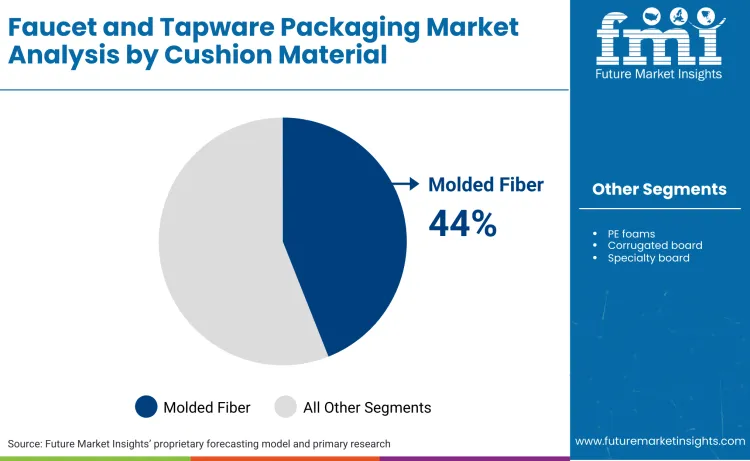
Molded fiber commands 44% of the market, maintaining its stronghold due to its superior sustainability profile and increasing technical capabilities. The "NormTec" fiber molded parts from Buhl Paperform, for example, are made from up to 100% recycled paper and are characterized by high rigidity and stability under heavy loads, making them ideal for heavy brass faucets. Furthermore, innovation is expanding the utility of this material; new wet-pressing techniques allow for smooth finishes that prevent the "dusting" issues historically associated with pulp, making it viable for premium dispensing spouts and chrome fixtures. This ability to combine heavy-duty protection with a clean, premium aesthetic is ensuring that molded fiber remains the material of choice for the industry's transition away from plastic.
Why are Residential Fixtures the dominant application?
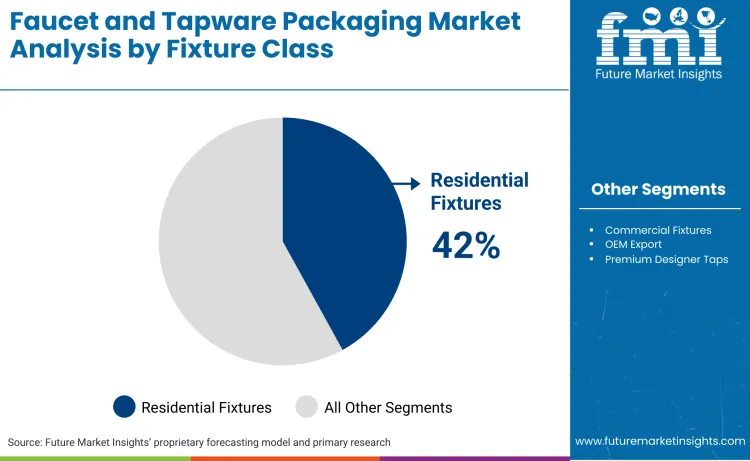
Residential fixtures hold a 42% market share, serving as the primary volume driver due to the continuous cycle of home improvement and bathroom upgrades. Unlike commercial installations which often utilize bulk corrugated bin boxes, residential products require individual, retail-ready packaging that protects the finish while serving as a marketing tool. The rise of e-commerce for home goods further amplifies this demand, as packaging must now survive the rigors of individual parcel shipment without damage. Consequently, manufacturers are investing in robust corrugated boxes with integrated fiber inserts that offer the "frustration-free" unboxing experience valued by modern consumers.
Why Is Bio-Material Innovation Accelerating?
The material footprint of packaging is undergoing a radical transformation as deep-tech startups challenge the dominance of petrochemical foams with "grown" and waste-derived alternatives. Startups like Renw are constructing facilities to produce industrial hemp pulp, claiming it requires less bleaching and emits less carbon dioxide equivalent per ton compared to conventional kraft pulp.
Woola is utilizing waste sheep wool to create protective envelopes, aiming to utilize the 200,000 tonnes of sheep wool that goes unused in Europe yearly. These innovations address the critical gap in protecting scratch-sensitive light water tap surfaces without plastic bags. Juulia Kuhlman, Director Business Development at Stora Enso Biofoams, emphasized the importance of collaboration in this space: "Collaborating with Novapor is a natural fit for us. With 50 years of experience in developing innovative packaging, they consistently go the extra mile to solve their clients' challenges. This curiosity and drive have been key to the success of our pilot project.".
What is the Regional Outlook for Faucet and Tapware Packaging Market?
The global market exhibits distinct regional drivers, from export-compliance growth in Asia to sustainability-led innovation in Europe, creating a complex tapestry of opportunities. China is projected to lead with a 13.6% CAGR, driven by the necessity to align with Western environmental standards, while Germany follows with 11.4% as the home of major fixture OEMs. The markets of the USA (10.8%) and Italy (9.6%) are pivoting toward capacity expansion and premium design integration respectively to drive value growth.
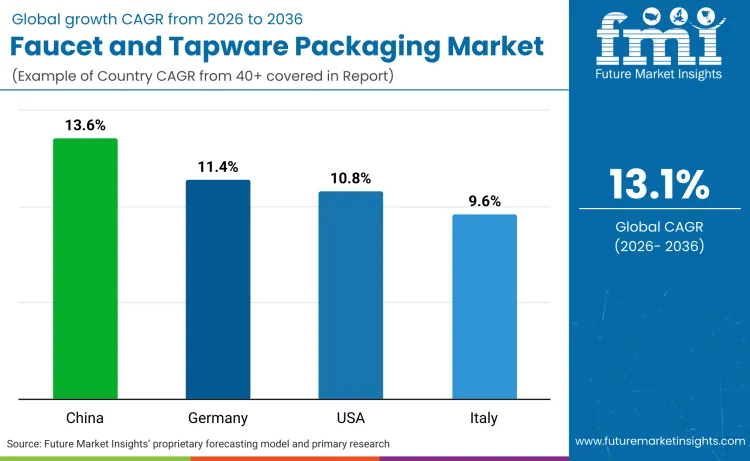
| Country | CAGR (2026 to 2036) |
|---|---|
| China | 13.6% |
| Germany | 11.4% |
| USA | 10.8% |
| Italy | 9.6% |
Source: FMI historical analysis and forecast data.
Why is China the Fastest Growing Market?
The faucet and tapware packaging sector in China is projected to expand at a Compound Annual Growth Rate (CAGR) of 13.6% through 2036, fueled by the urgent need for export compliance. As the "factory of the world" for sanitary ware, China based manufacturers are facing a "compliance wall" from Western buyers demanding carbon negative packaging. This is driving a massive retrofit cycle where factories are replacing manual EPS foam assembly lines with automated molded pulp systems. Kaiping Innpak, for instance, is actively advertising custom faucet packaging services including "cardboard and cloth bags" to replace traditional foam. This shift is not merely about cost but about maintaining market access to the EU and North America, effectively exporting sustainability standards back to the Chinese manufacturing base.
Why is Germany Leading in Sustainable Design?
The faucet and tapware packaging industry in Germany is anticipated to register a Compound Annual Growth Rate (CAGR) of 11.4%, driven largely by the presence of global industry titans like Hansgrohe and Grohe (LIXIL). These companies are setting the global standard for hygiene packaging and environmental responsibility. Hansgrohe’s "Green Packaging" initiative is a prime example, pushing the local supply chain to innovate rapidly in fiber engineering. The region acts as a testing ground for advanced materials; Buhl Paperform’s development of "NormTec" fiber parts capable of holding heavy loads demonstrates the high level of technical engineering being applied to replace plastic transport cases and boxes in the sanitary sector.
Why is the USA Building Fiber Capacity?
Demand outlook for faucet and tapware packaging in the United States is forecast to grow at a Compound Annual Growth Rate (CAGR) of 10.8%, heavily influenced by a surge in domestic manufacturing capacity for sustainable materials. The new Renw joint venture plans to build 10 regional production facilities for hemp-based molded fiber, significantly boosting the availability of non-wood fiber for rigid industrial packaging. Fortune Brands Innovations (Moen) is also driving this trend; CEO Nicholas Fink stated in July 2024: “Fortune Brands Innovations is geared to strategically pursue our biggest opportunities, including in areas where we see outsized growth potential, such as sustainability, safety, connected products and material conversion… In short, we seek to do well while doing good.” This alignment of massive capex and corporate strategy is positioning the US as a leader in industrial fiber scaling.
Why is Italy Focusing on Premium Unboxing?
The faucet and tapware packaging sector in Italy is poised to register a Compound Annual Growth Rate (CAGR) of 9.6%, reflecting a stringent focus on preserving the luxury appeal of its world-renowned designer tapware. Italian brands are increasingly turning to high-end corrugated and folding carton packaging that offers a premium unboxing experience without the environmental guilt of plastic. The use of specialty papers and rigid gift boxes is prevalent, as packaging is seen as an extension of the product's design language. This segment is particularly receptive to innovations like Stora Enso’s "Papira" wood foam, which provides the necessary cushioning for expensive finishes while maintaining the sleek, eco-friendly aesthetic demanded by the luxury market.
How Is Competition Evolving in the Faucet and Tapware Packaging Market?
The faucet and tapware sector is currently witnessing a ‘green arms race,’ where packaging suppliers distinguish themselves through their capacity to offer plastic-free alternatives. A prime illustration of this movement is Smurfit Kappa, which made a significant commitment of over €1 billion in 2023 to enhance its sustainable packaging initiatives, positioning itself solidly for future expansion. Such massive capital deployment is creating high barriers to entry for smaller players who cannot match the scale and R&D capabilities of the giants. Consequently, the market is seeing a consolidation of industrial chemical packaging suppliers who are pivoting to serve the specific needs of the durable goods sector.
Innovation partnerships are becoming a critical strategy for survival and growth. The collaboration between Stora Enso and Novapor to pilot wood foam packaging for furniture and bathroom fixtures highlights how material suppliers and converters are joining forces to solve complex protection challenges. Startups are also disrupting the status quo; Woola’s success in getting luxury retailers to adopt waste wool packaging proves that there is a viable market for niche, circular materials that solve specific pain points like scratch protection. This dynamic is forcing traditional flexible protective packaging manufacturers to either acquire these innovators or rapidly develop their own bio-based alternatives to remain relevant.
Recent Developments:
- In April 2025, Amcor completed its $10.4 billion all-stock merger with Berry Global, creating a global leader in consumer packaging. This combination enhances capabilities in flexible and rigid packaging solutions, including those for plumbing fixtures like faucets and tapware, by leveraging Berry's expertise in protective packaging for consumer goods.
- In July 2025, SIG Group formed a strategic partnership with PulPac to scale production of dry molded fiber closures and packaging components. This innovation supports eco-friendly molded pulp cradles, a leading segment in faucet and tapware protection systems, aligning with regulatory demands for sustainable materials in fixture packaging.
Key Players in Faucet and Tapware Packaging Market
- Stora Enso
- Graphic Packaging
- DS Smith
- Pregis
- Berry Global
- Smurfit Kappa
- Buhl Paperform
- Renw (Papacks & element6 JV)
- Woola
- Cullen Packaging
- Keiding, Inc.
- Huhtamaki
Market Definition
The faucet and tapware packaging market is defined as the aggregate of commercial activities related to the design, manufacturing, distribution, and sale of protective and display packaging materials specifically engineered for plumbing fixtures. This includes packaging for residential and commercial faucets, showerheads, mixing valves, and related bathroom and kitchen accessories. The market value is derived from the manufacturer-level revenue generated from the sale of these packaging goods to fixture Original Equipment Manufacturers (OEMs), distributors, and aftermarket retailers. The market is characterized by its critical role in preventing damage to sensitive chrome, brass, and matte finishes during global logistics and last-mile delivery.
The scope of this market explicitly includes revenue streams from the sale of primary packaging (contact layers like bags and wraps), secondary packaging (structural inserts and retail boxes), and tertiary packaging (bulk shipping cartons) when used specifically for tapware. It covers a wide range of material types, including corrugated board, molded pulp, expanded polystyrene (EPS) foam, polyethylene (PE) foam, and emerging bio-materials like mushroom packaging and wool. The market sizing also incorporates value-added services such as custom structural design and package testing services provided by the packaging manufacturer. Revenue from sustainable pcr market for e-commerce and protective packaging market solutions is also included.
The market explicitly excludes revenue generated from the sale of the faucets and tapware products themselves. It also excludes general-purpose dunnage packaging materials (like loose-fill peanuts or standard bubble wrap) sold through general office supply channels that are not specifically procured for fixture packaging applications. Packaging machinery and automation equipment sales are excluded from the material market valuation. Furthermore, the market excludes the internal logistics costs incurred by the fixture manufacturers, focusing solely on the procurement cost of the packaging materials. Finally, packaging for industrial piping and heavy infrastructure plumbing (non-consumer facing) is excluded unless it utilizes the same specialized protective technologies.
Scope of the Report
| Items | Values |
|---|---|
| Quantitative Units (2026) | USD 1.4 billion |
| Fixture Class | Residential Fixtures (Kitchen Faucets, Bathroom Taps), Commercial Fixtures (Sensor Taps, Flush Valves), OEM Export, Premium Designer Taps |
| Protection System | Molded-Pulp Cradles, Foam-in-Place Packs, Corrugated Inserts, Rigid Gift Boxes, Bio-based Cushioning (Wool, Mushroom, Hemp) |
| Cushion Material | Molded Fiber (Pulp), PE / EPS Foams, Corrugated Board, Specialty Board, Bio-Foams |
| End-Use Orientation | Retail-ready individual packaging, export-grade protective packaging, premium unboxing solutions for designer tapware |
| Material & Technology Focus | De-plasticized packaging systems, wet-pressed molded fiber, scratch-resistant premium pulp finishes, cellulose and wood-foam cushioning, grown bio-materials |
| Regions Covered | North America, Europe, Asia Pacific, Latin America, Middle East & Africa |
| Countries Covered | China, Germany, United States, Italy, and 40+ countries |
| Key Companies Profiled | Stora Enso, Graphic Packaging, DS Smith, Pregis, Berry Global, Smurfit Kappa, Buhl Paperform, Renw (Papacks & element6 JV), Woola, Cullen Packaging, Keiding Inc., Huhtamaki |
| Additional Attributes | Revenue analysis by fixture class and protection system, molded fiber adoption tracking (44% share), residential fixtures volume dominance (42% share), EPS-to-fiber substitution impact assessment, EU PPWR compliance modeling, export-driven packaging redesign in China, premium pulp surface-finish benchmarking for scratch-sensitive chrome fixtures, bio-material scalability analysis (hemp, wool, mycelium), and competitive positioning of fiber-molding infrastructure investments |
Faucet and Tapware Packaging Market by Segments
By Fixture Class:
- Residential Fixtures (Kitchen Faucets, Bathroom Taps)
- Commercial Fixtures (Sensor Taps, Flush Valves)
- OEM Export
- Premium Designer Taps
By Protection System:
- Molded-pulp Cradles
- Foam-in-place Packs
- Corrugated Inserts
- Rigid Gift Boxes
- Bio-based Cushioning (Wool, Mushroom, Hemp)
By Cushion Material:
- Molded Fiber (Pulp)
- PE / EPS Foams
- Corrugated Board
- Specialty Board
- Bio-Foams
By Region:
- North America
- Europe
- Asia Pacific
- Latin America
- Middle East & Africa
Bibliography
- European Topic Centre on Circular Economy and Resource Use. (2024). Material flow indicators for packaging waste and secondary raw materials. ETC-CE.
- United Nations Conference on Trade and Development. (2024). Trade and environment review: Plastics substitution and sustainable materials. UNCTAD.
- International Labour Organization. (2024). Employment impacts of circular economy transitions in packaging industries. ILO.
- World Bank. (2024). What a Waste 2.0 database update: Packaging and municipal waste streams. World Bank Data.
- Basel Convention Secretariat. (2024). Technical guidelines on plastic waste transboundary movement and recycling. UNEP.
- International Trade Centre. (2024). Trade map statistics for paperboard containers and packaging materials. ITC.
- U.S. Department of Agriculture. (2024). Forest products utilization and paperboard production statistics. USDA Forest Service.
Frequently Asked Questions
What is the current global market size for Faucet and Tapware Packaging?
The global market is valued at USD 1.4 billion in 2026, driven by the massive shift from plastic foam to sustainable fiber-based protection.
What is the projected CAGR for the Faucet and Tapware Packaging market?
The market is projected to grow at a robust 13.1% CAGR from 2026 to 2036, supported by strict plastic reduction mandates and the scaling of bio-material production.
Which material segment dominates the market?
Molded Fiber holds the largest share at 44%, rapidly replacing EPS foam due to its recyclability and improving surface finish capabilities.
Which country is experiencing the fastest growth?
China is growing at the fastest rate of 13.6%, fueled by the necessity for export manufacturers to meet Western compliance standards for plastic-free packaging.
Who are the leading players in the Faucet and Tapware Packaging market?
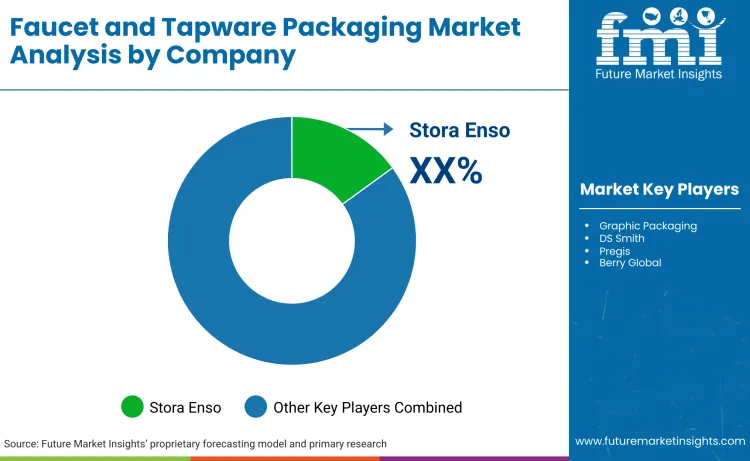
Stora Enso leads with a 15% market share, followed by major packaging converters like Graphic Packaging, DS Smith, and innovative material suppliers like Renw and Buhl Paperform.
Preview the report firsthand - request a free sample
Get SampleGet the brochure for pricing and purchase details.
Get PDFTable of Content
- Executive Summary
- Global Market Outlook
- Demand Side Trends
- Supply Side Trends
- Technology Roadmap Analysis
- Analysis and Recommendations
- Market Overview
- Market Coverage / Taxonomy
- Market Definition / Scope / Limitations
- Research Methodology
- Chapter Orientation
- Analytical Lens and Working Hypotheses
- Market Structure, Signals, and Trend Drivers
- Benchmarking and Cross-market Comparability
- Market Sizing, Forecasting, and Opportunity Mapping
- Research Design and Evidence Framework
- Desk Research Programme (Secondary Evidence)
- Company Annual and Sustainability Reports
- Peer-reviewed Journals and Academic Literature
- Corporate Websites, Product Literature, and Technical Notes
- Earnings Decks and Investor Briefings
- Statutory Filings and Regulatory Disclosures
- Technical White Papers and Standards Notes
- Trade Journals, Industry Magazines, and Analyst Briefs
- Conference Proceedings, Webinars, and Seminar Materials
- Government Statistics Portals and Public Data Releases
- Press Releases and Reputable Media Coverage
- Specialist Newsletters and Curated Briefings
- Sector Databases and Reference Repositories
- FMI Internal Knowledge Base and Historical Datasets
- Subscription Datasets and Paid Sources
- Social Channels, Communities, and Digital Listening Inputs
- Additional Desk Sources
- Expert Input and Fieldwork (Primary Evidence)
- Primary Modes
- Qualitative Interviews and Expert Elicitation
- Quantitative Surveys and Structured Data Capture
- Blended Approach
- Why Primary Evidence is Used
- Field Techniques
- Interviews
- Surveys
- Focus Groups
- Observational and In-context Research
- Social and Community Interactions
- Stakeholder Universe Engaged
- C-suite Leaders
- Board Members
- Presidents and Vice Presidents
- R&D and Innovation Heads
- Technical Specialists
- Domain Subject-matter Experts
- Scientists
- Physicians and Other Healthcare Professionals
- Governance, Ethics, and Data Stewardship
- Research Ethics
- Data Integrity and Handling
- Primary Modes
- Tooling, Models, and Reference Databases
- Desk Research Programme (Secondary Evidence)
- Data Engineering and Model Build
- Data Acquisition and Ingestion
- Cleaning, Normalisation, and Verification
- Synthesis, Triangulation, and Analysis
- Quality Assurance and Audit Trail
- Market Background
- Market Dynamics
- Drivers
- Restraints
- Opportunity
- Trends
- Scenario Forecast
- Demand in Optimistic Scenario
- Demand in Likely Scenario
- Demand in Conservative Scenario
- Opportunity Map Analysis
- Product Life Cycle Analysis
- Supply Chain Analysis
- Investment Feasibility Matrix
- Value Chain Analysis
- PESTLE and Porter's Analysis
- Regulatory Landscape
- Regional Parent Market Outlook
- Production and Consumption Statistics
- Import and Export Statistics
- Market Dynamics
- Global Market Analysis 2021 to 2025 and Forecast, 2026 to 2036
- Historical Market Size Value (USD Billion) Analysis, 2021 to 2025
- Current and Future Market Size Value (USD Billion) Projections, 2026 to 2036
- Y-o-Y Growth Trend Analysis
- Absolute $ Opportunity Analysis
- Global Market Pricing Analysis 2021 to 2025 and Forecast 2026 to 2036
- Y-o-Y Growth Trend Analysis 2021 to 2025
- Absolute $ Opportunity Analysis 2026 to 2036
- Global Market Analysis 2021 to 2025 and Forecast 2026 to 2036, By Fixture Class
- Introduction / Key Findings
- Historical Market Size Value (USD Billion) Analysis By Fixture Class, 2021 to 2025
- Current and Future Market Size Value (USD Billion) Analysis and Forecast By Fixture Class, 2026 to 2036
- Residential Fixtures
- Commercial Fixtures
- OEM Export
- Premium Designer Taps
- Y-o-Y Growth Trend Analysis By Fixture Class, 2021 to 2025
- Absolute $ Opportunity Analysis By Fixture Class, 2026 to 2036
- Global Market Analysis 2021 to 2025 and Forecast 2026 to 2036, By Protection System
- Introduction / Key Findings
- Historical Market Size Value (USD Billion) Analysis By Protection System, 2021 to 2025
- Current and Future Market Size Value (USD Billion) Analysis and Forecast By Protection System, 2026 to 2036
- Molded-pulp Cradles
- Foam-in-place Packs
- Corrugated Inserts
- Rigid Gift Boxes
- Bio-based Cushioning
- Y-o-Y Growth Trend Analysis By Protection System, 2021 to 2025
- Absolute $ Opportunity Analysis By Protection System, 2026 to 2036
- Global Market Analysis 2021 to 2025 and Forecast 2026 to 2036, By Cushion Material
- Introduction / Key Findings
- Historical Market Size Value (USD Billion) Analysis By Cushion Material, 2021 to 2025
- Current and Future Market Size Value (USD Billion) Analysis and Forecast By Cushion Material, 2026 to 2036
- Molded Fiber (Pulp)
- PE / EPS Foams
- Corrugated Board
- Specialty Board
- Bio-Foams
- Y-o-Y Growth Trend Analysis By Cushion Material, 2021 to 2025
- Absolute $ Opportunity Analysis By Cushion Material, 2026 to 2036
- Global Market Analysis 2021 to 2025 and Forecast 2026 to 2036, By Region
- Introduction
- Historical Market Size Value (USD Billion) Analysis By Region, 2021 to 2025
- Current Market Size Value (USD Billion) Analysis and Forecast By Region, 2026 to 2036
- North America
- Latin America
- Western Europe
- Eastern Europe
- East Asia
- South Asia and Pacific
- Middle East & Africa
- Market Attractiveness Analysis By Region
- North America Market Analysis 2021 to 2025 and Forecast 2026 to 2036, By Country
- Historical Market Size Value (USD Billion) Trend Analysis By Market Taxonomy, 2021 to 2025
- Market Size Value (USD Billion) Forecast By Market Taxonomy, 2026 to 2036
- By Country
- USA
- Canada
- Mexico
- By Fixture Class
- By Protection System
- By Cushion Material
- By Country
- Market Attractiveness Analysis
- By Country
- By Fixture Class
- By Protection System
- By Cushion Material
- Key Takeaways
- Latin America Market Analysis 2021 to 2025 and Forecast 2026 to 2036, By Country
- Historical Market Size Value (USD Billion) Trend Analysis By Market Taxonomy, 2021 to 2025
- Market Size Value (USD Billion) Forecast By Market Taxonomy, 2026 to 2036
- By Country
- Brazil
- Chile
- Rest of Latin America
- By Fixture Class
- By Protection System
- By Cushion Material
- By Country
- Market Attractiveness Analysis
- By Country
- By Fixture Class
- By Protection System
- By Cushion Material
- Key Takeaways
- Western Europe Market Analysis 2021 to 2025 and Forecast 2026 to 2036, By Country
- Historical Market Size Value (USD Billion) Trend Analysis By Market Taxonomy, 2021 to 2025
- Market Size Value (USD Billion) Forecast By Market Taxonomy, 2026 to 2036
- By Country
- Germany
- UK
- Italy
- Spain
- France
- Nordic
- BENELUX
- Rest of Western Europe
- By Fixture Class
- By Protection System
- By Cushion Material
- By Country
- Market Attractiveness Analysis
- By Country
- By Fixture Class
- By Protection System
- By Cushion Material
- Key Takeaways
- Eastern Europe Market Analysis 2021 to 2025 and Forecast 2026 to 2036, By Country
- Historical Market Size Value (USD Billion) Trend Analysis By Market Taxonomy, 2021 to 2025
- Market Size Value (USD Billion) Forecast By Market Taxonomy, 2026 to 2036
- By Country
- Russia
- Poland
- Hungary
- Balkan & Baltic
- Rest of Eastern Europe
- By Fixture Class
- By Protection System
- By Cushion Material
- By Country
- Market Attractiveness Analysis
- By Country
- By Fixture Class
- By Protection System
- By Cushion Material
- Key Takeaways
- East Asia Market Analysis 2021 to 2025 and Forecast 2026 to 2036, By Country
- Historical Market Size Value (USD Billion) Trend Analysis By Market Taxonomy, 2021 to 2025
- Market Size Value (USD Billion) Forecast By Market Taxonomy, 2026 to 2036
- By Country
- China
- Japan
- South Korea
- By Fixture Class
- By Protection System
- By Cushion Material
- By Country
- Market Attractiveness Analysis
- By Country
- By Fixture Class
- By Protection System
- By Cushion Material
- Key Takeaways
- South Asia and Pacific Market Analysis 2021 to 2025 and Forecast 2026 to 2036, By Country
- Historical Market Size Value (USD Billion) Trend Analysis By Market Taxonomy, 2021 to 2025
- Market Size Value (USD Billion) Forecast By Market Taxonomy, 2026 to 2036
- By Country
- India
- ASEAN
- Australia & New Zealand
- Rest of South Asia and Pacific
- By Fixture Class
- By Protection System
- By Cushion Material
- By Country
- Market Attractiveness Analysis
- By Country
- By Fixture Class
- By Protection System
- By Cushion Material
- Key Takeaways
- Middle East & Africa Market Analysis 2021 to 2025 and Forecast 2026 to 2036, By Country
- Historical Market Size Value (USD Billion) Trend Analysis By Market Taxonomy, 2021 to 2025
- Market Size Value (USD Billion) Forecast By Market Taxonomy, 2026 to 2036
- By Country
- Kingdom of Saudi Arabia
- Other GCC Countries
- Turkiye
- South Africa
- Other African Union
- Rest of Middle East & Africa
- By Fixture Class
- By Protection System
- By Cushion Material
- By Country
- Market Attractiveness Analysis
- By Country
- By Fixture Class
- By Protection System
- By Cushion Material
- Key Takeaways
- Key Countries Market Analysis
- USA
- Pricing Analysis
- Market Share Analysis, 2025
- By Fixture Class
- By Protection System
- By Cushion Material
- Canada
- Pricing Analysis
- Market Share Analysis, 2025
- By Fixture Class
- By Protection System
- By Cushion Material
- Mexico
- Pricing Analysis
- Market Share Analysis, 2025
- By Fixture Class
- By Protection System
- By Cushion Material
- Brazil
- Pricing Analysis
- Market Share Analysis, 2025
- By Fixture Class
- By Protection System
- By Cushion Material
- Chile
- Pricing Analysis
- Market Share Analysis, 2025
- By Fixture Class
- By Protection System
- By Cushion Material
- Germany
- Pricing Analysis
- Market Share Analysis, 2025
- By Fixture Class
- By Protection System
- By Cushion Material
- UK
- Pricing Analysis
- Market Share Analysis, 2025
- By Fixture Class
- By Protection System
- By Cushion Material
- Italy
- Pricing Analysis
- Market Share Analysis, 2025
- By Fixture Class
- By Protection System
- By Cushion Material
- Spain
- Pricing Analysis
- Market Share Analysis, 2025
- By Fixture Class
- By Protection System
- By Cushion Material
- France
- Pricing Analysis
- Market Share Analysis, 2025
- By Fixture Class
- By Protection System
- By Cushion Material
- India
- Pricing Analysis
- Market Share Analysis, 2025
- By Fixture Class
- By Protection System
- By Cushion Material
- ASEAN
- Pricing Analysis
- Market Share Analysis, 2025
- By Fixture Class
- By Protection System
- By Cushion Material
- Australia & New Zealand
- Pricing Analysis
- Market Share Analysis, 2025
- By Fixture Class
- By Protection System
- By Cushion Material
- China
- Pricing Analysis
- Market Share Analysis, 2025
- By Fixture Class
- By Protection System
- By Cushion Material
- Japan
- Pricing Analysis
- Market Share Analysis, 2025
- By Fixture Class
- By Protection System
- By Cushion Material
- South Korea
- Pricing Analysis
- Market Share Analysis, 2025
- By Fixture Class
- By Protection System
- By Cushion Material
- Russia
- Pricing Analysis
- Market Share Analysis, 2025
- By Fixture Class
- By Protection System
- By Cushion Material
- Poland
- Pricing Analysis
- Market Share Analysis, 2025
- By Fixture Class
- By Protection System
- By Cushion Material
- Hungary
- Pricing Analysis
- Market Share Analysis, 2025
- By Fixture Class
- By Protection System
- By Cushion Material
- Kingdom of Saudi Arabia
- Pricing Analysis
- Market Share Analysis, 2025
- By Fixture Class
- By Protection System
- By Cushion Material
- Turkiye
- Pricing Analysis
- Market Share Analysis, 2025
- By Fixture Class
- By Protection System
- By Cushion Material
- South Africa
- Pricing Analysis
- Market Share Analysis, 2025
- By Fixture Class
- By Protection System
- By Cushion Material
- USA
- Market Structure Analysis
- Competition Dashboard
- Competition Benchmarking
- Market Share Analysis of Top Players
- By Regional
- By Fixture Class
- By Protection System
- By Cushion Material
- Competition Analysis
- Competition Deep Dive
- Stora Enso
- Graphic Packaging
- DS Smith
- Pregis
- Berry Global
- Smurfit Kappa
- Buhl Paperform
- Renw
- Woola
- Cullen Packaging
- Competition Deep Dive
- Assumptions & Acronyms Used


