

- Industry Size (2026)
- USD 79.0 Mn
- Forecast (2036)
- USD 190.5 Mn
- CAGR
- (2026 to 2036)
Hyperspectral Wound Assessment Imaging Market Size, Market Forecast and Outlook By FMI
The hyperspectral wound assessment imaging market size was valued at USD 72.3 million in 2025. The sector is poised to cross USD 79.0 million in 2026 at a CAGR of 9.20% during the forecast period. Persistent investment activity fuels the growth in valuation USD 190.5 million through 2036 as clinical facilities transition from subjective visual inspection to non-contact hyperspectral imaging for mapping deep-tissue oxygenation, driving hyperspectral wound imaging market growth.
Wound care directors are currently being forced to decide whether to continue managing chronic wounds reactively based on surface appearance or to invest in wound perfusion imaging systems that quantify sub-surface ischemia before ulceration occurs. Facilities relying entirely on standard digital wound measurement devices risk severe downstream costs associated with preventable amputations. The integration of advanced diagnostics requires upfront capital, but the operational penalty for delaying this transition is the continued absorption of extended hospital stays and high surgical intervention rates for complex vascular patients.
Before this diagnostic approach becomes standard protocol across all secondary care settings, the underlying technology must pivot from simply displaying oxygenation heatmaps to providing definitive, algorithm-backed predictive outcomes. Vendors integrating this level of specific imaging solution trigger a shift where procurement committees view the equipment as an amputation-prevention asset rather than just a specialized camera. Once objective wound healing prediction imaging achieves broader regulatory validation, deployment shifts rapidly from quaternary academic centers to standard outpatient vascular clinics.
Summary of Hyperspectral Wound Assessment Imaging Market
- Hyperspectral Wound Assessment Imaging Market Definition
- This market tracks non-contact optical imaging systems that quantify tissue oxygenation and perfusion through spectral analysis. The boundary separates devices that map physiological viability for clinical decision-making from basic morphological wound measurement tools.
- Demand Drivers in the Market
- Rising rates of complex vascular complications compel wound clinic directors to adopt objective physiological measurement tools to reduce amputation rates.
- Evolving reimbursement protocols for advanced diagnostic procedures push hospital administrators to calculate the ROI of wound imaging devices to justify high-cost interventions with verifiable sub-surface tissue data.
- The movement toward outpatient chronic care models requires nursing directors to deploy at home ulcer testing capabilities or a bedside wound tissue oxygenation scanner that streamlines patient triage.
- Key Segments Analyzed in the FMI Report
- Portable handheld systems: Portable handheld systems are estimated to hold 48.0% share in 2026, driven by the operational reality that vascular assessments must occur at the patient bedside or in crowded outpatient rooms rather than dedicated imaging suites.
- Diabetic foot ulcers: The diabetic foot ulcer imaging market sub-segment is expected to account for 34.0% share in 2026, as this pathology presents the highest risk of undetected sub-surface necrosis and subsequent amputation.
- Hospital wound clinics and burn centers: Hospital wound clinics and burn centers are projected to garner 46.0% share in 2026, utilizing robust capital budgets and handling the highest volume of critical tissue viability cases via dedicated hospital outpatient wound imaging.
- Capital equipment systems: Capital equipment systems are likely to record 57.0% share in 2026, reflecting the current reliance on centralized purchasing for high-value optical diagnostic hardware.
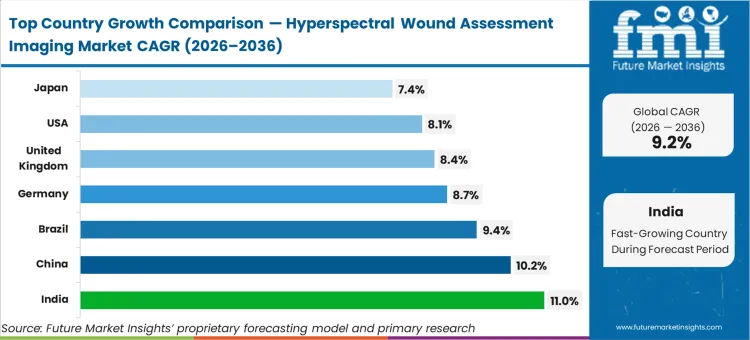
- India: 11.0% compound growth, propelled by the rapid expansion of corporate tertiary care chains addressing a massive baseline of diabetic complications.
- Analyst Opinion at FMI
- Sabyasachi Ghosh, Principal Analyst, Healthcare, at FMI, suggests, "The general metric used to evaluate these imaging systems is their accuracy in mapping tissue oxygenation against standard oximetry. What this measurement entirely misses is the workflow disruption these devices cause if they cannot deliver actionable predictive analytics in real time. A highly accurate spectral map is clinically useless if the attending physician has to wait twenty minutes for image processing or if the output requires a radiologist to interpret it. The systems capturing actual market share are those prioritizing real-time wound perfusion imaging outputs that dictate an immediate surgical or conservative pathway, bypassing raw data interpretation altogether."
- Strategic Implications / Executive Takeaways
- Medical device manufacturers must prioritize AI in hyperspectral wound assessment to secure placement in high-volume vascular clinics.
- Hospital procurement directors should negotiate comprehensive service and software update contracts to prevent rapid obsolescence of optical diagnostic capital.
- Diagnostic startup developers face intense clinical validation hurdles that require strategic partnerships with academic research centers to achieve necessary regulatory clearances.
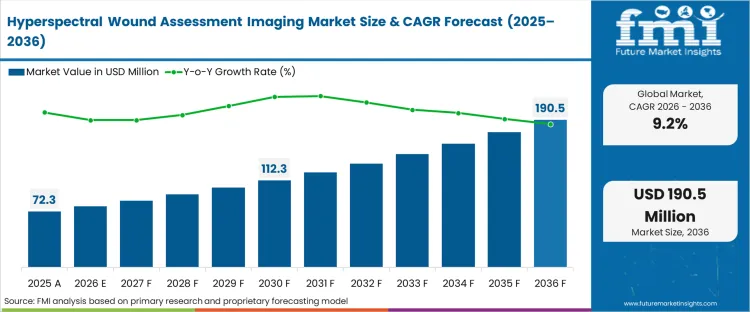
Hyperspectral Wound Assessment Imaging Market Key Takeaways
| Metric | Details |
|---|---|
| Industry Size (2026) | USD 79.0 Million |
| Industry Value (2036) | USD 190.5 Million |
| CAGR (2026–2036) | 9.20% |
India tracks at 11.0% compound growth, driven by an expanding corporate tertiary care infrastructure addressing high diabetic foot complications. China follows closely at 10.2%, leveraging localized optical diagnostic adoption within expanding urban medical centers. Brazil records a 9.4% trajectory as specialty vascular centres accelerate technology acquisition to modernize chronic care protocols. Germany advances at 8.7%, supported by highly structured clinical research ecosystems and established procurement capacity. The United Kingdom registers an 8.4% expansion, driven by centralized healthcare initiatives targeting complex wound management efficiency. The United States follows at 8.1%, characterized by an established base of active vendors operating within a mature reimbursement environment. Japan posts a 7.4% rate, reflecting a disciplined, budget-conscious approach to adopting new capital equipment. Such disparities illustrate that environments with tighter diagnostic capital resources modernize more quickly than markets progressing out of first‑generation oxygenation technologies.
Hyperspectral Wound Assessment Imaging Market Definition
The wound assessment imaging market encompasses non-invasive optical diagnostic platforms that capture spatial and spectral data across multiple electromagnetic bands to quantify tissue physiology. This hyperspectral wound imaging is defined by systems designed to measure localized hemoglobin oxygenation, perfusion dynamics, and tissue viability without direct patient contact. It excludes basic digital photography and standard thermal imaging, focusing strictly on hyperspectral tissue oxygenation imaging and noninvasive wound oxygenation imaging that maps sub-surface metabolic activity to guide clinical intervention in complex wounds.
Hyperspectral Wound Assessment Imaging Market Inclusions
This sector includes clinical-grade medical hyperspectral imaging devices utilized directly in patient care settings. Scope covers portable handheld scanners, cart-based hospital wound imaging platform configurations, and integrated AI-driven predictive platforms utilized for tissue viability imaging for wounds. The market accounts for both the hardware acquisition and the associated proprietary software licenses required for image reconstruction, spatial mapping, and perfusion analysis across various clinical indications including burns treatment and vascular assessments.
Hyperspectral Wound Assessment Imaging Market Exclusions
Systems designed exclusively for in-vitro laboratory analysis or generalized surgical fluorescence utilizing injected contrast agents are excluded from this analysis. The reason for this boundary is that contrast-dependent perfusion imaging operates under entirely different regulatory classifications, clinical workflows, and pharmacological procurement models than non-contact optical reflection hyperspectral diagnostics. Consumer-grade multispectral smartphone attachments are also excluded due to their lack of clinical diagnostic validation.
Hyperspectral Wound Assessment Imaging Market Research Methodology
- Primary Research: FMI analysts interview hospital procurement directors, chief medical officers of vascular clinics, and clinical leads at specialty wound care centers to understand wound assessment imaging system price sensitivity.
- Desk Research: Data aggregation relies on FDA 510(k) clearance databases, published clinical trial registries for wound tissue oxygenation market devices, and health technology assessment frameworks.
- Market-Sizing and Forecasting: The baseline anchors to the verifiable installed base of optical diagnostic capital equipment within tertiary hospitals and dedicated wound facilities, factoring in cost barriers for spectral wound imaging devices.
- Data Validation and Update Cycle: Forecast models are cross-validated against regional capital expenditure allocations for advanced diagnostic imaging and published surgical outcome registries.
Segmental Analysis
Hyperspectral Wound Assessment Imaging Market Analysis by Imaging modality
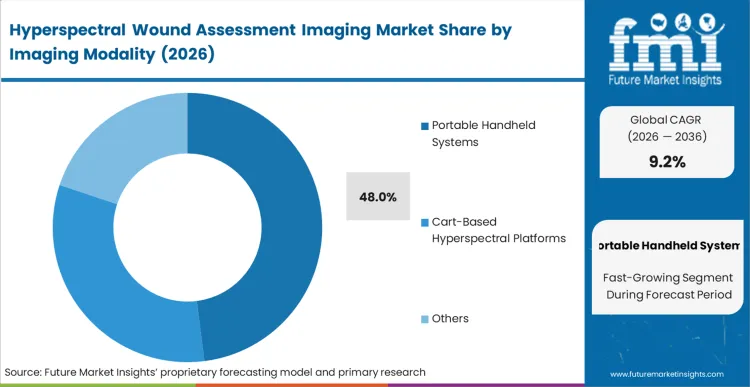
Portable handheld systems maintain their dominance, and the reason for this goes beyond simple ergonomics: complex wound patients are frequently immobile, making transport to centralized diagnostic suites clinically impractical. According to FMI's estimates, this modality commands 48.0% of the market because it directly addresses the spatial constraints of high-throughput outpatient clinics where space is at a premium. Medical staff require tools that integrate immediately into the existing bedside examination process. A standalone hyperspectral imaging camera that can be carried between examination rooms maximizes patient throughput and accelerates the return on investment for the facility. Procurement committees evaluating optical diagnostics heavily penalize systems that disrupt established nursing workflows or require dedicated operational space, meaning the best wound imaging platform for hospitals relies heavily on mobility.
- Initial screening: Portable form factors allow nursing staff to incorporate spectral imaging into routine intake assessments before the attending physician enters the room. This operational change accelerates clinical triage in high-volume diabetic foot clinics.
- Validation constraints: Mobile systems face strict engineering limitations regarding ambient light interference during capture. Technicians must strictly control examination room lighting to prevent spectral artifact contamination that skews perfusion data.
- Expansion criteria: Facilities scale their deployment of handheld units when the vendor proves the software can seamlessly integrate captured images directly into the hospital's electronic health record system.
Hyperspectral Wound Assessment Imaging Market Analysis by Wound type / clinical application
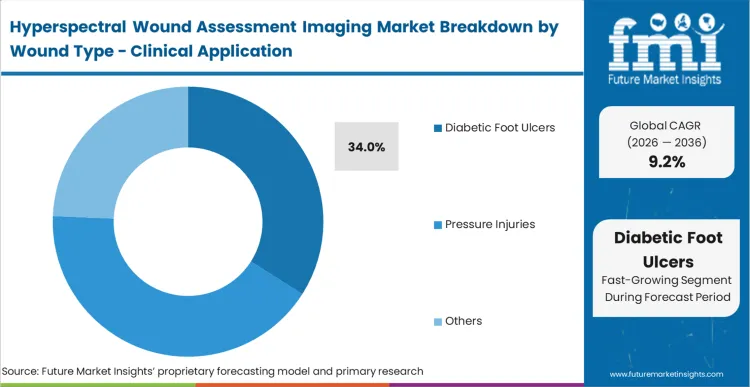
Current optical assessment adoption replaces subjective visual inspection specifically because visual cues fail entirely at identifying sub-surface ischemia before breakdown occurs. The demand for hyperspectral imaging for diabetic foot ulcers commands 34.0% of the opportunity precisely because this patient population lacks protective sensation and normal inflammatory responses, masking severe underlying tissue compromise. FMI analysts estimate that integrating foot care for diabetic patients with objective perfusion mapping moves the intervention timeline forward by weeks. When a clinician can visualize failing microcirculation before the epidermis ulcerates, they can alter offloading strategies or schedule immediate revascularization, cementing this application as the anchor of the broader chronic wound imaging market.
- Secondary validation: Beyond diabetic foot ulcers, hyperspectral imaging for pressure injury assessment provides an early warning system for bedbound patients. Vascular teams utilize this specific capability to justify early surgical intervention.
- Acute application: In trauma settings, hyperspectral imaging for burn wound assessment allows for exact depth-of-injury determinations to avoid unnecessary grafting.
- Full utilization: To capture the complete value of the technology, surgical teams must incorporate the spectral data directly into the operating theater to guide precise debridement margins.
Hyperspectral Wound Assessment Imaging Market Analysis by End user
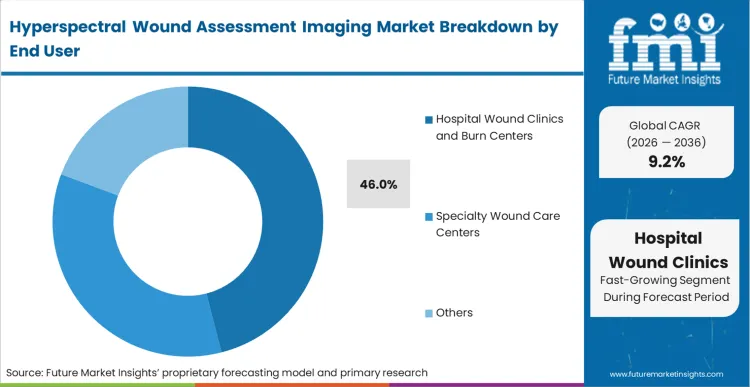
Chief medical officers at quaternary facilities are currently evaluating whether to standardize advanced optical diagnostics across all critical tissue viability cases. Hospital wound clinics and burn centers capture 46.0% of the demand because these environments manage the highest acuity patients and possess the capital budgets necessary for early technology adoption. In FMI's view, the transition from subjective assessment to objective measurement must begin in these centralized hubs where complex burn care protocols demand precise depth-of-injury determinations to avoid unnecessary grafting. These departments have the institutional authority to absorb the initial learning curve of integrating novel spectral data into established surgical decision trees. Facilities that delay this integration continue to experience high variance in surgical outcomes driven by subjective clinical experience rather than quantifiable physiological metrics.
- Early adopters: High-volume burn units deploy cart-based systems first to minimize the removal of viable tissue during surgical excision. This direct improvement in graft success rates provides the initial clinical validation for the hospital network.
- Secondary integration: Specialty outpatient clinics follow the hospital lead once the technology achieves portable form factors. Nursing staff in these environments utilize the tools primarily to track healing velocity and document treatment efficacy for reimbursement.
- Final conversion: Home-health networks adopt the technology last, strictly contingent upon the development of highly automated, cloud-connected interfaces that require zero technical expertise from the visiting clinician.
Hyperspectral Wound Assessment Imaging Market Analysis by Purchase model
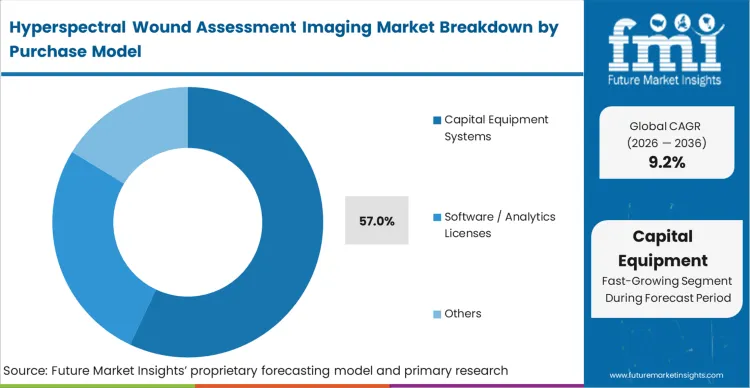
The trajectory of this market points toward a gradual switch from hardware-centric procurement to recurring analytical software licensing by 2036. Currently, capital equipment systems represent 57.0% of the market because hospital purchasing departments still classify optical diagnostics identically to traditional radiological assets. As per FMI's projection, this framework is changing as the true clinical value of advanced wound management platforms increasingly resides in the proprietary AI algorithms that interpret the spectral data, rather than the camera hardware itself. Vendors are pushing facilities toward subscription models that guarantee access to iterative algorithmic improvements. Procurement teams that cling to traditional outright capital purchases without securing long-term software upgrade pathways risk stranding their facilities with obsolete diagnostic capabilities within three years.
- Budget origination: High initial acquisition costs force hospital departments to utilize complex capital expenditure request cycles. Administrators calculate the return on investment strictly against the reduction in length-of-stay and surgical avoidance.
- Operational burden: Unplanned hardware recalibration and specialized maintenance create hidden costs that degrade the perceived value of the platform. Facilities must actively manage service contracts to ensure continuous clinical availability.
- Lifecycle analysis: Total cost of ownership comparisons increasingly favor software-as-a-service models where the facility leases the hardware and pays for analytical processing, moving the risk of technological obsolescence back to the vendor.
Hyperspectral Wound Assessment Imaging Market Drivers, Restraints, and Opportunities
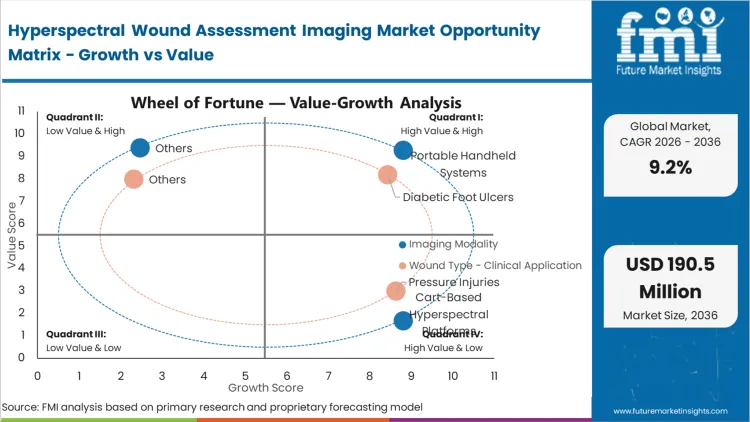
Need to reduce costly surgical interventions forces hospital administrators to invest in diagnostics that objectively quantify tissue viability. Relying on visual assessment frequently results in delayed revascularization for compromised patients, triggering a cascade of extended inpatient management and complex surgical reconstructions. Facilities are deploying optical perfusion mapping to identify failing tissue earlier in the treatment pathway, directly converting subjective clinical intuition into actionable physiological data. Individuals asking why are hospitals adopting spectral wound imaging find their answer in the direct conversion of this data into actionable, amputation-preventing surgical pathways. Delaying this transition exposes the clinical network to higher amputation rates and the associated financial penalties under value-based care reimbursement models.
The primary organizational friction slowing adoption is the difficulty of integrating non-standard optical diagnostic codes into established insurance reimbursement frameworks. Even when a system demonstrates clear clinical utility, pressure ulcer detection devices and hyperspectral tools face significant wound imaging reimbursement challenges, lacking specific procedural billing codes and forcing facilities to absorb the operational cost of the scan without direct financial recovery. This lack of clear procedural reimbursement restricts utilization strictly to environments where the downstream savings of surgical avoidance outweigh the uncompensated scanning time. While some specialized vendor partnerships assist hospitals with localized billing strategies, this gap limits rapid deployment in highly decentralized, private-practice clinics.
Opportunities in the Hyperspectral Wound Assessment Imaging Market
- Algorithm development: The accumulation of vast proprietary spectral datasets enables the training of highly accurate predictive models. Artificial intelligence developers partner with academic centers to commercialize ai enabled wound analysis tools that forecast healing trajectories.
- Surgical integration: The demand for objective margins during debridement creates an opening for overhead surgical lighting integration. Medical device engineers adapt hyperspectral sensors directly into operating room infrastructure to provide real-time guidance to surgical teams.
- Trial evidence: Pharmaceutical companies developing novel topical therapies require objective endpoints to demonstrate efficacy. Contract research organizations utilize precision optical mapping to quantify microvascular improvements, generating essential clinical evidence for hyperspectral wound imaging during early-stage drug trials.
Regional Analysis
.webp "Top Country Growth Comparison Hyperspectral Wound Assessment Imaging Market Cagr (2026 2036)")
From a regional perspective, the Hyperspectral Wound Assessment Imaging Market includes North America, Europe, Asia Pacific, and Latin America, collectively spanning more than 40 nations.
| Country | CAGR (2026 to 2036) |
|---|---|
| India | 11.0% |
| China | 10.2% |
| Brazil | 9.4% |
| Germany | 8.7% |
| United Kingdom | 8.4% |
| United States | 8.1% |
| Japan | 7.4% |
North America Hyperspectral Wound Assessment Imaging Market Analysis
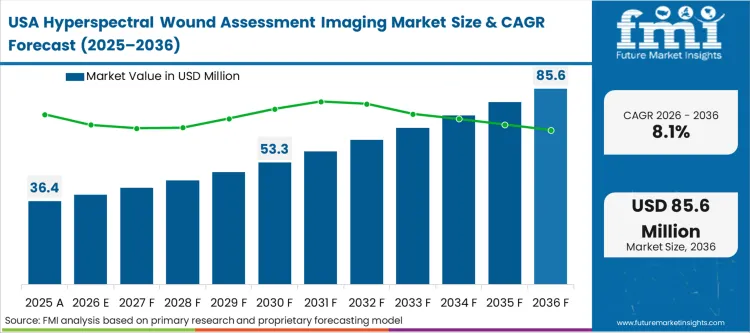
Cost containment pressures within value-based care frameworks shape the adoption of advanced diagnostics across North American health systems. Hospital networks are actively seeking technologies that demonstrate clear cost-avoidance metrics, specifically regarding chronic complications. Based on FMI's assessment, the trajectory of the North America hyperspectral wound imaging market is heavily influenced by the presence of established medical technology vendors and a high concentration of specialized vascular research centers. Facilities utilize detailed physiological data to justify expensive interventions to insurance providers, creating a unique operational environment where diagnostic validation directly supports therapeutic reimbursement.
- United States: Strict criteria for reimbursement approval define the United States' trajectory in optical diagnostics. Procurement directors must navigate a complex web of private and public payer requirements when integrating new capital equipment. A CAGR of 8.1% is expected for the sector in the United States over the forecast period. Despite the mature ecosystem for united states burns treatment and chronic care, true market expansion is tempered by the reality that individual clinics struggle to justify the upfront costs without guaranteed procedural billing codes.
FMI's report includes detailed analysis of the Canadian market structure. The region demonstrates a highly consolidated approach to capital equipment procurement, prioritizing systems that can be shared across broad regional health authorities rather than isolated clinic deployments.
Europe Hyperspectral Wound Assessment Imaging Market Analysis
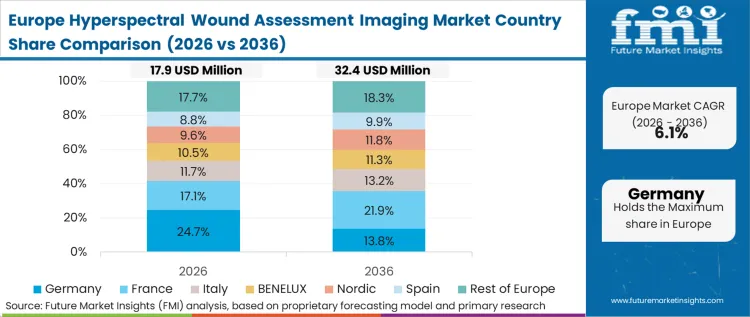
Centralized health technology assessment bodies dictate the pace of integration for novel diagnostic tools across European networks. National health services prioritize technologies that demonstrate systemic efficiency improvements rather than isolated clinical advantages. In FMI's view, the emphasis on robust clinical evidence generation forces vendors to engage in extensive, multi-year validation studies before achieving broad procurement authorization. This type of environment creates significant barriers to entry but ensures rapid, standardized deployment once a technology achieves national recommendation guidelines.
- Germany: FMI estimates the optical diagnostic market in Germany to expand at an annual growth rate of 8.7%. Germany's robust clinical research infrastructure accelerates the integration of novel optical technologies into complex surgical wound care pathways. Vascular surgeons in top-tier medical centers leverage strong institutional budgets to acquire advanced platforms for immediate clinical application. The market dynamics point toward a future where hyperspectral assessment becomes a mandatory step in the qualification process for any advanced biological skin substitute apcentreson.
- United Kingdom: The NHS mandate to reduce chronic care backlogs forces clinical commissioning groups to seek efficiencies in outpatient triage. The United Kingdom market for advanced diagnostics is likely to post a CAGR of 8.4%. Nursing teams in specialized community clinics deploy optical measurement tools to objectively determine when a patient requires escalation to a vascular surgeon. The integration of these tools successfully reduces unnecessary specialist referrals, streamlining the operational pathway for patients requiring complex negative pressure wound therapy or surgical intervention.
FMI's report includes insights covering the Nordic markets and Western European member states. These regions exhibit a strong preference for data interoperability, demanding that new diagnostic hardware seamlessly feed structured data into centralized national electronic health records.
Asia Pacific Hyperspectral Wound Assessment Imaging Market Analysis
The rapid modernization of corporate hospital infrastructure defines the adoption landscape across the Asia Pacific region. Investment is heavily concentrated in expanding tertiary care capabilities to address escalating rates of metabolic disease complications. FMI analysts opine that the lack of legacy diagnostic infrastructure allows new medical centers to leapfrog directly to advanced optical assessment tools, bypassing intermediate technologies. This environment favors vendors that can scale deployment rapidly and provide robust technical support across distributed hospital networks.
- India: Over the forecast period, the hyperspectral wound assessment imaging market is set for a CAGR of 11.0%. The massive baseline of undocumented diabetic complications combined with a rapidly expanding corporate hospital sector creates a unique environment for rapid technological integration. Corporate hospital administrators deploy advanced diagnostic tools to differentiate their vascular service lines and attract high-acuity patients. This aggressive adoption positions the leading corporate chains significantly ahead of public sector facilities, establishing a clear competitive hierarchy in complex surgical care.
- China: China's focus on localized medical device manufacturing and rapid urban healthcare expansion drives substantial volume growth in clinical diagnostics. High-throughput urban centers require technologies that accelerate clinical decision-making without adding significant time to patient consultations. Demand for optical assessment tools in China is estimated to expand at a CAGR of 10.2%. Vendors who secure early placement in these massive regional medical hubs capture lucrative, long-term maintenance and software service contracts.
- Japan: A highly disciplined, evidence-based approach to capital expenditure defines Japan's integration of new medical technologies. Japan is expected to see its optical diagnostic sector grow at a compound annual rate of 7.4%. Clinical directors demand extensive local validation studies before altering established japan burn care and vascular protocols. The nuance here is that while overall volume growth remains restrained by strict budgetary controls, the systems that do achieve approval are utilized with exceptionally high clinical compliance and integration into standardized care pathways.
FMI's report includes analysis of the expanding Southeast Asian medical technology landscape. Maturing healthcare networks in these countries prioritize cost-effective, portable diagnostic solutions that can operate reliably in varied environmental conditions outside of prime urban centers.
Latin America Hyperspectral Wound Assessment Imaging Market Analysis
The modernization of specialized chronic care facilities drives targeted technology acquisition across primary Latin American health networks. While broad public health systems face severe capital constraints, private vascular and diabetic care clinics are actively investing in diagnostic tools that improve clinical outcomes. As per FMI's projection, this dynamic creates a highly bifurcated environment where advanced optical mapping is concentrated almost entirely within specialized centers of excellence, serving patients capable of accessing premium care pathways.
- Brazil: The drive to elevate the standard of specialized vascular ulcer treatment forces private clinics in major metropolitan hubs to seek out advanced assessment tools. Facility directors utilize objective perfusion data to optimize surgical planning and reduce the incidence of post-operative complications. The Brazilian market for advanced optical diagnostics is forecast to register a CAGR of 9.4%. This catch-up adoption phase establishes the groundwork for future integration of automated, AI-driven predictive analytics once the baseline hardware infrastructure stabilizes.
FMI's report includes coverage of key medical hubs across the broader Latin American region. These markets exhibit a strong reliance on flexible financing structures and comprehensive service agreements to mitigate the financial risk associated with importing complex medical capital equipment.
Competitive Aligners for Market Players
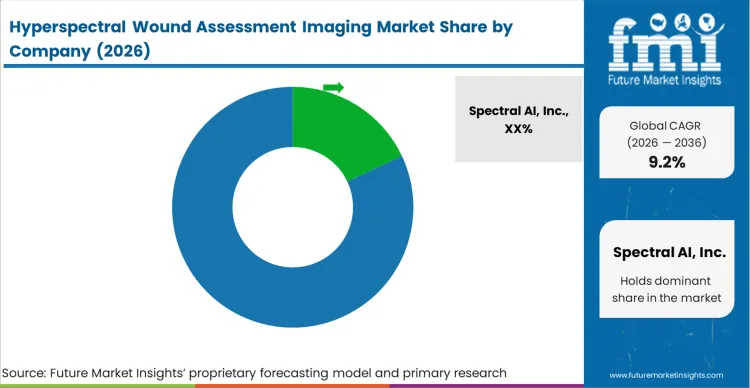
The high barrier of clinical validation and stringent FDA clearance requirements dictate the concentrated structure of the optical diagnostic sector. Hyperspectral wound imaging key players such as Spectral AI, Inc., MolecuLight Inc., and Kent Imaging Inc. dominate because they have successfully navigated the complex regulatory pathways required to make definitive physiological claims. Buyers do not distinguish hyperspectral wound imaging suppliers based on raw camera resolution; they judge how to evaluate a wound imaging vendor based on the depth of published, peer-reviewed clinical evidence proving that the system's specific spectral algorithms accurately correlate with actual surgical outcomes.
Incumbent leaders maintain their advantage through the continuous accumulation of proprietary patient data. Companies like HyperMed Imaging, Inc. and Perimed AB possess years of correlated chronic wound care imaging data, allowing them to refine their predictive algorithms far beyond the capabilities of a new entrant with comparable hardware. A challenger attempting to replicate this advantage cannot simply engineer a better sensor; they must build a massive, longitudinally tracked clinical database to validate their software, navigating the strict wound imaging system selection criteria imposed by clinical procurement committees.
Large hospital networks resist vendor lock-in by demanding standardized data export capabilities and interoperability with existing electronic health records. The tension moving toward 2036 involves vendors attempting to secure recurring revenue through proprietary predictive software ecosystems, while hospital IT directors fight to maintain hardware-agnostic data environments despite the high wound assessment imaging system price. The market is positioned to become more concentrated as the algorithmic complexity of wound healing ultrasound and advanced optical mapping pushes smaller hardware manufacturers to partner with or be acquired by specialized healthcare AI developers.
Key Players in Hyperspectral Wound Assessment Imaging Market
- Spectral AI, Inc.
- HyperMed Imaging, Inc.
- Kent Imaging Inc.
- MolecuLight Inc.
- Perimed AB
- WoundVision LLC
- ARANZ Medical Ltd.
Scope of the Report
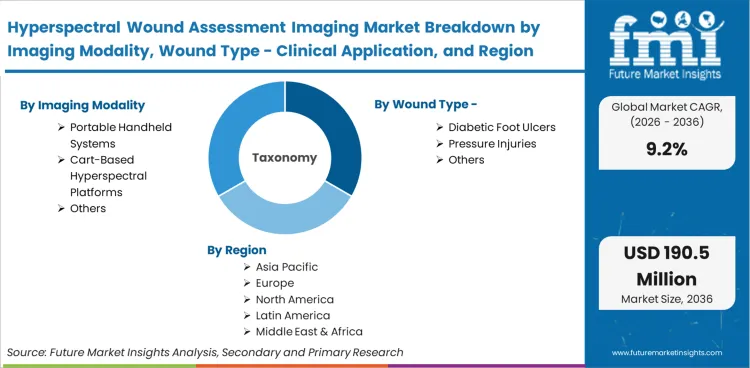
| Metric | Value |
|---|---|
| Quantitative Units | USD 79.0 Million to USD 190.5 Million, at a CAGR of 9.20% |
| Market Definition | This market tracks non-contact optical imaging systems that quantify tissue oxygenation and perfusion through spectral analysis to guide clinical intervention in complex wounds. |
| Imaging modality Segmentation | Portable handheld systems, Cart-based hyperspectral platforms, AI-enabled multispectral / predictive imaging systems, Research-grade tissue oxygenation systems |
| Wound type / clinical application Segmentation | Diabetic foot ulcers, Pressure injuries, Venous leg ulcers, Burn wounds, Post-surgical flap / graft viability assessment |
| End user Segmentation | Hospital wound clinics and burn centers, Specialty wound care centers, Vascular and diabetic foot clinics, Academic and translational research centers, Home-health / telewound pilots |
| Purchase model Segmentation | Capital equipment systems, Software / analytics licenses, Service and maintenance contracts, Clinical trial / evaluation placements |
| Regions Covered | North America, Europe, Asia Pacific, Latin America, Middle East and Africa |
| Countries Covered | United States, Germany, United Kingdom, China, India, Japan, Brazil, and 40 plus countries |
| Key Companies Profiled | Spectral AI, Inc., HyperMed Imaging, Inc., Kent Imaging Inc., MolecuLight Inc., Perimed AB, WoundVision LLC, ARANZ Medical Ltd. |
| Forecast Period | 2026 to 2036 |
| Approach | FMI analysts interview hospital procurement directors and clinical leads at specialty centers. The baseline anchors to the verifiable installed base of optical diagnostic capital equipment. Forecast models are cross-validated against regional capital expenditure allocations for advanced diagnostic imaging. |
Hyperspectral Wound Assessment Imaging Market Analysis by Segments
Imaging modality:
- Portable handheld systems
- Cart-based hyperspectral platforms
- AI-enabled multispectral / predictive imaging systems
- Research-grade tissue oxygenation systems
Wound type / clinical application:
- Diabetic foot ulcers
- Pressure injuries
- Venous leg ulcers
- Burn wounds
- Post-surgical flap / graft viability assessment
End user:
- Hospital wound clinics and burn centers
- Specialty wound care centers
- Vascular and diabetic foot clinics
- Academic and translational research centers
- Home-health / telewound pilots
Purchase model:
- Capital equipment systems
- Software / analytics licenses
- Service and maintenance contracts
- Clinical trial / evaluation placements
Region:
- North America
- United States
- Canada
- Europe
- Germany
- United Kingdom
- France
- Italy
- Spain
- Asia Pacific
- China
- India
- Japan
- Taiwan
- South Korea
- Singapore
- Latin America
- Brazil
- Mexico
- Argentina
- Middle East & Africa
- GCC Countries
- South Africa
Bibliography
- Zhao, C., Zhu, J., Li, X., Wang, Y., Liu, H., & Xu, Y. (2024, November). Non-invasive techniques for wound assessment: A comprehensive review. International Wound Journal.
- Sidhu, A. S., Singh, A., & colleagues. (2024, November). Emerging technologies for the management of diabetic foot ulcers. Frontiers in Clinical Diabetes and Healthcare.
- Centers for Disease Control and Prevention. (2026, January). National Diabetes Statistics Report. USA Department of Health and Human Services.
- NHS England Digital. (2024, May). National Diabetes Foot Care Audit 2018 to 2023: Data quality statement. NHS England.
- Weiss, M., et al. (2025, December). Hyperspectral imaging as an objective diagnostic tool for secondary lymphedema in breast cancer patients. Communications Medicine.
- Sari, N. N., et al. (2025, September). Non-invasive imaging techniques for predicting healing status in diabetes-related foot ulcers: A review. Frontiers in Medical Technology.
- Gherardi, A., et al. (2025, September). Hyperspectral reconstruction for mobile diabetic foot blood perfusion monitoring. Biomedical Engineering Online.
- Kluckner, M., et al. (2026, February). Real-time perfusion assessment with hyperspectral imaging after revascularization in peripheral artery disease. Journal of Vascular Surgery.
This bibliography is provided for reader reference. The full FMI report contains the complete reference list with primary source documentation.
This Report Addresses
- Market intelligence to support strategic decision making across portable handheld systems and cart-based hyperspectral platforms
- Market size estimation and 10-year revenue forecasts from 2026 to 2036, supported by clinical trial registries and hardware placement data
- Growth opportunity mapping across specific clinical applications with emphasis on the integration of AI-based predictive analytics
- Segment and regional revenue forecasts covering diabetic foot ulcers across expanding corporate tertiary care chains
- Competition strategy assessment including regulatory clearance barriers, clinical validation data, and software integration capabilities
- Hardware development tracking including portable spatial mapping, ambient light interference control, and advanced perfusion algorithms
- Market access analysis covering complex capital expenditure cycles, diagnostic reimbursement constraints, and value-based care frameworks
- Market report delivery in PDF, Excel, PPT, and interactive dashboard formats for executive strategy, hospital procurement planning, and operational benchmarking use
Frequently Asked Questions
What is hyperspectral imaging in wound care?
It is a non-invasive optical diagnostic modality that captures spatial and spectral data across multiple electromagnetic bands. In clinical wound settings, it quantifies sub-surface tissue physiology, measuring hemoglobin oxygenation and perfusion dynamics without requiring direct patient contact or injected contrast agents.
How does hyperspectral imaging measure wound healing?
The technology quantifies localized tissue microcirculation by reflecting specific wavelengths of light off the wound bed and surrounding skin. By tracking physiological shifts in oxygenation prior to visible tissue breakdown or granulation, it offers early, objective insights into healing trajectories.
Which wounds benefit most from hyperspectral imaging?
The most acute benefit is realized in diabetic foot ulcers and complex vascular wounds where patients lack normal protective sensation and inflammatory responses. Identifying deep-tissue ischemia in these wounds prevents unexpected ulceration and allows for early surgical revascularization.
How large is the hyperspectral wound assessment imaging opportunity?
The sector is anticipated to reach USD 79.0 million in 2026 and expand to USD 190.5 million by 2036. This valuation reflects the baseline installed capacity and future procurement cycles of specialized optical diagnostic hardware within quaternary care centers.
Which companies are active in hyperspectral wound imaging?
The highly concentrated vendor landscape is led by medical technology firms such as Spectral AI, Inc., HyperMed Imaging, Inc., Kent Imaging Inc., MolecuLight Inc., Perimed AB, WoundVision LLC, and ARANZ Medical Ltd.
Why are hospitals adopting spectral wound imaging now?
The acute operational need to reduce preventable surgical interventions forces facility administrators to adopt objective perfusion mapping. Translating subjective clinical intuition into quantifiable physiological data directly lowers the incidence of costly downstream amputations and length-of-stay penalties.
How does hyperspectral imaging compare with fluorescence wound imaging?
Fluorescence imaging primarily visualizes bacterial load and bioburden using excitation light, whereas hyperspectral mapping quantifies tissue oxygenation and microvascular perfusion to assess physiological viability. Hospitals frequently evaluate both modalities depending on whether their immediate clinical bottleneck is infection control or ischemia detection.
What are the biggest reimbursement and workflow barriers?
The primary organizational friction is the absence of specific procedural billing codes for optical diagnostic scans. Facilities must absorb the operational cost of the hardware without direct financial reimbursement, limiting deployment to environments where surgical avoidance generates clear institutional savings.
Which regions will grow fastest in wound assessment imaging?
India tracks at 11.0% compound growth, outpacing more mature markets. Its trajectory is defined by aggressive corporate tertiary care expansion that is actively capturing a massive, largely unmanaged baseline of diabetic vascular complications.
How should hospitals evaluate a wound imaging vendor?
Procurement committees should look beyond raw camera specifications and evaluate vendors based on their peer-reviewed clinical validation data, the ability to deliver real-time predictive analytics without disrupting nursing workflows, and the inclusion of sustainable software-upgrade pathways.
Preview the report firsthand - request a free sample
Get SampleGet the brochure for pricing and purchase details.
Get PDFTable of Content
- Executive Summary
- Global Market Outlook
- Demand-side Trends
- Supply-side Trends
- Technology Roadmap Analysis
- Analysis and Recommendations
- Market Overview
- Market Coverage / Taxonomy
- Market Definition / Scope / Limitations
- Research Methodology
- Chapter Orientation
- Analytical Lens and Working Hypotheses
- Market Sizing, Forecasting, and Opportunity Mapping
- Research Design and Evidence Framework
- Desk Research Programme (Secondary Evidence)
- Company Annual and Sustainability Reports
- Peer-reviewed Journals and Academic Literature
- Corporate Websites, Product Literature, and Technical Notes
- Earnings Decks and Investor Briefings
- Statutory Filings and Regulatory Disclosures
- Technical White Papers and Standards Notes
- Trade Journals, Industry Magazines, and Analyst Briefs
- Conference Proceedings, Webinars, and Seminar Materials
- Government Statistics Portals and Public Data Releases
- Press Releases and Reputable Media Coverage
- Specialist Newsletters and Curated Briefings
- Sector Databases and Reference Repositories
- FMI Internal Proprietary Databases and Historical Market Datasets
- Subscription Datasets and Paid Sources
- Social Channels, Communities, and Digital Listening Inputs
- Additional Desk Sources
- Expert Input and Fieldwork (Primary Evidence)
- Primary Modes
- Qualitative Interviews and Expert Elicitation
- Quantitative Surveys and Structured Data Capture
- Blended Approach
- Why Primary Evidence is Used
- Observational and In-context Research
- Social and Community Interactions
- Primary Modes
- Stakeholder Universe Engaged
- C-suite Leaders
- Board Members
- Presidents and Vice Presidents
- R&D and Innovation Heads
- Technical Specialists
- Domain Subject-matter Experts
- Scientists
- Physicians and Other Healthcare Professionals
- Governance, Ethics, and Data Stewardship
- Research Ethics
- Data Integrity and Handling
- Desk Research Programme (Secondary Evidence)
- Tooling, Models, and Reference Databases
- Data Engineering and Model Build
- Data Acquisition and Ingestion
- Cleaning, Normalisation, and Verification
- Synthesis, Triangulation, and Analysis
- Quality Assurance and Audit Trail
- Market Background
- Market Dynamics
- Drivers
- Restraints
- Opportunity
- Trends
- Scenario Forecast
- Demand in Optimistic Scenario
- Demand in Likely Scenario
- Demand in Conservative Scenario
- Opportunity Map Analysis
- Product Life Cycle Analysis
- Supply Chain Analysis
- Investment Feasibility Matrix
- Value Chain Analysis
- PESTLE and Porter’s Analysis
- Regulatory Landscape
- Regional Parent Market Outlook
- Production and Consumption Statistics
- Import and Export Statistics
- Market Dynamics
- Global Market Analysis 2021 to 2025 and Forecast, 2026 to 2036
- Historical Market Size Value (USD Million) Analysis, 2021 to 2025
- Current and Future Market Size Value (USD Million) Projections, 2026 to 2036
- Y-o-Y Growth Trend Analysis
- Absolute $ Opportunity Analysis
- Global Market Pricing Analysis 2021 to 2025 and Forecast 2026 to 2036
- Global Market Analysis 2021 to 2025 and Forecast 2026 to 2036, By Imaging Modality
- Introduction / Key Findings
- Historical Market Size Value (USD Million) Analysis By Imaging Modality , 2021 to 2025
- Current and Future Market Size Value (USD Million) Analysis and Forecast By Imaging Modality , 2026 to 2036
- Portable Handheld Systems
- Cart-Based Hyperspectral Platforms
- Others
- Portable Handheld Systems
- Y-o-Y Growth Trend Analysis By Imaging Modality , 2021 to 2025
- Absolute $ Opportunity Analysis By Imaging Modality , 2026 to 2036
- Global Market Analysis 2021 to 2025 and Forecast 2026 to 2036, By Wound Type / Clinical Application
- Introduction / Key Findings
- Historical Market Size Value (USD Million) Analysis By Wound Type / Clinical Application, 2021 to 2025
- Current and Future Market Size Value (USD Million) Analysis and Forecast By Wound Type / Clinical Application, 2026 to 2036
- Diabetic Foot Ulcers
- Pressure Injuries
- Others
- Diabetic Foot Ulcers
- Y-o-Y Growth Trend Analysis By Wound Type / Clinical Application, 2021 to 2025
- Absolute $ Opportunity Analysis By Wound Type / Clinical Application, 2026 to 2036
- Global Market Analysis 2021 to 2025 and Forecast 2026 to 2036, By End User
- Introduction / Key Findings
- Historical Market Size Value (USD Million) Analysis By End User, 2021 to 2025
- Current and Future Market Size Value (USD Million) Analysis and Forecast By End User, 2026 to 2036
- Hospital Wound Clinics and Burn Centers
- Specialty Wound Care Centers
- Others
- Hospital Wound Clinics and Burn Centers
- Y-o-Y Growth Trend Analysis By End User, 2021 to 2025
- Absolute $ Opportunity Analysis By End User, 2026 to 2036
- Global Market Analysis 2021 to 2025 and Forecast 2026 to 2036, By Purchase Model
- Introduction / Key Findings
- Historical Market Size Value (USD Million) Analysis By Purchase Model, 2021 to 2025
- Current and Future Market Size Value (USD Million) Analysis and Forecast By Purchase Model, 2026 to 2036
- Capital Equipment Systems
- Software / Analytics Licenses
- Others
- Capital Equipment Systems
- Y-o-Y Growth Trend Analysis By Purchase Model, 2021 to 2025
- Absolute $ Opportunity Analysis By Purchase Model, 2026 to 2036
- Global Market Analysis 2021 to 2025 and Forecast 2026 to 2036, By Region
- Introduction
- Historical Market Size Value (USD Million) Analysis By Region, 2021 to 2025
- Current Market Size Value (USD Million) Analysis and Forecast By Region, 2026 to 2036
- North America
- Latin America
- Western Europe
- Eastern Europe
- East Asia
- South Asia and Pacific
- Middle East & Africa
- Market Attractiveness Analysis By Region
- North America Market Analysis 2021 to 2025 and Forecast 2026 to 2036, By Country
- Historical Market Size Value (USD Million) Trend Analysis By Market Taxonomy, 2021 to 2025
- Market Size Value (USD Million) Forecast By Market Taxonomy, 2026 to 2036
- By Country
- USA
- Canada
- Mexico
- By Imaging Modality
- By Wound Type / Clinical Application
- By End User
- By Purchase Model
- By Country
- Market Attractiveness Analysis
- By Country
- By Imaging Modality
- By Wound Type / Clinical Application
- By End User
- By Purchase Model
- Key Takeaways
- Latin America Market Analysis 2021 to 2025 and Forecast 2026 to 2036, By Country
- Historical Market Size Value (USD Million) Trend Analysis By Market Taxonomy, 2021 to 2025
- Market Size Value (USD Million) Forecast By Market Taxonomy, 2026 to 2036
- By Country
- Brazil
- Chile
- Rest of Latin America
- By Imaging Modality
- By Wound Type / Clinical Application
- By End User
- By Purchase Model
- By Country
- Market Attractiveness Analysis
- By Country
- By Imaging Modality
- By Wound Type / Clinical Application
- By End User
- By Purchase Model
- Key Takeaways
- Western Europe Market Analysis 2021 to 2025 and Forecast 2026 to 2036, By Country
- Historical Market Size Value (USD Million) Trend Analysis By Market Taxonomy, 2021 to 2025
- Market Size Value (USD Million) Forecast By Market Taxonomy, 2026 to 2036
- By Country
- Germany
- UK
- Italy
- Spain
- France
- Nordic
- BENELUX
- Rest of Western Europe
- By Imaging Modality
- By Wound Type / Clinical Application
- By End User
- By Purchase Model
- By Country
- Market Attractiveness Analysis
- By Country
- By Imaging Modality
- By Wound Type / Clinical Application
- By End User
- By Purchase Model
- Key Takeaways
- Eastern Europe Market Analysis 2021 to 2025 and Forecast 2026 to 2036, By Country
- Historical Market Size Value (USD Million) Trend Analysis By Market Taxonomy, 2021 to 2025
- Market Size Value (USD Million) Forecast By Market Taxonomy, 2026 to 2036
- By Country
- Russia
- Poland
- Hungary
- Balkan & Baltic
- Rest of Eastern Europe
- By Imaging Modality
- By Wound Type / Clinical Application
- By End User
- By Purchase Model
- By Country
- Market Attractiveness Analysis
- By Country
- By Imaging Modality
- By Wound Type / Clinical Application
- By End User
- By Purchase Model
- Key Takeaways
- East Asia Market Analysis 2021 to 2025 and Forecast 2026 to 2036, By Country
- Historical Market Size Value (USD Million) Trend Analysis By Market Taxonomy, 2021 to 2025
- Market Size Value (USD Million) Forecast By Market Taxonomy, 2026 to 2036
- By Country
- China
- Japan
- South Korea
- By Imaging Modality
- By Wound Type / Clinical Application
- By End User
- By Purchase Model
- By Country
- Market Attractiveness Analysis
- By Country
- By Imaging Modality
- By Wound Type / Clinical Application
- By End User
- By Purchase Model
- Key Takeaways
- South Asia and Pacific Market Analysis 2021 to 2025 and Forecast 2026 to 2036, By Country
- Historical Market Size Value (USD Million) Trend Analysis By Market Taxonomy, 2021 to 2025
- Market Size Value (USD Million) Forecast By Market Taxonomy, 2026 to 2036
- By Country
- India
- ASEAN
- Australia & New Zealand
- Rest of South Asia and Pacific
- By Imaging Modality
- By Wound Type / Clinical Application
- By End User
- By Purchase Model
- By Country
- Market Attractiveness Analysis
- By Country
- By Imaging Modality
- By Wound Type / Clinical Application
- By End User
- By Purchase Model
- Key Takeaways
- Middle East & Africa Market Analysis 2021 to 2025 and Forecast 2026 to 2036, By Country
- Historical Market Size Value (USD Million) Trend Analysis By Market Taxonomy, 2021 to 2025
- Market Size Value (USD Million) Forecast By Market Taxonomy, 2026 to 2036
- By Country
- Kingdom of Saudi Arabia
- Other GCC Countries
- Turkiye
- South Africa
- Other African Union
- Rest of Middle East & Africa
- By Imaging Modality
- By Wound Type / Clinical Application
- By End User
- By Purchase Model
- By Country
- Market Attractiveness Analysis
- By Country
- By Imaging Modality
- By Wound Type / Clinical Application
- By End User
- By Purchase Model
- Key Takeaways
- Key Countries Market Analysis
- USA
- Pricing Analysis
- Market Share Analysis, 2025
- By Imaging Modality
- By Wound Type / Clinical Application
- By End User
- By Purchase Model
- Canada
- Pricing Analysis
- Market Share Analysis, 2025
- By Imaging Modality
- By Wound Type / Clinical Application
- By End User
- By Purchase Model
- Mexico
- Pricing Analysis
- Market Share Analysis, 2025
- By Imaging Modality
- By Wound Type / Clinical Application
- By End User
- By Purchase Model
- Brazil
- Pricing Analysis
- Market Share Analysis, 2025
- By Imaging Modality
- By Wound Type / Clinical Application
- By End User
- By Purchase Model
- Chile
- Pricing Analysis
- Market Share Analysis, 2025
- By Imaging Modality
- By Wound Type / Clinical Application
- By End User
- By Purchase Model
- Germany
- Pricing Analysis
- Market Share Analysis, 2025
- By Imaging Modality
- By Wound Type / Clinical Application
- By End User
- By Purchase Model
- UK
- Pricing Analysis
- Market Share Analysis, 2025
- By Imaging Modality
- By Wound Type / Clinical Application
- By End User
- By Purchase Model
- Italy
- Pricing Analysis
- Market Share Analysis, 2025
- By Imaging Modality
- By Wound Type / Clinical Application
- By End User
- By Purchase Model
- Spain
- Pricing Analysis
- Market Share Analysis, 2025
- By Imaging Modality
- By Wound Type / Clinical Application
- By End User
- By Purchase Model
- France
- Pricing Analysis
- Market Share Analysis, 2025
- By Imaging Modality
- By Wound Type / Clinical Application
- By End User
- By Purchase Model
- India
- Pricing Analysis
- Market Share Analysis, 2025
- By Imaging Modality
- By Wound Type / Clinical Application
- By End User
- By Purchase Model
- ASEAN
- Pricing Analysis
- Market Share Analysis, 2025
- By Imaging Modality
- By Wound Type / Clinical Application
- By End User
- By Purchase Model
- Australia & New Zealand
- Pricing Analysis
- Market Share Analysis, 2025
- By Imaging Modality
- By Wound Type / Clinical Application
- By End User
- By Purchase Model
- China
- Pricing Analysis
- Market Share Analysis, 2025
- By Imaging Modality
- By Wound Type / Clinical Application
- By End User
- By Purchase Model
- Japan
- Pricing Analysis
- Market Share Analysis, 2025
- By Imaging Modality
- By Wound Type / Clinical Application
- By End User
- By Purchase Model
- South Korea
- Pricing Analysis
- Market Share Analysis, 2025
- By Imaging Modality
- By Wound Type / Clinical Application
- By End User
- By Purchase Model
- Russia
- Pricing Analysis
- Market Share Analysis, 2025
- By Imaging Modality
- By Wound Type / Clinical Application
- By End User
- By Purchase Model
- Poland
- Pricing Analysis
- Market Share Analysis, 2025
- By Imaging Modality
- By Wound Type / Clinical Application
- By End User
- By Purchase Model
- Hungary
- Pricing Analysis
- Market Share Analysis, 2025
- By Imaging Modality
- By Wound Type / Clinical Application
- By End User
- By Purchase Model
- Kingdom of Saudi Arabia
- Pricing Analysis
- Market Share Analysis, 2025
- By Imaging Modality
- By Wound Type / Clinical Application
- By End User
- By Purchase Model
- Turkiye
- Pricing Analysis
- Market Share Analysis, 2025
- By Imaging Modality
- By Wound Type / Clinical Application
- By End User
- By Purchase Model
- South Africa
- Pricing Analysis
- Market Share Analysis, 2025
- By Imaging Modality
- By Wound Type / Clinical Application
- By End User
- By Purchase Model
- USA
- Market Structure Analysis
- Competition Dashboard
- Competition Benchmarking
- Market Share Analysis of Top Players
- By Regional
- By Imaging Modality
- By Wound Type / Clinical Application
- By End User
- By Purchase Model
- Competition Analysis
- Competition Deep Dive
- Spectral AI, Inc.
- Overview
- Product Portfolio
- Profitability by Market Segments (Product/Age /Sales Channel/Region)
- Sales Footprint
- Strategy Overview
- Marketing Strategy
- Product Strategy
- Channel Strategy
- HyperMed Imaging, Inc.
- Kent Imaging Inc.
- MolecuLight Inc.
- Perimed AB
- WoundVision LLC
- Spectral AI, Inc.
- Competition Deep Dive
- Assumptions & Acronyms Used


