

- Industry Size (2026)
- USD 6.26 Bn
- Forecast (2036)
- USD 9.53 Bn
- CAGR (2026 to 2036)
- 4.3%
Premium Lager Market Size, Market Forecast and Outlook By FMI
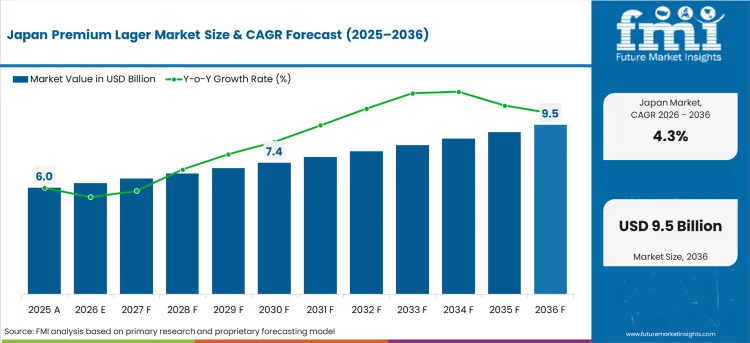
Demand for premium lager in Japan was valued at USD 6.00 Billion in 2025. Based on Future Market Insights' analysis, demand for premium lager is estimated to grow to USD 6.26 Billion in 2026 and USD 9.53 Billion by 2036. FMI projects a CAGR of 4.3% during the forecast period from 2026 to 2036. This translates to an incremental opportunity worth USD 3.27 Billion over the ten-year assessment window.
Summary of Premium Lager Market in Japan
- Market Snapshot
- Demand for premium lager in Japan is valued at USD Billion 6.00 in 2025 and is projected to reach USD Billion 9.53 by 2036.
- The market is expected to grow at a 4.3% CAGR from 2026 to 2036, creating an incremental opportunity of USD Billion 3.27.
- The market is a premiumization-driven, channel-dependent beer category where craft differentiation, on-trade margin structures, and off-trade seasonal listing cycles define competitive dynamics.
- Demand and Growth Drivers
- Revised Liquor Tax Law production thresholds have enabled regional microbreweries to enter the premium lager segment, expanding consumer choice and on-trade tap allocation.
- Off-trade retail channels, led by convenience stores and supermarkets, are driving volume growth through curated seasonal and limited-edition premium lager offerings.
- Import lager penetration from European and Asian breweries is increasing competitive pressure, supporting premiumization strategies among domestic brewers.
- Among key regions, Kyushu & Okinawa leads at 5.3% CAGR, followed by Kanto at 4.9%, Kansai at 4.3%, Chubu at 3.8%, Tohoku at 3.3%, and Rest of Japan at 3.2%.
- Product and Segment View
- Premium lager in Japan includes craft lager and conventional premium lager products, distributed through on-trade venues and off-trade retail channels.
- On-trade channels encompass izakaya chains, craft beer bars, hotel dining, and restaurant service; off-trade covers convenience stores, supermarkets, and e-commerce.
- Craft Lager leads by Product with 66% share in 2026, driven by consumer demand for varietal differentiation and regional brewing identity.
- On-trade leads by Distribution Channel with 58% share in 2026, reflecting the premium pricing and margin structure of bar and restaurant consumption.
- Scope includes craft and conventional premium lager. Excluded are standard-priced domestic lager, happoshu, and non-alcoholic beer.
- Geography and Competitive Outlook
- Kyushu & Okinawa and Kanto are the fastest-growing regional clusters, driven by concentrated processing, distribution, and consumption infrastructure.
- Demand in Tohoku and Rest of Japan follows steadier, replacement-driven procurement cycles in established networks.
- Competition centers on brand positioning, brewing method differentiation, on-trade listing agreements, and the ability to secure seasonal off-trade placement through convenience store and supermarket procurement cycles.
- Key players include Heineken N.V., China Resources Snow Breweries, Molson Coors Brewing, Tsingtao Brewery Group, Anheuser-Busch InBev.
- Analyst Opinion at FMI
- Nandini Roy Choudhury, Principal Consultant for Food & Beverage analysts observe that: 'In my analysis, I have observed that Japan's premium lager market is splitting along a craft-versus-scale axis that will reshape distribution economics within three years. On-trade operators are dedicating increasing tap allocations to craft lagers that command per-pour margins exceeding conventional options by 30% to 40%, while off-trade channels are competing on curated limited-edition offerings to attract younger legal-age drinkers. Brewery groups that maintain only conventional lager portfolios without a credible craft extension risk losing on-trade listing priority to smaller producers who deliver exclusivity and margin to venue operators.'
- Strategic Implications / Executive Takeaways
- Brewery groups should develop craft lager extensions to maintain on-trade listing priority as venue operators shift tap allocations toward higher-margin varietal offerings.
- Distribution strategists should secure seasonal limited-edition placement in convenience store and supermarket cold-shelf rotations to capture off-trade volume growth among younger consumers.
- Import brand managers should optimize landed cost structures under bilateral trade agreements and position varietal storytelling to compete against domestic premiumization narratives.
Premium Lager Market Key Takeaways
| Metric | Details |
|---|---|
| Industry Size (2026) | USD 6.26 Billion |
| Industry Value (2036) | USD 9.53 Billion |
| CAGR (2026 to 2036) | 4.3% |
Source: Future Market Insights, 2026
Japan's premium lager market operates under the National Tax Agency's liquor taxation framework, where beer-style beverages face tiered excise rates that influence retail pricing structures and category competition. The craft lager sub-segment has expanded as microbreweries and regional brewers leverage Japan's revised Liquor Tax Law of 2018, which lowered minimum production thresholds for beer manufacturing licenses. As per FMI, on-trade consumption through izakaya chains, craft beer bars, and hotel dining continues to anchor premium pricing, while off-trade distribution through convenience stores and supermarkets captures volume growth among younger consumers seeking variety beyond established domestic brands. Import lager penetration from European and Asian breweries adds competitive pressure to domestic premiumization strategies.
Across Japanese prefectural clusters, growth trajectories vary based on industrial concentration and end-use demand density. Kyushu & Okinawa is projected to expand at 5.3% CAGR. Kanto is projected to expand at 4.9% CAGR. Kansai is projected to expand at 4.3% CAGR. Chubu is projected to expand at 3.8% CAGR. Tohoku is projected to expand at 3.3% CAGR. Rest of Japan is projected to expand at 3.2% CAGR. Kyushu & Okinawa leads the growth ranking, supported by concentrated processing and distribution infrastructure. Kanto, anchoring the Tokyo metropolitan consumption base, follows closely. Mature clusters such as Tohoku and Rest of Japan register steadier, replacement-driven demand patterns.
Premium Lager Market Definition
Premium lager refers to lager-style beer products positioned above standard domestic price points, encompassing craft lager and conventional premium lager offerings. In the Japanese market, this category includes both domestically brewed and imported lager products distributed through on-trade (bars, restaurants, hotels) and off-trade (retail stores, convenience stores, e-commerce) channels. Product positioning is defined by ingredient sourcing, brewing method differentiation, and brand premiumization strategy.
Premium Lager Market Inclusions
Market scope includes craft lager and conventional premium lager products sold through on-trade and off-trade channels in Japan. Coverage extends to both domestically brewed and imported premium lager brands. The assessment covers market sizes by product type, distribution channel, and Japanese prefectural region for 2026 to 2036.
Premium Lager Market Exclusions
The scope excludes standard-priced domestic lager, happoshu (low-malt beer), and non-alcoholic beer alternatives. It also omits draft beer sold exclusively through on-premise keg systems without branded retail presence.
Premium Lager Market Research Methodology
- Primary Research: Analysts engaged with procurement managers, brand directors, and distribution leads at premium lager manufacturing and distribution operations across Japan to map decision triggers and specification requirements.
- Desk Research: Data collection aggregated regulatory filings from the Ministry of Health, Labour and Welfare, trade statistics from Japan Customs, and published industry standards relevant to premium lager production and distribution in Japan.
- Market-Sizing and Forecasting: Baseline values derive from a bottom-up aggregation of manufacturer shipments and import volumes, applying region-specific consumption curves to project demand velocity through 2036.
- Data Validation and Update Cycle: Projections are cross-checked against publicly reported production volumes, trade data, and downstream procurement disclosures from major producers and distributors operating in Japan.
Why is the Demand for Premium Lager in Japan Growing?
The demand for premium lager in Japan is growing as consumers seek higher-quality, more refined beer experiences. Premium lagers, known for their superior taste, ingredients, and brewing methods, are becoming increasingly popular among Japanese beer drinkers who are willing to invest in premium beverages. As the beer industry in Japan continues to evolve, there is a noticeable shift towards premium products, with consumers seeking more sophisticated and flavorful alternatives to standard mass-produced beers. This trend is particularly strong in urban areas where craft beer and premium beverages are gaining traction.
A key driver behind the growth of premium lager is the increasing demand for quality over quantity. Japanese consumers are becoming more discerning when it comes to alcoholic beverages, favoring products that offer unique flavors, higher quality ingredients, and an overall better drinking experience. Premium lagers, which often feature distinct flavor profiles, refined brewing techniques, and higher-quality ingredients, appeal to these changing tastes. As more international premium lager brands enter the Japanese industry, there is a growing appreciation for diverse beer styles, further fueling demand for premium products.
The growth of the hospitality and dining sectors in Japan, including bars, restaurants, and craft beer establishments, is contributing to the rising demand for premium lagers. As consumers increasingly enjoy beer as part of a dining experience, premium lagers are being paired with high-end meals, creating new opportunities for growth. With these trends continuing, the demand for premium lager in Japan is expected to grow steadily through 2035.
What is the Segment-Wise Analysis of Demand for Premium Lager in Japan?
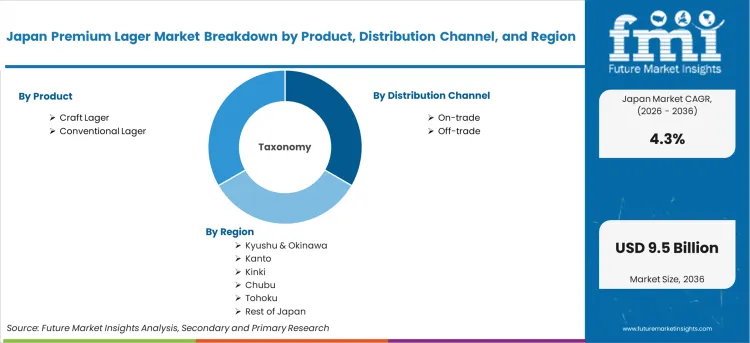
Demand for premium lager in Japan is segmented by product type, distribution channel, and region. By product type, demand is divided into craft lager and conventional lager, with craft lager leading at 66%. The demand is also segmented by distribution channel, including on-trade (bars, restaurants, and pubs) and off-trade (superindustrys, convenience stores), with on-trade accounting for 58%. Regionally, demand spans across Kyushu & Okinawa, Kanto, Kansai, Chubu, Tohoku, and the rest of Japan.
How Does Craft Lager Lead the Demand for Premium Lager in Japan?
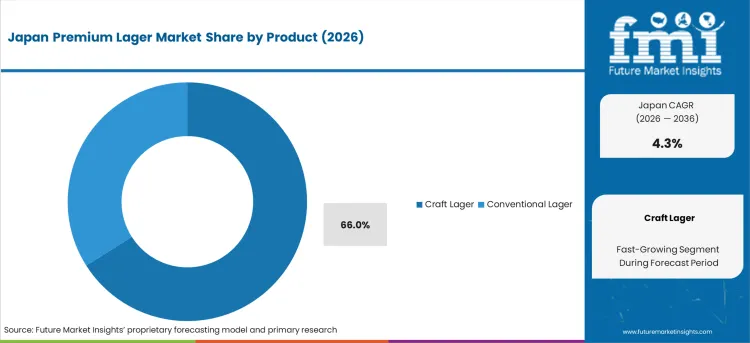
Craft lager accounts for 66% of the demand for premium lager in Japan, driven by the growing interest in craft beer and the desire for unique, high-quality brews. Japanese consumers increasingly seek out craft lagers due to their distinct, often locally-inspired flavors, which provide a more premium and artisanal drinking experience compared to conventional lagers. The rise in popularity of small-batch production and locally sourced ingredients has fueled the demand for craft lager, as these beers offer something different from mass-produced options.
The trend toward craft beer aligns with Japan's broader movement toward gourmet food and beverages, as consumers prioritize quality and authenticity. As craft breweries continue to emerge and evolve, craft lagers remain the dominant choice, appealing to both beer connoisseurs and casual drinkers looking for a more refined and exciting beverage option.
Why Does On-Trade Lead the Demand for Premium Lager in Japan?
On-trade accounts for 58% of the demand for premium lager in Japan, driven by the social and cultural significance of drinking in public settings such as bars, restaurants, and pubs. The Japanese tradition of enjoying drinks in social settings has led to high consumption of premium lagers in on-trade locations, where consumers seek a higher-quality beer experience. On-trade venues often feature a wide selection of craft and premium beers, catering to a growing trend of beer enthusiasts looking for unique, quality brews.
The increasing popularity of beer pairing with food in dining establishments has further driven the demand for premium lager in these settings. On-trade locations provide an opportunity for consumers to enjoy their favorite beverages with friends and colleagues, contributing to the continued dominance of on-trade sales. As the focus on craft beer and premium drinking experiences grows, on-trade will remain the leading distribution channel for premium lager in Japan.
What are the Key Trends, Drivers, and Restraints in Demand for Premium Lager in Japan?
Demand for premium lager in Japan is growing as consumers increasingly seek high-quality, taste-oriented beers rather than basic, lower-cost options. With the rise in interest for refined, flavorful beverages, premium lagers known for their smooth taste, high-quality ingredients, and brewing craftsmanship are gaining popularity. This trend aligns with a broader shift toward higher-end, experience-driven consumption across different food and beverage categories. Despite the overall decline in beer consumption, premium lagers have found a place among those looking for better quality rather than quantity. The premium price of these beers remains a key restraint, as economic pressures, along with the rising demand for low-alcohol or alternative beverages, may limit growth.
Why is Demand for Premium Lager Growing in Japan?
The growing demand for premium lager in Japan is driven by a shift in consumer preferences towards higher-quality beverages and a more refined drinking experience. As many consumers prioritize quality over quantity, premium lagers with their distinctive taste and premium ingredients are becoming the drink of choice. Smaller household sizes, increasingly busy lifestyles, and fewer frequent social drinking occasions lead many to choose fewer but better drinks. Premium lagers are also seen as an "affordable luxury," offering an upscale drinking experience without the cost of more expensive alcohol like wine or spirits. Japanese consumers are also more willing to pay for premium beers that align with their growing interest in artisanal and craft beverages.
How are Technological & Industry Innovations Driving Premium Lager Demand in Japan?
Technological advancements in brewing and packaging have been key to the growing popularity of premium lagers in Japan. Improvements in brewing processes, including the use of high-quality ingredients, better fermentation techniques, and advanced quality control measures, ensure that premium lagers offer a consistent and refined drinking experience. Innovations in packaging, such as nitrogen-infused cans and improved sealing methods, help preserve the beer’s quality, freshness, and taste during distribution.
These innovations also improve convenience, making premium lagers more accessible to consumers. The increased availability of premium lagers in superindustrys, convenience stores, and online platforms makes them easier to purchase. Creative strategies that emphasize the craft, quality, and heritage of premium lager brands help attract consumers looking for an authentic, high-quality beer experience.
What are the Key Challenges and Risks That Could Limit Premium Lager Demand in Japan?
One of the biggest barriers is the premium price point, which can deter price-sensitive consumers who are accustomed to more affordable beer options. Premium lagers typically cost more than standard beers, and with the increasing health awareness among consumers, many are turning to low-alcohol or non-alcoholic alternatives. The beer industry in Japan is shrinking overall, with younger generations often preferring other beverages, such as cocktails, spirits, or wine.
The competition from other alcoholic beverages, including ready-to-drink cocktails and chūhai, also poses a challenge for premium lager growth. The aging population and fewer social occasions for large gatherings could limit beer consumption overall. Finally, while premium lagers have gained popularity in certain circles, they still remain a niche product for many consumers who continue to prefer traditional or mass-industry beers.
What is the Regional Demand Outlook for Premium Lager in Japan?
.webp "Top Country Growth Comparison Japan Premium Lager Market Cagr (2026 2036)")
| Region | CAGR (%) |
|---|---|
| Kyushu & Okinawa | 5.3% |
| Kanto | 4.9% |
| Kansai | 4.3% |
| Chubu | 3.8% |
| Tohoku | 3.3% |
| Rest of Japan | 3.2% |
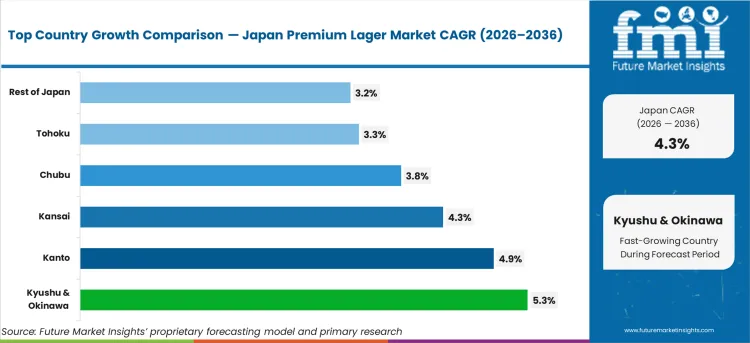
Demand for premium lager in Japan is growing steadily across all regions, with Kyushu & Okinawa leading at a 5.3% CAGR, driven by increasing consumer interest in higher-quality beverages. Kanto follows with a 4.9% CAGR, supported by the region’s large urban population and rising preference for premium alcoholic drinks. Kansai shows a 4.3% CAGR, fueled by the region’s rich food culture and growing demand for premium lager as part of a premium dining experience. Chubu experiences a 3.8% CAGR, with demand rising as more consumers seek high-quality beer options. Tohoku and the Rest of Japan see moderate growth at 3.3% and 3.2%, respectively, as premium lager gains popularity across both urban and rural areas.
How is Demand for Premium Lager Growing in Kyushu & Okinawa?
Kyushu & Okinawa leads the demand for premium lager, growing at a 5.3% CAGR. The region’s increasing interest in premium and craft beverages is a key factor driving this growth. Okinawa, known for its strong tourism sector, has seen rising demand for high-quality alcoholic beverages as both locals and visitors seek premium drinking experiences. The growing trend of premiumization in Japan’s alcoholic beverage industry is helping to boost the demand for premium lager. Consumers in Kyushu & Okinawa are increasingly choosing high-quality, flavorful beers to accompany their meals, particularly in restaurants and bars.
The increasing availability of premium lager in both retail and foodservice channels is further supporting the demand. As the region’s focus on craft beer and premium products continues, demand for premium lager is expected to grow steadily, driven by both local consumption and the influx of international visitors.
Why is Demand for Premium Lager Rising in Kanto?
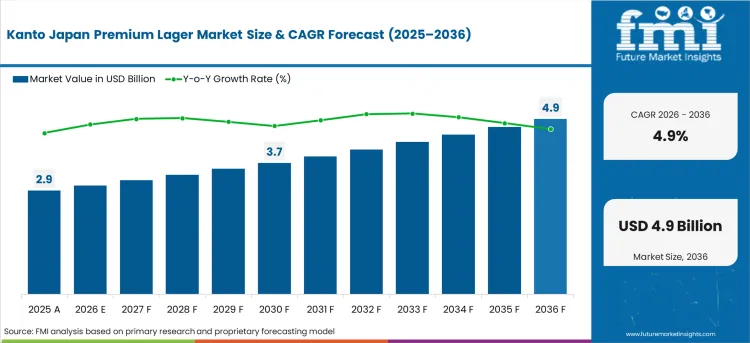
In Kanto, demand for premium lager is rising at a 4.9% CAGR. The region’s large urban population, particularly in Tokyo, has seen a growing preference for higher-quality alcoholic beverages, and premium lager fits into this trend. With busy lifestyles and a growing interest in craft beers, many consumers in Kanto are choosing premium lager as a way to enjoy a more refined beer experience. The region’s rich food culture, with a focus on dining out and pairing drinks with food, has also contributed to the rise in demand for premium lager, as consumers seek beers that complement fine dining experiences.
The growing availability of premium lager in superindustrys, convenience stores, and bars is making it more accessible. As consumer interest in premium products continues to rise, the demand for premium lager in Kanto is expected to remain strong, further fueled by the region's diverse and dynamic food and drink culture.
How is Demand for Premium Lager Expanding in Kansai?
Kansai shows steady demand for premium lager, with a 4.3% CAGR. The region’s rich culinary heritage, particularly in cities like Osaka and Kyoto, has contributed to a growing interest in pairing premium lager with meals. As Kansai’s food culture continues to evolve, there is an increasing preference for higher-quality alcoholic beverages like premium lager, which is often seen as an ideal accompaniment to premium dining experiences.
Consumers in Kansai are becoming more discerning about the beverages they choose, opting for premium lager for its refined taste and quality. The growing availability of premium lager in bars, restaurants, and retail outlets is helping to boost its consumption. As demand for craft and premium beers continues to rise, Kansai is expected to maintain steady growth in premium lager consumption. The region’s focus on food and drink pairing, along with rising health-consciousness, supports this trend.
Why is Demand for Premium Lager Growing in Chubu?
Chubu is experiencing steady demand for premium lager, growing at a 3.8% CAGR. As urbanization increases in cities like Nagoya, more consumers are seeking high-quality, flavorful beer options, contributing to the rise in premium lager consumption. The growing trend of premiumization in Japan's alcoholic beverage industry, along with an increasing interest in craft beers and specialty lagers, has led to a steady rise in demand for premium lager in Chubu.
The region’s focus on quality and taste is influencing consumers to choose beers that offer a richer, more refined drinking experience. Retailers and foodservice establishments in Chubu are expanding their offerings to include premium lager, catering to the growing consumer interest in high-quality beers. As the region’s population continues to adopt premium beverages, demand for premium lager is expected to continue growing, driven by both changing consumer preferences and increased availability of high-quality products.
How is Demand for Premium Lager Expanding in Tohoku?
Tohoku is seeing moderate growth in premium lager demand, with a 3.3% CAGR. While the region’s consumption of premium lager is smaller compared to urban areas, there is a gradual increase in interest as more consumers become health-conscious and seek high-quality alcoholic beverages. As Tohoku’s food culture evolves, there is a growing trend toward more sophisticated drinking habits, with premium lager gaining traction among those who appreciate its refined taste.
Retailers and local bars are beginning to stock more premium lager options, improving accessibility. The trend toward premiumization, along with increased interest in pairing quality beers with meals, is contributing to the demand for premium lager in Tohoku. As awareness of craft and premium beers grows, demand for premium lager is expected to rise steadily, driven by changing consumer habits and a growing appreciation for high-quality drinks.
Why is Demand for Premium Lager Steady in the Rest of Japan?
The Rest of Japan is experiencing steady demand for premium lager, with a 3.2% CAGR. Although demand is lower than in urban centers, there is a growing interest in premium and craft beers, particularly among older consumers and those with more disposable income. As awareness of premium lager’s quality and flavor spreads, consumers in rural and smaller urban areas are beginning to embrace it. The increasing availability of premium lager in convenience stores, and local bars is helping to increase its accessibility in these areas.
The growing trend of health-conscious living and an increasing desire for higher-quality beverages is also contributing to this shift. As the region becomes more exposed to global beer trends, demand for premium lager is expected to rise steadily, reflecting broader national trends toward premiumization and more sophisticated drinking experiences.
What Is Driving the Demand for Premium Lager in Japan and Who Are the Key Players Shaping the Industry?
The demand for premium lager in Japan is growing as consumers increasingly seek higher-quality, flavorful beers that offer a more sophisticated drinking experience. Japan, with its rich beer culture, has seen a shift toward premium and craft beer options, with consumers willing to pay more for beers that deliver superior taste, quality, and unique characteristics. The increasing popularity of premium lagers is also influenced by the growing interest in global beer brands and the premiumization trend across the beverage industry. Premium lager is increasingly being paired with food in dining experiences, and its appeal is enhanced by the demand for high-end beverages that offer better taste profiles, ingredients, and brewing techniques.
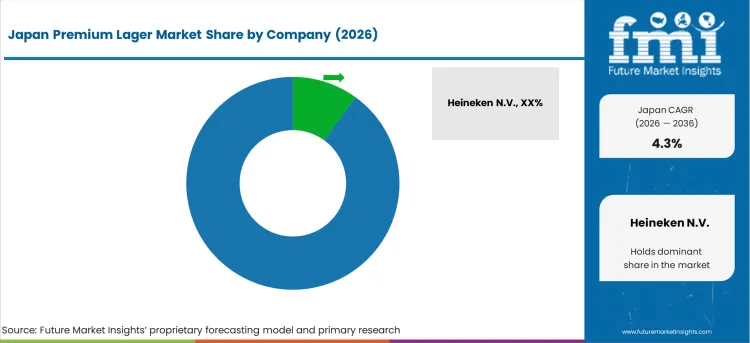
Key players shaping the premium lager industry in Japan include Heineken N.V., China Resources Snow Breweries, Molson Coors Brewing, Tsingtao Brewery Group, and Anheuser-Busch InBev. Heineken N.V. leads the industry with a 10.0% share, offering its world-renowned premium lager to Japanese consumers. These companies are driving industry growth by expanding their portfolios of premium lagers, leveraging brand recognition and high-quality brewing processes to meet the growing demand for premium and international beer options. Their focus on innovation, packaging, and distribution ensures that premium lagers remain a popular choice among Japanese beer enthusiasts.
The growth of the premium lager industry in Japan is also supported by the increasing trend toward higher-quality alcoholic beverages, as consumers continue to explore new and diverse beer options. As the demand for premium, imported, and craft beers continues to rise, premium lagers are expected to remain a key segment in Japan’s beer industry. With the rise of beer appreciation and the desire for more refined drinking experiences, the industry for premium lager is poised for continued expansion.
Key Players in Japan Premium Lager Demand
- Heineken N.V.
- China Resources Snow Breweries
- Molson Coors Brewing
- Tsingtao Brewery Group
- Anheuser-Busch InBev
Scope of the Report
| Metric | Value |
|---|---|
| Quantitative Units | USD Billion 6.26 to USD Billion 9.53, at a CAGR of 4.3% |
| Market Definition | Premium lager refers to lager-style beer products positioned above standard domestic price points, encompassing craft lager and conventional premium lager offerings. In the Japanese market, this category includes both domestically brewed and imported lager products distributed through on-trade (bars, restaurants, hotels) and off-trade (retail stores, convenience stores, e-commerce) channels. |
| Segmentation | Product: Craft Lager, Conventional Lager; Distribution Channel: On-trade, Off-trade |
| Regions Covered | Kyushu & Okinawa, Kanto, Kansai, Chubu, Tohoku, Rest of Japan |
| Key Companies Profiled | Heineken N.V., China Resources Snow Breweries, Molson Coors Brewing, Tsingtao Brewery Group, Anheuser-Busch InBev |
| Forecast Period | 2026 to 2036 |
| Approach | Forecasting models apply a bottom-up methodology starting with manufacturer shipment metrics and import volume data, cross-validated against downstream consumption patterns and regulatory compliance filings. |
Japan Premium Lager Demand by Key Segments
Product
- Craft Lager
- Conventional Lager
Distribution Channel
- On-trade
- Off-trade
Region
- Kyushu & Okinawa
- Kanto
- Kansai
- Chubu
- Tohoku
- Rest of Japan
Bibliography
- 1. National Tax Agency, Japan. (2025). Liquor Tax Statistical Report: Beer and Beer-Style Beverage Production and Import Data. NTA.
- 2. Ministry of Finance, Japan. (2025). Japan Customs Trade Statistics: Alcoholic Beverage Imports. MOF.
- 3. Brewers Association of Japan. (2024). Annual Brewing Industry Statistics Report. BAJ.
- 4. Japan External Trade Organization. (2025). Alcoholic Beverage Market Access Report. JETRO.
- 5. World Health Organization. (2024). Global Status Report on Alcohol and Health: Japan Profile. WHO.
This bibliography is provided for reader reference. The full Future Market Insights report contains the complete reference list with primary research documentation.
Frequently Asked Questions
How large is the demand for Premium Lager in Japan in 2026?
Demand for premium lager in Japan is estimated to be valued at USD Billion 6.26 in 2026.
What will be the market size of Premium Lager in Japan by 2036?
Market size for premium lager in Japan is projected to reach USD Billion 9.53 by 2036.
What is the expected demand growth for Premium Lager in Japan between 2026 and 2036?
Demand for premium lager in Japan is expected to grow at a CAGR of 4.3% between 2026 and 2036.
Which Product is poised to lead sales in 2026?
Craft Lager accounts for 66% share in 2026, driven by established procurement preferences and compatibility across primary end-use applications.
Which region is growing fastest for Premium Lager in Japan?
Kyushu & Okinawa is projected to grow at a CAGR of 5.3% during 2026 to 2036, leading all regional clusters in Japan.
What is included in the scope of this Premium Lager report?
Market scope includes craft lager and conventional premium lager products sold through on-trade and off-trade channels in Japan. Coverage extends to both domestically brewed and imported premium lager brands.
What is excluded from the scope of this report?
The scope excludes standard-priced domestic lager, happoshu (low-malt beer), and non-alcoholic beer alternatives. It also omits draft beer sold exclusively through on-premise keg systems without branded retail presence.
How does FMI build and validate the Premium Lager forecast?
Forecasting models apply a bottom-up methodology starting with manufacturer shipment data and import volumes, cross-validated against downstream consumption patterns and regulatory compliance filings.
Preview the report firsthand - request a free sample
Get SampleGet the brochure for pricing and purchase details.
Get PDFTable of Content
- Executive Summary
- Japan Market Outlook
- Demand-side Trends
- Supply-side Trends
- Technology Roadmap Analysis
- Analysis and Recommendations
- Market Overview
- Market Coverage / Taxonomy
- Market Definition / Scope / Limitations
- Research Methodology
- Chapter Orientation
- Analytical Lens and Working Hypotheses
- Market Structure, Signals, and Trend Drivers
- Benchmarking and Cross-market Comparability
- Market Sizing, Forecasting, and Opportunity Mapping
- Research Design and Evidence Framework
- Desk Research Programme (Secondary Evidence)
- Company Annual and Sustainability Reports
- Peer-reviewed Journals and Academic Literature
- Corporate Websites, Product Literature, and Technical Notes
- Earnings Decks and Investor Briefings
- Statutory Filings and Regulatory Disclosures
- Technical White Papers and Standards Notes
- Trade Journals, Industry Magazines, and Analyst Briefs
- Conference Proceedings, Webinars, and Seminar Materials
- Government Statistics Portals and Public Data Releases
- Press Releases and Reputable Media Coverage
- Specialist Newsletters and Curated Briefings
- Sector Databases and Reference Repositories
- FMI Internal Proprietary Databases and Historical Market Datasets
- Subscription Datasets and Paid Sources
- Social Channels, Communities, and Digital Listening Inputs
- Additional Desk Sources
- Expert Input and Fieldwork (Primary Evidence)
- Primary Modes
- Qualitative Interviews and Expert Elicitation
- Quantitative Surveys and Structured Data Capture
- Blended Approach
- Why Primary Evidence is Used
- Field Techniques
- Interviews
- Surveys
- Focus Groups
- Observational and In-context Research
- Social and Community Interactions
- Stakeholder Universe Engaged
- C-suite Leaders
- Board Members
- Presidents and Vice Presidents
- R&D and Innovation Heads
- Technical Specialists
- Domain Subject-matter Experts
- Scientists
- Physicians and Other Healthcare Professionals
- Governance, Ethics, and Data Stewardship
- Research Ethics
- Data Integrity and Handling
- Primary Modes
- Tooling, Models, and Reference Databases
- Desk Research Programme (Secondary Evidence)
- Data Engineering and Model Build
- Data Acquisition and Ingestion
- Cleaning, Normalisation, and Verification
- Synthesis, Triangulation, and Analysis
- Quality Assurance and Audit Trail
- Market Background
- Market Dynamics
- Drivers
- Restraints
- Opportunity
- Trends
- Scenario Forecast
- Demand in Optimistic Scenario
- Demand in Likely Scenario
- Demand in Conservative Scenario
- Opportunity Map Analysis
- Product Life Cycle Analysis
- Supply Chain Analysis
- Investment Feasibility Matrix
- Value Chain Analysis
- PESTLE and Porter’s Analysis
- Regulatory Landscape
- Regional Parent Market Outlook
- Production and Consumption Statistics
- Import and Export Statistics
- Market Dynamics
- Japan Market Analysis 2021 to 2025 and Forecast, 2026 to 2036
- Historical Market Size Value (USD Million) Analysis, 2021 to 2025
- Current and Future Market Size Value (USD Million) Projections, 2026 to 2036
- Y-o-Y Growth Trend Analysis
- Absolute $ Opportunity Analysis
- Japan Market Pricing Analysis 2021 to 2025 and Forecast 2026 to 2036
- Japan Market Analysis 2021 to 2025 and Forecast 2026 to 2036, By Product
- Introduction / Key Findings
- Historical Market Size Value (USD Million) Analysis By Product , 2021 to 2025
- Current and Future Market Size Value (USD Million) Analysis and Forecast By Product , 2026 to 2036
- Craft Lager
- Conventional Lager
- Craft Lager
- Y-o-Y Growth Trend Analysis By Product , 2021 to 2025
- Absolute $ Opportunity Analysis By Product , 2026 to 2036
- Japan Market Analysis 2021 to 2025 and Forecast 2026 to 2036, By Distribution Channel
- Introduction / Key Findings
- Historical Market Size Value (USD Million) Analysis By Distribution Channel, 2021 to 2025
- Current and Future Market Size Value (USD Million) Analysis and Forecast By Distribution Channel, 2026 to 2036
- On-trade
- Off-trade
- On-trade
- Y-o-Y Growth Trend Analysis By Distribution Channel, 2021 to 2025
- Absolute $ Opportunity Analysis By Distribution Channel, 2026 to 2036
- Japan Market Analysis 2021 to 2025 and Forecast 2026 to 2036, By Region
- Introduction
- Historical Market Size Value (USD Million) Analysis By Region, 2021 to 2025
- Current Market Size Value (USD Million) Analysis and Forecast By Region, 2026 to 2036
- Kyushu & Okinawa
- Kanto
- Kinki
- Chubu
- Tohoku
- Rest of Japan
- Market Attractiveness Analysis By Region
- Kyushu & Okinawa Market Analysis 2021 to 2025 and Forecast 2026 to 2036, By Country
- Historical Market Size Value (USD Million) Trend Analysis By Market Taxonomy, 2021 to 2025
- Market Size Value (USD Million) Forecast By Market Taxonomy, 2026 to 2036
- By Country
- By Product
- By Distribution Channel
- By Country
- Market Attractiveness Analysis
- By Country
- By Product
- By Distribution Channel
- Key Takeaways
- Kanto Market Analysis 2021 to 2025 and Forecast 2026 to 2036, By Country
- Historical Market Size Value (USD Million) Trend Analysis By Market Taxonomy, 2021 to 2025
- Market Size Value (USD Million) Forecast By Market Taxonomy, 2026 to 2036
- By Country
- By Product
- By Distribution Channel
- By Country
- Market Attractiveness Analysis
- By Country
- By Product
- By Distribution Channel
- Key Takeaways
- Kinki Market Analysis 2021 to 2025 and Forecast 2026 to 2036, By Country
- Historical Market Size Value (USD Million) Trend Analysis By Market Taxonomy, 2021 to 2025
- Market Size Value (USD Million) Forecast By Market Taxonomy, 2026 to 2036
- By Country
- By Product
- By Distribution Channel
- By Country
- Market Attractiveness Analysis
- By Country
- By Product
- By Distribution Channel
- Key Takeaways
- Chubu Market Analysis 2021 to 2025 and Forecast 2026 to 2036, By Country
- Historical Market Size Value (USD Million) Trend Analysis By Market Taxonomy, 2021 to 2025
- Market Size Value (USD Million) Forecast By Market Taxonomy, 2026 to 2036
- By Country
- By Product
- By Distribution Channel
- By Country
- Market Attractiveness Analysis
- By Country
- By Product
- By Distribution Channel
- Key Takeaways
- Tohoku Market Analysis 2021 to 2025 and Forecast 2026 to 2036, By Country
- Historical Market Size Value (USD Million) Trend Analysis By Market Taxonomy, 2021 to 2025
- Market Size Value (USD Million) Forecast By Market Taxonomy, 2026 to 2036
- By Country
- By Product
- By Distribution Channel
- By Country
- Market Attractiveness Analysis
- By Country
- By Product
- By Distribution Channel
- Key Takeaways
- Rest of Japan Market Analysis 2021 to 2025 and Forecast 2026 to 2036, By Country
- Historical Market Size Value (USD Million) Trend Analysis By Market Taxonomy, 2021 to 2025
- Market Size Value (USD Million) Forecast By Market Taxonomy, 2026 to 2036
- By Country
- By Product
- By Distribution Channel
- By Country
- Market Attractiveness Analysis
- By Country
- By Product
- By Distribution Channel
- Key Takeaways
- Key Countries Market Analysis
- Kyushu & Okinawa
- Pricing Analysis
- Market Share Analysis, 2025
- By Product
- By Distribution Channel
- Kanto
- Pricing Analysis
- Market Share Analysis, 2025
- By Product
- By Distribution Channel
- Kinki
- Pricing Analysis
- Market Share Analysis, 2025
- By Product
- By Distribution Channel
- Chubu
- Pricing Analysis
- Market Share Analysis, 2025
- By Product
- By Distribution Channel
- Tohoku
- Pricing Analysis
- Market Share Analysis, 2025
- By Product
- By Distribution Channel
- Rest of Japan
- Pricing Analysis
- Market Share Analysis, 2025
- By Product
- By Distribution Channel
- Kyushu & Okinawa
- Market Structure Analysis
- Competition Dashboard
- Competition Benchmarking
- Market Share Analysis of Top Players
- By Regional
- By Product
- By Distribution Channel
- Competition Analysis
- Competition Deep Dive
- Heineken N.V.
- Overview
- Product Portfolio
- Profitability by Market Segments (Product/Age /Sales Channel/Region)
- Sales Footprint
- Strategy Overview
- Marketing Strategy
- Product Strategy
- Channel Strategy
- China Resources Snow Breweries
- Molson Coors Brewing
- Tsingtao Brewery Group
- Anheuser-Busch InBev
- Heineken N.V.
- Competition Deep Dive
- Assumptions & Acronyms Used


