

- Market Size (2026)
- USD 1.0 Bn
- Forecast (2036)
- USD 1.9 Bn
- CAGR (2026 to 2036)
- 6.6%
Low-VOC and Chrome-Free Coating Application Services Market Size, Forecast, and Outlook By FMI
Summary of the Low-VOC and Chrome-Free Coating Application Services Market
- Demand and Growth Drivers
- VOC reduction orders are shifting spending toward waterborne coatings led by factory managers avoiding solvent permit pressure.
- Cr(VI) substitution raises demand for chrome-free corrosion protection coatings as aerospace and metal part suppliers rework approval files.
- Battery component finishing is creating service work around copper foil passivation and clean application records.
- Product and Segment View
- Waterborne systems are projected to account for 42.0% share in 2026 because of compatibility with existing spray booths and drying equipment.
- On-site application is expected to represent 46.0% share in 2026 led by buyers requiring line changeovers with limited downtime.
- Aluminum surfaces are forecast to capture 36.0% share in 2026 since aircraft and light vehicle parts require corrosion control.
- Geography and Competitive Outlook
- India is projected to record 10.5% CAGR by 2036 as vehicle assembly and supplier paint lines expand.
- China is expected to expand at 9.4% CAGR by 2036 as EV output gives coating applicators repeat qualification work.
- PPG and BASF Coatings hold strong positions based on formulation breadth and refinish training networks.
- Analyst Opinion
- Nikhil Kaitwade, Principal Consultant, Automotive Domain, FMI, opines, “Low-VOC and chrome-free coating application services are shifting from a paint shop compliance add-on into a production risk control service. Buyers need applicators that can prove film build and emission compliance during live line changeovers. Service providers are likely to gain as they connect chemistry knowledge with worker training and complete documentation.”
- Low-VOC and Chrome-Free Coating Application Services Market Value Analysis
- Low-VOC and chrome-free coating application services are moving from one-time trials into planned plant conversion programs for metal part makers.
- Manufacturers are expected to raise use of external applicators as coating approval files become more complex under VOC and Cr(VI) rules.
- Digital coating logs are being preferred since engineering teams need faster proof of film thickness and cure conditions.
- Demand is supported by automotive and aerospace part flow in which one failed coating batch can disrupt an approved production line.
Key Takeaways, Market Size, and Forecast
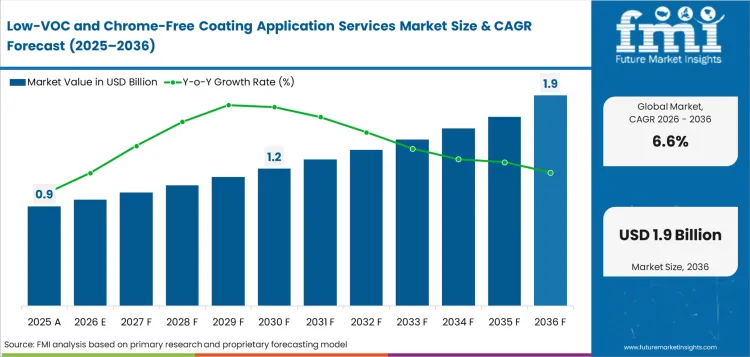
- The low-VOC and chrome-free coating application services market was valued at USD 0.9 billion in 2025.
- Industry revenue is projected to reach USD 1.9 billion by 2036 as factories replace solvent-heavy and Cr(VI)-based coating steps.
- The sector is estimated to expand at 6.6% CAGR from 2026 to 2036 across application conversion and compliance support.
- The industry is projected to create an incremental revenue opportunity of USD 1.0 billion between 2026 and 2036.
- On-site application services are projected to account for 46.0% share in 2026, led by manufacturers needing booth audits and line trials without moving parts.
- Waterborne systems are expected to hold 42.0% share in 2026 since coating shops reduce solvent load without changing every spray process.
- India is projected to record 10.5% CAGR by 2036 as automotive and industrial metal plants add compliant coating programs.
Low-VOC and chrome-free coating application services are moving from compliance support into production line assurance for factories that coat metal parts. USA EPA material from January 2025 stated that the aerosol coatings source category covers about 46 regulated sources. European Commission material from December 2025 stated that chromium trioxide and ten other Cr(VI) substances are under a planned REACH restriction path. Chemetall reported in October 2025 that it introduced a chromium-free and fluoride-free passivation technology for copper foils. Compliance expertise is becoming a direct production qualification tool for coating applicators.
Low-VOC and Chrome-Free Coating Application Services Market Definition
Sector scope covers commercially sold services that apply low-VOC and chrome-free coating systems on industrial parts or production lines. Covered work includes surface cleaning, pre-paint conversion, primer application and cure validation. Revenue scope includes labor contracts and application equipment setup. Booth audits and technical documentation complete part of the revenue boundary. Heavy equipment repainting is excluded unless sold as a compliant coating conversion package.
Low-VOC and Chrome-Free Coating Application Services Market Inclusions
Market scope covers coating application work used by automotive suppliers, aerospace part makers and industrial metal fabricators. Chemistry type and service model form the main segmentation. Substrate type and end use assess how buyers specify the surface and final duty cycle. Compliance need tracks VOC reduction and Cr(VI) substitution. Stakeholders include coating formulators and application contractors. Environmental agencies and OEM approval teams influence final service selection.
Low-VOC and Chrome-Free Coating Application Services Market Exclusions
Study scope excludes standalone coating material sales with no application support. Commodity architectural painting and household paint retail are outside scope. Electroplating services are excluded unless sold as a chrome-free coating replacement. Pure consulting products are excluded unless bundled with line trials or application work. Powder coating material manufacturing is excluded unless the provider sells factory application services.
Low-VOC and Chrome-Free Coating Application Services Market Research Methodology
- Primary Research: FMI analysts reviewed paint shop conversion needs and applicator qualification practices. Interviews focused on booth setup, cure time and documentation requirements.
- Desk Research: Desk research used USA EPA VOC standards and European chemical restriction material. Automotive output and company releases were checked for service triggers.
- Market Sizing and Forecasting: Forecast work combined coating line conversion rates and application service pricing. Country-level vehicle output and aerospace activity were used to adjust regional demand.
- Data Validation: Segment shares were checked against coating technology fit and common metal finishing workflows. Forecast outputs were compared with adjacent pretreatment and corrosion coating sectors.
Why is the Low-VOC and Chrome-Free Coating Application Services Market growing?
- Factories are moving toward low-solvent coating steps so application vendors gain value by reducing permit risk before production lines restart.
- Chrome-free pretreatment is being adopted as buyers need corrosion proof on the exact substrate and cure window.
- Automotive refinish and industrial metal plants need painter training as new chemistries change flash time and sanding behavior.
Regulatory pressure is expected to stay the main driver for coating conversion services during the forecast period. USA EPA finalized aerosol coating amendments in January 2025 under the Clean Air Act. EPA states that aerosol coating standards use VOC reactivity-based limits and encourage less reactive VOC ingredients. Plant teams therefore need help reviewing solvent choices and compliance records before switching materials. Application vendors with test panels and booth audits can reduce approval failure risk during low-VOC coating conversion. Waterborne automobile coating work should gain from this shift as body shops and OEM suppliers seek lower emissions without finish loss.
Chrome-free adoption depends on regulatory risk in aerospace and metal finishing. European Commission material from December 2025 stated that a Cr(VI) restriction under REACH could be adopted by the end of 2027 or the beginning of 2028. Suppliers cannot replace chromate primers without proving corrosion results under real line conditions. Qualification requires salt spray testing and adhesion checks before buyers approve a new coating route. Pretreatment coating application providers gain as buyers look for practical conversion support that limits approval delays.
Market Segmentation Analysis
- Waterborne systems are projected to account for 42.0% share in 2026 since shops reduce solvent exposure while keeping familiar spray methods.
- With an estimated 46.0% share in 2026, on-site application is expected to lead service model use as plants avoid moving qualified parts off line.
- Aluminum surfaces are anticipated to hold 36.0% share in 2026 as aircraft skins and light vehicle parts need corrosion control.
- Industrial metal buyers are projected to push end-use value to 31.0% share in 2026 with fabricated parts requiring repeat finish checks.
- VOC reduction is forecast to capture 39.0% share in 2026 as air permit limits guide chemistry and application choices.
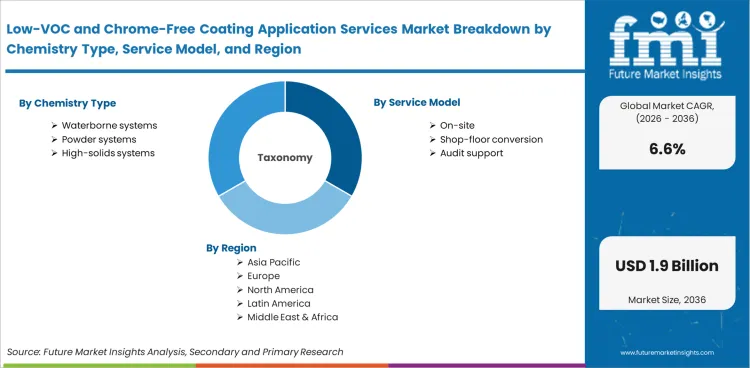
The market is segmented by service type and coating chemistry. Application method, end-use industry and compliance capability complete the scope. Service type segmentation includes surface preparation, coating application and pretreatment conversion. Testing and validation completes the service view. Coating chemistry scope covers waterborne coatings, powder coatings and high-solids coatings. Chrome-free pretreatments complete the chemistry scope. Application method includes spray application, dip coating and electrocoating. End use includes automotive and aerospace buyers. Industrial metal and construction equipment customers complete the buyer scope. Compliance capability covers VOC documentation, REACH support and corrosion testing. Operator training completes the compliance view. Buyers often start with the substrate condition and regulatory exposure. They then choose chemistry, booth setup and qualification route.
Insights into Low-VOC and Chrome-Free Coating Application Services Market by Chemistry Type
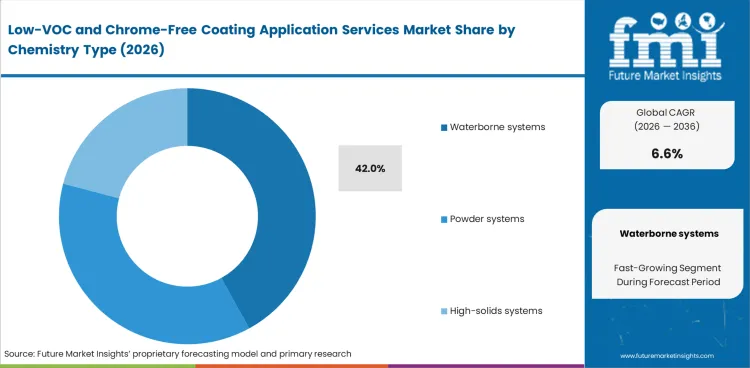
- Waterborne systems are expected to account for 42.0% share in 2026 since applicators reduce solvent load while using familiar guns and booth airflow settings.
- USA EPA aerosol coating amendments in January 2025 reinforced reactivity-based VOC control, making solvent selection a line setup issue for coating technicians.
Insights into Low-VOC and Chrome-Free Coating Application Services Market by Service Model
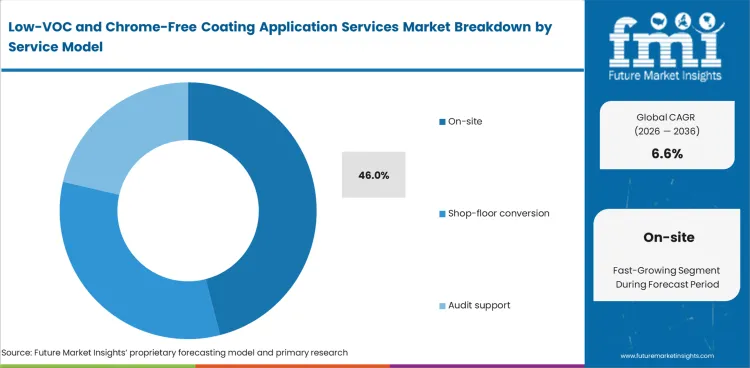
- On-site application is projected to hold 46.0% share in 2026 as buyers require trials around their own pretreatment tanks and operator routines.
- Factory-side work shortens approval cycles since film build and cure defects appear under the same humidity and shift pattern used in production.
Insights into Low-VOC and Chrome-Free Coating Application Services Market by Substrate Type
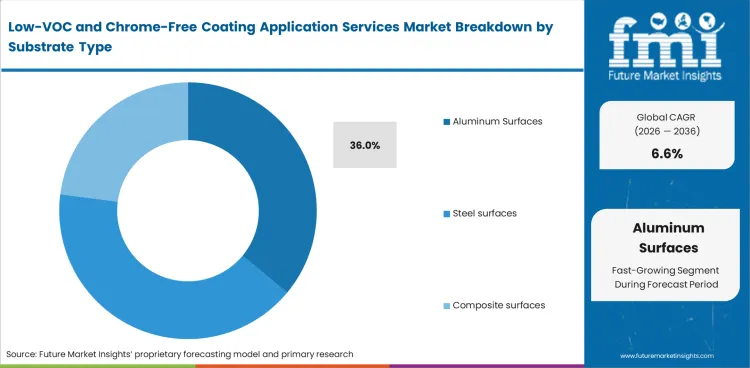
- Aluminum surfaces are anticipated to secure 36.0% share in 2026, reflected by aerospace and light vehicle parts needing corrosion resistance with lower hazardous chemistry.
- Application teams must control deoxidizing and rinse steps carefully since aluminum oxide reforms quickly and can weaken chrome-free primer adhesion.
Insights into Low-VOC and Chrome-Free Coating Application Services Market by End Use
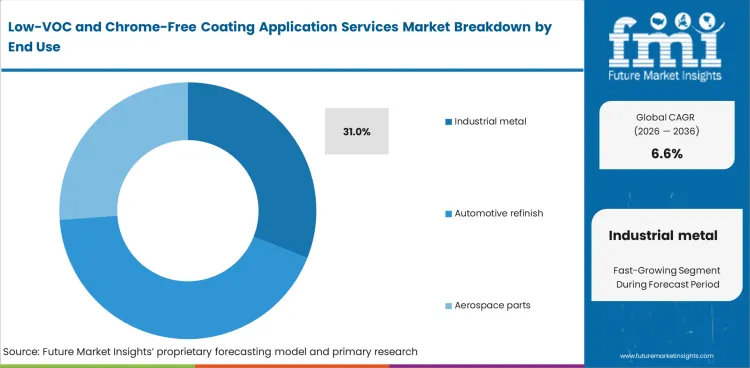
- Industrial metal is forecast to capture 31.0% share in 2026 as fabricators convert shop primers and topcoats for structural steel components.
- PPG introduced a lower-VOC waterborne shop primer in March 2026 curing in two minutes under standard heat, giving fabricators a clear throughput case.
Insights into Low-VOC and Chrome-Free Coating Application Services Market by Compliance Need
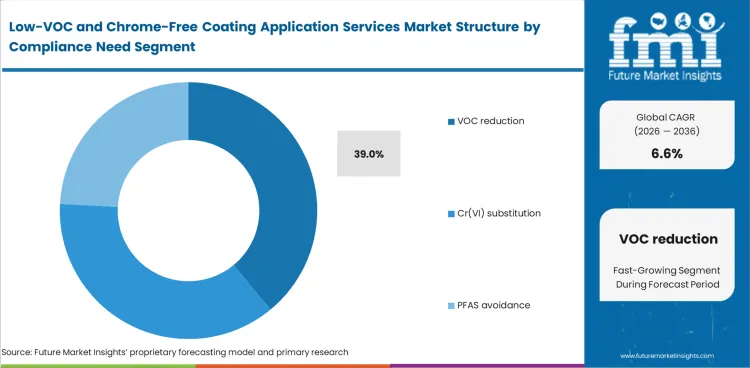
- VOC reduction is estimated to represent 39.0% share in 2026 as air-quality permits make coating chemistry a direct operating constraint.
- Cr(VI) substitution carries a different service burden as applicators are required to prove corrosion life before customers update approved material lists.
Low-VOC and Chrome-Free Coating Application Services Market Drivers, Restraints, and Opportunities
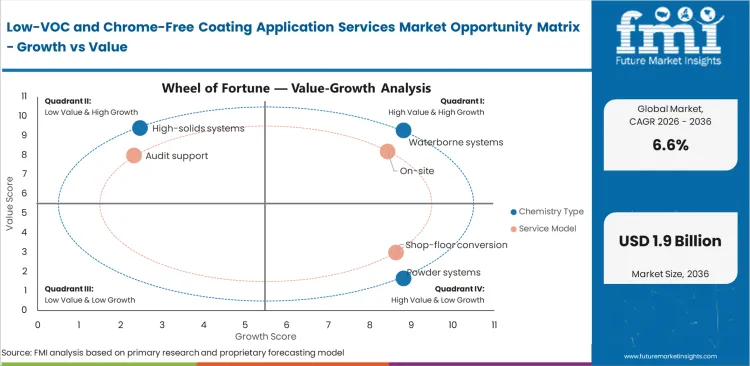
- VOC permit pressure is expected to raise line conversion orders as coating shops replace high-solvent materials with lower-emission systems.
- Chrome-free qualification work is anticipated to create repeat trials since corrosion results change by substrate and cure profile.
- Painter skill gaps are expected to slow adoption as new systems change sanding windows and spray technique.
- Battery foil passivation creates new prospects as copper foil makers need chromium-free surface treatment with stable adhesion.
Low-VOC and chrome-free coating application services are expected to gain stronger order flow as buyers move from coating replacement to full process conversion. USA Environmental Protection Agency stated in January 2025 that the aerosol coatings category includes about 46 regulated sources and uses VOC reactivity-based standards under Clean Air Act authority. That rule raises demand for application vendors able to document solvent mix and cure conditions during material changeovers.
Import Dependence and Trade Flow Analysis
Trade flow exposure is expected to shape the Low-VOC and Chrome-Free Coating Application Services Market as coating converters depend on cross-border access to specialty resins, additives and pretreatment inputs. Eurostat data from September 2025 showed that EU imports of chemicals and related products fell by 1.1% in 2024 while exports increased by 7.0%. EU sold production of chemicals and related products rose to €830 billion in 2024. For coating application vendors, this points to a market in which local service demand can rise even when input supply depends on global chemical flows. Buyers are likely to favor vendors that can manage material substitution, compliance files and supplier continuity during coating conversion programs.
Technology Adoption and Automation Penetration Analysis
Automation penetration is expected to support coating application services as factories seek tighter control over spray quality, curing repeatability and inspection records. International Federation of Robotics data released in September 2025 showed 542,000 industrial robots installed worldwide in 2024. Total industrial robots in operation reached 4,664,000 units in 2024, up 9% from the prior year. Global installations are expected to reach 575,000 units in 2025 and surpass 700,000 units by 2028. Coating service providers can apply robotic spray cells, sensor-based line monitoring and digital work records across industrial finishing plants.
Regional Analysis
.webp "Top Country Growth Comparison Low Voc And Chrome Free Coating Application Services Market Cagr (2026 2036)")
| Country | CAGR 2026 to 2036 |
|---|---|
| India | 10.5% |
| China | 9.4% |
| Germany | 7.8% |
| France | 7.3% |
| United States | 6.9% |
| Japan | 6.5% |
| United Kingdom | 6.2% |
Source: Future Market Insights analysis, 2026.
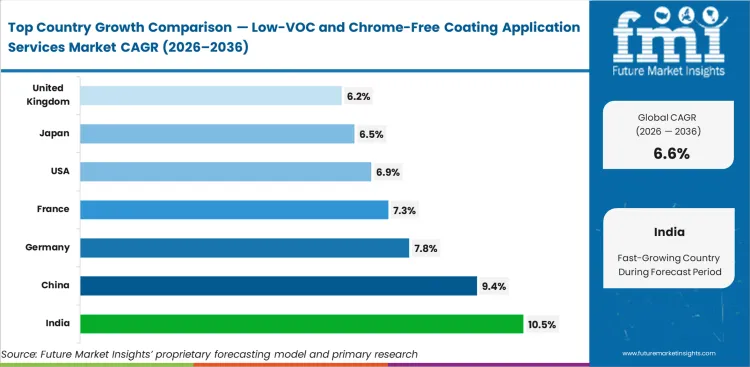
Analysis of Low-VOC and Chrome-Free Coating Application Services Market By Key Countries
- India is projected to record 10.5% CAGR by 2036, led by vehicle suppliers expanding compliant coating lines to serve both domestic production and export programs.
- China is expected to expand at 9.4% CAGR by 2036 as rising EV output increases chrome-free surface treatment demand for aluminum and copper components.
- Germany is forecast to grow at 7.8% CAGR by 2036 as REACH compliance pressure combines with a strong premium automotive supplier base.
- France is expected to advance at 7.3% CAGR by 2036 since aerospace manufacturers and refinish operators require approved low‑emission coating solutions.
- The United States is projected to grow at 6.9% CAGR by 2036 as EPA VOC regulations and aerospace supply-chain conversions support service orders.
- Japan is forecast to record 6.5% CAGR by 2036 as mature automotive plants transition gradually toward lower-emission finishes.
- The United Kingdom is projected to expand at 6.2% CAGR by 2036 as aerospace repainting and specialty metal finishing sustain service demand.
Country performance differs by vehicle output, coating regulation and qualification depth. India and China are forecast above the global pace because automotive and battery supply chains are expanding. Germany and France track near the global pace as REACH pressure supports chrome-free conversion. United States and Japan keep large compliant finishing networks, which supports steady service orders. United Kingdom grows slower while aerospace and defense finishing keep service value meaningful.
Demand Outlook for Low-VOC and Chrome-Free Coating Application Services Market in India
Demand in India is projected to record a 10.5% CAGR by 2036, led by vehicle production and OEM supplier expansion. OICA reported in April 2026 that India produced 6.49 million vehicles in 2025. Higher output creates more paint booths and pretreatment tanks requiring low-VOC and chrome-free validation. Tier suppliers often need line-side trials before OEM approval. Service providers with regional language training material can improve painter adoption across industrial coating teams.
- OEM-linked suppliers need coating trials able to prove corrosion control before moving from solvent-heavy systems to cleaner application routes.
- Painter training becomes important as waterborne and chrome-free systems change drying behavior during repair and component finishing work.
- Local applicators gain business by combining coating trials with documentation supporting export customer checks.
Sales Analysis of Low-VOC and Chrome-Free Coating Application Services Market in China
The market in China is expected to expand at 9.4% CAGR by 2036, reflected by EV output and battery component finishing raising service demand. OICA stated in April 2026 that China produced 16.626 million new-energy vehicles in 2025. Battery and vehicle parts need corrosion control with lower hazardous content. Copper foil and aluminum battery housings create conversion work beyond conventional body paint. Applicators with pilot lines and clean passivation records can access electronics-linked coating buyers.
- Battery component makers need surface treatment routes able to protect copper foil and housings without adding restricted chromium chemistry.
- EV suppliers favor pilot-scale coating support before full line changes as qualification failure can delay customer approval.
- Export-focused factories are expected to prefer applicators connecting low-VOC records with global buyer material rules.
Demand Analysis of Low-VOC and Chrome-Free Coating Application Services Market in Germany
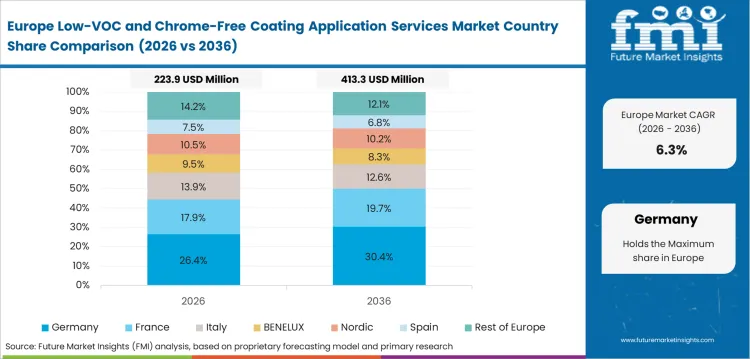
The sector in Germany is expected to advance at 7.8% CAGR by 2036 since regulated coating approvals continue to shape industrial finishing decisions. REACH pressure gives chrome-free services a clearer buying route for metal finishing shops. OICA reported in April 2026 that Germany stayed Europe’s largest production base as European output slipped 0.8% in 2025. Slower output does not remove coating conversion work as suppliers need compliant systems for export platforms. Service providers with aerospace coating documentation skill can support automotive and aviation parts.
- Automotive suppliers need coating conversion support maintaining stable approved film performance during stricter chemical review cycles.
- Aerospace and precision metal buyers place more weight on test evidence before replacing chromate-based pretreatment systems.
- Machinery producers are expected to choose applicators able to document coating durability across repeat production batches.
Opportunity Analysis of Low-VOC and Chrome-Free Coating Application Services Market in France
Demand in France is forecast to grow at 7.3% CAGR by 2036 as aerospace and automotive refinish activity need low-emission coating processes. OICA production data reported French vehicle output at about 1.36 million vehicles in 2024. Aerospace work creates demand for coating systems with controlled corrosion and documentation records. Applicators with chrome-free aircraft coating familiarity can support operators requiring lower hazardous chemistry without approval disruption. Service pricing is expected to reflect testing depth over labor hours.
- Aircraft component suppliers need chrome-free primer trials able to protect corrosion performance during long approval cycles.
- Refinish networks are expected to need low-VOC application training as repair shops adjust spray technique and drying windows.
- Industrial finishing buyers favor service teams supporting cleaner coating systems without slowing production schedules.
Future Outlook for Low-VOC and Chrome-Free Coating Application Services Market in the United States
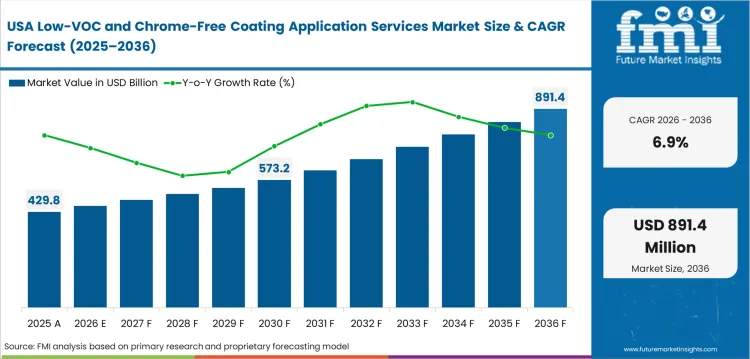
Industry in United States is projected to rise at 6.9% CAGR by 2036 as VOC rules and a large transport equipment base support conversion work. EPA finalized aerosol coating amendments in January 2025 under Clean Air Act authority for ozone-forming VOC control. OICA stated in April 2026 that the United States produced 10.24 million vehicles in 2025. Automotive refinish and aerospace suppliers therefore create a wide service pool for compliant application work. Providers gain when product approval is paired with painter training and booth support.
- Coating shops are expected to raise conversion work as VOC rules push buyers toward lower-emission materials and better records.
- Vehicle suppliers need application partners proving appearance quality and corrosion control before OEM approval.
- Aerospace buyers are likely to favor applicators with audit-ready records for chrome-free coating changes on regulated parts.
Demand Outlook for Low-VOC and Chrome-Free Coating Application Services Market in Japan
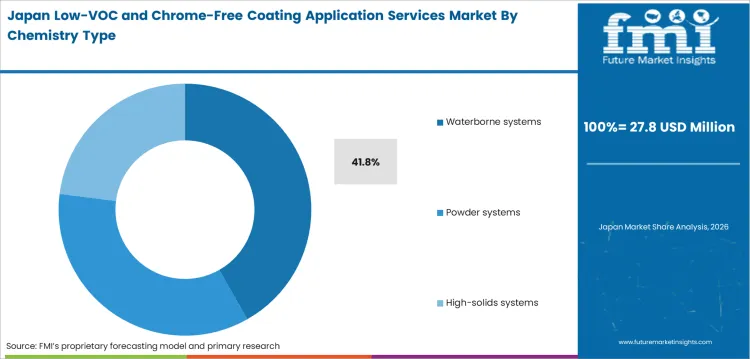
The sector in Japan is expected to post 6.5% CAGR by 2036 as automotive and electronics suppliers keep strict coating approval routines. Coating service demand is mature but technically demanding. OICA reported in April 2026 that Japan produced 8.41 million vehicles in 2025. Such output supports conversion work even as buyers move carefully through qualification cycles. Applicators serving electrical steel coatings and industrial parts need tight cure control. Supplier advantage comes from repeatable documentation and low-defect spray behavior.
- Automotive suppliers are expected to move cautiously toward cleaner coatings as repeat quality weighs heavily in approval decisions.
- Electronics manufacturers need surface treatment control able to protect coated metal parts used in compact high-value assemblies.
- Applicators with precise cure control gain preference as Japanese buyers focus on low-defect finishing across export programs.
In-depth Analysis of Low-VOC and Chrome-Free Coating Application Services Market in the United Kingdom
United Kingdom industry growth is projected to reach 6.2% CAGR by 2036 since aerospace repainting and specialty industrial finishing sustain demand. National vehicle production is smaller than Germany or France but high-value coating approvals remain important. OICA 2024 data show United Kingdom vehicle output near 0.91 million vehicles. Aerospace and defense suppliers add service value as chrome-free changes need controlled evidence before approval. Growth will depend on refinish shop training and stable access to approved chemistries.
- Aerospace and defense suppliers need chrome-free conversion evidence before approving changes on safety-sensitive coated parts.
- Refinish shops are expected to adopt cleaner systems as painter training reduces rework and finish variation.
- Industrial fabricators need protective coating support able to serve energy equipment without adding avoidable compliance risk.
Competitive Landscape and Strategic Positioning
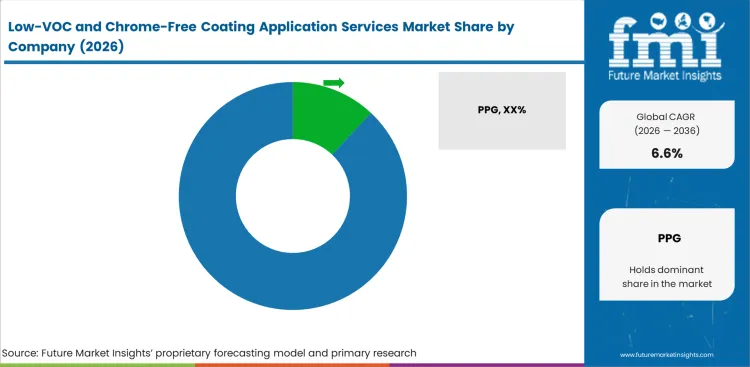
- Competition is shaped by coating chemistry depth and application proof as line trials decide supplier strength across regulated factories.
- PPG and BASF Coatings hold strong positions led by refinish networks and waterborne product support across body shop programs.
- Chemetall and Henkel compete based on surface treatment steps taking place before primer or powder application.
- Entry barriers stay high as buyers need OEM approvals and audited coating records before changing application partners.
Global coating firms and surface treatment specialists hold stronger positions in this market as buyers compare chemistry access and on-site troubleshooting before price. PPG introduced ENVIROLUXE Plus powder coatings in May 2025 with up to 18% recycled plastic content and PFAS-free positioning. Product launches of this kind matter for applicators as factories need materials able to meet both performance and sustainability checks. Service strength depends on lower-emission chemistry able to run at production speed without raising rework risk.
Capability depth separates broad coating providers from local paint contractors, mainly handling routine application work. BASF Coatings announced in January 2025 that BMW Group selected Glasurit and R-M among preferred paint brands in more than 50 markets. Preferred-brand programs pull service work toward providers able to train painters and document repair quality. AkzoNobel and Axalta announced a planned all-stock merger in November 2025 with about USD 25 billion enterprise value. A larger network can improve coating support networks but customers will test applicators on each qualified line.
Specialist vendors are expected to gain work by solving pretreatment and substrate problems which larger suppliers may not handle quickly. Chemetall launched Gardolene D in October 2025 as a chromium-free and fluoride-free passivation solution for copper foils. Battery and electronics users need such type of process as adhesion failure can raise scrap and reduce cell reliability. Smaller applicators can hold ground by serving local plants with fast panels and line audits. Competitive advantage is expected to favor providers combining approved chemistry with field training and reliable coating records.
Key Companies in the Low-VOC and Chrome-Free Coating Application Services Market
Competition spans coating formulators, surface treatment specialists and application service partners serving regulated manufacturing plants.
- Coating formulators: PPG, AkzoNobel and Axalta Coating Systems hold strong positions, led by waterborne and refinish systems. Sherwin-Williams and Nippon Paint add industrial coating breadth across metal fabricators and vehicle service networks. Buyer fit depends on approved product lists and painter training support.
- Surface treatment specialists: BASF Coatings, Chemetall and Henkel compete based on pretreatment chemistry and chrome-free conversion systems. Surface treatment firms are relevant before primer application since cleaning and passivation determine final corrosion results. Substrate knowledge is a core advantage in aluminum and copper foil work.
- Application and regional specialists: Kansai Paint and Hentzen Coatings serve industrial and aerospace buyers depending on approved coatings and technical service. Local applicators support factory trials and booth adjustments. Service quality depends on response speed and documentation satisfying OEM audits.
Competitive Benchmarking: Low-VOC and Chrome-Free Coating Application Services Market
| Company | Low-VOC Application Depth | Chrome-Free Pretreatment Skill | OEM Approval Support | Geographic Footprint |
|---|---|---|---|---|
| PPG | High | Strong | Strong | Global |
| BASF Coatings | High | High | Strong | Global |
| AkzoNobel | High | Strong | Strong | Global |
| Axalta Coating Systems | High | Strong | Medium | Global |
| Chemetall | Strong | High | Strong | Europe and Asia |
| Sherwin-Williams | Strong | Medium | Strong | North America and Europe |
| Henkel | Medium | High | Strong | Global |
| Nippon Paint | Strong | Medium | Medium | Asia and global |
| Kansai Paint | Medium | Medium | Medium | Asia |
| Hentzen Coatings | Medium | Strong | Medium | North America |
Source: Future Market Insights competitive analysis, 2026. Ratings reflect relative positioning based on low-VOC application depth, chrome-free pretreatment skill and OEM approval support.
Key Developments in Low-VOC and Chrome-Free Coating Application Services Market
- In April 2025, Axalta launched next generation Fast Cure Low Energy clearcoat and surfacer products.
- In October 2025, Chemetall launched Gardolene D chromium-free and fluoride-free passivation for copper foils.
- In March 2026, PPG introduced PPG AQUACRON WSP waterborne shop primers for structural steel.
Key Players in the Low-VOC and Chrome-Free Coating Application Services Market
Coating Formulators
- PPG
- AkzoNobel
- Axalta Coating Systems
- Sherwin-Williams
- Nippon Paint
- Kansai Paint
Surface Treatment Specialists
- BASF Coatings
- Chemetall
- Henkel
Aerospace and Industrial Specialists
- Hentzen Coatings
- Mankiewicz
- Tnemec
Report Scope and Coverage
| Item | Value |
|---|---|
| Market value in 2025 | USD 0.9 billion |
| Market value in 2026 | USD 1.0 billion |
| Market value in 2036 | USD 1.9 billion |
| CAGR from 2026 to 2036 | 6.6% CAGR |
| Quantitative units | USD billion |
| Market definition | Application services for low-VOC and chrome-free coating systems used on industrial parts and factory coating lines |
| By chemistry type | Waterborne systems, powder systems, high-solids systems, UV-curable systems |
| By service model | On-site application, shop-floor conversion, audit support, pilot trials |
| By substrate type | Aluminum surfaces, steel surfaces, composite surfaces, copper foils |
| By end use | Industrial metal, automotive refinish, aerospace parts, battery components |
| By compliance need | VOC reduction, Cr(VI) substitution, PFAS avoidance, energy savings |
| Regions covered | North America, Latin America, Western Europe, Eastern Europe, East Asia, South Asia and Pacific, Middle East and Africa |
| Countries covered | India, China, Germany, France, United States, Japan, United Kingdom, and 30+ countries |
| Key companies profiled | PPG, AkzoNobel, Axalta Coating Systems, BASF Coatings, Chemetall, Sherwin-Williams, Henkel, Nippon Paint, Kansai Paint, Hentzen Coatings |
| Forecast period | 2026 to 2036 |
| Approach | Hybrid bottom-up and top-down methodology using verified regulatory signals, production activity and service pricing assumptions |
Source: Future Market Insights, 2026.
Low-VOC and Chrome-Free Coating Application Services Market Breakdown by Service Type, Coating Chemistry, Application Method, End-use Industry, Compliance Capability, and Region
Low-VOC and Chrome-Free Coating Application Services Market Segmented by Chemistry Type
- Waterborne systems
- Powder systems
- High-solids systems
- UV-curable systems
Low-VOC and Chrome-Free Coating Application Services Market Segmented by Service Model
- On-site application
- Shop-floor conversion
- Audit support
- Pilot trials
Low-VOC and Chrome-Free Coating Application Services Market Segmented by Substrate Type
- Aluminum surfaces
- Steel surfaces
- Composite surfaces
- Copper foils
Low-VOC and Chrome-Free Coating Application Services Market Segmented by End Use
- Industrial metal
- Automotive refinish
- Aerospace parts
- Battery components
Low-VOC and Chrome-Free Coating Application Services Market Segmented by Compliance Need
- VOC reduction
- Cr(VI) substitution
- PFAS avoidance
- Energy savings
Low-VOC and Chrome-Free Coating Application Services Market by Region
- North America
- United States
- Canada
- Mexico
- Latin America
- Brazil
- Chile
- Rest of Latin America
- Western Europe
- Germany
- United Kingdom
- Italy
- Spain
- France
- Nordics
- BENELUX
- Rest of Western Europe
- Eastern Europe
- Russia
- Poland
- Hungary
- Balkan and Baltic
- Rest of Eastern Europe
- East Asia
- China
- Japan
- South Korea
- South Asia and Pacific
- India
- ASEAN
- Australia and New Zealand
- Rest of South Asia and Pacific
- Middle East and Africa
- Kingdom of Saudi Arabia
- Other GCC Countries
- Turkiye
- South Africa
- Other African Union
- Rest of Middle East and Africa
Research Sources and Bibliography
- USA Environmental Protection Agency. (2025, January 6). Final amendments to aerosol coatings: National volatile organic compound emission standards.
- European Commission. (2025, December 10). Questions and answers: Potential restriction of Cr(VI) substances.
- Chemetall. (2025, October 9). Chemetall launches first global chromium- and fluoride-free Gardolene D passivation solution for copper foils.
- BASF Coatings. (2025, October 24). Chemetall and Londian Wason partner on chromium- and fluoride-free copper foil passivation.
- PPG. (2026, March 10). PPG introduces PPG AQUACRON WSP shop primers series for structural steel.
- Eurostat. (2025, September 29). EU exports of chemicals reach a new record high.
- International Federation of Robotics. (2025, September). World Robotics 2025 report: Industrial robots.
- International Organization of Motor Vehicle Manufacturers. (2026, April 23). Auto industry growth shifted east in 2025 amid global repositioning.
- Axalta. (2025, April 22). Axalta takes its market-leading Fast Cure Low Energy technology to the next level.
- AkzoNobel. (2025, November 18). AkzoNobel and Axalta to combine in all-stock merger of equals creating a premier global coatings company.
- BASF. (2025, January 14). BASF Coatings enters into a strategic partnership for the aftersales market with BMW Group.
Sources are primary government, regulatory, trade body, robotics association and company publications checked for evidence review.
This Report Answers
- What is the current and future value of the low-VOC and chrome-free coating application services market?
- How fast is the low-VOC and chrome-free coating application services market expected to expand during 2026 to 2036?
- Which chemistry type is expected to hold a leading share in low-VOC and chrome-free coating application services?
- Which service model is projected to account for a leading share in compliant coating application work?
- What operational factors are driving coating shops toward low-VOC and chrome-free application support?
- How do VOC rules and REACH chromium controls change application service buying decisions?
- Which countries are forecast to grow faster in low-VOC and chrome-free coating application services?
- Which companies shape competition in low-VOC and chrome-free coating application services?
- How is the low-VOC and chrome-free coating application services market defined for revenue tracking?
- How does FMI size and forecast service revenue for compliant coating application work?
Frequently Asked Questions
What is the global low-VOC and chrome-free coating application services market size in 2026?
In 2026, the global low-VOC and chrome-free coating application services market is expected to surpass USD 1.0 billion.
What will the low-VOC and chrome-free coating application services market be worth by 2036?
By 2036, the low-VOC and chrome-free coating application services industry is projected to reach USD 1.9 billion worldwide.
What CAGR is expected for the low-VOC and chrome-free coating application services market?
The low-VOC and chrome-free coating application services sector is expected to expand at 6.6% CAGR from 2026 to 2036.
Which chemistry type leads the low-VOC and chrome-free coating application services market?
Waterborne systems are expected to hold 42.0% share in 2026 because of lower solvent load and familiar spray handling.
Which service model leads the low-VOC and chrome-free coating application services market?
On-site application services are projected to account for 46.0% share in 2026, led by factories preferring line-side conversion support.
Which country grows fastest in the low-VOC and chrome-free coating application services market?
India is projected to record 10.5% CAGR by 2036 as vehicle suppliers add compliant coating and pretreatment lines.
What does the low-VOC and chrome-free coating application services market include?
Scope includes application labor, line trials, booth audits and documentation services for lower-VOC and chrome-free coating systems.
How does FMI forecast the low-VOC and chrome-free coating application services market?
FMI uses a hybrid model based on coating line conversion rates, country production signals and service pricing assumptions.
Which low-VOC coating service is best for automotive refinish shops?
Waterborne basecoat conversion is usually the best starting point as it reduces solvent exposure while keeping color-match systems and painter routines close to current practice.
What is the difference between low-VOC and chrome-free coating services?
Low-VOC services focus on reducing solvent emissions. Chrome-free services replace Cr(VI)-based pretreatments or primers and need deeper corrosion testing before approval.
How long does a chrome-free coating conversion take?
A simple line trial can take weeks. Aerospace or OEM-approved work can take months because corrosion tests and customer sign-offs drive the timeline.
Which countries use low-VOC and chrome-free coating services most?
China, United States and Germany use these services heavily because of vehicle output, aerospace work and chemical restrictions affecting coating lines.
What is the main disadvantage of chrome-free coating application?
Approval risk is the main drawback. Buyers must prove corrosion performance on exact substrates before they can replace long-used chromate systems.
Preview the report firsthand - request a free sample
Get SampleGet the brochure for pricing and purchase details.
Get PDFTable of Content
- Key Takeaways
- Market Size and CAGR
- Top Growth Driver
- Fastest Growing Segment
- Leading Region
- Key Companies
- Emerging Opportunities
- Executive Summary
- Global Market Outlook
- Demand-side Trends
- Supply-side Trends
- Technology Roadmap Analysis
- Analysis and Recommendations
- Analyst Perspective (What is happening? Why now? What should investors know?)
- Key Questions Answered
- How large is the market?
- What is the CAGR?
- What are key trends?
- Which region dominates?
- Who are the leaders?
- Market Overview
- Market Coverage / Taxonomy
- Market Definition / Scope / Limitations
- Research Methodology
- Chapter Orientation
- Analytical Lens and Working Hypotheses
- Market Structure, Signals, and Trend Drivers
- Benchmarking and Cross-market Comparability
- Market Sizing, Forecasting, and Opportunity Mapping
- Research Design and Evidence Framework
- Desk Research Programme (Secondary Evidence)
- Expert Input and Fieldwork (Primary Evidence)
- Tooling, Models, and Reference Databases
- Data Engineering and Model Build
- Quality Assurance and Audit Trail
- Market Background
- Market Dynamics (Drivers, Restraints, Opportunity, Trends)
- Scenario Forecast (Optimistic, Likely, Conservative)
- Impact Analysis
- AI Impact
- Sustainability Impact
- Regulatory Impact
- Technology Impact
- Consumer / Buyer Analysis
- Purchase Drivers
- Adoption Barriers
- Buyer Journey
- Opportunity Map Analysis
- Product Life Cycle Analysis
- Supply Chain Analysis
- Investment Feasibility Matrix
- Value Chain Analysis
- PESTLE and Porter's Analysis
- Regulatory Landscape
- Regional Parent Market Outlook
- Production and Consumption Statistics
- Import and Export Statistics
- Global Market Analysis and Forecast, 2021 to 2036
- Historical Market Size Value (USD Billion) & Volume (Unit) Analysis, 2021 to 2025
- Current and Future Market Size Value (USD Billion) & Volume (Unit) Projections, 2026 to 2036
- Y-o-Y Growth Trend Analysis
- Absolute $ Opportunity Analysis
- Global Market Pricing Analysis, 2021 to 2036
- Global Market Analysis and Forecast, By Chemistry Type, 2021 to 2036
- Introduction / Key Findings
- Historical Market Size Value (USD Billion) & Volume (Unit) Analysis By Chemistry Type, 2021 to 2025
- Current and Future Market Size Value (USD Billion) & Volume (Unit) Analysis and Forecast By Chemistry Type, 2026 to 2036
- Waterborne systems
- Powder systems
- High-solids systems
- UV-curable systems
- Waterborne systems
- Y-o-Y Growth Trend Analysis By Chemistry Type, 2021 to 2025
- Absolute $ Opportunity Analysis By Chemistry Type, 2026 to 2036
- Global Market Analysis and Forecast, By Service Model, 2021 to 2036
- Introduction / Key Findings
- Historical Market Size Value (USD Billion) & Volume (Unit) Analysis By Service Model, 2021 to 2025
- Current and Future Market Size Value (USD Billion) & Volume (Unit) Analysis and Forecast By Service Model, 2026 to 2036
- On-site application
- Shop-floor conversion
- Audit support
- Pilot trials
- On-site application
- Y-o-Y Growth Trend Analysis By Service Model, 2021 to 2025
- Absolute $ Opportunity Analysis By Service Model, 2026 to 2036
- Global Market Analysis and Forecast, By Substrate Type, 2021 to 2036
- Introduction / Key Findings
- Historical Market Size Value (USD Billion) & Volume (Unit) Analysis By Substrate Type, 2021 to 2025
- Current and Future Market Size Value (USD Billion) & Volume (Unit) Analysis and Forecast By Substrate Type, 2026 to 2036
- Steel surfaces
- Aluminum surfaces
- Composite surfaces
- Copper foils
- Steel surfaces
- Y-o-Y Growth Trend Analysis By Substrate Type, 2021 to 2025
- Absolute $ Opportunity Analysis By Substrate Type, 2026 to 2036
- Global Market Analysis and Forecast, By End Use, 2021 to 2036
- Introduction / Key Findings
- Historical Market Size Value (USD Billion) & Volume (Unit) Analysis By End Use, 2021 to 2025
- Current and Future Market Size Value (USD Billion) & Volume (Unit) Analysis and Forecast By End Use, 2026 to 2036
- Industrial metal
- Automotive refinish
- Aerospace parts
- Battery components
- Industrial metal
- Y-o-Y Growth Trend Analysis By End Use, 2021 to 2025
- Absolute $ Opportunity Analysis By End Use, 2026 to 2036
- Global Market Analysis and Forecast, By Compliance Need, 2021 to 2036
- Introduction / Key Findings
- Historical Market Size Value (USD Billion) & Volume (Unit) Analysis By Compliance Need, 2021 to 2025
- Current and Future Market Size Value (USD Billion) & Volume (Unit) Analysis and Forecast By Compliance Need, 2026 to 2036
- VOC reduction
- Cr(VI) substitution
- PFAS avoidance
- Energy savings
- VOC reduction
- Y-o-Y Growth Trend Analysis By Compliance Need, 2021 to 2025
- Absolute $ Opportunity Analysis By Compliance Need, 2026 to 2036
- Global Market Analysis and Forecast, By Region, 2021 to 2036
- Introduction
- Historical Market Size Value (USD Billion) & Volume (Unit) Analysis By Region, 2021 to 2025
- Current Market Size Value (USD Billion) & Volume (Unit) Analysis and Forecast By Region, 2026 to 2036
- North America
- Latin America
- Western Europe
- Eastern Europe
- East Asia
- South Asia and Pacific
- Middle East & Africa
- Market Attractiveness Analysis By Region
- North America Market Analysis and Forecast, By Country, 2021 to 2036
- Historical Market Size Value (USD Billion) & Volume (Unit) Trend Analysis By Market Taxonomy, 2021 to 2025
- Market Size Value (USD Billion) & Volume (Unit) Forecast By Market Taxonomy, 2026 to 2036
- By Country
- USA
- Canada
- Mexico
- By Chemistry Type
- By Service Model
- By Substrate Type
- By End Use
- By Compliance Need
- By Country
- Market Attractiveness Analysis
- By Country
- By Chemistry Type
- By Service Model
- By Substrate Type
- By End Use
- By Compliance Need
- Key Takeaways
- Latin America Market Analysis and Forecast, By Country
- Historical Market Size Value (USD Billion) & Volume (Unit) Trend Analysis By Market Taxonomy, 2021 to 2025
- Market Size Value (USD Billion) & Volume (Unit) Forecast By Market Taxonomy, 2026 to 2036
- By Country
- Brazil
- Chile
- Rest of Latin America
- By Chemistry Type
- By Service Model
- By Substrate Type
- By End Use
- By Compliance Need
- By Country
- Market Attractiveness Analysis
- By Country
- By Chemistry Type
- By Service Model
- By Substrate Type
- By End Use
- By Compliance Need
- Key Takeaways
- Western Europe Market Analysis and Forecast, By Country
- Historical Market Size Value (USD Billion) & Volume (Unit) Trend Analysis By Market Taxonomy, 2021 to 2025
- Market Size Value (USD Billion) & Volume (Unit) Forecast By Market Taxonomy, 2026 to 2036
- By Country
- Germany
- UK
- Italy
- Spain
- France
- Nordic
- BENELUX
- Rest of Western Europe
- By Chemistry Type
- By Service Model
- By Substrate Type
- By End Use
- By Compliance Need
- By Country
- Market Attractiveness Analysis
- By Country
- By Chemistry Type
- By Service Model
- By Substrate Type
- By End Use
- By Compliance Need
- Key Takeaways
- Eastern Europe Market Analysis and Forecast, By Country
- Historical Market Size Value (USD Billion) & Volume (Unit) Trend Analysis By Market Taxonomy, 2021 to 2025
- Market Size Value (USD Billion) & Volume (Unit) Forecast By Market Taxonomy, 2026 to 2036
- By Country
- Russia
- Poland
- Hungary
- Balkan & Baltic
- Rest of Eastern Europe
- By Chemistry Type
- By Service Model
- By Substrate Type
- By End Use
- By Compliance Need
- By Country
- Market Attractiveness Analysis
- By Country
- By Chemistry Type
- By Service Model
- By Substrate Type
- By End Use
- By Compliance Need
- Key Takeaways
- East Asia Market Analysis and Forecast, By Country
- Historical Market Size Value (USD Billion) & Volume (Unit) Trend Analysis By Market Taxonomy, 2021 to 2025
- Market Size Value (USD Billion) & Volume (Unit) Forecast By Market Taxonomy, 2026 to 2036
- By Country
- China
- Japan
- South Korea
- By Chemistry Type
- By Service Model
- By Substrate Type
- By End Use
- By Compliance Need
- By Country
- Market Attractiveness Analysis
- By Country
- By Chemistry Type
- By Service Model
- By Substrate Type
- By End Use
- By Compliance Need
- Key Takeaways
- South Asia and Pacific Market Analysis and Forecast, By Country
- Historical Market Size Value (USD Billion) & Volume (Unit) Trend Analysis By Market Taxonomy, 2021 to 2025
- Market Size Value (USD Billion) & Volume (Unit) Forecast By Market Taxonomy, 2026 to 2036
- By Country
- India
- ASEAN
- Australia & New Zealand
- Rest of South Asia and Pacific
- By Chemistry Type
- By Service Model
- By Substrate Type
- By End Use
- By Compliance Need
- By Country
- Market Attractiveness Analysis
- By Country
- By Chemistry Type
- By Service Model
- By Substrate Type
- By End Use
- By Compliance Need
- Key Takeaways
- Middle East & Africa Market Analysis and Forecast, By Country
- Historical Market Size Value (USD Billion) & Volume (Unit) Trend Analysis By Market Taxonomy, 2021 to 2025
- Market Size Value (USD Billion) & Volume (Unit) Forecast By Market Taxonomy, 2026 to 2036
- By Country
- Kingdom of Saudi Arabia
- Other GCC Countries
- Türkiye
- South Africa
- Other African Union
- Rest of Middle East & Africa
- By Chemistry Type
- By Service Model
- By Substrate Type
- By End Use
- By Compliance Need
- By Country
- Market Attractiveness Analysis
- By Country
- By Chemistry Type
- By Service Model
- By Substrate Type
- By End Use
- By Compliance Need
- Key Takeaways
- Key Countries Market Analysis
- USA
- Pricing Analysis
- Market Share Analysis, 2025
- By Chemistry Type
- By Service Model
- By Substrate Type
- By End Use
- By Compliance Need
- Canada
- Pricing Analysis
- Market Share Analysis, 2025
- By Chemistry Type
- By Service Model
- By Substrate Type
- By End Use
- By Compliance Need
- Mexico
- Pricing Analysis
- Market Share Analysis, 2025
- By Chemistry Type
- By Service Model
- By Substrate Type
- By End Use
- By Compliance Need
- Brazil
- Pricing Analysis
- Market Share Analysis, 2025
- By Chemistry Type
- By Service Model
- By Substrate Type
- By End Use
- By Compliance Need
- Chile
- Pricing Analysis
- Market Share Analysis, 2025
- By Chemistry Type
- By Service Model
- By Substrate Type
- By End Use
- By Compliance Need
- Germany
- Pricing Analysis
- Market Share Analysis, 2025
- By Chemistry Type
- By Service Model
- By Substrate Type
- By End Use
- By Compliance Need
- UK
- Pricing Analysis
- Market Share Analysis, 2025
- By Chemistry Type
- By Service Model
- By Substrate Type
- By End Use
- By Compliance Need
- Italy
- Pricing Analysis
- Market Share Analysis, 2025
- By Chemistry Type
- By Service Model
- By Substrate Type
- By End Use
- By Compliance Need
- Spain
- Pricing Analysis
- Market Share Analysis, 2025
- By Chemistry Type
- By Service Model
- By Substrate Type
- By End Use
- By Compliance Need
- France
- Pricing Analysis
- Market Share Analysis, 2025
- By Chemistry Type
- By Service Model
- By Substrate Type
- By End Use
- By Compliance Need
- India
- Pricing Analysis
- Market Share Analysis, 2025
- By Chemistry Type
- By Service Model
- By Substrate Type
- By End Use
- By Compliance Need
- ASEAN
- Pricing Analysis
- Market Share Analysis, 2025
- By Chemistry Type
- By Service Model
- By Substrate Type
- By End Use
- By Compliance Need
- Australia & New Zealand
- Pricing Analysis
- Market Share Analysis, 2025
- By Chemistry Type
- By Service Model
- By Substrate Type
- By End Use
- By Compliance Need
- China
- Pricing Analysis
- Market Share Analysis, 2025
- By Chemistry Type
- By Service Model
- By Substrate Type
- By End Use
- By Compliance Need
- Japan
- Pricing Analysis
- Market Share Analysis, 2025
- By Chemistry Type
- By Service Model
- By Substrate Type
- By End Use
- By Compliance Need
- South Korea
- Pricing Analysis
- Market Share Analysis, 2025
- By Chemistry Type
- By Service Model
- By Substrate Type
- By End Use
- By Compliance Need
- Russia
- Pricing Analysis
- Market Share Analysis, 2025
- By Chemistry Type
- By Service Model
- By Substrate Type
- By End Use
- By Compliance Need
- Poland
- Pricing Analysis
- Market Share Analysis, 2025
- By Chemistry Type
- By Service Model
- By Substrate Type
- By End Use
- By Compliance Need
- Hungary
- Pricing Analysis
- Market Share Analysis, 2025
- By Chemistry Type
- By Service Model
- By Substrate Type
- By End Use
- By Compliance Need
- Kingdom of Saudi Arabia
- Pricing Analysis
- Market Share Analysis, 2025
- By Chemistry Type
- By Service Model
- By Substrate Type
- By End Use
- By Compliance Need
- Türkiye
- Pricing Analysis
- Market Share Analysis, 2025
- By Chemistry Type
- By Service Model
- By Substrate Type
- By End Use
- By Compliance Need
- South Africa
- Pricing Analysis
- Market Share Analysis, 2025
- By Chemistry Type
- By Service Model
- By Substrate Type
- By End Use
- By Compliance Need
- USA
- Market Structure Analysis
- Competition Dashboard
- Competition Benchmarking
- Market Share Analysis of Top Players
- By Regional
- By Chemistry Type
- By Service Model
- By Substrate Type
- By End Use
- By Compliance Need
- Emerging Startups
- Innovation Benchmarking
- Competition Analysis
- Competition Deep Dive
- PPG
- Overview
- Product Portfolio
- Profitability by Market Segments (Product/Region/Sales Channel)
- Sales Footprint
- Strategy Overview
- Marketing Strategy
- Product Strategy
- Channel Strategy
- AkzoNobel
- Axalta Coating Systems
- Sherwin-Williams
- Nippon Paint
- Kansai Paint
- BASF Coatings
- Chemetall
- Henkel
- Hentzen Coatings
- Mankiewicz
- Tnemec
- PPG
- Case Studies
- Success Stories
- Recent Developments
- Competition Deep Dive
- Assumptions & Acronyms Used


