

- Industry Size (2026)
- USD 262.84 Mn
- Forecast (2036)
- USD 397.02 Mn
- CAGR (2026 to 2036)
- 4.2%
Bandsaw Machines Outlook in the UK 2026 to 2036
Demand for bandsaw machines in the UK is projected at USD 262.84 million in 2026 and is expected to reach USD 397.02 million by 2036, expanding at a 4.2% CAGR. The day-to-day cutting, fabrication, and production planning decisions taken by metalworking shops, automotive component suppliers, contract manufacturers, furniture makers, and general manufacturing units define this demand curve.
Bandsaw machines sit inside production environments where cut quality, kerf control, repeatability, and uptime determine throughput. Buyers judge performance in minutes saved per cut, blade life stability, rework reduction, and how well the machine holds tolerance during long runs. Factory leaders prioritise systems that can maintain feed stability across mixed material batches, reduce operator effort through intuitive controls, and protect cut consistency when jobs move across shifts.
For technology service providers and shop-floor leaders, the purchasing conversation rarely stays limited to the saw itself. Decisions link to blade selection, coolant management, guarding and safety compliance, and service response capability. The ability to standardise machine settings across sites, train operators quickly, and keep maintenance predictable supports adoption across both large plants and smaller job shops.
Quick Stats for Bandsaw Machines Demand in the UK
- Bandsaw Machines Valuation in the UK (2026): USD 262.84 million
- Bandsaw Machines Forecast Valuation in the UK (2036): USD 397.02 million
- Bandsaw Machines Forecast CAGR (2026 to 2036): 4.2%
- Leading Regional Growth: England (4.6%)
- Leading End Use: Metalworking (37.0% share)
- Leading Motor Power: Medium Duty (45.0% share)
- Leading Orientation: Horizontal (55.0% share)
- Leading Cutting Range: Upto 200 mm (35% share)
- Leading Operation: Manual (56.0% share)
- Key Companies Profiled: Starrett (The L.S. Starrett Companies); KASTO Maschinenbau GmbH & Co. KG; Cosen Saws; HE&M Saw; ITL Industries Ltd.
Bandsaw Machines Industry in the UK Key Takeaways
| Metric | Value |
|---|---|
| Industry Value (2026) | USD 262.84 million |
| Industry Forecast Value (2036) | USD 397.02 million |
| Forecast CAGR 2026 to 2036 | 4.2% |
Why is the UK Building Steady Demand for Bandsaw Machines?
Demand in the UK grows as production leaders keep sharpening cost control, cut accuracy, and throughput reliability. Shops face pressure to deliver consistent parts with fewer iterations, especially where downstream operations such as welding, machining, and finishing depend on predictable cut geometry. A stable cut reduces fit-up time, improves joint alignment, and supports cleaner downstream processing.
Manufacturing momentum also influences procurement cycles. Official UK production data reported that manufacturing output rose by 0.5% in October 2025 compared with the previous month, reflecting broad-based movement across production activity. In this environment, operations teams focus on equipment that prevents bottlenecks and protects schedule discipline.
Cutting strategies also evolve with application mix. Fabricators handling structural work, heavy sections, and mixed alloys evaluate machine rigidity and blade tracking stability. Woodworking businesses care more about finish quality, kerf discipline, and operator safety in high-contact environments. Many buyers also cross-check bandsaw investments against adjacent cutting choices such as panel saw configurations used in high-throughput sheet processing when production lines handle both metal and wood workflows.
Procurement decisions are also shaped by safety and compliance expectations. UK guidance on narrow band saws highlights the importance of guarding to reduce blade contact risk and prevent blade ejection if a blade snaps. This pushes buyers to value equipment designs with better guarding, clearer operator controls, and service support that keeps safety components in reliable condition.
How is Bandsaw Machines Demand Segmented by End Use, Motor Power, Orientation, Cutting Range, and Operation?
The segmentation of the bandsaw machines industry in the UK reflects how production teams assign cutting tasks, balance capex with productivity goals, and manage workforce capability.
Why does metalworking remain the primary demand centre for bandsaw machines in the UK?
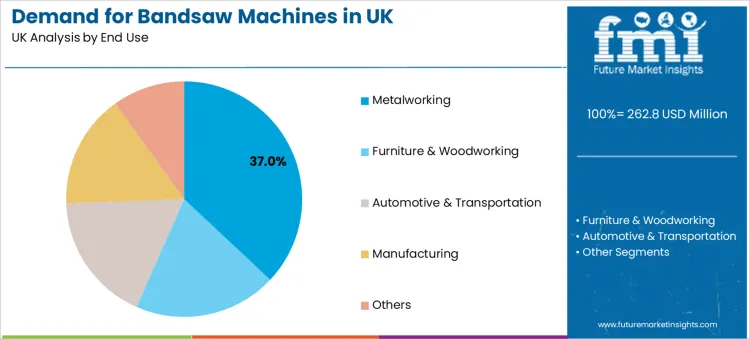
Metalworking holds a 37.0% share, making it the leading end-use segment. This reflects ongoing requirements for straight cuts, repeatable workholding, and consistent sectioning across bars, tubes, profiles, and plate-derived blanks. For owners of fabrication facilities, the main purchasing priority is cut stability that keeps downstream welding, machining, or assembly steps predictable.
Metalworking teams also value reliable blade tension control and feed regulation because they reduce variation across operators. In many factories, cutting strategy planning also aligns with sawing and cutting tools used for broader process efficiency where tool-life management affects unit economics.
What makes medium duty motor power the most selected option for mixed job profiles?
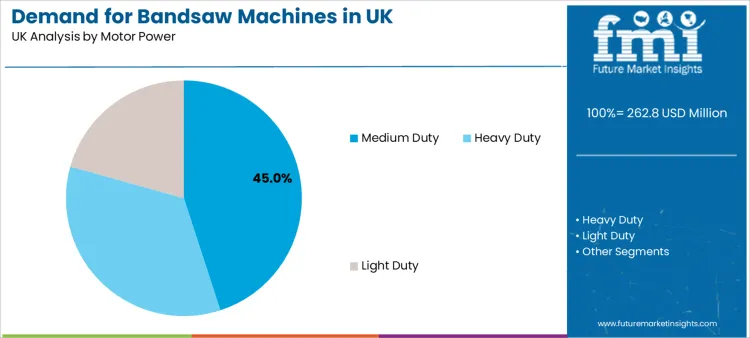
Medium duty accounts for a 45.0% share, reflecting how many UK operations run varied job lots that require both flexibility and durability. Medium duty systems offer enough cutting power for routine production tasks without forcing buyers into heavy-duty cost structures designed for extreme thickness.
This segment fits job shops that switch materials frequently, where cut quality consistency matters more than peak power. The segment also supports organisations that need stable torque response under load while keeping maintenance manageable through standard parts and service intervals.
Why are horizontal bandsaw setups preferred for production-led cutting routines?
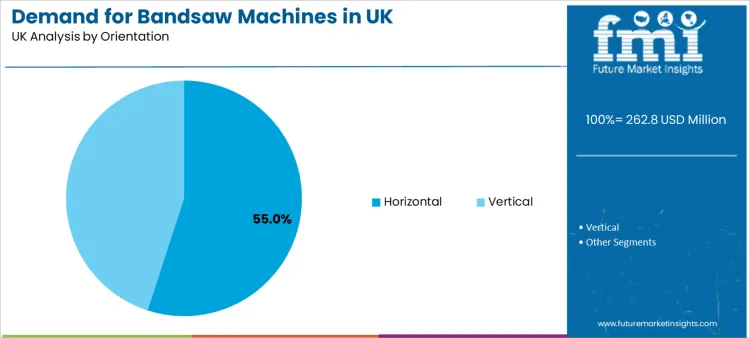
Horizontal orientation leads with a 55.0% share, driven by operational simplicity and repeatable throughput in many workshops. Horizontal configurations are frequently chosen for straight cuts, batch processing, and workflow layouts where material feed and part handling must remain efficient.
They also support safer operation for routine sectioning, since work pieces can be supported and clamped more securely. Many engineering teams pair this choice with blade strategy planning, including saw blades selected for stable wear behaviour when cut quality must remain consistent across long runs.
What is keeping Upto 200 mm as the most common cutting range requirement?
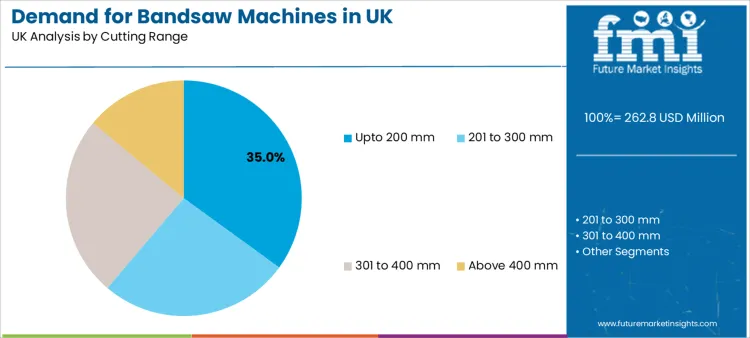
The upto 200 mm cutting range holds a 35% share, indicating that a large portion of UK demand sits in standard-size components rather than extreme heavy-section cutting. This range fits many profiles used in general manufacturing, automotive subassemblies, and maintenance operations.
Buyers often prioritise accuracy, minimal burr formation, and faster cycle control in this band. Cutting range selection is also linked to blade material choices where high-speed steel metal cutting tools influence broader procurement thinking around durability and repeatability.
Why does manual operation continue to dominate installation choices across UK sites?
Manual operation represents a 56.0% share, reflecting the reality that many UK workshops still optimise around operator-led control, flexible scheduling, and lower automation complexity. Manual systems remain attractive where job variety is high and where teams want fast setup changes without programming requirements. They also suit smaller facilities that prioritise reliability and serviceability over high automation density.
In many cases, manual bandsaw systems are paired with improved fixtures, better blade selection, and disciplined preventive maintenance to raise output without full automation upgrades. Tooling strategies in these workshops also connect to carbide tool choices used in precision-heavy cutting environments where durability supports cost control.
What are the Dynamics, Restraints, Opportunities, and Threats Shaping this Space?
What dynamics keep procurement active across both high-volume and job-shop environments?
Productivity discipline drives demand. Operations leaders want stable cut performance, predictable blade wear, and reduced operator fatigue. Maintenance managers prefer equipment designed for fast blade changes, stable tracking, and easier alignment checks.
Engineering teams look for repeatable cut geometry that lowers rejection rates. Formal safety expectations also remain a driver. Risk assessment principles embedded in ISO 12100 support structured evaluation of hazards and risk reduction during machine design and selection.
What restraints slow upgrade decisions for some buyers?
Upfront investment friction remains common, especially for smaller workshops balancing multiple equipment priorities. Training limits can also slow adoption of advanced features, since cutting performance improves only when operators run the machine correctly and maintain blade discipline.
Compliance burdens shape buying behaviour too. UK guidance on the Supply of Machinery (Safety) Regulations sets requirements that must be met before machinery is placed on the GB system or put into service. Buyers therefore pay close attention to documentation, conformity readiness, and supplier support.
Where are the strongest opportunities for suppliers and integrators?
Service-led differentiation is a major opportunity. Suppliers that provide fast service response, strong spare parts availability, and clear operator training win trust. Another opportunity sits in pairing equipment with better cutting consumables and tooling strategies.
Organisations that align bandsaw cutting with upstream and downstream processing often evaluate companion equipment such as timber cutting machine options for production facilities running wood workflows and adjacent tooling such as circular saw blade solutions for high-speed cutting requirements.
What threats can disrupt demand expectations?
Inconsistent production investment cycles can limit capex, especially when workshops delay equipment refresh and extend machine life. Supply chain disruption for blades and spare parts can also affect uptime confidence. Safety incidents remain a risk factor.
If guarding, maintenance, or operator habits degrade, sites face downtime and compliance exposure. This keeps attention on machine guarding discipline and operator protection guidance in UK woodworking and fabrication contexts.
How is Bandsaw Machines Demand Evolving across Key Regions in the UK?
Regional growth varies based on concentration of fabrication facilities, manufacturing intensity, project pipelines, and service support coverage.
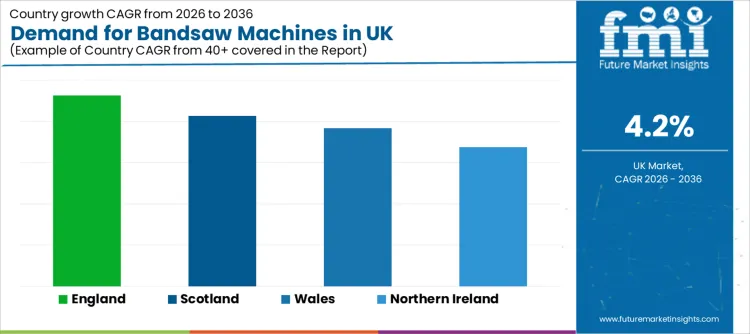
| Region | CAGR (2026-2036) |
|---|---|
| England | 4.6% |
| Scotland | 4.1% |
| Wales | 3.8% |
| Northern Ireland | 3.4% |
Why is England leading demand through manufacturing density and faster replacement cycles?
England grows at 4.6%, supported by higher concentration of manufacturing and fabrication activity across industrial corridors. Larger supplier ecosystems and stronger service coverage improve confidence in maintenance response. Many plants also standardise cutting workflows, which increases adoption for machines that reduce variance and support repeatable performance across shifts.
How is Scotland sustaining demand through steady fabrication workflows and reliability-focused buying?
Scotland expands at 4.1%, shaped by steady equipment replacement and practical investment decisions that prioritise durability. Buyers often focus on stable cut output, predictable servicing, and machine designs that perform consistently in mixed workload environments.
What is shaping Wales as it advances demand through cost discipline and multi-use equipment selection?
Wales grows at 3.8%, driven by workshops that prioritise flexible machine utilisation and manageable operating costs. Buyers often select configurations that support varied applications without high complexity, favouring equipment that performs reliably across a wide range of job types.
Why is Northern Ireland progressing with measured adoption centred on proven configurations?
Northern Ireland rises at 3.4%, reflecting careful, value-driven upgrades. Procurement teams frequently prioritise proven operating setups, clear service support, and machines that reduce downtime risk. Adoption grows fastest when suppliers provide installation confidence, training support, and dependable parts supply.
What Defines the Competitive Landscape for Bandsaw Machines in the UK?
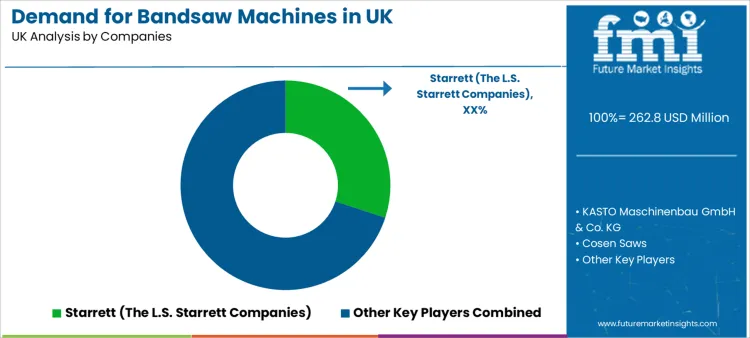
Competition is shaped by cut reliability, service responsiveness, lifecycle cost control, and the ability to support consistent outcomes across different operating environments. Buyers evaluate suppliers on practical factors such as machine rigidity, blade handling stability, ease of alignment, and how quickly the vendor can restore uptime when wear or failures occur.
Starrett is associated with precision measurement heritage and equipment portfolios that support quality-focused workshops. KASTO Maschinenbau GmbH & Co. KG competes through engineered systems suited to structured production routines and consistent cut performance. Cosen Saws provides solutions aligned with a wide range of workshop requirements, with attention to usability and reliability.
HE&M Saw is positioned in bandsaw solutions suited to fabrication environments where durable cutting performance matters. ITL Industries Ltd. contributes to the landscape through equipment availability and application fit across varied customer requirements.
Key Industry Participants
- Starrett (The L.S. Starrett Companies)
- KASTO Maschinenbau GmbH & Co. KG
- Cosen Saws
- HE&M Saw
- ITL Industries Ltd.
Scope of Report
| Items | Values |
|---|---|
| Quantitative Units | USD Million |
| End Use | Metalworking; Furniture & Woodworking; Automotive & Transportation; Manufacturing; Others |
| Motor Power | Medium Duty; Heavy Duty; Light Duty |
| Orientation | Horizontal; Vertical |
| Cutting Range | Upto 200 mm; 201 to 300 mm; 301 to 400 mm; Above 400 mm |
| Operation | Manual; Automated |
| Regions Covered | England; Scotland; Wales; Northern Ireland |
| Key Companies Profiled | Starrett (The L.S. Starrett Companies); KASTO Maschinenbau GmbH & Co. KG; Cosen Saws; HE&M Saw; ITL Industries Ltd. |
Bandsaw Machines Demand in the UK by Segment
By End Use:
- Metalworking
- Furniture & Woodworking
- Automotive & Transportation
- Manufacturing
- Others
By Motor Power:
- Medium Duty
- Heavy Duty
- Light Duty
By Orientation:
- Horizontal
- Vertical
By Cutting Range:
- Upto 200 mm
- 201 to 300 mm
- 301 to 400 mm
- Above 400 mm
By Operation:
- Manual
- Automated
By Region:
- England
- Scotland
- Wales
- Northern Ireland
Bibliography
- Health and Safety Executive. (2024). Narrow band saw (woodworking machinery safety guidance).
- International Organization for Standardization. (2010). ISO 12100:2010 Safety of machinery: General principles for design, risk assessment and risk reduction.
- Office for National Statistics. (2025). Index of Production, UK: October 2025.
- UK Government. (2008). The Supply of Machinery (Safety) Regulations 2008 (UKSI 2008/1597).
- UK Government. (2022). Supply of Machinery (Safety) Regulations 2008: Great Britain (guidance).
Frequently Asked Questions
What is the outlook for the Bandsaw Machines Industry in the UK for 2026?
The bandsaw machines industry in the UK is expected to total USD 262.84 million in 2026.
What value is expected for the Bandsaw Machines Industry in UK for 2036?
In 2036, demand for bandsaw machines in UK will likely be valued at USD 397.02 million.
At what rate will the Bandsaw Machines Industry in UK progress from 2026 to 2036?
The bandsaw machines landscape in UK is anticipated to advance at a 4.2% CAGR from 2026 to 2036.
Which end use will constitute the bulk of all Bandsaw Machines deployment in UK?
Metalworking is likely to be the dominant bandsaw machines end-user, capturing 37% of the total revenue in 2026.
Which Bandsaw Machines are expected to be most preferred in the UK by end-use industries based on motor power?
By motor power, medium duty bandsaw machines will account for 45% of all uses by key industrial users.
Preview the report firsthand - request a free sample
Get SampleGet the brochure for pricing and purchase details.
Get PDFTable of Content
- Executive Summary
- UK Market Outlook
- Demand-side Trends
- Supply-side Trends
- Technology Roadmap Analysis
- Analysis and Recommendations
- Market Overview
- Market Coverage / Taxonomy
- Market Definition / Scope / Limitations
- Market Background
- Market Dynamics
- Drivers
- Restraints
- Opportunity
- Trends
- Scenario Forecast
- Demand in Optimistic Scenario
- Demand in Likely Scenario
- Demand in Conservative Scenario
- Opportunity Map Analysis
- Product Life Cycle Analysis
- Supply Chain Analysis
- Investment Feasibility Matrix
- Value Chain Analysis
- PESTLE and Porter’s Analysis
- Regulatory Landscape
- Regional Parent Market Outlook
- Production and Consumption Statistics
- Import and Export Statistics
- Market Dynamics
- UK Market Analysis 2021 to 2025 and Forecast, 2026 to 2036
- Historical Market Size Value (USD Million) Analysis, 2021 to 2025
- Current and Future Market Size Value (USD Million) Projections, 2026 to 2036
- Y-o-Y Growth Trend Analysis
- Absolute $ Opportunity Analysis
- UK Market Pricing Analysis 2021 to 2025 and Forecast 2026 to 2036
- UK Market Analysis 2021 to 2025 and Forecast 2026 to 2036, By End Use
- Introduction / Key Findings
- Historical Market Size Value (USD Million) Analysis By End Use , 2021 to 2025
- Current and Future Market Size Value (USD Million) Analysis and Forecast By End Use , 2026 to 2036
- Metalworking
- Furniture & Woodworking
- Automotive & Transportation
- Manufacturing
- Others
- Metalworking
- Y-o-Y Growth Trend Analysis By End Use , 2021 to 2025
- Absolute $ Opportunity Analysis By End Use , 2026 to 2036
- UK Market Analysis 2021 to 2025 and Forecast 2026 to 2036, By Motor Power
- Introduction / Key Findings
- Historical Market Size Value (USD Million) Analysis By Motor Power, 2021 to 2025
- Current and Future Market Size Value (USD Million) Analysis and Forecast By Motor Power, 2026 to 2036
- Medium Duty
- Heavy Duty
- Light Duty
- Medium Duty
- Y-o-Y Growth Trend Analysis By Motor Power, 2021 to 2025
- Absolute $ Opportunity Analysis By Motor Power, 2026 to 2036
- UK Market Analysis 2021 to 2025 and Forecast 2026 to 2036, By Orientation
- Introduction / Key Findings
- Historical Market Size Value (USD Million) Analysis By Orientation, 2021 to 2025
- Current and Future Market Size Value (USD Million) Analysis and Forecast By Orientation, 2026 to 2036
- Horizontal
- Vertical
- Horizontal
- Y-o-Y Growth Trend Analysis By Orientation, 2021 to 2025
- Absolute $ Opportunity Analysis By Orientation, 2026 to 2036
- UK Market Analysis 2021 to 2025 and Forecast 2026 to 2036, By Cutting Range
- Introduction / Key Findings
- Historical Market Size Value (USD Million) Analysis By Cutting Range, 2021 to 2025
- Current and Future Market Size Value (USD Million) Analysis and Forecast By Cutting Range, 2026 to 2036
- Upto 200 mm
- 201 to 300 mm
- 301 to 400 mm
- Above 400 mm
- Upto 200 mm
- Y-o-Y Growth Trend Analysis By Cutting Range, 2021 to 2025
- Absolute $ Opportunity Analysis By Cutting Range, 2026 to 2036
- UK Market Analysis 2021 to 2025 and Forecast 2026 to 2036, By Operation
- Introduction / Key Findings
- Historical Market Size Value (USD Million) Analysis By Operation, 2021 to 2025
- Current and Future Market Size Value (USD Million) Analysis and Forecast By Operation, 2026 to 2036
- Manual
- Automated
- Manual
- Y-o-Y Growth Trend Analysis By Operation, 2021 to 2025
- Absolute $ Opportunity Analysis By Operation, 2026 to 2036
- Market Structure Analysis
- Competition Dashboard
- Competition Benchmarking
- Market Share Analysis of Top Players
- By Regional
- By End Use
- By Motor Power
- By Orientation
- By Cutting Range
- By Operation
- Competition Analysis
- Competition Deep Dive
- Starrett (The L.S. Starrett Companies)
- Overview
- Product Portfolio
- Profitability by Market Segments (Product/Age /Sales Channel/Region)
- Sales Footprint
- Strategy Overview
- Marketing Strategy
- Product Strategy
- Channel Strategy
- KASTO Maschinenbau GmbH & Co. KG
- Cosen Saws
- HE&M Saw
- ITL Industries Ltd.
- Starrett (The L.S. Starrett Companies)
- Competition Deep Dive
- Assumptions & Acronyms Used
- Research Methodology


