

- Industry Size (2026)
- USD 420.2 Bn
- Forecast (2036)
- USD 120.6 Bn
- CAGR (2026 to 2036)
- 13.3%
Automotive Telematics Sales Analysis in APAC Forecast and Outlook 2026 to 2036
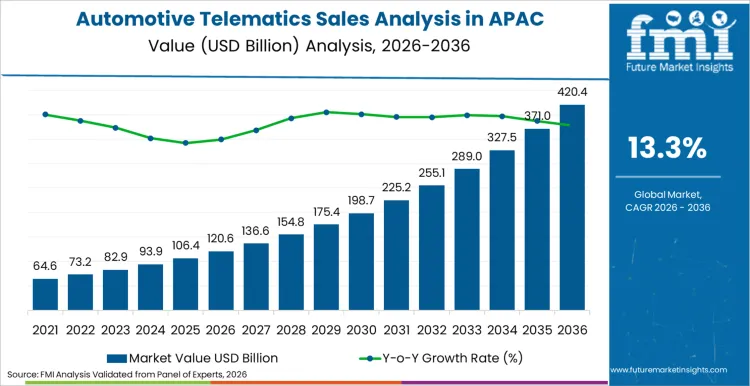
Automotive telematics sales in APAC are valued at USD 120.6 Billion in 2026 and are projected to reach USD 420.2 Billion by 2036, expanding at a 13.3% CAGR. FMI treats this expansion as a supplier and OEM monetisation shift from device-led deployments to software, services, and platform attach that scale with the connected vehicle parc, not with new vehicle cycles alone.
Supplier disclosures show capital and portfolio actions consistent with telematics becoming a core software revenue pool. Bosch stated that it expects to generate sales of more than €6 billion with software and services by the beginning of the next decade, with two-thirds in Mobility, and Stefan Hartung added: “AI has also become an integral part of our products and solutions.” This is a structural signal that telematics value is increasingly captured through software-defined features, lifecycle services, and data-driven operations.
Continental’s investor communications also signal a sharper focus on value creation and operating discipline as the group reorganises for a more software-centric automotive stack. CEO Nikolai Setzer stated: “Our priority is to create value.” In its Q2 2025 results communication, Continental disclosed that a listing of Automotive on the stock exchange was planned for September 18, 2025, and CFO Olaf Schick stated: “We continue to see solid earnings in all areas.”
On the platform side, HARMAN is positioning collaboration as the execution model for in-vehicle software ecosystems. Christian Sobottka, President of HARMAN Automotive, stated: “collaboration is the key to unlocking everyone’s full potential.” This reinforces an APAC reality where telematics scale comes from ecosystem integration across OEMs, suppliers, and software partners.
Summary of Automotive Telematics Sales Analysis in APAC
- The APAC automotive telematics market comprises portable and embedded telematics devices, connectivity modules, and software platforms that collect and operationalise vehicle data for safety, compliance, fleet productivity, diagnostics, and subscription-based services.
- The defined scope follows FMI taxonomy across product type and application in China, Japan, South Korea, India, ASEAN, and Rest of APAC, excluding standalone infotainment services, pure ADAS without telematics data services, and non-automotive asset tracking systems.
- The market is projected to grow at a 13.3% CAGR from 2026 to 2036, expanding from USD 120.6 billion in 2026 to USD 420.2 billion by 2036, based on installed-base growth of connected vehicles, compliance-driven tracking mandates, and recurring software and managed service monetisation.
- The sector is transitioning from device-led deployments to software-defined, subscription-backed platforms where portable telematics (58.0% share) and motion-linked applications such as velocity and displacement measurement (64.0% share) anchor revenue intensity.
- Competition includes Continental, Bosch Mobility Solutions, HARMAN, Teltonika, Trimble, Geotab, MiX Telematics, TomTom Telematics, and Verizon Connect, with platform scale, OEM integration, and in-country data governance compliance shaping leadership.
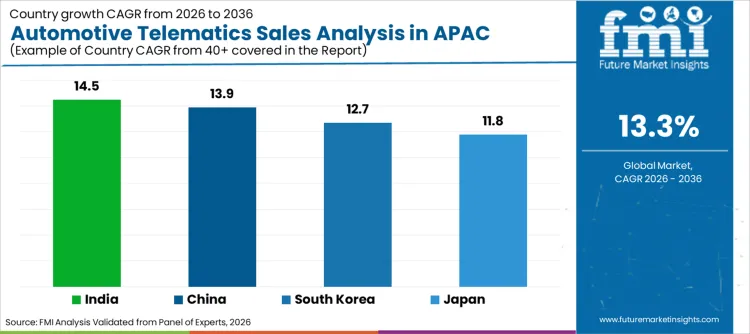
- India leads growth at 14.5% CAGR, followed by China at 13.9%, while South Korea (12.7%) and Japan (11.8%) expand through governance-aligned, software-driven telematics monetisation.
Automotive Telematics Sales Analysis in APAC Key Takeaways
| Metric | Value (USD Billion) |
|---|---|
| Market Size 2026 | USD 120.6 billion |
| Forecast Value 2036 | USD 420.2 billion |
| CAGR (2026 to 2036) | 13.3% |
What is driving growth in the automotive telematics sales analysis in APAC?
Regulatory tracking requirements and emergency response expectations are converting into compulsory device fitment and backend integration, expanding the addressable installed base for telematics vendors in APAC. India’s MoRTH notifications requiring vehicle tracking system devices as per AIS 140 for specified vehicles create non-discretionary adoption that pulls hardware sales and platform subscriptions into the same funnel. In China, automotive data security and cross-border transfer controls are tightening how connected vehicle data is collected, stored, and transferred, pushing OEMs and suppliers toward compliant in-country architectures and higher-value telematics platforms with governance features. On the supply side, tier-1s are explicitly scaling software and services as the monetisation layer, with Bosch signalling multi-billion-euro software and services ambitions tied to Mobility, reinforcing recurring revenue models that expand beyond one-time device sales.
How is the Automotive Telematics Sales Analysis in APAC Segmented?
Automotive telematics sales in APAC are segmented by product type, application, and country to reflect how deployment flexibility, data intensity, and regulatory structures shape adoption pathways. By product type, the market includes portable and handheld telematics systems, with portable deployments leading due to retrofit scalability across mixed-age and multi-brand fleets. By application, demand is concentrated in velocity and displacement measurement and vibration monitoring, where continuous motion data directly supports compliance, safety scoring, routing optimisation, fuel control, and predictive maintenance workflows. By country, adoption patterns differ across India, China, Japan, and South Korea, reflecting regulatory enforcement intensity, OEM embedded connectivity baselines, and data governance architecture.
FMI analysis suggests that while software-defined vehicle platforms are accelerating monetisation through recurring services, the market structure remains anchored in motion-linked telemetry as the core data layer. This segmentation highlights a dual-structure market where portable hardware enables rapid installed-base expansion while software and subscription layers deepen lifecycle revenue capture across the connected vehicle parc.
Why do portable telematics deployments lead buying decisions across APAC fleets?
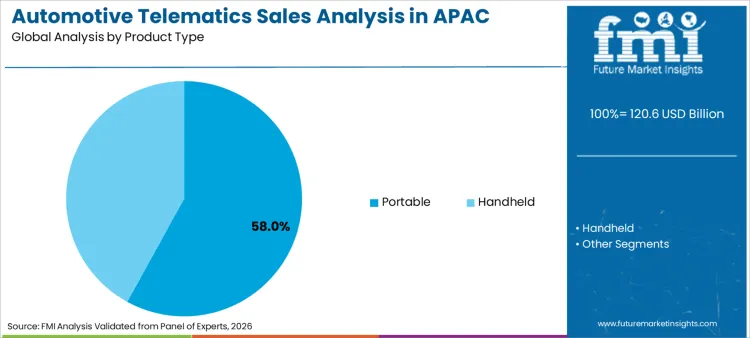
Portable telematics leads with 58% market share because APAC fleet composition skews mixed-age and multi-brand, which rewards retrofit-first deployment that avoids waiting for OEM embedded cycles. This preference is reinforced by commercial execution moves that expand local onboarding capacity and channel coverage, such as Geotab’s acquisition of Verizon Connect’s commercial operations in Australia, which immediately adds in-market sales and support scale and targets small to mid-sized fleets where portable deployments dominate early-stage digitisation. Supplier roadmaps are also converging toward modular platform stacks where sensing, connectivity, and software services are bundled, increasing the value of portable nodes that can be standardised across fleet classes. HARMAN’s intent to integrate ZF’s ADAS capabilities into cross-domain automotive electronics is a structural signal that vendors are prioritising scalable platforms that can be deployed broadly and monetised through software-defined features over time. The result is a buying centre that treats portable telematics as the fastest route to measurable ROI and policy compliance.
Why does velocity and displacement measurement concentrate the largest share of telematics spend?
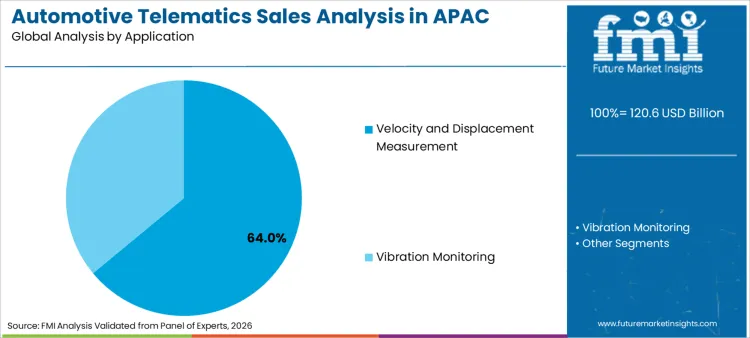
Velocity and displacement measurement leads with 64% market share because it is the highest-frequency data stream that directly supports cost, safety, and compliance decisions in real operations, making it the primary input for scorecards, alerts, routing discipline, and maintenance triggers. In APAC, this use case remains structurally advantaged because regulators and operators increasingly require auditable tracking and incident traceability, pulling fleets toward always-on motion data as the minimum viable dataset for governance. India’s AIS 140-linked tracking requirements expand the compliance perimeter for motion-linked monitoring, which increases the value of solutions that can continuously measure and report location and movement under defined standards. On the supplier side, the shift to software-defined vehicles strengthens the monetisation of continuous data streams, since software and services roadmaps depend on persistent telemetry for updates, diagnostics, and lifecycle services. Bosch’s public emphasis on scaling software and services in Mobility reinforces that the profit pool is increasingly in recurring, data-driven services rather than device-only sales. This keeps motion measurement at the centre of spend.
What are the key Trends and Restraints in Automotive Telematics Sales Analysis in APAC?
APAC telematics trends are being shaped by supplier consolidation and software-first monetisation. Platform providers are buying execution footprint to win SMB fleets and accelerate onboarding, illustrated by Geotab’s acquisition of Verizon Connect’s commercial operations in Australia and multiple European markets, bringing local sales and support capacity into a single platform and expanding access to connected vehicle data insights. In parallel, tier-1 suppliers are positioning AI and software-defined architectures as the growth layer for connected vehicles, signalling higher software content per vehicle and higher attach for subscription services over the vehicle lifecycle.
Constraints are tightening around data governance, consent, and localisation requirements, which raise compliance costs and slow cross-border platform standardisation. China’s automotive data security direction increases scrutiny on how vehicle data is collected, processed, stored, and transferred, pushing telematics providers toward local hosting, stricter controls, and more complex contracting with OEMs and cloud partners. In South Korea, privacy and location information protections increase the burden on telematics services that rely on precise location data, forcing more rigorous consent management and retention controls that can lengthen deployments and raise operating overhead.
What is Automotive Telematics Sales Analysis in APAC Regional Outlook?
Sales across APAC are outpacing traditional automotive hardware growth cycles, driven by regulatory tracking mandates, OEM default connectivity strategies, and fleet cost-optimisation pressures that embed telematics into operational baselines rather than discretionary upgrades. While the APAC market expands at 13.3%, high-growth economies are exceeding this pace through compliance-led installation frameworks and governance-driven architecture upgrades. India leads with a 14.5% CAGR, supported by AIS 140-backed enforcement pathways that directly convert regulation into hardware deployment and recurring platform subscriptions, followed closely by China at 13.9%, where strict automotive data security rules are reshaping platform architecture and elevating software intensity per vehicle.
South Korea advances at 12.7%, reflecting privacy-grade location governance and enterprise-grade deployment standards, while Japan grows at a steadier 11.8%, driven by OEM baseline connectivity and service-layer monetisation rather than step-change adoption. FMI analysis indicates that future growth will be governed by policy formalisation, data governance, and recurring software attach across the connected vehicle parc rather than vehicle production volatility.
| Country | CAGR (2026 to 2036) |
|---|---|
| India | 14.5% |
| Japan | 11.8% |
| China | 13.9% |
| South Korea | 12.7% |
Source: Future Market Insights (FMI) analysis, based on proprietary forecasting model and primary research.
Why is India converting telematics growth through compliance-driven installation and enforcement pathways?
India’s growth is anchored in policy-backed tracking requirements that expand the compliant installed base and pull telematics into regulated fleet categories. MoRTH’s Gazette notification requires vehicle tracking system devices as per AIS 140 for specified vehicles, creating a direct conversion path from regulatory obligation to device procurement, installation, and backend integration. As states operationalise vendor enlistment and activation procedures for AIS-140 certified devices, the market shifts from discretionary fleet optimisation to mandated participation, improving volume visibility for suppliers and integrators. This mechanism supports higher CAGR because it reduces adoption volatility and expands addressable fleets beyond early adopters, while also increasing recurring revenue as compliant fleets require ongoing connectivity, maintenance, and service renewals to remain operational under enforcement regimes.
Why does Japan sustain telematics demand through OEM default connectivity and service-layer monetisation?
Japan’s telematics growth is being manufactured through OEM-led standardisation of connected capabilities and the linkage of vehicle data to services and ownership experience. Toyota’s stated direction to make connected vehicles standard on new domestic passenger vehicles from key model launches is a structural signal that embedded connectivity is treated as a baseline feature set, not an option package, expanding the data-generating parc that supports telematics services. This expands platform monetisation opportunities in diagnostics, safety services, and usage-linked insurance models tied to driving behaviour data, reinforcing recurring value beyond initial vehicle sale. Japan’s safety policy direction also continues to emphasise advanced vehicle safety performance, sustaining demand for connected sensing and data pathways that support continuous monitoring and updates. These mechanisms keep growth steady rather than explosive, consistent with a mature OEM ecosystem where adoption is engineered through standard-fit strategies.
Why is China scaling telematics through data security rules that reshape platform architecture and supplier choices?
China’s telematics growth is reinforced by the combination of high connected-vehicle penetration ambitions and strict data governance that forces platform investment rather than lightweight add-ons. US trade guidance notes that China’s automotive industry is among the most regulated for data governance, with clear expectations on how automotive data is collected, processed, protected, stored, and transferred, including cross-border transfer reviews. This shifts procurement toward compliant, in-country telematics stacks with stronger security controls, auditability, and localisation, raising average contract value even as it increases compliance complexity. The outcome is a market where growth comes from both unit expansion and higher software and services intensity per connected vehicle as suppliers and OEMs redesign architectures to meet governance expectations.
Why does South Korea’s telematics expansion depend on privacy-grade location governance and trusted data handling?
South Korea’s telematics growth is shaped by a high digital readiness baseline combined with strict privacy and location information protections that influence product design and contracting. The Korean legal framework includes a comprehensive Personal Information Protection Act and a dedicated Act on the Protection and Use of Location Information, which directly affects telematics services that rely on precise vehicle location and driver-linked data. This pushes vendors toward stronger consent, retention discipline, and security controls, raising the importance of trusted providers and enterprise-grade deployments rather than informal retrofits. Growth is supported when suppliers can prove compliant handling while delivering measurable fleet outcomes, making the market expand through higher-quality implementations, platform integrations, and managed services that fleets can defend under governance scrutiny.
What does competition look like in the automotive telematics sales analysis in APAC?
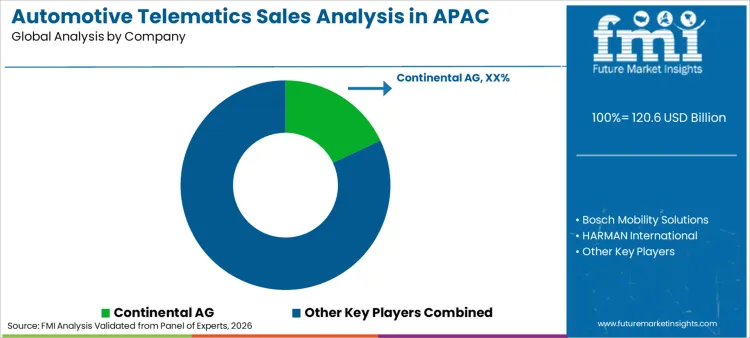
Competition is led by suppliers that can bundle connectivity, sensing, software platforms, and lifecycle services, with leadership increasingly defined by platform scale and execution footprint rather than device hardware alone. Scope includes fleet telematics devices, embedded connectivity modules, telematics software platforms, and associated managed services for commercial and passenger vehicles. Scope excludes standalone infotainment content services, pure ADAS without telematics data services, and non-automotive asset trackers. Supplier strategies show consolidation into cross-domain automotive electronics, with HARMAN’s planned acquisition of ZF’s ADAS business strengthening centralised compute and perception stacks that support software-defined vehicle roadmaps and persistent telemetry monetisation. In commercial telematics, Geotab’s acquisition of Verizon Connect’s commercial operations in Australia and Europe expands on-the-ground distribution and onboarding capacity, sharpening its ability to win SMB fleets where APAC growth is concentrated. Tier-1 leadership is reinforced by software and services scale ambitions, with Bosch explicitly forecasting multi-billion-euro software and services sales tied to Mobility, strengthening its positioning as OEM programs shift toward software-defined architectures. Regional leadership in APAC will not always mirror global leadership because data localisation, consent regimes, and channel footprint determine win rates market by market.
Recent developments
- In December 2025, HARMAN International agreed to acquire ZF Group’s ADAS business for €1.5 billion, strengthening its automotive compute, smart camera, radar, and software capabilities to advance centralized platforms and the SDV ecosystem.
- In October 2025, Geotab acquired Verizon Connect’s commercial telematics operations across Australia and multiple European countries, expanding its global footprint and strengthening its presence in the small- to mid-sized fleet segment, while excluding Verizon’s product, engineering, and non-sales teams.
Key players
- Continental AG
- Bosch Mobility Solutions
- HARMAN International
- Teltonika Telematics
- Trimble Inc.
- Geotab
- Zonar Systems
- MiX Telematics
- TomTom Telematics
- Verizon Connect
Market definition
Automotive telematics in APAC refers to hardware, embedded modules, and software platforms that collect, transmit, and operationalise vehicle data for safety, compliance, fleet productivity, diagnostics, and lifecycle services. It covers commercial and passenger vehicle telematics where connectivity enables location tracking, motion analytics, remote diagnostics, alerts, and subscription-based services delivered through OEM or aftermarket platforms. The scope reflects APAC market structures where regulation, fleet economics, and software-defined vehicle roadmaps increasingly determine adoption and monetisation.
Market inclusion
Included are portable and embedded telematics units, vehicle connectivity control modules, fleet management and telematics software, motion and location analytics, driver safety and coaching systems, remote diagnostics, OTA-enabled telemetry services where applicable, and managed services tied to telematics deployment and operations. Included demand includes compliance-driven tracking deployments such as AIS 140-linked vehicle tracking requirements in India and governance-driven platform upgrades in data-regulated markets such as China.
Market exclusion
Excluded are standalone infotainment streaming services, pure ADAS feature sales that do not include telematics data services, generic consumer navigation apps without vehicle device integration, and non-automotive asset trackers not tied to vehicle telematics platforms. Also excluded are adjacent smart mobility infrastructure systems unless revenues are directly tied to vehicle telematics subscriptions or device deployments. Competitive interpretation emphasises disclosed platform scale, execution footprint, and repeated executive positioning around software and services rather than undisclosed standalone telematics revenue.
Scope of Report
| Items | Values |
|---|---|
| Quantitative Units | USD 120.6 Billion |
| Product Type Segments | Portable; Handheld |
| Application Segments | Velocity and Displacement Measurement; Vibration Monitoring |
| Geography Focus | Asia Pacific (APAC) |
| Countries Covered | China; Japan; South Korea; India; ASEAN; Rest of APAC |
| Regions Covered | APAC |
| Key Companies Profiled | Continental AG; Bosch Mobility Solutions; HARMAN International; Teltonika Telematics; Trimble Inc.; Geotab; Zonar Systems; MiX Telematics; TomTom Telematics; Verizon Connect |
| Additional Attributes | Revenue analysis by product type and application; assessment of compliance-driven tracking adoption and its conversion into recurring subscriptions; evaluation of software-defined vehicle roadmaps shaping telematics platform attach; analysis of data governance and localisation constraints influencing architecture and vendor selection; competitive positioning based on platform scale, OEM and fleet partnerships, and in-country execution footprint across APAC. |
Automotive Telematics Sales Analysis in APAC by Key Segments
-
By Product Type
- Portable
- Handheld
-
By Application
- Velocity and Displacement Measurement
- Vibration Monitoring
-
By Country
- China
- Japan
- South Korea
- India
- ASEAN
- Rest of APAC
Bibliography
- Ministry of Road Transport and Highways (MoRTH). (2023). Status of implementation of Vehicle Location Tracking Devices (VLTD) and Panic Buttons [Press release]. Press Information Bureau, Government of India.
- Korea Communications Commission. (2024). Act on the Protection and Use of Location Information: Compliance guide for location-based service providers. Korea Legislation Research Institute.
- International Trade Administration. (2024). China: Automotive industry data security and regulatory landscape. U.S. Department of Commerce.
- Toyota Motor Corporation. (2024). Toyota Integrated Report 2024: Transforming into a mobility company. Toyota Motor Corporation.
Frequently Asked Questions
How big is the automotive telematics sales analysis in APAC in 2026 and 2036?
The market is valued at USD 120.6 billion in 2026 and is projected to reach USD 420.2 billion by 2036.
What is the growth outlook for automotive telematics sales in APAC over 2026 to 2036?
The market is forecast to expand at a 13.3% CAGR, driven by compliance-led tracking, OEM embedded connectivity, and subscription monetisation.
Which segment anchors adoption intensity in 2026?
Portable telematics leads with a 58.0% share, reflecting retrofit-led scale across mixed-age fleets and faster deployment economics.
Which use case concentrates the largest spending pool in 2026?
Velocity and displacement measurement leads with a 64.0% share, because it underpins safety scoring, compliance reporting, routing discipline, and maintenance triggers.
What are the main risks and constraints affecting APAC telematics growth?
Key constraints include data localisation and governance requirements, consent and location privacy obligations, and platform integration complexity across fragmented fleet and OEM ecosystems.
Preview the report firsthand - request a free sample
Get SampleGet the brochure for pricing and purchase details.
Get PDFTable of Content
- Executive Summary
- Global Market Outlook
- Demand-side Trends
- Supply-side Trends
- Technology Roadmap Analysis
- Analysis and Recommendations
- Market Overview
- Market Coverage / Taxonomy
- Market Definition / Scope / Limitations
- Market Background
- Market Dynamics
- Drivers
- Restraints
- Opportunity
- Trends
- Scenario Forecast
- Demand in Optimistic Scenario
- Demand in Likely Scenario
- Demand in Conservative Scenario
- Opportunity Map Analysis
- Product Life Cycle Analysis
- Supply Chain Analysis
- Investment Feasibility Matrix
- Value Chain Analysis
- PESTLE and Porter’s Analysis
- Regulatory Landscape
- Regional Parent Market Outlook
- Production and Consumption Statistics
- Import and Export Statistics
- Market Dynamics
- Global Market Analysis 2021 to 2025 and Forecast, 2026 to 2036
- Historical Market Size Value (USD Million) Analysis, 2021 to 2025
- Current and Future Market Size Value (USD Million) Projections, 2026 to 2036
- Y-o-Y Growth Trend Analysis
- Absolute $ Opportunity Analysis
- Global Market Pricing Analysis 2021 to 2025 and Forecast 2026 to 2036
- Global Market Analysis 2021 to 2025 and Forecast 2026 to 2036, By Product Type
- Introduction / Key Findings
- Historical Market Size Value (USD Million) Analysis By Product Type , 2021 to 2025
- Current and Future Market Size Value (USD Million) Analysis and Forecast By Product Type , 2026 to 2036
- Portable
- Handheld
- Portable
- Y-o-Y Growth Trend Analysis By Product Type , 2021 to 2025
- Absolute $ Opportunity Analysis By Product Type , 2026 to 2036
- Global Market Analysis 2021 to 2025 and Forecast 2026 to 2036, By Application
- Introduction / Key Findings
- Historical Market Size Value (USD Million) Analysis By Application, 2021 to 2025
- Current and Future Market Size Value (USD Million) Analysis and Forecast By Application, 2026 to 2036
- Velocity and Displacement Measurement
- Vibration Monitoring
- Velocity and Displacement Measurement
- Y-o-Y Growth Trend Analysis By Application, 2021 to 2025
- Absolute $ Opportunity Analysis By Application, 2026 to 2036
- Global Market Analysis 2021 to 2025 and Forecast 2026 to 2036, By Region
- Introduction
- Historical Market Size Value (USD Million) Analysis By Region, 2021 to 2025
- Current Market Size Value (USD Million) Analysis and Forecast By Region, 2026 to 2036
- North America
- Latin America
- Western Europe
- Eastern Europe
- East Asia
- South Asia and Pacific
- Middle East & Africa
- Market Attractiveness Analysis By Region
- North America Market Analysis 2021 to 2025 and Forecast 2026 to 2036, By Country
- Historical Market Size Value (USD Million) Trend Analysis By Market Taxonomy, 2021 to 2025
- Market Size Value (USD Million) Forecast By Market Taxonomy, 2026 to 2036
- By Country
- USA
- Canada
- Mexico
- By Product Type
- By Application
- By Country
- Market Attractiveness Analysis
- By Country
- By Product Type
- By Application
- Key Takeaways
- Latin America Market Analysis 2021 to 2025 and Forecast 2026 to 2036, By Country
- Historical Market Size Value (USD Million) Trend Analysis By Market Taxonomy, 2021 to 2025
- Market Size Value (USD Million) Forecast By Market Taxonomy, 2026 to 2036
- By Country
- Brazil
- Chile
- Rest of Latin America
- By Product Type
- By Application
- By Country
- Market Attractiveness Analysis
- By Country
- By Product Type
- By Application
- Key Takeaways
- Western Europe Market Analysis 2021 to 2025 and Forecast 2026 to 2036, By Country
- Historical Market Size Value (USD Million) Trend Analysis By Market Taxonomy, 2021 to 2025
- Market Size Value (USD Million) Forecast By Market Taxonomy, 2026 to 2036
- By Country
- Germany
- UK
- Italy
- Spain
- France
- Nordic
- BENELUX
- Rest of Western Europe
- By Product Type
- By Application
- By Country
- Market Attractiveness Analysis
- By Country
- By Product Type
- By Application
- Key Takeaways
- Eastern Europe Market Analysis 2021 to 2025 and Forecast 2026 to 2036, By Country
- Historical Market Size Value (USD Million) Trend Analysis By Market Taxonomy, 2021 to 2025
- Market Size Value (USD Million) Forecast By Market Taxonomy, 2026 to 2036
- By Country
- Russia
- Poland
- Hungary
- Balkan & Baltic
- Rest of Eastern Europe
- By Product Type
- By Application
- By Country
- Market Attractiveness Analysis
- By Country
- By Product Type
- By Application
- Key Takeaways
- East Asia Market Analysis 2021 to 2025 and Forecast 2026 to 2036, By Country
- Historical Market Size Value (USD Million) Trend Analysis By Market Taxonomy, 2021 to 2025
- Market Size Value (USD Million) Forecast By Market Taxonomy, 2026 to 2036
- By Country
- China
- Japan
- South Korea
- By Product Type
- By Application
- By Country
- Market Attractiveness Analysis
- By Country
- By Product Type
- By Application
- Key Takeaways
- South Asia and Pacific Market Analysis 2021 to 2025 and Forecast 2026 to 2036, By Country
- Historical Market Size Value (USD Million) Trend Analysis By Market Taxonomy, 2021 to 2025
- Market Size Value (USD Million) Forecast By Market Taxonomy, 2026 to 2036
- By Country
- India
- ASEAN
- Australia & New Zealand
- Rest of South Asia and Pacific
- By Product Type
- By Application
- By Country
- Market Attractiveness Analysis
- By Country
- By Product Type
- By Application
- Key Takeaways
- Middle East & Africa Market Analysis 2021 to 2025 and Forecast 2026 to 2036, By Country
- Historical Market Size Value (USD Million) Trend Analysis By Market Taxonomy, 2021 to 2025
- Market Size Value (USD Million) Forecast By Market Taxonomy, 2026 to 2036
- By Country
- Kingdom of Saudi Arabia
- Other GCC Countries
- Turkiye
- South Africa
- Other African Union
- Rest of Middle East & Africa
- By Product Type
- By Application
- By Country
- Market Attractiveness Analysis
- By Country
- By Product Type
- By Application
- Key Takeaways
- Key Countries Market Analysis
- USA
- Pricing Analysis
- Market Share Analysis, 2025
- By Product Type
- By Application
- Canada
- Pricing Analysis
- Market Share Analysis, 2025
- By Product Type
- By Application
- Mexico
- Pricing Analysis
- Market Share Analysis, 2025
- By Product Type
- By Application
- Brazil
- Pricing Analysis
- Market Share Analysis, 2025
- By Product Type
- By Application
- Chile
- Pricing Analysis
- Market Share Analysis, 2025
- By Product Type
- By Application
- Germany
- Pricing Analysis
- Market Share Analysis, 2025
- By Product Type
- By Application
- UK
- Pricing Analysis
- Market Share Analysis, 2025
- By Product Type
- By Application
- Italy
- Pricing Analysis
- Market Share Analysis, 2025
- By Product Type
- By Application
- Spain
- Pricing Analysis
- Market Share Analysis, 2025
- By Product Type
- By Application
- France
- Pricing Analysis
- Market Share Analysis, 2025
- By Product Type
- By Application
- India
- Pricing Analysis
- Market Share Analysis, 2025
- By Product Type
- By Application
- ASEAN
- Pricing Analysis
- Market Share Analysis, 2025
- By Product Type
- By Application
- Australia & New Zealand
- Pricing Analysis
- Market Share Analysis, 2025
- By Product Type
- By Application
- China
- Pricing Analysis
- Market Share Analysis, 2025
- By Product Type
- By Application
- Japan
- Pricing Analysis
- Market Share Analysis, 2025
- By Product Type
- By Application
- South Korea
- Pricing Analysis
- Market Share Analysis, 2025
- By Product Type
- By Application
- Russia
- Pricing Analysis
- Market Share Analysis, 2025
- By Product Type
- By Application
- Poland
- Pricing Analysis
- Market Share Analysis, 2025
- By Product Type
- By Application
- Hungary
- Pricing Analysis
- Market Share Analysis, 2025
- By Product Type
- By Application
- Kingdom of Saudi Arabia
- Pricing Analysis
- Market Share Analysis, 2025
- By Product Type
- By Application
- Turkiye
- Pricing Analysis
- Market Share Analysis, 2025
- By Product Type
- By Application
- South Africa
- Pricing Analysis
- Market Share Analysis, 2025
- By Product Type
- By Application
- USA
- Market Structure Analysis
- Competition Dashboard
- Competition Benchmarking
- Market Share Analysis of Top Players
- By Regional
- By Product Type
- By Application
- Competition Analysis
- Competition Deep Dive
- Continental AG
- Overview
- Product Portfolio
- Profitability by Market Segments (Product/Age /Sales Channel/Region)
- Sales Footprint
- Strategy Overview
- Marketing Strategy
- Product Strategy
- Channel Strategy
- Bosch Mobility Solutions
- HARMAN International
- Teltonika Telematics
- Trimble Inc.
- Geotab
- Zonar Systems
- MiX Telematics
- TomTom Telematics
- Verizon Connect
- Continental AG
- Competition Deep Dive
- Assumptions & Acronyms Used
- Research Methodology


