

- Industry Size (2026)
- USD 0.8 Bn
- Forecast (2036)
- USD 2.9 Bn
- CAGR (2026 to 2036)
- 13.7%
Neurodiverse Workforce Productivity Tools Market Size, Market Forecast and Outlook By FMI
The neurodiverse workforce productivity tools market crossed a valuation of USD 0.7 billion in 2025, foreseeing a steady increase seeming to cross USD 0.8 billion in 2026 as it is projected at a 13.7% CAGR for the decade. Total market revenue is expected to reach USD 2.9 billion by 2036, representing the imperative need for neurodivergent employees to possess tools that reduce reading, writing, focus, and task-management friction across virtual workspace management tools at workplaces.
Legal and HR teams now expect workplace software to meet daily accessibility requirements, pushing IT buyers to assess whether tools support clearer communication, better meeting recall, and easier task handling. Many standard workplace platforms still offer limited control over sensory load, reading support, or executive-function support. Generic accessibility features are often too broad for this need.
Summary of Neurodiverse Workforce Productivity Tools Market
- Market Snapshot:
- The neurodiverse workforce productivity tools market is estimated to be valued at USD 0.7 billion in 2025 and is expected to reach USD 2.9 billion by 2036.
- Acknowledging these fast-paced transitions of the workplace environments globally, it is expected to expand at a 13.8% CAGR for the forecast period, creating an incremental opportunity of USD 2.2 billion.
- This industry encompasses paid enterprise tools that reduce friction in reading, writing, note capture, task planning, and focus management for neurodivergent workers using smart workplace setups.
- The market represents a narrow, software-led layer within the broader collaboration and work management stack, where adoption depends on HR policy, accessibility budgets, IT approval, and workflow integration.
- Demand and Growth Drivers:
- Workplace expectations are shifting as companies adjust to changing employee needs, especially in the United States. Many salaried workers have already asked for better schedules, improved equipment, revised task structures, and wider telework options to support day-to-day productivity. These shifts show that employers are under growing pressure to build work environments that better match how people want to work.
- Adoption is also supported by public funding and employer support channels, with the UK’s Access to Work framework explicitly covering specialist equipment and assistive software in the workplace.
- AI-based meeting notes, transcription, reading support, and contextual work assistants are lifting adoption because they lower memory load, reduce writing friction, and improve meeting recall inside web conferencing tools people already use every day.
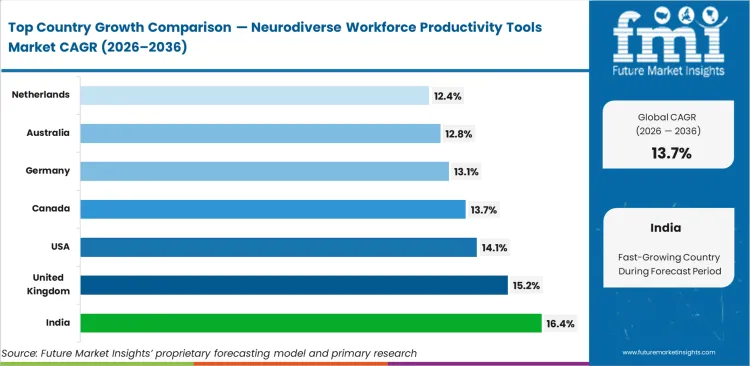
- Among key countries, India demonstrates a solid 16.4% CAGR, followed by the United Kingdom at 15.2%, the United States at 14.1%, Canada at 13.7%, Germany at 13.1%, Australia at 12.8%, and the Netherlands at 12.4%.
- Growth is moderated by acquisition overlap with mainstream collaboration suites, limited budget line-item visibility, and the fact that many enterprises still buy accessibility tools through broader HR, DEI, or IT budgets instead of a dedicated neurodiversity-software category.
- Product and Segment View:
- Core capabilities ranging from AI-driven meeting capture to task-breakdown utilities reach knowledge workers primarily through browser extensions or native integrations within existing enterprise suites.
- Daily application spans the entire corporate workflow, from deciphering complex procedural documents and drafting internal communications to tracking project deliverables and organizing unstructured meeting notes.
- Corporate demand for tone translation and dyslexia-friendly text restructuring secures a 31.0% share for writing support applications, resolving immediate communication friction between diverse technical teams.
- By bypassing complex local endpoint installations, cloud-based architectures capture 78.0% of the deployment market, giving IT administrators frictionless, cross-device rollout capabilities.
- Large enterprises are expected to account for 49.0% of the buyer landscape in 2026, supported by centralized budgets for formal neuro-inclusion initiatives.
- Operations managers prioritize communication clarity above all else, driving 29.0% of use-case adoption to quickly eliminate the expensive rework caused by misread emails and chaotic chat threads.
- The heavy reliance on asynchronous summaries, live captions, and structured digital collaboration to bridge the gap between remote isolation and physical office chaos pushes hybrid environments to a 46.0% share.
- Analysis focuses strictly on paid corporate software, embedded workflow assistants, and meeting-intelligence features, intentionally excluding clinical diagnostics, generic wellness trackers, and broad human resources information systems.
- Geography and Competitive Outlook:
- While aggressive global capability center hiring drives rapid expansion in India and the United Kingdom, the concentration of massive enterprise IT budgets and major platform vendors makes the United States the most lucrative baseline market.
- Winning enterprise contracts depends entirely on seamlessly weaving cognitive supports, such as automated task structuring and live captions, directly into everyday corporate workflows rather than marketing a standalone neurodiversity brand.
- Leveraging its massive installed base across Teams and Office 365, Microsoft captures the market through its Immersive Reader ecosystem, competing alongside specialized players like Atlassian, Notion, Asana, Zoom, Texthelp, and Otter.ai.
- Highly specialized developers still find lucrative pockets of adoption, though long-term structural dominance favors massive platforms capable of naturally bundling cognitive accommodations into standard daily interfaces.
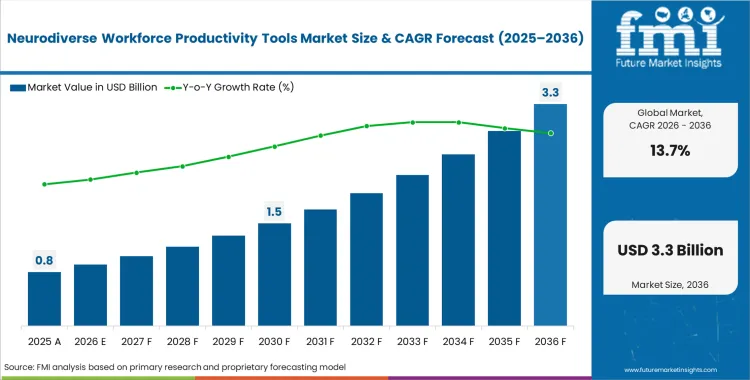
Buyers are no longer comparing vendors solely on broad collaboration tools features. They are also checking whether each product helps neurodivergent employees manage work with less strain. This is changing how enterprise software is shortlisted. Once accessibility settings are built into standard deployments, they become part of the core workplace software stack, making adoption easier across larger teams.
As global capability centers expand neurodivergent hiring programs, India’s rising adaptation of the same is predicted to showcase a 16.4% CAGR from 2026 to 2036. The United Kingdom is expected to record a 15.2% CAGR as public sector buying rules are helping push this popular feature into private-sector vendor selection. The United States is expected to record a 14.1% CAGR through 2036, supported by broader corporate focus on inclusion and workplace support tools.
Regional differences reflect two main demand paths: compliance-led buying in some markets and talent-driven adoption in others. Canada is projected to expand at a 13.7% CAGR, followed by Germany at 13.1%, Australia at 12.8%, and the Netherlands at 12.4%, as these markets increasingly align with compliance-driven adoption.
Segmental Analysis
Neurodiverse Workforce Productivity Tools Market Analysis by Tool Type
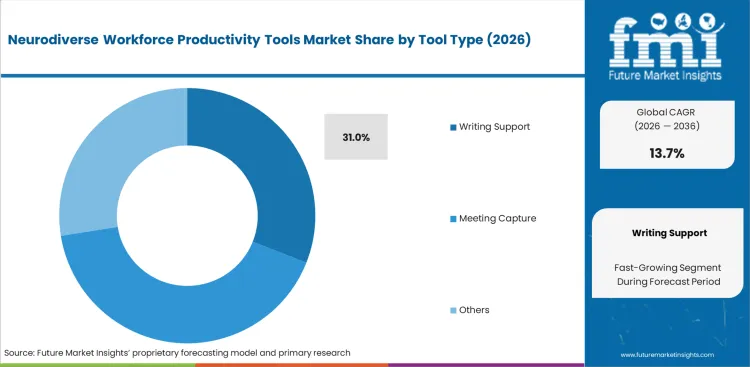
Navigating the nuances of corporate communication is often a primary hurdle for neurodivergent employees, making writing support tools essential. By translating literal thoughts into standard corporate phrasing, these applications prevent unintended friction among team members. The 31.0% market share in 2026 for this category stems directly from a critical need among HR leaders to minimize workplace conflicts before they escalate. Instead of forcing highly skilled technical staff into exhausting masking behaviors, technology buyers are investing heavily in native text modification features within workflow management software. Interestingly, many neurotypical workers also end up using these tools to refine their own emails, meaning the actual daily user base is much wider than initial accessibility audits suggest.
- Intent Translation Mechanism: AI-driven tone modifiers parse direct technical communication into neurotypical corporate norms. HR directors deploying this mechanism avoid costly employee relations interventions stemming from pure communication style differences.
- Cognitive Load Reduction: Predictive phrasing algorithms decrease executive function required drafting complex updates. Software engineers gain hours of deep-work capacity previously lost agonizing over appropriate email etiquette.
- Asynchronous Validation: Integrated spell and tone checkers provide immediate, private feedback before broad distribution. Department managers ensure professional standards without micro-managing individual employee communication styles.
Neurodiverse Workforce Productivity Tools Market Analysis by Deployment
Bypassing the massive headaches of local software installation is a top priority for IT security teams adopting cloud based collaboration software, which explains the 78.0% market share for Cloud SaaS delivery in 2026. These browser-based environments eliminate the need to vet and approve every single endpoint application across a diverse enterprise network. Centralized updates guarantee that companies stay compliant with the latest digital accessibility standards without asking individual users to download patches or troubleshoot local errors. Cloud-based tools allow staff to access necessary cognitive accommodations quietly, protecting their privacy without having to formally request a desktop installation from the IT helpdesk.
- Frictionless Provisioning: Cloud architecture allows administrators activating cognitive support features instantly upon onboarding. IT support teams eliminate weeks of ticket resolution associated with custom desktop software installations.
- Platform Agnosticism: SaaS delivery ensures consistent accessibility features across mixed operating system environments. Enterprise architects maintain tight security controls while satisfying diverse user hardware preferences.
- Silent Accommodation: Browser-integrated tools operate without visible desktop icons or specialized hardware. Neurodivergent employees access necessary supports without drawing unwanted attention from colleagues.
Neurodiverse Workforce Productivity Tools Market Analysis by Buyer Type
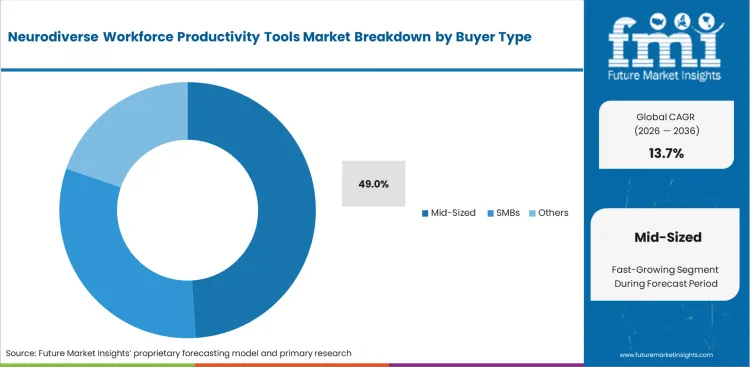
Major global organizations are tying corporate diversity goals directly to executive compensation, which naturally drives significant investments into inclusive HR tech. Chief Diversity Officers now control dedicated budgets to ensure their digital work environments actually support neurodivergent talent from day one. Because centralized purchasing models allow for massive volume licensing, these big companies can roll out cognitive support suites across thousands of employees at once. Mid-sized competitors that fail to match this level of digital accommodation frequently lose their best technical minds to these bigger players, resulting in a 49.0% market share for large enterprises in 2026 as they completely dominate this specialized purchase space.
- Compliance-Driven Scale: Sourcing directors authorize massive enterprise licenses satisfying internal accessibility audits. Legal departments gain verifiable proof of accommodation provision across global workforces.
- Centralized Integration: Enterprise IT architects demand API connections between cognitive tools and core productivity suites. Data security officers maintain strict governance over sensitive internal communications processed by assistive algorithms.
- Talent Retention Leverage: Talent acquisition leaders promote comprehensive neurodiversity software stacks during technical recruiting. Hiring managers secure specialized neurodivergent talent guaranteeing accommodating digital environments.
Neurodiverse Workforce Productivity Tools Market Analysis by Use Case
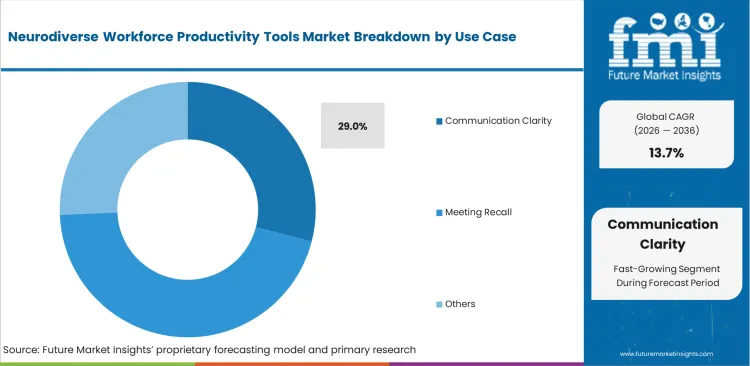
The constant misinterpretation of intent across digital channels creates immense operational drag, positioning communication clarity as the primary investment target for exasperated project teams. These solutions help operations managers cut down repeated clarification meetings and improve coordination across teams. That benefit is one reason this segment is expected to capture 29.0% of the global market in 2026. The segment continues to gain attention as companies look for tools that support faster and clearer execution. Translating dense procedural documents into easy-to-read formats requires advanced speech and voice analytics and text processors that can break complex instructions down into clear, actionable steps. While surface adoption metrics look good, they often hide the fact that these clarity engines secretly function as essential project management lifelines for employees struggling with executive dysfunction.
- Nuance Decoding: Natural language processors highlight ambiguous corporate phrasing and suggest literal alternatives. Project managers prevent expensive rework caused when neurodivergent developers misinterpret vague functional requirements.
- Format Restructuring: Automated tools convert dense paragraphs into structured bullet points featuring clear visual hierarchy. Operations directors accelerate document review cycles for staff easily overwhelmed by unbroken text blocks.
- Pacing Control: Asynchronous communication features allow users processing information at individual cognitive speeds. Team leads accommodate diverse processing rates without delaying overall project momentum.
Neurodiverse Workforce Productivity Tools Market Analysis by Work Setting
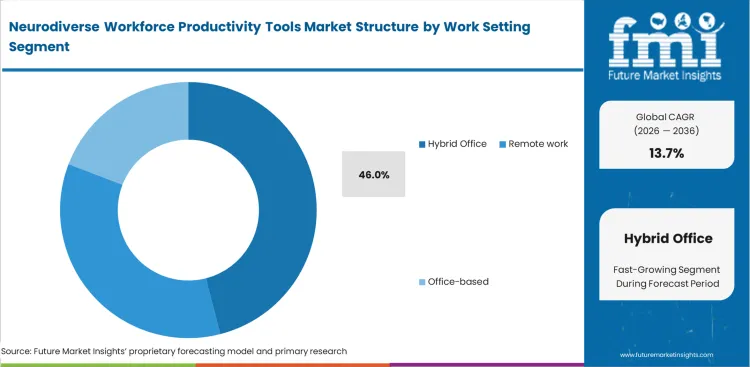
Hybrid office setups depend heavily on specialized software to connect quiet home environments with busy corporate spaces, explaining their 46.0% market share in 2026. Switching between a controlled remote environment and a chaotic physical office can overload the processing capacity of neurodivergent employees. Facility managers use these applications to provide consistent cognitive support across virtual workspace solutions, regardless of where an employee is working that day. Vendor licensing data often overlooks how hybrid workers rely on noise-filtering and focus features more on their office days, using the software as an invisible shield against severe sensory overload.
- Sensory Environment Bridging: Digital focus aids simulate isolated remote work environments during chaotic office days. Hybrid workers maintain consistent productivity output despite wildly fluctuating physical sensory inputs.
- Context Switching Reduction: Integrated platforms minimize required software toggling when moving between home and office networks. IT directors reduce login fatigue and password-related helpdesk tickets.
- Asynchronous Continuity: Meeting capture tools ensure staff processing information slower in physical settings retain full digital records. Operations managers prevent critical detail loss during intense in-person collaborative sessions.
Neurodiverse Workforce Productivity Tools Market Drivers, Restraints, and Opportunities
New laws around digital accessibility are forcing IT teams to urgently check if their current software actually works for everyone. Software buyers risk serious discrimination lawsuits if the everyday platforms they purchase shut out neurodivergent employees from getting their jobs done. Waiting to add these supportive features can lead to expensive legal battles and cause companies to lose their best technical talent. HR teams are therefore rushing to roll out employee advocacy software alongside specialized productivity tools to show they genuinely care about building an inclusive culture. At the same time, tough accessibility rules originating in Europe are quickly becoming the everyday standard for global companies everywhere. Businesses that ignore neuro-inclusive technology will simply fall behind when trying to recruit highly skilled neurodivergent engineers and analysts.
Strict internal rules about data privacy, however, make it incredibly difficult for companies to adopt these advanced AI tools. Security teams regularly block these helpful third-party apps because they do not want outside software reading sensitive company emails just to adjust a writer's tone or organize their daily tasks. This clash happens because these supportive tools actually need deep access to private company information to function properly. Software creators are having a hard time building secure, locally installed versions of these tools that are as powerful as the cloud-based ones. Companies try to get around this problem by using the basic accessibility features already built into their standard office software, but those tools simply lack the specific adjustments neurodivergent staff actually need. As a result, these employees are stuck in the middle, needing advanced software to work comfortably, but completely blocked by rigid corporate rules designed to stop data leaks.
- Native Platform Integration: Developing APIs linking cognitive translation layers directly into dominant enterprise communication channels. Product managers capture immense value by eliminating standalone application fatigue.
- Neuro-Specific Project Management: Engineering visual workflow systems specifically catering to neurodivergent executive function processing. Software architects differentiate products from generic project portfolio management trackers by addressing specific neurological friction points.
- Automated Workforce Analytics Tracking: Creating privacy-first dashboards correlating cognitive tool usage with burnout risk. HR directors secure budget proving proactive workforce analytics software deployment reduces expensive employee turnover.
Regional Analysis
Based on regional analysis, the Neurodiverse Workforce Productivity Tools Market is segmented into North America, Europe, and Asia Pacific across 40 plus countries. Structural divergence emerges across these territories, driven by strict legal compliance requirements in some areas versus acute talent acquisition scarcity in others.
| Country | CAGR (2026 to 2036) |
|---|---|
| India | 16.4% |
| United Kingdom | 15.2% |
| United States | 14.1% |
| Canada | 13.7% |
| Germany | 13.1% |
| Australia | 12.8% |
| Netherlands | 12.4% |
.webp "Top Country Growth Comparison Neurodiverse Workforce Productivity Tools Market Cagr (2026 2036)")
Source: Future Market Insights (FMI) analysis, based on proprietary forecasting model and primary research
Asia Pacific Neurodiverse Workforce Productivity Tools Market Analysis
Aggressive neurodiversity hiring mandates from Western parent companies cascade directly into local operational requirements across Asian technology hubs. Human resources directors in these high-volume environments deploy cognitive support software to stabilize massive engineering workforces. Local technology buyers rapidly substitute informal accommodations with structured enterprise-grade software solutions to mitigate acute technical talent retention challenges. This transition from manual managerial accommodation to systemic digital support defines the regional adoption curve. Enterprise leaders increasingly recognize neuro-inclusive software as critical infrastructure rather than a niche compliance initiative.
- India: Demand for the neurodiverse workforce productivity tools market in India is anticipated to rise at a 16.4% CAGR during the forecast period, supported by the rapid expansion of global capability centers across the country. Multinational employers are formalizing inclusive hiring mandates to reach skilled technical talent that remains underrepresented in conventional recruitment channels. Enterprise IT teams are deploying integrated cognitive tools to standardize accommodations across large engineering workforces. This is helping employers improve engagement and reduce pressure from technical staff attrition. Vendors that secure enterprise-scale contracts early are expected to strengthen their standing as regional providers work to improve product depth and deployment capability. The country is set to remain an important growth center for this market as global accessibility standards gain stronger local execution.
- Australia: Sales in the neurodiverse workforce productivity tools market in Australia are set to record a 12.8% CAGR through 2036, reflecting a mature understanding of neurodiversity within workplace strategy. Corporate governance expectations tied to inclusion are supporting adoption across both public and private sector organizations. Demand is also rising as institutions replace legacy systems with platforms that include native cognitive support functions. Vendors offering integrated solutions are likely to benefit as buyers place greater weight on usability, compliance fit, and enterprise-wide deployment readiness. This is expanding the addressable opportunity for suppliers serving accessibility-focused workplace technology requirements across Australia. The country is expected to remain a steady market for vendors aligned with enterprise inclusion priorities.
FMI's report includes Japan and South Korea. Rapid digitization of traditional hierarchical workplaces exposes deep communication friction points. Organizations in these countries face intense pressure to modernize their internal workflows to retain younger technical talent.
Europe Neurodiverse Workforce Productivity Tools Market Analysis
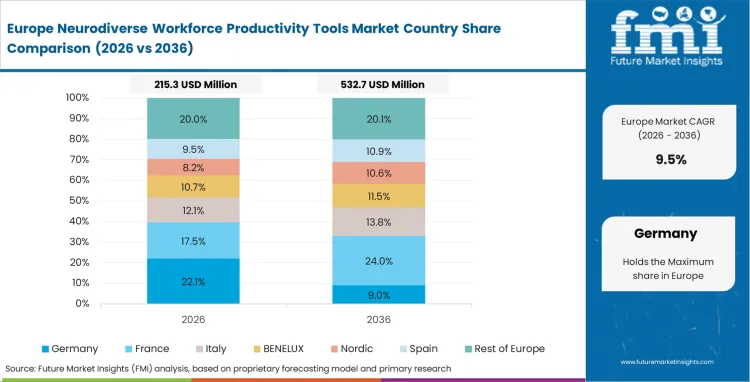
Stringent European Union digital accessibility directives fundamentally alter corporate software procurement. Legal compliance officers force comprehensive audits of existing internal communication platforms to ensure neurodivergent compatibility. Public sector mandates increasingly demand verifiable cognitive support layers from all contracted technology vendors. European organizations prioritize privacy-first deployments due to aggressive GDPR enforcement. Companies strictly limit external AI processing of internal employee communication, complicating advanced tone-translation tool adoption. European buyers demand explicit data localization guarantees before authorizing enterprise-wide cognitive support software deployments.
- United Kingdom: Demand for the Neurodiverse Workforce Productivity Tools Market in the United Kingdom is anticipated to rise at a 15.2% CAGR during the forecast period, supported by strict public sector procurement standards. Government IT teams are requiring software contractors to demonstrate clear cognitive accessibility compliance before vendor approval. These requirements are also influencing private vendor ecosystems, as suppliers align product design and documentation with public procurement expectations. Vendors that fail accessibility audits are likely to lose access to major contract opportunities across government-linked programs. This is increasing pressure on legacy project management software providers to improve platform accessibility. The United Kingdom is expected to remain a key market where compliance strength shapes supplier selection.
- Germany: Sales of the Neurodiverse Workforce Productivity Tools Market in Germany are being shaped by strong workplace privacy expectations and accommodation requirements. Works councils are pressing employers to adopt cognitive support tools with explicit protections around employee data. Information security teams are also reviewing cloud-based translation and assistance platforms closely for data sovereignty compliance. This buying environment is set to help the market record a 13.1% CAGR through 2036. Vendors that meet these privacy expectations are better positioned to build long-term enterprise relationships. Germany is expected to remain a structured market where compliance readiness supports competitive strength.
- Netherlands: Demand for the Neurodiverse Workforce Productivity Tools Market in the Netherlands is poised to expand at a 12.4% CAGR by 2036, reflecting the country’s broad focus on employee support and workplace inclusion. Employers are integrating specialized tools more quickly as corporate culture places stronger acceptance on neurodivergent talent across knowledge-based roles. HR teams are giving greater weight to well-being measures alongside standard productivity targets when evaluating internal support systems. This is supporting wider use of workplace tools designed for cognitive flexibility and accessibility. Vendors aligned with these priorities are likely to see stronger demand from organizations seeking practical and normalized accommodation strategies. The Netherlands is expected to remain a steady market for inclusive workforce productivity solutions.
FMI's report includes France and Italy. Heavy reliance on outsourced digital workplace service requires distinct integration strategies for distributed teams. Vendors must tailor their deployment models to accommodate highly fragmented operational setups in these specific nations.
North America Neurodiverse Workforce Productivity Tools Market Analysis
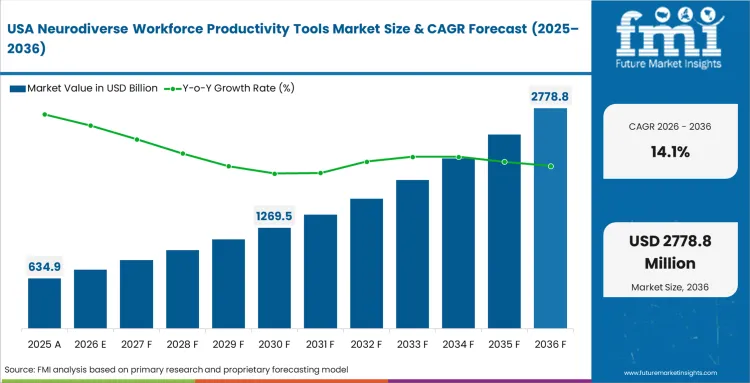
Aggressive corporate diversity initiatives and fierce technical talent competition dictate software procurement strategies across North America. Chief Diversity Officers wield substantial budgets to operationalize inclusion commitments through tangible technological investments. Enterprise software architects seek platform-agnostic cognitive layers to bridge disparate legacy corporate systems via managed workplace services. Massive tech sector layoffs paradoxically accelerate software integration as remaining staff face intense cognitive load increases. Organizations leverage specialized software to maintain high productivity without burning out critical technical employees. Legal pressure stemming from disability discrimination lawsuits forces proactive deployment of verifiable cognitive support infrastructure.
- United States: Corporate diversity governance initiatives command immediate technological upgrades across Fortune 500 companies. Legal departments mandate broad accessibility software deployment to preempt costly discrimination litigation. Enterprise buyers demand seamless API integration with existing communication platforms. A preferred vendor status with major tech conglomerates yields massive commercial opportunity, forecasting a landscape with 14.1% CAGR for the region.
- Canada: Government-backed inclusion initiatives provide funding structures for enterprise accessibility upgrades. Public sector technology buyers heavily weigh neuro-inclusive features during vendor selection, setting the CAGR at 13.7% over the forecast decade. Organizations prioritize bilingual cognitive translation capabilities. Successful deployment across these complex linguistic environments signifies a major operational outcome for multinational vendors.
FMI's report includes Mexico. Nearshoring trends require standardized cognitive support systems bridging distinct cultural communication styles. Bridging these diverse corporate communication methods proves essential for maintaining high productivity across cross-border teams.
Competitive Aligners for Market Players
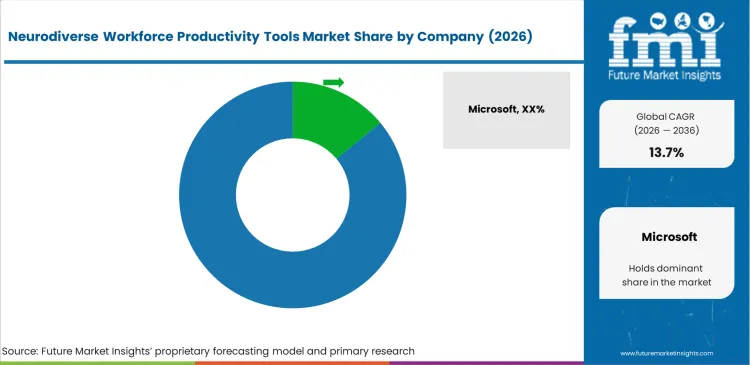
Massive enterprise software conglomerates are increasingly building niche cognitive accessibility features directly into their core product suites, creating intense pressure on standalone vendors. Giant players like Microsoft rely on their massive workplace presence to roll out native neuro-inclusive features, instantly commoditizing basic functions like task breakdown and reading support. To survive, standalone developers must offer hyper-specialized cognitive translation capabilities that generalist platforms cannot legally or technically replicate. Furthermore, buyers evaluate these solutions purely on how well they integrate; a brilliant tone-translator holds zero commercial value if employees have to copy and paste text outside of their approved corporate email clients.
Established productivity giants have access to massive libraries of user behavioral data, allowing them to rapidly refine their predictive text and task organization algorithms. Startups typically lack this fundamental dataset, which forces them to rely on public APIs, a move that often triggers immediate security rejections from corporate IT departments. As seen with companies like Zoom Communications, integrating distinct accessibility layers directly into standard video conferencing architecture can quickly neutralize standalone meeting-capture competitors. Successful challengers are adapting by building deep expertise around complex cognitive processing disorders, offering highly nuanced solutions that massive corporate vendors deem too specialized for broad mainstream release.
Enterprise technology buyers actively try to avoid getting locked into a single-vendor ecosystem by qualifying specialized third-party accessibility layers. Strict data privacy officers demand clear separation between cognitive translation engines and core corporate data storage to protect sensitive information. Operations managers champion specialized tools like Atlassian and Asana when native, generic employee recognition software features fail to prevent neurodivergent staff from burning out. Winning future deployments requires vendors to provide absolute proof of security compliance right alongside verifiable metrics showing a real reduction in daily cognitive load for the end users.
Key Players in Neurodiverse Workforce Productivity Tools Market
- Microsoft
- Zoom Communications
- Asana
- Atlassian
- Texthelp
- Otter.ai
Scope of the Report
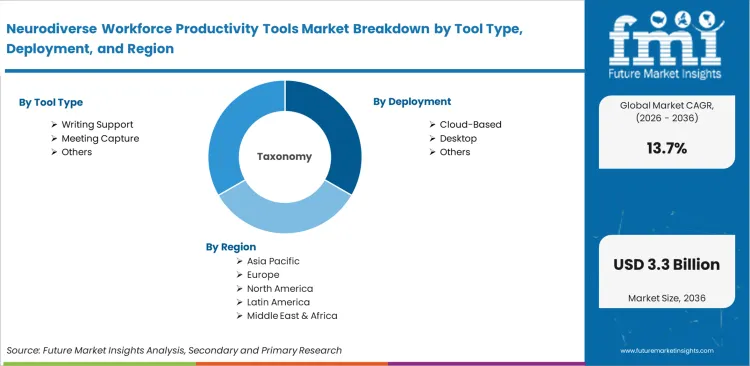
| Metric | Value |
|---|---|
| Quantitative Units | USD 0.8 billion to USD 2.9 billion, at a CAGR of 13.7% |
| Market Definition | Software applications purposefully designed to reduce executive function strain, sensory overload, and communication friction for neurodivergent professionals. These platforms translate standard workflows into accessible formats. |
| Segmentation | Tool type, Deployment, Buyer type, Use case, Work setting, and Region |
| Regions Covered | North America, Europe, Asia Pacific, Latin America, Middle East and Africa |
| Countries Covered | United States, Canada, Germany, United Kingdom, France, Italy, Spain, Russia, Poland, China, Japan, India, Australia and New Zealand, South Korea, ASEAN, Brazil, Mexico, Argentina, GCC Countries, South Africa, Israel |
| Key Companies Profiled | Microsoft, Zoom Communications, Asana, Atlassian, Texthelp, Otter.ai |
| Forecast Period | 2026 to 2036 |
| Approach | Paid active enterprise seats for explicitly marketed cognitive accommodation software anchored quantitative baselines. |
Source: Future Market Insights (FMI) analysis, based on proprietary forecasting model and primary research
Segments
Tool Type:
- Writing support
- Meeting capture
- Task breakdown
- Focus aids
- Reading support
Deployment:
- Cloud SaaS
- Desktop
- Browser add-ons
- Mobile apps
Buyer Type:
- Large enterprises
- Mid-market
- SMBs
- Public sector
Use Case:
- Communication clarity
- Meeting recall
- Task planning
- Reading access
- Attention support
Work Setting:
- Hybrid offices
- Remote work
- Office-based
- Field teams
Regions:
- North America & Latin America
- United States
- Canada
- Mexico
- Brazil
- Asia Pacific & ASEAN
- China
- India
- Japan
- Australia
- Europe
- Germany
- United Kingdom
- Netherlands
- Middle-East
- United Arab Emirates
Bibliography
- U.S Bureau of Labor Statistics. (2026, January 2). 5.9 million wage and salary workers requested a change to help them do their job better. U.S. Department of Labor.
- Bureau of Labor Statistics. (2026, March 3). People with a disability: Labor force characteristics, 2025. U.S. Department of Labor.
- Department for Work and Pensions. (2026, January 20). Survey of employees and self-employed workers, 2024 to 2025. GOV.UK.
- European Agency for Safety and Health at Work. (2025, April 11). Neurodiversity in the workplace.
International Labour Organization. (2025, January 16). World employment and social outlook: Trends 2025. International Labour Organization.
This Report Addresses
- Specific cognitive accessibility standards driving cloud SaaS adoption across major Fortune 500 enterprise environments.
- Tone translation algorithms preventing communication friction between neurodivergent technical staff and standard corporate operations.
- Privacy constraints blocking third-party cognitive applications from parsing secure internal enterprise data streams.
- Regional compliance variation forcing divergent software procurement strategies across North American and European markets.
- Integration friction between specialized neuro-inclusive tools and legacy project management systems causing talent attrition.
- Hybrid office reliance on digital focus aids mitigating severe sensory overload during mandatory in-person rotations.
- Centralized budget consolidation empowering Chief Diversity Officers mandating enterprise-wide accessible technology deployments.
- Asynchronous meeting capture systems reducing executive function demands during complex software development life cycles.
Frequently Asked Questions
What drives Writing support holding 31.0% share in 2026?
Procurement directors demand tone-translation algorithms to mitigate internal communication friction and prevent costly employee relations interventions caused by misunderstood intents.
Why does Cloud SaaS control 78.0% deployment share?
Cloud environments bypass lengthy local endpoint software vetting processes and ensure immediate, centralized compliance with evolving digital accessibility standards.
How do large enterprises maintain 49.0% buyer share?
Empowered by corporate diversity initiatives, Chief Diversity Officers utilize centralized procurement models to volume-license cognitive support suites across their global workforces.
Why is Communication clarity the dominant use case at 29.0%?
Features that restructure complex instructions and dense procedural documents into digestible formats directly impact project delivery timelines by preventing expensive rework and misinterpretation.
What pushes Hybrid offices to 46.0% work setting share?
Specialized software provides consistent cognitive scaffolding to help hybrid workers transition seamlessly between controlled remote setups and chaotic physical offices without severe processing strain.
Why does India lead regional growth at 16.4%?
Driven by aggressive hiring mandates from Western parent companies, IT directors at rapidly expanding global capability centers standardize cognitive accommodations to retain essential technical talent.
What structural difference elevates United Kingdom growth to 15.2%?
Strict public sector procurement requirements cascade into private ecosystems, forcing government IT architects to demand verifiable cognitive accessibility standards from all conference room solutions vendors.
How does sensory environment bridging operate?
Digital focus aids simulate isolated remote work environments, allowing employees to maintain consistent productivity and prevent burnout despite fluctuating sensory inputs on office days.
Why do incumbent giants possess structural advantages?
Massive corporate vendors leverage vast user behavioral data libraries to rapidly refine predictive text algorithms, creating a structural advantage over startups navigating strict data governance policies.
What hidden operational cost impacts mid-market buyers?
Organizations failing to provide digital accommodations face massive recruiting costs and delayed deliverables as they lose critical neurodivergent technical talent to enterprise rivals.
How do automated tools restructure formatting?
Algorithms convert dense paragraphs into structured bullet points with clear visual hierarchies, accelerating document review cycles for easily overwhelmed staff.
Why do European buyers prioritize privacy-first deployments?
Aggressive GDPR enforcement restricts external AI processing, forcing European buyers to demand explicit data localization guarantees before authorizing enterprise-wide cognitive deployments.
What role do Chief Diversity Officers play in procurement?
These executives leverage centralized budgets to bypass traditional IT spend restrictions and mandate accessible technological platforms across global organizations.
How does asynchronous continuity support neurodivergent staff?
Meeting capture tools ensure that staff who process information more slowly retain full digital records, preventing critical detail loss during intense collaborative sessions.
What friction blocks standalone tone translation tools?
Information security officers routinely block third-party tone translation applications because effective cognitive support requires deep access to proprietary data, triggering immediate data loss prevention alerts.
Why do neurotypical staff adopt these specialized tools?
Standard employees frequently utilize these platforms because predictive phrasing algorithms naturally decrease the overall cognitive load required to draft complex workplace updates.
How do global capability centers alter regional trajectories?
Massive technical hubs drive Asia Pacific market expansion by substituting informal, manual managerial accommodations with structured, enterprise-grade digital support solutions.
What risk do legacy software providers face?
Organizations clinging to strict local-installation policies experience immediate talent drain as neurodivergent candidates reject environments lacking immediate cognitive support tools.
How do specific features reduce context switching?
Integrated platforms minimize the need for software toggling between home and office networks, significantly reducing login fatigue and helpdesk tickets for hybrid staff.
Why do legal departments mandate neuro-inclusive software?
Corporate counsel mandates verifiable accommodation software to preempt severe discrimination liabilities and costly litigation caused by standard, non-inclusive digital suites.
What mechanism ensures asynchronous validation?
Integrated spell and tone checkers provide private feedback before broad distribution, allowing department managers to ensure professional standards without micromanaging individual communication styles.
How does the talent retention leverage function?
Talent acquisition leaders promote comprehensive neurodiversity software stacks during recruiting so hiring managers can secure specialized talent by guaranteeing a cognitively accommodating digital environment.
Preview the report firsthand - request a free sample
Get SampleGet the brochure for pricing and purchase details.
Get PDFTable of Content
- Executive Summary
- Global Market Outlook
- Demand-side Trends
- Supply-side Trends
- Technology Roadmap Analysis
- Analysis and Recommendations
- Market Overview
- Market Coverage / Taxonomy
- Market Definition / Scope / Limitations
- Research Methodology
- Chapter Orientation
- Analytical Lens and Working Hypotheses
- Market Structure, Signals, and Trend Drivers
- Benchmarking and Cross-market Comparability
- Market Sizing, Forecasting, and Opportunity Mapping
- Research Design and Evidence Framework
- Desk Research Programme (Secondary Evidence)
- Company Annual and Sustainability Reports
- Peer-reviewed Journals and Academic Literature
- Corporate Websites, Product Literature, and Technical Notes
- Earnings Decks and Investor Briefings
- Statutory Filings and Regulatory Disclosures
- Technical White Papers and Standards Notes
- Trade Journals, Industry Magazines, and Analyst Briefs
- Conference Proceedings, Webinars, and Seminar Materials
- Government Statistics Portals and Public Data Releases
- Press Releases and Reputable Media Coverage
- Specialist Newsletters and Curated Briefings
- Sector Databases and Reference Repositories
- FMI Internal Proprietary Databases and Historical Market Datasets
- Subscription Datasets and Paid Sources
- Social Channels, Communities, and Digital Listening Inputs
- Additional Desk Sources
- Expert Input and Fieldwork (Primary Evidence)
- Primary Modes
- Qualitative Interviews and Expert Elicitation
- Quantitative Surveys and Structured Data Capture
- Blended Approach
- Why Primary Evidence is Used
- Field Techniques
- Interviews
- Surveys
- Focus Groups
- Observational and In-context Research
- Social and Community Interactions
- Stakeholder Universe Engaged
- C-suite Leaders
- Board Members
- Presidents and Vice Presidents
- R&D and Innovation Heads
- Technical Specialists
- Domain Subject-matter Experts
- Scientists
- Physicians and Other Healthcare Professionals
- Governance, Ethics, and Data Stewardship
- Research Ethics
- Data Integrity and Handling
- Primary Modes
- Tooling, Models, and Reference Databases
- Desk Research Programme (Secondary Evidence)
- Data Engineering and Model Build
- Data Acquisition and Ingestion
- Cleaning, Normalisation, and Verification
- Synthesis, Triangulation, and Analysis
- Quality Assurance and Audit Trail
- Market Background
- Market Dynamics
- Drivers
- Restraints
- Opportunity
- Trends
- Scenario Forecast
- Demand in Optimistic Scenario
- Demand in Likely Scenario
- Demand in Conservative Scenario
- Opportunity Map Analysis
- Product Life Cycle Analysis
- Supply Chain Analysis
- Investment Feasibility Matrix
- Value Chain Analysis
- PESTLE and Porter’s Analysis
- Regulatory Landscape
- Regional Parent Market Outlook
- Production and Consumption Statistics
- Import and Export Statistics
- Market Dynamics
- Global Market Analysis 2021 to 2025 and Forecast, 2026 to 2036
- Historical Market Size Value (USD Million) Analysis, 2021 to 2025
- Current and Future Market Size Value (USD Million) Projections, 2026 to 2036
- Y-o-Y Growth Trend Analysis
- Absolute $ Opportunity Analysis
- Global Market Pricing Analysis 2021 to 2025 and Forecast 2026 to 2036
- Global Market Analysis 2021 to 2025 and Forecast 2026 to 2036, By Tool Type
- Introduction / Key Findings
- Historical Market Size Value (USD Million) Analysis By Tool Type , 2021 to 2025
- Current and Future Market Size Value (USD Million) Analysis and Forecast By Tool Type , 2026 to 2036
- Writing Support
- Meeting Capture
- Others
- Writing Support
- Y-o-Y Growth Trend Analysis By Tool Type , 2021 to 2025
- Absolute $ Opportunity Analysis By Tool Type , 2026 to 2036
- Global Market Analysis 2021 to 2025 and Forecast 2026 to 2036, By Deployment
- Introduction / Key Findings
- Historical Market Size Value (USD Million) Analysis By Deployment, 2021 to 2025
- Current and Future Market Size Value (USD Million) Analysis and Forecast By Deployment, 2026 to 2036
- Cloud-Based
- Desktop
- Others
- Cloud-Based
- Y-o-Y Growth Trend Analysis By Deployment, 2021 to 2025
- Absolute $ Opportunity Analysis By Deployment, 2026 to 2036
- Global Market Analysis 2021 to 2025 and Forecast 2026 to 2036, By Buyer Type
- Introduction / Key Findings
- Historical Market Size Value (USD Million) Analysis By Buyer Type, 2021 to 2025
- Current and Future Market Size Value (USD Million) Analysis and Forecast By Buyer Type, 2026 to 2036
- Mid-Sized
- SMBs
- Others
- Mid-Sized
- Y-o-Y Growth Trend Analysis By Buyer Type, 2021 to 2025
- Absolute $ Opportunity Analysis By Buyer Type, 2026 to 2036
- Global Market Analysis 2021 to 2025 and Forecast 2026 to 2036, By Use Case
- Introduction / Key Findings
- Historical Market Size Value (USD Million) Analysis By Use Case, 2021 to 2025
- Current and Future Market Size Value (USD Million) Analysis and Forecast By Use Case, 2026 to 2036
- Communication Clarity
- Meeting Recall
- Others
- Communication Clarity
- Y-o-Y Growth Trend Analysis By Use Case, 2021 to 2025
- Absolute $ Opportunity Analysis By Use Case, 2026 to 2036
- Global Market Analysis 2021 to 2025 and Forecast 2026 to 2036, By Work Setting
- Introduction / Key Findings
- Historical Market Size Value (USD Million) Analysis By Work Setting, 2021 to 2025
- Current and Future Market Size Value (USD Million) Analysis and Forecast By Work Setting, 2026 to 2036
- Hybrid Office
- Remote work
- Office-based
- Hybrid Office
- Y-o-Y Growth Trend Analysis By Work Setting, 2021 to 2025
- Absolute $ Opportunity Analysis By Work Setting, 2026 to 2036
- Global Market Analysis 2021 to 2025 and Forecast 2026 to 2036, By Region
- Introduction
- Historical Market Size Value (USD Million) Analysis By Region, 2021 to 2025
- Current Market Size Value (USD Million) Analysis and Forecast By Region, 2026 to 2036
- North America
- Latin America
- Western Europe
- Eastern Europe
- East Asia
- South Asia and Pacific
- Middle East & Africa
- Market Attractiveness Analysis By Region
- North America Market Analysis 2021 to 2025 and Forecast 2026 to 2036, By Country
- Historical Market Size Value (USD Million) Trend Analysis By Market Taxonomy, 2021 to 2025
- Market Size Value (USD Million) Forecast By Market Taxonomy, 2026 to 2036
- By Country
- USA
- Canada
- Mexico
- By Tool Type
- By Deployment
- By Buyer Type
- By Use Case
- By Work Setting
- By Country
- Market Attractiveness Analysis
- By Country
- By Tool Type
- By Deployment
- By Buyer Type
- By Use Case
- By Work Setting
- Key Takeaways
- Latin America Market Analysis 2021 to 2025 and Forecast 2026 to 2036, By Country
- Historical Market Size Value (USD Million) Trend Analysis By Market Taxonomy, 2021 to 2025
- Market Size Value (USD Million) Forecast By Market Taxonomy, 2026 to 2036
- By Country
- Brazil
- Chile
- Rest of Latin America
- By Tool Type
- By Deployment
- By Buyer Type
- By Use Case
- By Work Setting
- By Country
- Market Attractiveness Analysis
- By Country
- By Tool Type
- By Deployment
- By Buyer Type
- By Use Case
- By Work Setting
- Key Takeaways
- Western Europe Market Analysis 2021 to 2025 and Forecast 2026 to 2036, By Country
- Historical Market Size Value (USD Million) Trend Analysis By Market Taxonomy, 2021 to 2025
- Market Size Value (USD Million) Forecast By Market Taxonomy, 2026 to 2036
- By Country
- Germany
- UK
- Italy
- Spain
- France
- Nordic
- BENELUX
- Rest of Western Europe
- By Tool Type
- By Deployment
- By Buyer Type
- By Use Case
- By Work Setting
- By Country
- Market Attractiveness Analysis
- By Country
- By Tool Type
- By Deployment
- By Buyer Type
- By Use Case
- By Work Setting
- Key Takeaways
- Eastern Europe Market Analysis 2021 to 2025 and Forecast 2026 to 2036, By Country
- Historical Market Size Value (USD Million) Trend Analysis By Market Taxonomy, 2021 to 2025
- Market Size Value (USD Million) Forecast By Market Taxonomy, 2026 to 2036
- By Country
- Russia
- Poland
- Hungary
- Balkan & Baltic
- Rest of Eastern Europe
- By Tool Type
- By Deployment
- By Buyer Type
- By Use Case
- By Work Setting
- By Country
- Market Attractiveness Analysis
- By Country
- By Tool Type
- By Deployment
- By Buyer Type
- By Use Case
- By Work Setting
- Key Takeaways
- East Asia Market Analysis 2021 to 2025 and Forecast 2026 to 2036, By Country
- Historical Market Size Value (USD Million) Trend Analysis By Market Taxonomy, 2021 to 2025
- Market Size Value (USD Million) Forecast By Market Taxonomy, 2026 to 2036
- By Country
- China
- Japan
- South Korea
- By Tool Type
- By Deployment
- By Buyer Type
- By Use Case
- By Work Setting
- By Country
- Market Attractiveness Analysis
- By Country
- By Tool Type
- By Deployment
- By Buyer Type
- By Use Case
- By Work Setting
- Key Takeaways
- South Asia and Pacific Market Analysis 2021 to 2025 and Forecast 2026 to 2036, By Country
- Historical Market Size Value (USD Million) Trend Analysis By Market Taxonomy, 2021 to 2025
- Market Size Value (USD Million) Forecast By Market Taxonomy, 2026 to 2036
- By Country
- India
- ASEAN
- Australia & New Zealand
- Rest of South Asia and Pacific
- By Tool Type
- By Deployment
- By Buyer Type
- By Use Case
- By Work Setting
- By Country
- Market Attractiveness Analysis
- By Country
- By Tool Type
- By Deployment
- By Buyer Type
- By Use Case
- By Work Setting
- Key Takeaways
- Middle East & Africa Market Analysis 2021 to 2025 and Forecast 2026 to 2036, By Country
- Historical Market Size Value (USD Million) Trend Analysis By Market Taxonomy, 2021 to 2025
- Market Size Value (USD Million) Forecast By Market Taxonomy, 2026 to 2036
- By Country
- Kingdom of Saudi Arabia
- Other GCC Countries
- Turkiye
- South Africa
- Other African Union
- Rest of Middle East & Africa
- By Tool Type
- By Deployment
- By Buyer Type
- By Use Case
- By Work Setting
- By Country
- Market Attractiveness Analysis
- By Country
- By Tool Type
- By Deployment
- By Buyer Type
- By Use Case
- By Work Setting
- Key Takeaways
- Key Countries Market Analysis
- USA
- Pricing Analysis
- Market Share Analysis, 2025
- By Tool Type
- By Deployment
- By Buyer Type
- By Use Case
- By Work Setting
- Canada
- Pricing Analysis
- Market Share Analysis, 2025
- By Tool Type
- By Deployment
- By Buyer Type
- By Use Case
- By Work Setting
- Mexico
- Pricing Analysis
- Market Share Analysis, 2025
- By Tool Type
- By Deployment
- By Buyer Type
- By Use Case
- By Work Setting
- Brazil
- Pricing Analysis
- Market Share Analysis, 2025
- By Tool Type
- By Deployment
- By Buyer Type
- By Use Case
- By Work Setting
- Chile
- Pricing Analysis
- Market Share Analysis, 2025
- By Tool Type
- By Deployment
- By Buyer Type
- By Use Case
- By Work Setting
- Germany
- Pricing Analysis
- Market Share Analysis, 2025
- By Tool Type
- By Deployment
- By Buyer Type
- By Use Case
- By Work Setting
- UK
- Pricing Analysis
- Market Share Analysis, 2025
- By Tool Type
- By Deployment
- By Buyer Type
- By Use Case
- By Work Setting
- Italy
- Pricing Analysis
- Market Share Analysis, 2025
- By Tool Type
- By Deployment
- By Buyer Type
- By Use Case
- By Work Setting
- Spain
- Pricing Analysis
- Market Share Analysis, 2025
- By Tool Type
- By Deployment
- By Buyer Type
- By Use Case
- By Work Setting
- France
- Pricing Analysis
- Market Share Analysis, 2025
- By Tool Type
- By Deployment
- By Buyer Type
- By Use Case
- By Work Setting
- India
- Pricing Analysis
- Market Share Analysis, 2025
- By Tool Type
- By Deployment
- By Buyer Type
- By Use Case
- By Work Setting
- ASEAN
- Pricing Analysis
- Market Share Analysis, 2025
- By Tool Type
- By Deployment
- By Buyer Type
- By Use Case
- By Work Setting
- Australia & New Zealand
- Pricing Analysis
- Market Share Analysis, 2025
- By Tool Type
- By Deployment
- By Buyer Type
- By Use Case
- By Work Setting
- China
- Pricing Analysis
- Market Share Analysis, 2025
- By Tool Type
- By Deployment
- By Buyer Type
- By Use Case
- By Work Setting
- Japan
- Pricing Analysis
- Market Share Analysis, 2025
- By Tool Type
- By Deployment
- By Buyer Type
- By Use Case
- By Work Setting
- South Korea
- Pricing Analysis
- Market Share Analysis, 2025
- By Tool Type
- By Deployment
- By Buyer Type
- By Use Case
- By Work Setting
- Russia
- Pricing Analysis
- Market Share Analysis, 2025
- By Tool Type
- By Deployment
- By Buyer Type
- By Use Case
- By Work Setting
- Poland
- Pricing Analysis
- Market Share Analysis, 2025
- By Tool Type
- By Deployment
- By Buyer Type
- By Use Case
- By Work Setting
- Hungary
- Pricing Analysis
- Market Share Analysis, 2025
- By Tool Type
- By Deployment
- By Buyer Type
- By Use Case
- By Work Setting
- Kingdom of Saudi Arabia
- Pricing Analysis
- Market Share Analysis, 2025
- By Tool Type
- By Deployment
- By Buyer Type
- By Use Case
- By Work Setting
- Turkiye
- Pricing Analysis
- Market Share Analysis, 2025
- By Tool Type
- By Deployment
- By Buyer Type
- By Use Case
- By Work Setting
- South Africa
- Pricing Analysis
- Market Share Analysis, 2025
- By Tool Type
- By Deployment
- By Buyer Type
- By Use Case
- By Work Setting
- USA
- Market Structure Analysis
- Competition Dashboard
- Competition Benchmarking
- Market Share Analysis of Top Players
- By Regional
- By Tool Type
- By Deployment
- By Buyer Type
- By Use Case
- By Work Setting
- Competition Analysis
- Competition Deep Dive
- Microsoft
- Overview
- Product Portfolio
- Profitability by Market Segments (Product/Age /Sales Channel/Region)
- Sales Footprint
- Strategy Overview
- Marketing Strategy
- Product Strategy
- Channel Strategy
- Zoom Communications
- Asana
- Atlassian
- Texthelp
- Microsoft
- Competition Deep Dive
- Assumptions & Acronyms Used


