

- Industry Size (2026)
- USD 0.7 Bn
- Forecast (2036)
- USD 2.2 Bn
- CAGR (2026 to 2036)
- 12.1%
NIAS Migration Testing Market Size, Market Forecast and Outlook By FMI
The NIAS migration testing market was valued at USD 0.6 billion in 2025. Industry is poised to cross USD 0.7 billion in 2026 at a CAGR of 12.1% during the forecast period. Demand outlook carries the valuation to USD 2.2 billion through 2036 as migration limits compel packaging converters to adopt non-targeted analytical screening for unknown chemical degradation products.
The transition from simple compliance checklists to rigorous chemical profiling forces global food packaging converters to invest heavily in non-targeted analytical methodologies. Converters who delay this transition lose critical supplier contracts with multinational food and beverage brands that refuse to absorb downstream recall liabilities. Most migration failures do not originate from the virgin raw materials themselves, but rather from unpredictable reaction intermediates formed during high-temperature converting processes or secondary recycling loops. This structural shift elevates the importance of food contact safety verification beyond a mere quality control step into a fundamental market access requirement, particularly within the heavily scrutinized FMCG packaging sector.
Summary of NIAS Migration Testing Market
- NIAS Migration Testing Market Definition
- The NIAS migration testing market provides the advanced non-targeted chemical analysis and toxicological risk assessment services required to detect, identify, and quantify unpredictable reaction by-products migrating from packaging materials into food products.
- Demand Drivers in the Market
- The strict enforcement of Commission Regulation (EU) No 10/2011 compels global food packaging converters to fundamentally alter their quality assurance frameworks by investing in non-targeted analytical screening.
- The aggressive expansion of Post-Consumer Recycled (PCR) content mandates requires secondary resin producers to secure exhaustive toxicological clearance to prove their polymers do not introduce legacy impurities into the supply chain.
- Heightened litigation risks force multinational food and beverage brands to demand proactive exposure assessments from their packaging suppliers before authorizing any new product commercialization.
- Key Segments Analyzed in the FMI Report
- Plastics: 46.5% share in 2026, driven directly by the inherent chemical complexity of polymer manufacturing and the elevated risk of degradation compounds forming during high-temperature extrusion.
- Gas Chromatography-Mass Spectrometry (GC-MS): 52.0% share in 2026, leading the sector due to its unparalleled efficacy in detecting volatile and semi-volatile unknown compounds down to the critical 10 ppb threshold.
- Food Packaging: 65.0% share in 2026, dominating demand as brand owners intensify their scrutiny of multi-layer barrier films and emerging compostable substrates.
- China: 14.5% compound growth, advancing rapidly as the domestic rollout of the updated GB 9685 national standard strictly enforces food contact safety.
- Analyst Opinion at FMI
- Nikhil Kaitwade, Principal Consultant for Testing Equipment, opines, "In my analysis, I have observed that the true bottleneck in food contact compliance is not identifying intentionally added additives, but predicting the complex reaction intermediates formed during thermal recycling loops. Converters who continue relying solely on targeted legacy assays will face sudden market exclusion when regulators detect unknown migrants in their final packaging."
- Strategic Implications / Executive Takeaways
- Global food packaging converters must implement continuous non-targeted batch screening protocols to prevent catastrophic product recalls before regional enforcement deadlines expire.
- Secondary resin producers should aggressively qualify their mechanical recycling processes through accredited third-party toxicological assessments to secure premium off-take agreements with top-tier brands.
- Contract testing laboratories must heavily expand their proprietary mass spectral libraries or face rapid obsolescence as basic targeted analysis becomes entirely commoditized.
- Methodology
- Primary Research: FMI conducted detailed technical interviews with principal analytical chemists and regulatory affairs directors across 40 countries to validate the specific timeline for non-targeted analysis adoption.
- Desk Research: Analysts aggregated public hazard evaluation methodologies, including the TTC approach, and reviewed massive chemical registry databases to define the limits of current screening technology.
- Market-Sizing and Forecasting: The model applies a bottom-up methodology starting with regional testing laboratory capacities and projecting the required scale-up to meet upcoming compliance mandates.
- Data Validation and Update Cycle: Segment forecasts undergo rigorous cross-validation against quarterly financial disclosures from the largest multinational testing, inspection, and certification (TIC) conglomerates.
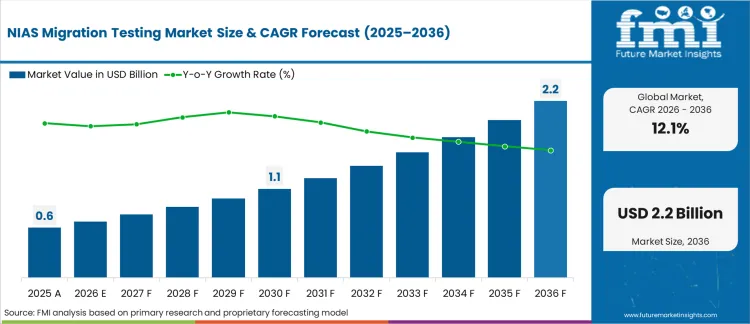
When regulatory bodies transition the 10 ppb threshold for unidentified substances from an advisory guideline to a legally enforced hard cap, the baseline requirements for market participation permanently change. Global packaging converters must implement continuous non-targeted batch screening across their entire production output within a strict 18-month compliance window. Facilities that successfully integrate these protocols secure their supply chain position, while non-compliant operators face immediate exclusion from premium retail distribution channels.
China sets the pace with a 14.5% CAGR, advancing rapidly as the domestic rollout of the updated GB 9685 national standard strictly governs food contact materials. India records a 13.8% rate, driven by expanding export-oriented packaging manufacturing requiring strict international compliance. Germany tracks at 13.2% as robust mechanical recycling infrastructures demand stringent toxicological verification of secondary polymers. The United States follows at 12.5%, responding to heightened FDA scrutiny on complex multi-layer barrier structures. The United Kingdom expands at 11.8%, while Japan reaches an 11.0% trajectory. Brazil posts a 10.2% growth rate. This geographic spread reflects the varying velocities at which national authorities are codifying trace chemical migration thresholds into absolute and enforceable law.
NIAS Migration Testing Market Definition
The NIAS migration testing market encompasses specialized analytical services and toxicological risk assessments designed to identify and quantify non-intentionally added substances transferring from packaging into food. These substances include impurities, degradation chemicals, and reaction by-products formed during material manufacturing or recycling processes. The market relies heavily on advanced mass spectrometry techniques and computational toxicology to ensure compliance with international food safety frameworks.
NIAS Migration Testing Market Inclusions
The market scope includes non-targeted chemical screening, specific migration limit (SML) testing, and exposure assessment modeling for complex food contact materials. Services utilizing advanced chromatographic detection methods such as GC-MS and LC-MS to identify volatile and semi-volatile compounds down to trace levels are fully incorporated. Risk assessment services applying the Threshold of Toxicological Concern (TTC) approach to evaluate the safety of unidentified migrants, and analytical procedures used to ensure the safety of smart labels and active materials, also fall strictly within these boundaries.
NIAS Migration Testing Market Exclusions
Standard microbiological pathogen testing and basic nutritional profiling of food products are explicitly excluded from this valuation. Standalone physical stress testing, shelf-life integrity evaluations, and packaging aesthetic assessments are omitted. Routine testing for intentionally added substances (IAS) that does not incorporate dedicated screening protocols for unknown degradation products or reaction intermediates falls completely outside the defined parameters of this specialized analytical market.
NIAS Migration Testing Market Research Methodology
- Primary Research: Analysts engaged with toxicology directors, regulatory compliance managers at packaging converters, and lead analytical chemists to map the specific decision gates triggering advanced non-targeted screening investments.
- Desk Research: The data collection phase aggregated compliance roadmaps from the European Food Safety Authority (EFSA), FDA food contact notifications, and technical guidelines from the Food Packaging Forum regarding reaction intermediates.
- Market-Sizing and Forecasting: The baseline value derives from a bottom-up aggregation of commercial laboratory testing volumes, applying region-specific regulatory enforcement curves to project the future adoption velocity of mass spectrometry services.
- Data Validation and Update Cycle: Projections are rigorously cross-validated against publicly reported capital expenditure guidance from leading contract research organizations and global food packaging conglomerates.
NIAS Migration Testing Market Key Takeaways
| Metric | Details |
|---|---|
| Industry Size (2026) | USD 0.7 billion |
| Industry Value (2036) | USD 2.2 billion |
| CAGR (2026-2036) | 12.1% |
Source: Future Market Insights (FMI) analysis, based on proprietary forecasting model and primary research
Segmental Analysis
NIAS Migration Testing Market Analysis by Material Type
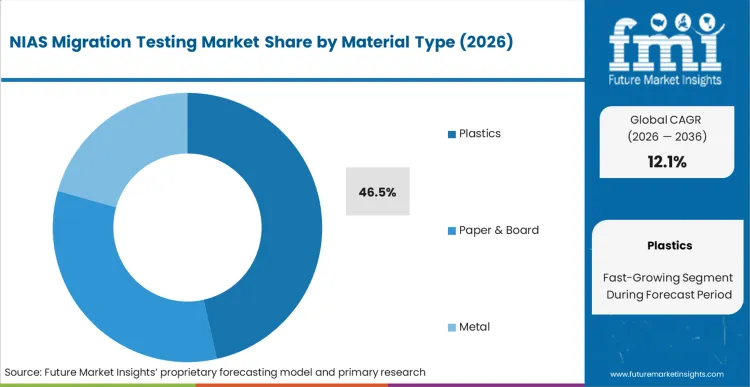
Plastics represent the dominant material segment, capturing 46.5% of the total share in 2026. This concentration is driven directly by the inherent chemical complexity of polymer manufacturing and the aggressive expansion of post-consumer recycled (PCR) content mandates. Global food packaging converters must validate that their recycled polymer resins do not introduce hazardous impurities or breakdown products into the food supply chain. Facilities that fail to implement rigorous screening protocols for these plastic substrates risk catastrophic recall events and permanent damage to their vendor qualification status. According to FMI's estimates, the integration of advanced mass spectrometry into routine quality control allows converters to detect trace oligomers and photoinitiators long before the packaging reaches retail shelves. Quality assurance directors specifying testing protocols for plastic food contact materials must demonstrate compliance with strict specific migration limits to secure brand owner approval.
- Polymer verification: Continuous regulatory scrutiny forces recycled resin producers to implement highly sensitive screening protocols for legacy contaminants.
- Contamination control: Advanced detection platforms allow packaging engineers to isolate and quantify reaction intermediates formed during high-temperature extrusion processes.
- Liability mitigation: Converters utilizing extensive chemical profiling avoid the massive financial penalties associated with downstream regulatory migration failures.
NIAS Migration Testing Market Analysis by Analytical Technique
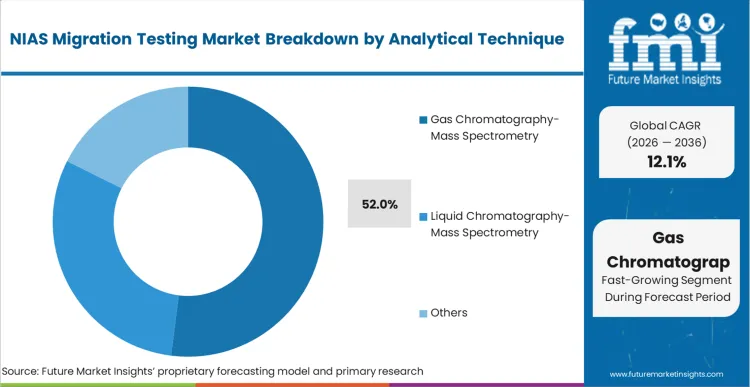
Gas Chromatography-Mass Spectrometry (GC-MS) leads the analytical technique segment, securing a 52.0% share in 2026 due to its unparalleled efficacy in detecting volatile and semi-volatile unknown compounds. Contract laboratory directors invest heavily in this specific instrumentation to meet the 10 ppb (micrograms/kg) screening threshold demanded by European regulators. FMI analysts opine that the expansion of proprietary spectral libraries directly enhances the capability of these systems to confidently identify complex degradation products. Testing laboratories that fail to upgrade their GC-MS capabilities find themselves unable to offer the comprehensive chemical hazard screening required by tier-one packaging suppliers. Without this technical foundation, analytical providers simply cannot execute the rigorous non-targeted methodologies necessary for complete toxicological risk assessments.
- Trace detection: Precise instrumentation enables analytical chemists to detect parts-per-billion concentrations of migrating substances.
- Library expansion: Continuous updates to mass spectral databases provide toxicologists with the critical reference points needed to identify obscure reaction by-products.
- Methodology standardization: Accredited laboratories deploying high-resolution mass spectrometry secure priority status in complex compliance auditing programs.
NIAS Migration Testing Market Analysis by End Use
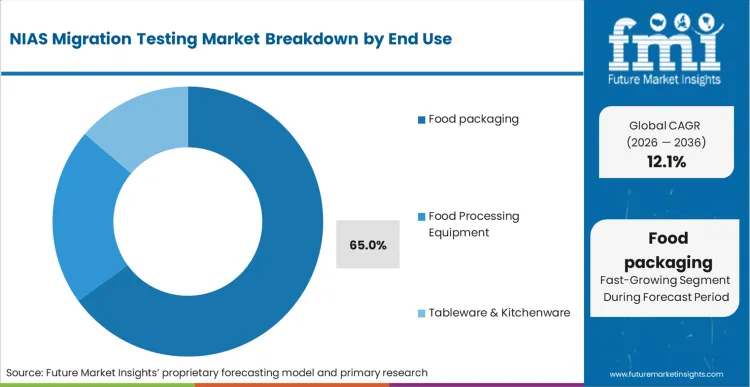
Food packaging emerges as the primary end use, commanding a 65.0% share in 2026 as brand owners intensify their scrutiny of multi-layer barrier films and sustainable paperboard liners. Multinational food and beverage corporations enforce strict vendor qualification standards that require comprehensive documentation of all potential chemical migrants. Based on FMI's assessment, the shift away from legacy single-use plastics toward novel bio-based materials introduces entirely new profiles of non-intentionally added substances that require extensive baseline testing. Packaging procurement leads must present verifiable toxicological risk assessments for every new substrate introduced into their supply chain. Failure to provide this critical analytical data results in immediate disqualification from major commercial tenders.
- Barrier validation: Brand owners demand extensive migration data to prove that novel multi-layer structures effectively block external chemical transfer.
- Substrate qualification: Procurement teams utilize rigorous non-targeted screening reports to justify the safety profile of emerging bio-based packaging formats.
- Risk quantification: Regulatory affairs managers rely on comprehensive exposure assessments to authorize the commercial launch of complex new packaging designs.
NIAS Migration Testing Market Drivers, Restraints, and Opportunities
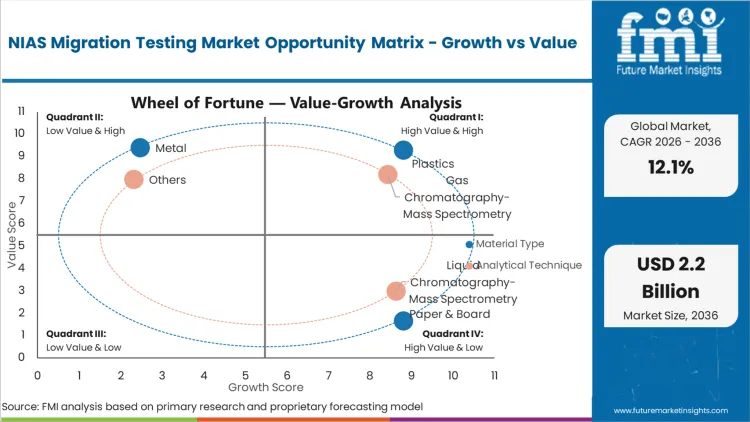
The strict enforcement of Commission Regulation (EU) No 10/2011 and Article 3 of Framework Regulation (EC) 1935/2004 forces global food packaging converters to fundamentally alter their quality assurance frameworks. This regulatory mandate drives a massive expansion in outsourced analytical screening, as manufacturers must prove that their materials transfer no hazardous constituents into food products. Converters upgrading their production lines face an absolute requirement to document the safety of all chemical species, including those not intentionally added. Facilities that attempt to bypass these comprehensive evaluations face severe product seizures and immediate exclusion from the lucrative metal packaging sector and the broader European consumer market.
The extreme analytical complexity required to identify unknown reaction intermediates creates significant operational bottlenecks for testing laboratories. Translating complex chromatograms into actionable toxicological risk assessments demands highly specialized scientific expertise that remains in critically short supply globally. While laboratories deploy advanced software algorithms to accelerate spectral matching, the final hazard evaluation relies heavily on manual toxicological review, strictly limiting the scalability of high-throughput screening operations and keeping service turnaround times extended.
Opportunities in the NIAS Migration Testing Market
- Digital traceability integration: Blockchain implementation connects specific physical test results directly to individual polymer batches. Supply chain managers who deploy these integrated data ledgers secure premium pricing by offering brands absolute proof of compliance.
- Recycled resin qualification: Advanced decontamination technologies generate new streams of food-grade secondary plastics requiring intense baseline testing. Accredited testing bodies that specialize in qualifying these sustainable materials, including advanced plastic healthcare packaging formats, capture massive, long-term monitoring contracts from global petrochemical firms.
- Predictive modeling software: The integration of in silico toxicological modeling reduces the reliance on physical extraction testing. Regulatory consultants who utilize these advanced predictive systems accelerate the compliance pathway for novel packaging formats.
Regional Analysis
Based on the regional analysis, the NIAS Migration Testing market is segmented into North America, Latin America, Europe, East Asia, South Asia, Oceania, and Middle East & Africa across 40 plus countries.
.webp "Top Country Growth Comparison Nias Migration Testing Market Cagr (2026 2036)")
| Country | CAGR (2026 to 2036) |
|---|---|
| China | 14.5% |
| India | 13.8% |
| Germany | 13.2% |
| United States | 12.5% |
| United Kingdom | 11.8% |
| Japan | 11.0% |
| Brazil | 10.2% |
Source: Future Market Insights (FMI) analysis, based on proprietary forecasting model and primary research
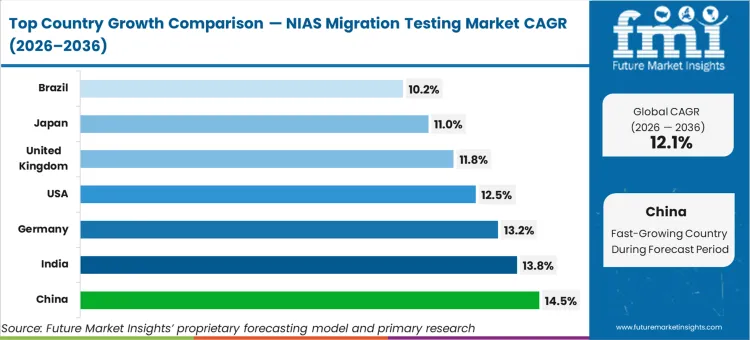
Asia Pacific NIAS Migration Testing Market Analysis
Aggressive regulatory modernization programs across the Asia Pacific region fundamentally reshape the compliance obligations for regional packaging manufacturers. Governments overhauling their food safety standards mandate rigorous analytical evaluation of all contact materials, effectively eliminating the historical reliance on self-certification. As per FMI's projection, this sweeping legislative shift forces domestic producers to partner with accredited third-party laboratories to validate their export readiness. The resulting surge in demand for specialized migration screening protocols rapidly expands the regional footprint of international testing conglomerates.
- China: China's implementation of the stringent GB 9685 national standard strictly dictates the permissible limits for food contact additives and unknown contaminants. Expanding at 14.5% between 2026 and 2036, this regulatory mechanism forces domestic packaging converters to invest heavily in comprehensive chemical profiling. Technology vendors supplying high-resolution mass spectrometers for glass packaging analysis capture significant capital equipment contracts as local laboratories scale their capacity to meet national mandates.
- India: Expanding export-oriented manufacturing in India demands strict adherence to European and North American food safety frameworks. Advancing at 13.8% compound between 2026 and 2036, regional contract laboratories are rapidly upgrading their analytical capabilities to serve the pharmaceutical and recycled plastics validation sectors. System integrators deploying turnkey testing solutions enable these facilities to overcome complex validation hurdles and secure international supply chain contracts.
- Japan: Japan's highly advanced food and beverage sector operates under meticulous quality control standards that prioritize extreme material purity. Sustaining an 11.0% CAGR to 2036, brand owners aggressively push packaging suppliers to implement ultra-sensitive screening protocols for trace oligomers and photoinitiators. Procurement specification leads utilizing these exactingly detailed reports successfully mitigate the risk of reputational damage in a consumer market fiercely dedicated to food safety.
FMI's report includes comprehensive evaluation of the broader regional deterministic frameworks encompassing South Korea, Indonesia, and the ASEAN economic bloc. A prevailing dynamic across these supplementary markets involves the rapid localization of specialized analytical capacity, driven by the unsustainable costs of shipping complex physical samples to centralized testing hubs.
Europe NIAS Migration Testing Market Analysis
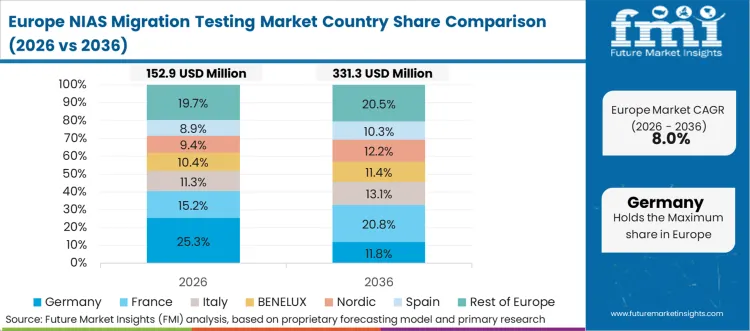
Europe's transition toward a fully circular packaging economy introduces extreme chemical complexity into the material recovery infrastructure. The aggressive mandate to incorporate high percentages of post-consumer recycled content directly conflicts with the absolute requirement for zero hazardous chemical migration. In FMI's view, this structural tension forces recycling facility operators and packaging converters to implement continuous, high-frequency analytical screening. Validating that mechanical and chemical recycling processes effectively strip out non-intentionally added substances requires highly sophisticated contaminant detection networks operating at the very edge of analytical capability.
- Germany: Germany's extensive mechanical recycling infrastructure demands rigorous chemical verification to clear secondary polymers for direct food contact. Projected at 13.2% compound growth over the forecast period, national testing bodies are heavily expanding their toxicological risk assessment capabilities to support major automotive and chemical conglomerates transitioning into active and smart packaging. Facility owners who successfully deploy continuous inline monitoring systems avoid the costly rejection of entire recycled resin batches.
- United Kingdom: Post-Brexit regulatory divergence in the United Kingdom forces packaging manufacturers to navigate dual compliance pathways for domestic and European markets. Tracking 11.8% annual growth to 2036, testing laboratories are capitalizing on this administrative complexity by offering integrated compliance consulting and screening packages while maintaining strict low migration flexo inks standards. Regulatory affairs managers utilizing these comprehensive outsourced services successfully maintain crucial cross-border trade flows without incurring devastating border delays.
FMI's report encompasses detailed intelligence tracking the Nordic and Benelux regions, highlighting intense corporate sustainability pledges that push testing demands far beyond basic regulatory baselines. The shift from synthetic fossil-derived materials toward biologically sourced alternatives is creating entirely new demands for unknown substance quantification across these environmentally conscious nations.
North America & Latin America NIAS Migration Testing Market Analysis
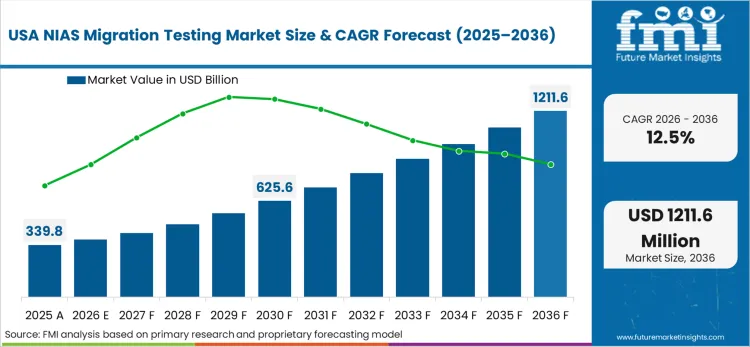
Heightened litigation risks and intense consumer advocacy pressure in the Americas force major food brands to adopt highly defensive procurement strategies. Multinational corporations operating across these jurisdictions increasingly reject the baseline regulatory minimums, instead demanding proactive, non-targeted screening of all supplier materials. FMI analysts opine that this aggressive risk mitigation approach forces packaging converters to execute extensive exposure assessments before a new product ever reaches the commercialization phase. By demanding comprehensive protective packaging validation, these massive buyers effectively set private safety standards that far exceed federal requirements.
- United States: Heightened FDA scrutiny on complex multi-layer structures and PFAS in the United States forces food grade PCR compliance into continuous batch testing. Anchored to a 12.5% annual expansion through the decade, the domestic market relies heavily on specialized contract research organizations to perform advanced in vitro toxicological modeling. Capital project directors investing in dedicated corporate testing laboratories effectively internalize this critical capability to accelerate their novel product development cycles.
- Brazil: Brazil's massive agricultural export sector requires absolute confidence in the chemical stability of its bulk transit packaging. Advancing at a 10.2% compound rate through 2036, the regional market is defined by a rapid influx of foreign direct investment aimed at modernizing local analytical laboratories. Network operators deploying centralized data management systems provide massive exporters with the immutable traceability records required by international customs authorities.
FMI's coverage evaluates the expansive North American supply network, assessing Canada and Mexico's structural roles in supporting multinational brand compliance. Increased integration of cross-border packaging ecosystems forces regional converters to harmonize their toxicological screening protocols to ensure uninterrupted continental product distribution.
Competitive Aligners for Market Players
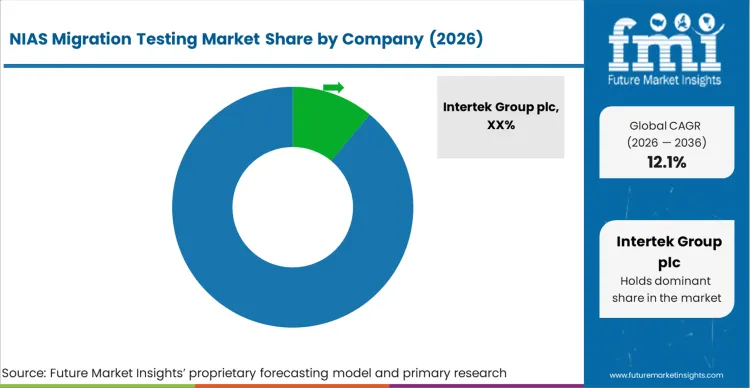
The global NIAS migration testing market operates as a highly concentrated landscape dominated by a select group of multinational testing, inspection, and certification (TIC) conglomerates. This consolidated structure exists because the capital intensity required to outfit facilities with state-of-the-art mass spectrometry equipment, combined with the difficulty of recruiting specialized toxicologists, creates an immense barrier to entry. Industry heavyweights such as Eurofins Scientific SE, Intertek Group plc, and SGS SA leverage their massive global laboratory networks to secure exclusive, multi-year compliance contracts with top-tier food and beverage brands. Buyers primarily evaluate these vendors based on the proprietary breadth of their chemical spectral libraries and their established credibility with regional regulatory authorities like EFSA and the FDA.
Established market leaders maintain a profound structural advantage through their accumulated historical databases of known reaction intermediates and polymer degradation profiles. A regional challenger attempting to disrupt this hierarchy must specifically build a comprehensive, digitally integrated toxicological modeling platform capable of matching the rapid turnaround times of the incumbents. The ability to seamlessly integrate analytical reporting data directly into a client's supply chain management software represents a critical differentiator. Challengers that fail to invest in predictive in silico capabilities will remain relegated to low-margin, targeted analytical work, entirely locked out of the lucrative non-targeted screening sector.
To counteract the pricing leverage held by these massive testing conglomerates, large packaging converters actively split their compliance portfolios across multiple accredited vendors. This structural tension between buyers seeking cost-efficiency and laboratories demanding premium rates for specialized toxicological assessments naturally limits extreme pricing power, even within a highly concentrated market. Furthermore, leading packaging manufacturers are increasingly investing in their own internal baseline screening capabilities to pre-qualify materials before submitting them for formal third-party certification. Moving toward 2036, the market is projected to undergo moderate fragmentation at the regional level, as agile, highly specialized boutique laboratories emerge to service the specific analytical needs of niche bio-based compostable adhesives startups.
Key Players in NIAS Migration Testing Market
- Intertek Group plc
- Smithers
- Eurofins Scientific SE
- SGS SA
- TÜV SÜD
- Bureau Veritas SA
- Mérieux NutriSciences
Scope of the Report
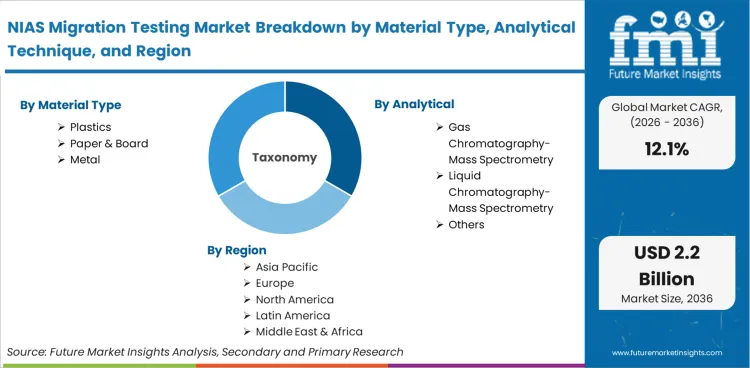
| Metric | Value |
|---|---|
| Quantitative Units | USD 0.7 billion to USD 2.2 billion, at a CAGR of 12.1% |
| Market Definition | The NIAS migration testing market encompasses specialized analytical services and toxicological risk assessments designed to identify and quantify non-intentionally added substances transferring from packaging into food. |
| Material Type Segmentation | Plastics, Paper & Board, Metal, Glass & Ceramics, Multi-material/Others |
| Analytical Technique Segmentation | Gas Chromatography-Mass Spectrometry (GC-MS), Liquid Chromatography-Mass Spectrometry (LC-MS), Inductively Coupled Plasma (ICP), Others |
| End Use Segmentation | Food Packaging, Food Processing Equipment, Tableware & Kitchenware |
| Regions Covered | North America, Latin America, Europe, East Asia, South Asia, Oceania, Middle East & Africa |
| Countries Covered | China, India, Germany, United States, United Kingdom, Japan, Brazil, and 40 plus countries |
| Key Companies Profiled | Intertek Group plc, Smithers, Eurofins Scientific SE, SGS SA, TÜV SÜD, Bureau Veritas SA, Mérieux NutriSciences |
| Forecast Period | 2026 to 2036 |
| Approach | The baseline value derives from a bottom-up aggregation of commercial laboratory testing volumes, applying region-specific regulatory enforcement curves to project the future adoption velocity. |
Source: Future Market Insights (FMI) analysis, based on proprietary forecasting model and primary research
Non-Intentionally Added Substances (NIAS) Migration Testing Market Analysis by Segments
Material Type:
- Plastics
- Paper & Board
- Metal
- Glass & Ceramics
- Multi-material/Others
Analytical Technique:
- Gas Chromatography-Mass Spectrometry (GC-MS)
- Liquid Chromatography-Mass Spectrometry (LC-MS)
- Inductively Coupled Plasma (ICP)
- Others
End Use:
- Food Packaging
- Food Processing Equipment
- Tableware & Kitchenware
Region:
- North America
- United States
- Canada
- Mexico
- Latin America
- Brazil
- Argentina
- Chile
- Rest of Latin America
- Europe
- Germany
- United Kingdom
- France
- Italy
- Spain
- Benelux (Belgium, Netherlands, Luxembourg)
- Nordics (Sweden, Norway, Denmark, Finland, Iceland)
- Central & Eastern Europe
- Rest of Europe
- East Asia
- China
- Japan
- South Korea
- South Asia
- India
- Indonesia
- Thailand
- Malaysia
- Rest of South Asia
- Oceania
- Australia
- New Zealand
- Middle East & Africa
- Kingdom of Saudi Arabia (KSA)
- United Arab Emirates (UAE)
- South Africa
- Turkey
- Rest of Middle East & Africa
Bibliography
- Smithers. (2024, March 10). Non Intentionally Added Substances | NIAS Testing. Smithers.
- Food Packaging Forum. (2024, April 05). Non-intentionally added substances (NIAS). Food Packaging Forum.
- European Chemical Industry Council (Cefic). (2024, May 20). Risk Assessment of non-listed substances (NLS) and non-intentionally added substances (NIAS). Cefic.
- Research Institutes of Sweden (RISE). (2024, June 18). Risk assessment of screening of non-intentionally added substances (NIAS). RISE.
- Eurofins Scientific SE. (2024, September 14). Food Contact Materials Testing Services. Eurofins.
- SGS SA. (2024, October 05). Food Contact Material Testing and Certification. SGS.
This bibliography is provided for reader reference. The full FMI report contains the complete reference list with primary source documentation.
This Report Addresses
- Market intelligence to support strategic decision making across analytical screening platforms, risk assessment methodologies, and compliance validation services unique to this market
- Market size estimation and 10-year revenue forecasts from 2026 to 2036, supported by commercial laboratory capacity tracking and regulatory enforcement models
- Growth opportunity mapping across specific material substrates and detection technologies with emphasis on the absolute enforcement of the 10 ppb threshold
- Segment and regional revenue forecasts covering plastics, multi-material laminates, and GC-MS platforms across stringent European and rapidly modernizing Asian regulatory contexts
- Competition strategy assessment including mass spectral library breadth, turnaround capability, and digital data integration features
- Analytical capability development tracking including non-targeted screening mechanisms, specific migration limits, Threshold of Toxicological Concern (TTC) approaches, and GC-MS library expansions discussed in this article
- Market access analysis covering EFSA compliance frameworks, FDA food contact notifications, and GB 9685 validation pathways
- Market report delivery in PDF, Excel, PPT, and interactive dashboard formats for executive strategy, global compliance planning, and operational benchmarking use
Frequently Asked Questions
How large is the NIAS migration testing in 2026?
The NIAS migration testing market is estimated to be valued at USD 0.7 billion in 2026 as stringent migration limits force packaging converters to abandon targeted legacy assays.
What will it be valued at by 2036?
Market size for NIAS migration testing is projected to reach USD 2.2 billion by 2036 as continuous non-targeted batch screening becomes a universal supply chain requirement.
What CAGR is projected?
Demand for NIAS migration testing is expected to grow at a CAGR of 12.1% between 2026 and 2036, driven by the structural necessity of identifying unpredictable reaction intermediates.
Which material type segment leads?
Plastics leads with a 46.5% share in 2026 as intense chemical complexity and recycled content integration demand massive contamination baseline testing.
Which analytical technique segment leads?
Gas Chromatography-Mass Spectrometry (GC-MS) leads because its detection precision is structurally required to isolate and identify semi-volatile compounds down to 10 ppb thresholds.
Which end use segment leads?
Food Packaging dominates due to massive global production volumes and intense brand owner scrutiny of multi-layer barrier films.
What drives rapid growth?
The strict enforcement of Commission Regulation (EU) No 10/2011 forces global food packaging converters to fundamentally alter their quality assurance frameworks and invest in advanced screening.
What is the primary restraint?
Translating complex chromatograms into actionable toxicological risk assessments demands highly specialized scientific expertise that remains in critically short supply globally.
Which country grows fastest?
China expands at 14.5% compound rate, advancing rapidly as the domestic rollout of the updated GB 9685 national standard strictly governs food contact materials.
How does Framework Regulation (EC) 1935/2004 affect testing volumes?
Article 3 mandates that all migrating substances must be safe, structurally requiring laboratories to execute comprehensive hazard evaluations for previously ignored degradation products.
Why is non-targeted analysis replacing legacy methods?
Targeted chemical analysis only finds known substances, forcing the industry to adopt non-targeted screening methods capable of detecting entirely unknown degradation and reaction products.
How do the top TIC players compete for enterprise contracts?
Incumbents fiercely protect their market position by heavily investing in the proprietary breadth of their mass spectral libraries and highly specialized computational toxicology platforms.
How does India navigate shifting regulations?
Expanding export-oriented manufacturing in India demands strict adherence to European food safety frameworks, driving intense localized laboratory capital expansion.
What creates pressure in the German market?
Germany's extensive mechanical recycling infrastructure demands rigorous chemical verification to clear secondary polymers for direct food contact.
Why is the 10 ppb threshold significant?
It represents the critical analytical sensitivity point where undetected non-intentionally added substances begin to trigger massive regulatory rejection events.
What role does blockchain play in compliance?
Digital traceability integration connects specific physical test results directly to individual polymer batches, granting manufacturers absolute proof of compliance during audits.
How do USA buyers influence vendor standards?
Intense consumer advocacy pressure forces major food brands to adopt defensive procurement strategies, setting private safety standards that far exceed federal requirements.
Why are recycled resins driving testing demand?
Secondary plastics carry significant risk of legacy contamination, requiring continuous batch-level exposure assessments before being cleared for consumer contact.
What defines the United Kingdom's adoption velocity?
Post-Brexit regulatory divergence forces packaging manufacturers to navigate dual compliance pathways, multiplying the total volume of necessary toxicological evaluations.
How does Brazil integrate mass spectrometry?
The massive agricultural export sector requires absolute confidence in bulk transit packaging, triggering heavy capital investment in modern analytical laboratories.
What falls outside the scope of this report?
Standard microbiological pathogen testing and routine evaluations for intentionally added substances that lack unknown degradation screening are explicitly excluded.
How was this forecast validated?
Projections underwent rigorous cross-validation against publicly reported capital expenditure guidance from the world's leading testing, inspection, and certification conglomerates.
What is the core strategic takeaway for packaging manufacturers?
Facilities must implement continuous non-targeted batch screening protocols to prevent catastrophic product recalls before regional enforcement deadlines permanently shut them out of retail channels.
Preview the report firsthand - request a free sample
Get SampleGet the brochure for pricing and purchase details.
Get PDFTable of Content
- Executive Summary
- Global Market Outlook
- Demand-side Trends
- Supply-side Trends
- Technology Roadmap Analysis
- Analysis and Recommendations
- Market Overview
- Market Coverage / Taxonomy
- Market Definition / Scope / Limitations
- Research Methodology
- Chapter Orientation
- Analytical Lens and Working Hypotheses
- Market Structure, Signals, and Trend Drivers
- Benchmarking and Cross-market Comparability
- Market Sizing, Forecasting, and Opportunity Mapping
- Research Design and Evidence Framework
- Desk Research Programme (Secondary Evidence)
- Company Annual and Sustainability Reports
- Peer-reviewed Journals and Academic Literature
- Corporate Websites, Product Literature, and Technical Notes
- Earnings Decks and Investor Briefings
- Statutory Filings and Regulatory Disclosures
- Technical White Papers and Standards Notes
- Trade Journals, Industry Magazines, and Analyst Briefs
- Conference Proceedings, Webinars, and Seminar Materials
- Government Statistics Portals and Public Data Releases
- Press Releases and Reputable Media Coverage
- Specialist Newsletters and Curated Briefings
- Sector Databases and Reference Repositories
- FMI Internal Proprietary Databases and Historical Market Datasets
- Subscription Datasets and Paid Sources
- Social Channels, Communities, and Digital Listening Inputs
- Additional Desk Sources
- Expert Input and Fieldwork (Primary Evidence)
- Primary Modes
- Qualitative Interviews and Expert Elicitation
- Quantitative Surveys and Structured Data Capture
- Blended Approach
- Why Primary Evidence is Used
- Field Techniques
- Interviews
- Surveys
- Focus Groups
- Observational and In-context Research
- Social and Community Interactions
- Stakeholder Universe Engaged
- C-suite Leaders
- Board Members
- Presidents and Vice Presidents
- R&D and Innovation Heads
- Technical Specialists
- Domain Subject-matter Experts
- Scientists
- Physicians and Other Healthcare Professionals
- Governance, Ethics, and Data Stewardship
- Research Ethics
- Data Integrity and Handling
- Primary Modes
- Tooling, Models, and Reference Databases
- Desk Research Programme (Secondary Evidence)
- Data Engineering and Model Build
- Data Acquisition and Ingestion
- Cleaning, Normalisation, and Verification
- Synthesis, Triangulation, and Analysis
- Quality Assurance and Audit Trail
- Market Background
- Market Dynamics
- Drivers
- Restraints
- Opportunity
- Trends
- Scenario Forecast
- Demand in Optimistic Scenario
- Demand in Likely Scenario
- Demand in Conservative Scenario
- Opportunity Map Analysis
- Product Life Cycle Analysis
- Supply Chain Analysis
- Investment Feasibility Matrix
- Value Chain Analysis
- PESTLE and Porter’s Analysis
- Regulatory Landscape
- Regional Parent Market Outlook
- Production and Consumption Statistics
- Import and Export Statistics
- Market Dynamics
- Global Market Analysis 2021 to 2025 and Forecast, 2026 to 2036
- Historical Market Size Value (USD Million) Analysis, 2021 to 2025
- Current and Future Market Size Value (USD Million) Projections, 2026 to 2036
- Y-o-Y Growth Trend Analysis
- Absolute $ Opportunity Analysis
- Global Market Pricing Analysis 2021 to 2025 and Forecast 2026 to 2036
- Global Market Analysis 2021 to 2025 and Forecast 2026 to 2036, By Material Type
- Introduction / Key Findings
- Historical Market Size Value (USD Million) Analysis By Material Type , 2021 to 2025
- Current and Future Market Size Value (USD Million) Analysis and Forecast By Material Type , 2026 to 2036
- Plastics
- Paper & Board
- Metal
- Plastics
- Y-o-Y Growth Trend Analysis By Material Type , 2021 to 2025
- Absolute $ Opportunity Analysis By Material Type , 2026 to 2036
- Global Market Analysis 2021 to 2025 and Forecast 2026 to 2036, By Analytical Technique
- Introduction / Key Findings
- Historical Market Size Value (USD Million) Analysis By Analytical Technique, 2021 to 2025
- Current and Future Market Size Value (USD Million) Analysis and Forecast By Analytical Technique, 2026 to 2036
- Gas Chromatography-Mass Spectrometry
- Liquid Chromatography-Mass Spectrometry
- Others
- Gas Chromatography-Mass Spectrometry
- Y-o-Y Growth Trend Analysis By Analytical Technique, 2021 to 2025
- Absolute $ Opportunity Analysis By Analytical Technique, 2026 to 2036
- Global Market Analysis 2021 to 2025 and Forecast 2026 to 2036, By End Use
- Introduction / Key Findings
- Historical Market Size Value (USD Million) Analysis By End Use, 2021 to 2025
- Current and Future Market Size Value (USD Million) Analysis and Forecast By End Use, 2026 to 2036
- Food packaging
- Food Processing Equipment
- Tableware & Kitchenware
- Food packaging
- Y-o-Y Growth Trend Analysis By End Use, 2021 to 2025
- Absolute $ Opportunity Analysis By End Use, 2026 to 2036
- Global Market Analysis 2021 to 2025 and Forecast 2026 to 2036, By Region
- Introduction
- Historical Market Size Value (USD Million) Analysis By Region, 2021 to 2025
- Current Market Size Value (USD Million) Analysis and Forecast By Region, 2026 to 2036
- North America
- Latin America
- Western Europe
- Eastern Europe
- East Asia
- South Asia and Pacific
- Middle East & Africa
- Market Attractiveness Analysis By Region
- North America Market Analysis 2021 to 2025 and Forecast 2026 to 2036, By Country
- Historical Market Size Value (USD Million) Trend Analysis By Market Taxonomy, 2021 to 2025
- Market Size Value (USD Million) Forecast By Market Taxonomy, 2026 to 2036
- By Country
- USA
- Canada
- Mexico
- By Material Type
- By Analytical Technique
- By End Use
- By Country
- Market Attractiveness Analysis
- By Country
- By Material Type
- By Analytical Technique
- By End Use
- Key Takeaways
- Latin America Market Analysis 2021 to 2025 and Forecast 2026 to 2036, By Country
- Historical Market Size Value (USD Million) Trend Analysis By Market Taxonomy, 2021 to 2025
- Market Size Value (USD Million) Forecast By Market Taxonomy, 2026 to 2036
- By Country
- Brazil
- Chile
- Rest of Latin America
- By Material Type
- By Analytical Technique
- By End Use
- By Country
- Market Attractiveness Analysis
- By Country
- By Material Type
- By Analytical Technique
- By End Use
- Key Takeaways
- Western Europe Market Analysis 2021 to 2025 and Forecast 2026 to 2036, By Country
- Historical Market Size Value (USD Million) Trend Analysis By Market Taxonomy, 2021 to 2025
- Market Size Value (USD Million) Forecast By Market Taxonomy, 2026 to 2036
- By Country
- Germany
- UK
- Italy
- Spain
- France
- Nordic
- BENELUX
- Rest of Western Europe
- By Material Type
- By Analytical Technique
- By End Use
- By Country
- Market Attractiveness Analysis
- By Country
- By Material Type
- By Analytical Technique
- By End Use
- Key Takeaways
- Eastern Europe Market Analysis 2021 to 2025 and Forecast 2026 to 2036, By Country
- Historical Market Size Value (USD Million) Trend Analysis By Market Taxonomy, 2021 to 2025
- Market Size Value (USD Million) Forecast By Market Taxonomy, 2026 to 2036
- By Country
- Russia
- Poland
- Hungary
- Balkan & Baltic
- Rest of Eastern Europe
- By Material Type
- By Analytical Technique
- By End Use
- By Country
- Market Attractiveness Analysis
- By Country
- By Material Type
- By Analytical Technique
- By End Use
- Key Takeaways
- East Asia Market Analysis 2021 to 2025 and Forecast 2026 to 2036, By Country
- Historical Market Size Value (USD Million) Trend Analysis By Market Taxonomy, 2021 to 2025
- Market Size Value (USD Million) Forecast By Market Taxonomy, 2026 to 2036
- By Country
- China
- Japan
- South Korea
- By Material Type
- By Analytical Technique
- By End Use
- By Country
- Market Attractiveness Analysis
- By Country
- By Material Type
- By Analytical Technique
- By End Use
- Key Takeaways
- South Asia and Pacific Market Analysis 2021 to 2025 and Forecast 2026 to 2036, By Country
- Historical Market Size Value (USD Million) Trend Analysis By Market Taxonomy, 2021 to 2025
- Market Size Value (USD Million) Forecast By Market Taxonomy, 2026 to 2036
- By Country
- India
- ASEAN
- Australia & New Zealand
- Rest of South Asia and Pacific
- By Material Type
- By Analytical Technique
- By End Use
- By Country
- Market Attractiveness Analysis
- By Country
- By Material Type
- By Analytical Technique
- By End Use
- Key Takeaways
- Middle East & Africa Market Analysis 2021 to 2025 and Forecast 2026 to 2036, By Country
- Historical Market Size Value (USD Million) Trend Analysis By Market Taxonomy, 2021 to 2025
- Market Size Value (USD Million) Forecast By Market Taxonomy, 2026 to 2036
- By Country
- Kingdom of Saudi Arabia
- Other GCC Countries
- Turkiye
- South Africa
- Other African Union
- Rest of Middle East & Africa
- By Material Type
- By Analytical Technique
- By End Use
- By Country
- Market Attractiveness Analysis
- By Country
- By Material Type
- By Analytical Technique
- By End Use
- Key Takeaways
- Key Countries Market Analysis
- USA
- Pricing Analysis
- Market Share Analysis, 2025
- By Material Type
- By Analytical Technique
- By End Use
- Canada
- Pricing Analysis
- Market Share Analysis, 2025
- By Material Type
- By Analytical Technique
- By End Use
- Mexico
- Pricing Analysis
- Market Share Analysis, 2025
- By Material Type
- By Analytical Technique
- By End Use
- Brazil
- Pricing Analysis
- Market Share Analysis, 2025
- By Material Type
- By Analytical Technique
- By End Use
- Chile
- Pricing Analysis
- Market Share Analysis, 2025
- By Material Type
- By Analytical Technique
- By End Use
- Germany
- Pricing Analysis
- Market Share Analysis, 2025
- By Material Type
- By Analytical Technique
- By End Use
- UK
- Pricing Analysis
- Market Share Analysis, 2025
- By Material Type
- By Analytical Technique
- By End Use
- Italy
- Pricing Analysis
- Market Share Analysis, 2025
- By Material Type
- By Analytical Technique
- By End Use
- Spain
- Pricing Analysis
- Market Share Analysis, 2025
- By Material Type
- By Analytical Technique
- By End Use
- France
- Pricing Analysis
- Market Share Analysis, 2025
- By Material Type
- By Analytical Technique
- By End Use
- India
- Pricing Analysis
- Market Share Analysis, 2025
- By Material Type
- By Analytical Technique
- By End Use
- ASEAN
- Pricing Analysis
- Market Share Analysis, 2025
- By Material Type
- By Analytical Technique
- By End Use
- Australia & New Zealand
- Pricing Analysis
- Market Share Analysis, 2025
- By Material Type
- By Analytical Technique
- By End Use
- China
- Pricing Analysis
- Market Share Analysis, 2025
- By Material Type
- By Analytical Technique
- By End Use
- Japan
- Pricing Analysis
- Market Share Analysis, 2025
- By Material Type
- By Analytical Technique
- By End Use
- South Korea
- Pricing Analysis
- Market Share Analysis, 2025
- By Material Type
- By Analytical Technique
- By End Use
- Russia
- Pricing Analysis
- Market Share Analysis, 2025
- By Material Type
- By Analytical Technique
- By End Use
- Poland
- Pricing Analysis
- Market Share Analysis, 2025
- By Material Type
- By Analytical Technique
- By End Use
- Hungary
- Pricing Analysis
- Market Share Analysis, 2025
- By Material Type
- By Analytical Technique
- By End Use
- Kingdom of Saudi Arabia
- Pricing Analysis
- Market Share Analysis, 2025
- By Material Type
- By Analytical Technique
- By End Use
- Turkiye
- Pricing Analysis
- Market Share Analysis, 2025
- By Material Type
- By Analytical Technique
- By End Use
- South Africa
- Pricing Analysis
- Market Share Analysis, 2025
- By Material Type
- By Analytical Technique
- By End Use
- USA
- Market Structure Analysis
- Competition Dashboard
- Competition Benchmarking
- Market Share Analysis of Top Players
- By Regional
- By Material Type
- By Analytical Technique
- By End Use
- Competition Analysis
- Competition Deep Dive
- Intertek Group plc
- Overview
- Product Portfolio
- Profitability by Market Segments (Product/Age /Sales Channel/Region)
- Sales Footprint
- Strategy Overview
- Marketing Strategy
- Product Strategy
- Channel Strategy
- Smithers
- Eurofins Scientific SE
- SGS SA
- TÜV SÜD
- Bureau Veritas SA
- Mérieux NutriSciences
- Intertek Group plc
- Competition Deep Dive
- Assumptions & Acronyms Used


