

- Industry Size (2026)
- USD 2.6 Bn
- Forecast (2036)
- USD 11.4 Bn
- CAGR
- (2026 to 2036)
AR-Enabled Virtual Furniture Try-On Market Size, Market Forecast and Outlook By FMI
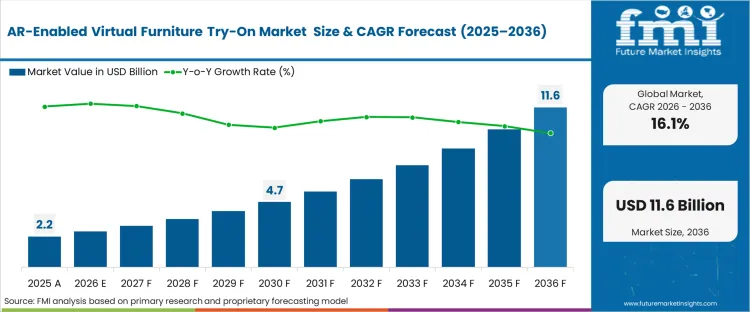
The AR-enabled virtual furniture try-on market size was valued at USD 2.2 billion in 2025. The industry is poised to surpass USD 2.6 billion in 2026 at a CAGR of 16.1% during the forecast period. The cumulative buildup propels the AR-enabled virtual furniture try-on market to USD 11.4 billion through 2036 as the financial burden of reverse logistics forces retailers to replace legacy product photography with dimensional visualization tools that function as core loss-prevention systems.
As furniture retailers advance their digital transformation strategies, the question is no longer whether to offer 3D visualization, but whether to develop proprietary asset pipelines or outsource these capabilities to managed rendering platforms. Delaying this architectural decision creates immediate margin risk, since physical product returns continue to rise as consumers increasingly demand precise dimensional validation before committing to high‑value purchases. While early virtual try-on platform features were adequate in the past, retailers now face a market where fully accurate spatial representation is considered the minimum standard in augmented reality furniture shopping. Operational priorities across leading retailers have therefore shifted from focusing solely on conversion improvements to prioritizing technologies that materially reduce ecommerce return rates.
Summary of AR-Enabled Virtual Furniture Try-On Market
- AR-Enabled Virtual Furniture Try-On Market Definition
- The sector comprises spatial computing tools and asset management pipelines that project dimensionally accurate furniture models into physical spaces. It operates as the critical bridge between digital discovery and physical spatial validation for large-ticket items.
- Demand Drivers in the Market
- Margin erosion from reverse logistics forces digital supply chain heads to mandate pre-purchase spatial validation for bulky SKUs.
- Mobile browser rendering advancements require e-commerce directors to integrate lightweight spatial assets directly into native web interfaces.
- Capital constraints on physical showroom expansion compel brand operators to digitize inventory for virtual staging and spatial planning.
- Key Segments Analyzed in the FMI Report
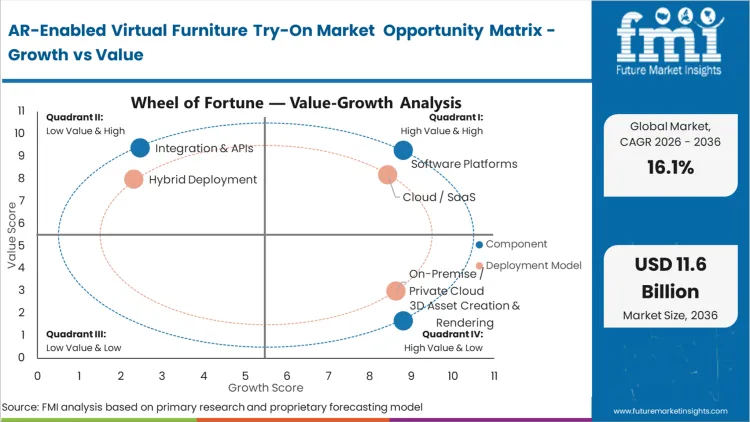
- Software Platforms: Software Platforms are estimated to hold 58.0% share in 2026, as retailers prioritize API-driven integrations over building proprietary rendering engines in the AR-enabled virtual furniture try-on market.
- Cloud / SaaS: Cloud / SaaS is poised to grab 64.0% share in 2026, driven by the need to continuously stream updated 3D catalog data to distributed endpoints without local storage limits.
- Smartphones & Tablets: Smartphones & tablets are projected to account for 68.0% share in 2026, functioning as the ubiquitous spatial capture device already in the buyer's possession.
- Furniture Retailers / Marketplaces: Furniture retailers / marketplaces are likely to garner 47.0% share in 2026, as aggregation platforms use spatial tools to standardize the buying experience across thousands of third-party vendors.
- Living Room Furniture: Living room furniture is anticipated to hold 31.0% share in 2026, representing the highest concentration of high-consideration, bulky items requiring strict spatial validation.
- Subscription Licensing: Subscription licensing is set to capture 42.0% share in 2026, aligning vendor revenue with the continuous hosting and streaming requirements of massive 3D asset libraries.
- Residential / Consumer Commerce: Residential / consumer commerce is expected to record 72.0% share in 2026, as the core margin preservation challenge resides in the unpredictable environments of individual homes.
- India: Driven by an unorganized retail sector rapidly formalizing through digital-first marketplaces that lack legacy physical showrooms, the market in India is expected to register a CAGR of around 21.9% during the forecast period.
- Analyst Opinion at FMI
- Rahul Pandita, Principal Analyst, Technology, at FMI, opines, "The standard metric captures top-line conversion uplift, measuring how many users click buy after a 3D interaction. This process lacks the catastrophic margin impact of reverse logistics; the true financial driver of AR-enabled virtual furniture try-on market growth is the elimination of the return rate on bulky items that simply do not fit in the buyer's physical space."
- Strategic Implications / Executive Takeaways
- E-commerce directors must transition from native app development to web-based spatial rendering to capture casual browsers who refuse application downloads.
- 3D pipeline managers should standardize asset metadata to avoid re-rendering entire catalogs when operating system spatial guidelines change.
- Furniture brand operators face physical showroom constraints that require shifting capital expenditure toward high-fidelity digital inventory digitization.
- Methodology
- Primary Research: Focused on decision-makers selecting rendering engines and managing catalog digitization budgets.
- Desk Research: Evaluated API integration documentation and vendor pricing models.
- Market-Sizing and Forecasting: Anchored to retail e-commerce volumes and software licensing penetration.
- Data Validation and Update Cycle: Corroborated through vendor deployment announcements and retail margin impact reports.
AR-Enabled Virtual Furniture Try-On Market Key Takeaways
| Metric | Details |
|---|---|
| Industry Size (2026) | USD 2.6 billion |
| Industry Value (2036) | USD 11.4 billion |
| CAGR (2026-2036) | 16.1% |
Source: Future Market Insights (FMI) analysis, based on proprietary forecasting model and primary research
A key catalyst for widespread adoption is the maturing of operating system level browser rendering, which eliminates the need for consumers to download dedicated applications. Smartphone manufacturers are accelerating this shift by enabling native, on‑device processing of complex 3D assets within mobile browsers. This advancement directly influences the forecast outlook for the furniture augmented reality software market, as it removes one of the most significant barriers to consumer engagement. Once this friction point disappears, user hesitation declines, and the cost per digital interaction drops to a level that supports the full digitization of furniture catalogs rather than limiting 3D asset creation to only the highest volume items.
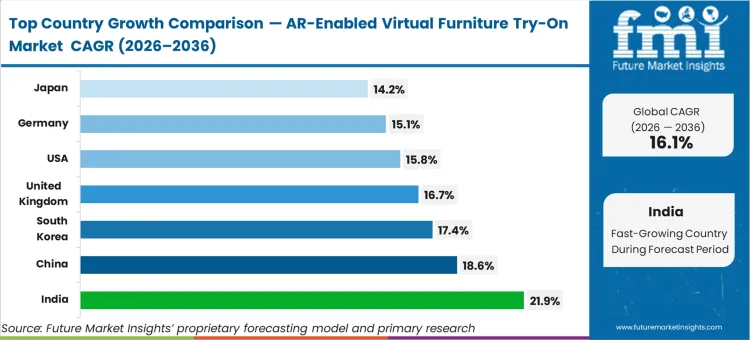
India is expected to advance at 21.9%, followed by China tracking at 18.6%, South Korea registering 17.4%, the United Kingdom growing at 16.7%, the United States expanding at 15.8%, Germany following at 15.1%, and Japan posting 14.2%. The divergence across this range reflects the tension between mobile-first populations skipping physical showroom phases entirely versus legacy retail environments gradually retrofitting digital tools onto established brick-and-mortar footprints.
AR-Enabled Virtual Furniture Try-On Market Definition
The AR-enabled virtual furniture try-on market encompasses software solutions, rendering engines, and managed services that allow consumers to overlay physically accurate, scaled 3D models of furniture into real-world environments using spatial computing interfaces. To explain the difference between room planners and virtual try-on for furniture, this category is functionally distinct from a virtual room planner market because it strictly requires real-time environmental mapping, dimensional anchoring, and lighting estimation to validate physical fit prior to purchase, rather than manually building a 2D floor plan.
AR-Enabled Virtual Furniture Try-On Market Inclusions
This sector includes native and webAR furniture visualization market spatial rendering applications, 3D asset creation for furniture AR commerce pipelines specifically tuned for furniture SKUs, API connectors that embed rendering capabilities into existing digital storefronts, and cloud-hosted platforms managing 3D object repositories. Solutions driving augmented reality shopping for interior design, B2B space planning, and direct-to-consumer furniture retail fall within the analytical boundary.
AR-Enabled Virtual Furniture Try-On Market Exclusions
Hardware systems like mobile phones and dedicated augmented reality glasses are explicitly excluded from the sizing scope because they represent general-purpose computing devices rather than furniture-specific retail infrastructure. Standalone CAD software used purely for manufacturing design without consumer-facing try-on capabilities is also excluded, as the driver of this sector is pre-purchase spatial validation by the end buyer, not the industrial design process.
AR-Enabled Virtual Furniture Try-On Market Research Methodology
- Primary Research: FMI conducted structured interviews with e-commerce directors, spatial computing product managers, and digital supply chain heads at tier-1 home goods retailers to validate asset digitization costs.
- Desk Research: Analysts aggregated deployment case studies, 3D asset standardization protocols from spatial computing consortiums, and retail logistics disclosures regarding return rate impacts.
- Market-Sizing and Forecasting: The baseline anchors to observed digital commerce penetration rates for bulky home goods multiplied by the licensing and integration costs of spatial visualization software suites.
- Data Validation and Update Cycle: Forecasts were triangulated against the capital expenditure allocations of major furniture brands actively transitioning their product catalogs from 2D photography to 3D spatial assets.
Segmental Analysis
AR-Enabled Virtual Furniture Try-On Market Analysis by Component
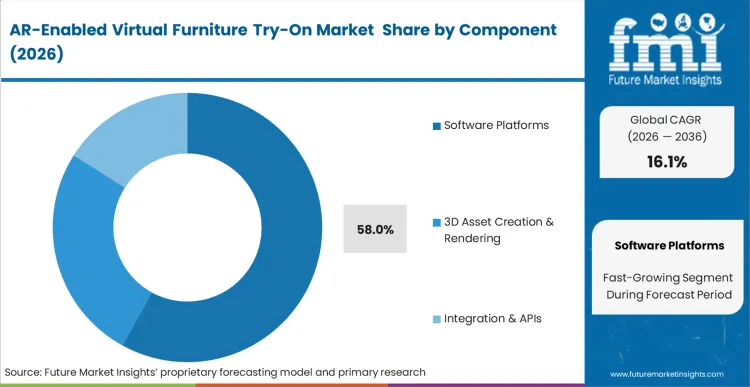
Software platforms segment accounts for 58.0% of this market because of the inherent complexity of spatial mapping, which retail organizations cannot cost‑effectively address with in‑house engineering teams. FMI’s analysis indicates that the primary value resides in the core rendering engine, the component responsible for interpreting physical environments, assessing ambient lighting conditions, and anchoring 3D assets accurately without positional drift. As a result, strategic focus is shifting toward the integration of augmented reality engines that can connect seamlessly with existing product information management systems.
As retailers expand their digital catalogs from a few hundred SKUs to several thousand, operational challenges move away from the initial spatial projection and toward managing the 3D assets at scale. This includes version control, automated optimization, metadata alignment, and consistent publishing across multiple platforms. Retailers that attempt to develop proprietary spatial rendering engines encounter continuous maintenance demands, as they must update their systems frequently to keep pace with rapid changes in mobile operating systems and device hardware.
- Initial selection: Core engine stability determines whether the 3D object drifts during the user's camera movement. Platforms that fail this basic tracking test are disqualified before furniture visualization software pricing is even considered.
- Qualification check: Integration flexibility dictates how easily the rendering capability embeds into the retailer's existing web architecture. Heavy SDKs that slow page load times face immediate rejection from digital operations teams.
- Renewal driver: Automated asset pipeline management dictates the total cost of ownership over the software lifecycle. Platforms that streamline the ingestion of raw CAD files into web-optimized 3D formats capture long-term vendor lock-in.
AR-Enabled Virtual Furniture Try-On Market Analysis by Deployment Model
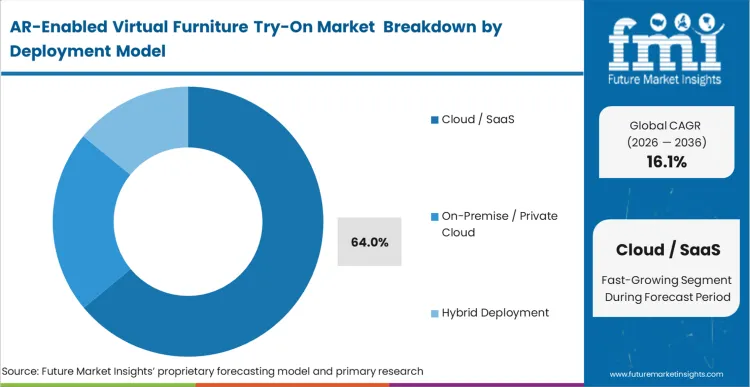
Cloud / SaaS delivery models segment holds 64.0% share of the market in 2026 because the processing and distribution requirements of high fidelity spatial assets exceed the capabilities of traditional on‑premise architectures. Digital operations leaders must evaluate how large repositories of complex polygon files can be streamed instantly to mobile browsers without requiring consumers to pre‑download heavy assets. The need for uninterrupted, low latency streaming makes cloud-based furniture visualization platforms the only scalable option for supporting spontaneous buyer engagement.
In this model, intensive 3D rendering workloads are shifted to distributed edge networks, allowing end‑user devices to concentrate solely on camera tracking and display functions. This division of processing ensures that AR experiences remain fast, stable, and responsive across a wide range of consumer hardware. Retailers attempting to self‑host enterprise web-based AR solutions face significant bandwidth constraints during peak traffic periods, creating delays that disrupt the spatial experience and drive session abandonment. As a result, cloud native architectures have emerged as the operational backbone of modern furniture ecommerce visualization strategies.
- Origin of savings: Offloading heavy rendering infrastructure reduces initial capital expenditure on server capacity. Retailers avoid the hardware lifecycle costs associated with self-hosting complex graphical assets.
- Hidden operational cost: Bandwidth egress fees accumulate silently as consumer interaction rates climb. High-traffic AR VR software events quickly expose the variable cost vulnerabilities of cloud streaming contracts.
- Lifecycle comparison: The continuous feature updates delivered via SaaS outweigh the perceived control of on-premise solutions. The total cost of ownership calculation heavily favors cloud models when factoring in necessary operating system compatibility updates.
AR-Enabled Virtual Furniture Try-On Market Analysis by Device Interface
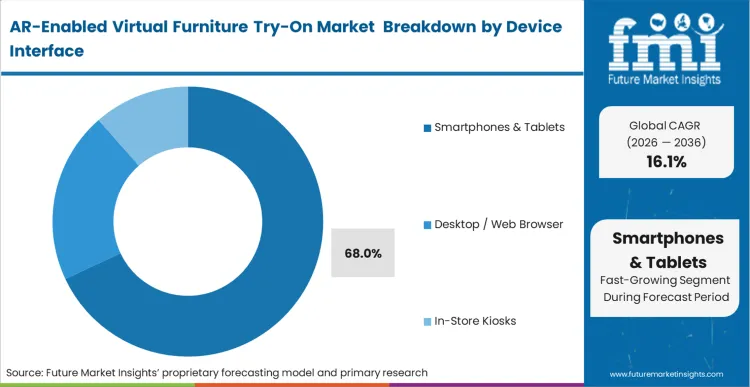
Earlier approaches that required shoppers to borrow in‑store tablets or rely on desktop webcams failed to provide an accurate representation of their real living environment. The integration of LiDAR scanners and advanced depth sensing cameras into standard consumer mobile devices has significantly reshaped the adoption curve for AR furniture placement. Smartphones and tablets segment account for 68.0% of the market in 2026 because they are the only spatial capture devices already deployed at scale in consumers’ homes. Consumers no longer need specialized hardware to generate precise dimensional meshes of their rooms.
When comparing web based AR with native app furniture try on, solutions that attempt to deliver 3D somatosensory virtual fitting through desktop interfaces face substantial interaction drop off, since users increasingly reject the friction of manually entering room measurements. The widespread availability of mobile depth sensing enables an intuitive, device native workflow that supports high engagement and minimizes user abandonment, making smartphones and tablets the dominant platform for AR driven furniture visualization.
- Failure prevention: Immediate spatial anchoring prevents the user frustration of manually scaling 3D objects. Native mobile sensors handle dimensional validation automatically.
- Residual risk: Poor lighting conditions in the physical environment still degrade tracking stability. Users must be actively guided to scan well-lit areas to maintain the spatial illusion.
- Operational requirement: Vendors must optimize 3D polygon counts specifically for mobile GPU constraints. Heavy assets that cause thermal throttling on consumer devices lead to immediate session abandonment.
AR-Enabled Virtual Furniture Try-On Market Analysis by End User
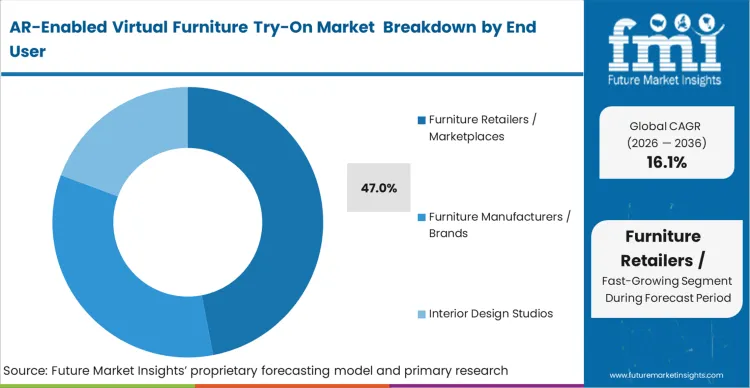
Aggregators face a unique operational challenge, since they do not manufacture the products yet absorb the reverse logistics costs when third‑party items fail to fit the customer’s physical space. United States AR VR software deployments by tier‑1 retailers have established a new expectation for spatial accuracy, compelling smaller marketplace participants to adopt standardized AR room‑planning tools or risk exclusion from premium digital storefronts. Furniture retailers / marketplaces segment account for 47.0% share of the market in 2026, driven by the need to standardize the spatial viewing experience across highly fragmented supply chains. Marketplaces that delay the implementation of spatial visualization technologies experience immediate competitive disadvantages, as consumers increasingly migrate to platforms offering immersive digital showrooms that eliminate dimensional uncertainty for large‑ticket purchases. By providing a consistent, accurate spatial experience across diverse supplier catalogs, retailers strengthen buyer confidence, reduce return rates, and secure a defensible position within the rapidly evolving furniture ecommerce landscape.
- Scale capability: Cloud rendering pipelines allow marketplaces to ingest varying qualities of manufacturer CAD files and standardize them for web display. The technical burden is shifted away from the individual vendor.
- Supply bottleneck: The sheer volume of legacy SKUs lacking any 3D metadata slows the transition. Marketplaces must incentivize suppliers to provide dimensional data or fund the digitization process internally.
- Future state: Standardized 3D asset requirements become mandatory for listing on tier-1 platforms. Suppliers who fail to provide spatial-ready files are algorithmically deprioritized in search results.
AR-Enabled Virtual Furniture Try-On Market Analysis by Room/Application
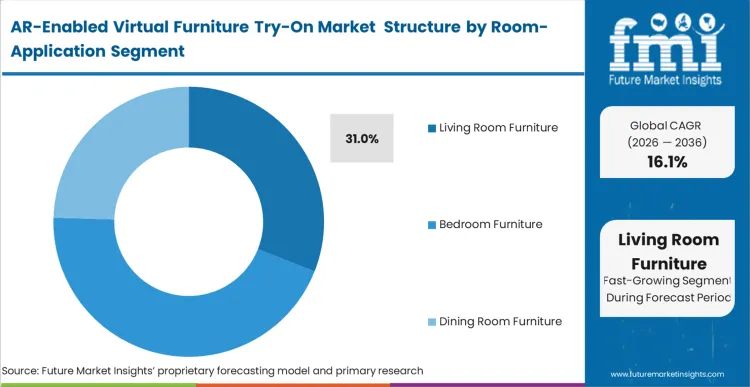
Living room furniture is emerging as the segment that will define the trajectory of spatial interaction over the next three years, and it currently holds the largest share of 31.0% in 2026. This category contains the highest concentration of high‑consideration, physically dominant items such as sectionals, modular sofas, and entertainment centers, where dimensional inaccuracies create significant customer dissatisfaction. FMI analysts estimate that while home decor visualization previously focused on aesthetic alignment and color matching, the core value proposition in augmented reality for living room furniture has shifted toward spatial conflict detection. Consumers increasingly need clarity on whether a sofa obstructs a walkway, whether a coffee table disrupts traffic flow, or whether a rug overwhelms the room’s layout.
Brands that prioritize precise spatial visualization for living room products, particularly through custom sectional configurators or modular sofa AR tools, achieve measurable reductions in post‑delivery rejection rates. This improvement directly protects unit‑level margins, since fewer returns translate to significant savings in reverse logistics and refurbishment costs. As a result, the living room category is becoming the primary battleground for retailers seeking to differentiate themselves through advanced spatial computing capabilities.
- Where performance exceeds: High-fidelity texture rendering accurately conveys fabric sheen and material weight. Consumers gain confidence in material quality without physical tactile validation.
- Edge condition gaps: Complex ambient lighting environments confuse the rendering engine's shadow estimation. The virtual object can look artificially bright or flat, breaking the suspension of disbelief.
- Acceptability standard: The physical dimensions must anchor flawlessly to the floor plane without clipping through existing physical objects. If a sofa appears to float above the rug, the spatial validation fails.
AR-Enabled Virtual Furniture Try-On Market Analysis by Business Model
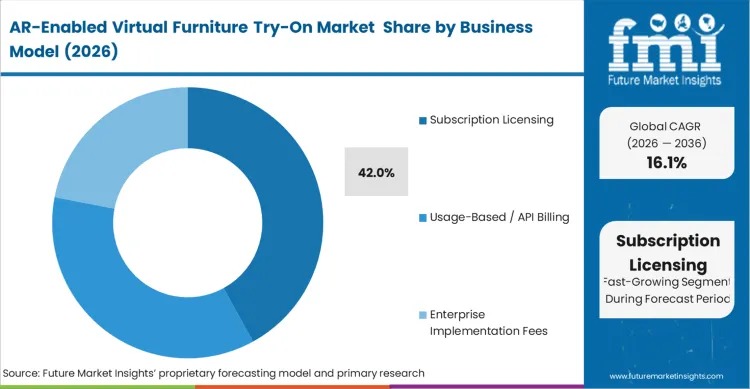
Procurement directors are increasingly required to choose between absorbing a significant upfront implementation cost for a perpetual furniture AR software license or transitioning to a variable operational expense model tied to catalog size. Subscription licensing segment accounts for 42.0% of the market in 2026, reflecting the operational reality that 3D assets must be continuously hosted, streamed, and optimized to maintain performance at scale. According to FMI’s assessment, the pace of updates within the mobile augmented reality ecosystem makes perpetual licensing financially impractical. The software demands ongoing patching to remain compatible with annual iOS and Android spatial framework releases, as well as continuous adjustments to accommodate evolving web‑optimized 3D formats.
Procurement teams that continue to rely on traditional enterprise implementation fee structures often find themselves locked into outdated rendering engines that cannot support modern asset pipelines or real time browser‑based spatial computing. In contrast, subscription models ensure continuous technical alignment, allowing retailers to maintain the fidelity, responsiveness, and compatibility required for contemporary AR furniture visualization.
- Early adopters: Tier-1 retailers deploy massive capital to define the initial spatial workflows. They establish the baseline expectations for asset fidelity and tracking stability.
- Mid-market followers: Regional chains adopt standardized SaaS tools once the infrastructure costs compress. They benefit from the optimized pipelines developed during the early adopter phase.
- Late arrivals: Smaller boutique brands integrate spatial tools only when API plugins become commoditized within basic e-commerce platforms. They convert when the technical friction drops to zero.
AR-Enabled Virtual Furniture Try-On Market Analysis by Customer Segment
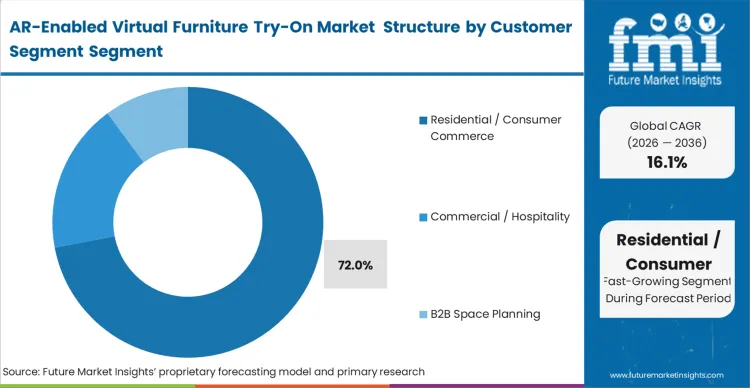
Professional B2B planners may accept complex interfaces and large application downloads, but residential consumers expect immediate access through a simple web link when engaging in AR‑enabled home décor and furniture shopping. FMI’s analysis indicates that the incorporation of Japan AR VR software standards into global ecommerce platforms demonstrates that lightweight, browser‑based rendering is the only scalable approach for mass consumer adoption. The residential and consumer commerce segment captures 72.0% of market share in 2026, highlighting the structural tension between feature‑rich professional design tools and the need for frictionless everyday interaction.
Platforms that strike the right balance between photorealism and low latency delivery achieve consistently higher consumer engagement. By contrast, brands that require residential users to complete complex calibration steps or navigate multi‑stage setup processes face elevated abandonment rates, with many consumers exiting before spatial validation even begins. For retailers targeting mainstream adoption, the strategic priority is clear, simplify access, minimize friction, and ensure that AR visualization loads instantly within the mobile browser environment.
- Consumer validation: The buyer evaluates the physical footprint and aesthetic harmony in real-time. This step replaces the legacy behavior of measuring physical spaces with tape and hoping the item fits.
- Secondary confirmation: The user shares screenshots of the spatially anchored item with household members for consensus. This social validation loop accelerates the final purchase decision.
- Retention mechanic: High-confidence purchases resulting from accurate spatial validation reduce return friction. The buyer returns to the same platform for future home furnishing needs.
AR-Enabled Virtual Furniture Try-On Market Drivers, Restraints, and Opportunities
Escalating reverse logistics costs are now a primary driver of AR furniture shopping adoption among retailers. Digital supply chain leaders face increasing pressure to mandate spatial validation tools, since returning a large sofa or sectional is significantly more expensive than processing an apparel return and can negate the profit margin from several successful transactions. This financial reality is pushing retail operations teams to embed augmented reality and virtual reality capabilities directly into the product discovery stage, shifting spatial rendering from an experimental marketing initiative to a core loss‑prevention function within the supply chain. Retailers that postpone this integration continue to experience avoidable margin erosion caused by dimensional mismatches that could have been resolved through pre‑purchase spatial verification.
The main organizational barrier to adopting AR at scale is the substantial upfront effort required to digitize extensive legacy product catalogs. Producing physically accurate 3D models with correct materials, textures, and real‑world dimensions for thousands of existing SKUs presents a major operational challenge. This issue is compounded by the fact that many traditional furniture manufacturers historically developed physical prototypes without creating corresponding digital CAD files, leaving retailers without foundational assets to feed into modern spatial rendering engines. Although automated photogrammetry pipelines are advancing and can accelerate the capture of physical objects, the resulting scans still require detailed manual cleanup to meet the performance, accuracy, and optimization standards necessary for a professional 3D model pipeline in furniture ecommerce.
Opportunities in the AR-Enabled Virtual Furniture Try-On Market
- WebAR API Integration: The maturation of browser-based spatial computing eliminates the application download barrier. E-commerce platforms can capture casual browsers by embedding USA digital commerce spatial links directly into standard product description pages.
- Automated Photogrammetry Pipelines: The severe lack of digital metadata for legacy SKUs creates a void for rapid scanning solutions. 3D service bureaus that streamline the physical-to-digital asset creation process capture lucrative catalog conversion contracts.
- Spatial Analytics: The interactions consumers have while placing digital furniture yield deep behavioral data. Merchandising teams use heat maps of spatial interactions to identify exactly which dimensional conflicts cause buyers to abandon carts.
Regional Analysis
Based on the regional analysis, the AR-Enabled Virtual Furniture Try-On market is segmented into North America, Europe, and Asia Pacific across 40 plus countries.
.webp "Top Country Growth Comparison Ar Enabled Virtual Furniture Try On Market Cagr (2026 2036)")
| Country | CAGR (2026 to 2036) |
|---|---|
| India | 21.9% |
| China | 18.6% |
| South Korea | 17.4% |
| United Kingdom | 16.7% |
| United States | 15.8% |
| Germany | 15.1% |
| Japan | 14.2% |
Source: Future Market Insights (FMI) analysis, based on proprietary forecasting model and primary research
North America AR-Enabled Virtual Furniture Try-On Market Analysis
The primary factor influencing adoption in the North America market is the vast physical scale of the region’s retail logistics infrastructure, which imposes significant penalties on reverse supply chain movements. Unlike smaller geographic markets, the cost of retrieving a rejected sectional sofa over long distances creates a structural requirement for robust pre‑purchase spatial validation. FMI’s analysis indicates that these financial pressures have transformed alternative retailing technologies into essential operational infrastructure for tier‑1 retailers operating decentralized fulfillment networks. In this environment, procurement directors must evaluate rendering engines based on their ability to minimize dimensional inaccuracies, rather than focusing solely on visual fidelity.
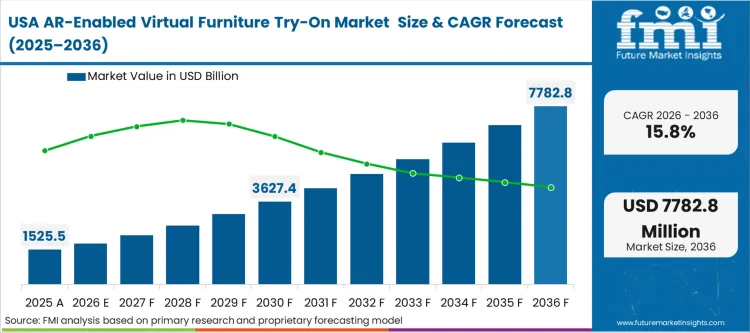
- United States: The United States furniture AR software market is characterized by a concentrated tier‑1 retail landscape that accelerates the standardization of spatial visualization capabilities across digital storefronts. Procurement teams within major home improvement and furniture chains are required to deploy web‑based rendering engines to prevent consumer migration toward competing platforms that offer superior dimensional accuracy. The USA is projected to grow at a CAGR of 15.8%, because retailers are digitizing core inventory catalogs. This is resulting in retailers rapidly gain access to high value B2B staging contracts that depend on reliable, large‑scale spatial planning capabilities, strengthening their competitive position in both consumer and commercial segments.
FMI's report includes detailed analysis of Canada and Mexico. The integration of cross-border logistics data with spatial analytics allows North American operators to map exactly which product dimensions trigger the highest return rates across different regional housing stocks.
Europe AR-Enabled Virtual Furniture Try-On Market Analysis
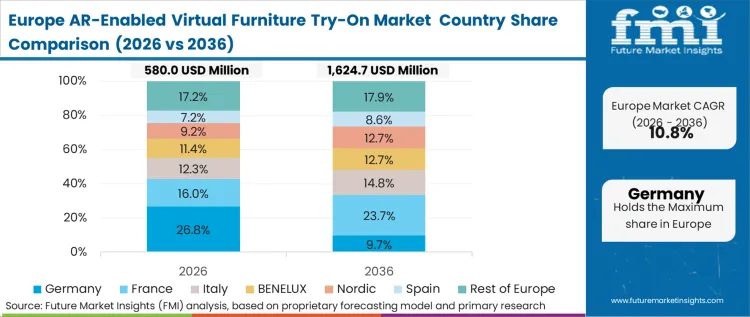
The regulatory environment surrounding digital privacy and data localization directly shapes how European retailers deploy spatial computing tools in the Europe virtual furniture try-on market. Buyers interact with applications that map the interior of their homes, triggering strict compliance requirements regarding the storage and processing of environmental data. Based on FMI's assessment, platforms utilizing 3D camera inputs must guarantee that spatial meshes are processed locally on the device without transmitting recognizable room layouts to external cloud servers. This forces European digital directors to prioritize edge-rendering architectures over centralized cloud processing.
- United Kingdom: Space constraints within legacy urban housing stock define the United Kingdom's trajectory in spatial commerce. Over the forecast period, the UK is set for a CAGR of 16.7%, owing to increasing number of consumers utilizing high-fidelity dimensional validation specifically to detect micro-conflicts in tight corridors and small living spaces. Platforms that optimize their tracking engines for smaller, cluttered environments establish a distinct gap against generic spatial tools built for larger physical footprints.
- Germany: Digital operations teams deploy native browser tools that process all dimensional geometry locally on the user's hardware. Germany is poised to expand at a CAGR of 15.1% during the forecast period, as strict adherence to data localization policies forces Germany retailers to favor spatial engines that guarantee zero environmental data transmission, heavily influencing the Germany furniture room planner market. This compliance-first approach fundamentally alters the server architecture, freeing up backend bandwidth while ensuring the organization completely avoids consumer privacy liabilities.
FMI's report includes France, Italy, and the Nordics. The overarching pattern across these markets reveals a distinct preference for spatial tools that emphasize hyper-accurate material rendering to satisfy the high aesthetic demands of heritage furniture brands.
Asia Pacific AR-Enabled Virtual Furniture Try-On Market Analysis
Infrastructure maturity, specifically the rapid deployment of 5G networks and the near-total dominance of mobile-first digital commerce, dictates the regional adoption pattern for the Asia Pacific furniture visualization market. Buyers in these markets skip desktop interactions entirely, demanding spatial rendering that functions flawlessly within integrated super-apps. FMI analysts opine that smart mirror and mobile spatial tools succeed here only if they load instantaneously without requiring external application downloads. Procurement directors operate on a completely different latency budget than their Western counterparts, discarding any rendering engine that cannot stream massive 3D assets over cellular networks without stuttering.
- India: In the India virtual furniture shopping market, a rapidly formalizing but historically unorganized retail sector leaps directly to spatial commerce without building legacy physical showrooms. The market is expected to witness growth at a CAGR of 21.9% because digital marketplaces serve as the primary discovery engine, and spatial rendering replaces the physical viewing phase entirely for newly upwardly mobile consumers. The reality on the ground is that spatial validation is not a premium feature here; it is the fundamental mechanism that convinces a first-time online buyer to trust a digital transaction for a massive physical asset.
- China: Deep integration of spatial tools within dominant social commerce ecosystems enables China furniture AR market growth. Consumers share spatial projections of furniture within messaging platforms to gather real-time feedback before executing the purchase inside the same application layer. A CAGR of 18.6% is expected for China over the forecast period as the dynamic is shifting rapidly from isolated spatial viewing toward multiplayer environmental planning. Multiple users manipulate the same digital asset inside a shared physical space.
- Japan: An aging demographic combined with extreme spatial constraints drives the Japanese requirement for hyper-precise dimensional anchoring. Consumers rely on spatial tools to ensure items clear specific architectural features, completely rejecting solutions that display millimeter-level tracking drift. The market for spatial tools in Japan is likely to post a CAGR of 14.2% due to increasing online purchase trend. Domestic manufacturers that embed flawlessly stable rendering capabilities into their direct-to-consumer portals secure long-term loyalty from a highly risk-averse buyer base.
- South Korea: South Korea's advanced mobile infrastructure enables the deployment of ultra-high-polygon assets that would choke networks in other regions. Buyers expect cinematic-quality lighting estimation and shadow mapping as the baseline standard for digital interaction. The sector is forecast to register a CAGR of 17.4% owing to high adoption of technology. Retailers operating here push the technical boundaries of mobile rendering, creating a technical capability gap that competitors in adjacent regional markets struggle to replicate.
FMI's report includes Southeast Asian markets and Australia. The pattern across the broader APAC region demonstrates that spatial rendering is increasingly tied to digital wallet integration, where the spatial confirmation triggers the immediate financial transaction without leaving the camera interface.
Competitive Aligners for Market Players

The concentrated nature of the spatial rendering sector stems directly from the massive capital required to maintain compatibility with constantly shifting mobile operating system frameworks. Buyers distinguish qualified furniture AR software vendors from unqualified ones based on a single variable: tracking stability under poor lighting conditions. When evaluating the best virtual furniture try-on platform for retailers, companies like 3D Cloud and Cylindo maintain their position because they have absorbed years of edge-case spatial data, refining engines that do not allow the digital sofa to float above the physical floor. Retailers abandon platforms instantly if the spatial illusion breaks, meaning the barrier to entry is defined by the depth of the vendor's proprietary computer vision algorithms, not their pricing models.
Incumbents among the top companies in furniture AR market hold a distinct advantage in the form of massive, standardized 3D asset libraries. Companies like IKEA and Wayfair have already absorbed the brutal initial cost of digitizing thousands of SKUs into web-optimized formats. When procurement teams look to compare Ikea Kreative vs Wayfair view in room for market influence, they realize a challenger attempting to replicate this scale or build alternatives to Ikea Kreative for furniture brands must build an automated ingestion pipeline capable of converting raw, heavy manufacturing CAD files into lightweight assets suitable for retail displays and mobile browsers. This capability-the rapid, low-touch conversion of physical geometry into optimized digital metadata-is what separates a sustainable spatial platform from a temporary marketing gimmick.
Large retail buyers actively resist vendor lock-in by demanding spatial assets be delivered in open-source, standardized formats like USDZ and glTF. The tension between dominant rendering platforms wanting to trap retailers in proprietary ecosystems and retailers demanding asset portability defines the contracting landscape. Moving toward 2036, the sector consolidates around managed service providers who can offer seamless API integration, as retailers flatly refuse to rebuild their 3D catalog every time they switch spatial rendering vendors.
Key Players in AR-Enabled Virtual Furniture Try-On Market
- IKEA
- Wayfair
- Houzz
- 3D Cloud (formerly Marxent)
- Cylindo
- Roomle
- Roomvo
Scope of the Report
| Metric | Value |
| Quantitative Units | USD 2.6 billion to USD 11.4 billion, at a CAGR of 16.1% |
| Market Definition | The sector comprises spatial computing tools and asset management pipelines that project dimensionally accurate furniture models into physical spaces. |
| Component Segmentation | Software Platforms, 3D Asset Creation & Rendering, Integration & APIs, Managed Services, Analytics & Optimization |
| Deployment Model Segmentation | Cloud / SaaS, On-Premise / Private Cloud, Hybrid Deployment |
| Device Interface Segmentation | Smartphones & Tablets, Desktop / Web Browser, In-Store Kiosks, AR Glasses / Headsets |
| End User Segmentation | Furniture Retailers / Marketplaces, Furniture Manufacturers / Brands, Interior Design Studios, Home Improvement Chains, Real Estate / Staging Platforms |
| Room/Application Segmentation | Living Room Furniture, Bedroom Furniture, Dining Room Furniture, Home Office Furniture, Outdoor Furniture, Storage & Accent Furniture |
| Business Model Segmentation | Subscription Licensing, Usage-Based / API Billing, Enterprise Implementation Fees, Content Digitization Fees, Performance / Conversion-Based Commercial Models |
| Customer Segment Segmentation | Residential / Consumer Commerce, Commercial / Hospitality, B2B Space Planning |
| Regions Covered | North America, Europe, Asia Pacific |
| Countries Covered | United States, China, India, United Kingdom, Germany, Japan, South Korea, and 40 plus countries |
| Key Companies Profiled | IKEA, Wayfair, Houzz, 3D Cloud (formerly Marxent), Cylindo, Roomle, Roomvo |
| Forecast Period | 2026 to 2036 |
| Approach | Primary interviews targeted digital supply chain heads and e-commerce directors making asset digitization budgets. The baseline is anchored to observed digital commerce penetration rates multiplied by software licensing costs. Forecasts were cross-validated against the capital expenditure allocations of tier-1 retail brands. |
Source: Future Market Insights (FMI) analysis, based on proprietary forecasting model and primary research
AR-Enabled Virtual Furniture Try-On Market Analysis by Segments
Component:
- Software Platforms
- 3D Asset Creation & Rendering
- Integration & APIs
- Managed Services
- Analytics & Optimization
Deployment Model:
- Cloud / SaaS
- On-Premise / Private Cloud
- Hybrid Deployment
Device Interface:
- Smartphones & Tablets
- Desktop / Web Browser
- In-Store Kiosks
- AR Glasses / Headsets
End User:
- Furniture Retailers / Marketplaces
- Furniture Manufacturers / Brands
- Interior Design Studios
- Home Improvement Chains
- Real Estate / Staging Platforms
Room/Application:
- Living Room Furniture
- Bedroom Furniture
- Dining Room Furniture
- Home Office Furniture
- Outdoor Furniture
- Storage & Accent Furniture
Business Model:
- Subscription Licensing
- Usage-Based / API Billing
- Enterprise Implementation Fees
- Content Digitization Fees
- Performance / Conversion-Based Commercial Models
Customer Segment:
- Residential / Consumer Commerce
- Commercial / Hospitality
- B2B Space Planning
Region:
- North America
- United States
- Canada
- Europe
- Germany
- United Kingdom
- France
- Italy
- Spain
- Asia Pacific
- China
- Japan
- South Korea
- Taiwan
- Singapore
- Latin America
- Brazil
- Mexico
- Argentina
- Middle East & Africa
- GCC Countries
- South Africa
- Israel
- Rest of Middle East & Africa
Bibliography
- Guo, C., Li, X., & Zhang, Y. (2024, August). The impact of AR online shopping experience on customer purchase intentions. PLOS ONE.
- Chen, C. (2024, December). Virtual try-on systems in fashion consumption: A systematic review. Applied Sciences.
- Pfaff, A., & colleagues. (2025, October). Augmented reality and spatial fit uncertainty in online furniture retail. Journal of Retailing and Consumer Services.
- Berg, H., et al. (2025, June). Enhancing online retail engagement: The role of augmented reality technologies. Journal of Marketing Management.
- Monaro, M., et al. (2025, August). Enhancing shopping experience in augmented reality environments. Entertainment Computing.
This bibliography is provided for reader reference. The full FMI report contains the complete reference list with primary source documentation.
This Report Addresses
- Market intelligence to support strategic decision making across Software Platforms and Managed Services categories.
- Market size estimation and 10-year revenue forecasts from 2026 to 2036, supported by digital commerce penetration baselines.
- Growth opportunity mapping across Deployment Models with emphasis on the maturation of OS-level browser rendering capabilities.
- Segment and regional revenue forecasts covering Living Room Furniture across strict data localization frameworks in Europe.
- Competition strategy assessment including tracking stability, 3D pipeline ingestion speed, and asset portability variables.
- Technology development tracking including WebAR protocols, glTF formatting, and local edge-rendering frameworks.
- Market access analysis covering integration specifications for tier-1 digital marketplaces and spatial rendering APIs.
- Market report delivery in PDF, Excel, PPT, and interactive dashboard formats for executive strategy, 3D asset pipeline planning, and operational benchmarking use.
Frequently Asked Questions
What is the AR-enabled virtual furniture try-on market?
The sector encompasses software solutions, rendering engines, and managed services that allow consumers to overlay physically accurate, scaled 3D models of furniture into real-world environments using spatial computing interfaces to validate fit and aesthetics before purchase.
How big is the virtual furniture try-on market?
The sector is valued at USD 2.6 billion in 2026. This figure signals the baseline software licensing expenditure required for retailers to begin migrating their top-tier SKUs into spatial formats.
Tell me the growth outlook for AR-enabled virtual furniture try-on?
It is projected to reach USD 11.4 billion by 2036 at a what is the forecast cagr for furniture AR platforms rate of 16.1%. This cumulative buildup reflects the absolute necessity of spatial validation as a core logistics tool to prevent catastrophic margin erosion from physical furniture returns.
Which companies lead the virtual furniture try-on market in 2026?
The best AR software for furniture retailers is currently dominated by specialized providers like 3D Cloud and Cylindo, alongside major retail innovators like IKEA and Wayfair who have built proprietary engines. Retailers recognize that building proprietary tracking engines is a massive capital drain, choosing instead to license stable core engines from dedicated computer vision specialists.
Is WebAR better than app-based furniture AR?
Cloud / SaaS commands 64.0% share because WebAR eliminates the download friction. The need to instantly stream complex, high-polygon files to mobile browsers forces organizations away from app-based constraints that suffer from severe egress bandwidth chokepoints and lower user adoption rates.
What technologies power furniture AR apps?
Smartphones & Tablets dominate with 68.0% share. They represent the only spatially aware hardware already embedded in the consumer's environment, completely eliminating the friction of requiring specialized external equipment, relying heavily on built-in LiDAR and depth-sensing cameras.
Why is AR important in furniture ecommerce?
The severe financial penalty of reverse logistics forces adoption. Digital supply chain heads deploy spatial tools specifically to stop the margin bleed caused by consumers ordering bulky items that fail basic physical fit tests upon delivery.
How does virtual furniture try-on reduce returns?
By allowing the buyer to evaluate the physical footprint and aesthetic harmony in real-time, the technology replaces the legacy behavior of measuring physical spaces with tape. It eliminates the guesswork that leads to dimensional mismatches.
Which regions lead the furniture AR market?
India expands at 21.9%, compared to China's 18.6%. The difference lies in India's unorganized retail sector formalizing directly onto digital-first platforms, skipping the legacy physical showroom phase entirely.
How do AI and AR furniture shopping trends affect social commerce integration in APAC?
Consumers in China utilize social commerce platforms to share real-time spatial projections with household members. This social validation loop accelerates the purchase decision without the user ever leaving the messaging application environment.
Create a market overview for furniture AR software focusing on residential segments?
Advanced mobile UX design services have proven that residential buyers refuse the friction of downloading dedicated applications for single-use purchases. Native browser rendering is the only mechanism that successfully captures impulsive spatial viewing.
How do data privacy regulations shape European architectures?
Stringent localization laws compel German and UK retailers to process spatial meshes directly on the user's hardware. This prevents environmental layout data from being transmitted to cloud servers, completely mitigating privacy liabilities.
How accurate is AR furniture placement and why does it matter competitively?
The ability to maintain tracking stability in poor ambient lighting separates functional tools from gimmicks. If a spatial sofa drifts across a digital room, the consumer immediately loses confidence in the dimensional accuracy and abandons the session.
Which furniture categories benefit most from augmented reality?
Living rooms contain the highest concentration of visually dominant, physically massive items like sectionals. A dimensional error here blocks walkways and ruins floor plans, making spatial validation a mandatory step before purchase.
Why is subscription licensing preferred over perpetual models?
Spatial software must be constantly patched to maintain compatibility with annual iOS and Android spatial framework updates. Perpetual licenses leave retailers stranded with obsolete rendering engines that fail on modern mobile devices.
What forces marketplace aggregators to standardize 3D assets?
Aggregators absorb the financial blow of return shipping for third-party items that don't fit. They must mandate open-source formats like glTF to ensure a uniform spatial viewing experience regardless of the underlying manufacturer.
How does spatial rendering impact physical retail footprints?
Brand operators utilize in-store kiosks to offer endless-aisle spatial staging. This allows them to shrink physical real estate costs while still providing dimensional validation for inventory housed at central distribution centers.
What is the role of automated photogrammetry in a furniture product configurator supplier strategy?
Service bureaus deploy automated scanning rigs to rapidly convert physical inventory into digital meshes. This solves the core operational bottleneck for legacy manufacturers who lack native CAD files or configurator assets.
How do spatial tools integrate with existing PIM systems?
When preparing an rfq for furniture AR platform, vendors must provide API connectors that link the 3D asset directly to the product's SKU identifier. This ensures that when inventory data updates, the spatial rendering engine pulls the correct material textures and dimensional bounds automatically.
What is the end state of spatial commerce by 2036?
Spatial geometry becomes standard metadata. Providing a verified 3D asset for a furniture SKU will be identical to providing a 2D photograph today, dictated by universal marketplace listing requirements.
Preview the report firsthand - request a free sample
Get SampleGet the brochure for pricing and purchase details.
Get PDFTable of Content
- Executive Summary
- Global Market Outlook
- Demand-side Trends
- Supply-side Trends
- Technology Roadmap Analysis
- Analysis and Recommendations
- Market Overview
- Market Coverage / Taxonomy
- Market Definition / Scope / Limitations
- Research Methodology
- Chapter Orientation
- Analytical Lens and Working Hypotheses
- Market Structure, Signals, and Trend Drivers
- Benchmarking and Cross-market Comparability
- Market Sizing, Forecasting, and Opportunity Mapping
- Research Design and Evidence Framework
- Desk Research Programme (Secondary Evidence)
- Company Annual and Sustainability Reports
- Peer-reviewed Journals and Academic Literature
- Corporate Websites, Product Literature, and Technical Notes
- Earnings Decks and Investor Briefings
- Statutory Filings and Regulatory Disclosures
- Technical White Papers and Standards Notes
- Trade Journals, Industry Magazines, and Analyst Briefs
- Conference Proceedings, Webinars, and Seminar Materials
- Government Statistics Portals and Public Data Releases
- Press Releases and Reputable Media Coverage
- Specialist Newsletters and Curated Briefings
- Sector Databases and Reference Repositories
- FMI Internal Proprietary Databases and Historical Market Datasets
- Subscription Datasets and Paid Sources
- Social Channels, Communities, and Digital Listening Inputs
- Additional Desk Sources
- Expert Input and Fieldwork (Primary Evidence)
- Primary Modes
- Qualitative Interviews and Expert Elicitation
- Quantitative Surveys and Structured Data Capture
- Blended Approach
- Why Primary Evidence is Used
- Field Techniques
- Interviews
- Surveys
- Focus Groups
- Observational and In-context Research
- Social and Community Interactions
- Stakeholder Universe Engaged
- C-suite Leaders
- Board Members
- Presidents and Vice Presidents
- R&D and Innovation Heads
- Technical Specialists
- Domain Subject-matter Experts
- Scientists
- Physicians and Other Healthcare Professionals
- Governance, Ethics, and Data Stewardship
- Research Ethics
- Data Integrity and Handling
- Primary Modes
- Tooling, Models, and Reference Databases
- Desk Research Programme (Secondary Evidence)
- Data Engineering and Model Build
- Data Acquisition and Ingestion
- Cleaning, Normalisation, and Verification
- Synthesis, Triangulation, and Analysis
- Quality Assurance and Audit Trail
- Market Background
- Market Dynamics
- Drivers
- Restraints
- Opportunity
- Trends
- Scenario Forecast
- Demand in Optimistic Scenario
- Demand in Likely Scenario
- Demand in Conservative Scenario
- Opportunity Map Analysis
- Product Life Cycle Analysis
- Supply Chain Analysis
- Investment Feasibility Matrix
- Value Chain Analysis
- PESTLE and Porter’s Analysis
- Regulatory Landscape
- Regional Parent Market Outlook
- Production and Consumption Statistics
- Import and Export Statistics
- Market Dynamics
- Global Market Analysis 2021 to 2025 and Forecast, 2026 to 2036
- Historical Market Size Value (USD Million) Analysis, 2021 to 2025
- Current and Future Market Size Value (USD Million) Projections, 2026 to 2036
- Y-o-Y Growth Trend Analysis
- Absolute $ Opportunity Analysis
- Global Market Pricing Analysis 2021 to 2025 and Forecast 2026 to 2036
- Global Market Analysis 2021 to 2025 and Forecast 2026 to 2036, By Component
- Introduction / Key Findings
- Historical Market Size Value (USD Million) Analysis By Component , 2021 to 2025
- Current and Future Market Size Value (USD Million) Analysis and Forecast By Component , 2026 to 2036
- Software Platforms
- 3D Asset Creation & Rendering
- Integration & APIs
- Software Platforms
- Y-o-Y Growth Trend Analysis By Component , 2021 to 2025
- Absolute $ Opportunity Analysis By Component , 2026 to 2036
- Global Market Analysis 2021 to 2025 and Forecast 2026 to 2036, By Deployment Model
- Introduction / Key Findings
- Historical Market Size Value (USD Million) Analysis By Deployment Model, 2021 to 2025
- Current and Future Market Size Value (USD Million) Analysis and Forecast By Deployment Model, 2026 to 2036
- Cloud / SaaS
- On-Premise / Private Cloud
- Hybrid Deployment
- Cloud / SaaS
- Y-o-Y Growth Trend Analysis By Deployment Model, 2021 to 2025
- Absolute $ Opportunity Analysis By Deployment Model, 2026 to 2036
- Global Market Analysis 2021 to 2025 and Forecast 2026 to 2036, By Device Interface
- Introduction / Key Findings
- Historical Market Size Value (USD Million) Analysis By Device Interface, 2021 to 2025
- Current and Future Market Size Value (USD Million) Analysis and Forecast By Device Interface, 2026 to 2036
- Smartphones & Tablets
- Desktop / Web Browser
- In-Store Kiosks
- Smartphones & Tablets
- Y-o-Y Growth Trend Analysis By Device Interface, 2021 to 2025
- Absolute $ Opportunity Analysis By Device Interface, 2026 to 2036
- Global Market Analysis 2021 to 2025 and Forecast 2026 to 2036, By End User
- Introduction / Key Findings
- Historical Market Size Value (USD Million) Analysis By End User, 2021 to 2025
- Current and Future Market Size Value (USD Million) Analysis and Forecast By End User, 2026 to 2036
- Furniture Retailers / Marketplaces
- Furniture Manufacturers / Brands
- Interior Design Studios
- Furniture Retailers / Marketplaces
- Y-o-Y Growth Trend Analysis By End User, 2021 to 2025
- Absolute $ Opportunity Analysis By End User, 2026 to 2036
- Global Market Analysis 2021 to 2025 and Forecast 2026 to 2036, By Room/Application
- Introduction / Key Findings
- Historical Market Size Value (USD Million) Analysis By Room/Application, 2021 to 2025
- Current and Future Market Size Value (USD Million) Analysis and Forecast By Room/Application, 2026 to 2036
- Living Room Furniture
- Bedroom Furniture
- Dining Room Furniture
- Living Room Furniture
- Y-o-Y Growth Trend Analysis By Room/Application, 2021 to 2025
- Absolute $ Opportunity Analysis By Room/Application, 2026 to 2036
- Global Market Analysis 2021 to 2025 and Forecast 2026 to 2036, By Business Model
- Introduction / Key Findings
- Historical Market Size Value (USD Million) Analysis By Business Model, 2021 to 2025
- Current and Future Market Size Value (USD Million) Analysis and Forecast By Business Model, 2026 to 2036
- Subscription Licensing
- Usage-Based / API Billing
- Enterprise Implementation Fees
- Subscription Licensing
- Y-o-Y Growth Trend Analysis By Business Model, 2021 to 2025
- Absolute $ Opportunity Analysis By Business Model, 2026 to 2036
- Global Market Analysis 2021 to 2025 and Forecast 2026 to 2036, By Customer Segment
- Introduction / Key Findings
- Historical Market Size Value (USD Million) Analysis By Customer Segment, 2021 to 2025
- Current and Future Market Size Value (USD Million) Analysis and Forecast By Customer Segment, 2026 to 2036
- Residential / Consumer Commerce
- Commercial / Hospitality
- B2B Space Planning
- Residential / Consumer Commerce
- Y-o-Y Growth Trend Analysis By Customer Segment, 2021 to 2025
- Absolute $ Opportunity Analysis By Customer Segment, 2026 to 2036
- Global Market Analysis 2021 to 2025 and Forecast 2026 to 2036, By Region
- Introduction
- Historical Market Size Value (USD Million) Analysis By Region, 2021 to 2025
- Current Market Size Value (USD Million) Analysis and Forecast By Region, 2026 to 2036
- North America
- Latin America
- Western Europe
- Eastern Europe
- East Asia
- South Asia and Pacific
- Middle East & Africa
- Market Attractiveness Analysis By Region
- North America Market Analysis 2021 to 2025 and Forecast 2026 to 2036, By Country
- Historical Market Size Value (USD Million) Trend Analysis By Market Taxonomy, 2021 to 2025
- Market Size Value (USD Million) Forecast By Market Taxonomy, 2026 to 2036
- By Country
- USA
- Canada
- Mexico
- By Component
- By Deployment Model
- By Device Interface
- By End User
- By Room/Application
- By Business Model
- By Customer Segment
- By Country
- Market Attractiveness Analysis
- By Country
- By Component
- By Deployment Model
- By Device Interface
- By End User
- By Room/Application
- By Business Model
- By Customer Segment
- Key Takeaways
- Latin America Market Analysis 2021 to 2025 and Forecast 2026 to 2036, By Country
- Historical Market Size Value (USD Million) Trend Analysis By Market Taxonomy, 2021 to 2025
- Market Size Value (USD Million) Forecast By Market Taxonomy, 2026 to 2036
- By Country
- Brazil
- Chile
- Rest of Latin America
- By Component
- By Deployment Model
- By Device Interface
- By End User
- By Room/Application
- By Business Model
- By Customer Segment
- By Country
- Market Attractiveness Analysis
- By Country
- By Component
- By Deployment Model
- By Device Interface
- By End User
- By Room/Application
- By Business Model
- By Customer Segment
- Key Takeaways
- Western Europe Market Analysis 2021 to 2025 and Forecast 2026 to 2036, By Country
- Historical Market Size Value (USD Million) Trend Analysis By Market Taxonomy, 2021 to 2025
- Market Size Value (USD Million) Forecast By Market Taxonomy, 2026 to 2036
- By Country
- Germany
- UK
- Italy
- Spain
- France
- Nordic
- BENELUX
- Rest of Western Europe
- By Component
- By Deployment Model
- By Device Interface
- By End User
- By Room/Application
- By Business Model
- By Customer Segment
- By Country
- Market Attractiveness Analysis
- By Country
- By Component
- By Deployment Model
- By Device Interface
- By End User
- By Room/Application
- By Business Model
- By Customer Segment
- Key Takeaways
- Eastern Europe Market Analysis 2021 to 2025 and Forecast 2026 to 2036, By Country
- Historical Market Size Value (USD Million) Trend Analysis By Market Taxonomy, 2021 to 2025
- Market Size Value (USD Million) Forecast By Market Taxonomy, 2026 to 2036
- By Country
- Russia
- Poland
- Hungary
- Balkan & Baltic
- Rest of Eastern Europe
- By Component
- By Deployment Model
- By Device Interface
- By End User
- By Room/Application
- By Business Model
- By Customer Segment
- By Country
- Market Attractiveness Analysis
- By Country
- By Component
- By Deployment Model
- By Device Interface
- By End User
- By Room/Application
- By Business Model
- By Customer Segment
- Key Takeaways
- East Asia Market Analysis 2021 to 2025 and Forecast 2026 to 2036, By Country
- Historical Market Size Value (USD Million) Trend Analysis By Market Taxonomy, 2021 to 2025
- Market Size Value (USD Million) Forecast By Market Taxonomy, 2026 to 2036
- By Country
- China
- Japan
- South Korea
- By Component
- By Deployment Model
- By Device Interface
- By End User
- By Room/Application
- By Business Model
- By Customer Segment
- By Country
- Market Attractiveness Analysis
- By Country
- By Component
- By Deployment Model
- By Device Interface
- By End User
- By Room/Application
- By Business Model
- By Customer Segment
- Key Takeaways
- South Asia and Pacific Market Analysis 2021 to 2025 and Forecast 2026 to 2036, By Country
- Historical Market Size Value (USD Million) Trend Analysis By Market Taxonomy, 2021 to 2025
- Market Size Value (USD Million) Forecast By Market Taxonomy, 2026 to 2036
- By Country
- India
- ASEAN
- Australia & New Zealand
- Rest of South Asia and Pacific
- By Component
- By Deployment Model
- By Device Interface
- By End User
- By Room/Application
- By Business Model
- By Customer Segment
- By Country
- Market Attractiveness Analysis
- By Country
- By Component
- By Deployment Model
- By Device Interface
- By End User
- By Room/Application
- By Business Model
- By Customer Segment
- Key Takeaways
- Middle East & Africa Market Analysis 2021 to 2025 and Forecast 2026 to 2036, By Country
- Historical Market Size Value (USD Million) Trend Analysis By Market Taxonomy, 2021 to 2025
- Market Size Value (USD Million) Forecast By Market Taxonomy, 2026 to 2036
- By Country
- Kingdom of Saudi Arabia
- Other GCC Countries
- Turkiye
- South Africa
- Other African Union
- Rest of Middle East & Africa
- By Component
- By Deployment Model
- By Device Interface
- By End User
- By Room/Application
- By Business Model
- By Customer Segment
- By Country
- Market Attractiveness Analysis
- By Country
- By Component
- By Deployment Model
- By Device Interface
- By End User
- By Room/Application
- By Business Model
- By Customer Segment
- Key Takeaways
- Key Countries Market Analysis
- USA
- Pricing Analysis
- Market Share Analysis, 2025
- By Component
- By Deployment Model
- By Device Interface
- By End User
- By Room/Application
- By Business Model
- By Customer Segment
- Canada
- Pricing Analysis
- Market Share Analysis, 2025
- By Component
- By Deployment Model
- By Device Interface
- By End User
- By Room/Application
- By Business Model
- By Customer Segment
- Mexico
- Pricing Analysis
- Market Share Analysis, 2025
- By Component
- By Deployment Model
- By Device Interface
- By End User
- By Room/Application
- By Business Model
- By Customer Segment
- Brazil
- Pricing Analysis
- Market Share Analysis, 2025
- By Component
- By Deployment Model
- By Device Interface
- By End User
- By Room/Application
- By Business Model
- By Customer Segment
- Chile
- Pricing Analysis
- Market Share Analysis, 2025
- By Component
- By Deployment Model
- By Device Interface
- By End User
- By Room/Application
- By Business Model
- By Customer Segment
- Germany
- Pricing Analysis
- Market Share Analysis, 2025
- By Component
- By Deployment Model
- By Device Interface
- By End User
- By Room/Application
- By Business Model
- By Customer Segment
- UK
- Pricing Analysis
- Market Share Analysis, 2025
- By Component
- By Deployment Model
- By Device Interface
- By End User
- By Room/Application
- By Business Model
- By Customer Segment
- Italy
- Pricing Analysis
- Market Share Analysis, 2025
- By Component
- By Deployment Model
- By Device Interface
- By End User
- By Room/Application
- By Business Model
- By Customer Segment
- Spain
- Pricing Analysis
- Market Share Analysis, 2025
- By Component
- By Deployment Model
- By Device Interface
- By End User
- By Room/Application
- By Business Model
- By Customer Segment
- France
- Pricing Analysis
- Market Share Analysis, 2025
- By Component
- By Deployment Model
- By Device Interface
- By End User
- By Room/Application
- By Business Model
- By Customer Segment
- India
- Pricing Analysis
- Market Share Analysis, 2025
- By Component
- By Deployment Model
- By Device Interface
- By End User
- By Room/Application
- By Business Model
- By Customer Segment
- ASEAN
- Pricing Analysis
- Market Share Analysis, 2025
- By Component
- By Deployment Model
- By Device Interface
- By End User
- By Room/Application
- By Business Model
- By Customer Segment
- Australia & New Zealand
- Pricing Analysis
- Market Share Analysis, 2025
- By Component
- By Deployment Model
- By Device Interface
- By End User
- By Room/Application
- By Business Model
- By Customer Segment
- China
- Pricing Analysis
- Market Share Analysis, 2025
- By Component
- By Deployment Model
- By Device Interface
- By End User
- By Room/Application
- By Business Model
- By Customer Segment
- Japan
- Pricing Analysis
- Market Share Analysis, 2025
- By Component
- By Deployment Model
- By Device Interface
- By End User
- By Room/Application
- By Business Model
- By Customer Segment
- South Korea
- Pricing Analysis
- Market Share Analysis, 2025
- By Component
- By Deployment Model
- By Device Interface
- By End User
- By Room/Application
- By Business Model
- By Customer Segment
- Russia
- Pricing Analysis
- Market Share Analysis, 2025
- By Component
- By Deployment Model
- By Device Interface
- By End User
- By Room/Application
- By Business Model
- By Customer Segment
- Poland
- Pricing Analysis
- Market Share Analysis, 2025
- By Component
- By Deployment Model
- By Device Interface
- By End User
- By Room/Application
- By Business Model
- By Customer Segment
- Hungary
- Pricing Analysis
- Market Share Analysis, 2025
- By Component
- By Deployment Model
- By Device Interface
- By End User
- By Room/Application
- By Business Model
- By Customer Segment
- Kingdom of Saudi Arabia
- Pricing Analysis
- Market Share Analysis, 2025
- By Component
- By Deployment Model
- By Device Interface
- By End User
- By Room/Application
- By Business Model
- By Customer Segment
- Turkiye
- Pricing Analysis
- Market Share Analysis, 2025
- By Component
- By Deployment Model
- By Device Interface
- By End User
- By Room/Application
- By Business Model
- By Customer Segment
- South Africa
- Pricing Analysis
- Market Share Analysis, 2025
- By Component
- By Deployment Model
- By Device Interface
- By End User
- By Room/Application
- By Business Model
- By Customer Segment
- USA
- Market Structure Analysis
- Competition Dashboard
- Competition Benchmarking
- Market Share Analysis of Top Players
- By Regional
- By Component
- By Deployment Model
- By Device Interface
- By End User
- By Room/Application
- By Business Model
- By Customer Segment
- Competition Analysis
- Competition Deep Dive
- IKEA
- Overview
- Product Portfolio
- Profitability by Market Segments (Product/Age /Sales Channel/Region)
- Sales Footprint
- Strategy Overview
- Marketing Strategy
- Product Strategy
- Channel Strategy
- Wayfair
- Houzz
- 3D Cloud (formerly Marxent)
- Cylindo
- Roomle
- IKEA
- Competition Deep Dive
- Assumptions & Acronyms Used


