

- Market Size (2026)
- USD 151.9 Bn
- Forecast (2036)
- USD 208.2 Bn
- CAGR (2026 to 2036)
- 3.2%
How big is Beverage Packaging Market in 2026?
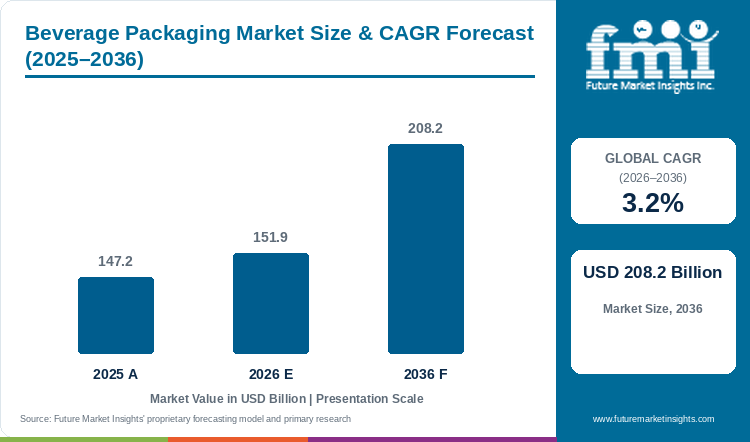
Sales in the beverage packaging market are projected to grow at 3.2% CAGR, with the market size rising from USD 147.2 billion in 2025 to USD 151.9 billion in 2026 and reaching USD 208.2 billion by 2036.
According to Future Market Insights analysis, the global beverage packaging market stands at USD 147.2 billion in 2025 and rises to USD 151.9 billion in 2026. Industry valuation is projected to reach USD 208.2 billion by 2036, expanding at a 3.2% CAGR and generating USD 56.3 billion in added revenue. High-speed automated filling lines and stringent container recovery mandates push baseline packaging demand as bottlers balance lightweighting against structural integrity. In 2025, European regulatory directives mandated a minimum 25% recycled plastic content in PET beverage containers along with tethered closure requirements, converting circular packaging from a voluntary target into a statutory operational standard [1]. Plastic bottles capture the leading material share of 48.2% in 2026, supported by mature preform supply and low freight weight. While mature economies focus on closed-loop container recycling, emerging markets in Asia Pacific and Latin America drive volume through single-serve beverage penetration.
Key Market Trends & Insights
- By material type: Plastic bottles are projected to account for 48.2% in 2026, driven by PET line speed and low unit weight.
- By packaging type: Bottles are estimated to hold 35.0% in 2026, owing to installed filling assets across water, juice, and soft drinks.
- By beverage type: Carbonated soft drinks are forecast to represent 28.3% in 2026, supported by pressure-resistant PET and aluminum can systems.
- By capacity: Small packs are likely to capture 38.0% share in 2026, linked to convenience retail and single-serve consumption.
- By closure type: Screw caps are set to lead with 33.0% in 2026, underpinned by resealability and bottle-line familiarity.
Regional Highlights
- Fastest-growing evaluated country: India, at 7.6% CAGR from 2026 to 2036.
- China at 6.2% and Brazil at 5.9% follow, while Japan records the lowest evaluated CAGR at 2.4%.
Market Size & Forecast
Table 1: Market Size and Forecast for the Beverage Packaging Market (USD billion and CAGR percentage), 2025 to 2036
| Metric | Value |
|---|---|
| 2025 Market Size | USD 147.2 billion |
| Estimated Market Size in 2026 | USD 151.9 billion |
| Projected Market Size by 2036 | USD 208.2 billion |
| CAGR, 2026 to 2036 | 3.2% |
| Added Revenue, 2026 to 2036 | USD 56.3 billion |
Pack conversion is becoming more demanding even when secondary material claims appear commercially viable. Beverage companies first require the container to preserve oxygen barriers, seal securely, and run without slowing installed filling assets. Regulation (EU) 2025/40, published in the Official Journal on 22 January 2025, sets binding packaging waste reduction targets of 5% by 2030, 10% by 2035, and 15% by 2040, and requires all packaging to be recyclable from 2030, establishing a broader lifecycle framework that shapes long-term beverage container design [2]. The commercial adoption of paper-barrier aseptic cartons and lightweight preforms depends on whether plants can clear high-speed qualification runs without triggering seal leakage, package deformities, or downstream line stoppages.
Pack-Format Revenue and Incremental Opportunity Sizing
Table 2: Pack-Format Revenue Sizing for the Beverage Packaging Market (USD billion and percentage), 2026 and 2036
| Metric | 2026 | 2036 |
|---|---|---|
| Total market revenue | 151.9 | 208.2 |
| Plastic bottle revenue at 48.2% share | 73.2 | 100.4* |
| Bottle packaging revenue at 35.0% share | 53.2 | 72.9* |
| Carbonated soft drink packaging at 28.3% share | 43.0 | 58.9* |
| Incremental market opportunity | - | 56.3 |
Material Throughput and Procurement Indicators
Beverage packaging procurement is moving closer to a production decision than a simple material purchase. A lighter bottle can reduce freight and resin use, but the saving disappears if the base deforms, the closure leaks or the pack slows conveying. The same applies to cartons and cans, where barrier performance and seam control decide whether a lower-footprint format can actually be used. Buyers are therefore asking suppliers to prove line output, pack weight, recovery evidence and recycled-content traceability together, which gives an advantage to vendors that can support trials inside the plant rather than only supply the material. This also keeps plastic bottle supply relevant to the buying decision.
Table 3: Material and Format Revenue Indicators for the Beverage Packaging Market (USD billion), 2026
| Indicator | Value | Basis |
|---|---|---|
| Plastic bottle revenue | USD 73.2 billion | 48.2% of 2026 market |
| Bottle packaging revenue | USD 53.2 billion | 35.0% of 2026 market |
| Small pack revenue | USD 57.7 billion | 38.0% of 2026 market |
| Screw cap linked revenue | USD 50.1 billion | 33.0% of 2026 market |
Table 4: Compliance and Line-Qualification Indicators for Beverage Packaging
| Metric | Commercial implication | Buyer response |
|---|---|---|
| 25% recycled plastic in PET bottles from 2025 | Food-grade rPET becomes a contracted input | Dual-source resin and preform suppliers |
| Attached caps for relevant EU beverage containers | Closure geometry affects conversion and consumer use | Qualify tethered-cap molds and torque |
| 90% renewable content in new 1 L carton | Paper-based barriers move to full-size packs | Run shelf-life and aseptic line trials |
| Up to 50% lower carton carbon footprint | Carbon claims can support pack conversion | Require verified product footprint evidence |
Analyst Perspective
“Beverage pack conversion succeeds only when recycled content and recovery claims survive filling-line qualification. Suppliers that combine material access with proven barrier and closure performance will secure longer supply agreements.”
- Nandini Roy Choudhury, Principal Consultant, Future Market Insights.
How is the Beverage Packaging Market segmented?
The beverage packaging market is segmented by material type, packaging type, beverage type, capacity, and closure type. In 2026, plastic bottles are projected at 48.2%, bottles at 35.0%, carbonated soft drinks at 28.3%, small packs at 38.0%, and screw caps at 33.0%.
By material type: Plastic bottles, glass bottles, metal bottles, cartons, pouches, and others.
By packaging type: Bottles, cans, cartons, pouches, and others.
By beverage type: Carbonated soft drinks, bottled water, juice, dairy beverages, alcoholic beverages, energy drinks, and others.
By capacity: Small packs, medium packs, large packs, and bulk or multi-serve formats.
By closure type: Screw caps, crown caps, sports caps, flip-top caps, and others.
Why do Plastic Bottles account for a notable share of Material Type demand?
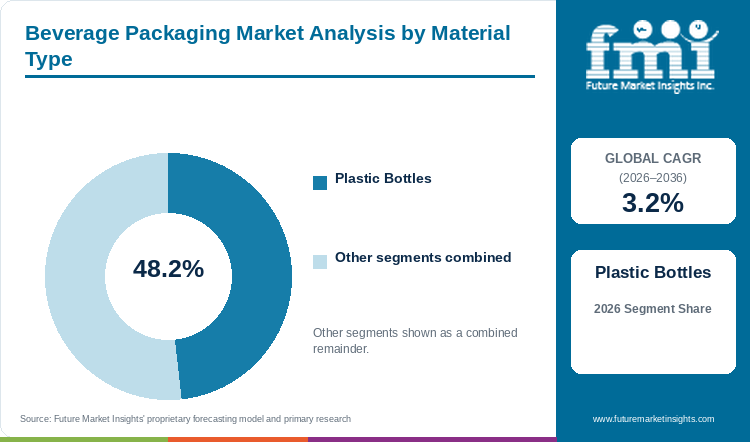
Plastic bottles represent 48.2% of material type in 2026, balancing high-speed filling with low unit weight.
Table 5: Material Type Share for the Beverage Packaging Market (percentage share), 2026
| Material Type | Share (2026) |
|---|---|
| Plastic Bottles | 48.2% |
| Other Segments Combined | 51.8%* |
| Total | 100.0% |
*Calculated as the balance remaining after deducting the leading segment share from 100.0%.
Table 6: Material Type Leadership and Market Growth for the Beverage Packaging Market, 2026 to 2036
| Metric | Value |
|---|---|
| Global CAGR | 3.2% |
| Leading Segment | Plastic Bottles |
Plastic bottles are expected to account for 48.2% in 2026 because the format gives water and soft-drink producers a workable balance of weight, speed and pack cost. The share is not protected only by consumer familiarity. Bottle plants already have preform, blow-moulding, filling, label and cap systems built around PET, which makes a wide format shift expensive. Recycled-content rules can support bottle-to-bottle resin demand, but poor colour consistency, acetaldehyde control or variable intrinsic viscosity could hold back suppliers that cannot protect bottle quality at full production speed. This also keeps PET packaging economics relevant to the buying decision.
- Plastic bottles are projected to hold 48.2% in 2026, supported by mature preform supply and lightweight distribution.
- European recycled-content rules raise the value of bottle-to-bottle resin partnerships.
What supports Bottles as a preferred choice in the Packaging Type category?
Bottles account for 35.0% of packaging type in 2026, meeting both line familiarity and resealable use needs.
Bottles hold 35.0% of packaging type demand in 2026 as the same broad format can serve water, juice, carbonated drinks and alcoholic beverages through different materials. This gives beverage companies more room to change resin, weight, label or closure without rebuilding the entire route to market. The advantage can narrow where heavier glass raises freight exposure or where PET supply becomes costly, yet bottle familiarity still shortens trials and reduces the risk attached with a completely new pack format.
- Bottles are estimated to hold 35.0% in 2026, reinforced by broad compatibility across beverage categories.
- Format familiarity shortens line trials and limits changeover downtime.
How are Carbonated Soft Drinks gaining use across Beverage Type packaging?
Carbonated soft drinks hold 28.3% of beverage type in 2026, driven by pressure-resistant containers and high retail rotation.
Carbonated soft drinks represent 28.3% of beverage type packaging in 2026 because the package has to retain pressure from filling until consumption, not only look suitable on shelf. PET bottles and aluminium cans already meet this requirement at high speed, which keeps both formats difficult to displace. Growth can favour lighter bottles and higher-recycled-content cans, but weak seams, cap leakage or gas loss can create product waste larger than the material saving, so beverage brands are likely to move only after shelf-life and transport trials are cleared. This also keeps beverage aluminium cans relevant to the buying decision.
- Carbonated soft drinks are forecast at 28.3% in 2026, attributable to established PET and can systems.
- Weak barrier performance can erase sustainability gains through product loss.
Why are buyers selecting Small Packs within the Capacity segment?
Small packs account for 38.0% of capacity in 2026, linked to impulse retail and portion control.
Small packs account for 38.0% of capacity demand in 2026 as convenience stores, vending machines and chilled cabinets favour a pack that can be bought and consumed immediately. This supports unit sales, but it also raises packaging material used per litre and makes lightweighting more important. A thinner bottle or can can improve economics when top-load and drop performance remain stable; if the pack dents, bursts or loses shelf presence during distribution, the lower material cost will not be enough to protect adoption. This also keeps can packaging lines relevant to the buying decision.
- Small packs are likely to capture 38.0% in 2026, enabled by on-the-go beverage use.
- Lightweighting must preserve drop resistance and filling-line stability.
Which market conditions keep Screw Caps ahead by Closure Type?
Screw caps represent 33.0% of closure type in 2026, managing resealability across high-volume bottle lines.
Screw caps hold 33.0% in 2026 because resealability fits bottled water, juice and other drinks that are not always consumed at once. Their lead also comes from production familiarity, as torque control, cap feeding and neck finishes are already understood across bottle lines. Attached-cap rules are now changing the geometry rather than removing the need for screw closures. This can favour suppliers with mould and line-conversion support, while weak hinge movement, poor opening force or cap interference during drinking could delay a design even when it meets the regulation. This also keeps closure demand relevant to the buying decision.
- Screw caps are set to lead closure type with 33.0% in 2026, underpinned by resealable convenience.
- Attached-cap conversion creates tooling cost but protects regulatory access.
What are the drivers, restraints, and opportunities in the Beverage Packaging Market?
Recycled-content mandates strengthen demand for qualified material supply, while heavy formats face freight pressure and paper-based barriers create new substitution routes.
- Driver: Recycled-content and collection rules make compliant bottle and closure design a condition for market access.
- Restraint: Glass weight, food-grade rPET premiums, and line-conversion costs raise the delivered cost of packaging change.
- Opportunity: Paper-based barriers and mono-material structures can reduce material complexity without sacrificing beverage shelf life.
Growth Analysis and Future Potential: Recovery Rules Reshape Bottle Procurement
Recycled PET is no longer purchased only to support a sustainability claim; it is becoming a production input that has to arrive with food-contact quality and stable processing behaviour. U.S. Environmental Protection Agency data indicates that packaging and containers comprise substantial municipal volume, pushing brand owners toward closed-loop procurement protocols [3]. The 25% recycled-plastic requirement for PET beverage bottles from 2025 raises the value of secure bottle-to-bottle supply because a converter cannot protect line output if colour, viscosity or contamination changes between lots. This pushes longer resin and preform agreements, while smaller buyers face procurement hurdles where premium food-grade feedstock is allocated first to large beverage accounts.
Risk Assessment of the Beverage Packaging Market: Weight, Barrier, and Conversion Friction
Material substitution can go wrong when the transport and filling conditions are considered after the pack is selected. Glass can protect taste and support premium positioning, but its weight raises freight and breakage exposure. Recycled PET reduces virgin-resin use, yet shade and process variation can disturb blow-moulding. Paper-based structures also need oxygen and light barriers to survive ambient distribution. These limits do not stop conversion, but they make plant trials important because a package with a lower footprint can still lose commercial support if shelf life shortens or the filling line produces more scrap.
Commercial Opportunity Analysis: Paper Barriers and Mono-Material Design
Paper-based barriers are opening a practical route for shelf-stable dairy and juice packs where ambient distribution is already part of the economics. The one-litre carton introduced in April 2026 carries 90% renewable content when paired with plant-based polymers and is reported to lower the carbon footprint by up to 50%. The opportunity comes from removing complexity without giving up shelf life; still, the result will depend on barrier consistency, seal integrity and how easily the structure enters local recovery systems. Producers will adopt it faster where cold-chain avoidance covers the cost and risk of conversion. This also keeps aseptic packaging systems relevant to the buying decision.
Beverage Packaging Market by Country (2026 to 2036)
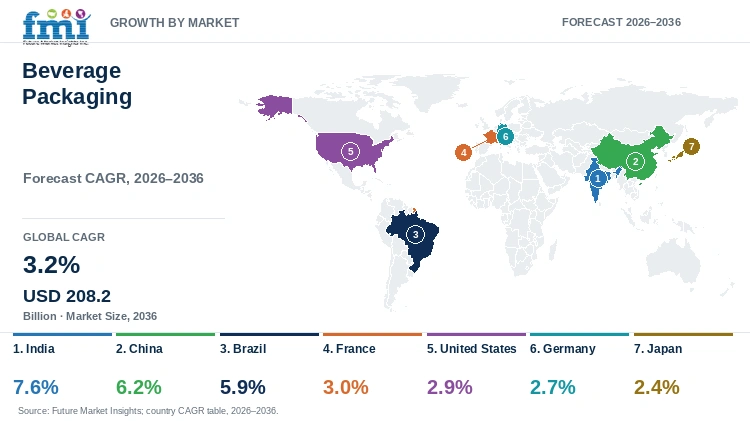
Country growth is split between markets adding packaged beverage occasions and markets replacing or refining an established pack base. India leads the evaluated countries at 7.6% CAGR, followed by China at 6.2% and Brazil at 5.9%, whereas France, the United States, Germany and Japan remain between 2.4% and 3.0%. The difference means the first group can grow through more packaged water, soft drinks and single-serve formats, while the mature group will depend more on lightweighting, deposit systems, recycled content and format change. The same bottle or can proposal will therefore not win for the same reason in every country.
Table 7: Country CAGR and Primary Growth Levers for the Beverage Packaging Market (CAGR percentage and operational drivers), 2026 to 2036
| Country | CAGR | Primary Growth Lever |
|---|---|---|
| India | 7.6% | Packaged water growth and single-serve penetration |
| China | 6.2% | Large beverage output and PET or can capacity |
| Brazil | 5.9% | Aluminum can recovery and soft drink consumption |
| France | 3.0% | Collection rules and tethered-cap compliance |
| United States | 2.9% | Can economics and ready-to-drink growth |
| Germany | 2.7% | Deposit-return infrastructure and refillable systems |
| Japan | 2.4% | Mature beverage demand and lightweight pack engineering |
Source: Future Market Insights analysis
India Beverage Packaging Market Outlook (2026 to 2036)
- India has a larger runway than the global market because packaged water and single-serve drinks are still reaching new retail points. A 7.6% CAGR can be supported by formal retail, hot-weather demand and wider cold availability, but the pack has to remain affordable. This keeps downgauged PET, small bottles and high-cavity closure production important. Growth could slow where local recovery remains uneven or where a very light bottle loses top-load strength on long, hot distribution routes, so the winning pack is likely to be low cost without becoming weak. This also keeps bottled water packaging relevant to the buying decision.
Key takeaway: India needs low pack cost and heat-resistant distribution performance to translate beverage penetration into packaging revenue.
China Beverage Packaging Market Outlook (2026 to 2036)
- China is different from the global market because demand is backed by a deep local base for PET, cans, closures and filling equipment. The 6.2% CAGR is therefore less about importing packaging capacity and more about using existing capacity for fast product turns across bottled water and ready-to-drink beverages. Price competition can make margins thin, while frequent artwork and format changes can raise downtime. Suppliers that shorten tool changes and keep recycled-resin quality stable across several plants can gain, whereas capacity without traceability may not be enough for larger beverage accounts.
Key takeaway: China rewards short changeovers and multi-plant resin control more than capacity alone.
Brazil Beverage Packaging Market Outlook (2026 to 2036)
- Brazil carries a stronger can-recovery angle than many markets, which supports the 5.9% CAGR across soft drinks, beer and ready-to-drink formats. Aluminium scrap value can keep cans commercially attractive, while PET remains important for water and family-size soft drinks. The hurdle comes from currency and freight volatility because imported parts or material can quickly change delivered cost. Local can sheet, closures and bottle conversion can push adoption in favour, but weak seasonal capacity or transport disruption could leave beverage companies exposed during peak demand. This also keeps drink can recovery relevant to the buying decision.
Key takeaway: Brazil gains from can recovery and local supply, but currency and seasonal capacity remain the pressure points.
France Beverage Packaging Market Outlook (2026 to 2036)
- France is likely to grow at 3.0% CAGR mainly through compliance-led pack change rather than first-time use of packaged beverages. Attached caps, recycled content and collection performance are forcing bottle and closure redesign, but the consumer still has to drink comfortably from the pack. This makes hinge position, opening force and cap movement practical adoption issues. Suppliers can gain when a compliant design runs on existing lines with limited mould change; conversion may move slower where tooling cost is high or beverage brands face complaints during the first consumer-use cycle.
Key takeaway: France turns closure compliance into a consumer-use and line-conversion test.
United States Beverage Packaging Market Outlook (2026 to 2036)
- The United States remains a mature packaging market, but its 2.9% CAGR can be supported by energy drinks, ready-to-drink beverages and strong can use. Unlike Europe, recovery conditions differ by state, which makes one national recycled-content or collection case difficult to apply. Can makers can use scrap value and chilled retail rotation in their favour, while PET converters need regional food-grade rPET access. Adoption may weaken where deposit coverage is limited or freight distance removes the benefit of a distant recycling partnership.
Key takeaway: The United States depends on regional recovery economics because state systems do not move together.
Germany Beverage Packaging Market Outlook (2026 to 2036)
- Germany is shaped more by the return system than by rapid beverage-volume expansion. The 2.7% CAGR can come from refillable formats, package replacement and continued lightweighting, but labels, caps and bottle bodies must work with sorting and deposit infrastructure already in place. A pack that performs globally can still face a hurdle if it sorts poorly or interferes with return handling. Suppliers that design around repeated logistics and clean material separation are likely to gain faster approval than those selling only a lighter single-use container.
Key takeaway: Germany gives recovery-system compatibility equal importance with package weight.
Japan Beverage Packaging Market Outlook (2026 to 2036)
- Japan records 2.4% CAGR because packaged beverage use is already high and growth has to come from compact formats, vending, premium single serves and weight reduction. The market is less forgiving on print, tactile use and pack appearance, so a thin-wall bottle or can must not feel weak during handling. Smaller households can support compact packs, but material used per litre can rise. Suppliers can move demand in favour by reducing weight without changing stiffness or opening quality; visible deformation could stop adoption even when the material saving is measurable.
Key takeaway: Japan will accept lightweighting only when pack feel, vending performance and finish remain unchanged.
Full report country CAGRs cover: North America; Latin America; Western Europe; Eastern Europe; East Asia; South Asia and Pacific; Middle East and Africa.
Who are the notable companies in the Beverage Packaging Market?
Amcor plc, Ball Corporation, Crown Holdings, Tetra Pak, O-I Glass, Ardagh Group, SIG, and Mondi are the significant market players in this market.
Competition in beverage packaging is divided by the assets a supplier controls. Can producers win where high-speed filling and scrap value matter, carton suppliers connect the package with aseptic equipment, and bottle suppliers compete through resin, preforms, closures and local conversion. Buyers do not approve a vendor only because the material is available. The supplier also needs technicians, tooling support, regional capacity and evidence that the pack can protect output and shelf life. This is why plant access can carry more commercial weight than a broad product catalogue. This also keeps liquid packaging formats relevant to the buying decision.
- Plastic and Flexible Platforms: Amcor and Mondi provide broad material science, closures, films, and multipack capability.
- Metal and Glass Platforms: Ball, Crown, O-I Glass, and Ardagh compete through can or bottle scale and regional plant access.
- Aseptic Carton Platforms: Tetra Pak and SIG compete through barrier systems, filling equipment compatibility, and service networks.
Competitive Benchmarking: Beverage Packaging Market
Table 8: Competitive Benchmarking for the Beverage Packaging Market (qualitative capability ratings), 2026
| Company | Format Breadth | Recycling Systems | Filling-Line Access | Geographic Reach |
|---|---|---|---|---|
| Amcor plc | High | High | High | High |
| Ball Corporation | Medium | High | High | High |
| Crown Holdings | Medium | High | High | High |
| Tetra Pak | Medium | High | High | High |
| O-I Glass | Medium | Medium | High | High |
| Ardagh Group | High | High | High | High |
| SIG | Medium | High | High | High |
| Mondi | High | High | Medium | High |
Key Developments in the Beverage Packaging Market
- In April 2026, Tetra Pak and Sterilgarda launched a one-litre aseptic carton with a paper-based barrier and 90% renewable content [5].
- In April 2025, Amcor completed its all-stock combination with Berry Global, creating a global leader in consumer and healthcare packaging solutions with an expanded portfolio of flexible packaging, rigid packaging, cartons, and closures across more than 400 locations in over 40 countries [6].
- In January 2025, Sidel introduced StarLITE-R STILL for 0.25 L to 2.5 L packages using up to 100% recycled PET [7].
Key Players in the Beverage Packaging Market
Plastic, Flexible, and Closure Platforms
- Amcor plc
- Mondi
Metal and Glass Packaging Platforms
- Ball Corporation
- Crown Holdings
- O-I Glass
- Ardagh Group
Aseptic Carton Platforms
- Tetra Pak
- SIG
Beverage Packaging Market - Report Scope
Table 9: Report Scope for the Beverage Packaging Market (coverage fields and definitions), 2026 to 2036
| Coverage field | Report scope |
|---|---|
| Market breakdown | Material Type; Packaging Type; Beverage Type; Capacity; Closure Type |
| Quantitative units | USD billion |
| Market definition | Primary beverage containers and closures used to protect and sell ready-to-consume drinks. |
| Regions covered | North America; Latin America; Western Europe; Eastern Europe; East Asia; South Asia and Pacific; Middle East and Africa |
| Countries covered | India, China, Brazil, France, United States, Germany, Japan, and additional countries |
| Key companies | Amcor, Ball, Crown, Tetra Pak, O-I Glass, Ardagh, SIG, Mondi |
| Forecast period | 2026 to 2036 |
| Approach | Primary and secondary research with market triangulation |
Beverage Packaging Market - Research Methodology
Table 10: Research Methodology for the Beverage Packaging Market (research methods and approach), 2026 edition
| Method | Approach |
|---|---|
| Primary Research | Interviews with converters, beverage producers, resin suppliers, machinery companies, distributors, and packaging specialists validate demand, qualification, and purchasing patterns. |
| Secondary Research | Company reports, investor releases, regulatory publications, industry associations, technical papers, product literature, and official public sources support evidence review. |
| Market Sizing and Forecasting | Top-down and bottom-up approaches assess format demand, price points, and adoption for the 2026 to 2036 period. |
| Data Triangulation and Validation | Values are checked against beverage output, packaging recovery rules, corporate developments, and historical trend analysis without double counting adjacent categories. |
Beverage Packaging Market by Segments
Beverage Packaging Market segmented by Material Type:
- Plastic Bottles
- Glass Bottles
- Metal Bottles
- Cartons
- Pouches
- Others
Beverage Packaging Market segmented by Packaging Type:
- Bottles
- Cans
- Cartons
- Pouches
- Others
Beverage Packaging Market segmented by Beverage Type:
- Carbonated Soft Drinks
- Bottled Water
- Juice
- Dairy Beverages
- Alcoholic Beverages
- Energy Drinks
- Others
Beverage Packaging Market segmented by Capacity:
- Small Packs
- Medium Packs
- Large Packs
- Bulk or Multi-Serve
Beverage Packaging Market segmented by Closure Type:
- Screw Caps
- Crown Caps
- Sports Caps
- Flip-Top Caps
- Others
Beverage Packaging Market by Region
- North America
- United States
- Canada
- Latin America
- Brazil
- Mexico
- Argentina
- Chile
- Western Europe
- Germany
- France
- United Kingdom
- Italy
- Spain
- Benelux
- Nordics
- Eastern Europe
- Poland
- Czech Republic
- Romania
- Hungary
- East Asia
- China
- Japan
- South Korea
- South Asia and Pacific
- India
- ASEAN
- Australia and New Zealand
- Middle East and Africa
- GCC Countries
- South Africa
- Türkiye
- Israel
Research Sources and Bibliography
- [1] European Parliament and Council of the European Union. (2019). Directive (EU) 2019/904 on the reduction of the impact of certain plastic products on the environment (Single-Use Plastics Directive), Article 6. Official Journal of the European Union, L 155, 1–19.
- [2] European Parliament and Council. (2025). Regulation (EU) 2025/40 on packaging and packaging waste. Official Journal of the European Union.
- [3] U.S. Environmental Protection Agency. (2025). Containers and packaging: Sustainable materials management and recycling data report. EPA Reports.
- [4] United Nations Environment Programme. (2025). Global environmental outlook: Policy guidance for circular beverage packaging systems. UNEP Knowledge Repository.
- [5] Tetra Pak. (2026, April 22). Tetra Pak and Sterilgarda Alimenti launch industry-first 1-litre aseptic carton with paper-based barrier. Corporate Press Releases.
- [6] Amcor plc. (2025, April 30). Amcor completes combination with Berry Global to create global consumer packaging leader. Corporate Investor Disclosures.
- [7] Sidel. (2025, January 30). StarLITE-R STILL: Sidel's new high production speed 100% rPET lightweight bottle base for still products. Sidel Official Newsroom / Asia Food Journal, January 31, 2025.
This bibliography is provided for reader reference and is not exhaustive. The full report contains the complete reference list and detailed citations.
This Report Answers
- How large is the beverage packaging market in 2026 and what is forecast for 2036?
- Which material and format pressures support beverage packaging demand?
- Why do plastic bottles lead material type demand?
- Why do bottles lead the packaging type category?
- How do growth rates differ across India, China, Brazil, and mature economies?
- Which companies supply major beverage packaging formats today?
- What limits material substitution or supplier switching?
- What should buyers evaluate before changing a beverage package?
Frequently Asked Questions
How big is the beverage packaging market in 2026, and what is forecast for 2036?
Future Market Insights estimates that the global beverage packaging market will reach USD 151.9 billion in 2026 and USD 208.2 billion by 2036.
What is the CAGR from 2026 to 2036?
The beverage packaging market is projected to expand at a 3.2% CAGR across the assessment period.
Which material type leads?
Plastic bottles are projected to hold 48.2% share in 2026 due to established PET filling and distribution economics.
Which packaging type leads?
Bottles are expected to account for 35.0% in 2026 across plastic and glass applications.
Which country has the fastest growth outlook?
FMI finds that India is projected to register 7.6% CAGR from 2026 to 2036.
Who are the key players?
Key participants include Amcor, Ball, Crown, Tetra Pak, O-I Glass, Ardagh, SIG, and Mondi.
Preview the report firsthand - request a free sample
Get SampleGet the brochure for pricing and purchase details.
Get PDFTable of Content
- Key Takeaways
- Market Size and CAGR
- Top Growth Driver
- Fastest Growing Segment
- Leading Region
- Key Companies
- Emerging Opportunities
- Executive Summary
- Global Market Outlook
- Demand-side Trends
- Supply-side Trends
- Technology Roadmap Analysis
- Analysis and Recommendations
- Analyst Perspective (What is happening? Why now? What should investors know?)
- Key Questions Answered
- How large is the market?
- What is the CAGR?
- What are key trends?
- Which region dominates?
- Who are the leaders?
- Market Overview
- Market Coverage / Taxonomy
- Market Definition / Scope / Limitations
- Research Methodology
- Chapter Orientation
- Analytical Lens and Working Hypotheses
- Market Structure, Signals, and Trend Drivers
- Benchmarking and Cross-market Comparability
- Market Sizing, Forecasting, and Opportunity Mapping
- Research Design and Evidence Framework
- Desk Research Programme (Secondary Evidence)
- Expert Input and Fieldwork (Primary Evidence)
- Tooling, Models, and Reference Databases
- Data Engineering and Model Build
- Quality Assurance and Audit Trail
- Market Background
- Market Dynamics (Drivers, Restraints, Opportunity, Trends)
- Scenario Forecast (Optimistic, Likely, Conservative)
- Impact Analysis
- AI Impact
- Sustainability Impact
- Regulatory Impact
- Technology Impact
- Consumer / Buyer Analysis
- Purchase Drivers
- Adoption Barriers
- Buyer Journey
- Opportunity Map Analysis
- Product Life Cycle Analysis
- Supply Chain Analysis
- Investment Feasibility Matrix
- Value Chain Analysis
- PESTLE and Porter's Analysis
- Regulatory Landscape
- Regional Parent Market Outlook
- Production and Consumption Statistics
- Import and Export Statistics
- Global Market Analysis and Forecast, 2021 to 2036
- Historical Market Size Value (USD Billion) Analysis, 2021 to 2025
- Current and Future Market Size Value (USD Billion) Projections, 2026 to 2036
- Y-o-Y Growth Trend Analysis
- Absolute $ Opportunity Analysis
- Global Market Pricing Analysis, 2021 to 2036
- Global Market Analysis and Forecast, By Material Type, 2021 to 2036
- Introduction / Key Findings
- Historical Market Size Value (USD Billion) Analysis By Material Type, 2021 to 2025
- Current and Future Market Size Value (USD Billion) Analysis and Forecast By Material Type, 2026 to 2036
- Plastic Bottles
- Glass Bottles
- Metal Bottles
- Cartons
- Pouches
- Others
- Y-o-Y Growth Trend Analysis By Material Type, 2021 to 2025
- Absolute $ Opportunity Analysis By Material Type, 2026 to 2036
- Global Market Analysis and Forecast, By Packaging Type, 2021 to 2036
- Introduction / Key Findings
- Historical Market Size Value (USD Billion) Analysis By Packaging Type, 2021 to 2025
- Current and Future Market Size Value (USD Billion) Analysis and Forecast By Packaging Type, 2026 to 2036
- Bottles
- Cans
- Cartons
- Pouches
- Others
- Y-o-Y Growth Trend Analysis By Packaging Type, 2021 to 2025
- Absolute $ Opportunity Analysis By Packaging Type, 2026 to 2036
- Global Market Analysis and Forecast, By Beverage Type, 2021 to 2036
- Introduction / Key Findings
- Historical Market Size Value (USD Billion) Analysis By Beverage Type, 2021 to 2025
- Current and Future Market Size Value (USD Billion) Analysis and Forecast By Beverage Type, 2026 to 2036
- Carbonated Soft Drinks
- Bottled Water
- Juice
- Dairy Beverages
- Alcoholic Beverages
- Energy Drinks
- Others
- Y-o-Y Growth Trend Analysis By Beverage Type, 2021 to 2025
- Absolute $ Opportunity Analysis By Beverage Type, 2026 to 2036
- Global Market Analysis and Forecast, By Capacity, 2021 to 2036
- Introduction / Key Findings
- Historical Market Size Value (USD Billion) Analysis By Capacity, 2021 to 2025
- Current and Future Market Size Value (USD Billion) Analysis and Forecast By Capacity, 2026 to 2036
- Small Packs
- Medium Packs
- Large Packs
- Bulk or Multi-Serve
- Y-o-Y Growth Trend Analysis By Capacity, 2021 to 2025
- Absolute $ Opportunity Analysis By Capacity, 2026 to 2036
- Global Market Analysis and Forecast, By Closure Type, 2021 to 2036
- Introduction / Key Findings
- Historical Market Size Value (USD Billion) Analysis By Closure Type, 2021 to 2025
- Current and Future Market Size Value (USD Billion) Analysis and Forecast By Closure Type, 2026 to 2036
- Screw Caps
- Crown Caps
- Sports Caps
- Flip-Top Caps
- Others
- Y-o-Y Growth Trend Analysis By Closure Type, 2021 to 2025
- Absolute $ Opportunity Analysis By Closure Type, 2026 to 2036
- Global Market Analysis and Forecast, By Region, 2021 to 2036
- Introduction
- Historical Market Size Value (USD Billion) Analysis By Region, 2021 to 2025
- Current Market Size Value (USD Billion) Analysis and Forecast By Region, 2026 to 2036
- North America
- Latin America
- Western Europe
- Eastern Europe
- East Asia
- South Asia and Pacific
- Middle East and Africa
- Market Attractiveness Analysis By Region
- North America Market Analysis and Forecast, By Country, 2021 to 2036
- Historical Market Size Value (USD Billion) Trend Analysis By Market Taxonomy, 2021 to 2025
- Market Size Value (USD Billion) Forecast By Market Taxonomy, 2026 to 2036
- By Country
- United States
- Canada
- By Material Type
- By Packaging Type
- By Beverage Type
- By Capacity
- By Closure Type
- By Country
- Market Attractiveness Analysis
- By Country
- By Material Type
- By Packaging Type
- By Beverage Type
- By Capacity
- By Closure Type
- Key Takeaways
- Latin America Market Analysis and Forecast, By Country
- Historical Market Size Value (USD Billion) Trend Analysis By Market Taxonomy, 2021 to 2025
- Market Size Value (USD Billion) Forecast By Market Taxonomy, 2026 to 2036
- By Country
- Brazil
- Mexico
- Argentina
- Chile
- By Material Type
- By Packaging Type
- By Beverage Type
- By Capacity
- By Closure Type
- By Country
- Market Attractiveness Analysis
- By Country
- By Material Type
- By Packaging Type
- By Beverage Type
- By Capacity
- By Closure Type
- Key Takeaways
- Western Europe Market Analysis and Forecast, By Country
- Historical Market Size Value (USD Billion) Trend Analysis By Market Taxonomy, 2021 to 2025
- Market Size Value (USD Billion) Forecast By Market Taxonomy, 2026 to 2036
- By Country
- Germany
- France
- United Kingdom
- Italy
- Spain
- Benelux
- Nordics
- By Material Type
- By Packaging Type
- By Beverage Type
- By Capacity
- By Closure Type
- By Country
- Market Attractiveness Analysis
- By Country
- By Material Type
- By Packaging Type
- By Beverage Type
- By Capacity
- By Closure Type
- Key Takeaways
- Eastern Europe Market Analysis and Forecast, By Country
- Historical Market Size Value (USD Billion) Trend Analysis By Market Taxonomy, 2021 to 2025
- Market Size Value (USD Billion) Forecast By Market Taxonomy, 2026 to 2036
- By Country
- Poland
- Czech Republic
- Romania
- Hungary
- By Material Type
- By Packaging Type
- By Beverage Type
- By Capacity
- By Closure Type
- By Country
- Market Attractiveness Analysis
- By Country
- By Material Type
- By Packaging Type
- By Beverage Type
- By Capacity
- By Closure Type
- Key Takeaways
- East Asia Market Analysis and Forecast, By Country
- Historical Market Size Value (USD Billion) Trend Analysis By Market Taxonomy, 2021 to 2025
- Market Size Value (USD Billion) Forecast By Market Taxonomy, 2026 to 2036
- By Country
- China
- Japan
- South Korea
- By Material Type
- By Packaging Type
- By Beverage Type
- By Capacity
- By Closure Type
- By Country
- Market Attractiveness Analysis
- By Country
- By Material Type
- By Packaging Type
- By Beverage Type
- By Capacity
- By Closure Type
- Key Takeaways
- South Asia and Pacific Market Analysis and Forecast, By Country
- Historical Market Size Value (USD Billion) Trend Analysis By Market Taxonomy, 2021 to 2025
- Market Size Value (USD Billion) Forecast By Market Taxonomy, 2026 to 2036
- By Country
- India
- ASEAN
- Australia and New Zealand
- By Material Type
- By Packaging Type
- By Beverage Type
- By Capacity
- By Closure Type
- By Country
- Market Attractiveness Analysis
- By Country
- By Material Type
- By Packaging Type
- By Beverage Type
- By Capacity
- By Closure Type
- Key Takeaways
- Middle East and Africa Market Analysis and Forecast, By Country
- Historical Market Size Value (USD Billion) Trend Analysis By Market Taxonomy, 2021 to 2025
- Market Size Value (USD Billion) Forecast By Market Taxonomy, 2026 to 2036
- By Country
- GCC Countries
- South Africa
- Türkiye
- Israel
- By Material Type
- By Packaging Type
- By Beverage Type
- By Capacity
- By Closure Type
- By Country
- Market Attractiveness Analysis
- By Country
- By Material Type
- By Packaging Type
- By Beverage Type
- By Capacity
- By Closure Type
- Key Takeaways
- Key Countries Market Analysis
- United States
- Pricing Analysis
- Market Share Analysis, 2025
- By Material Type
- By Packaging Type
- By Beverage Type
- By Capacity
- By Closure Type
- Canada
- Pricing Analysis
- Market Share Analysis, 2025
- By Material Type
- By Packaging Type
- By Beverage Type
- By Capacity
- By Closure Type
- Mexico
- Pricing Analysis
- Market Share Analysis, 2025
- By Material Type
- By Packaging Type
- By Beverage Type
- By Capacity
- By Closure Type
- Brazil
- Pricing Analysis
- Market Share Analysis, 2025
- By Material Type
- By Packaging Type
- By Beverage Type
- By Capacity
- By Closure Type
- Chile
- Pricing Analysis
- Market Share Analysis, 2025
- By Material Type
- By Packaging Type
- By Beverage Type
- By Capacity
- By Closure Type
- Germany
- Pricing Analysis
- Market Share Analysis, 2025
- By Material Type
- By Packaging Type
- By Beverage Type
- By Capacity
- By Closure Type
- United Kingdom
- Pricing Analysis
- Market Share Analysis, 2025
- By Material Type
- By Packaging Type
- By Beverage Type
- By Capacity
- By Closure Type
- Italy
- Pricing Analysis
- Market Share Analysis, 2025
- By Material Type
- By Packaging Type
- By Beverage Type
- By Capacity
- By Closure Type
- Spain
- Pricing Analysis
- Market Share Analysis, 2025
- By Material Type
- By Packaging Type
- By Beverage Type
- By Capacity
- By Closure Type
- France
- Pricing Analysis
- Market Share Analysis, 2025
- By Material Type
- By Packaging Type
- By Beverage Type
- By Capacity
- By Closure Type
- India
- Pricing Analysis
- Market Share Analysis, 2025
- By Material Type
- By Packaging Type
- By Beverage Type
- By Capacity
- By Closure Type
- ASEAN
- Pricing Analysis
- Market Share Analysis, 2025
- By Material Type
- By Packaging Type
- By Beverage Type
- By Capacity
- By Closure Type
- Australia and New Zealand
- Pricing Analysis
- Market Share Analysis, 2025
- By Material Type
- By Packaging Type
- By Beverage Type
- By Capacity
- By Closure Type
- China
- Pricing Analysis
- Market Share Analysis, 2025
- By Material Type
- By Packaging Type
- By Beverage Type
- By Capacity
- By Closure Type
- Japan
- Pricing Analysis
- Market Share Analysis, 2025
- By Material Type
- By Packaging Type
- By Beverage Type
- By Capacity
- By Closure Type
- South Korea
- Pricing Analysis
- Market Share Analysis, 2025
- By Material Type
- By Packaging Type
- By Beverage Type
- By Capacity
- By Closure Type
- Poland
- Pricing Analysis
- Market Share Analysis, 2025
- By Material Type
- By Packaging Type
- By Beverage Type
- By Capacity
- By Closure Type
- Hungary
- Pricing Analysis
- Market Share Analysis, 2025
- By Material Type
- By Packaging Type
- By Beverage Type
- By Capacity
- By Closure Type
- Türkiye
- Pricing Analysis
- Market Share Analysis, 2025
- By Material Type
- By Packaging Type
- By Beverage Type
- By Capacity
- By Closure Type
- South Africa
- Pricing Analysis
- Market Share Analysis, 2025
- By Material Type
- By Packaging Type
- By Beverage Type
- By Capacity
- By Closure Type
- United States
- Market Structure Analysis
- Competition Dashboard
- Competition Benchmarking
- Market Share Analysis of Top Players
- By Regional
- By Material Type
- By Packaging Type
- By Beverage Type
- By Capacity
- By Closure Type
- Emerging Startups
- Innovation Benchmarking
- Competition Analysis
- Competition Deep Dive
- Amcor plc
- Overview
- Product Portfolio
- Profitability by Market Segments
- Sales Footprint
- Strategy Overview
- Marketing Strategy
- Product Strategy
- Channel Strategy
- Ball Corporation
- Crown Holdings
- Tetra Pak
- O-I Glass
- Ardagh Group
- SIG
- Mondi
- Amcor plc
- Case Studies
- Success Stories
- Recent Developments
- Competition Deep Dive
- Assumptions & Acronyms Used


