

- Industry Size (2026)
- USD 4.6 Bn
- Forecast (2036)
- USD 14.8 Bn
- CAGR (2026 to 2036)
- 12.4%
Dupe Beauty Products Market Size, Market Forecast and Outlook By FMI
The Dupe Beauty Products Market was pegged at USD 4.1 billion in 2025. Industry revenues are estimated to reach USD 4.6 billion in 2026, tracking a 12.4% CAGR across the projection period. By 2036, the market is forecast to hit USD 14.8 billion, powered by rising consumer preference for high‑performance, value‑engineered alternatives.
Merchandising directors recalibrate shelf space toward rapid-turnover labels that capture viral attention. Securing priority placement across regional drugstore networks requires mass beauty formulators to match premium ingredient stories at fraction costs. Product development teams reformulating cosmetics for faster speed-to-market compress launch windows from twelve months to twelve weeks. Suppliers failing to accelerate manufacturing lead times lose priority status in major retail resets.
Summary of Dupe Beauty Products Market
- Dupe Beauty Products Market Definition
- The market covers cosmetics and personal care products formulated and positioned as affordable alternatives that match the shade, finish, scent profile, or use-case of higher-priced items.
- Demand Drivers in the Market
- Social platform discovery algorithms accelerate product comparison cycles, transforming dupe identification into a primary purchase trigger for mass beauty consumers.
- Elevated consumer basket pressures drive trial of mid-mass formulations that replicate prestige textures and packaging at accessible entry prices.
- Aggressive online marketplace expansion democratizes access for emerging digital-first labels, facilitating rapid SKU refreshes and unseating legacy brand loyalty.
- Key Segments Analyzed in the FMI Report
- Makeup (face, eye, lip): 46% share in 2026, leading the sector because high-visibility shade formats convert immediately through creator-led tutorials and short repeat purchase cycles.
- Mid-mass dupes (drugstore premium-feel): 44% share in 2026, capturing maximum volume by balancing perceived quality improvements with pricing that encourages impulse buying.
- Online marketplaces (Amazon/Flipkart/Shopee etc.): 48% share in 2026, dominating distribution as shoppers consolidate discovery, price comparison, and fulfillment into single digital sessions.
- Analyst Opinion at FMI
- Ronak Shah, Principal Consultant for Consumer Product, opines: “Fast-beauty formulators know that rapid product drops secure digital shelf share, but these accelerated timelines simultaneously escalate compliance exposure under tightening cosmetics regulations. Brand owners attempting to outpace trend cycles often bypass rigorous claims substantiation, creating massive recall vulnerabilities. Formulators who fail to automate product notification documentation alongside new shade launches will encounter severe supply bottlenecks. Within the next sourcing cycle, operators treating compliance as secondary to speed forfeit access to high-velocity marketplace channels entirely.”
- Strategic Implications / Executive Takeaways
- Brand operators must develop scalable fast-follow manufacturing pipelines embedded with hard compliance guardrails to safely commercialize viral trends.
- Digital marketing directors should structure marketplace acquisition funnels to migrate single-item shoppers into D2C bundle subscriptions, neutralizing platform fee degradation.
- Assortment planners need to execute aggressive SKU pruning protocols, eliminating slow-moving shades to fund rapid iteration in high-traffic fragrance and lip categories.
- Methodology
- Primary Research: FMI conducted interviews with beauty brand managers, marketplace category leaders, drugstore buyers, and regulatory compliance specialists across diverse geographic hubs.
- Desk Research: Analysts reviewed public regulations on cosmetics safety, corporate earnings transcripts, and authority guidance documents covering product notification enforcement.
- Market-Sizing and Forecasting: The hybrid model triangulates top-down beauty spend allocations with bottom-up channel throughput assumptions, stress-tested against price-tier mix shifts and platform return rates.
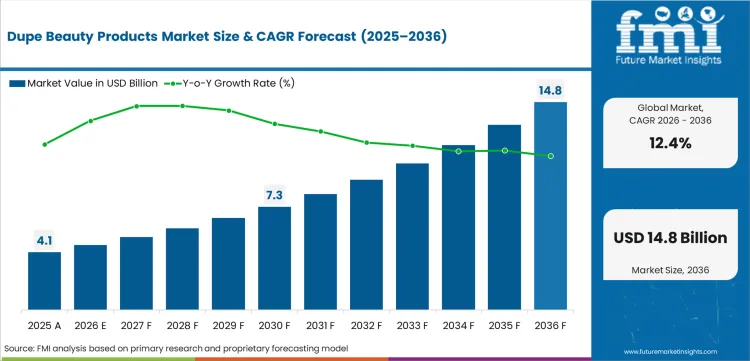
Dupe Beauty Products Market Key Takeaways
| Metric | Details |
|---|---|
| Industry Size (2026) | USD 4.6 billion |
| Industry Value (2036) | USD 14.8 billion |
| CAGR (2026-2036) | 12.4% |
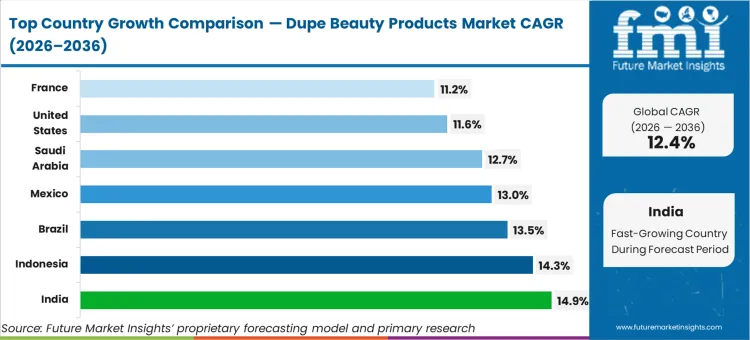
Expansion of social commerce platforms and cashless digital ecosystems propels India at 14.9% and Indonesia at 14.3%, where marketplace trial behavior bypasses traditional retail gatekeepers entirely. In Latin America, severe price sensitivity and currency volatility position Brazil at a 13.5% rate and Mexico at 13.0% as mid-mass alternatives permanently replace imported prestige items. Saudi Arabia expands at 12.7% as consumers demand luxury aesthetic cues at accessible entry points. Meanwhile, strict compliance frameworks and high return rates temper growth in mature markets, with the United States advancing at 11.6%, France at 11.2%, and the United Kingdom at 10.9%, forcing brand owners to prioritize listing discipline over sheer launch velocity.
Dupe Beauty Products Market Definition
The Dupe Beauty Products market covers mass-market cosmetics and personal care items specifically formulated to replicate the sensory, performance, and aesthetic cues of premium beauty benchmarks. Formulation chemists engineer these alternatives using cost-optimized synthetic micas, stabilized botanical extracts, and standardized emulsion bases to match the shade payoff and wear time of prestige equivalents. The category encompasses color cosmetics, facial skincare regimens, fine fragrance mists, and application tools distributed primarily through digital marketplaces and mass-market pharmacy channels. Regulatory frameworks govern the exact safety substantiation and labeling parameters defining these mass-market formulas.
Dupe Beauty Products Market Inclusions
The market scope includes mid-mass color cosmetics, hybrid hydrating concealers, and budget-friendly fragrance mists featuring premium packaging cues. Drugstore skincare formulations incorporating trending active ingredients like niacinamide or hyaluronic acid at accessible price points fall within the boundaries. Private-label retailer collections explicitly designed to offer "look-for-less" alternatives alongside branded products are fully incorporated. Borderline cases, such as fast-fashion apparel brands launching their own compliant cosmetic lines to capture impulse checkout volume, are included if they maintain distinct cosmetic brand identities.
Dupe Beauty Products Market Exclusions
Counterfeit cosmetics, trademark-infringing replicas, and unauthorized grey-market parallel imports are strictly omitted from the valuation. Professional salon-only chemical treatments, dermatological prescription topicals, and high-margin luxury skincare sold exclusively through prestige department stores fall outside the defined parameters. Standalone influencer resale of opened products or peer-to-peer decanted fragrance samples are explicitly excluded. Formulations supplied directly as bulk raw materials to private-label manufacturers without consumer-facing alternative positioning do not qualify for this market scope.
Dupe Beauty Products Market Research Methodology
- Primary Research: FMI conducted detailed technical interviews with mass beauty brand managers, digital marketplace category leaders, and cosmetics compliance directors across North America, Europe, and Asia Pacific to validate product refresh cycles.
- Desk Research: Analysts aggregated public cosmetics notification registries, corporate earnings materials from major drugstore chains, and regulatory enforcement timelines from national health agencies.
- Market-Sizing and Forecasting: The baseline value derives from a hybrid approach combining top-down consumer beauty spend allocations with bottom-up channel throughput assumptions, tied directly to marketplace sell-through velocity.
- Data Validation and Update Cycle: Segment projections undergo rigorous cross-validation against major e-commerce platform return rates, seller fee structure changes, and quarterly mass-retail inventory resets.
Segmental Analysis
Dupe Beauty Products Market Analysis by Product Category
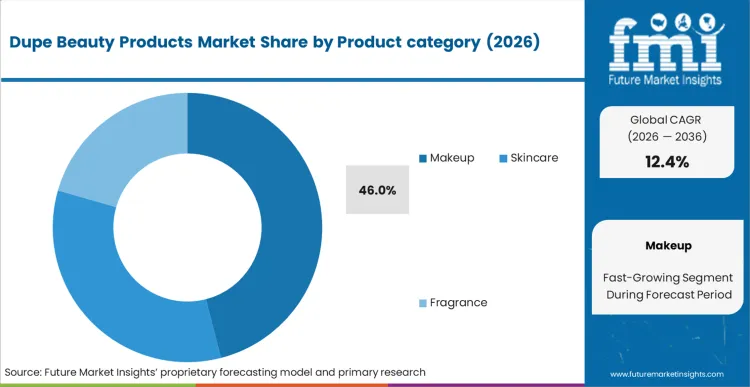
Makeup items dominate the product category dimension, expected to represent 46% of total market share in 2026, as color-cosmetics trends generate the highest volume of comparative digital content. Consumers actively seek affordable shade equivalents for prestige launches, accelerating the replacement cycle for face, eye, and lip items. FMI analysts opine that integrating formulation insights from adjacent skincare segments elevates the perceived value of these budget cosmetics. Fast-beauty formulators are blending hydrating actives into entry-level concealers, directly mimicking the hybrid functionality of luxury skincare products. Pigment suppliers unable to deliver stable hybrid textures at mass-market price points risk exclusion from the next wave of integrated beauty procurement contracts.
- Pigment load parity: Formulators engineer high-opacity color cosmetics using cost-optimized synthetic micas to match the one-swipe payoff of prestige palettes.
- Skin-barrier integration: Category buyers demand infused active ingredients within base makeup, forcing contract manufacturers to upgrade emulsion stability.
- Viscosity matching: Chemical engineers replicate the specific sensory application feel of high-end primers, directly triggering consumer brand-switching behavior.
Dupe Beauty Products Market Analysis by Price Tier / Positioning
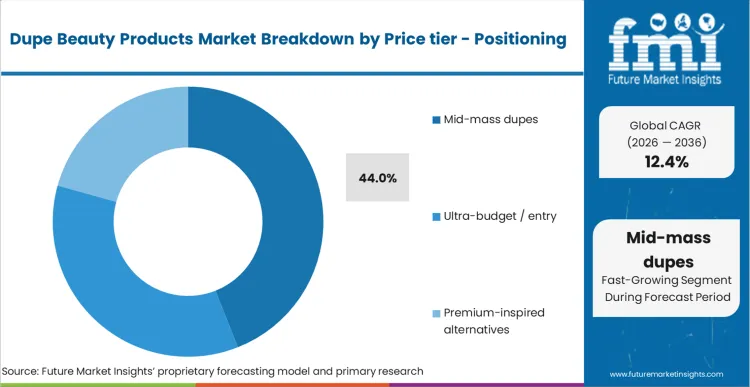
Every fast-beauty merchandising director now faces intense pressure to upgrade packaging aesthetics without breaking entry-level margin structures. Mid-mass dupes represent a leading 44% share in 2026. Shoppers reject flimsy budget compacts, preferring "drugstore premium-feel" alternatives that look convincing on social media. Developing these convincing equivalents demands specialized tooling investments from contract packagers aiming to capture volume away from authentic premium cosmetics. Retail category buyers specifically source formulations positioned alongside beauty and wellness positioning, blurring the boundary between basic hygiene and prestige self-care. Contract manufacturers failing to upgrade secondary packaging quality lose shelf placement in high-visibility pharmacy end-caps.
- Tactile packaging upgrades: Component sourcing teams specify weighted plastics and soft-touch finishes, establishing prestige physical cues for budget formulations.
- Fragrance profile cloning: Scent engineers map the molecular structure of viral prestige perfumes, enabling mass-market mists to clear consumer olfactory comparison tests.
- Margin compression mitigation: Operations directors offset higher packaging costs through aggressive raw material volume consolidation across multiple mid-mass sub-brands.
Dupe Beauty Products Market Analysis by Channel
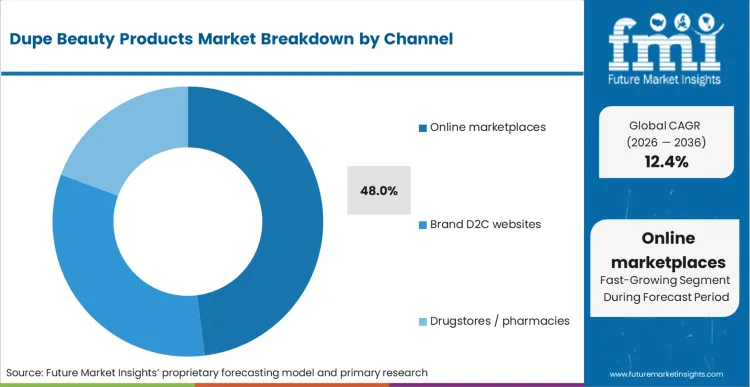
Prior reliance on physical drugstore browsing restricted the speed at which fast-beauty brands could launch and validate new shade ranges. The expansion of online marketplaces resolves this distribution lag, allowing digital-first brands to bypass traditional retail category resets. Online marketplaces capture 48% of market share in 2026 by aggregating consumer reviews, viral trend alerts, and immediate fulfillment into one ecosystem. As per FMI's projection, marketplace search algorithms prioritize listings that feature clean-label attributes, accelerating the launch of budget-friendly organic cosmetics. Digital merchants attempting to capitalize on the natural cosmetics halo effect must provide explicit ingredient documentation to survive algorithmic scrutiny. Brands operating without verified claims substantiation face immediate delisting from major retail platform search results.
- Algorithm-driven discovery: E-commerce merchandising teams optimize listing metadata around trending prestige product names, intercepting high-intent search traffic.
- Frictionless trial mechanics: Marketplace fulfillment infrastructure reduces the perceived risk of testing unknown budget brands, driving impulse conversion.
- Distributed review validation: Brand operators weaponize user-generated comparison photos to definitively prove color-match claims against prestige benchmarks.
Dupe Beauty Products Market Drivers, Restraints, and Opportunities
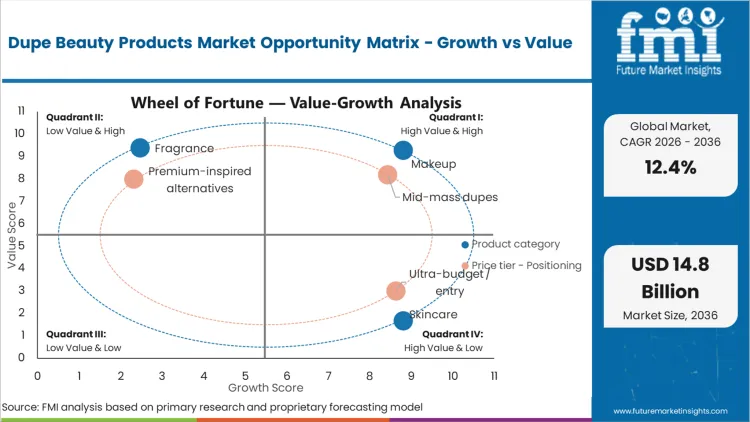
Short-form video platforms compress the traditional beauty adoption curve, converting viral product awareness into immediate mass-market demand. Social commerce directors leverage this velocity by deploying targeted creator campaigns that position affordable alternatives directly against out-of-stock prestige items. This mechanism systematically trains consumers to seek functional equivalents rather than waiting for original inventory replenishment. FMI's analysis indicates that independent labels modeling their launches on rapid k beauty product development cycles capture dominant market share within weeks. Formulators unable to transition from concept to commercialization in under 90 days surrender the viral sales window entirely.
Tightening regulatory scrutiny over cosmetic ingredient claims fundamentally disrupts the fast-beauty business model in mature jurisdictions. Compliance officers operating under expanded frameworks like MoCRA must validate safety substantiation for every new SKU, stalling the rapid-drop cadence that digital brands rely on. Aggressive marketing teams promoting budget c beauty product alternatives frequently trigger regulatory audits by making unsupported dermatological claims. Legal review bottlenecks force brands to either dilute their marketing language or accept prolonged launch delays.
- Niche personalization capabilities: Supply chain directors utilizing modular formulation bases enable profitable production of customized skincare at scale. Digital brands capturing distinct demographic needs secure highly loyal subscription revenue streams.
- Botanical extract integration: R&D leads formulating affordable herbal beauty products capture consumers pivoting away from synthetic chemical profiles. Delivering stable plant-based efficacy at drugstore prices unlocks entirely new retail distribution tiers.
- Targeted active inclusion: Chemists incorporating stabilized Vitamin C and niacinamide into budget skin lightening products address specific hyperpigmentation concerns. Delivering clinical-grade visible results at mass-market pricing permanently displaces prestige competitors.
Regional Analysis
Based on the regional analysis, the Dupe Beauty Products market is segmented into North America, Latin America, Europe, East Asia, South Asia, Oceania and Middle East & Africa across 40+ countries. The full report also offers market attractiveness analysis based on regional trends.
.webp "Top Country Growth Comparison Dupe Beauty Products Market Cagr (2026 2036)")
| Country | CAGR (2026 to 2036) |
|---|---|
| India | 14.9% |
| Indonesia | 14.3% |
| Brazil | 13.5% |
| Mexico | 13.0% |
| Saudi Arabia | 12.7% |
| United States | 11.6% |
| France | 11.2% |
| United Kingdom | 10.9% |
Source: Future Market Insights (FMI) analysis, based on proprietary forecasting model and primary research
North America Dupe Beauty Products Market Analysis
North American retail environments function as a performance-for-price battleground where digitally native shoppers publicly dissect chemical ingredient lists to validate budget brand claims. Digital marketing directors competing in this saturated zone must balance the demand for rapid shade iteration against the escalating cost of processing e-commerce returns. Relying purely on viral social media momentum fails when consumers receive formulations that separate during transit or cause unexpected dermal reactions. Capturing sustainable share requires contract manufacturers to implement rigorous stability testing protocols that mirror prestige lab standards without inflating unit costs. The regulatory overhaul across the region forces domestic formulators to document these safety protocols formally before launching new collections.
- United States: MoCRA compliance mandates fundamentally alter the launch calculus for independent fast-beauty brands operating nationwide. Domestic compliance officers must now secure facility registrations, list exact product formulations, and maintain accessible adverse event records, stripping away the anonymity that historically shielded budget importers. The United States advances at an 11.6% compound rate across the forecast decade as mass retailers purge non-compliant suppliers from their physical and digital shelves. Brand operators entering the 2027 procurement cycles without verified FDA listing documentation face immediate disqualification from major national pharmacy reset programs.
FMI's report includes detailed analysis and country-wise assessment for the broader North American market. The coverage encompasses Canada and Mexico, mapping the cross-border distribution flows of fast-beauty items. A defining structural dynamic across these nations involves the aggressive expansion of multinational drugstore chains harmonizing their private-label supplier networks to combat escalating logistics and warehousing overhead.
Europe Dupe Beauty Products Market Analysis
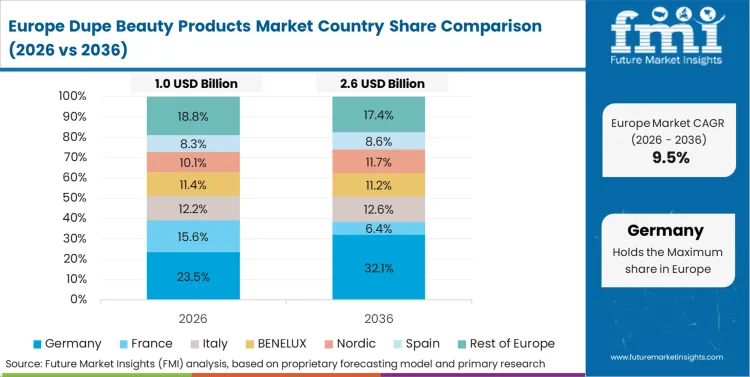
European industrial policy aggressively penalizes unsubstantiated cosmetic claims, creating a hostile environment for fast-fashion beauty entrants accustomed to unregulated marketing. Compliance directors navigating the European market must maintain comprehensive Product Information Files and designate a legal Responsible Person for every individual shade variant launched. This heavy administrative burden drastically slows the speed-to-shelf advantage that budget brands typically exploit, forcing them to compete on sustained formulation quality rather than fleeting digital trends. Success requires sourcing teams to secure high-purity synthetic ingredients that easily clear stringent toxicological safety assessments. The resulting market architecture heavily favors established domestic manufacturers who leverage existing regulatory infrastructure to block non-compliant overseas imports.
- France: The domestic pharmacy sector operates as the ultimate gatekeeper for skincare credibility, enforcing strict dermatological testing standards that budget brands must match. French formulation chemists bypass cheap harsh surfactants, utilizing gentle botanical alternatives to engineer affordable micellar waters and barrier creams. France's market expands at an 11.2% CAGR through 2036 as these sophisticated mass-market dupes cannibalize sales from entry-level prestige lines. Overseas manufacturers attempting to penetrate the French retail ecosystem without complete cosmetic safety assessments lose all priority status during annual supermarket tender evaluations.
- United Kingdom: Post-Brexit regulatory divergence requires brands to duplicate compliance efforts across both the EU portal and the UK cosmetic notification system. Supply chain leads must maintain separate labeling protocols and distinct responsible persons, adding significant frictional cost to every low-margin budget item imported. This critical infrastructure transition anchors the UK's 10.9% compound trajectory to 2036 as dominant high-street pharmacy chains consolidate shelf space around highly compliant, high-volume supplier networks. Importers lacking dedicated UK regulatory representation forfeit access to the dominant domestic health and beauty retail pipelines.
FMI's report includes comprehensive evaluation of the European mass beauty sector. The analysis features specific investigation of Germany, Italy, Spain, and the Nordics. A prevailing structural condition across these jurisdictions is the mandatory transition toward fully recyclable primary packaging components, forcing budget brands to redesign their compacts and bottles without violating strict retail price ceilings.
Asia Pacific Dupe Beauty Products Market Analysis
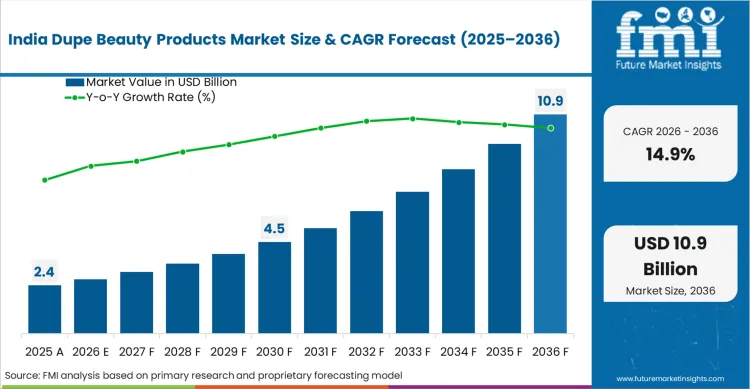
Marketplace ecosystems across the Asia Pacific region fuse entertainment with transaction, fundamentally altering how young demographics discover and procure cosmetics. Digital merchandising directors leverage live-selling events to demonstrate real-time performance parity between budget items and luxury anti wrinkle products, collapsing the consideration phase into minutes. Based on FMI's assessment, this concentrated digital infrastructure entirely bypasses the physical retail distribution hurdles that block new entrants in Western markets. The convergence of secure digital payment gateways and hyper-local logistics networks converts rural aspiration into measurable commercial volume.
- India: Non-metro consumer cohorts rapidly migrate from unbranded personal care to organized fast-beauty labels via aggressive social commerce penetration. This transition forces domestic formulators to upgrade sensory profiles while defending hyper-competitive entry price points. India's digital-first beauty sector registers intense activity around hybrid formulations, establishing a baseline where mass-market shoppers expect prestige-level hydration. Anchoring India's 14.9% compound expansion of dupe beauty demand to 2036, consumers actively substitute premium imports with locally manufactured moisturizing skincare products. Brand operators failing to secure prominent positioning on major regional e-commerce platforms forfeit access to the fastest-growing demographic dividend globally.
- Indonesia: The national regulatory shift implementing BPOM Notifkos 3.0 mandates stringent product file handling, creating a distinct compliance barrier for unauthorized grey-market cosmetics. Authorized importers navigating this documentation gauntlet successfully monopolize the surging creator-commerce demand channels. Indonesia's massive youth demographic treats short-form video product comparisons as definitive purchasing guides for barrier-repair items. This aggressive modernization strategy drives a 14.3% CAGR for affordable healing skin care products in Indonesia through 2036. Formulators lacking verified BPOM notification credentials face immediate exclusion from authorized TikTok Shop and Shopee vendor ecosystems.
FMI's report includes extensive coverage of the Asia Pacific mass beauty landscape. It incorporates detailed analysis of Japan, South Korea, Australia, and the broader ASEAN region. A primary trend shaping these nations is the rapid localization of contract manufacturing facilities, forcing regional brand owners to near-shore their production pipelines to avoid cross-border regulatory delays and import tariffs.
Latin America Dupe Beauty Products Market Analysis
Currency volatility and persistent import tariffs across Latin America render authentic prestige cosmetics mathematically inaccessible for the broader middle class. Category buyers at major pharmacy chains aggressively source high-quality regional dupes to fill the resulting assortment gaps. Supplying this localized demand requires contract manufacturers to navigate complex sanitary control frameworks while isolating production from imported raw material price shocks.
- Brazil: ANVISA's rigorous authorization pathways govern the commercialization of active-infused cosmetics, forcing budget brands to achieve clinical safety standards comparable to luxury imports. Domestic laboratories invest heavily in clinical efficacy testing to validate oil-control claims specific to the local climate. Brazilian consumers actively scrutinize texture and wear-time metrics, rejecting low-quality imports in favor of domestically engineered mattifying skin care products. Brazil's market expands at a 13.5% CAGR through 2036 as these sophisticated domestic dupes permanently replace premium international brands. Manufacturing facilities unable to clear ANVISA's RDC 907/2024 compliance hurdles lose access to the dominant national pharmacy networks.
- Mexico: Proximity to North American trend cycles fuels immediate local demand for viral beauty aesthetics, yet economic realities dictate that fulfillment occurs through mass-market retail channels. Drugstore procurement teams prioritize agility, demanding that local suppliers rapidly replicate complex multi-step skincare routines. The Mexican fast-beauty sector exhibits high turnover rates for microbiome-friendly formulations that mimic trending prestige active ingredients. This systemic qualification pressure drives a 13.0% annual expansion rate for affordable rebalancing skin care products as the standard proliferates. Formulators unable to match North American ingredient trends within a single fiscal quarter forfeit crucial seasonal shelf space allocations.
FMI's report includes thorough investigation of the Latin American beauty framework. The analysis encompasses Argentina, Chile, Colombia, and Peru. A prevailing structural condition across these nations involves hyper-inflationary pressures forcing consumers to abandon imported luxury regimens in favor of domestically formulated, climate-specific skincare and color cosmetics.
Middle East & Africa Dupe Beauty Products Market Analysis
Consumers across the Middle East demand intense pigment payoff and sophisticated fragrance profiles, treating cosmetic application as a high-engagement daily ritual. Distributors curating mass-market portfolios specifically select dupes that project luxury aesthetic cues without the corresponding price tags.
- Saudi Arabia: The SFDA strictly enforces cosmetic notification protocols, requiring comprehensive ingredient disclosures that act as a quality filter against sub-standard budget imports. Approved regional distributors capitalize on this vetted environment by launching high-performance color cosmetics that directly challenge established prestige market share. Saudi consumers exhibit strong preferences for budget formulations infused with perceived luxury elements. This structural pressure positions Saudi Arabia's beauty segment at a 12.7% compound growth rate through 2036, heavily influenced by the adoption of gold infused beauty products. Retail buyers operating outside the SFDA compliance framework risk total inventory confiscation at border checkpoints.
FMI's report includes detailed analysis and country-wise assessment for the Middle East & Africa region. The coverage spans the United Arab Emirates, South Africa, and Turkey. A prevailing structural condition across these nations involves the rapid professionalization of distributor networks, forcing regional brand owners to formalize product safety documentation to satisfy stringent modern retail vendor guidelines.
Competitive Aligners for Market Players
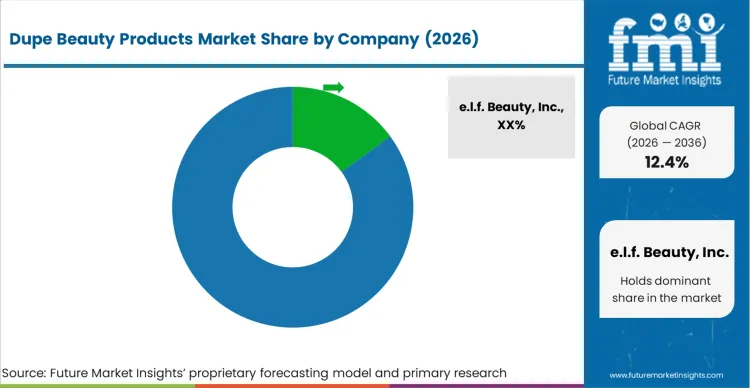
Regulatory authorities actively expanding ingredient safety mandates force fast-beauty formulators to fundamentally restructure their compliance architectures. FMI's proprietary forecasting model projects that brands historically reliant on minimal documentation must now implement pharmaceutical-grade traceability for botanical extracts to maintain market access. Ingredient sourcing teams must validate the precise origin and processing methods of specialized components like camellia skincare and cosmetics before authorizing production runs. Formulators attempting to bypass rigorous toxicological assessments face severe legal penalties and permanent consumer trust deficits. Operations directors failing to integrate automated compliance software into their product lifecycle management systems risk disqualification from major multi-national retail partnerships.
Legacy mass-market manufacturing infrastructure proves inadequate for replicating the complex emulsion technologies characterizing modern hybrid beauty items. Contract manufacturers executing full-scale equipment upgrades install advanced homogenization machinery to achieve the ultra-fine textures previously exclusive to luxury production lines. Upgrading the physical processing capabilities allows facilities to stabilize volatile active ingredients like coffee beauty products within budget-friendly suspension mediums. These capital-intensive facility upgrades establish a formidable barrier to entry against low-cost, low-quality regional competitors. Supply chain leads delaying capital expenditure on advanced mixing technology lose priority status in critical brand commercialization cycles.
Digital marketplaces systematically alter the criteria for algorithmic product visibility, demanding comprehensive data richness from listed vendors. E-commerce directors navigating this ecosystem update product detail pages with certified clinical claims, full ingredient glossaries, and user-generated visual proof. Establishing this transparent digital footprint elevates conversion rates by neutralizing the inherent consumer skepticism surrounding ultra-budget cosmetic claims. Brand operators neglecting digital asset optimization experience catastrophic declines in organic search visibility across primary marketplace platforms.
Key Players in Dupe Beauty Products Market
- e.l.f. Beauty, Inc.
- Revolution Beauty Group PLC (Makeup Revolution)
- SEED Beauty (ColourPop Cosmetics)
- cosnova GmbH (essence, Catrice)
- Markwins Beauty Brands (wet n wild)
- L’Oréal (NYX Professional Makeup)
- DBG Health (MCoBeauty)
- SHEIN (SHEGLAM)
- Milani Cosmetics
- L.A. Girl Cosmetics
Scope of the Report

| Metric | Value |
|---|---|
| Quantitative Units | USD 4.6 billion to USD 14.8 billion, at a CAGR of 12.4% |
| Market Definition | Affordable cosmetics and personal care products positioned as alternatives that match key use-cues of higher-priced items across makeup, skincare, fragrance, hair care, and tools. |
| Product category Segmentation | Makeup (face, eye, lip), Skincare (cleansers, moisturizers, serums, sunscreen), Fragrance (EDP/EDT dupes, body mists), Hair care (shampoo/conditioner, styling), Tools & accessories (brushes, sponges, lash kits) |
| Price tier / positioning Segmentation | Ultra-budget / entry (mass “look-for-less”), Mid-mass dupes (drugstore premium-feel), Premium-inspired alternatives (near-prestige but cheaper), Private label dupes (retailer-owned) |
| Channel Segmentation | Online marketplaces (Amazon/Flipkart/Shopee etc.), Brand D2C websites, Drugstores / pharmacies, Supermarkets / hypermarkets, Specialty beauty retailers, Social commerce / live selling (TikTok Shop, Instagram storefronts) |
| Regions Covered | North America, Latin America, Europe, Asia Pacific, Middle East & Africa |
| Countries Covered | India, Indonesia, Brazil, Mexico, Saudi Arabia, United States, United Kingdom, France, and 40 plus countries |
| Key Companies Profiled | e.l.f. Beauty, Inc., Revolution Beauty Group PLC, SEED Beauty, cosnova GmbH, Markwins Beauty Brands, L’Oréal (NYX), DBG Health, SHEIN (SHEGLAM), Milani Cosmetics, L.A. Girl Cosmetics |
| Forecast Period | 2026 to 2036 |
| Approach | Hybrid top-down and bottom-up modeling validated through primary interviews with brands, retailers, marketplaces, and contract manufacturers. |
Dupe Beauty Products Market Analysis by Segments
Product category:
- Makeup (face, eye, lip)
- Skincare (cleansers, moisturizers, serums, sunscreen)
- Fragrance (EDP/EDT dupes, body mists)
- Hair care (shampoo/conditioner, styling)
- Tools & accessories (brushes, sponges, lash kits)
Price tier / positioning:
- Ultra-budget / entry (mass “look-for-less”)
- Mid-mass dupes (drugstore premium-feel)
- Premium-inspired alternatives (near-prestige but cheaper)
- Private label dupes (retailer-owned)
Channel:
- Online marketplaces (Amazon/Flipkart/Shopee etc.)
- Brand D2C websites
- Drugstores / pharmacies
- Supermarkets / hypermarkets
- Specialty beauty retailers
- Social commerce / live selling (TikTok Shop, Instagram storefronts)
Region:
- Asia Pacific
- India
- Indonesia
- China
- Japan
- South Korea
- Australia & New Zealand
- ASEAN
- Rest of Asia Pacific
- Europe
- Germany
- Italy
- France
- United Kingdom
- Spain
- Benelux
- Nordics
- Central & Eastern Europe
- Rest of Europe
- North America
- United States
- Canada
- Mexico
- Latin America
- Brazil
- Argentina
- Chile
- Rest of Latin America
- Middle East & Africa
- Kingdom of Saudi Arabia
- United Arab Emirates
- South Africa
- Turkey
- Rest of Middle East & Africa
Bibliography
- Central Drugs Standard Control Organisation (CDSCO). (2024, December). Cosmetics Rules, 2020 (Guidance document).
- UK Government (OPSS). (2025, March). Regulation (EC) No 1223/2009 and the Cosmetic Products Enforcement Regulations 2013 (Great Britain) (Regulatory filing).
- International Trade Administration (USA Department of Commerce). (2024, November). Indonesia Cosmetics Notification System (Government report).
- ANVISA. (2024, October). Personal Hygiene Products, Cosmetics and Fragrances (RDC 907/2024) (Guidance document).
- Saudi Food & Drug Authority (SFDA). (2025, January). Requirements for Cosmetic Product Notification (Technical report).
This bibliography is provided for reader reference. The full FMI report contains the complete reference list with primary research documentation.
This Report Addresses
- Market sizing metrics detailing the precise global and regional revenue capture for fast-beauty alternatives across all major cosmetic sub-categories.
- Segmentation analysis mapping the consumer adoption velocity between mid-mass drugstore items and ultra-budget marketplace cosmetics.
- Regional deployment intelligence comparing the rapid social commerce penetration in Southeast Asia against the rigid compliance environments shaping European distribution.
- Regulatory compliance assessment analyzing how MoCRA and BPOM Notifkos 3.0 requirements force structural changes to mass-market formulation speeds.
- Competitive posture evaluation tracking the mandatory shift toward rapid trend iteration and its impact on manufacturing lead times.
- Supply chain vulnerability analysis identifying specific ingredient procurement bottlenecks that extend facility commercialization timelines.
- Custom data delivery formats encompassing interactive dashboards, raw Excel datasets, and comprehensive PDF narrative reports.
Frequently Asked Questions
How large is the demand for Dupe Beauty Products in the global market in 2026?
Demand for Dupe Beauty Products in the global market is estimated to be valued at USD 4.6 billion in 2026.
What will be the market size of Dupe Beauty Products in the global market by 2036?
Market size for Dupe Beauty Products is projected to reach USD 14.8 billion by 2036.
What is the expected demand growth for Dupe Beauty Products in the global market between 2026 and 2036?
Demand for Dupe Beauty Products is expected to grow at a CAGR of 12.4% between 2026 and 2036.
Which Product category is poised to lead global sales by 2026?
Makeup (face, eye, lip) accounts for 46% in 2026 as high-visibility shade formats convert immediately through creator-led tutorials and short repeat purchase cycles.
How significant is the role of Mid-mass dupes in driving Dupe Beauty Products adoption in 2026?
Mid-mass dupes represents 44% of segment share as category buyers balance perceived quality improvements with pricing that encourages impulse buying.
What is driving demand in India?
Non-metro consumer cohorts rapidly migrate from unbranded personal care to organized fast-beauty labels via aggressive social commerce penetration.
What compliance standards or regulations are referenced for Indonesia?
The BPOM Notifkos 3.0 notification system mandates stringent product file handling and ingredient documentation.
What is the India growth outlook in this report?
India is projected to grow at a CAGR of 14.9% during 2026 to 2036.
Why is Asia Pacific described as a priority region in this report?
Digital merchandising directors leverage live-selling events to demonstrate real-time performance parity, bypassing physical retail distribution hurdles.
What type of demand dominates in Asia Pacific?
Demand heavily focuses on marketplace ecosystems that fuse entertainment with transaction to drive rapid cosmetic trial purchases.
What is Indonesia's growth outlook in this report?
Indonesia is projected to expand at a CAGR of 14.3% during 2026 to 2036.
Does the report cover Brazil in its regional analysis?
Yes, Brazil is included within Latin America under the regional scope of analysis.
What are the sources referred to for analyzing Brazil?
ANVISA's rigorous authorization pathways and clinical safety standards form the analytical basis.
What is the main demand theme linked to Brazil in its region coverage?
Consumers actively scrutinize texture and wear-time metrics, rejecting low-quality imports in favor of domestically engineered skincare formats.
Does the report cover Mexico in its regional analysis?
Yes, Mexico is included within Latin America under the regional coverage framework.
What is the main Mexico related demand theme in its region coverage?
Proximity to North American trend cycles fuels immediate local demand for viral beauty aesthetics fulfilled through mass-market retail channels.
Which product formats or configurations are strategically important for North America supply chains?
Rapid-turnover labels that balance fast shade refresh rates with strict MoCRA safety substantiation requirements.
What is Dupe Beauty Products and what is it mainly used for?
Affordable cosmetics and personal care items designed to replicate the key features of premium beauty items. They are primarily used by value-conscious shoppers seeking prestige performance cues.
What does Dupe Beauty Products mean in this report?
The scope encompasses affordable cosmetics and personal care products positioned as alternatives that match key use-cues of higher-priced items.
What is included in the scope of this Dupe Beauty Products report?
The market covers makeup, skincare, fragrance, hair care, and basic beauty tools sold across online marketplaces and mass retail channels.
What is excluded from the scope of this report?
Counterfeit goods, trademark-infringing replicas, professional salon-only product lines, and grey-market parallel imports are explicitly excluded.
What does market forecast mean on this page?
The market forecast represents a model-based projection built on defined social commerce and retail adoption assumptions for strategic planning purposes.
How does FMI build and validate the Dupe Beauty Products forecast?
The hybrid model triangulates top-down beauty spend allocations with bottom-up channel throughput assumptions, stress-tested against return rates.
What does zero reliance on speculative third-party market research mean here?
Primary interviews, verified corporate earnings transcripts, and official regulatory guidance documents are used exclusively instead of unverified syndicated estimates.
Preview the report firsthand - request a free sample
Get SampleGet the brochure for pricing and purchase details.
Get PDFTable of Content
- Executive Summary
- Global Market Outlook
- Demand-side Trends
- Supply-side Trends
- Technology Roadmap Analysis
- Analysis and Recommendations
- Market Overview
- Market Coverage / Taxonomy
- Market Definition / Scope / Limitations
- Research Methodology
- Chapter Orientation
- Analytical Lens and Working Hypotheses
- Market Structure, Signals, and Trend Drivers
- Benchmarking and Cross-market Comparability
- Market Sizing, Forecasting, and Opportunity Mapping
- Research Design and Evidence Framework
- Desk Research Programme (Secondary Evidence)
- Company Annual and Sustainability Reports
- Peer-reviewed Journals and Academic Literature
- Corporate Websites, Product Literature, and Technical Notes
- Earnings Decks and Investor Briefings
- Statutory Filings and Regulatory Disclosures
- Technical White Papers and Standards Notes
- Trade Journals, Industry Magazines, and Analyst Briefs
- Conference Proceedings, Webinars, and Seminar Materials
- Government Statistics Portals and Public Data Releases
- Press Releases and Reputable Media Coverage
- Specialist Newsletters and Curated Briefings
- Sector Databases and Reference Repositories
- FMI Internal Proprietary Databases and Historical Market Datasets
- Subscription Datasets and Paid Sources
- Social Channels, Communities, and Digital Listening Inputs
- Additional Desk Sources
- Expert Input and Fieldwork (Primary Evidence)
- Primary Modes
- Qualitative Interviews and Expert Elicitation
- Quantitative Surveys and Structured Data Capture
- Blended Approach
- Why Primary Evidence is Used
- Field Techniques
- Interviews
- Surveys
- Focus Groups
- Observational and In-context Research
- Social and Community Interactions
- Stakeholder Universe Engaged
- C-suite Leaders
- Board Members
- Presidents and Vice Presidents
- R&D and Innovation Heads
- Technical Specialists
- Domain Subject-matter Experts
- Scientists
- Physicians and Other Healthcare Professionals
- Governance, Ethics, and Data Stewardship
- Research Ethics
- Data Integrity and Handling
- Primary Modes
- Tooling, Models, and Reference Databases
- Desk Research Programme (Secondary Evidence)
- Data Engineering and Model Build
- Data Acquisition and Ingestion
- Cleaning, Normalisation, and Verification
- Synthesis, Triangulation, and Analysis
- Quality Assurance and Audit Trail
- Market Background
- Market Dynamics
- Drivers
- Restraints
- Opportunity
- Trends
- Scenario Forecast
- Demand in Optimistic Scenario
- Demand in Likely Scenario
- Demand in Conservative Scenario
- Opportunity Map Analysis
- Product Life Cycle Analysis
- Supply Chain Analysis
- Investment Feasibility Matrix
- Value Chain Analysis
- PESTLE and Porter’s Analysis
- Regulatory Landscape
- Regional Parent Market Outlook
- Production and Consumption Statistics
- Import and Export Statistics
- Market Dynamics
- Global Market Analysis 2021 to 2025 and Forecast, 2026 to 2036
- Historical Market Size Value (USD Million) Analysis, 2021 to 2025
- Current and Future Market Size Value (USD Million) Projections, 2026 to 2036
- Y-o-Y Growth Trend Analysis
- Absolute $ Opportunity Analysis
- Global Market Pricing Analysis 2021 to 2025 and Forecast 2026 to 2036
- Global Market Analysis 2021 to 2025 and Forecast 2026 to 2036, By Product category
- Introduction / Key Findings
- Historical Market Size Value (USD Million) Analysis By Product category , 2021 to 2025
- Current and Future Market Size Value (USD Million) Analysis and Forecast By Product category , 2026 to 2036
- Makeup
- Skincare
- Fragrance
- Makeup
- Y-o-Y Growth Trend Analysis By Product category , 2021 to 2025
- Absolute $ Opportunity Analysis By Product category , 2026 to 2036
- Global Market Analysis 2021 to 2025 and Forecast 2026 to 2036, By Price tier - Positioning
- Introduction / Key Findings
- Historical Market Size Value (USD Million) Analysis By Price tier - Positioning, 2021 to 2025
- Current and Future Market Size Value (USD Million) Analysis and Forecast By Price tier - Positioning, 2026 to 2036
- Mid-mass dupes
- Ultra-budget / entry
- Premium-inspired alternatives
- Mid-mass dupes
- Y-o-Y Growth Trend Analysis By Price tier - Positioning, 2021 to 2025
- Absolute $ Opportunity Analysis By Price tier - Positioning, 2026 to 2036
- Global Market Analysis 2021 to 2025 and Forecast 2026 to 2036, By Channel
- Introduction / Key Findings
- Historical Market Size Value (USD Million) Analysis By Channel, 2021 to 2025
- Current and Future Market Size Value (USD Million) Analysis and Forecast By Channel, 2026 to 2036
- Online marketplaces
- Brand D2C websites
- Drugstores / pharmacies
- Online marketplaces
- Y-o-Y Growth Trend Analysis By Channel, 2021 to 2025
- Absolute $ Opportunity Analysis By Channel, 2026 to 2036
- Global Market Analysis 2021 to 2025 and Forecast 2026 to 2036, By Region
- Introduction
- Historical Market Size Value (USD Million) Analysis By Region, 2021 to 2025
- Current Market Size Value (USD Million) Analysis and Forecast By Region, 2026 to 2036
- North America
- Latin America
- Western Europe
- Eastern Europe
- East Asia
- South Asia and Pacific
- Middle East & Africa
- Market Attractiveness Analysis By Region
- North America Market Analysis 2021 to 2025 and Forecast 2026 to 2036, By Country
- Historical Market Size Value (USD Million) Trend Analysis By Market Taxonomy, 2021 to 2025
- Market Size Value (USD Million) Forecast By Market Taxonomy, 2026 to 2036
- By Country
- USA
- Canada
- Mexico
- By Product category
- By Price tier - Positioning
- By Channel
- By Country
- Market Attractiveness Analysis
- By Country
- By Product category
- By Price tier - Positioning
- By Channel
- Key Takeaways
- Latin America Market Analysis 2021 to 2025 and Forecast 2026 to 2036, By Country
- Historical Market Size Value (USD Million) Trend Analysis By Market Taxonomy, 2021 to 2025
- Market Size Value (USD Million) Forecast By Market Taxonomy, 2026 to 2036
- By Country
- Brazil
- Chile
- Rest of Latin America
- By Product category
- By Price tier - Positioning
- By Channel
- By Country
- Market Attractiveness Analysis
- By Country
- By Product category
- By Price tier - Positioning
- By Channel
- Key Takeaways
- Western Europe Market Analysis 2021 to 2025 and Forecast 2026 to 2036, By Country
- Historical Market Size Value (USD Million) Trend Analysis By Market Taxonomy, 2021 to 2025
- Market Size Value (USD Million) Forecast By Market Taxonomy, 2026 to 2036
- By Country
- Germany
- UK
- Italy
- Spain
- France
- Nordic
- BENELUX
- Rest of Western Europe
- By Product category
- By Price tier - Positioning
- By Channel
- By Country
- Market Attractiveness Analysis
- By Country
- By Product category
- By Price tier - Positioning
- By Channel
- Key Takeaways
- Eastern Europe Market Analysis 2021 to 2025 and Forecast 2026 to 2036, By Country
- Historical Market Size Value (USD Million) Trend Analysis By Market Taxonomy, 2021 to 2025
- Market Size Value (USD Million) Forecast By Market Taxonomy, 2026 to 2036
- By Country
- Russia
- Poland
- Hungary
- Balkan & Baltic
- Rest of Eastern Europe
- By Product category
- By Price tier - Positioning
- By Channel
- By Country
- Market Attractiveness Analysis
- By Country
- By Product category
- By Price tier - Positioning
- By Channel
- Key Takeaways
- East Asia Market Analysis 2021 to 2025 and Forecast 2026 to 2036, By Country
- Historical Market Size Value (USD Million) Trend Analysis By Market Taxonomy, 2021 to 2025
- Market Size Value (USD Million) Forecast By Market Taxonomy, 2026 to 2036
- By Country
- China
- Japan
- South Korea
- By Product category
- By Price tier - Positioning
- By Channel
- By Country
- Market Attractiveness Analysis
- By Country
- By Product category
- By Price tier - Positioning
- By Channel
- Key Takeaways
- South Asia and Pacific Market Analysis 2021 to 2025 and Forecast 2026 to 2036, By Country
- Historical Market Size Value (USD Million) Trend Analysis By Market Taxonomy, 2021 to 2025
- Market Size Value (USD Million) Forecast By Market Taxonomy, 2026 to 2036
- By Country
- India
- ASEAN
- Australia & New Zealand
- Rest of South Asia and Pacific
- By Product category
- By Price tier - Positioning
- By Channel
- By Country
- Market Attractiveness Analysis
- By Country
- By Product category
- By Price tier - Positioning
- By Channel
- Key Takeaways
- Middle East & Africa Market Analysis 2021 to 2025 and Forecast 2026 to 2036, By Country
- Historical Market Size Value (USD Million) Trend Analysis By Market Taxonomy, 2021 to 2025
- Market Size Value (USD Million) Forecast By Market Taxonomy, 2026 to 2036
- By Country
- Kingdom of Saudi Arabia
- Other GCC Countries
- Turkiye
- South Africa
- Other African Union
- Rest of Middle East & Africa
- By Product category
- By Price tier - Positioning
- By Channel
- By Country
- Market Attractiveness Analysis
- By Country
- By Product category
- By Price tier - Positioning
- By Channel
- Key Takeaways
- Key Countries Market Analysis
- USA
- Pricing Analysis
- Market Share Analysis, 2025
- By Product category
- By Price tier - Positioning
- By Channel
- Canada
- Pricing Analysis
- Market Share Analysis, 2025
- By Product category
- By Price tier - Positioning
- By Channel
- Mexico
- Pricing Analysis
- Market Share Analysis, 2025
- By Product category
- By Price tier - Positioning
- By Channel
- Brazil
- Pricing Analysis
- Market Share Analysis, 2025
- By Product category
- By Price tier - Positioning
- By Channel
- Chile
- Pricing Analysis
- Market Share Analysis, 2025
- By Product category
- By Price tier - Positioning
- By Channel
- Germany
- Pricing Analysis
- Market Share Analysis, 2025
- By Product category
- By Price tier - Positioning
- By Channel
- UK
- Pricing Analysis
- Market Share Analysis, 2025
- By Product category
- By Price tier - Positioning
- By Channel
- Italy
- Pricing Analysis
- Market Share Analysis, 2025
- By Product category
- By Price tier - Positioning
- By Channel
- Spain
- Pricing Analysis
- Market Share Analysis, 2025
- By Product category
- By Price tier - Positioning
- By Channel
- France
- Pricing Analysis
- Market Share Analysis, 2025
- By Product category
- By Price tier - Positioning
- By Channel
- India
- Pricing Analysis
- Market Share Analysis, 2025
- By Product category
- By Price tier - Positioning
- By Channel
- ASEAN
- Pricing Analysis
- Market Share Analysis, 2025
- By Product category
- By Price tier - Positioning
- By Channel
- Australia & New Zealand
- Pricing Analysis
- Market Share Analysis, 2025
- By Product category
- By Price tier - Positioning
- By Channel
- China
- Pricing Analysis
- Market Share Analysis, 2025
- By Product category
- By Price tier - Positioning
- By Channel
- Japan
- Pricing Analysis
- Market Share Analysis, 2025
- By Product category
- By Price tier - Positioning
- By Channel
- South Korea
- Pricing Analysis
- Market Share Analysis, 2025
- By Product category
- By Price tier - Positioning
- By Channel
- Russia
- Pricing Analysis
- Market Share Analysis, 2025
- By Product category
- By Price tier - Positioning
- By Channel
- Poland
- Pricing Analysis
- Market Share Analysis, 2025
- By Product category
- By Price tier - Positioning
- By Channel
- Hungary
- Pricing Analysis
- Market Share Analysis, 2025
- By Product category
- By Price tier - Positioning
- By Channel
- Kingdom of Saudi Arabia
- Pricing Analysis
- Market Share Analysis, 2025
- By Product category
- By Price tier - Positioning
- By Channel
- Turkiye
- Pricing Analysis
- Market Share Analysis, 2025
- By Product category
- By Price tier - Positioning
- By Channel
- South Africa
- Pricing Analysis
- Market Share Analysis, 2025
- By Product category
- By Price tier - Positioning
- By Channel
- USA
- Market Structure Analysis
- Competition Dashboard
- Competition Benchmarking
- Market Share Analysis of Top Players
- By Regional
- By Product category
- By Price tier - Positioning
- By Channel
- Competition Analysis
- Competition Deep Dive
- e.l.f. Beauty, Inc.
- Overview
- Product Portfolio
- Profitability by Market Segments (Product/Age /Sales Channel/Region)
- Sales Footprint
- Strategy Overview
- Marketing Strategy
- Product Strategy
- Channel Strategy
- Revolution Beauty Group PLC (Makeup Revolution)
- SEED Beauty (ColourPop Cosmetics)
- cosnova GmbH (essence, Catrice)
- Markwins Beauty Brands (wet n wild)
- L’Oréal (NYX Professional Makeup)
- e.l.f. Beauty, Inc.
- Competition Deep Dive
- Assumptions & Acronyms Used


