

- Industry Size (2026)
- USD 0.7 Bn
- Forecast (2036)
- USD 1.88 Bn
- CAGR (2026 to 2036)
- 10.6%
Neuro-Sensory Flavored Beverages Innovation Market Size, Market Forecast and Outlook By FMI
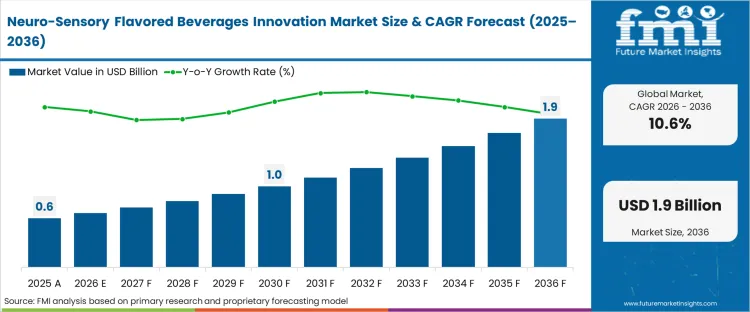
The neuro-sensory flavored beverages innovation market was valued at USD 0.6 billion in 2025. The sector is expected to cross USD 0.7 billion in 2026 at a CAGR of 10.6% during the beverage flavor innovation market forecast. Continued investment carries the valuation to USD 1.88 billion through 2036 as formulators utilize neuro sensory beverage innovation to transition from using flavors merely to mask bitter active ingredients toward engineering complex organoleptic profiles that actively trigger physiological cognitive responses.
Product development directors are moving their procurement strategies away from isolated botanical extracts and toward integrated cognitive beverage flavor systems. The core decision centers on whether to build formulations around active ingredients and fix the taste later, or to use beverage flavoring as the primary delivery mechanism for the functional claim, advancing sensory driven beverage innovation. Brands that delay this integration risk launching nootropic supplement formats that fail consumer trials, resulting in costly reformulation cycles and lost shelf space for nootropic flavored drinks innovation. Practitioners recognize that a functional beverage rarely fails because the clinical dose is too low; it fails because a sharp, astringent mouthfeel contradicts the emotional "relaxation" claim printed on the label.
Summary of Neuro-Sensory Flavored Beverages Innovation Market
- Neuro-Sensory Flavored Beverages Innovation Market Definition:
- This category comprises the specialized flavor compounds, modulators, and sensory delivery systems engineered to actively enhance cognitive states or mask high-dose functional ingredients in liquid formats.
- Demand Drivers in the Market:
- Stringent clean-label mandates push formulation directors to rely on premium wellness drink flavor development to replace synthetic masking agents with natural botanical blends.
- The change toward evening-use relaxation formats compels sensory scientists to prioritise calming beverage flavor development that triggers physiological responses before actives cross the blood-brain barrier.
- High failure rates in early adaptogenic product launches drive category managers to invest in functional beverage sensory science over isolated active ingredient procurement.
- Key Segments Analyzed in the FMI Report:
- Natural neuro-sensory flavor systems: Expected to hold 34.0% share in 2026, as brands demand natural neuro sensory flavor systems to avoid synthetic identifiers.
- Ready-to-drink functional beverages: Projected to hold 38.0% share in 2026, leading ready to drink nootropic beverages due to exact dosing and sensory stability.
- Focus & mental clarity beverages: Set to hold 31.0% share in 2026, driving flavored functional beverages for focus as white-collar professionals substitute traditional caffeine.
- Large beverage brands: Holding 41.0% share in 2026, as legacy players acquire lines requiring sophisticated beverage flavor houses for wellness drinks.
- Flavor-first formulation platforms: Leading with 36.0% share in 2026, defining next generation beverage flavor trends by switching from active-first to taste-first methodologies.
- India: Expanding at 13.2% compound growth, as urbanization accelerates demand for stress-calming formats.
- Analyst Opinion at FMI:
- Nandini Roy Choudhury, Principal Analyst, Food and Beverage, at FMI, estimates, "The generalist assumption is that a stronger clinical dose of an adaptogen guarantees a more effective functional beverage. However, practitioners understand that the human central nervous system frequently rejects potent botanical extracts as 'toxic' via bitter taste receptors. If the neuro-sensory flavour profile contradicts the physiological intention of the active ingredient, the consumer's stress response triggers before the drink is even swallowed, nullifying the functional claim."
- Strategic Implications / Executive Takeaways:
- Formulation directors must secure access to proprietary taste masking for botanical nootropic beverages to ensure their high-dose beverages survive consumer sensory trials.
- Brand category managers should integrate aroma and color expectations into early-stage product design to prevent cross-modal sensory dissonance.
- Contract manufacturers face urgent capital upgrades to handle the complex shear requirements of encapsulated neuro sensory beverage innovation.
- Methodology:
- Baseline sizing anchors to the specialized functional flavor systems for beverages portfolios of tier-1 flavor houses. Forecast models are validated against global launch volumes of functional beverages carrying cognitive claims.
Before this category can scale past early adopters, the supply chain must standardize functional flavor systems for beverages. Once tier-1 beverage flavor houses for wellness drinks provide off-the-shelf taste modulation in functional beverages that survives high-heat pasteurization without compromising volatile aroma profiles, mid-market beverage brands will bypass complex custom R&D and launch mood enhancing beverage flavors at commercial speed.
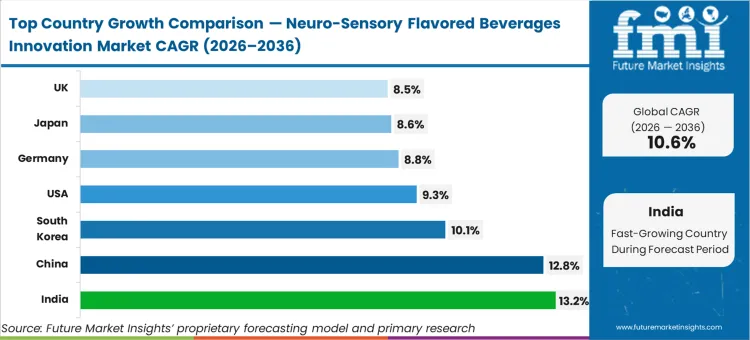
Demand tracks unevenly across regions, with India expanding at 13.2%, followed by China at 12.8% and South Korea at 10.1%. The United States advances at 9.3%, while Germany posts an 8.8% growth rate, narrowly outpacing Japan at 8.6% and the United Kingdom at 8.5%. The rapid acceleration in Asian hubs reflects a compressed adoption curve, where consumers bypass legacy energy categories and transition directly into sophisticated mood-modulating formats driven by aggressive localised brain health beverage flavor trends and premium flavour localisation.
Neuro-Sensory Flavored Beverages Innovation Market Key Takeaways
| Metric | Details |
|---|---|
| Industry Size (2026) | USD 0.7 billion |
| Industry Value (2036) | USD 1.88 billion |
| CAGR (2026-2036) | 10.6% |
Source: Future Market Insights (FMI) analysis, based on proprietary forecasting model and primary research
Neuro-Sensory Flavored Beverages Innovation Market Definition
Answering what are neuro-sensory flavored beverages, the neuro-sensory flavored beverages innovation market encompasses the specialized formulation systems, flavor modulators for cognitive drinks, and aroma compounds engineered specifically to interact with the human nervous system to augment cognitive or emotional states. This sector is defined by the intentional pairing of organoleptic stimuli with functional ingredients, bridging the gap between basic functional beverages and targeted psychobiotic delivery systems.
Neuro-Sensory Flavored Beverages Innovation Market Inclusions
Scope includes natural neuro sensory flavor systems that provide active feedback, botanical masking agents used in high-dose formulations, cross-modal beverage flavor design applications (aroma and color integration), and encapsulated cognitive performance functional beverage additive systems. It covers the raw components and beverage sensory experience trends utilized by beverage innovation suppliers for mood drinks to achieve targeted physiological responses.
Neuro-Sensory Flavored Beverages Innovation Market Exclusions
The category explicitly excludes traditional commodity sweeteners, standard flavors without secondary functional claims, and the finished retail beverage products themselves. Standard nutritional fortifications are excluded because they do not rely on next generation beverage flavor trends or neuro-active pathways to deliver their intended functional benefit, remaining firmly within legacy ingredient procurement.
Neuro-Sensory Flavored Beverages Innovation Market Research Methodology
- Primary Research: Chief formulation officers, sensory scientists at tier-1 flavor houses, and R&D directors at brands utilizing functional drink flavor development services were interviewed to assess formulation friction points.
- Desk Research: European Food Safety Authority evaluations, SEC filings of major flavor conglomerates, and peer-reviewed food science literature regarding sensory-cognitive interactions.
- Market-Sizing and Forecasting: The baseline anchors to the reported B2B revenue of functional flavor portfolios and taste modulation in functional beverages within top global flavor houses.
- Data Validation and Update Cycle: Forecasts were triangulated using capital expenditure data from contract beverage manufacturers upgrading their high-shear mixing capabilities to handle encapsulated cognitive beverage flavor systems.
Segmental Analysis
Neuro-Sensory Flavored Beverages Innovation Market Analysis by Product type
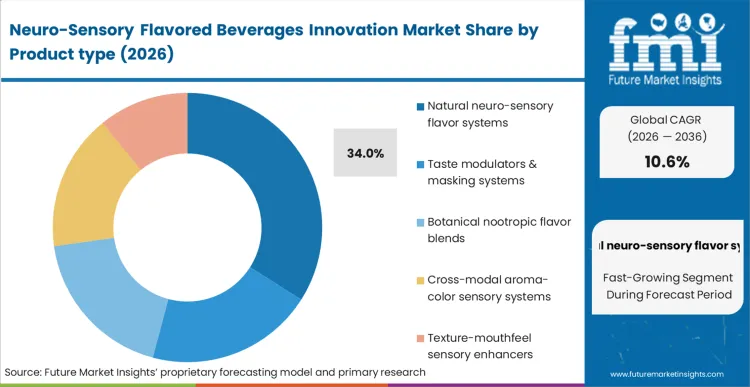
The necessity of clean-label declarations dictates that natural neuro sensory flavor systems hold 34.0% of this segment. Formulation directors cannot utilize synthetic masking agents when launching premium wellness brands, forcing a reliance on sophisticated botanical extracts that neutralize bitterness without triggering regulatory scrutiny.
According to FMI's estimates, this reliance on natural flavours alters procurement, pushing brands to compare natural vs synthetic neuro-sensory flavors and ultimately partner with tier-1 flavor houses that control proprietary extraction technologies. This creates a highly concentrated supplier base for high-performance functional flavor solutions. Brands attempting to formulate complex nootropic profiles with standard commodity extracts face distinct phase-separation and flavor-degradation risks during extended shelf storage.
- Bitterness suppression: Natural extracts block specific taste receptors rather than overpowering them with sweetness. Formulation scientists deploy taste masking for botanical nootropic beverages to achieve high active-ingredient dosing without destroying the core beverage profile.
- Aroma volatility: Complex botanical compounds degrade rapidly under high-heat pasteurization. Supply chain managers must coordinate specialized thermal processing to maintain the intended neuro-sensory trigger.
- Cross-modal alignment: The integration of specific natural colors and aromas creates an anticipated physiological response. Category managers must validate these combinations through rigorous consumer neuro-mapping before commercial launch.
Neuro-Sensory Flavored Beverages Innovation Market Analysis by Beverage format
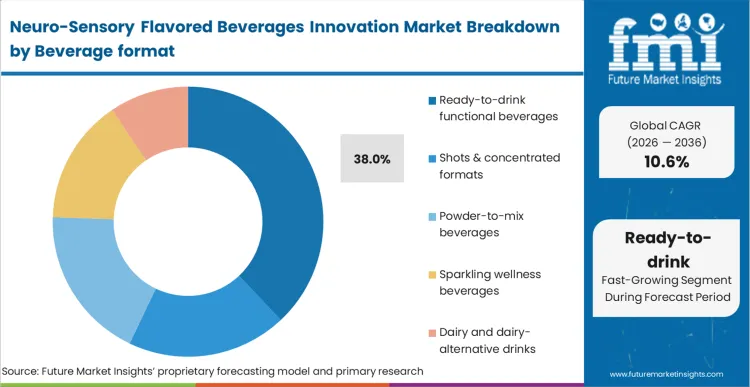
Dry powders and effervescent tablets fail to deliver the immediate, multi-sensory experience required by premium functional claims, driving the 38.0% share held by ready to drink nootropic beverages.
In FMI's view, the RTD format is not merely a convenience choice; it is a key necessity for maintaining the delicate suspension of volatile beverage flavoring agent compounds and encapsulated active ingredients. Formulators evaluating ready to drink vs powder neuro beverage formats require a stable liquid matrix to ensure the precise application of sensory science in RTD beverages. When a consumer opens an RTD product, the headspace aroma immediately primes the nervous system, a sequence impossible to replicate reliably in consumer-mixed powders. Operations directors who fail to master the complex liquid stabilization required for these formats face immediate product separation and severe brand damage on retail shelves.
- First-mover convenience: Urban consumers adopt RTD formats rapidly due to immediate consumption capability. Retail buyers prioritize these SKUs for high-visibility cold vault placement.
- Matrix stabilization: Liquid formats require advanced hydrocolloid networks to prevent flavor dropout. Contract manufacturers upgrade their mixing capabilities to retain these high-margin contracts.
- Late-stage powder conversion: As encapsulation technologies improve, premium powder formats will eventually replicate the RTD sensory experience. Ingredient suppliers are actively developing these heat-stable dry flavor systems to capture direct-to-consumer shipping advantages.
Neuro-Sensory Flavored Beverages Innovation Market Analysis by Functional positioning
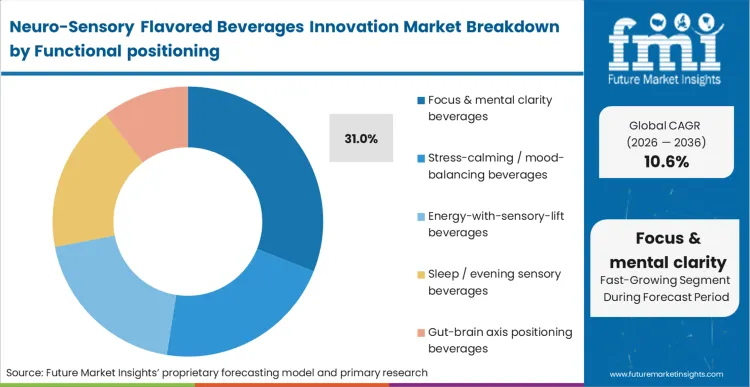
The immediate, recognizable feedback loop of focus and mental clarity beverages anchors their 31.0% segment share. White-collar professionals evaluating flavored functional beverages for focus require immediate proof of efficacy, which formulators deliver by engineering a sharp, crisp flavor modulator profile that mimics the alertness of traditional caffeine without the subsequent crash. Based on FMI's assessment, analyzing focus drink formulation trends reveals that the decision to position a beverage for mental clarity dictates its entire organoleptic architecture; a sweet, heavy mouthfeel actively contradicts the physiological expectation of alertness. Product developers searching for the best flavors for focus drinks must align the sensory onset with the pharmacological absorption curve of the active nootropics. Formulators who mismatch the sensory cue with the active claim produce a dissonant experience, resulting in a single-purchase novelty rather than a recurring subscription.
- Initial trial trigger: Consumers purchase based on the specific promise of cognitive enhancement over generalized wellness. Marketing directors align packaging aesthetics with the sharp sensory profile to reinforce the focus drinks vs energy drinks flavor strategy.
- Physiological validation: The rapid onset of a cooling or tingling sensory agent confirms to the buyer that the product is working. R&D teams calibrate these triggers to match the delayed onset of botanical nootropics.
- Habitual renewal: Long-term brand loyalty requires the sensory profile to remain pleasant during daily consumption. Formulators balance the intense active triggers with smooth finishing notes to prevent palate fatigue.
Neuro-Sensory Flavored Beverages Innovation Market Analysis by End user
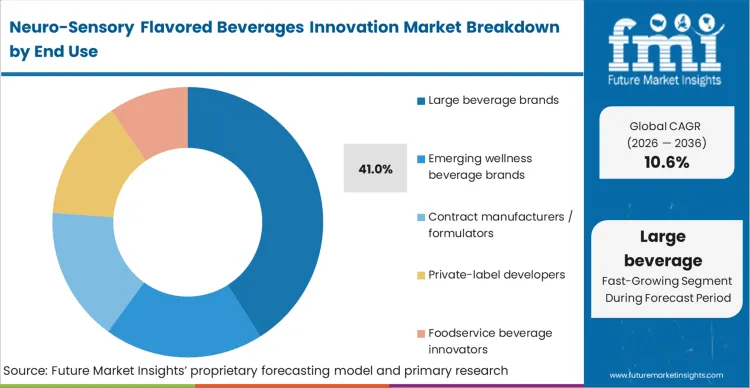
The immense capital requirements for conducting global consumer neuro-sensory trials ensure that large beverage brands capture 41.0% of the procurement volume. These legacy entities are rapidly acquiring or developing functional lines to offset declining traditional soda volumes, but they cannot risk their brand equity on unpalatable adaptogenic profiles.
FMI analysts suggest that these conglomerates utilize their massive scale to secure exclusive rights to advanced flavour modulators from tier-1 beverage flavor houses for wellness drinks, effectively locking smaller competitors out of the most effective masking technologies. This utilise a high barrier to entry for emerging brands attempting to deploy sensory beverage concepts for CPG brands without access to the same intellectual property. Emerging brands forced to rely on off-the-shelf flavor systems face a permanent cost disadvantage in masking high-dose bitter active ingredients.
- R&D amortization: Large brands spread the immense cost of sensory mapping across vast global volumes. Procurement directors leverage this scale to demand custom, exclusive flavor systems from their sensory beverage formulation partner.
- Supply chain friction: Implementing highly volatile neuro-sensory compounds requires customized pasteurization profiles. Plant managers must re-tool existing high-speed filling lines to prevent flavor flash-off during production.
- Total lifecycle advantage: Exclusive flavor systems create a moat against private-label replication. Strategy directors protect premium margins by maintaining organoleptic profiles that discount competitors cannot mimic.
Neuro-Sensory Flavored Beverages Innovation Market Analysis by Technology
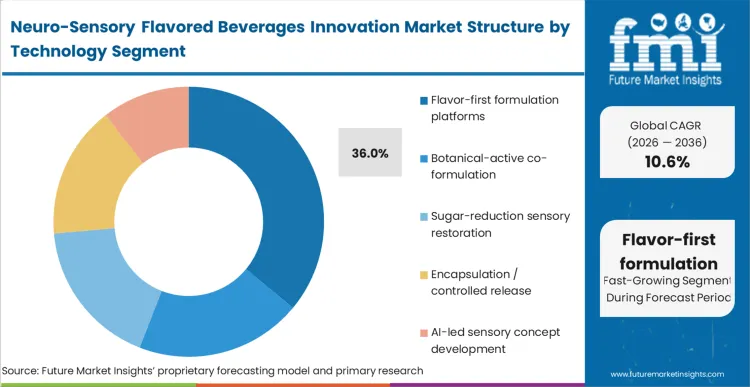
The historical failure of active-first formulations, where bitter botanicals were simply heavily sweetened, drives the 36.0% dominance of flavor-first formulation platforms. Brands evaluating taste modulators vs flavor enhancers in beverages now recognise that the physiological benefits of a beverage are irrelevant if the consumer's brain registers the taste modulators as unpalatable.
As per FMI's projection, this approach reverses traditional development: sensory scientists utilize cross-modal beverage flavor design to map the optimal aroma, mouthfeel, and taste profile required to trigger a specific emotional state, and then select active ingredients that fit within that boundary. This methodology ensures a cohesive aroma led beverage experience design that supports the functional claim. Formulators who cling to the legacy method of forcing high botanical doses into a base liquid and attempting to mask it later consistently produce beverages with lingering astringent or metallic off-notes.
- Baseline acceptability: Flavor-first methodology guarantees the product clears the initial consumer taste hurdle. Sensory panels validate the profile before expensive active ingredients are even sourced.
- Edge-case degradation: High-acid or highly carbonated environments can strip away delicate neuro-sensory top notes. Quality assurance teams establish strict pH boundaries to protect the fragile flavor architecture.
- Regulatory clearance: Standardized flavor-first platforms utilize globally approved GRAS ingredients. Compliance officers streamline international rollouts by avoiding novel or heavily restricted active compounds that trigger secondary review.
Neuro-Sensory Flavored Beverages Innovation Market Drivers, Restraints, and Opportunities
The movement toward holistic sensory experiences forces product development directors to integrate mouthfeel enhancers directly into their functional beverage architectures. Consumers no longer accept thin, watery textures in products positioned for evening relaxation or gut-brain health; they expect a physical viscosity that mirrors the calming claim. This pressure compels formulators to move beyond simple flavoring and engineer the physical suspension of the liquid matrix, advancing sensory driven beverage innovation that begins the moment the beverage touches the palate, elevating the commercial stakes for brands that fail to deliver a cohesive physical experience.
The primary friction in this market is formulation scale-up. Moving a complex, precisely balanced taste modulation in functional beverages from a controlled R&D bench to a 50,000-gallon high-shear commercial blending tank frequently destroys the delicate volatile aroma compounds necessary for the cognitive trigger. This thermal and mechanical instability forces contract manufacturers to run slower, customized pasteurization profiles, driving up unit economics and creating severe bottlenecks for emerging brands attempting to scale rapidly. While advanced encapsulation offers a partial solution, it remains cost-prohibitive for lower-tier product lines.
Opportunities in the Neuro-Sensory Flavored Beverages Innovation Market
- Sugar-reduction sensory restoration: Tightening global sugar taxes compel formulation changes. Flavor scientists utilize advanced sweetness enhancers to rebuild the missing mouthfeel and volume of sugar without triggering insulin spikes, capturing high-margin contracts from legacy soda brands.
- Cross-modal sleep formulations: Urban burnout expands the evening wind-down category. R&D directors deploy beverage flavor design for stress relief drinks, layering specific aromatic botanical terpenes with heavy, soothing mouthfeels to trigger physiological relaxation, capturing a new consumption occasion previously dominated by alcohol.
- Biometric-validated flavor IP: The integration of wearable health tech allows real-time measurement of functional claims. Tier-1 flavor houses map specific volatile compounds directly to heart rate variability and brainwave states, creating highly defensible flavor systems for cognitive wellness drinks.
Regional Analysis
Based on the regional analysis, the Neuro-Sensory Flavored Beverages Innovation market is segmented into North America, Asia Pacific, and Europe across 40-plus countries.
.webp "Top Country Growth Comparison Neuro Sensory Flavored Beverages Innovation Market Cagr (2026 2036)")
| Country | CAGR (2026 to 2036) |
|---|---|
| India | 13.2% |
| China | 12.8% |
| South Korea | 10.1% |
| United States | 9.3% |
| Germany | 8.8% |
| Japan | 8.6% |
| United Kingdom | 8.5% |
Source: Future Market Insights (FMI) analysis, based on proprietary forecasting model and primary research
North America Neuro-Sensory Flavoured Beverages Innovation Market Analysis
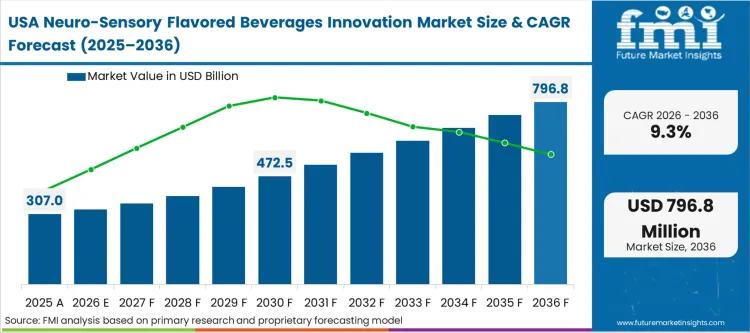
The intense retail competition for cold-vault space in North America forces procurement practices to prioritize aggressive, immediately recognizable sensory claims over subtle functional benefits. In FMI's view, buyers for major national convenience chains evaluate new functional lines based entirely on the immediate organoleptic impact, knowing that the average consumer will not wait thirty minutes for a botanical nootropic to take effect. This buyer behavior drives formulators to over-index on bold, sharp aroma and flavor triggers that simulate immediate efficacy. The mature beverage ingredients supply chain allows for rapid prototyping, but also saturates the market with easily replicated flavor profiles.
- United States: The intense concentration of venture-backed wellness startups forces established brands into rapid formulation cycles to maintain shelf dominance, accelerating United States neuro-sensory beverage innovation. Brand managers are utilizing advanced neuro-sensory mapping to differentiate products in a crowded retail environment. The United States market advances at a 9.3% CAGR. This rapid iteration cycle ensures that US formulators establish the global benchmarks for cross-modal sensory integration, forcing European and Asian competitors to react to flavor trends originating in North American test markets.
Asia Pacific Neuro-Sensory Flavored Beverages Innovation Market Analysis
Cost structures and rapid urbanization drive the adoption patterns across the Asia Pacific region, where an expanding middle class is leapfrogging traditional energy drinks and demanding sophisticated mood-modulating formats. The economic reality of scaling these complex beverages requires localized production of specialized funspecialiseder systems, as importing delicate encapsulated flavour compounds is cost-prohibitive. FMI analysts opine that procurement directors in this region must balance the demand for premium, scientifically validated sensory profiles with strict unit-cost constraints, driving heavy investment into domestic flavour extraction and masking capabilities that cater specifically to regional palate preferences.
- China: China tracks a 12.8% CAGR through 2036. China's aggressive domestic innovation cycle enables local beverage giants to launch highly complex adaptogenic lines at price points Western brands cannot match, rapidly expanding the China neuro sensory drinks market. Supply chain managers localize the procurement of functional botanicals to circumvent import bottlenecks. Formulators who master these localized sensory profiles secure massive volume contracts in tier-2 and tier-3 cities where premium localised trends are just beginning to penetrate.
- Japan: Japan's highly disciplined regulatory framework regarding functional claims requires absolute precision in sensory formulation, defining the trajectory of Japan functional flavor beverages. R&D teams must prove that the sensory profile does not mislead the consumer regarding the product's physiological efficacy. Growing at an 8.6% CAGR, Japan's trajectory is defined by meticulous optimisation rather than explosive volume growth. The resulting manufacturing discipline strips out formulation inefficiencies, creating highly stable, premium products that set the quality standard for the rest of the region.
- India: India's rapidly modernizing workforce is creating immense new demand for evening relaxation and stress-calming beverage formats, driving the India focus drink flavor market. FMI estimates the India market to expand at an annual growth rate of 13.2%. Product developers are adapting traditional Ayurvedic botanicals with modern neuro-sensory masking technologies to appeal to younger, urban demographics. Beverage brands that successfully balance aggressive masking systems with familiar regional flavor profiles capture early dominance in an entirely new consumption occasion.
- South Korea: High-pressure academic and corporate environments in South Korea create a demand for extreme mental clarity formats, heavily influencing South Korea mood beverage trends. Formulators prioritize sharp, immediate sensory triggers over complex, layered mouthfeels to simulate rapid cognitive enhancement. The market records a 10.1% CAGR. As the focus moves toward scientifically validated formulations, South Korea is expected to transition into a primary export hub for highly engineered, tech-forward functional beverage platforms.
Europe Neuro-Sensory Flavored Beverages Innovation Market Analysis
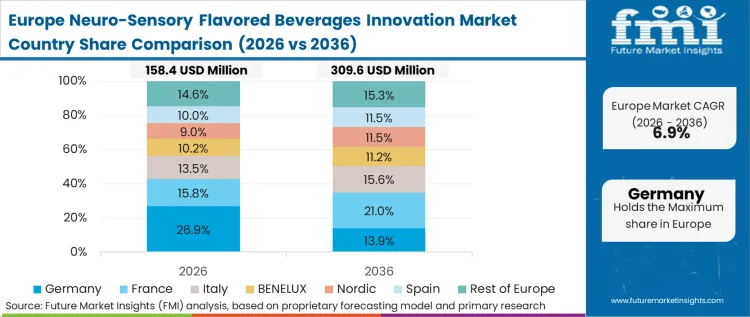
Europe's strict regulatory calendar regarding allowable health claims and novel food ingredients dictates the boundary of sensory innovation in the region. Formulators cannot utilize many of the aggressive synthetic masking agents common in North America, forcing a heavy reliance on natural botanical modulators that comply with EFSA guidelines. According to FMI's estimates, this policy-led environment slows the initial time-to-market for complex functional lines, as each new water enhancers profile requires rigorous compliance documentation. However, it also creates a highly defensible market for tier-1 flavor houses that have already navigated the regulatory pathways for their proprietary natural masking systems.
- Germany: Germany's rigid adherence to clean-label transparency prevents brands from hiding artificial masking agents under generalized "natural flavors" loopholes, anchoring Germany beverage sensory innovation. Formulation scientists must utilize highly advanced, EFSA-compliant botanical extracts to achieve the necessary neuro-sensory profiles. Generating an 8.8% CAGR, the German market advances methodically. This regulatory pressure forces the entire domestic supply chain toward the highest tier of natural flavour innovation, establishing a framework that will eventually become the baseline for the entire European Union.
- United Kingdom: UK procurement directors operate under intense pressure from major grocery multiples to deliver complex functional claims without utilizing sugar or artificial sweeteners, shaping United Kingdom wellness drink flavor trends. Brand managers are forced to balance demanding retail category requirements with the high cost of advanced natural modulators. The neuro-sensory flavoured beverages innovation market in the UK is poised to expand at an 8.5% CAGR. Behind the growth figures, mid-tier beverage brands frequently struggle to secure consistent allocations of premium masking agents, leaving them vulnerable to subtle batch-to-batch flavor variations that damage consumer trust.
FMI's report includes extensive analysis of adjacent markets in Latin America and the Middle East, alongside 40 plus countries. Across these emerging geographies, the initial adoption of neuro-sensory platforms is heavily concentrated in premium foodservice and hospitality channels, creating new neuro beverage opportunities in foodservice before trickling down to mass retail environments.
Competitive Aligners for Market Players
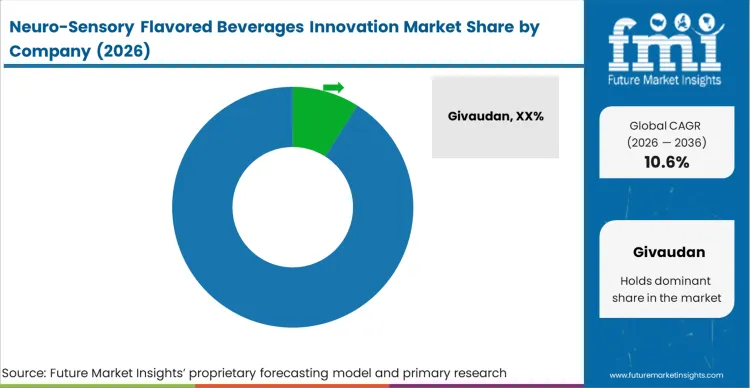
The competitive situation of this market is highly concentrated at the top, driven by the immense capital required to fund global sensory science and neuro-mapping R&D. Buyers do not select vendors based on the raw cost of ingredients; they qualify suppliers based entirely on their proprietary ability to mask high-dose botanicals without destroying the underlying enhanced water profile. Addressing the query of who are the top flavor houses in neuro-sensory beverage innovation, tier-1 flavor houses like Givaudan, dsm-firmenich, and International Flavors & Fragrances Inc. dominate because they control the intellectual property for these advanced encapsulation and modulation systems, leaving fragmented mid-tier mood drink ingredient manufacturers to compete on commodity flavorings that cannot support complex functional claims.
Incumbents in this space possess an advantage in their vast, globally validated consumer sensory databases, allowing them to predict cross-modal emotional responses before physical prototyping begins. Challengers offering nootropic beverage formulation services must build localised, AI-led predictive modeling capabilities to replicate this advantage. A regional functional shots formulator cannot compete simply by offering a cheaper masking agent; they must demonstrate that their specific beverage flavor technology for mental clarity physically maps to the targeted cognitive state better than the legacy solutions.
Large beverage brands actively resist complete lock-in with a single flavor house by splitting their functional portfolios across multiple neuro beverage ingredient suppliers, creating a tension between buyer demands for transparency and vendor incentives to protect proprietary formulations. However, as the market moves toward 2036, the necessity for deeply integrated, scientifically validated sensory profiles will likely force deeper, exclusive partnerships, effectively locking out smaller formulators who cannot provide comprehensive, end-to-end adaptogenic beverages development platforms.
Key Players in Neuro-Sensory Flavored Beverages Innovation Market
- Givaudan
- dsm-firmenich
- International Flavors & Fragrances Inc.
- Symrise AG
- Kerry Group plc
- T. Hasegawa Co., Ltd.
- Sensient Technologies Corporation
Scope of the Report
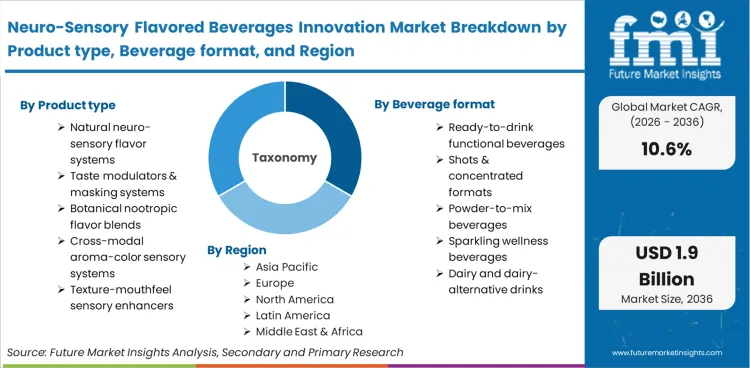
| Metric | Value |
|---|---|
| Quantitative Units | USD 0.7 billion to USD 1.88 billion, at a CAGR of 10.6% |
| Market Definition | This category comprises the specialized flavor compounds, modulators, and sensory delivery systems engineered to actively enhance cognitive states or mask high-dose functional ingredients in liquid formats. |
| Product type Segmentation | Natural neuro-sensory flavor systems, Taste modulators & masking systems, Botanical nootropic flavor blends, Cross-modal aroma-color sensory systems, Texture-mouthfeel sensory enhancers |
| Beverage format Segmentation | Ready-to-drink functional beverages, Shots & concentrated formats, Powder-to-mix beverages, Sparkling wellness beverages, Dairy and dairy-alternative drinks |
| Functional positioning Segmentation | Focus & mental clarity beverages, Stress-calming / mood-balancing beverages, Energy-with-sensory-lift beverages, Sleep / evening sensory beverages, Gut-brain axis positioning beverages |
| End user Segmentation | Large beverage brands, Emerging wellness beverage brands, Contract manufacturers / formulators, Private-label developers, Foodservice beverage innovators |
| Technology Segmentation | Flavor-first formulation platforms, Botanical-active co-formulation, Sugar-reduction sensory restoration, Encapsulation / controlled release, AI-led sensory concept development |
| Regions Covered | North America, Latin America, Europe, East Asia, South Asia, Oceania, Middle East and Africa |
| Countries Covered | United States, China, Japan, Germany, United Kingdom, India, South Korea, and 40 plus countries |
| Key Companies Profiled | Givaudan, dsm-firmenich, International Flavors & Fragrances Inc., Symrise AG, Kerry Group plc, T. Hasegawa Co., Ltd., Sensient Technologies Corporation |
| Forecast Period | 2026 to 2036 |
| Approach | Primary interviews were conducted with chief formulation officers and sensory scientists to map formulation friction points. Baseline data anchors to the B2B functional flavor revenues of top global flavor houses. Forecasts are validated against capital expenditure rates at major contract beverage manufacturing facilities. |
Source: Future Market Insights (FMI) analysis, based on proprietary forecasting model and primary research
Neuro-Sensory Flavored Beverages Innovation Market Analysis by Segments
Product type:
- Natural neuro-sensory flavor systems
- Taste modulators & masking systems
- Botanical nootropic flavor blends
- Cross-modal aroma-color sensory systems
- Texture-mouthfeel sensory enhancers
Beverage format:
- Ready-to-drink functional beverages
- Shots & concentrated formats
- Powder-to-mix beverages
- Sparkling wellness beverages
- Dairy and dairy-alternative drinks
Functional positioning:
- Focus & mental clarity beverages
- Stress-calming / mood-balancing beverages
- Energy-with-sensory-lift beverages
- Sleep / evening sensory beverages
- Gut-brain axis positioning beverages
End user:
- Large beverage brands
- Emerging wellness beverage brands
- Contract manufacturers / formulators
- Private-label developers
- Foodservice beverage innovators
Technology:
- Flavor-first formulation platforms
- Botanical-active co-formulation
- Sugar-reduction sensory restoration
- Encapsulation / controlled release
- AI-led sensory concept development
Region:
- North America
- United States
- Canada
- Europe
- Germany
- United Kingdom
- France
- Italy
- Spain
- Asia Pacific
- China
- Japan
- South Korea
- Taiwan
- Singapore
- Latin America
- Brazil
- Mexico
- Argentina
- Middle East & Africa
- GCC Countries
- South Africa
Bibliography
- European Food Safety Authority. (2024, May). Flavouring Group Evaluation 413 (FGE.413): Naringenin. EFSA Journal.
- Hossain, M. S., et al. (2025). Flavor and Well-Being: A Comprehensive Review of Food Flavor and Human Health. Food Science & Nutrition.
- International Flavors & Fragrances Inc. (2025). Annual report pursuant to Section 13 or 15(d) of the Securities Exchange Act of 1934 for the fiscal year ended December 31, 2024. U.S. Securities and Exchange Commission.
- Jensen, J. D., & Smed, S. (2024). Consumer preferences for attributes in sweet beverages and the role of satiation and energy density. Appetite.
- Kerry Group plc. (2025). Annual Report 2024.
- Munarso, S. J., et al. (2026). A bibliometric and consumer insights analysis (2006-2025). Beverages, 12(1), 7.
- Zanuttini, B., et al. (2024, December). Sensory expectations of beverages generated by colours. British Food Journal.
This bibliography is provided for reader reference. The full FMI report contains the complete reference list with primary source documentation.
This Report Addresses
- Market intelligence to support strategic decision making across taste modulators and cross-modal aroma-color sensory systems
- Market size estimation and 10-year revenue forecasts from 2026 to 2036, supported by functional flavor portfolios of tier-1 flavor houses mapped against new product launch volumes
- Growth opportunity mapping across functional positioning formats with emphasis on the standardization of sensory-active encapsulation technologies
- Segment and regional revenue forecasts covering natural neuro-sensory flavor systems across stringent EFSA clean-label regulatory environments
- Competition strategy assessment including proprietary AI-led predictive modeling capabilities and exclusive flavor-masking intellectual property
- Product development tracking including flavor-first formulation platforms, natural botanical modulators, and sugar-reduction sensory restoration
- Market access analysis covering EFSA compliance pathways for natural masking agents and high-shear liquid matrix stabilization protocols
- Market report delivery in PDF, Excel, PPT, and interactive dashboard formats for executive strategy, functional beverage formulation planning, and operational benchmarking use
Frequently Asked Questions
What are neuro-sensory flavored beverages?
The neuro-sensory flavored beverages innovation market encompasses liquid formats engineered with specialized flavor compounds, modulators, and sensory delivery systems. These are designed to actively enhance cognitive states or cleanly mask high-dose functional botanicals without contradicting the intended physiological response.
How do neuro sensory beverage flavors work?
These systems work by pairing organoleptic stimuli (taste, aroma, mouthfeel, and color) directly with the pharmacological onset of active ingredients. If a beverage claims to offer relaxation, the flavor system utilizes heavy, soothing botanical terpenes to trigger a physiological calming response before the active nootropics cross the blood-brain barrier.
Why are beverage brands using mood-based flavors?
Brands invest in mood enhancing beverage flavors because the failure rate of early adaptogenic product launches proved that consumers reject bitter, highly dosed functional drinks. If the sensory profile triggers a stress response (e.g., sharp astringency), it nullifies the functional relaxation claim entirely.
Which companies supply flavor systems for focus drinks?
Addressing who are the top flavor houses in neuro-sensory beverage innovation, tier-1 entities like Givaudan, dsm-firmenich, International Flavors & Fragrances Inc., Symrise AG, and Kerry Group plc dominate the supply of cognitive beverage flavor systems. They hold the critical intellectual property for advanced encapsulation and natural masking technologies.
What ingredients are used in focus drinks?
Formulators utilize complex natural extracts that suppress bitterness by blocking specific taste receptors rather than overpowering them with sweetness. These are paired with sharp, volatile aroma compounds-often derived from citrus or mint botanicals-that simulate rapid cognitive alertness.
Are nootropic flavored beverages growing?
Yes, the overarching neuro beverage ingredient market size is projected to grow from USD 0.7 billion in 2026 to USD 1.88 billion by 2036. This 10.6% CAGR reflects rapid capital deployment by contract manufacturers upgrading their high-shear mixing capabilities to stabilize complex liquid matrices.
How is sensory science used in beverage innovation?
Functional beverage sensory science reverses traditional product development by mapping the optimal aroma, mouthfeel, and taste profile required to trigger a specific emotional state first. Sensory scientists then select active ingredients that fit within that organoleptic boundary to ensure a cohesive consumer experience.
What makes a beverage flavor emotionally engaging?
Emotional engagement is achieved through cross-modal beverage flavor design, where visual cues (color), headspace aroma, and liquid viscosity are meticulously aligned. A mismatched sensory cue-such as a thick, sweet mouthfeel paired with a mental clarity claim-creates cognitive dissonance that prevents repeat purchases.
Can flavor influence beverage wellness perception?
Absolutely. The human central nervous system relies on taste and aroma to identify the safety and efficacy of ingested botanicals. A crisp, clean flavor profile provides immediate, verifiable feedback to the consumer, confirming the functional claim of "alertness" long before the active ingredients take physiological effect.
Explain the neuro-sensory beverages opportunity for beverage brands
As consumers substitute traditional caffeine and alcohol for holistic wellness formats, brands that deploy premium wellness drink flavor development can capture entirely new consumption occasions, such as evening wind-down or midday cognitive support, securing high-margin recurring subscriptions.
How big could neuro-sensory beverage innovation become by 2036?
Continued investment will carry the valuation to USD 1.88 billion by 2036. This long-term expansion indicates the complete normalization of sensory driven beverage innovation, where active ingredients and organoleptic profiles are universally co-developed rather than treated as sequential steps.
Compare mood beverage flavors vs nootropic beverage additives
While nootropic additives provide the underlying pharmacological benefit (the active dose), mood beverage flavors provide the immediate neurological trigger. Flavor modulators for cognitive drinks ensure the bitter nootropic is palatable, while specific aromas immediately prime the nervous system for the impending functional state.
What sensory technologies are shaping functional drink launches?
Advanced encapsulation and controlled release technologies are critical. These systems protect volatile aroma compounds from degrading during high-heat pasteurization, ensuring the beverage retains its complex beverage sensory experience trends throughout its commercial shelf life.
What regions are growing fastest for neuro-sensory beverages?
India is expanding at a 13.2% CAGR, significantly outpacing China's 12.8%. India's rapid urbanization creates immense new demand for stress-calming formats, allowing local formulators to leapfrog traditional energy drinks and immediately adopt advanced masking technologies tailored to regional palates.
Compare natural vs synthetic neuro-sensory flavors
When evaluating compare natural vs synthetic neuro-sensory flavors, synthetic masking agents are often cheaper but are strictly prohibited in premium wellness and EFSA-regulated markets. Natural neuro sensory flavor systems utilize sophisticated botanical extracts that neutralize bitterness cleanly, satisfying stringent clean-label requirements.
Focus drinks vs energy drinks flavor strategy
Traditional energy drinks rely on high sucrose and bold, aggressive synthetic flavors to signal stimulation. In contrast, the focus drinks vs energy drinks flavor strategy utilizes subtle, crisp flavor systems for cognitive wellness drinks that promise mental clarity without the sensory fatigue or metabolic crash associated with legacy products.
Adaptogenic drinks vs nootropic beverages
Adaptogenic drinks generally focus on long-term systemic stress balance, often utilizing heavy, earthy botanical flavor profiles. Nootropic beverages target immediate cognitive enhancement, requiring formulators to deploy beverage flavor technology for mental clarity that delivers a sharp, rapidly onset sensory experience.
Taste modulators vs flavor enhancers in beverages
When assessing taste modulators vs flavor enhancers in beverages, flavor enhancers simply amplify existing notes (like making a strawberry flavor sweeter). Taste modulators actively alter the consumer's perception by blocking specific bitter receptors on the tongue, allowing formulators to use high doses of functional botanicals without destroying palatability.
Taste modulators vs flavor enhancers in beverages
When assessing taste modulators vs flavor enhancers in beverages, flavor enhancers simply amplify existing notes (like making a strawberry flavor sweeter). Taste modulators actively alter the consumer's perception by blocking specific bitter receptors on the tongue, allowing formulators to use high doses of functional botanicals without destroying palatability.
Preview the report firsthand - request a free sample
Get SampleGet the brochure for pricing and purchase details.
Get PDFTable of Content
- Executive Summary
- Global Market Outlook
- Demand-side Trends
- Supply-side Trends
- Technology Roadmap Analysis
- Analysis and Recommendations
- Market Overview
- Market Coverage / Taxonomy
- Market Definition / Scope / Limitations
- Research Methodology
- Chapter Orientation
- Analytical Lens and Working Hypotheses
- Market Structure, Signals, and Trend Drivers
- Benchmarking and Cross-market Comparability
- Market Sizing, Forecasting, and Opportunity Mapping
- Research Design and Evidence Framework
- Desk Research Programme (Secondary Evidence)
- Company Annual and Sustainability Reports
- Peer-reviewed Journals and Academic Literature
- Corporate Websites, Product Literature, and Technical Notes
- Earnings Decks and Investor Briefings
- Statutory Filings and Regulatory Disclosures
- Technical White Papers and Standards Notes
- Trade Journals, Industry Magazines, and Analyst Briefs
- Conference Proceedings, Webinars, and Seminar Materials
- Government Statistics Portals and Public Data Releases
- Press Releases and Reputable Media Coverage
- Specialist Newsletters and Curated Briefings
- Sector Databases and Reference Repositories
- FMI Internal Proprietary Databases and Historical Market Datasets
- Subscription Datasets and Paid Sources
- Social Channels, Communities, and Digital Listening Inputs
- Additional Desk Sources
- Expert Input and Fieldwork (Primary Evidence)
- Primary Modes
- Qualitative Interviews and Expert Elicitation
- Quantitative Surveys and Structured Data Capture
- Blended Approach
- Why Primary Evidence is Used
- Field Techniques
- Interviews
- Surveys
- Focus Groups
- Observational and In-context Research
- Social and Community Interactions
- Stakeholder Universe Engaged
- C-suite Leaders
- Board Members
- Presidents and Vice Presidents
- R&D and Innovation Heads
- Technical Specialists
- Domain Subject-matter Experts
- Scientists
- Physicians and Other Healthcare Professionals
- Governance, Ethics, and Data Stewardship
- Research Ethics
- Data Integrity and Handling
- Primary Modes
- Tooling, Models, and Reference Databases
- Desk Research Programme (Secondary Evidence)
- Data Engineering and Model Build
- Data Acquisition and Ingestion
- Cleaning, Normalisation, and Verification
- Synthesis, Triangulation, and Analysis
- Quality Assurance and Audit Trail
- Market Background
- Market Dynamics
- Drivers
- Restraints
- Opportunity
- Trends
- Scenario Forecast
- Demand in Optimistic Scenario
- Demand in Likely Scenario
- Demand in Conservative Scenario
- Opportunity Map Analysis
- Product Life Cycle Analysis
- Supply Chain Analysis
- Investment Feasibility Matrix
- Value Chain Analysis
- PESTLE and Porter’s Analysis
- Regulatory Landscape
- Regional Parent Market Outlook
- Production and Consumption Statistics
- Import and Export Statistics
- Market Dynamics
- Global Market Analysis 2021 to 2025 and Forecast, 2026 to 2036
- Historical Market Size Value (USD Million) Analysis, 2021 to 2025
- Current and Future Market Size Value (USD Million) Projections, 2026 to 2036
- Y-o-Y Growth Trend Analysis
- Absolute $ Opportunity Analysis
- Global Market Pricing Analysis 2021 to 2025 and Forecast 2026 to 2036
- Global Market Analysis 2021 to 2025 and Forecast 2026 to 2036, By Product type
- Introduction / Key Findings
- Historical Market Size Value (USD Million) Analysis By Product type , 2021 to 2025
- Current and Future Market Size Value (USD Million) Analysis and Forecast By Product type , 2026 to 2036
- Natural neuro-sensory flavor systems
- Taste modulators & masking systems
- Botanical nootropic flavor blends
- Cross-modal aroma-color sensory systems
- Texture-mouthfeel sensory enhancers
- Natural neuro-sensory flavor systems
- Y-o-Y Growth Trend Analysis By Product type , 2021 to 2025
- Absolute $ Opportunity Analysis By Product type , 2026 to 2036
- Global Market Analysis 2021 to 2025 and Forecast 2026 to 2036, By Beverage format
- Introduction / Key Findings
- Historical Market Size Value (USD Million) Analysis By Beverage format, 2021 to 2025
- Current and Future Market Size Value (USD Million) Analysis and Forecast By Beverage format, 2026 to 2036
- Ready-to-drink functional beverages
- Shots & concentrated formats
- Powder-to-mix beverages
- Sparkling wellness beverages
- Dairy and dairy-alternative drinks
- Ready-to-drink functional beverages
- Y-o-Y Growth Trend Analysis By Beverage format, 2021 to 2025
- Absolute $ Opportunity Analysis By Beverage format, 2026 to 2036
- Global Market Analysis 2021 to 2025 and Forecast 2026 to 2036, By Functional positioning
- Introduction / Key Findings
- Historical Market Size Value (USD Million) Analysis By Functional positioning, 2021 to 2025
- Current and Future Market Size Value (USD Million) Analysis and Forecast By Functional positioning, 2026 to 2036
- Focus & mental clarity beverages
- Stress-calming / mood-balancing beverages
- Energy-with-sensory-lift beverages
- Sleep / evening sensory beverages
- Gut-brain axis positioning beverages
- Focus & mental clarity beverages
- Y-o-Y Growth Trend Analysis By Functional positioning, 2021 to 2025
- Absolute $ Opportunity Analysis By Functional positioning, 2026 to 2036
- Global Market Analysis 2021 to 2025 and Forecast 2026 to 2036, By End Use
- Introduction / Key Findings
- Historical Market Size Value (USD Million) Analysis By End Use, 2021 to 2025
- Current and Future Market Size Value (USD Million) Analysis and Forecast By End Use, 2026 to 2036
- Large beverage brands
- Emerging wellness beverage brands
- Contract manufacturers / formulators
- Private-label developers
- Foodservice beverage innovators
- Large beverage brands
- Y-o-Y Growth Trend Analysis By End Use, 2021 to 2025
- Absolute $ Opportunity Analysis By End Use, 2026 to 2036
- Global Market Analysis 2021 to 2025 and Forecast 2026 to 2036, By Technology
- Introduction / Key Findings
- Historical Market Size Value (USD Million) Analysis By Technology, 2021 to 2025
- Current and Future Market Size Value (USD Million) Analysis and Forecast By Technology, 2026 to 2036
- Flavor-first formulation platforms
- Botanical-active co-formulation
- Sugar-reduction sensory restoration
- Encapsulation / controlled release
- AI-led sensory concept development
- Flavor-first formulation platforms
- Y-o-Y Growth Trend Analysis By Technology, 2021 to 2025
- Absolute $ Opportunity Analysis By Technology, 2026 to 2036
- Global Market Analysis 2021 to 2025 and Forecast 2026 to 2036, By Region
- Introduction
- Historical Market Size Value (USD Million) Analysis By Region, 2021 to 2025
- Current Market Size Value (USD Million) Analysis and Forecast By Region, 2026 to 2036
- North America
- Latin America
- Western Europe
- Eastern Europe
- East Asia
- South Asia and Pacific
- Middle East & Africa
- Market Attractiveness Analysis By Region
- North America Market Analysis 2021 to 2025 and Forecast 2026 to 2036, By Country
- Historical Market Size Value (USD Million) Trend Analysis By Market Taxonomy, 2021 to 2025
- Market Size Value (USD Million) Forecast By Market Taxonomy, 2026 to 2036
- By Country
- USA
- Canada
- Mexico
- By Product type
- By Beverage format
- By Functional positioning
- By End Use
- By Technology
- By Country
- Market Attractiveness Analysis
- By Country
- By Product type
- By Beverage format
- By Functional positioning
- By End Use
- By Technology
- Key Takeaways
- Latin America Market Analysis 2021 to 2025 and Forecast 2026 to 2036, By Country
- Historical Market Size Value (USD Million) Trend Analysis By Market Taxonomy, 2021 to 2025
- Market Size Value (USD Million) Forecast By Market Taxonomy, 2026 to 2036
- By Country
- Brazil
- Chile
- Rest of Latin America
- By Product type
- By Beverage format
- By Functional positioning
- By End Use
- By Technology
- By Country
- Market Attractiveness Analysis
- By Country
- By Product type
- By Beverage format
- By Functional positioning
- By End Use
- By Technology
- Key Takeaways
- Western Europe Market Analysis 2021 to 2025 and Forecast 2026 to 2036, By Country
- Historical Market Size Value (USD Million) Trend Analysis By Market Taxonomy, 2021 to 2025
- Market Size Value (USD Million) Forecast By Market Taxonomy, 2026 to 2036
- By Country
- Germany
- UK
- Italy
- Spain
- France
- Nordic
- BENELUX
- Rest of Western Europe
- By Product type
- By Beverage format
- By Functional positioning
- By End Use
- By Technology
- By Country
- Market Attractiveness Analysis
- By Country
- By Product type
- By Beverage format
- By Functional positioning
- By End Use
- By Technology
- Key Takeaways
- Eastern Europe Market Analysis 2021 to 2025 and Forecast 2026 to 2036, By Country
- Historical Market Size Value (USD Million) Trend Analysis By Market Taxonomy, 2021 to 2025
- Market Size Value (USD Million) Forecast By Market Taxonomy, 2026 to 2036
- By Country
- Russia
- Poland
- Hungary
- Balkan & Baltic
- Rest of Eastern Europe
- By Product type
- By Beverage format
- By Functional positioning
- By End Use
- By Technology
- By Country
- Market Attractiveness Analysis
- By Country
- By Product type
- By Beverage format
- By Functional positioning
- By End Use
- By Technology
- Key Takeaways
- East Asia Market Analysis 2021 to 2025 and Forecast 2026 to 2036, By Country
- Historical Market Size Value (USD Million) Trend Analysis By Market Taxonomy, 2021 to 2025
- Market Size Value (USD Million) Forecast By Market Taxonomy, 2026 to 2036
- By Country
- China
- Japan
- South Korea
- By Product type
- By Beverage format
- By Functional positioning
- By End Use
- By Technology
- By Country
- Market Attractiveness Analysis
- By Country
- By Product type
- By Beverage format
- By Functional positioning
- By End Use
- By Technology
- Key Takeaways
- South Asia and Pacific Market Analysis 2021 to 2025 and Forecast 2026 to 2036, By Country
- Historical Market Size Value (USD Million) Trend Analysis By Market Taxonomy, 2021 to 2025
- Market Size Value (USD Million) Forecast By Market Taxonomy, 2026 to 2036
- By Country
- India
- ASEAN
- Australia & New Zealand
- Rest of South Asia and Pacific
- By Product type
- By Beverage format
- By Functional positioning
- By End Use
- By Technology
- By Country
- Market Attractiveness Analysis
- By Country
- By Product type
- By Beverage format
- By Functional positioning
- By End Use
- By Technology
- Key Takeaways
- Middle East & Africa Market Analysis 2021 to 2025 and Forecast 2026 to 2036, By Country
- Historical Market Size Value (USD Million) Trend Analysis By Market Taxonomy, 2021 to 2025
- Market Size Value (USD Million) Forecast By Market Taxonomy, 2026 to 2036
- By Country
- Kingdom of Saudi Arabia
- Other GCC Countries
- Turkiye
- South Africa
- Other African Union
- Rest of Middle East & Africa
- By Product type
- By Beverage format
- By Functional positioning
- By End Use
- By Technology
- By Country
- Market Attractiveness Analysis
- By Country
- By Product type
- By Beverage format
- By Functional positioning
- By End Use
- By Technology
- Key Takeaways
- Key Countries Market Analysis
- USA
- Pricing Analysis
- Market Share Analysis, 2025
- By Product type
- By Beverage format
- By Functional positioning
- By End Use
- By Technology
- Canada
- Pricing Analysis
- Market Share Analysis, 2025
- By Product type
- By Beverage format
- By Functional positioning
- By End Use
- By Technology
- Mexico
- Pricing Analysis
- Market Share Analysis, 2025
- By Product type
- By Beverage format
- By Functional positioning
- By End Use
- By Technology
- Brazil
- Pricing Analysis
- Market Share Analysis, 2025
- By Product type
- By Beverage format
- By Functional positioning
- By End Use
- By Technology
- Chile
- Pricing Analysis
- Market Share Analysis, 2025
- By Product type
- By Beverage format
- By Functional positioning
- By End Use
- By Technology
- Germany
- Pricing Analysis
- Market Share Analysis, 2025
- By Product type
- By Beverage format
- By Functional positioning
- By End Use
- By Technology
- UK
- Pricing Analysis
- Market Share Analysis, 2025
- By Product type
- By Beverage format
- By Functional positioning
- By End Use
- By Technology
- Italy
- Pricing Analysis
- Market Share Analysis, 2025
- By Product type
- By Beverage format
- By Functional positioning
- By End Use
- By Technology
- Spain
- Pricing Analysis
- Market Share Analysis, 2025
- By Product type
- By Beverage format
- By Functional positioning
- By End Use
- By Technology
- France
- Pricing Analysis
- Market Share Analysis, 2025
- By Product type
- By Beverage format
- By Functional positioning
- By End Use
- By Technology
- India
- Pricing Analysis
- Market Share Analysis, 2025
- By Product type
- By Beverage format
- By Functional positioning
- By End Use
- By Technology
- ASEAN
- Pricing Analysis
- Market Share Analysis, 2025
- By Product type
- By Beverage format
- By Functional positioning
- By End Use
- By Technology
- Australia & New Zealand
- Pricing Analysis
- Market Share Analysis, 2025
- By Product type
- By Beverage format
- By Functional positioning
- By End Use
- By Technology
- China
- Pricing Analysis
- Market Share Analysis, 2025
- By Product type
- By Beverage format
- By Functional positioning
- By End Use
- By Technology
- Japan
- Pricing Analysis
- Market Share Analysis, 2025
- By Product type
- By Beverage format
- By Functional positioning
- By End Use
- By Technology
- South Korea
- Pricing Analysis
- Market Share Analysis, 2025
- By Product type
- By Beverage format
- By Functional positioning
- By End Use
- By Technology
- Russia
- Pricing Analysis
- Market Share Analysis, 2025
- By Product type
- By Beverage format
- By Functional positioning
- By End Use
- By Technology
- Poland
- Pricing Analysis
- Market Share Analysis, 2025
- By Product type
- By Beverage format
- By Functional positioning
- By End Use
- By Technology
- Hungary
- Pricing Analysis
- Market Share Analysis, 2025
- By Product type
- By Beverage format
- By Functional positioning
- By End Use
- By Technology
- Kingdom of Saudi Arabia
- Pricing Analysis
- Market Share Analysis, 2025
- By Product type
- By Beverage format
- By Functional positioning
- By End Use
- By Technology
- Turkiye
- Pricing Analysis
- Market Share Analysis, 2025
- By Product type
- By Beverage format
- By Functional positioning
- By End Use
- By Technology
- South Africa
- Pricing Analysis
- Market Share Analysis, 2025
- By Product type
- By Beverage format
- By Functional positioning
- By End Use
- By Technology
- USA
- Market Structure Analysis
- Competition Dashboard
- Competition Benchmarking
- Market Share Analysis of Top Players
- By Regional
- By Product type
- By Beverage format
- By Functional positioning
- By End Use
- By Technology
- Competition Analysis
- Competition Deep Dive
- Givaudan
- Overview
- Product Portfolio
- Profitability by Market Segments (Product/Age /Sales Channel/Region)
- Sales Footprint
- Strategy Overview
- Marketing Strategy
- Product Strategy
- Channel Strategy
- dsm-firmenich
- International Flavors & Fragrances Inc.
- Symrise AG
- Kerry Group plc
- T. Hasegawa Co., Ltd.
- Sensient Technologies Corporation
- Givaudan
- Competition Deep Dive
- Assumptions & Acronyms Used


